1
Crisis Communications
Planning
Barbara Pierce, APR
Tipping Point Public Relations
November 8, 2012
What is a “crisis”?

Critical event or point of decision which, if not handled
in an appropriate and timely manner (or if not handled
at all), may turn into a disaster or catastrophe.


                                                            3
Types of Crises
• What does a “crisis” look like to your organization?
  –   Product issue              –   Facilities issue
  –   Service issue              –   Natural disaster
  –   Financial issue            –   Mistake
  –   HR issue                   –   Accident
       • Discrimination          –   Injury or death
       • Harassment              –   Protest
  – Employee misconduct          –   Coordinated external
  – Executive misconduct             campaign (e.g., online)
  – Board misconduct


                                                               4
What happens to people in crisis?
A flood of epinephrine, norepinephrine and other
hormones cause changes in the body:
• heart rate and blood pressure increase
• pupils dilate
• veins in skin constrict
• blood-glucose level increases
• muscles tense up, energized by adrenaline and glucose
• smooth muscle relaxes so more oxygen gets to the lungs
• nonessential systems (digestion, immune system) shut down
• trouble focusing on small tasks (brain is directed to focus only
  on big picture to determine where threat is coming from)
                                                                     5
The “Fight or Flight” Response

“When our fight or flight system is activated, we tend to
 perceive everything in our environment as a possible
   threat to our survival…We may overreact to the
     slightest comment. Our fear is exaggerated.
  Our thinking is distorted... Fear becomes the lens
           through which we see the world.”

                 - Neil M. Neimark, M.D., The Body/Soul Connection


                                                                     6
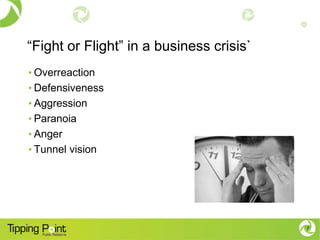
“Fight or Flight” in a business crisis`
• Overreaction
• Defensiveness
• Aggression
• Paranoia
• Anger
• Tunnel vision


                                          7
Crisis Communications Plans
• Planning for potential issues when we’re in a
  thoughtful and coherent frame of mind

• First-aid kit
• Fire escape plan
• Hurricane plan


                                                  8
When Opportunity Knocks…


                   Wei Chi
        crisis = danger + opportunity


                                        9
Crisis Communications Plans
• Are not disaster response plans
  – Do the right thing
  – Utilize (or define) established operational and
    emergency response protocols
• Are never final
  – Continually adjust to meet current realities
  – Set schedule for regular reviews and updates
  – Quarterly or biannually


                                                      10
Crisis Communications Objectives
• Minimize the impact of a crisis on operations and
  target audiences
• Minimize the amount of time spent focused on the
  crisis
  – Internally
  – By our constituents
• Regain control of the situation and the conversation as
  quickly as possible


                                                            11
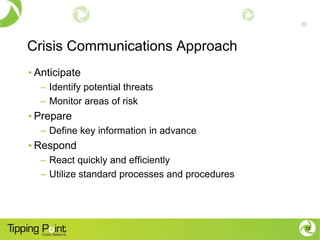
Crisis Communications Approach
• Anticipate
  – Identify potential threats
  – Monitor areas of risk
• Prepare
  – Define key information in advance
• Respond
  – React quickly and efficiently
  – Utilize standard processes and procedures


                                                12
Identify potential threats, monitor areas of risk

ANTICIPATE


                                                    13
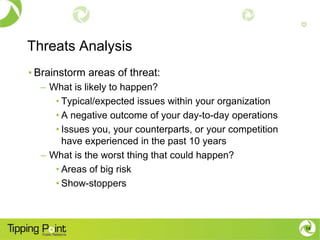
Threats Analysis
• Brainstorm areas of threat:
  – What is likely to happen?
     • Typical/expected issues within your organization
     • A negative outcome of your day-to-day operations
     • Issues you, your counterparts, or your competition
       have experienced in the past 10 years
  – What is the worst thing that could happen?
     • Areas of big risk
     • Show-stoppers


                                                            14
Monitor Areas of Risk
• Incorporate discussions of threats and brewing
  situations during regular internal meetings
   – Add as standing topic on management meeting
     agendas

• Listen!
   –   Traditional media
   –   Google Alerts, RSS feeds
   –   Social media: Facebook, Twitter
   –   The employee and customer grapevine


                                                   15
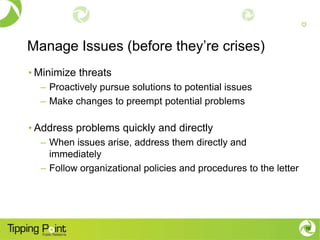
Manage Issues (before they’re crises)
• Minimize threats
  – Proactively pursue solutions to potential issues
  – Make changes to preempt potential problems

• Address problems quickly and directly
  – When issues arise, address them directly and
    immediately
  – Follow organizational policies and procedures to the letter


                                                                  16
Define key information in advance

PREPARE


                                    17
Emergency Protocols
• Establish, document and communicate emergency
  protocols
  – Ensure internal teams know and practice processes and
    procedures in the event of emergencies
  – Document protocols to ensure clarity and help educate
    teams on proper processes
     • Documented protocols, signed by staff and volunteers,
       support communications efforts later
• Ensure Crisis Communications Protocols dovetail with
  Emergency Protocols


                                                               18
The Crisis Communications Team
• Whom do you need on your team to manage
  communications around the potential threats?

• Define their roles (not their titles!)

• Define their responsibilities on the crisis
  communications team

• How will you reach them?
   – Relevant contact information

                                                 19
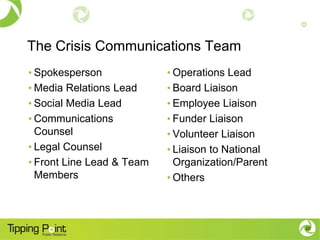
The Crisis Communications Team
• Spokesperson             • Operations Lead
• Media Relations Lead     • Board Liaison
• Social Media Lead        • Employee Liaison
• Communications           • Funder Liaison
  Counsel                  • Volunteer Liaison
• Legal Counsel            • Liaison to National
• Front Line Lead & Team     Organization/Parent
  Members                  • Others


                                                   20
Crisis Communications Command Centers
• Team Command Center
  – Where does the Crisis Communications Team meet?
  – What resources will your team need to effectively
    coordinate in a crisis?
  – What’s your back-up plan?
• Media Command/Update Center
  – How will you update the media?
  – What resources will they need?
  – How do you protect the team and employees while
    regularly sharing key information?


                                                        21
Communications Policies & Procedures
• Media Relations and Social Media Policies &
  Procedures, e.g.,
  – No informal conversations or communications about the
    crisis via email, text, or other written form
  – All communications reviewed by legal
  – Only designated spokesperson(s)
  – No “off the record”
  – Define procedures for press conference updates
  – Establish procedures for Social Media Lead to feed
    information into team about online conversation


                                                            22
Communications Policies & Procedures
• Inbound Inquiry Protocol, e.g.,
  – No Crisis Team member should answer inbound calls
    from unknown numbers (or known media numbers) – let
    calls go to voicemail and check voicemail often
  – Communicate standard reception messages
  – No Crisis Team member or employee should comment to
    anyone about the situation – refer all inbound inquiries to
    Front Line or Communications Lead


                                                                  23
Communications Policies & Procedures
• Other important Policies and Procedures for
  communications to:
  – Funders
  – Employees
  – Families or Other “Affected Audiences”


                                                24
Communications Resources: Lists
Updated lists, contact information, and details:
• Management Phone Trees
• Media Lists
• Employee Distribution Lists
• Communications Consultant Contact Information
• Legal Consultant Contact Information
• Monitoring Services


                                                   25
Communications Resources: Templates
• Media Statement Template
• News Release Template
• Fact Sheets
  – For likely issues
• Fact Sheet Template


                                      26
Communications Resources: Your Brand
• Reminders of what you stand for
  – Prepare yourself to recognize opportunities in the mess

• Standard Organizational Key Messages
• Organizational Fact Sheet
• Key Issues
• Boilerplate


                                                              27
Prepare the Team
• Alert team members that they’re on the team!
• Brief the Team
   – Review Crisis Communications Plan
   – Discuss their individual roles & responsibilities and how
     they engage with their teammates
   – Conduct regular review briefings – bi-annual at least,
     during which you review updated plan
• Media Train Spokespeople
   – Conduct regular refresher trainings
   – Remind them of the core brand/key messages
• Drills
                                                                 28
Get Ready to Get Ready to Respond
• Develop checklists and worksheets
  – Identify the key questions you’ll need answers to –
    before you’re in crisis mode


                                                          29
React quickly & efficiently, utilize standard processes & procedures

RESPOND


                                                                       30
Scope Assessment
• Develop list of questions that will help quantify a crisis
  situation when it happens
  – How many people are involved/aware?
  – Is media already covering the situation?
  – What is the financial impact?
• Establish quantitative thresholds that distinguishes
  between “issues to watch” and “full-blown crises”
  – How many online impressions warrant a response vs. quietly
    monitoring?
  – Remember: sometimes an aggressive response on your part

    can make a minor issue a larger crisis!


                                                                 31
Crisis Checklist and Worksheet
• Develop a literal checklist for the Crisis Communications
  Lead for any situation
  – What steps should you take in the moment?
  – Develop your to-do list when you are able to thoughtfully
    consider and outline important steps
• Develop Fact-Gathering Worksheet
  – List of facts you will need to confirm to assess the situation
  – Simple but comprehensive, this list can span dozens of
    questions
      • Start with who, what, when, where, how


                                                                     32
Logs
• Track your communications
  –   Who’s made inquiries
  –   What was said
  –   By whom
  –   When
  –   How
  –   To whom
• Be deliberate in your communications
  – Don’t allow the way you communicate to worsen the crisis!


                                                                33
Crisis Communications Plans


                    Wei Chi
         crisis = danger + opportunity


                                         34
Barbara Pierce, APR
     Tipping Point Public Relations
    277 Alexander Street, Suite 100
         Rochester, NY 14607
            (585) 340-1119
   barbara@tippingpointmedia.com
        www.tippingpointpr.com
Follow us on Twitter: @TippingPointPR

Crisis Communications Planning

  • 1.
  • 2.
    Crisis Communications Planning Barbara Pierce,APR Tipping Point Public Relations November 8, 2012
  • 3.
    What is a“crisis”? Critical event or point of decision which, if not handled in an appropriate and timely manner (or if not handled at all), may turn into a disaster or catastrophe. 3
  • 4.
    Types of Crises •What does a “crisis” look like to your organization? – Product issue – Facilities issue – Service issue – Natural disaster – Financial issue – Mistake – HR issue – Accident • Discrimination – Injury or death • Harassment – Protest – Employee misconduct – Coordinated external – Executive misconduct campaign (e.g., online) – Board misconduct 4
  • 5.
    What happens topeople in crisis? A flood of epinephrine, norepinephrine and other hormones cause changes in the body: • heart rate and blood pressure increase • pupils dilate • veins in skin constrict • blood-glucose level increases • muscles tense up, energized by adrenaline and glucose • smooth muscle relaxes so more oxygen gets to the lungs • nonessential systems (digestion, immune system) shut down • trouble focusing on small tasks (brain is directed to focus only on big picture to determine where threat is coming from) 5
  • 6.
    The “Fight orFlight” Response “When our fight or flight system is activated, we tend to perceive everything in our environment as a possible threat to our survival…We may overreact to the slightest comment. Our fear is exaggerated. Our thinking is distorted... Fear becomes the lens through which we see the world.” - Neil M. Neimark, M.D., The Body/Soul Connection 6
  • 7.
    “Fight or Flight”in a business crisis` • Overreaction • Defensiveness • Aggression • Paranoia • Anger • Tunnel vision 7
  • 8.
    Crisis Communications Plans •Planning for potential issues when we’re in a thoughtful and coherent frame of mind • First-aid kit • Fire escape plan • Hurricane plan 8
  • 9.
    When Opportunity Knocks… Wei Chi crisis = danger + opportunity 9
  • 10.
    Crisis Communications Plans •Are not disaster response plans – Do the right thing – Utilize (or define) established operational and emergency response protocols • Are never final – Continually adjust to meet current realities – Set schedule for regular reviews and updates – Quarterly or biannually 10
  • 11.
    Crisis Communications Objectives •Minimize the impact of a crisis on operations and target audiences • Minimize the amount of time spent focused on the crisis – Internally – By our constituents • Regain control of the situation and the conversation as quickly as possible 11
  • 12.
    Crisis Communications Approach •Anticipate – Identify potential threats – Monitor areas of risk • Prepare – Define key information in advance • Respond – React quickly and efficiently – Utilize standard processes and procedures 12
  • 13.
    Identify potential threats,monitor areas of risk ANTICIPATE 13
  • 14.
    Threats Analysis • Brainstormareas of threat: – What is likely to happen? • Typical/expected issues within your organization • A negative outcome of your day-to-day operations • Issues you, your counterparts, or your competition have experienced in the past 10 years – What is the worst thing that could happen? • Areas of big risk • Show-stoppers 14
  • 15.
    Monitor Areas ofRisk • Incorporate discussions of threats and brewing situations during regular internal meetings – Add as standing topic on management meeting agendas • Listen! – Traditional media – Google Alerts, RSS feeds – Social media: Facebook, Twitter – The employee and customer grapevine 15
  • 16.
    Manage Issues (beforethey’re crises) • Minimize threats – Proactively pursue solutions to potential issues – Make changes to preempt potential problems • Address problems quickly and directly – When issues arise, address them directly and immediately – Follow organizational policies and procedures to the letter 16
  • 17.
    Define key informationin advance PREPARE 17
  • 18.
    Emergency Protocols • Establish,document and communicate emergency protocols – Ensure internal teams know and practice processes and procedures in the event of emergencies – Document protocols to ensure clarity and help educate teams on proper processes • Documented protocols, signed by staff and volunteers, support communications efforts later • Ensure Crisis Communications Protocols dovetail with Emergency Protocols 18
  • 19.
    The Crisis CommunicationsTeam • Whom do you need on your team to manage communications around the potential threats? • Define their roles (not their titles!) • Define their responsibilities on the crisis communications team • How will you reach them? – Relevant contact information 19
  • 20.
    The Crisis CommunicationsTeam • Spokesperson • Operations Lead • Media Relations Lead • Board Liaison • Social Media Lead • Employee Liaison • Communications • Funder Liaison Counsel • Volunteer Liaison • Legal Counsel • Liaison to National • Front Line Lead & Team Organization/Parent Members • Others 20
  • 21.
    Crisis Communications CommandCenters • Team Command Center – Where does the Crisis Communications Team meet? – What resources will your team need to effectively coordinate in a crisis? – What’s your back-up plan? • Media Command/Update Center – How will you update the media? – What resources will they need? – How do you protect the team and employees while regularly sharing key information? 21
  • 22.
    Communications Policies &Procedures • Media Relations and Social Media Policies & Procedures, e.g., – No informal conversations or communications about the crisis via email, text, or other written form – All communications reviewed by legal – Only designated spokesperson(s) – No “off the record” – Define procedures for press conference updates – Establish procedures for Social Media Lead to feed information into team about online conversation 22
  • 23.
    Communications Policies &Procedures • Inbound Inquiry Protocol, e.g., – No Crisis Team member should answer inbound calls from unknown numbers (or known media numbers) – let calls go to voicemail and check voicemail often – Communicate standard reception messages – No Crisis Team member or employee should comment to anyone about the situation – refer all inbound inquiries to Front Line or Communications Lead 23
  • 24.
    Communications Policies &Procedures • Other important Policies and Procedures for communications to: – Funders – Employees – Families or Other “Affected Audiences” 24
  • 25.
    Communications Resources: Lists Updatedlists, contact information, and details: • Management Phone Trees • Media Lists • Employee Distribution Lists • Communications Consultant Contact Information • Legal Consultant Contact Information • Monitoring Services 25
  • 26.
    Communications Resources: Templates •Media Statement Template • News Release Template • Fact Sheets – For likely issues • Fact Sheet Template 26
  • 27.
    Communications Resources: YourBrand • Reminders of what you stand for – Prepare yourself to recognize opportunities in the mess • Standard Organizational Key Messages • Organizational Fact Sheet • Key Issues • Boilerplate 27
  • 28.
    Prepare the Team •Alert team members that they’re on the team! • Brief the Team – Review Crisis Communications Plan – Discuss their individual roles & responsibilities and how they engage with their teammates – Conduct regular review briefings – bi-annual at least, during which you review updated plan • Media Train Spokespeople – Conduct regular refresher trainings – Remind them of the core brand/key messages • Drills 28
  • 29.
    Get Ready toGet Ready to Respond • Develop checklists and worksheets – Identify the key questions you’ll need answers to – before you’re in crisis mode 29
  • 30.
    React quickly &efficiently, utilize standard processes & procedures RESPOND 30
  • 31.
    Scope Assessment • Developlist of questions that will help quantify a crisis situation when it happens – How many people are involved/aware? – Is media already covering the situation? – What is the financial impact? • Establish quantitative thresholds that distinguishes between “issues to watch” and “full-blown crises” – How many online impressions warrant a response vs. quietly monitoring? – Remember: sometimes an aggressive response on your part can make a minor issue a larger crisis! 31
  • 32.
    Crisis Checklist andWorksheet • Develop a literal checklist for the Crisis Communications Lead for any situation – What steps should you take in the moment? – Develop your to-do list when you are able to thoughtfully consider and outline important steps • Develop Fact-Gathering Worksheet – List of facts you will need to confirm to assess the situation – Simple but comprehensive, this list can span dozens of questions • Start with who, what, when, where, how 32
  • 33.
    Logs • Track yourcommunications – Who’s made inquiries – What was said – By whom – When – How – To whom • Be deliberate in your communications – Don’t allow the way you communicate to worsen the crisis! 33
  • 34.
    Crisis Communications Plans Wei Chi crisis = danger + opportunity 34
  • 35.
    Barbara Pierce, APR Tipping Point Public Relations 277 Alexander Street, Suite 100 Rochester, NY 14607 (585) 340-1119 barbara@tippingpointmedia.com www.tippingpointpr.com Follow us on Twitter: @TippingPointPR