We Must Be Ready
We Must Be Ready
When you are walking through the flames
You should be thinking about What’s Next?
A Crisis of Sorts?
Violence Crisis
A “Dilbert” View
Hazards:  The List Continues to Expand Natural Hazards –  hurricanes, earthquakes, tornadoes, floods Terrorism – the threat continues to loom large  Workplace Violence – becoming more frequent Power Outages – blackouts, brownouts, rolling blackouts  Fires, Explosions, Chemical Releases  Security Threats- new generation of eCrime
New Breed of Damaging Brand Attacks Classic Phishing Vishing (aka:  VoIP phishing using phones) SMiShing (test message to a link that installs a Trojan) Malware 419 Scams ( morphed Nigerian letter scam gone cyber)  Blended Abuse H1N1 Treatment Products Fraud
New Security Threats Economy Driven A DuPont scientist stole $400 million in intellectual property from him employer in the form of 16, 706 documents and over 25,000 scientific abstracts An employee working in a Texas physician’s office that was contracted to treat FBI agents attempted to sell an agent’s health records to drug traffickers for $500. A Federal Emergency Management Agency employee stole the identity information of 200 people and opened $150,000 in credit accounts.
21 st  Century Hacktivism Microsoft’s Irish website defaced  FBI website defaced Scotland Yard career website defaced Hackers invade Obama website: users redirected to Clinton campaign website Safe website let you embarrass people in high places- ananomize Palin’s Yahoo mail hacked- published on wikileaks.org Blackmail and Extortion using stolen information
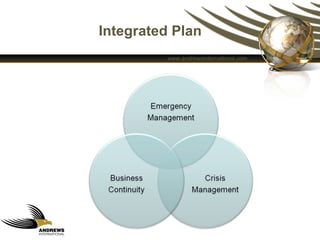
Understanding Key Terms Emergency Management –  An Ongoing Process to: Prevent, mitigate, prepare for, respond to, and recover … From an incident that threatens life, property, operations, or the environment.”  Examples Medical Emergencies Fires or explosions Natural hazards  Hazardous material spills or releases Security threats
Terms Business Continuity An ongoing process to successfully:  Identify the impact of potential losses Apply viable recovery strategies and plans Maintain continuity of services Needed When . . .  Interruption or loss of:  Technology:  hardware, software, data, connectivity Operations:  critical facility, building, process, system, equipment  Transportation:  air, land Communication Essential personnel unavailable

Terms Crisis Management Crisis:  situation threatens to significantly harm: Operations Financial Results  Reputation or Image Relations with Key Stakeholders Needed When . . .  Accident, Natural or Environmental Disaster Financial Troubles Rumors or Scandals Litigation Strategic/Business Environment Terrorism/Cyber Terrorism Media Reports
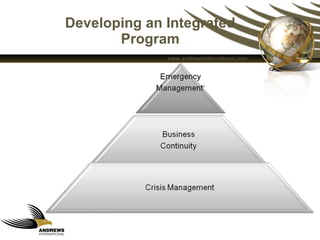
Developing an Integrated Program
Integrated Plan
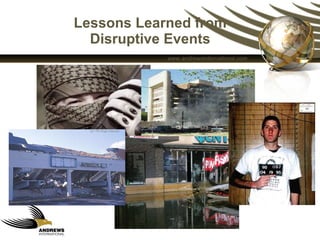
Lessons Learned from Disruptive Events
Normal life may be impacted
It could be difficult to travel
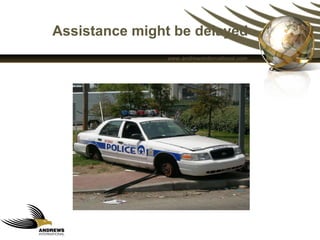
Assistance might be delayed
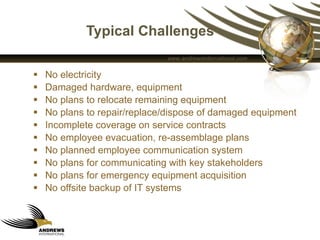
Typical Challenges No electricity  Damaged hardware, equipment  No plans to relocate remaining equipment No plans to repair/replace/dispose of damaged equipment Incomplete coverage on service contracts No employee evacuation, re-assemblage plans No planned employee communication system  No plans for communicating with key stakeholders  No plans for emergency equipment acquisition  No offsite backup of IT systems
Lessons Learned: Power No power, or limited power supplies No time estimates for restoring power Poor location of generators  Poor location of redundant power supplies No testing of redundant power supplies No plan for acquiring generators Inadequate fuel supply Inadequate protection for fuels
Things you assume will be there- may not
Lessons Learned: Infrastructure Located in high risk area Did not foresee risk, vulnerabilities of locations Structural Damage Security, Accessibility problems Storage/Location of critical assets Mold, contaminants Mobile solution didn’t work in affected areas No access to vendor contact information for clean-up
Lessons Learned: Insurance Poor or inadequate coverage Did not know what disaster scenarios were covered No documented information for claims adjuster  Inventory of Assets Inventory of Event Activities Had not assessed risks vs. coverage Had not insurance-tested various disaster scenarios Keep an inventory of all assets No independent review of insurance coverage
Lessons Learned: The Plan Itself Plans  Outdated or non-existent Not available - were in the damaged facility Plans were not linked to change management Plans too complex for quick use under stress Not tested; lack of regular team drills No incident command system IT and business change plans not integrated Crisis response structure not organization-wide Teams not set: Incident Command, Crisis, Operational No pre-set locations, equipment to facilitate teams
Lessons Learned: Travel Movement takes longer than expected People did not follow local agency directions  Limited or no gasoline Limited or no air travel available No rental vehicles available Heavy traffic, contra-flow Limited housing availability No plan for moving key employees and families
Lessons Learned: Communications No central number for employees/customers to call Cell phones may not work Cordless phones may not work Internet, Email may not be accessible No plans to address the media, authorities, others No communications with public sector agencies Emergency contact information not easily accessible No emergency notification system  Not prepared to handle incoming inquiries
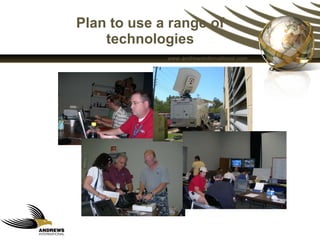
Plan to use a range of technologies
Lessons Learned: People Employees Not 100% focused Traumatized With or concerned about families Did not know what to do  Safety not considered in plans Emergency loans not available Alternate team members not planned Confusion = slow, inadequate decision-making Not prepared to inform families Incoming family inquiries Notify families of injured, deceased employees
Operational Challenges Scale: Large magnitude, multi-location event/crisis Infrastructure: Damage or Loss of: Voice, data communications systems Power/Fuel Facilities Rapidly changing environment = unique support needs  Competing interests = non-productive behavior:   Individual, bureaucratic and departmental interests Stovepipes, silos and measurement issues  Complex coordination between company, authorities
Operational Challenges (Cont’d) Acquiring Needed Resources:  Food Supplies Security Transportation Personnel Funding  Sanitation Chaos, trauma, emotional stress, harsh environment Polices, regulations, practices Limited staff with crisis, disaster experience
Communications Challenges “ 90 percent of a crisis response is communications”  –  Barbara Reynolds, Center for Disease Control, USA Responding quickly but accurately Managing both the company and the crisis Coordinating crisis operations and communications Managing rumors Establishing control of communications Media Internet Employees Other stakeholders
Crisis Communications: Be Prepared Know your vulnerabilities  Have crisis communications plans already in place Immediate response plan 72-hour response plan Pre-set teams  One to manage the company One to manage the crisis Pre-set decision structure (rapid-response) Pre-set contact lists (frequently updated) Pre-test with crisis communications drills
At Crisis Time  Activate the teams – minutes count! Quickly establish:  Secured crisis location  Command Center (operations and communications) Access to accurate information Control of outgoing information  Media Internet  Credibility is your most valuable asset
Some Thoughts on Crisis Management “ In a crisis, don’t hide behind anybody or anything.  They’re going to find you anyway.”  -Paul “Bear” Bryant- American Football Coach “ What one decides to do in a crisis depends on one’s philosophy of life, and that philosophy cannot be changed by an incident.  If one has no philosophy in crisis, others make the decision.” – Jeanette Rankin- US House of Representatives “ It takes 20 years to build a reputation and 5 minutes to ruin it” – Warren Buffet- “ If it’s not important to senior management, it will not be important to middle management or line management at all” –  Denny Lynch, Senior VP of Communications, Wendy’s-
Primary Challenge & Priority Maintaining communication regardless of the nature of the event, be it a natural disaster or terrorist incident, is the primary challenge during a disaster
Integrated Approach  to Crisis Management  Operations and communications  Risk Assessment – vulnerability audits  Crisis Prevention – mitigating the risks  Crisis Response Planning – becoming prepared Crisis Response Training – preparing your people Responding to the Crisis – minimizing damage  Managing Reputation – before, during, and after
 
EXECUTIVE DIRECTOR CONSULTING & INVESTIGATIONS ANDREWS INTERNATIONAL 469.737.5926 (OFFICE) 972.741.7532 (CELL) [email_address] William M. “Bill” Besse

Crisis Mgt Presentation

  • 1.
  • 2.
  • 3.
    When you arewalking through the flames
  • 4.
    You should bethinking about What’s Next?
  • 5.
  • 6.
  • 7.
  • 8.
    Hazards: TheList Continues to Expand Natural Hazards – hurricanes, earthquakes, tornadoes, floods Terrorism – the threat continues to loom large Workplace Violence – becoming more frequent Power Outages – blackouts, brownouts, rolling blackouts Fires, Explosions, Chemical Releases Security Threats- new generation of eCrime
  • 9.
    New Breed ofDamaging Brand Attacks Classic Phishing Vishing (aka: VoIP phishing using phones) SMiShing (test message to a link that installs a Trojan) Malware 419 Scams ( morphed Nigerian letter scam gone cyber) Blended Abuse H1N1 Treatment Products Fraud
  • 10.
    New Security ThreatsEconomy Driven A DuPont scientist stole $400 million in intellectual property from him employer in the form of 16, 706 documents and over 25,000 scientific abstracts An employee working in a Texas physician’s office that was contracted to treat FBI agents attempted to sell an agent’s health records to drug traffickers for $500. A Federal Emergency Management Agency employee stole the identity information of 200 people and opened $150,000 in credit accounts.
  • 11.
    21 st Century Hacktivism Microsoft’s Irish website defaced FBI website defaced Scotland Yard career website defaced Hackers invade Obama website: users redirected to Clinton campaign website Safe website let you embarrass people in high places- ananomize Palin’s Yahoo mail hacked- published on wikileaks.org Blackmail and Extortion using stolen information
  • 12.
    Understanding Key TermsEmergency Management – An Ongoing Process to: Prevent, mitigate, prepare for, respond to, and recover … From an incident that threatens life, property, operations, or the environment.” Examples Medical Emergencies Fires or explosions Natural hazards Hazardous material spills or releases Security threats
  • 13.
    Terms Business ContinuityAn ongoing process to successfully: Identify the impact of potential losses Apply viable recovery strategies and plans Maintain continuity of services Needed When . . . Interruption or loss of: Technology: hardware, software, data, connectivity Operations: critical facility, building, process, system, equipment Transportation: air, land Communication Essential personnel unavailable
  • 14.
    Terms Crisis ManagementCrisis: situation threatens to significantly harm: Operations Financial Results Reputation or Image Relations with Key Stakeholders Needed When . . . Accident, Natural or Environmental Disaster Financial Troubles Rumors or Scandals Litigation Strategic/Business Environment Terrorism/Cyber Terrorism Media Reports
  • 15.
  • 16.
  • 17.
    Lessons Learned fromDisruptive Events
  • 18.
    Normal life maybe impacted
  • 19.
    It could bedifficult to travel
  • 20.
  • 21.
    Typical Challenges Noelectricity Damaged hardware, equipment No plans to relocate remaining equipment No plans to repair/replace/dispose of damaged equipment Incomplete coverage on service contracts No employee evacuation, re-assemblage plans No planned employee communication system No plans for communicating with key stakeholders No plans for emergency equipment acquisition No offsite backup of IT systems
  • 22.
    Lessons Learned: PowerNo power, or limited power supplies No time estimates for restoring power Poor location of generators Poor location of redundant power supplies No testing of redundant power supplies No plan for acquiring generators Inadequate fuel supply Inadequate protection for fuels
  • 23.
    Things you assumewill be there- may not
  • 24.
    Lessons Learned: InfrastructureLocated in high risk area Did not foresee risk, vulnerabilities of locations Structural Damage Security, Accessibility problems Storage/Location of critical assets Mold, contaminants Mobile solution didn’t work in affected areas No access to vendor contact information for clean-up
  • 25.
    Lessons Learned: InsurancePoor or inadequate coverage Did not know what disaster scenarios were covered No documented information for claims adjuster Inventory of Assets Inventory of Event Activities Had not assessed risks vs. coverage Had not insurance-tested various disaster scenarios Keep an inventory of all assets No independent review of insurance coverage
  • 26.
    Lessons Learned: ThePlan Itself Plans Outdated or non-existent Not available - were in the damaged facility Plans were not linked to change management Plans too complex for quick use under stress Not tested; lack of regular team drills No incident command system IT and business change plans not integrated Crisis response structure not organization-wide Teams not set: Incident Command, Crisis, Operational No pre-set locations, equipment to facilitate teams
  • 27.
    Lessons Learned: TravelMovement takes longer than expected People did not follow local agency directions Limited or no gasoline Limited or no air travel available No rental vehicles available Heavy traffic, contra-flow Limited housing availability No plan for moving key employees and families
  • 28.
    Lessons Learned: CommunicationsNo central number for employees/customers to call Cell phones may not work Cordless phones may not work Internet, Email may not be accessible No plans to address the media, authorities, others No communications with public sector agencies Emergency contact information not easily accessible No emergency notification system Not prepared to handle incoming inquiries
  • 29.
    Plan to usea range of technologies
  • 30.
    Lessons Learned: PeopleEmployees Not 100% focused Traumatized With or concerned about families Did not know what to do Safety not considered in plans Emergency loans not available Alternate team members not planned Confusion = slow, inadequate decision-making Not prepared to inform families Incoming family inquiries Notify families of injured, deceased employees
  • 31.
    Operational Challenges Scale:Large magnitude, multi-location event/crisis Infrastructure: Damage or Loss of: Voice, data communications systems Power/Fuel Facilities Rapidly changing environment = unique support needs Competing interests = non-productive behavior: Individual, bureaucratic and departmental interests Stovepipes, silos and measurement issues Complex coordination between company, authorities
  • 32.
    Operational Challenges (Cont’d)Acquiring Needed Resources: Food Supplies Security Transportation Personnel Funding Sanitation Chaos, trauma, emotional stress, harsh environment Polices, regulations, practices Limited staff with crisis, disaster experience
  • 33.
    Communications Challenges “90 percent of a crisis response is communications” – Barbara Reynolds, Center for Disease Control, USA Responding quickly but accurately Managing both the company and the crisis Coordinating crisis operations and communications Managing rumors Establishing control of communications Media Internet Employees Other stakeholders
  • 34.
    Crisis Communications: BePrepared Know your vulnerabilities Have crisis communications plans already in place Immediate response plan 72-hour response plan Pre-set teams One to manage the company One to manage the crisis Pre-set decision structure (rapid-response) Pre-set contact lists (frequently updated) Pre-test with crisis communications drills
  • 35.
    At Crisis Time Activate the teams – minutes count! Quickly establish: Secured crisis location Command Center (operations and communications) Access to accurate information Control of outgoing information Media Internet Credibility is your most valuable asset
  • 36.
    Some Thoughts onCrisis Management “ In a crisis, don’t hide behind anybody or anything. They’re going to find you anyway.” -Paul “Bear” Bryant- American Football Coach “ What one decides to do in a crisis depends on one’s philosophy of life, and that philosophy cannot be changed by an incident. If one has no philosophy in crisis, others make the decision.” – Jeanette Rankin- US House of Representatives “ It takes 20 years to build a reputation and 5 minutes to ruin it” – Warren Buffet- “ If it’s not important to senior management, it will not be important to middle management or line management at all” – Denny Lynch, Senior VP of Communications, Wendy’s-
  • 37.
    Primary Challenge &Priority Maintaining communication regardless of the nature of the event, be it a natural disaster or terrorist incident, is the primary challenge during a disaster
  • 38.
    Integrated Approach to Crisis Management Operations and communications Risk Assessment – vulnerability audits Crisis Prevention – mitigating the risks Crisis Response Planning – becoming prepared Crisis Response Training – preparing your people Responding to the Crisis – minimizing damage Managing Reputation – before, during, and after
  • 39.
  • 40.
    EXECUTIVE DIRECTOR CONSULTING& INVESTIGATIONS ANDREWS INTERNATIONAL 469.737.5926 (OFFICE) 972.741.7532 (CELL) [email_address] William M. “Bill” Besse