Crisis Management


         Presenter
    Muhammad Rizwan Qamar
CRISIS
A crisis can be defined as any unplanned event,
 occurrence or sequence of events that has undesirable
 consequence.

A crisis is a change – either sudden or evolving – that
 results in an urgent problem that must be addressed
 immediately.

A major crisis can affect the entire organization and, in
 some cases can lead to its collapse.

We must act quickly to recognize its root causes,
 contain it, and eventually resolve the crisis with the least
 amount of damage.
Understanding Crisis

 Crisis can affect all segments of society – businesses,
  hospitals, educational institutions, families, and are
  caused by a wide range of reasons.

 The definitions can vary greatly, three elements are
  common to most definitions of crisis:

      1. threat
      2. surprise, &
      3. short decision time.
Crisis - common features

•   Time is short
•   Decisions are required urgently
•   Specific threats are identified
•   Urgent demands for information are received
•   There is sense of loss of control
•   Pressures build over time
•   Demands are made to identify someone to blame
•   Reputation suffers
•   Communications are increasingly difficult to manage
CRISIS MANAGENENT

Crisis Management consists of skills and techniques
required to assess, understand, and cope with any serious
situation.


With effective Crisis Management, we can minimize the
impact of potential crisis, avoid altogether – or in some
cases, even benefit from a crisis.”
Crisis Management
          Objectives

1) Reducing tension during the incident
2) Demonstrating commitment & expertise
3) Controlling flow & accuracy of information
4) Managing resources effectively
TYPES OF CRISIS
Natural (cataclysmic) events –
uncontrollable natural events, health disasters, earthquakes,
floods, fire, disastrous accidents, environmental pollutions.

Technology breakdowns –
data loss, security breaches, out-of-date equipment.

Economic and market forces –
market swings, investment bubbles.

Business-related crisis – sudden death of a crucial leader,
serious breach of law, vendor fails to deliver critical supplies,
employee stealing from a client.
TYPES OF CRISIS
Personal Crisis - events that have special meaning to
individuals and only individual suffers – failing exams,
divorce, being unemployed, etc.

Confrontation Crisis – e.g. disputes.

Acts of Malevolence – e.g. terrorism, kidnapping

Misconduct Crisis - e.g. harassment, corruption, fraud,
false invoicing

 Smoldering Crisis - problems or issues that start out
 small and could be fixed if someone was paying attention or
 recognized the potential for trouble.
 e.g. financial crisis in an organization, strike by union etc
HOW TO DEAL WITH
     CRISIS ?
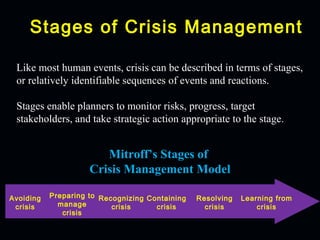
Stages of Crisis Management

 Like most human events, crisis can be described in terms of stages,
 or relatively identifiable sequences of events and reactions.

 Stages enable planners to monitor risks, progress, target
 stakeholders, and take strategic action appropriate to the stage.


                        Mitroff’s Stages of
                     Crisis Management Model

Avoiding   Preparing to Recognizing Containing   Resolving   Learning from
 crisis      manage        crisis     crisis       crisis        crisis
              crisis
1) Avoiding Crisis


a) Make crisis planning a part of your strategic planning

b) Get together and share ideas – work with colleagues
   to analyze your situation

c) Perform a SWOT analysis

d) Narrow your crisis-risk list – focus on the crisis that
   would have the worst result, would be most likely to
   occur.
2)     Preparing to Manage Crisis

Recognize the risks and costs
 a) Brainstorm potential crisis. Consider the ‘what-ifs‘.
 b) Once you have determined what crises you need to plan for,
    consider ways to minimize these risks and the costs for each
    risk.
 c) Consider everything that could go wrong, in the order of
    importance and its costs.


Develop A Crisis Plan
 After you have selected a key what-if scenario and analyzed
 possible consequences, brainstorm the kinds of decisions that will
 have to be made and who should make these decisions.

 Also perform a reality check to identify possible unintended &
 undesirable side effects.
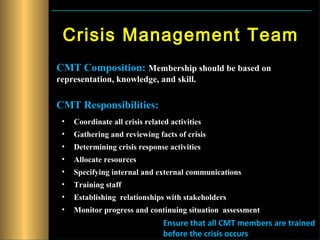
Crisis Management Team
CMT Composition: Membership should be based on
representation, knowledge, and skill.

CMT Responsibilities:
 •   Coordinate all crisis related activities
 •   Gathering and reviewing facts of crisis
 •   Determining crisis response activities
 •   Allocate resources
 •   Specifying internal and external communications
 •   Training staff
 •   Establishing relationships with stakeholders
 •   Monitor progress and continuing situation assessment
                                 Ensure that all CMT members are trained
                                 before the crisis occurs
CMT - Training
The training of the Crisis Management Team is one of the critical
success factors that must be addressed if an adequate response is to be
achieved.

Principles of Effective Training:

     Training Need Assessment:

     Contents:

     Trainer:

     Methods:

     Evaluation:
Crisis Management

            •   What happened?
            •   Were there any deaths or injuries?
What        •   What is the extent of the damage?
            •   Is there a danger of future injuries or
media           damage?

want to     •
            •
                Why did it happen?
                Who or what is responsible?
know in     •   What is being done about it?
            •   When will it be over?
a crisis?   •   Has it happened before?
            •   Were there any warning signs of the
                problem?
Media Demands

• Accuracy and simplicity
• Statistics which are explained
• Context of information
• Comments from highest authority
• Both sides of the issue
• Speed, speed and speed
YOU’RE IN THE SPOTLIGHT

• In a crisis, everyone watches what you do. Whether you
  like it or not, you are in the spotlight.

• The key is getting out in front of the crisis in its first
  hours with clear statements, both internally and
  externally.

• Accept responsibility      and    build   confidence    &
  credibility.
The Ideal Spokesperson

• Polite & patient
• Well-informed
• Accurate & reliable
• Fluent
• Available
• Trustworthy
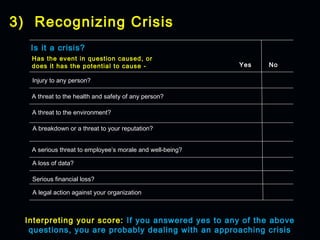
3) Recognizing Crisis
   Is it a crisis?
   Has the event in question caused, or
   does it has the potential to cause -                    Yes   No

   Injury to any person?

   A threat to the health and safety of any person?

   A threat to the environment?

   A breakdown or a threat to your reputation?


   A serious threat to employee’s morale and well-being?

   A loss of data?

   Serious financial loss?

   A legal action against your organization


  Interpreting your score: If you answered yes to any of the above
   questions, you are probably dealing with an approaching crisis
4) Containing Crisis

“One’s objective should be to get it right, get it quick, get
                 it out, and get it over.”
                                                     - Warren Buffet


1) When a crisis strikes, the first thing you must do is to contain
   it.
2) You must make decisions quickly.
3) Be on the scene. Your physical presence is important.
4) Communicate about the crisis quickly – expect rumors and
   false information, notify key people (management, general
   public, or employees, vendors, government authorities and
   clients), and stick to the facts (do not guess or attempt to
   cover up).
5) Resolving Crisis


A crisis requires fast, confident decision making. But
how do you make good decisions when events move so
quickly, when things are confusing, and when it is hard
to sort out what’s important.

Managing emotions that accompany a crisis, effective
leader’s role, and taking effective action can help.
6) Learning from Crisis

When you survive a crisis, don’t just try to put it behind you. Rather
take the opportunity to learn from the experience and make changes
to avoid or prepare for another similar event.


Review how the crisis was handled .
Ask yourself the following questions:

   1. Could we have prevented the crisis? If so how?
   2. At what point did we realize we were in crisis? Could we have
      recognized the signs earlier?
   3. What warning signals went off that we may have ignored?
   4. What warning signals did we pay attention to?
   5. What did we do right?
   6. What could we have done better?
Crisis Management

• Publicly promise that to the best of organization's
  ability similar situations will never occur

• Go beyond community`s and victim`s expectations.

• Adverse situations managed quickly cost far less and
  are controversial for much shorter periods of time.

      Prepare Contingency Plans in Advance
CRISIS MAY BE YOUR
          DEFINING MOMENT
• The crisis you are facing, or inevitably will face, may be
  the defining moment in your professional life.

• Leaders who don’t take advantage of crises to make
  long-term changes not only waste opportunities but sow
  the seeds for a repeat experience

• Do your best and leave the rest to ALLAH
Crisis management

Crisis management

  • 1.
    Crisis Management Presenter Muhammad Rizwan Qamar
  • 2.
    CRISIS A crisis canbe defined as any unplanned event, occurrence or sequence of events that has undesirable consequence. A crisis is a change – either sudden or evolving – that results in an urgent problem that must be addressed immediately. A major crisis can affect the entire organization and, in some cases can lead to its collapse. We must act quickly to recognize its root causes, contain it, and eventually resolve the crisis with the least amount of damage.
  • 3.
    Understanding Crisis  Crisiscan affect all segments of society – businesses, hospitals, educational institutions, families, and are caused by a wide range of reasons.  The definitions can vary greatly, three elements are common to most definitions of crisis: 1. threat 2. surprise, & 3. short decision time.
  • 4.
    Crisis - commonfeatures • Time is short • Decisions are required urgently • Specific threats are identified • Urgent demands for information are received • There is sense of loss of control • Pressures build over time • Demands are made to identify someone to blame • Reputation suffers • Communications are increasingly difficult to manage
  • 5.
    CRISIS MANAGENENT Crisis Managementconsists of skills and techniques required to assess, understand, and cope with any serious situation. With effective Crisis Management, we can minimize the impact of potential crisis, avoid altogether – or in some cases, even benefit from a crisis.”
  • 6.
    Crisis Management Objectives 1) Reducing tension during the incident 2) Demonstrating commitment & expertise 3) Controlling flow & accuracy of information 4) Managing resources effectively
  • 7.
    TYPES OF CRISIS Natural(cataclysmic) events – uncontrollable natural events, health disasters, earthquakes, floods, fire, disastrous accidents, environmental pollutions. Technology breakdowns – data loss, security breaches, out-of-date equipment. Economic and market forces – market swings, investment bubbles. Business-related crisis – sudden death of a crucial leader, serious breach of law, vendor fails to deliver critical supplies, employee stealing from a client.
  • 8.
    TYPES OF CRISIS PersonalCrisis - events that have special meaning to individuals and only individual suffers – failing exams, divorce, being unemployed, etc. Confrontation Crisis – e.g. disputes. Acts of Malevolence – e.g. terrorism, kidnapping Misconduct Crisis - e.g. harassment, corruption, fraud, false invoicing Smoldering Crisis - problems or issues that start out small and could be fixed if someone was paying attention or recognized the potential for trouble. e.g. financial crisis in an organization, strike by union etc
  • 9.
    HOW TO DEALWITH CRISIS ?
  • 10.
    Stages of CrisisManagement Like most human events, crisis can be described in terms of stages, or relatively identifiable sequences of events and reactions. Stages enable planners to monitor risks, progress, target stakeholders, and take strategic action appropriate to the stage. Mitroff’s Stages of Crisis Management Model Avoiding Preparing to Recognizing Containing Resolving Learning from crisis manage crisis crisis crisis crisis crisis
  • 11.
    1) Avoiding Crisis a)Make crisis planning a part of your strategic planning b) Get together and share ideas – work with colleagues to analyze your situation c) Perform a SWOT analysis d) Narrow your crisis-risk list – focus on the crisis that would have the worst result, would be most likely to occur.
  • 12.
    2) Preparing to Manage Crisis Recognize the risks and costs a) Brainstorm potential crisis. Consider the ‘what-ifs‘. b) Once you have determined what crises you need to plan for, consider ways to minimize these risks and the costs for each risk. c) Consider everything that could go wrong, in the order of importance and its costs. Develop A Crisis Plan After you have selected a key what-if scenario and analyzed possible consequences, brainstorm the kinds of decisions that will have to be made and who should make these decisions. Also perform a reality check to identify possible unintended & undesirable side effects.
  • 13.
    Crisis Management Team CMTComposition: Membership should be based on representation, knowledge, and skill. CMT Responsibilities: • Coordinate all crisis related activities • Gathering and reviewing facts of crisis • Determining crisis response activities • Allocate resources • Specifying internal and external communications • Training staff • Establishing relationships with stakeholders • Monitor progress and continuing situation assessment Ensure that all CMT members are trained before the crisis occurs
  • 14.
    CMT - Training Thetraining of the Crisis Management Team is one of the critical success factors that must be addressed if an adequate response is to be achieved. Principles of Effective Training:  Training Need Assessment:  Contents:  Trainer:  Methods:  Evaluation:
  • 15.
    Crisis Management • What happened? • Were there any deaths or injuries? What • What is the extent of the damage? • Is there a danger of future injuries or media damage? want to • • Why did it happen? Who or what is responsible? know in • What is being done about it? • When will it be over? a crisis? • Has it happened before? • Were there any warning signs of the problem?
  • 16.
    Media Demands • Accuracyand simplicity • Statistics which are explained • Context of information • Comments from highest authority • Both sides of the issue • Speed, speed and speed
  • 17.
    YOU’RE IN THESPOTLIGHT • In a crisis, everyone watches what you do. Whether you like it or not, you are in the spotlight. • The key is getting out in front of the crisis in its first hours with clear statements, both internally and externally. • Accept responsibility and build confidence & credibility.
  • 18.
    The Ideal Spokesperson •Polite & patient • Well-informed • Accurate & reliable • Fluent • Available • Trustworthy
  • 19.
    3) Recognizing Crisis Is it a crisis? Has the event in question caused, or does it has the potential to cause - Yes No Injury to any person? A threat to the health and safety of any person? A threat to the environment? A breakdown or a threat to your reputation? A serious threat to employee’s morale and well-being? A loss of data? Serious financial loss? A legal action against your organization Interpreting your score: If you answered yes to any of the above questions, you are probably dealing with an approaching crisis
  • 20.
    4) Containing Crisis “One’sobjective should be to get it right, get it quick, get it out, and get it over.” - Warren Buffet 1) When a crisis strikes, the first thing you must do is to contain it. 2) You must make decisions quickly. 3) Be on the scene. Your physical presence is important. 4) Communicate about the crisis quickly – expect rumors and false information, notify key people (management, general public, or employees, vendors, government authorities and clients), and stick to the facts (do not guess or attempt to cover up).
  • 21.
    5) Resolving Crisis Acrisis requires fast, confident decision making. But how do you make good decisions when events move so quickly, when things are confusing, and when it is hard to sort out what’s important. Managing emotions that accompany a crisis, effective leader’s role, and taking effective action can help.
  • 22.
    6) Learning fromCrisis When you survive a crisis, don’t just try to put it behind you. Rather take the opportunity to learn from the experience and make changes to avoid or prepare for another similar event. Review how the crisis was handled . Ask yourself the following questions: 1. Could we have prevented the crisis? If so how? 2. At what point did we realize we were in crisis? Could we have recognized the signs earlier? 3. What warning signals went off that we may have ignored? 4. What warning signals did we pay attention to? 5. What did we do right? 6. What could we have done better?
  • 23.
    Crisis Management • Publiclypromise that to the best of organization's ability similar situations will never occur • Go beyond community`s and victim`s expectations. • Adverse situations managed quickly cost far less and are controversial for much shorter periods of time. Prepare Contingency Plans in Advance
  • 24.
    CRISIS MAY BEYOUR DEFINING MOMENT • The crisis you are facing, or inevitably will face, may be the defining moment in your professional life. • Leaders who don’t take advantage of crises to make long-term changes not only waste opportunities but sow the seeds for a repeat experience • Do your best and leave the rest to ALLAH