Ethics in commonlife:
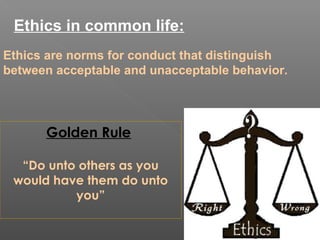
Ethics are norms for conduct that distinguish
between acceptable and unacceptable behavior.
Golden Rule
“Do unto others as you
would have them do unto
you”
4.
Ethics in businessmessages:
All business messages demand attention to ethics
and etiquette
For negative messages standard of ethics and
etiquettes are more important: as bad news
messages involve:
01. Laws and regulations
02. Human impact
03. Emotions
5.
01. Laws andregulations
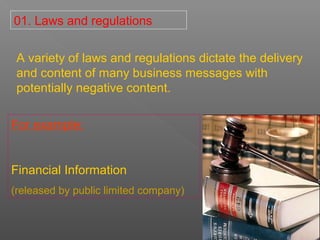
A variety of laws and regulations dictate the delivery
and content of many business messages with
potentially negative content.
For example:
Financial Information
(released by public limited company)
6.
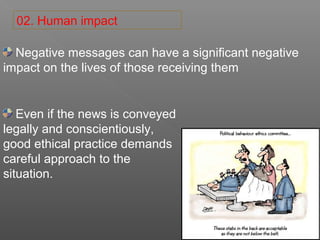
02. Human impact
Negativemessages can have a significant negative
impact on the lives of those receiving them
Even if the news is conveyed
legally and conscientiously,
good ethical practice demands
careful approach to the
situation.
7.
03. Emotions
Emotions oftenrun high when negative messages
are involved, for both the sender and the receiver.
Senders need to not only manage
their own emotions but also consider
the emotional state of their audience.
8.
Ethical Responsibilities:
sharing badnews messages effectively
require commitment from everyone in the
organization.
The Delivery of the negative message
should not be delayed
The longer you wait to deliver bad news, the harder
you make it for recipients to react and respond.
Work with self-control and demonstrate
business etiquettes when exposed to negative
situation
9.
Conclusion:
For the longterm survival of the company
and its goodwill the high standards of ethics
and etiquettes are very important specially
when bad news are communicated,
because they acutely flesh opportunities
for corrective actions.
Crises Management:
Crisis managementis a critical organizational function.
It’s a process designed to prevent or lessen the damage a
crisis can inflict on an organization and its stakeholders
Public relations practitioners are an integral part of
crisis management teams.
A crisis is defined as a significant threat to operations
that can have negative consequences if not handled
properly.
Public relations can play a critical role in preparing
spokespersons for handling questions from the news
media.
12.
Communicating Crises:
During Crises,Employees, their Families, the surrounding
community, and the general public demand information.
The Rumors can spread uncontrollably, and the news
media ascend quickly, asking questions of anyone they
can find
Poor communication can increase victim’s trauma
and damage company reputation
Organizational members must devote considerable
attention to media relations in a crisis
13.
Crises Management Plan:
Thekey to successful communication efforts during a
crises is having a “Crises Management Plan”
A crises management plan outlines:
Operational Procedures
Authorized Persons to Communicate
Media and Technology to be used for communication
Communication Tasks
Communication Channels
14.
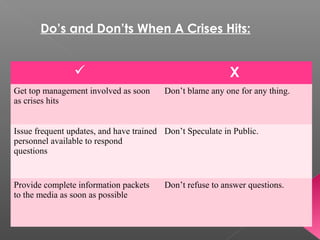
Do’s and Don’tsWhen A Crises Hits:
Х
Get top management involved as soon
as crises hits
Don’t blame any one for any thing.
Issue frequent updates, and have trained
personnel available to respond
questions
Don’t Speculate in Public.
Provide complete information packets
to the media as soon as possible
Don’t refuse to answer questions.
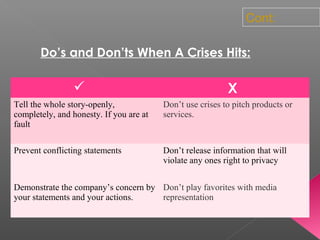
15.
Х
Tell thewhole story-openly,
completely, and honesty. If you are at
fault
Don’t use crises to pitch products or
services.
Prevent conflicting statements Don’t release information that will
violate any ones right to privacy
Demonstrate the company’s concern by
your statements and your actions.
Don’t play favorites with media
representation
Do’s and Don’ts When A Crises Hits:
Cont:
16.
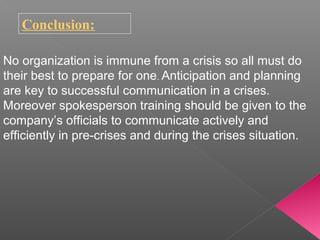
Conclusion:
No organization isimmune from a crisis so all must do
their best to prepare for one. Anticipation and planning
are key to successful communication in a crises.
Moreover spokesperson training should be given to the
company’s officials to communicate actively and
efficiently in pre-crises and during the crises situation.
#3 Respected sir and dear fellows Good afternoon , this is………………… representing my group d with my friend……..
We are here to acknowledge you on the importance of high standard and ethics in bad news messages. We will appreciate your kind attention
#4 When we talk of the ethics in our common life we basically refer to the difference between right and wrong, importantly in our own perception, but that’s not true all the time, what ethics are those differences which are actually perceived in the same way from both the sides.
For example. What is right and ethical in my view might not be the same for the others so here ethics are the principles which are universally acceptable.
As the golden rule suggests:
That means deal with the people in the way you want to be dealt by them.
#5 We do business for our profit but surely there is also an intention of the betterment of others. Otherwise how can we operate in the society
#6 Laws monitor the content and delivery of the negative messages, specially because negative message contrary to the positive influence badly to the receivers such as disclosure of financial information by a public limited company.
#7 What if someone comes and say to me that the company in which I had invested my oodles of amount has been bankrupt and disposed off all its assets, surely I will be shocked and I might have a heart attack but the ethics can change way of delivery to lessen the impact of the message on me.
#11 Some of the most critical instances of business communication occur during crises, which can include anything from incidents of product tempering to industrial accidents, crimes or scandals involving company employees, on-site hostage situations or terrorists attacks.
#12 The primary concern in a crisis has to be public safety. A failure to address public safety intensifies the damage from a crisis. Reputation and financial concerns are considered after public safety has been remedied.
#13 Obviously accuracy is important anytime an organization communicates with publics. People want accurate information about what happened and how that event might affect them. Because of the time pressure in a crisis, there is a risk of inaccurate information. If mistakes are made, they must be corrected. However, inaccuracies make an organization look inconsistent. Incorrect statements must be corrected making an organization appear to be incompetent. The philosophy of speaking with one voice in a crisis is a way to maintain accuracy