



Crisis   Management A presentation by   Bruce Hugman Consultant to  the  Uppsala Monitoring Centre Pretoria, September 2004
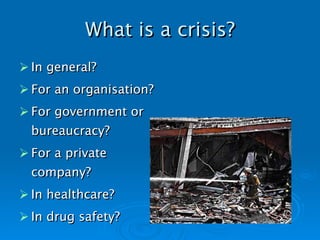
What is a crisis? In general? For an organisation? For government or bureaucracy? For a private company? In healthcare? In drug safety ?
Topics The nature of crisis Crisis management model Planning Risk assessment Risk management Crisis communications Risk Communications
Key features of a Crisis Low probability High impact Uncertain/ambiguous causes and effects Differential perception s
High level threats: Safety Health Environment National security
Specific threats to organisation:   Operational viability Reputation Credibility Financial stability Legal  action
Consequential effects: Uncertainty/ambiguity Urgency of response Strategic effects of decisions
Common features of a crisis: The situation materialises unexpectedly Decisions are required urgently Time is short Specific threats are identified Urgent demands for information are received There is sense of loss of control Pressures build over time Routine business become increasingly difficult Demands are made to identify someone to blame Outsiders take an unaccustomed  interest Reputation suffers Communications are increasingly difficult to manage
Purpose of crisis management: Prevention Survival Successful outcomes
Successful outcomes: Positive balance of success/failure
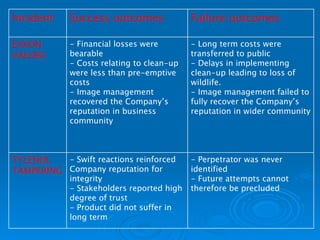
- Perpetrator was never identified - Future attempts cannot therefore be precluded - Swift reactions reinforced Company reputation for integrity - Stakeholders reported high degree of trust - Product did not suffer in long term TYLENOL TAMPERING - Long term costs were transferred to public - Delays in implementing clean-up leading to loss of wildlife. - Image management failed to fully recover the Company’s reputation in wider community - Financial losses were bearable  - Costs relating to clean-up were less than pre-emptive costs - Image management recovered the Company’s reputation in business community EXXON VALDEZ Failure outcomes Success outcomes Incident
 
Three criteria of success: Has organisational capacity been restored? Have losses been minimised? Have lessons been learned?
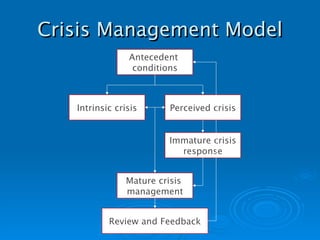
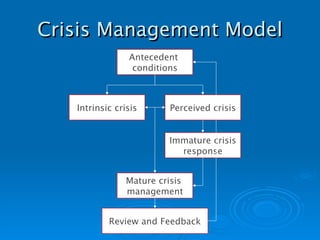
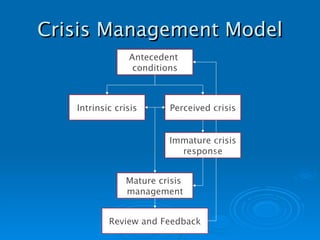
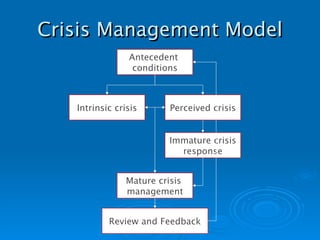
Crisis Management Model Antecedent  conditions Intrinsic crisis Perceived crisis Immature crisis  response Mature crisis  management Review and Feedback
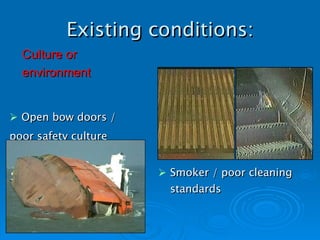
Existing conditions: Open bow doors /  poor safety culture Smoker / poor cleaning standards Culture or  environment
Existing conditions: Crisis-prepared  or crisis-prone?
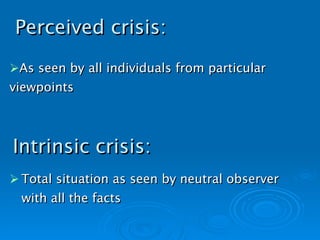
Intrinsic crisis: Total situation as seen by neutral observer with all the facts   As seen by all individuals from particular viewpoints   Perceived crisis:
Crisis Management Model Antecedent  conditions Intrinsic crisis Perceived crisis Immature crisis  response Mature crisis  management Review and Feedback
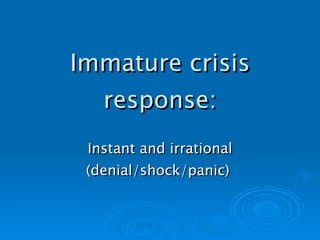
Immature crisis response: Instant and irrational (denial/shock/panic)
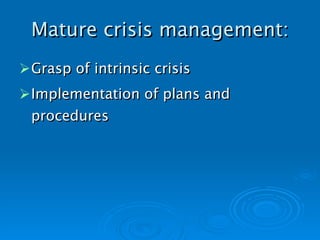
Mature crisis management: Grasp of intrinsic crisis Implementation of plans and procedures
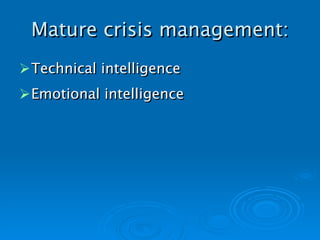
Mature crisis management: Technical intelligence Emotional intelligence
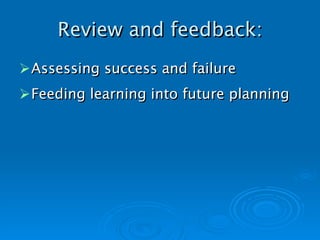
Review and feedback: Assessing success and failure Feeding learning into future planning
Crisis Management Model Antecedent  conditions Intrinsic crisis Perceived crisis Immature crisis  response Mature crisis  management Review and Feedback
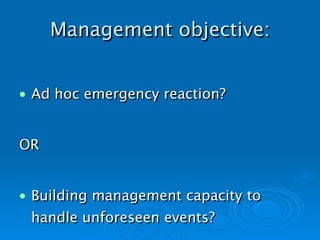
Management objective: Ad hoc emergency reaction? OR Building management capacity to handle unforeseen events?
End of Part 1
 
Part 2:   Planning for Crisis Management
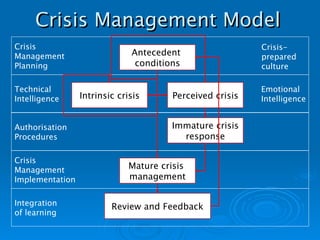
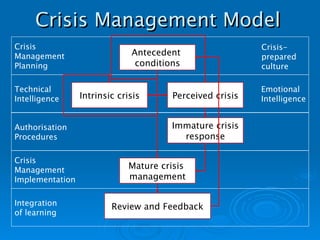
Crisis Management Model Integration of learning Crisis Management Implementation Authorisation Procedures Technical Intelligence Crisis  Management Planning Antecedent  conditions Intrinsic crisis Perceived crisis Immature crisis  response Mature crisis  management Review and Feedback Crisis- prepared culture Emotional Intelligence
Gathering intelligence: Who? What? When? How?
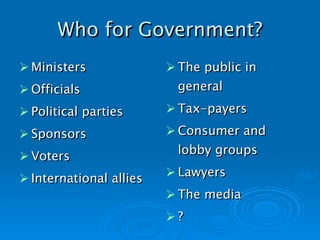
Who for Government? Ministers Officials Political parties Sponsors Voters International allies The public in general Tax-payers Consumer and lobby groups Lawyers The media ?
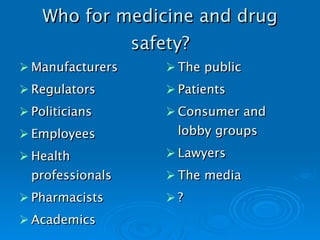
Who for medicine and drug safety? Manufacturers Regulators Politicians Employees Health professionals Pharmacists Academics The public Patients Consumer and lobby groups Lawyers The media ?
The first goal of crisis management is prevention
Intelligence: Continuous scanning (networks/media/ppublic opinion, etc) Outward focus Collaboration Positive relationships
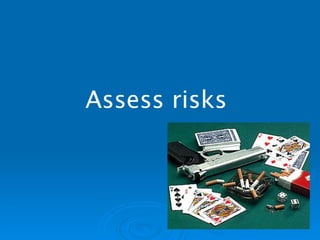
Assess risks
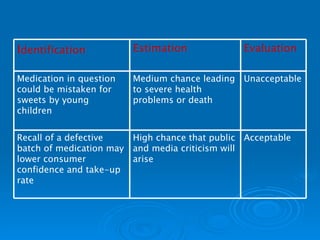
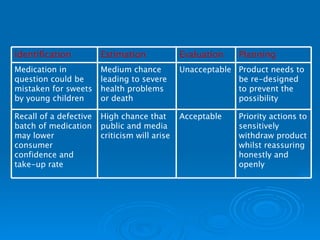
Risk assessment is: Identification define and describe Estimation likelihood and consequences Evaluation acceptability of risk
Acceptable High chance that public and media criticism will arise Recall of a defective batch of medication may lower consumer confidence and take-up rate Unacceptable Medium chance leading to severe health problems or death Medication in question could be mistaken for sweets by young children Evaluation Estimation I dentification
Priority actions to sensitively withdraw product whilst reassuring honestly and openly Acceptable High chance that public and media criticism will arise Recall of a defective batch of medication may lower consumer confidence and take-up rate Product needs to be re-designed to prevent the possibility Unacceptable Medium chance leading to severe health problems or death Medication in question could be mistaken for sweets by young children Planning Evaluation Estimation Identification
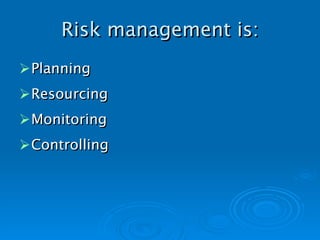
Risk management is: Planning Resourcing Monitoring Controlling
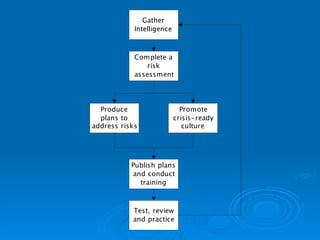
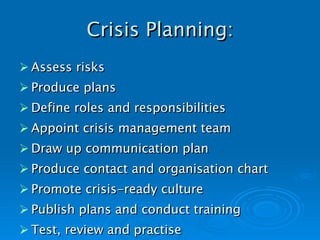
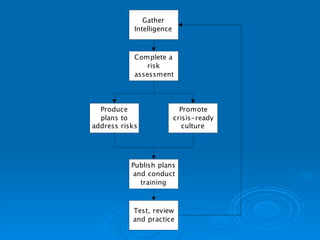
Crisis Planning: Assess risks Produce plans Define roles and responsibilities Appoint crisis management team Draw up communication plan Produce contact and organisation chart   Promote crisis-ready culture Publish plans and conduct training Test, review and practise
End of Part 2
 
Part 3:   Crisis Communications
Communication plan:   Core elements are: Identifying audiences (Who?) How communication is to take place (How?) What messages are to be communicated (What?)   The core process is: Active, two-way communication
Who  matters and how will they be contacted? Ministers Officials Political parties Sponsors Voters International allies Tax-payers Manufacturers Politicians Health professionals Pharmacists Academics Patients Shareholders Stock-market Regulators Senior executives Experts Employees The public Customers Consumer and lobby groups Lawyers The media ?
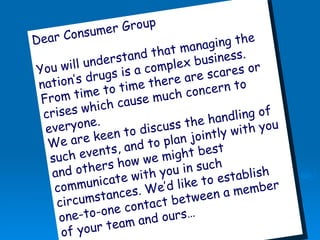
Dear Consumer Group You will understand that managing the nation’s drugs is a complex business. From time to time there are scares or crises which cause much concern to everyone. We are keen to discuss the handling of such events, and to plan jointly with you and others how we might best communicate with you in such circumstances. We’d like to establish one-to-one contact between a member of your team and ours…
 
Message Options  [What?] Full apology Corrective action Ingratiation Justification Excuse Denial Attack the attacker
What does the world want to see? Acceptance of responsibility Willingness to take positive steps
Message Options: Full apology Corrective action Ingratiation Justification Excuse Denial Attack the attacker
Critical activities: Initial response Lines to take
Initial response: Tell the truth as it is known Facts beyond question Actions being taken Acknowledgement of emotions/psychological needs
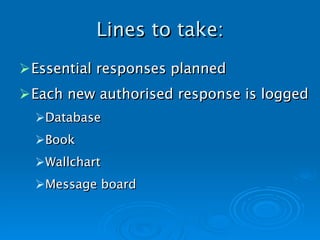
Lines to take: Essential responses planned Each new authorised response is logged Database Book Wallchart Message board
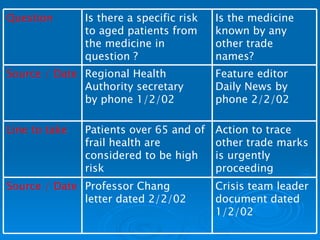
Question Is there a specific risk to aged patients from the medicine in question ? Is the medicine known by any other trade names? Source / Date Regional Health Authority secretary by phone 1/2/02 Feature editor Daily News by phone 2/2/02 Line to take Patients over 65 and of frail health are considered to be high risk Action to trace other trade marks is urgently proceeding Source / Date Professor Chang letter dated 2/2/02 Crisis team leader document dated 1/2/02
Media demands  [How?] Accuracy and simplicity Statistics which are explained Context of information Comments from highest authority Some controversial elements Both sides of the issue Speed, speed and speed
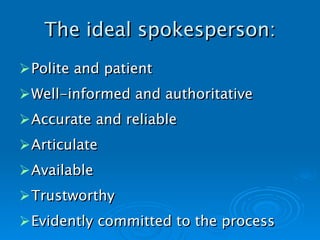
The ideal spokesperson: Polite and patient Well-informed and authoritative Accurate and reliable Articulate Available Trustworthy Evidently committed to the process
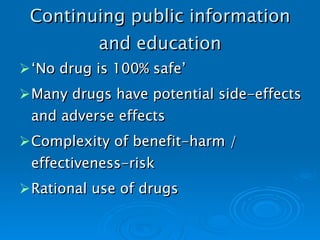
Continuing public information and education ‘ No drug is 100% safe’ Many drugs have potential side-effects and adverse effects Complexity of benefit-harm / effectiveness-risk Rational use of drugs
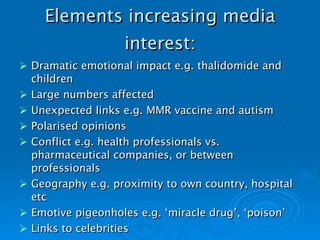
Elements increasing media interest: Dramatic emotional impact e.g. thalidomide and children Large numbers affected Unexpected links e.g. MMR vaccine and autism Polarised opinions Conflict e.g. health professionals vs. pharmaceutical companies, or between professionals Geography e.g. proximity to own country, hospital etc Emotive pigeonholes e.g. ‘miracle drug’, ‘poison’ Links to celebrities
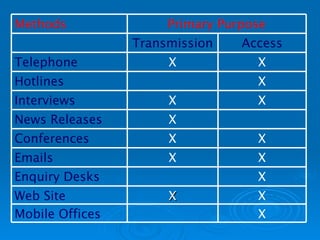
X X Web Site X Mobile Offices X Enquiry Desks X X Emails X X Conferences X News Releases X X Interviews X Hotlines X X Telephone Access Transmission Primary Purpose Methods
Crisis Management Model Antecedent  conditions Intrinsic crisis Perceived crisis Immature crisis  response Mature crisis  management Review and Feedback
Crisis Management Model Integration of learning Crisis Management Implementation Authorisation Procedures Technical Intelligence Crisis  Management Planning Antecedent  conditions Intrinsic crisis Perceived crisis Immature crisis  response Mature crisis  management Review and Feedback Crisis- prepared culture Emotional Intelligence
 
End of Part 3
 
Part 4:   Communicating Risk
Communication of risk Very poor public grasp of risk and risk statistics Confusion between relative/absolute/reference/ attributable risk Variable perception/tolerance of different kinds of risk Fantasy of a ‘safe drug’
Perception of risk Factors increasing intolerance: Involuntary  - e.g. exposure to pollution rather than voluntary, such as smoking or playing dangerous sports Unfairly distributed  - some benefit whilst other suffer Inescapable  - cannot be avoided by one’s personal actions Unfamiliar  - arising from a novel source Man-made  - from other than natural sources continued…
Perception of risk Factors increasing intolerance: Hidden/irreversible  - e.g. effects damaging but concealed for years Affects posterity  - threatens children, births or future generations Particularly dreadful  - e.g. distressing symptoms or social rejection Victims identifiable  - e.g. a particular blood type or social group Scientifically obscure  - new or rare Contradicted  - argued by responsible sources
Problematic issues in drug safety: Adverse effects Risk as a concept in medicine Benefit-harm Effectiveness-risk Public health versus profit Access to medicines continued...
Problematic issues in drug safety: Individual patient variation and susceptibility Polypharmacy Relationship of allopathic and traditional medicines Resistance Diagnostic errors Prescribing errors Compliance issues
Risk Factors for Government Officials Political expediency Culture of secrecy Accountability Bureaucracy and inertia Hierarchy Process versus performance Complexity Workload Corruption
Summary Topics covered: The nature of crisis Crisis management model Planning Risk assessment Risk management Crisis communications Learning from experience
 
 
Thank you - and good luck! (though luck has nothing to do with good crisis management!)
 

19b crisis management

  • 1.
    Crisis Management A presentation by Bruce Hugman Consultant to the Uppsala Monitoring Centre Pretoria, September 2004
  • 2.
    What is acrisis? In general? For an organisation? For government or bureaucracy? For a private company? In healthcare? In drug safety ?
  • 3.
    Topics The natureof crisis Crisis management model Planning Risk assessment Risk management Crisis communications Risk Communications
  • 4.
    Key features ofa Crisis Low probability High impact Uncertain/ambiguous causes and effects Differential perception s
  • 5.
    High level threats:Safety Health Environment National security
  • 6.
    Specific threats toorganisation: Operational viability Reputation Credibility Financial stability Legal action
  • 7.
    Consequential effects: Uncertainty/ambiguityUrgency of response Strategic effects of decisions
  • 8.
    Common features ofa crisis: The situation materialises unexpectedly Decisions are required urgently Time is short Specific threats are identified Urgent demands for information are received There is sense of loss of control Pressures build over time Routine business become increasingly difficult Demands are made to identify someone to blame Outsiders take an unaccustomed interest Reputation suffers Communications are increasingly difficult to manage
  • 9.
    Purpose of crisismanagement: Prevention Survival Successful outcomes
  • 10.
    Successful outcomes: Positivebalance of success/failure
  • 11.
    - Perpetrator wasnever identified - Future attempts cannot therefore be precluded - Swift reactions reinforced Company reputation for integrity - Stakeholders reported high degree of trust - Product did not suffer in long term TYLENOL TAMPERING - Long term costs were transferred to public - Delays in implementing clean-up leading to loss of wildlife. - Image management failed to fully recover the Company’s reputation in wider community - Financial losses were bearable - Costs relating to clean-up were less than pre-emptive costs - Image management recovered the Company’s reputation in business community EXXON VALDEZ Failure outcomes Success outcomes Incident
  • 12.
  • 13.
    Three criteria ofsuccess: Has organisational capacity been restored? Have losses been minimised? Have lessons been learned?
  • 14.
    Crisis Management ModelAntecedent conditions Intrinsic crisis Perceived crisis Immature crisis response Mature crisis management Review and Feedback
  • 15.
    Existing conditions: Openbow doors / poor safety culture Smoker / poor cleaning standards Culture or environment
  • 16.
  • 17.
    Intrinsic crisis: Totalsituation as seen by neutral observer with all the facts As seen by all individuals from particular viewpoints Perceived crisis:
  • 18.
    Crisis Management ModelAntecedent conditions Intrinsic crisis Perceived crisis Immature crisis response Mature crisis management Review and Feedback
  • 19.
    Immature crisis response:Instant and irrational (denial/shock/panic)
  • 20.
    Mature crisis management:Grasp of intrinsic crisis Implementation of plans and procedures
  • 21.
    Mature crisis management:Technical intelligence Emotional intelligence
  • 22.
    Review and feedback:Assessing success and failure Feeding learning into future planning
  • 23.
    Crisis Management ModelAntecedent conditions Intrinsic crisis Perceived crisis Immature crisis response Mature crisis management Review and Feedback
  • 24.
    Management objective: Adhoc emergency reaction? OR Building management capacity to handle unforeseen events?
  • 25.
  • 26.
  • 27.
    Part 2: Planning for Crisis Management
  • 28.
    Crisis Management ModelIntegration of learning Crisis Management Implementation Authorisation Procedures Technical Intelligence Crisis Management Planning Antecedent conditions Intrinsic crisis Perceived crisis Immature crisis response Mature crisis management Review and Feedback Crisis- prepared culture Emotional Intelligence
  • 29.
  • 30.
    Who for Government?Ministers Officials Political parties Sponsors Voters International allies The public in general Tax-payers Consumer and lobby groups Lawyers The media ?
  • 31.
    Who for medicineand drug safety? Manufacturers Regulators Politicians Employees Health professionals Pharmacists Academics The public Patients Consumer and lobby groups Lawyers The media ?
  • 32.
    The first goalof crisis management is prevention
  • 33.
    Intelligence: Continuous scanning(networks/media/ppublic opinion, etc) Outward focus Collaboration Positive relationships
  • 34.
  • 35.
    Risk assessment is:Identification define and describe Estimation likelihood and consequences Evaluation acceptability of risk
  • 36.
    Acceptable High chancethat public and media criticism will arise Recall of a defective batch of medication may lower consumer confidence and take-up rate Unacceptable Medium chance leading to severe health problems or death Medication in question could be mistaken for sweets by young children Evaluation Estimation I dentification
  • 37.
    Priority actions tosensitively withdraw product whilst reassuring honestly and openly Acceptable High chance that public and media criticism will arise Recall of a defective batch of medication may lower consumer confidence and take-up rate Product needs to be re-designed to prevent the possibility Unacceptable Medium chance leading to severe health problems or death Medication in question could be mistaken for sweets by young children Planning Evaluation Estimation Identification
  • 38.
    Risk management is:Planning Resourcing Monitoring Controlling
  • 39.
    Crisis Planning: Assessrisks Produce plans Define roles and responsibilities Appoint crisis management team Draw up communication plan Produce contact and organisation chart Promote crisis-ready culture Publish plans and conduct training Test, review and practise
  • 40.
  • 41.
  • 42.
    Part 3: Crisis Communications
  • 43.
    Communication plan: Core elements are: Identifying audiences (Who?) How communication is to take place (How?) What messages are to be communicated (What?) The core process is: Active, two-way communication
  • 44.
    Who mattersand how will they be contacted? Ministers Officials Political parties Sponsors Voters International allies Tax-payers Manufacturers Politicians Health professionals Pharmacists Academics Patients Shareholders Stock-market Regulators Senior executives Experts Employees The public Customers Consumer and lobby groups Lawyers The media ?
  • 45.
    Dear Consumer GroupYou will understand that managing the nation’s drugs is a complex business. From time to time there are scares or crises which cause much concern to everyone. We are keen to discuss the handling of such events, and to plan jointly with you and others how we might best communicate with you in such circumstances. We’d like to establish one-to-one contact between a member of your team and ours…
  • 46.
  • 47.
    Message Options [What?] Full apology Corrective action Ingratiation Justification Excuse Denial Attack the attacker
  • 48.
    What does theworld want to see? Acceptance of responsibility Willingness to take positive steps
  • 49.
    Message Options: Fullapology Corrective action Ingratiation Justification Excuse Denial Attack the attacker
  • 50.
    Critical activities: Initialresponse Lines to take
  • 51.
    Initial response: Tellthe truth as it is known Facts beyond question Actions being taken Acknowledgement of emotions/psychological needs
  • 52.
    Lines to take:Essential responses planned Each new authorised response is logged Database Book Wallchart Message board
  • 53.
    Question Is therea specific risk to aged patients from the medicine in question ? Is the medicine known by any other trade names? Source / Date Regional Health Authority secretary by phone 1/2/02 Feature editor Daily News by phone 2/2/02 Line to take Patients over 65 and of frail health are considered to be high risk Action to trace other trade marks is urgently proceeding Source / Date Professor Chang letter dated 2/2/02 Crisis team leader document dated 1/2/02
  • 54.
    Media demands [How?] Accuracy and simplicity Statistics which are explained Context of information Comments from highest authority Some controversial elements Both sides of the issue Speed, speed and speed
  • 55.
    The ideal spokesperson:Polite and patient Well-informed and authoritative Accurate and reliable Articulate Available Trustworthy Evidently committed to the process
  • 56.
    Continuing public informationand education ‘ No drug is 100% safe’ Many drugs have potential side-effects and adverse effects Complexity of benefit-harm / effectiveness-risk Rational use of drugs
  • 57.
    Elements increasing mediainterest: Dramatic emotional impact e.g. thalidomide and children Large numbers affected Unexpected links e.g. MMR vaccine and autism Polarised opinions Conflict e.g. health professionals vs. pharmaceutical companies, or between professionals Geography e.g. proximity to own country, hospital etc Emotive pigeonholes e.g. ‘miracle drug’, ‘poison’ Links to celebrities
  • 58.
    X X WebSite X Mobile Offices X Enquiry Desks X X Emails X X Conferences X News Releases X X Interviews X Hotlines X X Telephone Access Transmission Primary Purpose Methods
  • 59.
    Crisis Management ModelAntecedent conditions Intrinsic crisis Perceived crisis Immature crisis response Mature crisis management Review and Feedback
  • 60.
    Crisis Management ModelIntegration of learning Crisis Management Implementation Authorisation Procedures Technical Intelligence Crisis Management Planning Antecedent conditions Intrinsic crisis Perceived crisis Immature crisis response Mature crisis management Review and Feedback Crisis- prepared culture Emotional Intelligence
  • 61.
  • 62.
  • 63.
  • 64.
    Part 4: Communicating Risk
  • 65.
    Communication of riskVery poor public grasp of risk and risk statistics Confusion between relative/absolute/reference/ attributable risk Variable perception/tolerance of different kinds of risk Fantasy of a ‘safe drug’
  • 66.
    Perception of riskFactors increasing intolerance: Involuntary - e.g. exposure to pollution rather than voluntary, such as smoking or playing dangerous sports Unfairly distributed - some benefit whilst other suffer Inescapable - cannot be avoided by one’s personal actions Unfamiliar - arising from a novel source Man-made - from other than natural sources continued…
  • 67.
    Perception of riskFactors increasing intolerance: Hidden/irreversible - e.g. effects damaging but concealed for years Affects posterity - threatens children, births or future generations Particularly dreadful - e.g. distressing symptoms or social rejection Victims identifiable - e.g. a particular blood type or social group Scientifically obscure - new or rare Contradicted - argued by responsible sources
  • 68.
    Problematic issues indrug safety: Adverse effects Risk as a concept in medicine Benefit-harm Effectiveness-risk Public health versus profit Access to medicines continued...
  • 69.
    Problematic issues indrug safety: Individual patient variation and susceptibility Polypharmacy Relationship of allopathic and traditional medicines Resistance Diagnostic errors Prescribing errors Compliance issues
  • 70.
    Risk Factors forGovernment Officials Political expediency Culture of secrecy Accountability Bureaucracy and inertia Hierarchy Process versus performance Complexity Workload Corruption
  • 71.
    Summary Topics covered:The nature of crisis Crisis management model Planning Risk assessment Risk management Crisis communications Learning from experience
  • 72.
  • 73.
  • 74.
    Thank you -and good luck! (though luck has nothing to do with good crisis management!)
  • 75.