   здравей

http://www.youtube.com/watch?v=om7O0M
Boring, but I have to ask this ….
 What’s your name ?
 Did you ever hear of Public Relations
  or Corporate communication
  before ?
 Did you already have courses on PR/
  CC ?
First task :
   Try to work out following questions
    with your neighbour :
    – Write down your definition of Public
      Relations
    – Is this definition based on your
      experience of Public Relations and
      former lessons ?
    – Is it based on what you read/saw/heard
      about PR in the media ?
Second Task
   Compare your definitions with those
    of 2 other groups.
    – How different are they ?
    – What do they have in common ?
    – What are the differences and why do
      you think they exist ?
Defining Public Relations
   Is a very difficult task because :
    – It became a ‘weaselword’
    – It developed in an other way in different
      countries
    – The American view versus the European
      view although one of the ‘founders’
      James Grunig was a German in the USA
    – It is part of the department of
      Communication or Sociology, Political
      Science, …
   Public Relations was as growing
    mushrooms : you put them in the dark en
    gave them a lot of shit (S. Wolstenholme)
But Public Relations is far more
than that ..
   The right angle is : LEGITIMACY

What does this means ?
To explain we need a bit of
history !
   Remember the mushrooms and then
    you’ll understand !
1st phase :1850-1900 : The
public be damned or ignored !
   Between 1850-1900 : America : technological
    expansion.
     This created a gap between the ‘rich’ and the
        ‘poor’.
   It’s the era of the ‘Baron robbers’ (Rockefeller,
    Carnegie, Vanderbilt,…)
    : “We work for the shareholders NOT the public !”
(PUBLICITYMODEL)
2nd phase : 1900-1920 : the
 public be informed or served
   • Muckrackers
   • Journalists as ‘affection recruiters’
   • First attempts on professionalising Public
     Relations
       – 1906 : declaration of principles of Ivy Lee
           • Ethical code for PR-practitioner s : Basic
             idea : “ the public be informed, be
             served’. You can’t ignore the public
             opnion !
3rd phase1920-1945 : The public
be educated and respected
   Public Relations became more and more a
    professional discipline
   Other disciplines influence Public Relations (political
    science, sociology,….)
   Market Research became more important cf. 1926 :
    General Foods
   University of Yale, Harvard and Columbia start
    developing PR-courses
   New businessmoral : ‘Principles of Business Conduct’
   Crisis 1929-1930 : The economic crisis
    shocked the public opinion
    – Looking for new methods to restore the
      confidence
       • New Deal plan of president Roosevelt
       • Social responsibility became important
       • Companies created PR-functions and
         departments.
       (PUBLIC INFORMATION MODEL°
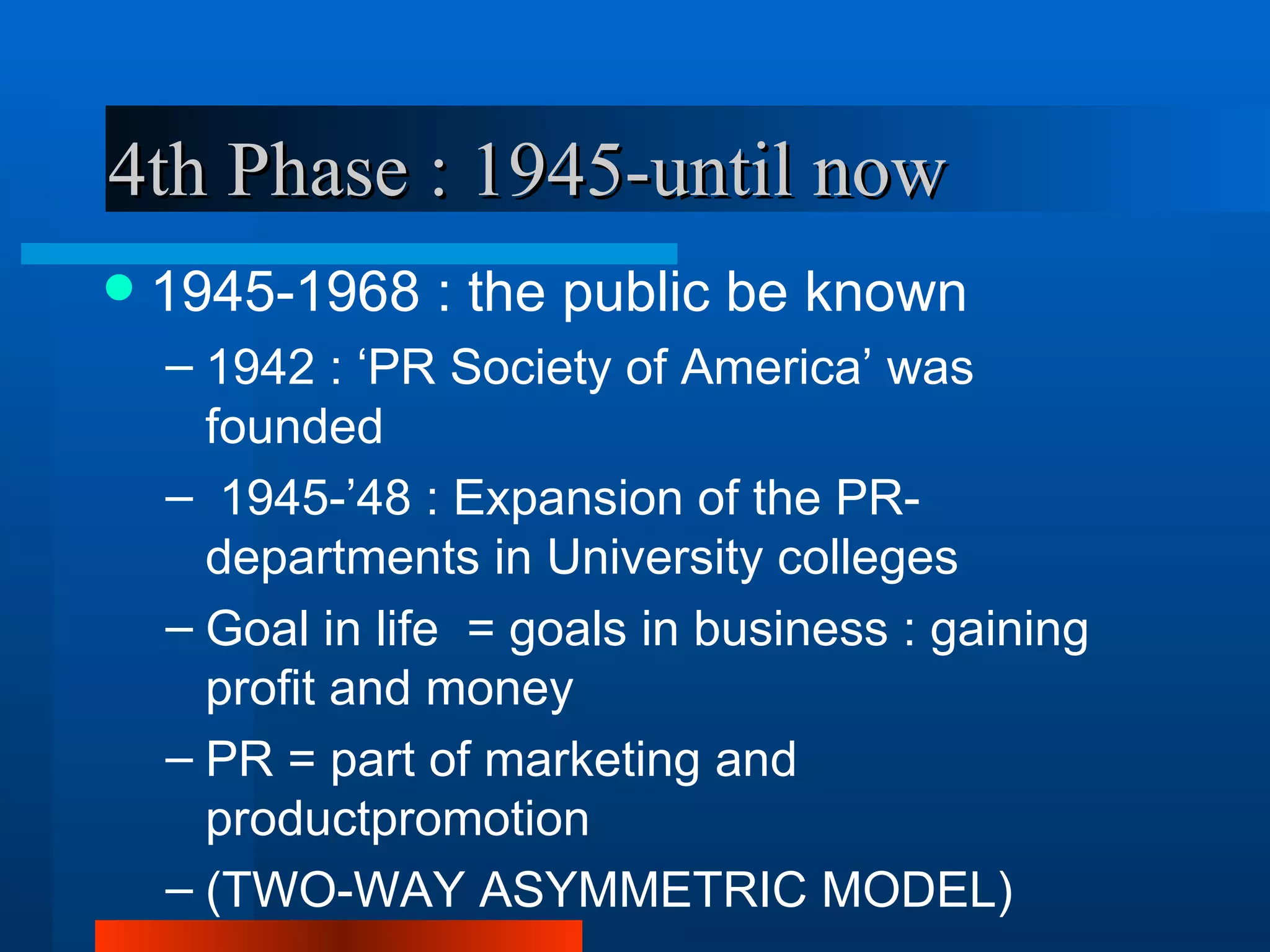
4th Phase : 1945-until now
   1945-1968 : the public be known
    – 1942 : ‘PR Society of America’ was
      founded
    – 1945-’48 : Expansion of the PR-
      departments in University colleges
    – Goal in life = goals in business : gaining
      profit and money
    – PR = part of marketing and
      productpromotion
    – (TWO-WAY ASYMMETRIC MODEL)
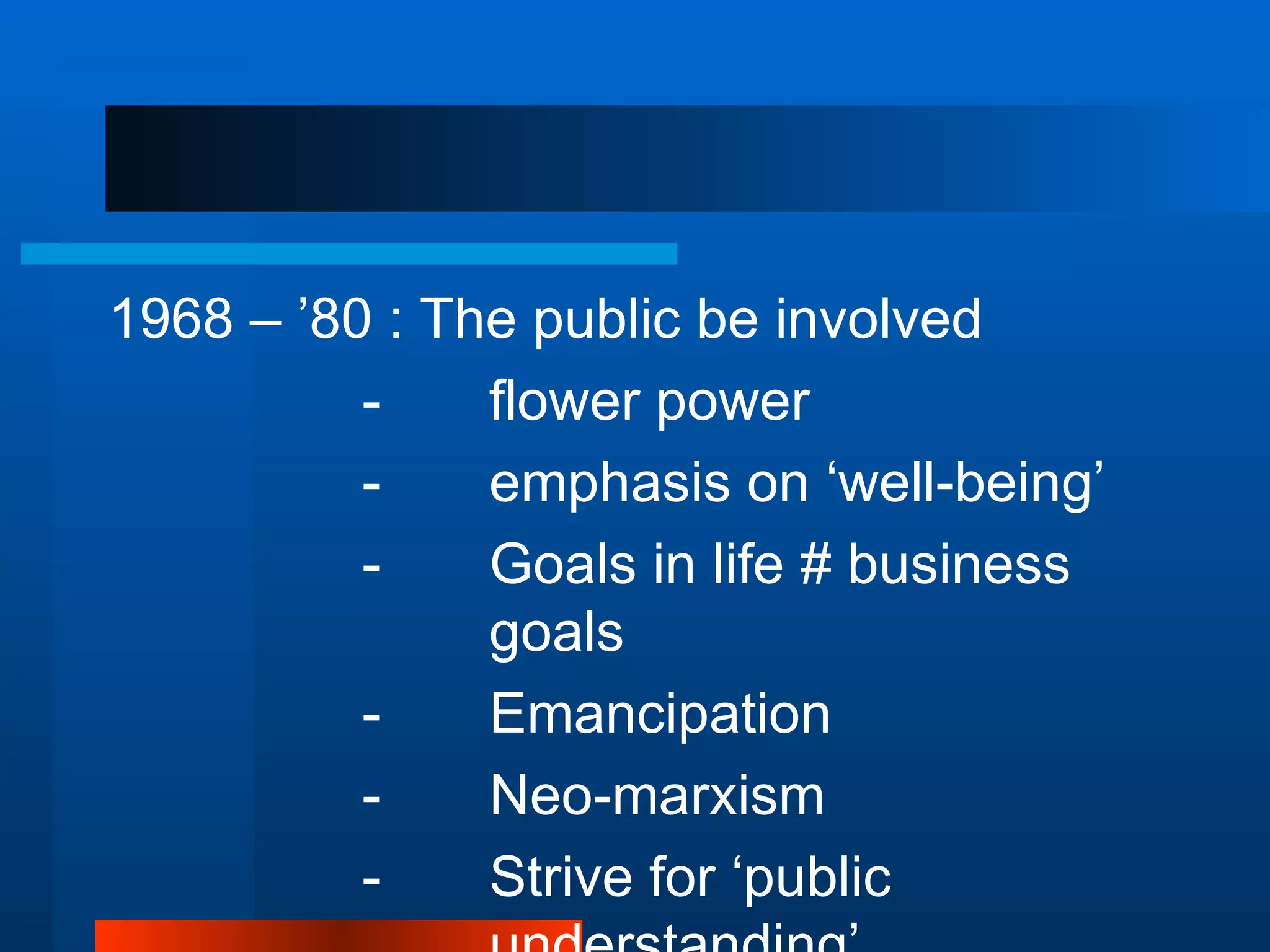
1968 – ’80 : The public be involved
          -    flower power
          -    emphasis on ‘well-being’
          -    Goals in life # business
               goals
          -    Emancipation
          -    Neo-marxism
          -    Strive for ‘public
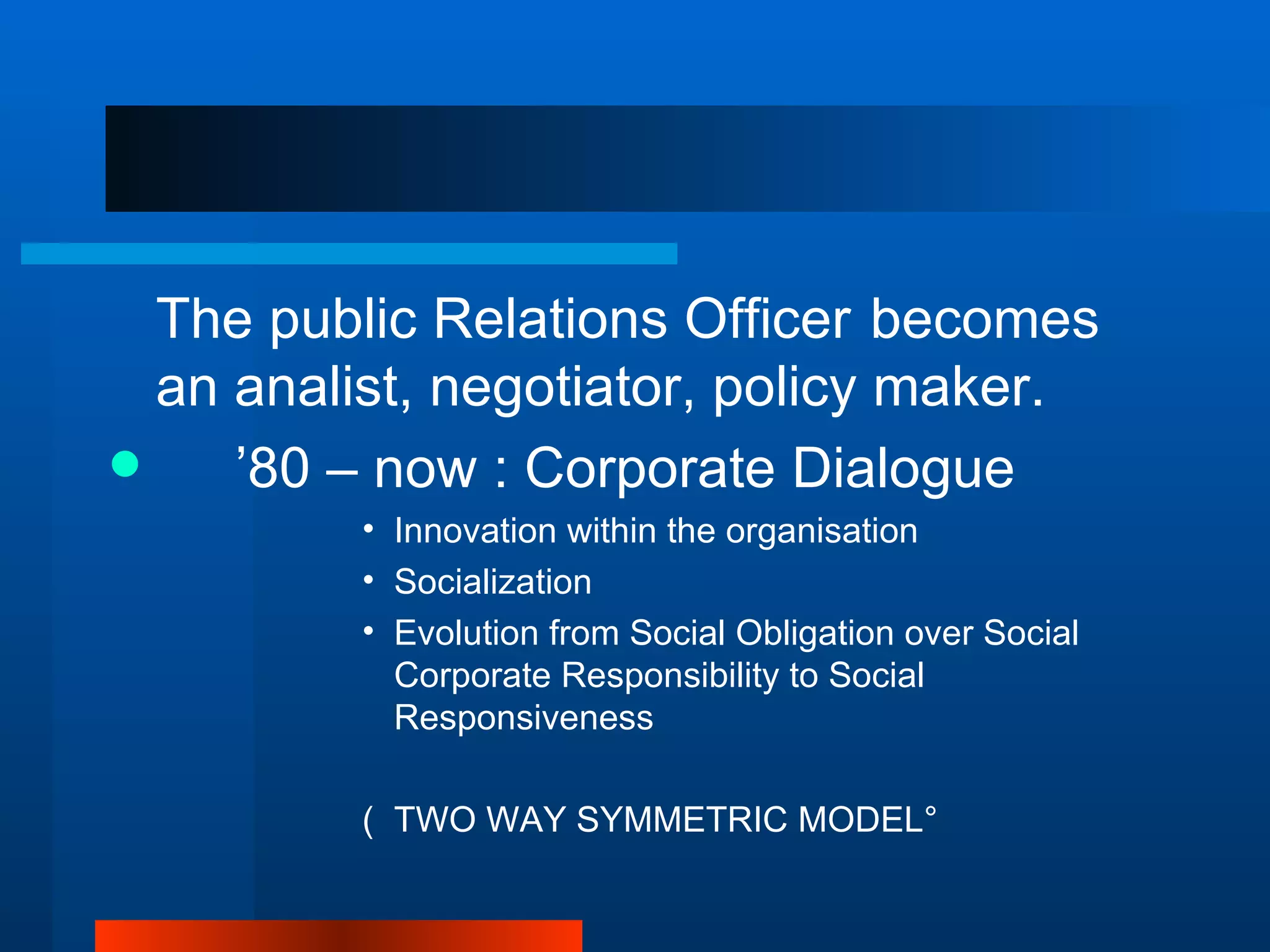
The public Relations Officer becomes
  an analist, negotiator, policy maker.
    ’80 – now : Corporate Dialogue
         • Innovation within the organisation
         • Socialization
         • Evolution from Social Obligation over Social
           Corporate Responsibility to Social
           Responsiveness

         ( TWO WAY SYMMETRIC MODEL°
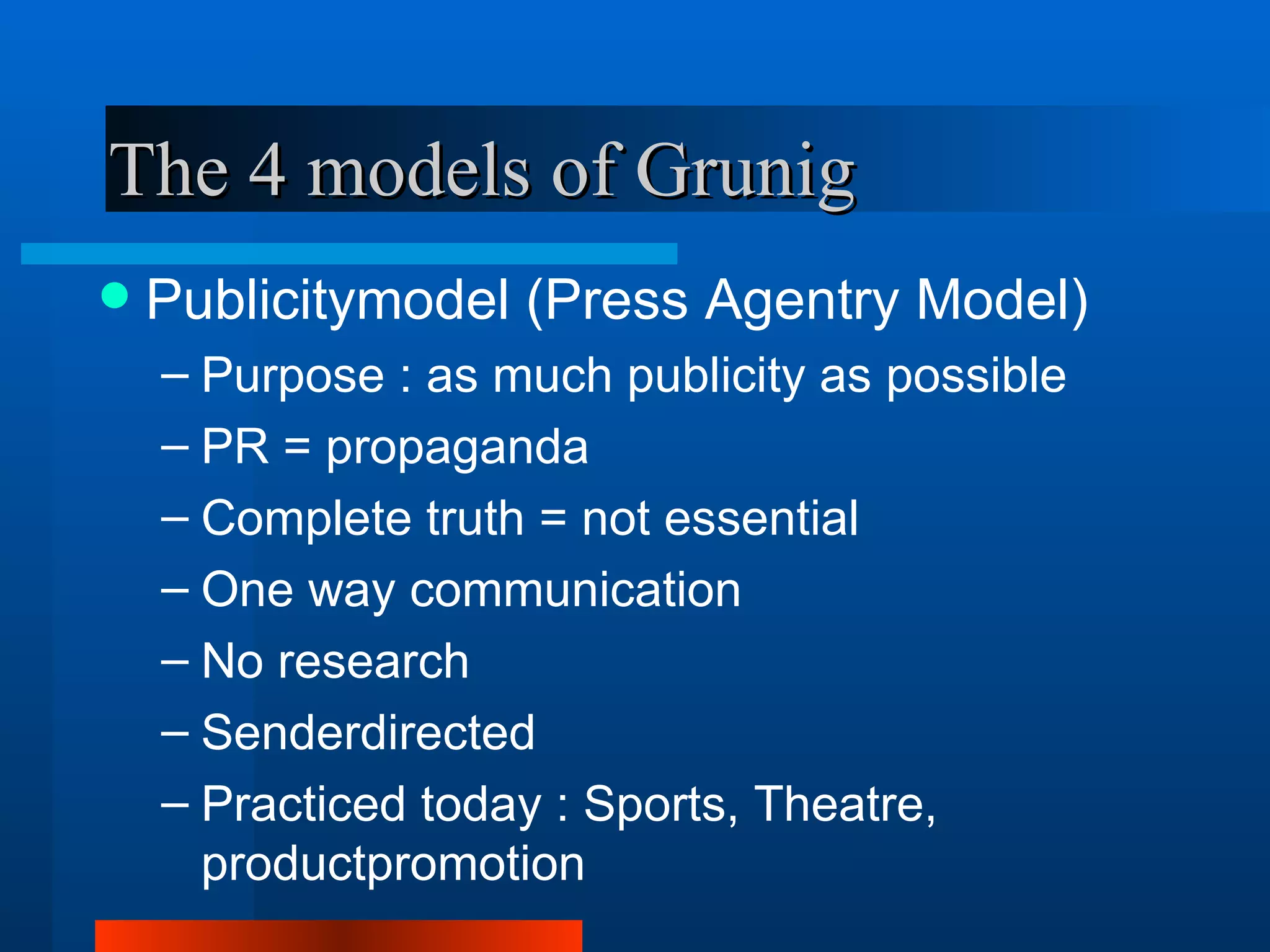
The 4 models of Grunig
   Publicitymodel (Press Agentry Model)
    – Purpose : as much publicity as possible
    – PR = propaganda
    – Complete truth = not essential
    – One way communication
    – No research
    – Senderdirected
    – Practiced today : Sports, Theatre,
      productpromotion
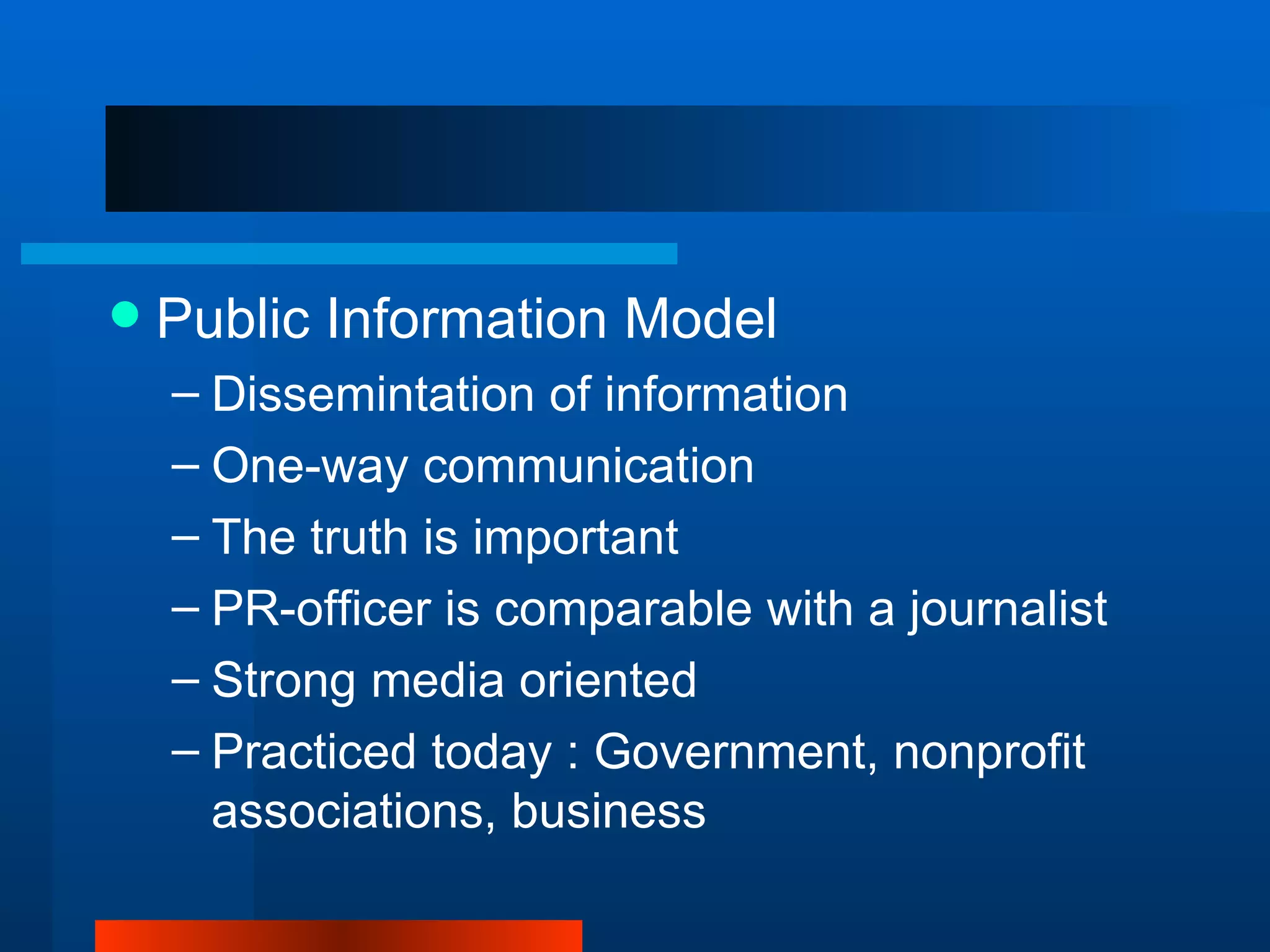
   Public Information Model
    – Dissemintation of information
    – One-way communication
    – The truth is important
    – PR-officer is comparable with a journalist
    – Strong media oriented
    – Practiced today : Government, nonprofit
      associations, business
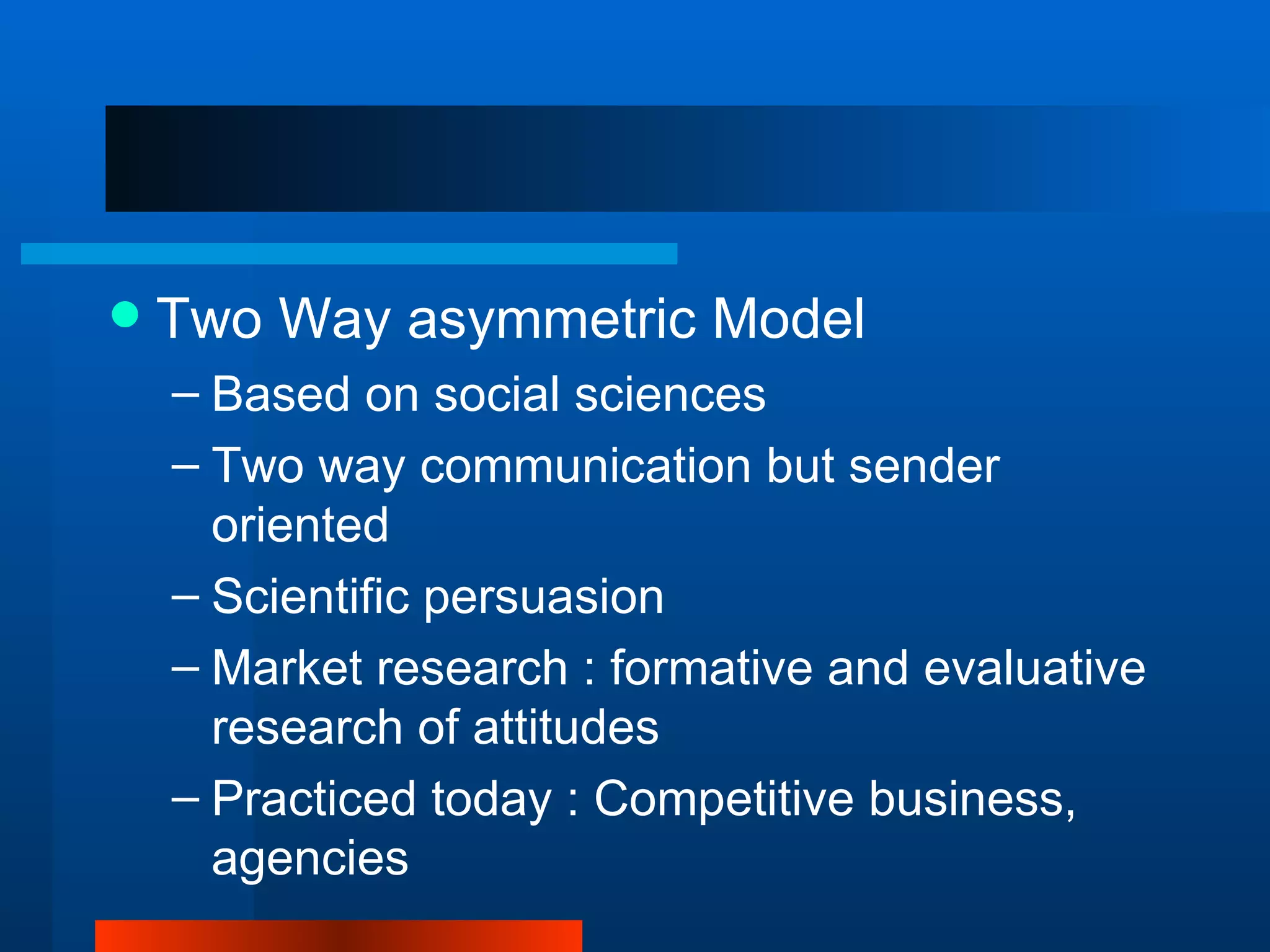
   Two Way asymmetric Model
    – Based on social sciences
    – Two way communication but sender
      oriented
    – Scientific persuasion
    – Market research : formative and evaluative
      research of attitudes
    – Practiced today : Competitive business,
      agencies
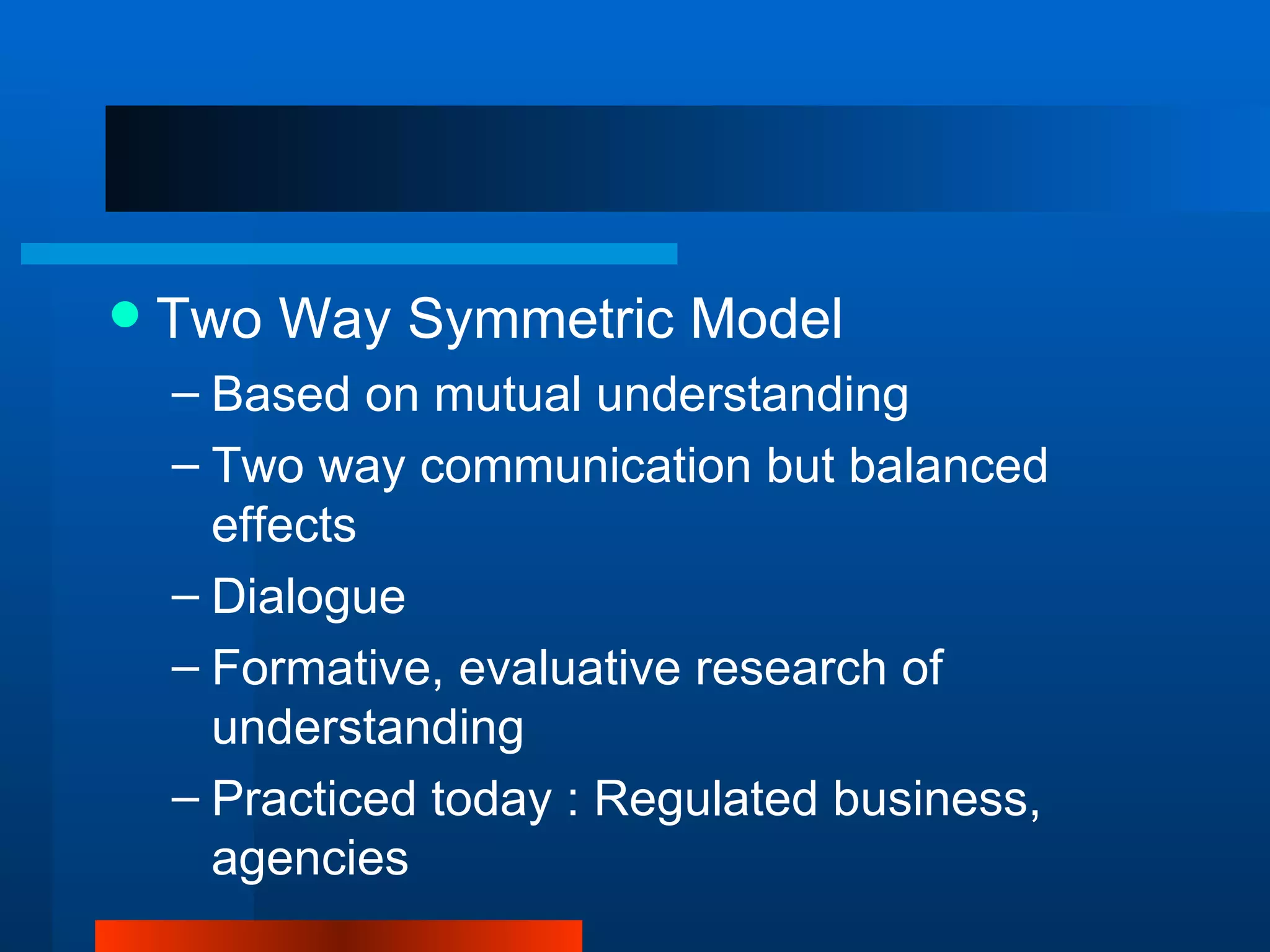
   Two Way Symmetric Model
    – Based on mutual understanding
    – Two way communication but balanced
      effects
    – Dialogue
    – Formative, evaluative research of
      understanding
    – Practiced today : Regulated business,
      agencies
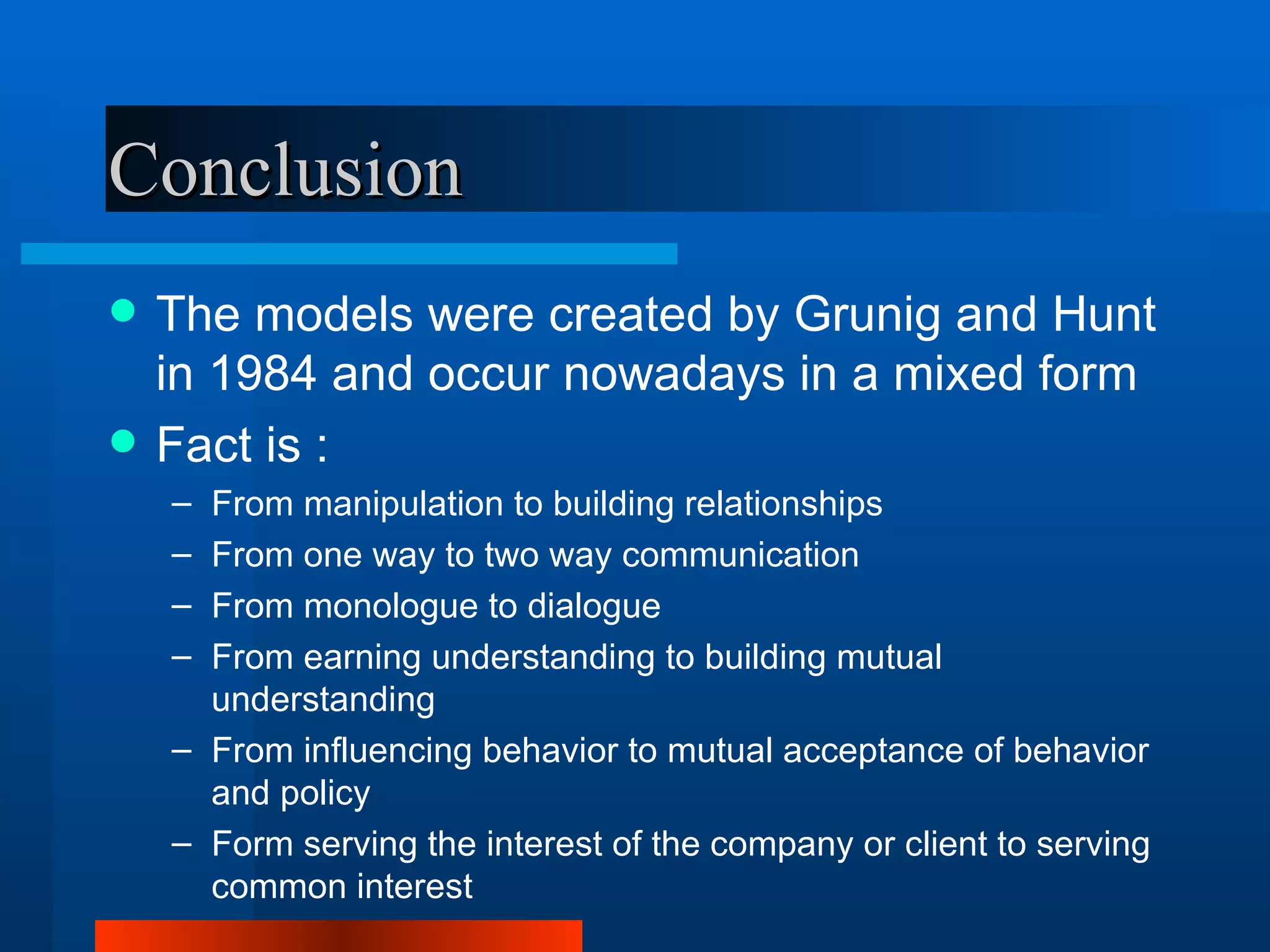
Conclusion
   The models were created by Grunig and Hunt
    in 1984 and occur nowadays in a mixed form
   Fact is :
    – From manipulation to building relationships
    – From one way to two way communication
    – From monologue to dialogue
    – From earning understanding to building mutual
      understanding
    – From influencing behavior to mutual acceptance of behavior
      and policy
    – Form serving the interest of the company or client to serving
      common interest
PR Objectives
   Alignment and influencing the social
    environment
    – Every company is in a situation of
      permanent exchange with the environment
    – The environment changes quickly
    – So does an organisation/company
Permanent exchange with the
environment
   Fast development of science and technology
   Population Explosion + strong urbanization
   Extensive division of labor and automation
   Increasing Educational level followed by more
    knowledge and higher involvement
   Social evolution and even revolution : Democracy
    became a goal
   Changes in businesslife : more managers leading
    companies (instead of owners) : Higher degree of
    efficiency, commercial pressure and also openess.
   Communicatieboom : new media, : more access to
    information
   Increasing prosperity – longer lifetime – more spare
    time
Consequences
“One of the biggest problems in our modern
  society is that communication only happens
  through different abstract mediators !”(Claude
  Levi-Strauss)
Influence of these changes on PR
   Increasing influence from technology on information :
    New researchpossibilities, immediate feedback,
    better possibilities in measuring PR, faster
    informationstreaming : danger of overload..
   The balance between financial-economic policy and
    Social policy : under pressure : High wage costs,
    aging and retirement issues, flexilble working hours
    and time,…
   Internal changes : management development, the
    need for human contact on a smaller scale, home
    working
   External influence : tension between
    shortterm (profit) and longterm thinking
    (common good), new environmental
    legacy, EU-input and regulations

This all leaded to : more communication,
 transparency, dialogue
LEGITIMACY
= earning : ‘License to operate’

= an invitation to a ‘Corporate
  Dialogue’
PR Objectives
 Alignment and influencing the social
  environment
 Acceptance of policy
  Internal and external acceptance of the
  companies policy.
  Need for transparency
   Social Responsibility
    – Sponsoring
    – Political Responsibility
    – Social Responsibility
 Communication
 Building and supporting the Corporate
  Image
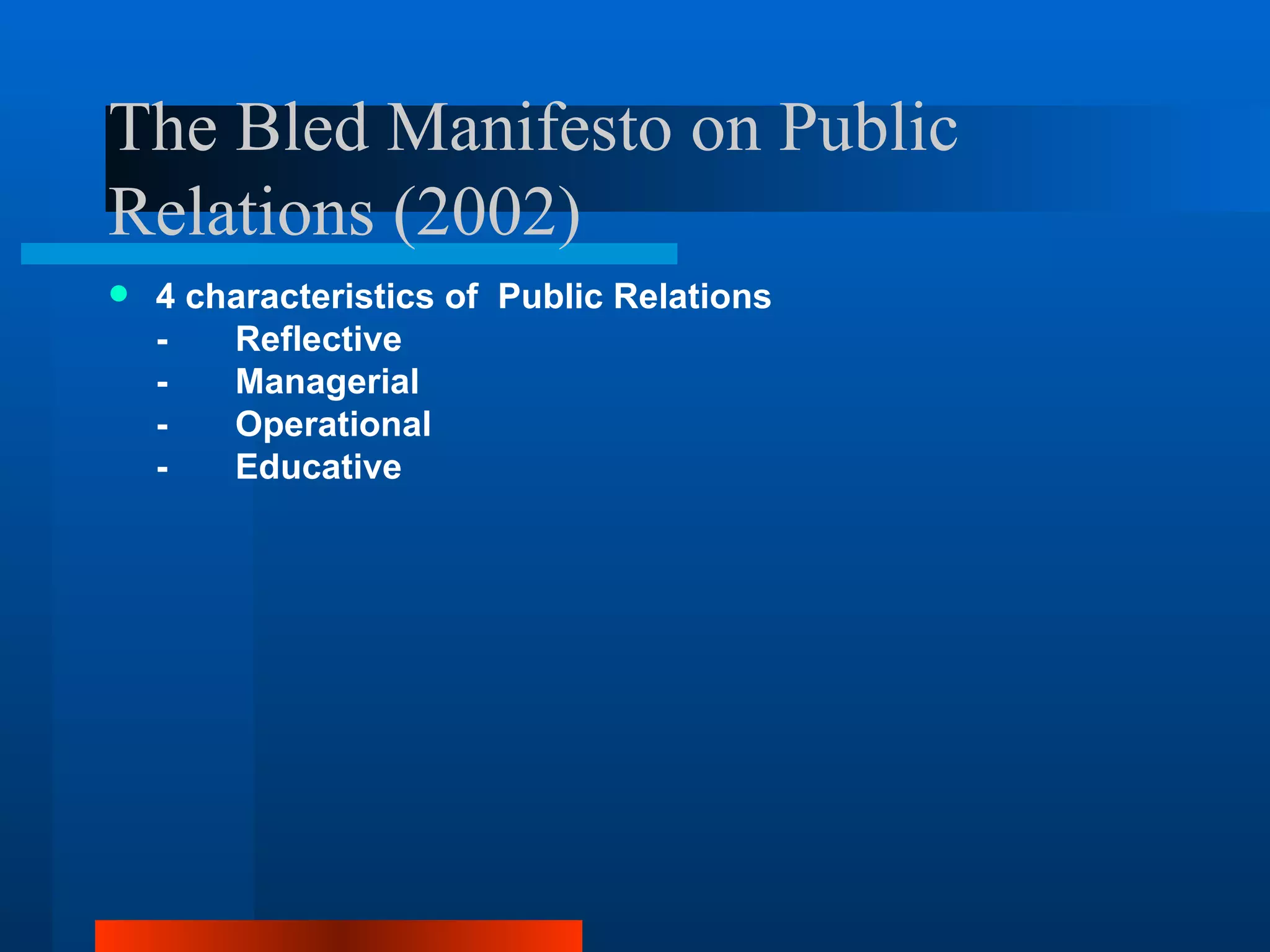
The Bled Manifesto on Public
Relations (2002)
   4 characteristics of Public Relations
    -   Reflective
    -   Managerial
    -   Operational
    -   Educative

Defining public relations

  • 1.
    здравей http://www.youtube.com/watch?v=om7O0M
  • 2.
    Boring, but Ihave to ask this ….  What’s your name ?  Did you ever hear of Public Relations or Corporate communication before ?  Did you already have courses on PR/ CC ?
  • 3.
    First task :  Try to work out following questions with your neighbour : – Write down your definition of Public Relations – Is this definition based on your experience of Public Relations and former lessons ? – Is it based on what you read/saw/heard about PR in the media ?
  • 4.
    Second Task  Compare your definitions with those of 2 other groups. – How different are they ? – What do they have in common ? – What are the differences and why do you think they exist ?
  • 5.
    Defining Public Relations  Is a very difficult task because : – It became a ‘weaselword’ – It developed in an other way in different countries – The American view versus the European view although one of the ‘founders’ James Grunig was a German in the USA – It is part of the department of Communication or Sociology, Political Science, …
  • 7.
    Public Relations was as growing mushrooms : you put them in the dark en gave them a lot of shit (S. Wolstenholme)
  • 8.
    But Public Relationsis far more than that ..  The right angle is : LEGITIMACY What does this means ?
  • 9.
    To explain weneed a bit of history !  Remember the mushrooms and then you’ll understand !
  • 10.
    1st phase :1850-1900: The public be damned or ignored !  Between 1850-1900 : America : technological expansion. This created a gap between the ‘rich’ and the ‘poor’.  It’s the era of the ‘Baron robbers’ (Rockefeller, Carnegie, Vanderbilt,…) : “We work for the shareholders NOT the public !” (PUBLICITYMODEL)
  • 11.
    2nd phase :1900-1920 : the public be informed or served • Muckrackers • Journalists as ‘affection recruiters’ • First attempts on professionalising Public Relations – 1906 : declaration of principles of Ivy Lee • Ethical code for PR-practitioner s : Basic idea : “ the public be informed, be served’. You can’t ignore the public opnion !
  • 12.
    3rd phase1920-1945 :The public be educated and respected  Public Relations became more and more a professional discipline  Other disciplines influence Public Relations (political science, sociology,….)  Market Research became more important cf. 1926 : General Foods  University of Yale, Harvard and Columbia start developing PR-courses  New businessmoral : ‘Principles of Business Conduct’
  • 13.
    Crisis 1929-1930 : The economic crisis shocked the public opinion – Looking for new methods to restore the confidence • New Deal plan of president Roosevelt • Social responsibility became important • Companies created PR-functions and departments. (PUBLIC INFORMATION MODEL°
  • 14.
    4th Phase :1945-until now  1945-1968 : the public be known – 1942 : ‘PR Society of America’ was founded – 1945-’48 : Expansion of the PR- departments in University colleges – Goal in life = goals in business : gaining profit and money – PR = part of marketing and productpromotion – (TWO-WAY ASYMMETRIC MODEL)
  • 15.
    1968 – ’80: The public be involved - flower power - emphasis on ‘well-being’ - Goals in life # business goals - Emancipation - Neo-marxism - Strive for ‘public
  • 16.
    The public RelationsOfficer becomes an analist, negotiator, policy maker.  ’80 – now : Corporate Dialogue • Innovation within the organisation • Socialization • Evolution from Social Obligation over Social Corporate Responsibility to Social Responsiveness ( TWO WAY SYMMETRIC MODEL°
  • 17.
    The 4 modelsof Grunig  Publicitymodel (Press Agentry Model) – Purpose : as much publicity as possible – PR = propaganda – Complete truth = not essential – One way communication – No research – Senderdirected – Practiced today : Sports, Theatre, productpromotion
  • 18.
    Public Information Model – Dissemintation of information – One-way communication – The truth is important – PR-officer is comparable with a journalist – Strong media oriented – Practiced today : Government, nonprofit associations, business
  • 19.
    Two Way asymmetric Model – Based on social sciences – Two way communication but sender oriented – Scientific persuasion – Market research : formative and evaluative research of attitudes – Practiced today : Competitive business, agencies
  • 20.
    Two Way Symmetric Model – Based on mutual understanding – Two way communication but balanced effects – Dialogue – Formative, evaluative research of understanding – Practiced today : Regulated business, agencies
  • 21.
    Conclusion  The models were created by Grunig and Hunt in 1984 and occur nowadays in a mixed form  Fact is : – From manipulation to building relationships – From one way to two way communication – From monologue to dialogue – From earning understanding to building mutual understanding – From influencing behavior to mutual acceptance of behavior and policy – Form serving the interest of the company or client to serving common interest
  • 22.
    PR Objectives  Alignment and influencing the social environment – Every company is in a situation of permanent exchange with the environment – The environment changes quickly – So does an organisation/company
  • 23.
    Permanent exchange withthe environment  Fast development of science and technology  Population Explosion + strong urbanization  Extensive division of labor and automation  Increasing Educational level followed by more knowledge and higher involvement  Social evolution and even revolution : Democracy became a goal  Changes in businesslife : more managers leading companies (instead of owners) : Higher degree of efficiency, commercial pressure and also openess.  Communicatieboom : new media, : more access to information  Increasing prosperity – longer lifetime – more spare time
  • 24.
    Consequences “One of thebiggest problems in our modern society is that communication only happens through different abstract mediators !”(Claude Levi-Strauss)
  • 25.
    Influence of thesechanges on PR  Increasing influence from technology on information : New researchpossibilities, immediate feedback, better possibilities in measuring PR, faster informationstreaming : danger of overload..  The balance between financial-economic policy and Social policy : under pressure : High wage costs, aging and retirement issues, flexilble working hours and time,…  Internal changes : management development, the need for human contact on a smaller scale, home working
  • 26.
    External influence : tension between shortterm (profit) and longterm thinking (common good), new environmental legacy, EU-input and regulations This all leaded to : more communication, transparency, dialogue
  • 27.
    LEGITIMACY = earning :‘License to operate’ = an invitation to a ‘Corporate Dialogue’
  • 28.
    PR Objectives  Alignmentand influencing the social environment  Acceptance of policy Internal and external acceptance of the companies policy. Need for transparency
  • 29.
    Social Responsibility – Sponsoring – Political Responsibility – Social Responsibility  Communication  Building and supporting the Corporate Image
  • 30.
    The Bled Manifestoon Public Relations (2002)  4 characteristics of Public Relations - Reflective - Managerial - Operational - Educative