PSYCHOMETRIC TOOLS IN
COMPETENCY BASED
RECRUITMENT
Priti Mudgal
Methods of Competency Based
Recruitment
 Competency Based Interview
 Psychometric Testing
 Group Discussions
 Role Plays
 Work simulation tests
 Group exercises
 Presentations
 Assessment Centers
“Organizations tend to recruit
people for their technical
skills, but fire them for their
personalities”
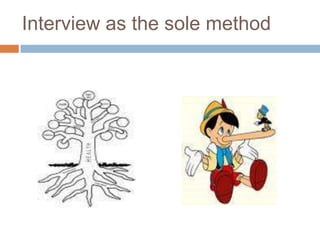
Interview as the sole method
What is a psychometric
assessment?
Tests, exercises or questionnaires, designed by
psychologists, which measure
cognitive, behavioral and personality
constructs of an individual
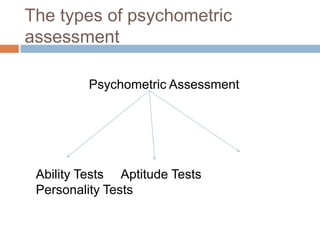
The types of psychometric
assessment
Psychometric Assessment
Ability Tests Aptitude Tests
Personality Tests
Ability Testing…
 Measures a persons potential
 Focus is on potential
 Ability tests composes of
numerical, verbal, and spatial ability scales
brought together
 Numerical reasoning, numerical
analysis, numerical estimation, verbal
reasoning, verbal analysis, verbal
application, verbal evaluation, data
interpretation, verbal comprehension, visual
estimation
Aptitude Testing…
 Aptitude refers to specific ability
 Aptitude tests tend to be job related
Personality Testing…
 Personality can be defined as those relatively
stable and enduring aspects of an individual
which distinguishes them from other
people, making them unique, but which at the
same time permit a comparison between
individuals
PURPOSE
 Recruitment & Selection
 Personal Development
 Team Building
 Succession planning
 Organisational change
Questions asked in Personality
Testing
 How you relate to other people
 Your work style
 Your ability to deal with emotions
 Your motivation, determination, & general
outlook
 Your ability to handle stressful situations
Personality tests used in
recruitment
 16PF
 Leadership Opinion Questionnaire
 DISC Test
 EQ Test
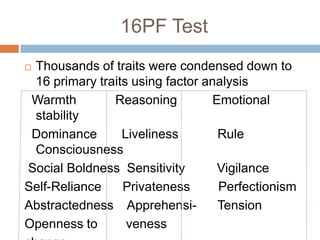
16PF Test
 Thousands of traits were condensed down to
16 primary traits using factor analysis
Warmth Reasoning Emotional
stability
Dominance Liveliness Rule
Consciousness
Social Boldness Sensitivity Vigilance
Self-Reliance Privateness Perfectionism
Abstractedness Apprehensi- Tension
Openness to veness
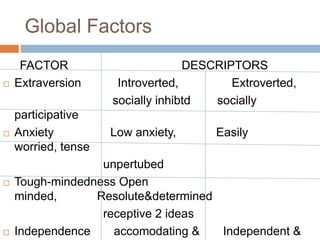
Global Factors
FACTOR DESCRIPTORS
 Extraversion Introverted, Extroverted,
socially inhibtd socially
participative
 Anxiety Low anxiety, Easily
worried, tense
unpertubed
 Tough-mindedness Open
minded, Resolute&determined
receptive 2 ideas
 Independence accomodating & Independent &
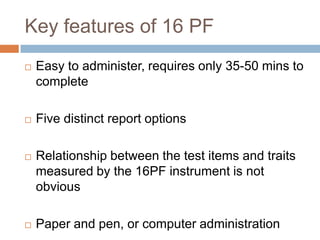
Key features of 16 PF
 Easy to administer, requires only 35-50 mins to
complete
 Five distinct report options
 Relationship between the test items and traits
measured by the 16PF instrument is not
obvious
 Paper and pen, or computer administration
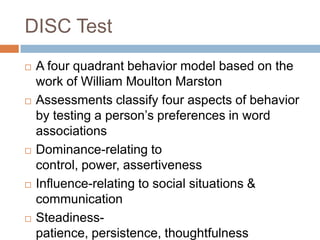
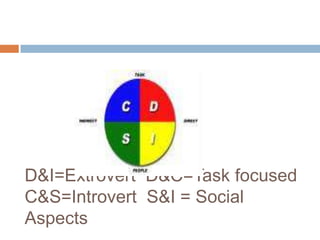
DISC Test
 A four quadrant behavior model based on the
work of William Moulton Marston
 Assessments classify four aspects of behavior
by testing a person’s preferences in word
associations
 Dominance-relating to
control, power, assertiveness
 Influence-relating to social situations &
communication
 Steadiness-
patience, persistence, thoughtfulness
D&I=Extrovert D&C=Task focused
C&S=Introvert S&I = Social
Aspects
Key features of DISC
 Each DISC consists of 24 questions with four
options
 Takes very little time to complete-10 to 20 mins
 Information thus collected is collated and 3
final graphs are made-Internal profile, External
profile, and summary profile
Leadership Opinion
Questionnaire
 A self assessment tool for managers that
provides insight into how they relate to their
supervisees on two dimensions-considerations
& structure
 Percentile scores are reported for each of the
dimensions
Emotional Quotient Test
 Self-awareness
 Emotional resilience
 Motivation
 Interpersonal sensitivity
 Influence & persuasion
 Decisiveness
 Conscientiousness & integrity
Necessities of a psychometric
test
 objective
 Standardized
 Reliable
 Predictive
 Non-discriminatory
Why use psychometric tests?
 Cost of a bad hire
 Failure of traditional techniques
 Saves time, effort, and money
 Objective and fair practice
 Better hiring decisions
 Hire the best
Benefits
 Candidate gets insight into work style and
strengths
 Adds to fairness of selection process
 Candidates can utilize feedback for
development purpose
 Great deal of accuracy about suitability
 However not a fool proof or altogether
objective method-subjective to human error in
case of interpretation
 Best method-mix of competency based
interview with psychometric test
Still…
 Expensive
 Difficult to understand
 Difficult to interpret & easy to misinterpret
A Summary
 Come out with the competencies required for
the job
 Use the psychometric tests on the existing
employees to check its validity
 The psychometric test scores of candidates
can be compared with the ideal scores
 Selected candidates can be interviewed
Assessment Centers
 Most effective tool used for assessing
individuals in both individual and group based
environments for selection or development
 Assessment Center actually refers to an
approach
 Involves participants completing a range of
exercises which simulate the activities carried
out in the target job
Assessment Centers…
 Have a pass/fail criteria
 Are geared towards filling a job vacancy
 Address an immediate organisational need
 Have fewer assessors and more participants
 Focus on what the candidate can do now
 Place emphasis on selection with little or no
development feedback and follow up
 Tend to be used with external candidates
Thank You!

Psycometric test for cbr

  • 1.
    PSYCHOMETRIC TOOLS IN COMPETENCYBASED RECRUITMENT Priti Mudgal
  • 2.
    Methods of CompetencyBased Recruitment  Competency Based Interview  Psychometric Testing  Group Discussions  Role Plays  Work simulation tests  Group exercises  Presentations  Assessment Centers
  • 3.
    “Organizations tend torecruit people for their technical skills, but fire them for their personalities”
  • 4.
    Interview as thesole method
  • 5.
    What is apsychometric assessment? Tests, exercises or questionnaires, designed by psychologists, which measure cognitive, behavioral and personality constructs of an individual
  • 6.
    The types ofpsychometric assessment Psychometric Assessment Ability Tests Aptitude Tests Personality Tests
  • 7.
    Ability Testing…  Measuresa persons potential  Focus is on potential  Ability tests composes of numerical, verbal, and spatial ability scales brought together  Numerical reasoning, numerical analysis, numerical estimation, verbal reasoning, verbal analysis, verbal application, verbal evaluation, data interpretation, verbal comprehension, visual estimation
  • 8.
    Aptitude Testing…  Aptituderefers to specific ability  Aptitude tests tend to be job related
  • 9.
    Personality Testing…  Personalitycan be defined as those relatively stable and enduring aspects of an individual which distinguishes them from other people, making them unique, but which at the same time permit a comparison between individuals
  • 10.
    PURPOSE  Recruitment &Selection  Personal Development  Team Building  Succession planning  Organisational change
  • 11.
    Questions asked inPersonality Testing  How you relate to other people  Your work style  Your ability to deal with emotions  Your motivation, determination, & general outlook  Your ability to handle stressful situations
  • 12.
    Personality tests usedin recruitment  16PF  Leadership Opinion Questionnaire  DISC Test  EQ Test
  • 13.
    16PF Test  Thousandsof traits were condensed down to 16 primary traits using factor analysis Warmth Reasoning Emotional stability Dominance Liveliness Rule Consciousness Social Boldness Sensitivity Vigilance Self-Reliance Privateness Perfectionism Abstractedness Apprehensi- Tension Openness to veness
  • 14.
    Global Factors FACTOR DESCRIPTORS Extraversion Introverted, Extroverted, socially inhibtd socially participative  Anxiety Low anxiety, Easily worried, tense unpertubed  Tough-mindedness Open minded, Resolute&determined receptive 2 ideas  Independence accomodating & Independent &
  • 15.
    Key features of16 PF  Easy to administer, requires only 35-50 mins to complete  Five distinct report options  Relationship between the test items and traits measured by the 16PF instrument is not obvious  Paper and pen, or computer administration
  • 16.
    DISC Test  Afour quadrant behavior model based on the work of William Moulton Marston  Assessments classify four aspects of behavior by testing a person’s preferences in word associations  Dominance-relating to control, power, assertiveness  Influence-relating to social situations & communication  Steadiness- patience, persistence, thoughtfulness
  • 17.
  • 18.
    Key features ofDISC  Each DISC consists of 24 questions with four options  Takes very little time to complete-10 to 20 mins  Information thus collected is collated and 3 final graphs are made-Internal profile, External profile, and summary profile
  • 19.
    Leadership Opinion Questionnaire  Aself assessment tool for managers that provides insight into how they relate to their supervisees on two dimensions-considerations & structure  Percentile scores are reported for each of the dimensions
  • 20.
    Emotional Quotient Test Self-awareness  Emotional resilience  Motivation  Interpersonal sensitivity  Influence & persuasion  Decisiveness  Conscientiousness & integrity
  • 21.
    Necessities of apsychometric test  objective  Standardized  Reliable  Predictive  Non-discriminatory
  • 22.
    Why use psychometrictests?  Cost of a bad hire  Failure of traditional techniques  Saves time, effort, and money  Objective and fair practice  Better hiring decisions  Hire the best
  • 23.
    Benefits  Candidate getsinsight into work style and strengths  Adds to fairness of selection process  Candidates can utilize feedback for development purpose  Great deal of accuracy about suitability
  • 24.
     However nota fool proof or altogether objective method-subjective to human error in case of interpretation  Best method-mix of competency based interview with psychometric test
  • 25.
    Still…  Expensive  Difficultto understand  Difficult to interpret & easy to misinterpret
  • 26.
    A Summary  Comeout with the competencies required for the job  Use the psychometric tests on the existing employees to check its validity  The psychometric test scores of candidates can be compared with the ideal scores  Selected candidates can be interviewed
  • 27.
    Assessment Centers  Mosteffective tool used for assessing individuals in both individual and group based environments for selection or development  Assessment Center actually refers to an approach  Involves participants completing a range of exercises which simulate the activities carried out in the target job
  • 28.
    Assessment Centers…  Havea pass/fail criteria  Are geared towards filling a job vacancy  Address an immediate organisational need  Have fewer assessors and more participants  Focus on what the candidate can do now  Place emphasis on selection with little or no development feedback and follow up  Tend to be used with external candidates
  • 29.