

UNDERSTANDING
PSYCHOMETRIC
TESTING
MEASURING HIDDEN TRAITS
OVERVIEW
 What is Psychometric Testing?
 Usefulness of Psychometric Testing
 Psychometric Selection Test Types
 Common Testing Tools
 Advantages & Disadvantages
 Myths/Realities
 References
WHAT IS PSYCHOMETRIC
TESTING?
 These are tests, exercises or questionnaires, designed
by psychologists, which measure cognitive, behavioral
and personality constructs of an individual.
 They are psychological measurements use to assess
knowledge, abilities, attitudes, education and
personality traits.
USEFULNESS OF PSYCHOMETRIC
TESTING
 They are used for recruitment and the selection process, alongside other assessment
methods to explore the match between the candidate and the role.
 To identify training and development needs.
 To provide information for use in coaching.
 For succession planning, to assess and develop future talent and leadership potential.
 And to profile individuals and teams to assist team selection and development such as
self-awareness, understanding and team communication.
 And in the workplace, to measure the performance and potential of current and future
employee.
PSYCHOMETRIC SELECTION TEST
TYPES
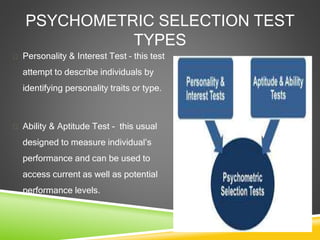
 Personality & Interest Test – this test
attempt to describe individuals by
identifying personality traits or type.
 Ability & Aptitude Test - this usual
designed to measure individual’s
performance and can be used to
access current as well as potential
performance levels.
COMMON PSYCHOMETRIC TEST
TOOLS
 Myers Briggs Type Indicator (MBTI)
 16 Personality Factors Sales Profile (16PF)
 FIRO-B
 Hogan Development Survey
 DiSC
ADVANTAGE & DISADVANTAGES
Advantages Disadvantage
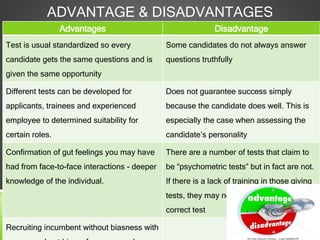
Test is usual standardized so every
candidate gets the same questions and is
given the same opportunity
Some candidates do not always answer
questions truthfully
Different tests can be developed for
applicants, trainees and experienced
employee to determined suitability for
certain roles.
Does not guarantee success simply
because the candidate does well. This is
especially the case when assessing the
candidate’s personality
Confirmation of gut feelings you may have
had from face-to-face interactions - deeper
knowledge of the individual.
There are a number of tests that claim to
be “psychometric tests” but in fact are not.
If there is a lack of training in those giving
tests, they may not give job applicants the
correct test
Recruiting incumbent without biasness with
MYTHS/REALITIES
MYTHS/REALITIES
Myths Realities
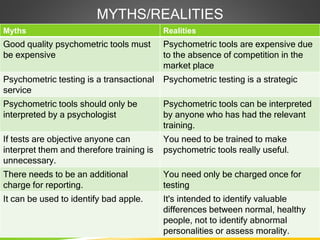
Good quality psychometric tools must
be expensive
Psychometric tools are expensive due
to the absence of competition in the
market place
Psychometric testing is a transactional
service
Psychometric testing is a strategic
Psychometric tools should only be
interpreted by a psychologist
Psychometric tools can be interpreted
by anyone who has had the relevant
training.
If tests are objective anyone can
interpret them and therefore training is
unnecessary.
You need to be trained to make
psychometric tools really useful.
There needs to be an additional
charge for reporting.
You need only be charged once for
testing
It can be used to identify bad apple. It's intended to identify valuable
differences between normal, healthy
people, not to identify abnormal
personalities or assess morality.
REFERENCES
E-Books
LoveWorkLife. "Hiring the right person demystified: psychometrics in the digital age."
March 2014
Team Focus "Preparing for psychometric tests" September 2012
Search Engines
Google
Websites
www.personalitypathways.com/type_inventory.html
www.wikepedia.org
www.slideshare.com/Psychometric Test to Understand Behavior
Understanding psychometric testing

Understanding psychometric testing

  • 1.
  • 2.
    OVERVIEW  What isPsychometric Testing?  Usefulness of Psychometric Testing  Psychometric Selection Test Types  Common Testing Tools  Advantages & Disadvantages  Myths/Realities  References
  • 3.
    WHAT IS PSYCHOMETRIC TESTING? These are tests, exercises or questionnaires, designed by psychologists, which measure cognitive, behavioral and personality constructs of an individual.  They are psychological measurements use to assess knowledge, abilities, attitudes, education and personality traits.
  • 4.
    USEFULNESS OF PSYCHOMETRIC TESTING They are used for recruitment and the selection process, alongside other assessment methods to explore the match between the candidate and the role.  To identify training and development needs.  To provide information for use in coaching.  For succession planning, to assess and develop future talent and leadership potential.  And to profile individuals and teams to assist team selection and development such as self-awareness, understanding and team communication.  And in the workplace, to measure the performance and potential of current and future employee.
  • 5.
    PSYCHOMETRIC SELECTION TEST TYPES Personality & Interest Test – this test attempt to describe individuals by identifying personality traits or type.  Ability & Aptitude Test - this usual designed to measure individual’s performance and can be used to access current as well as potential performance levels.
  • 6.
    COMMON PSYCHOMETRIC TEST TOOLS Myers Briggs Type Indicator (MBTI)  16 Personality Factors Sales Profile (16PF)  FIRO-B  Hogan Development Survey  DiSC
  • 7.
    ADVANTAGE & DISADVANTAGES AdvantagesDisadvantage Test is usual standardized so every candidate gets the same questions and is given the same opportunity Some candidates do not always answer questions truthfully Different tests can be developed for applicants, trainees and experienced employee to determined suitability for certain roles. Does not guarantee success simply because the candidate does well. This is especially the case when assessing the candidate’s personality Confirmation of gut feelings you may have had from face-to-face interactions - deeper knowledge of the individual. There are a number of tests that claim to be “psychometric tests” but in fact are not. If there is a lack of training in those giving tests, they may not give job applicants the correct test Recruiting incumbent without biasness with
  • 8.
  • 9.
    MYTHS/REALITIES Myths Realities Good qualitypsychometric tools must be expensive Psychometric tools are expensive due to the absence of competition in the market place Psychometric testing is a transactional service Psychometric testing is a strategic Psychometric tools should only be interpreted by a psychologist Psychometric tools can be interpreted by anyone who has had the relevant training. If tests are objective anyone can interpret them and therefore training is unnecessary. You need to be trained to make psychometric tools really useful. There needs to be an additional charge for reporting. You need only be charged once for testing It can be used to identify bad apple. It's intended to identify valuable differences between normal, healthy people, not to identify abnormal personalities or assess morality.
  • 10.
    REFERENCES E-Books LoveWorkLife. "Hiring theright person demystified: psychometrics in the digital age." March 2014 Team Focus "Preparing for psychometric tests" September 2012 Search Engines Google Websites www.personalitypathways.com/type_inventory.html www.wikepedia.org www.slideshare.com/Psychometric Test to Understand Behavior

Editor's Notes

  • #7 MBTI :assessment is a psychometric questionnaire designed to measure psychological preferences in how people perceive the world and make decisions. FIRO-B : “Fundamental Interpersonal Relations Orientation, this is based on the theory that when people get together in a group , there are three main interpersonal needs they are looking to obtain - affection/openness, control and inclusion.