Psychological Aging:  The effects of cognitive, social & personality development. By Wendy Scott
Abstract The psychological theories of aging can be quite complex, it depends on ones personality, the way a person adapts to old age and a persons mental state. Age alone does not always define a person. Those who usually adapt well during the aging process are open to new experiences, flexible in thinking, creative and empathetic.  In addition they believe in themselves, have a good social support system, pay attention to their health and have a sense of adventure.
Overview   Introduction Life span Selective optimization with compensation Socioemotional selectivity Cognition & aging Personality and aging Ulyssean approaches
Introduction During an individuals life span several changes in behavior will occur therefore there is no defining psychology of aging theory as everyone’s experience will vary. For those who are less fortunate pathological changes in personality and cognition may occur. There is of course the ideal thought that one can continue the journey by living a Ulyssean type lifestyle, this may be harder for those with pathological changes but these individuals may also benefit the most from this approach.  During the presentation I will briefly explain each theory and how it may influence the aging process.
Psychological Theories of Aging Life span:  The second half of life is characterized by significant individual differentiation, multidirectionality, and intraindividual plasticity Selective optimization:  A model of psychological and behavior adaptation with compensation identifying three fundamental mechanisms for managing adaptive development in later life Socioemotional selectivity:  Describes individual choices in interaction, based on self-interested need for emotional closeness that leads to selective interactions Cognition and aging:  Distal determinant Factors that affect cognition reside outside the individual, for example, in the social and cultural environment Proximal determinant Specific individual differences are the cause of cognitive change Personality and aging:  Theories that focus on the extent and nature of personality stability and change over time Bonder, Bette; Bello-Haas, Vanina Dal, Jan ,2009, Functional Performance in Older Adults.
Life Span Development Theory Social & psychological forces throughout ones life course such as  individual dynamics, transitions, social context, cultural meanings and social structural location will each contribute to ones life span.  Life-Span Development Theory: Baltes & Smith identify three principles:  1) Evolutionary selection benefits decrease with age  2) the need for culture increases with age, and  3) the efficacy of culture decrease with age.  “ Their focus is on how these dynamics contribute to the optimal expression of human development and the production of outcomes of adaptive fitness”. They “also postulate that a condition of loss, limitation, or deficit could play a catalytic role for positive change”. ( Bonder, B., Bello-Haas, Vanina Dal, Jan ,2009)
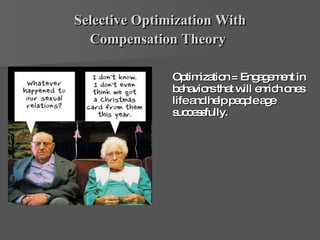
Selective Optimization With Compensation Theory   Optimization = Engagement in behaviors that will enrich ones life and help people age successfully.
Socioemotional Selectivity Theory The theory that social exchanges and interactions are reduced over time.  As one ages a person may become more selective with whom they choose to spend their time with. Emotional closeness may become more important with significant others. The idea to which one can selectively choose with whom they want to dedicate their time for becomes more important as ones ages. * (quality verses quantity)
Cognitive and Aging Theories “The theory of cognition is the age-related decline in fluid cognitive performance (the efficiency or effectiveness of performing tasks of learning, memory, reasoning and spatial abilities.) However, crystallized abilities are more stable across the life span and may even increase with age. (Representing social cultural influences on general world knowledge)”. (Bonder, 2009)
Personality & Aging Theories Theories focus on the nature and extent of personality stability and how they change over a persons life span.  Developmental Explanations and Personality Trait Explanations based on the “big five”:  1) neuroticism  2) extroversion  3) openness to experience  4) agreeableness  5) conscientiousness  Many believe that personality traits are more stable later in life whereas “goals, values, coping styles and control beliefs” are more that likely to change. (Bonder, 2009)
Ulyssean Approaches Play time! The importance of play throughout life.  Why do we play?  WARNING This video may give you a temptation for a better life .   PLAY
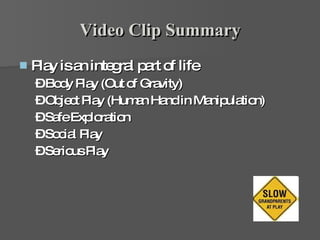
Video Clip Summary Play is an integral part of life Body Play (Out of Gravity) Object Play (Human Hand in Manipulation) Safe Exploration Social Play Serious Play
Three dimensional play can help memory, there is a connection between psychological play and well being. Play is now being used in care facilities. Ex. Nintendo Wii Game.  Non-Players – Do not come out & die (flee & hide) Players – Explore environment and begin to try new things.  As stated in the recommended video attached play may be pretty important to our survival.  Video Clip Summary:  From play to innovation
Summary Psychological changes will vary as will the way an individual adapts and develops the skills needed to enjoy life to the fullest. Some may develop mental health disorders however it is how these individuals cope and move forward that will determine how successfully they age. The Ulsyssean lifestyle is ideal not only to those who have no mental health issues but especially important to those who have developed some form of mental health barrier. Having a positive outlook and seeking positive social support systems will help during the aging process.
Additional Resources To look at when you have extra time: The eight irresistible principles of fun: Video Format:  Eight Principles - Play Video
References Bette R., Bello-Haas, Vanina Dal (2009).  Functional Performance in Older Adults.  Retrieved May, 21, 2010 from  http://www.viu.ca   The eight irresistible principles of fun  (2010). Retrieved May, 24, from:  http://www.eightprinciples.com/ Stuart Brown says play is more than fun  (2008). Retrieved May, 20,   from:   http://www.ted.com/talks/stuart_brown_says_ play_is_more_ than_fun_it_s_vital.html McGuire, F., Boyd, R., Tedrick, R., (2004)  Leisure And Aging.  Sagamore Publishing.

Psychological Aging Presentation

  • 1.
    Psychological Aging: The effects of cognitive, social & personality development. By Wendy Scott
  • 2.
    Abstract The psychologicaltheories of aging can be quite complex, it depends on ones personality, the way a person adapts to old age and a persons mental state. Age alone does not always define a person. Those who usually adapt well during the aging process are open to new experiences, flexible in thinking, creative and empathetic. In addition they believe in themselves, have a good social support system, pay attention to their health and have a sense of adventure.
  • 3.
    Overview Introduction Life span Selective optimization with compensation Socioemotional selectivity Cognition & aging Personality and aging Ulyssean approaches
  • 4.
    Introduction During anindividuals life span several changes in behavior will occur therefore there is no defining psychology of aging theory as everyone’s experience will vary. For those who are less fortunate pathological changes in personality and cognition may occur. There is of course the ideal thought that one can continue the journey by living a Ulyssean type lifestyle, this may be harder for those with pathological changes but these individuals may also benefit the most from this approach. During the presentation I will briefly explain each theory and how it may influence the aging process.
  • 5.
    Psychological Theories ofAging Life span: The second half of life is characterized by significant individual differentiation, multidirectionality, and intraindividual plasticity Selective optimization: A model of psychological and behavior adaptation with compensation identifying three fundamental mechanisms for managing adaptive development in later life Socioemotional selectivity: Describes individual choices in interaction, based on self-interested need for emotional closeness that leads to selective interactions Cognition and aging: Distal determinant Factors that affect cognition reside outside the individual, for example, in the social and cultural environment Proximal determinant Specific individual differences are the cause of cognitive change Personality and aging: Theories that focus on the extent and nature of personality stability and change over time Bonder, Bette; Bello-Haas, Vanina Dal, Jan ,2009, Functional Performance in Older Adults.
  • 6.
    Life Span DevelopmentTheory Social & psychological forces throughout ones life course such as individual dynamics, transitions, social context, cultural meanings and social structural location will each contribute to ones life span. Life-Span Development Theory: Baltes & Smith identify three principles: 1) Evolutionary selection benefits decrease with age 2) the need for culture increases with age, and 3) the efficacy of culture decrease with age. “ Their focus is on how these dynamics contribute to the optimal expression of human development and the production of outcomes of adaptive fitness”. They “also postulate that a condition of loss, limitation, or deficit could play a catalytic role for positive change”. ( Bonder, B., Bello-Haas, Vanina Dal, Jan ,2009)
  • 7.
    Selective Optimization WithCompensation Theory Optimization = Engagement in behaviors that will enrich ones life and help people age successfully.
  • 8.
    Socioemotional Selectivity TheoryThe theory that social exchanges and interactions are reduced over time. As one ages a person may become more selective with whom they choose to spend their time with. Emotional closeness may become more important with significant others. The idea to which one can selectively choose with whom they want to dedicate their time for becomes more important as ones ages. * (quality verses quantity)
  • 9.
    Cognitive and AgingTheories “The theory of cognition is the age-related decline in fluid cognitive performance (the efficiency or effectiveness of performing tasks of learning, memory, reasoning and spatial abilities.) However, crystallized abilities are more stable across the life span and may even increase with age. (Representing social cultural influences on general world knowledge)”. (Bonder, 2009)
  • 10.
    Personality & AgingTheories Theories focus on the nature and extent of personality stability and how they change over a persons life span. Developmental Explanations and Personality Trait Explanations based on the “big five”: 1) neuroticism 2) extroversion 3) openness to experience 4) agreeableness 5) conscientiousness Many believe that personality traits are more stable later in life whereas “goals, values, coping styles and control beliefs” are more that likely to change. (Bonder, 2009)
  • 11.
    Ulyssean Approaches Playtime! The importance of play throughout life. Why do we play? WARNING This video may give you a temptation for a better life . PLAY
  • 12.
    Video Clip SummaryPlay is an integral part of life Body Play (Out of Gravity) Object Play (Human Hand in Manipulation) Safe Exploration Social Play Serious Play
  • 13.
    Three dimensional playcan help memory, there is a connection between psychological play and well being. Play is now being used in care facilities. Ex. Nintendo Wii Game. Non-Players – Do not come out & die (flee & hide) Players – Explore environment and begin to try new things. As stated in the recommended video attached play may be pretty important to our survival. Video Clip Summary: From play to innovation
  • 14.
    Summary Psychological changeswill vary as will the way an individual adapts and develops the skills needed to enjoy life to the fullest. Some may develop mental health disorders however it is how these individuals cope and move forward that will determine how successfully they age. The Ulsyssean lifestyle is ideal not only to those who have no mental health issues but especially important to those who have developed some form of mental health barrier. Having a positive outlook and seeking positive social support systems will help during the aging process.
  • 15.
    Additional Resources Tolook at when you have extra time: The eight irresistible principles of fun: Video Format: Eight Principles - Play Video
  • 16.
    References Bette R.,Bello-Haas, Vanina Dal (2009). Functional Performance in Older Adults. Retrieved May, 21, 2010 from http://www.viu.ca The eight irresistible principles of fun (2010). Retrieved May, 24, from: http://www.eightprinciples.com/ Stuart Brown says play is more than fun (2008). Retrieved May, 20, from: http://www.ted.com/talks/stuart_brown_says_ play_is_more_ than_fun_it_s_vital.html McGuire, F., Boyd, R., Tedrick, R., (2004) Leisure And Aging. Sagamore Publishing.

Editor's Notes

  • #11 Developmental Tasks were briefly discussed in our text book “the notion of maturity, a state of being that is needed to meet the psychological tasks of adulthood”. The text outlines the characteristics of maturity: Extended sense of self, concern for others, participation in different dimensions of outside environment. Ability to relate warmly to others: bonds of intimacy treat others with sensitivity. Self acceptance combined with a sense of emotional security. The ability to show tolerance to frustration. Having an accurate representation of reality and being able to act accordingly. The ability to develop meaningful goals while working to reach them combined with a unifying philosophy on life. (McGuire, A., Boyd, R., Tedrick, R., 2004)
  • #12 Play time can help reduce the risk of disease and depression