TERMS
• Elderly- 60years and above
• Old- 80 years and above
• Young old - Upto age of 75 yrs biological function in comparable to
adult person.
• Upto age of 85 yrs biological function has declined significantly.
• Very old - over age of 85 yrs and requires the help of care givers.
3.
• Biologically: Agingbegins at least as early as puberty and is
continuous process throughout adult life.
• Socially: Members of society who are perceived as being old vary
with the cultural setting and from generation to generation.
• Economically: Defined in terms of retirement from the work-force.
• Chronologically: As an indicator of expected residual life span.
4.
NORMAL AGING PROCESS
•Aging, the normal process of time-related change, begins with birth
and continues throughout life. It is progressive, ubiquitous and
inevitable to all living things.
• Normal aging and diseases
associated with aging are two
separate entities. Some of the
diseases that are associated with
aging such as decreased bone mass,
osteoarthritis, cataracts, etc.
5.
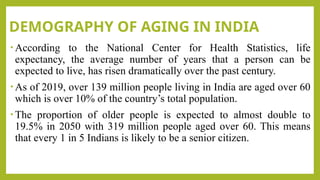
DEMOGRAPHY OF AGINGIN INDIA
• According to the National Center for Health Statistics, life
expectancy, the average number of years that a person can be
expected to live, has risen dramatically over the past century.
• As of 2019, over 139 million people living in India are aged over 60
which is over 10% of the country’s total population.
• The proportion of older people is expected to almost double to
19.5% in 2050 with 319 million people aged over 60. This means
that every 1 in 5 Indians is likely to be a senior citizen.
6.
CONCEPTS OF AGING
•The term “geras” meaning old age & “iatro” means medical
treatment.
• Geriatrics - The study of old age includes the physiology,
pathology, diagnosis, and management of the diseases of older
adults.
• Gerontology – It is the study of the aging process, draws from the
biologic, psychological, and sociologic sciences within their
environment.
7.
• Geriatric nursing– It is the field of nursing that is related to the
assessment, nursing diagnosis, planning, implementation and
evaluation of older adults in all environment, including acute
intermediate and skilled care as well as within the community.
8.
AIMS OF GERIATRICNURSING
• Maintenance of health in old age by high levels of engagement and
avoidance of disease.
• Early detection & appropriate treatment of disease.
• Maintenance of maximum independence consistent with irreversible
disease and disability.
• Sympathetic care & support during terminal illness.
9.
NORMAL BIOLOGICAL AGING
•The biological changes due to ageing are clear but the mechanisms
that mediate them are unclear. Different species have different life
spans that can be explained without invoking a specific ageing
process.
• If ageing exists as a distinct process, there is a consensus that
mechanisms involved are likely to be multifactorial, environmentally
motivated and species-specific. As a result of this, there are as many
theories of aging as investigators.
10.
MYTHS AND REALITY
Mythsand stereotypes perpetuate erroneous ideas regarding aging.
Reaching age 65 dose not provide automatic entry into inactive
frailty. Infact, the onset of aging is a gradual subtle process,varying in
rate and intensity by individual.
Aging is not an abrupt change, nor is it a sure and steady
retrogression from good health to poor health.Although the number of
chronic ailments does increase as a people grow older.These ailments
do not necessary inhibit or impaire every older person. Some people
do become more frail as they get older,but many do not.
11.
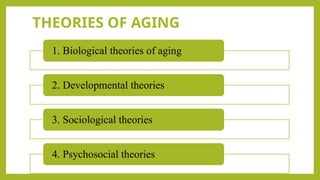
THEORIES OF AGING
1.Biological theories of aging
2. Developmental theories
3. Sociological theories
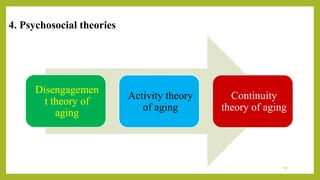
4. Psychosocial theories
12.
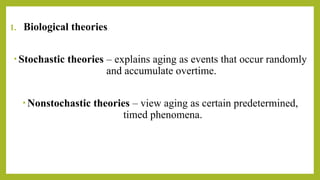
1. Biological theories
•Stochastic theories – explains aging as events that occur randomly
and accumulate overtime.
• Nonstochastic theories – view aging as certain predetermined,
timed phenomena.
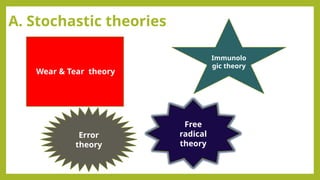
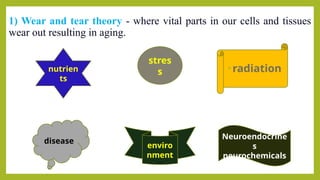
1) Wear andtear theory - where vital parts in our cells and tissues
wear out resulting in aging.
stres
s
nutrien
ts
• radiation
enviro
nment
disease
Neuroendocrine
s
neurochemicals
15.
2) Rate ofliving theory/ Error theory - that supports the theory that the
greater an organism's rate of oxygen, basal metabolism, the shorter its life
span.
3) Cross-linking theory – is a result of decrease in cellular division due
to chemical and radiation, an accumulation of cross-linked proteins
damages cells and tissues, slowing down bodily processes and thus result
in ageing.
4) Free radicals theory - which proposes that superoxide and other free
radicals cause damage to the macromolecular components of the cell,
giving rise to accumulated damage causing cells, and eventually organs,
to stop functioning.
16.
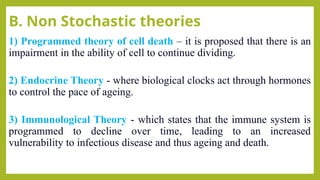
B. Non Stochastictheories
1) Programmed theory of cell death – it is proposed that there is an
impairment in the ability of cell to continue dividing.
2) Endocrine Theory - where biological clocks act through hormones
to control the pace of ageing.
3) Immunological Theory - which states that the immune system is
programmed to decline over time, leading to an increased
vulnerability to infectious disease and thus ageing and death.
17.
2. Developmental Theories– It is proposed by Erikson in 1963.
According to this theory, the person life consist of eight stages, each
representing a crucial turning point in life stretching from birth to
death.
3. Sociological Theories - According to this theory, aging attempt to
predict and explain the social interaction and roles that contribute to
successful adjustment to old age in old adults.
1) Disengagement theoryof aging
This theory states that aging people withdraw from customary roles &
engage in more introspective, self-focused activities. This theory
includes 4 basic concepts:
Aging person and society mutually withdraw from each other.
Disengagement is biologically & psychologically intrinsic &
inevitable.
Disengagement is considered necessary for successful aging.
Disengagement is beneficial for older adults and society.
20.
2) Activity Theory
Olderperson should continue a middle aged lifestyle.
Society should apply the same norms to old age.
Not advocate diminishing activity, interests and involvement as its
members grew old.
Suggests ways of maintaining activity in the presence of multiple
losses associated with the aging process.
When physical capacity is reduced, replacing the work role with
other roles.
21.
3) Continuity Theory
Relatespersonality and predisposition toward certain action.
Personality and basic patterns of behavior remain unchanged as the
individual ages.
Patterns developed over a life time will determine the individuals
activity.
Recognition of unique features of each individual allow for multiple
adaptations to aging.
It encourages the young to consider their current activities are
laying a foundation for their future old age.
22.
COGNITIVE ASPECTS OFAGING
• The natural aging process is impossible to avoid, but its effects go
beyond fine lines and wrinkles on our skin. As we age, our body
goes through a number of changes and our brain isn’t the exception.
• Our cognitive abilities tend to decline with age, which is why it is
difficult to spot signs of major cognitive issues in elderly as they
often interpreted as natural part of life. However, cognition is the
one which helps us to plan and implement activities.
23.
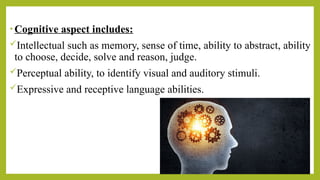
• Cognitive aspectincludes:
Intellectual such as memory, sense of time, ability to abstract, ability
to choose, decide, solve and reason, judge.
Perceptual ability, to identify visual and auditory stimuli.
Expressive and receptive language abilities.
24.
What Is CognitiveImpairment In The Elderly?
• Cognitive impairment in the elderly has a number of causes ranging
from medication side effects to depression and neurodegenerative
disorders.
• Cognitive impairment in the elderly has a number of signs and
symptoms. Learning to recognize them allows you to address these
problems effectively and prevent or delay more severe problems. It
is important for the elderly to consult a healthcare provider when
they experience symptoms of cognitive decline and adhere to
doctor’s instructions. Here are 10 symptoms to remember:
25.
1. Decreased ProcessingSpeed
2. Problems With Attention
3. Memory Problems
4. Difficulty Finding “Right Words” To Express Oneself
5. Losing Things
6. Losing Train Of Thought
7. Social Withdrawal
8. Getting Easily Overwhelmed When Making Decisions
9. Missing Social Engagements and Appointments
10. Difficulty Accepting Change
26.
PSYCHOLOGICAL ASPECTS OFAGEING
• Psychosocial theories focus on behavior and attitude changes that
accompany advancing age, as opposed to the implications of
anatomic deterioration. For this purpose, the sociological or non-
physical changes are combined with the psychological changes.
Each individual, young, middle-aged, or old is unique and
experiences a multitude of events throughout a life.
27.
• During thelast 40 years, several theories have been put fourth to
describe how attitudes and behavior in the early phase of life has
affected the individuals ability to adapt the aging process. This is
called the process of “successful aging”.
• Each aspect of this interactive process is important for the full
functioning of the concept of successful aging. Key to successful
aging is the lifestyle of the individual although it is never too late to
develop a healthy life style.
28.
AGE RELATED BODYSYSTEM CHANGES
Physical changes related to “Normal” aging ARE NOT DISEASE.
Changes occur in most of the body systems, include:
Physical appearance
Sensory system
Nervous system
Musculoskeletal system
Gastrointestinal system
• Cardiovascular system
Respiratory system
Renal
Reproductive system
Immune system
Personality changes
Social changes
29.
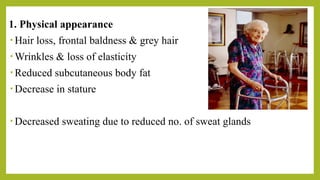
1. Physical appearance
•Hair loss, frontal baldness & grey hair
• Wrinkles & loss of elasticity
• Reduced subcutaneous body fat
• Decrease in stature
• Decreased sweating due to reduced no. of sweat glands
30.
2. CNS Reductionin: nerve cells, cerebral blood flow & metabolism.
• Slower reflexes, delayed responses & changes in balance (increased
risk falls)
• Changes in sleep pattern (stages: III & IV)
• Cell and fibre loss ↑
• Neuro-axonal degeneration ↑
• Central conduction ↓
• Catecholamine synthesis ↓
• Catecholamine disposal ↑
31.
3. Musculoskeletal system
•Decreased height & Decreased ROM joints
• Increased postural sway/ difficulty in balance
• Shrinking vertebral discs, slight kyphosis
• Loss of bone mineral & mass, bones become more brittle (increased
resorption)
• Tendons shrink and harden
• Muscle atrophy/decreased lean body mass
• Joint degeneration
• Common problems: Osteoporosis, Osteoarthritis, Cervico-lumbar
spondylosis
32.
4. Special senses
•Diminished ability to focus on close objects; inability to tolerate
glare; difficulty adjusting to changes of light intensity; decreased
ability to distinguish colors
• Tears more easily.
• Decreased ability to hear high-frequency sounds; tympanic
membrane thinning, high tone deafness
• Reduced taste and smell
• Perspires less.
6. Respiratory system
•Reduced respiratory activity, vital capacity, gas exchange
• Increased rigidity of thoracic cage
• Increased antero-posterior diameter of chest
• Reduced cilia
• Increase in residual lung volume
• Less lung expansion
• Decreased cough efficiency
36.
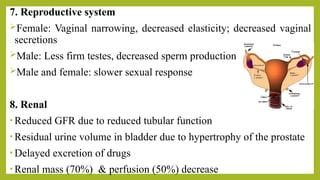
7. Reproductive system
Female:Vaginal narrowing, decreased elasticity; decreased vaginal
secretions
Male: Less firm testes, decreased sperm production
Male and female: slower sexual response
8. Renal
• Reduced GFR due to reduced tubular function
• Residual urine volume in bladder due to hypertrophy of the prostate
• Delayed excretion of drugs
• Renal mass (70%) & perfusion (50%) decrease
37.
9. Vascular system
•Systolic HTN due to rigidity or arteriosclerosis of vessels
• Impaired autonomic function and rigidity of arteries
10. Immune system
• Depressed immune response
• Decreased fever response
• Thymus gland shrinks, T-cell activity declines
• Decline in cell-mediated immunity
• Increased risk for infection, cancer
• Potential for reactivation of dormant varicella-zoster & TB
38.
8. Personality changes
•Personality change in mid life and old age
Loose their intelligence and competence
Difficulty in doing task that involved speed
• Psychological issues in old age
Life satisfaction
Loneliness
Adjustment and well-being
Cognitive changes
39.
9. Social changes
•Bereavement/Widowhood
• Retirement
• Loss of social status
• Agism and generation
• Changes in family and living arrangements
• Older people lives alone