At the end
of the
Road
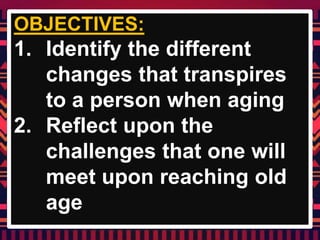
OBJECTIVES:
1. Identify the different
changes that transpires
to a person when aging
2. Reflect upon the
challenges that one will
meet upon reaching old
age
Essential
Question:
How does the
quality of one’s life
reflected in old
age?
Activity 1:
Better Days

Activity 2:
Meet
MARTINA
Martina Delos Santos-Casten
 November 11,1933
 A native of Batanes
 Widow
 2 Children
 Will be turning 85 this Nov. 11
 A former purchaser of Liana’s
Supermarket
 Graduate of Stenography at
Underwood College, Recto Ave.,
Manila
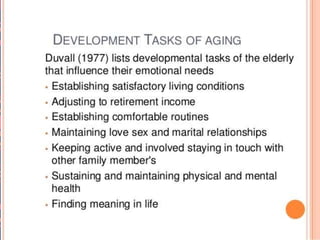
Developmental
Tasks in Old
Age
Carlos
Sampayan
Bulosan
Physical
Changes 
•During late adulthood the skin continues
to lose elasticity, reaction time slows
further, muscle strength and mobility
diminishes, hearing and vision decline, and
the immune system weakens.
•The aging process generally results in
changes and lower functioning in the brain,
leading to problems like decreased
intellectual function and neurodegenerative
diseases such as Alzheimer’s.
•Many of the changes in the bodies
and minds of older adults are due in
part to a reduction in the size of the
brain as well as loss of brain plasticity.
•Memory degenerates in old age, so
older adults have a harder time
remembering and attending to
information. In general, an older
person’s procedural memory tends to
remain stable, while working memory
declines.
•cerebellum: Part of the hindbrain in
vertebrates; in humans it lies between
the brainstem and the cerebrum and
plays an important role in sensory
perception, motor output, balance,
and posture.
•Alzheimer’s disease: A disorder
involving loss of mental functions
resulting from brain-tissue changes; a
form of senile dementia.
•corpus callosum: In mammals,
a broad band of nerve fibers
that connects the left and right
hemispheres of the brain.
•neurodegenerative: Of,
pertaining to, or resulting in the
progressive loss of nerve cells
and of neurologic function.
Senile Dementia in old age is
characterized by memory loss,
forgetfulness, disorientation of
time and place, a decline in the
ability to think, impaired attention,
altered personality, and difficulties
in relating to others. Dementia has
many causes, some treatable,
some not.
Change in
Motor Abilities
Physical strength declines
about 1% per year through
adulthood. About 31% of
American adults are obese.
Good health in younger years
carries over to adulthood.
Eating habits and exercise
influence the patterns of health
and disease
About 35% of elderly have one
chronic disease (a permanent
disability, as opposed to acute or
temporary). The four most
prevalent chronic diseases are
heart disease, hypertension,
diabetes, arthritis. The major
cause of death among the old are
heart disease, cancer, and strokes
Some elderly are no longer
able to take care of
themselves and might move
in with relatives. Only about
4% of people 65 and older
live in a nursing home.
Nursing homes often have
inadequate facilities.
Change in
Mental Abilities
The aging process generally results in
changes and lower functioning in the
brain, leading to problems like
memory loss and decreased
intellectual function. Age is a major
risk factor for most common
neurodegenerative diseases,
including mild cognitive impairment,
Alzheimer’s disease, cerebrovascular
disease, Parkinson’s disease, and Lou
Gehrig’s disease.
Brain plasticity is the brain’s
ability to change structure and
function. The brain’s main
function is to decide what
information is worth keeping
and what is not; if there is an
action or a thought that a
person is not using, the brain
will eliminate space for it.
Brain size and composition change along with
brain function. Computed tomography (CT)
studies have found that the cerebral ventricles
expand as a function of age in a process
known as ventriculomegaly. More recent MRI
studies have reported age-related regional
decreases in cerebral volume. The brain
begins to lose neurons in later adult years;
the loss of neurons within the cerebral cortex
occurs at different rates, with some areas
losing neurons more quickly than others.
The frontal lobe (which is responsible
for the integration of information,
judgement, and reflective thought)
and corpus callosum tend to lose
neurons faster than other areas, such
as the temporal and occipital lobes.
The cerebellum, which is responsible
for balance and coordination,
eventually loses about 25 percent of
its neurons as well.
Adjustment to
Retirement
The frontal lobe (which is responsible
for the integration of information,
judgement, and reflective thought)
and corpus callosum tend to lose
neurons faster than other areas, such
as the temporal and occipital lobes.
The cerebellum, which is responsible
for balance and coordination,
eventually loses about 25 percent of
its neurons as well.
"Losses" after Retirement
 stable income
 freedom in spending
 career identity and job satisfaction
 sense of belonging to the career or organization
 opportunities to socialize with co-workers
 daily routine and regular working hours
 personal working space
 direct involvement in societal changes and opportunities to acquire new knowledge as well as
working skills
 self-worth and sense of value from one's contribution to the society
Word: hazy
(adjective)
Sentence:
The sun was hazy
during the cloudy
day.
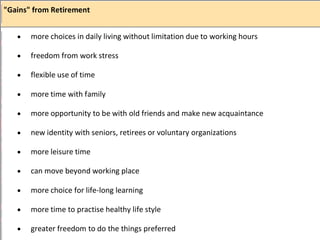
"Gains" from Retirement
 more choices in daily living without limitation due to working hours
 freedom from work stress
 flexible use of time
 more time with family
 more opportunity to be with old friends and make new acquaintance
 new identity with seniors, retirees or voluntary organizations
 more leisure time
 can move beyond working place
 more choice for life-long learning
 more time to practise healthy life style
 greater freedom to do the things preferred
Adjustments to
Loss of Spouse
1. Loss of
Independence
Couples that are frail or ill may
have been able to maintain
their independence together by
compensating for one another.
A wife with limited mobility may
rely on her husband to help her
get up and down the stairs or
carry items, such as groceries.
She in return could be covering
for his memory loss by prompting
him to take his medication, pay
bills or providing directions in the
car. In these cases, when an
elderly person loses their spouse,
their inability to manage daily
tasks on their own becomes
apparent and they are no longer
able to manage on their own.
2. New
Responsibilities
Even for those seniors who are in good
health, there will likely be many new and
overwhelming tasks to learn. Many elderly
couples have set roles within their marriage,
where one spouse is solely responsible for a
certain job. For example, many husbands
have never been required to prepare a meal or
wash their clothes and consequently may
struggle with domestic chores. Or, if the
responsibility of paying bills and managing
funds fell to her husband, a widow may feel at
a loss when faced with financial decisions.
3. Isolation
If they were living independently, as
opposed to in an assisted living facility, the
surviving spouse is now alone. Often, older
couples are always together and therefore
don’t feel the need to develop a wider social
network. The loss of their life-long
companion is felt in every aspect of their day
as well as having to sleep alone, often for
the first time in decades. Meals, routines and
outings such as afternoon walks may get
neglected causing the surviving spouse to
get stuck in continuing cycle of depression.
Socio-emotional
Development
•As people age, they become more
dependent on others. Older adults may
struggle with feelings of guilt, shame, or
depression because of their increased
dependency, especially in societies where
the elderly are viewed as a burden.
•Many older adults contend with feelings of
loneliness and isolation as their loved ones
pass away, which can negatively impact
their health and well-being. Staying active
and involved in life can help to counteract
these challenges.
•According to Erikson, the final stage of life is
marked by a crisis over integrity vs. despair.
People who believe they have had a positive
impact on the world feel a sense of integrity,
while those who feel they have not
measured up to certain standards develop a
sense of despair.
•According to Elisabeth Kübler-Ross, people
go through five distinct stages of grief upon
dealing with death and dying: denial, anger,
bargaining, depression, and acceptance.
Change in Life
Situation
In late adulthood transitions are often
negative with reduced responsibilities
and isolation. About 43% of women and
15% of men are widowed. By the age of
75, nearly 22% and 60% of women are
alone. The symptoms of depression are
very common in older adults,
Symptoms include feelings of
worthlessness, extreme sadness,
inability to concentrate, and thoughts
of death and suicide
Change in
Sexual
Activity
The majority of people over the age of
65 continue to be interested in sex.
“Sexy young people mature in to sexy
middle aged and mature people. The
best predictor of future behavior is
past behavior. Older adults might not
engage in sexual activity because of
poor health or the death of a spouse
not due to lack of interest.
Cohabitation
in Old Age 
Adjustment to
Singlehood 
Loneliness
and
Connection
As we get older, socioemotional selectivity theory
suggests that our social support and friendships
dwindle in number, but remain as close as, if not
closer than, in our earlier years (Carstensen,
1992). Many older adults contend with feelings of
loneliness as their loves ones, partners, or
friends pass away or as their children or other
family members move away and live their own
lives. Loneliness and isolation can have
detrimental effects on health and psychological
well-being. However, many adults counteract
loneliness by having active social lives, living in
retirement communities, or participating in
positive hobbies.
Integrity
vs.
Despair
As people enter the final stages of life, they
have what Erik Erikson described as a crisis
over integrity versus despair. In other words,
they review the events of their lives and try
to come to terms with the mark (or lack
thereof) that they have made on the world.
People who believe they have had a positive
impact on the world through their
contributions live the end of life with a sense
of integrity. Those who feel they have not
measured up to certain standards—either
their own or others’—develop a sense of
despair.
Confronting
Death
•Denial: People believe there must be some
mistake. They pretend death isn’t
happening, perhaps live life as if nothing is
wrong, or even tell people things are fine.
Underneath this facade, however, is a great
deal of fear and other emotions.
•Anger: After people start to realize death is
imminent, they become angry. They believe
life is unfair and usually blame others
(such as a higher power or doctors) for the
state of being they are experiencing.
•Bargaining: Once anger subsides, fear
sets in again. Now, however, people
plead with life or a higher power to give
them more time, to let them accomplish
just one more goal, or for some other
request.
•Depression: The realization that death
is near sets in, and people become
extremely sad. They may isolate
themselves, contemplate suicide, or
otherwise refuse to live life. Motivation is
gone and the will to live disappears.
•Acceptance: People realize
that all forms of life, including
the self, come to an end, and
they accept that life is ending.
They make peace with others
around them, and they make
the most of the time they have
remaining.
When we die…

Life Lessons


OLD AGE HUMAN DEVELOPMENT

  • 1.
    At the end ofthe Road
  • 2.
    OBJECTIVES: 1. Identify thedifferent changes that transpires to a person when aging 2. Reflect upon the challenges that one will meet upon reaching old age
  • 3.
    Essential Question: How does the qualityof one’s life reflected in old age?
  • 4.
  • 5.
  • 8.
    Martina Delos Santos-Casten November 11,1933  A native of Batanes  Widow  2 Children  Will be turning 85 this Nov. 11  A former purchaser of Liana’s Supermarket  Graduate of Stenography at Underwood College, Recto Ave., Manila
  • 9.
  • 10.
  • 11.
  • 12.
    •During late adulthoodthe skin continues to lose elasticity, reaction time slows further, muscle strength and mobility diminishes, hearing and vision decline, and the immune system weakens. •The aging process generally results in changes and lower functioning in the brain, leading to problems like decreased intellectual function and neurodegenerative diseases such as Alzheimer’s.
  • 13.
    •Many of thechanges in the bodies and minds of older adults are due in part to a reduction in the size of the brain as well as loss of brain plasticity. •Memory degenerates in old age, so older adults have a harder time remembering and attending to information. In general, an older person’s procedural memory tends to remain stable, while working memory declines.
  • 14.
    •cerebellum: Part ofthe hindbrain in vertebrates; in humans it lies between the brainstem and the cerebrum and plays an important role in sensory perception, motor output, balance, and posture. •Alzheimer’s disease: A disorder involving loss of mental functions resulting from brain-tissue changes; a form of senile dementia.
  • 15.
    •corpus callosum: Inmammals, a broad band of nerve fibers that connects the left and right hemispheres of the brain. •neurodegenerative: Of, pertaining to, or resulting in the progressive loss of nerve cells and of neurologic function.
  • 16.
    Senile Dementia inold age is characterized by memory loss, forgetfulness, disorientation of time and place, a decline in the ability to think, impaired attention, altered personality, and difficulties in relating to others. Dementia has many causes, some treatable, some not.
  • 17.
  • 18.
    Physical strength declines about1% per year through adulthood. About 31% of American adults are obese. Good health in younger years carries over to adulthood. Eating habits and exercise influence the patterns of health and disease
  • 19.
    About 35% ofelderly have one chronic disease (a permanent disability, as opposed to acute or temporary). The four most prevalent chronic diseases are heart disease, hypertension, diabetes, arthritis. The major cause of death among the old are heart disease, cancer, and strokes
  • 20.
    Some elderly areno longer able to take care of themselves and might move in with relatives. Only about 4% of people 65 and older live in a nursing home. Nursing homes often have inadequate facilities.
  • 21.
  • 22.
    The aging processgenerally results in changes and lower functioning in the brain, leading to problems like memory loss and decreased intellectual function. Age is a major risk factor for most common neurodegenerative diseases, including mild cognitive impairment, Alzheimer’s disease, cerebrovascular disease, Parkinson’s disease, and Lou Gehrig’s disease.
  • 23.
    Brain plasticity isthe brain’s ability to change structure and function. The brain’s main function is to decide what information is worth keeping and what is not; if there is an action or a thought that a person is not using, the brain will eliminate space for it.
  • 24.
    Brain size andcomposition change along with brain function. Computed tomography (CT) studies have found that the cerebral ventricles expand as a function of age in a process known as ventriculomegaly. More recent MRI studies have reported age-related regional decreases in cerebral volume. The brain begins to lose neurons in later adult years; the loss of neurons within the cerebral cortex occurs at different rates, with some areas losing neurons more quickly than others.
  • 25.
    The frontal lobe(which is responsible for the integration of information, judgement, and reflective thought) and corpus callosum tend to lose neurons faster than other areas, such as the temporal and occipital lobes. The cerebellum, which is responsible for balance and coordination, eventually loses about 25 percent of its neurons as well.
  • 26.
  • 27.
    The frontal lobe(which is responsible for the integration of information, judgement, and reflective thought) and corpus callosum tend to lose neurons faster than other areas, such as the temporal and occipital lobes. The cerebellum, which is responsible for balance and coordination, eventually loses about 25 percent of its neurons as well. "Losses" after Retirement  stable income  freedom in spending  career identity and job satisfaction  sense of belonging to the career or organization  opportunities to socialize with co-workers  daily routine and regular working hours  personal working space  direct involvement in societal changes and opportunities to acquire new knowledge as well as working skills  self-worth and sense of value from one's contribution to the society
  • 28.
    Word: hazy (adjective) Sentence: The sunwas hazy during the cloudy day. "Gains" from Retirement  more choices in daily living without limitation due to working hours  freedom from work stress  flexible use of time  more time with family  more opportunity to be with old friends and make new acquaintance  new identity with seniors, retirees or voluntary organizations  more leisure time  can move beyond working place  more choice for life-long learning  more time to practise healthy life style  greater freedom to do the things preferred
  • 29.
  • 30.
  • 31.
    Couples that arefrail or ill may have been able to maintain their independence together by compensating for one another. A wife with limited mobility may rely on her husband to help her get up and down the stairs or carry items, such as groceries.
  • 32.
    She in returncould be covering for his memory loss by prompting him to take his medication, pay bills or providing directions in the car. In these cases, when an elderly person loses their spouse, their inability to manage daily tasks on their own becomes apparent and they are no longer able to manage on their own.
  • 33.
  • 34.
    Even for thoseseniors who are in good health, there will likely be many new and overwhelming tasks to learn. Many elderly couples have set roles within their marriage, where one spouse is solely responsible for a certain job. For example, many husbands have never been required to prepare a meal or wash their clothes and consequently may struggle with domestic chores. Or, if the responsibility of paying bills and managing funds fell to her husband, a widow may feel at a loss when faced with financial decisions.
  • 35.
  • 36.
    If they wereliving independently, as opposed to in an assisted living facility, the surviving spouse is now alone. Often, older couples are always together and therefore don’t feel the need to develop a wider social network. The loss of their life-long companion is felt in every aspect of their day as well as having to sleep alone, often for the first time in decades. Meals, routines and outings such as afternoon walks may get neglected causing the surviving spouse to get stuck in continuing cycle of depression.
  • 37.
  • 38.
    •As people age,they become more dependent on others. Older adults may struggle with feelings of guilt, shame, or depression because of their increased dependency, especially in societies where the elderly are viewed as a burden. •Many older adults contend with feelings of loneliness and isolation as their loved ones pass away, which can negatively impact their health and well-being. Staying active and involved in life can help to counteract these challenges.
  • 39.
    •According to Erikson,the final stage of life is marked by a crisis over integrity vs. despair. People who believe they have had a positive impact on the world feel a sense of integrity, while those who feel they have not measured up to certain standards develop a sense of despair. •According to Elisabeth Kübler-Ross, people go through five distinct stages of grief upon dealing with death and dying: denial, anger, bargaining, depression, and acceptance.
  • 40.
  • 41.
    In late adulthoodtransitions are often negative with reduced responsibilities and isolation. About 43% of women and 15% of men are widowed. By the age of 75, nearly 22% and 60% of women are alone. The symptoms of depression are very common in older adults, Symptoms include feelings of worthlessness, extreme sadness, inability to concentrate, and thoughts of death and suicide
  • 42.
  • 43.
    The majority ofpeople over the age of 65 continue to be interested in sex. “Sexy young people mature in to sexy middle aged and mature people. The best predictor of future behavior is past behavior. Older adults might not engage in sexual activity because of poor health or the death of a spouse not due to lack of interest.
  • 44.
  • 45.
  • 46.
  • 47.
    As we getolder, socioemotional selectivity theory suggests that our social support and friendships dwindle in number, but remain as close as, if not closer than, in our earlier years (Carstensen, 1992). Many older adults contend with feelings of loneliness as their loves ones, partners, or friends pass away or as their children or other family members move away and live their own lives. Loneliness and isolation can have detrimental effects on health and psychological well-being. However, many adults counteract loneliness by having active social lives, living in retirement communities, or participating in positive hobbies.
  • 48.
  • 49.
    As people enterthe final stages of life, they have what Erik Erikson described as a crisis over integrity versus despair. In other words, they review the events of their lives and try to come to terms with the mark (or lack thereof) that they have made on the world. People who believe they have had a positive impact on the world through their contributions live the end of life with a sense of integrity. Those who feel they have not measured up to certain standards—either their own or others’—develop a sense of despair.
  • 50.
  • 51.
    •Denial: People believethere must be some mistake. They pretend death isn’t happening, perhaps live life as if nothing is wrong, or even tell people things are fine. Underneath this facade, however, is a great deal of fear and other emotions. •Anger: After people start to realize death is imminent, they become angry. They believe life is unfair and usually blame others (such as a higher power or doctors) for the state of being they are experiencing.
  • 52.
    •Bargaining: Once angersubsides, fear sets in again. Now, however, people plead with life or a higher power to give them more time, to let them accomplish just one more goal, or for some other request. •Depression: The realization that death is near sets in, and people become extremely sad. They may isolate themselves, contemplate suicide, or otherwise refuse to live life. Motivation is gone and the will to live disappears.
  • 53.
    •Acceptance: People realize thatall forms of life, including the self, come to an end, and they accept that life is ending. They make peace with others around them, and they make the most of the time they have remaining.
  • 54.
  • 55.

Editor's Notes

  • #2 Born: 8 January 1912 Died: 26 April 1966
  • #3 Born: 8 January 1912 Died: 26 April 1966
  • #4 Born: 8 January 1912 Died: 26 April 1966
  • #5 Born: 8 January 1912 Died: 26 April 1966
  • #6 Born: 8 January 1912 Died: 26 April 1966
  • #7 Born: 8 January 1912 Died: 26 April 1966
  • #8 Born: 8 January 1912 Died: 26 April 1966
  • #9 Born: 8 January 1912 Died: 26 April 1966
  • #10 Born: 8 January 1912 Died: 26 April 1966
  • #11 Born: 8 January 1912 Died: 26 April 1966
  • #12 Born: 8 January 1912 Died: 26 April 1966
  • #13 Born: 8 January 1912 Died: 26 April 1966
  • #14 Born: 8 January 1912 Died: 26 April 1966
  • #15 Born: 8 January 1912 Died: 26 April 1966
  • #16 Born: 8 January 1912 Died: 26 April 1966
  • #17 Born: 8 January 1912 Died: 26 April 1966
  • #18 Born: 8 January 1912 Died: 26 April 1966
  • #19 Born: 8 January 1912 Died: 26 April 1966
  • #20 Born: 8 January 1912 Died: 26 April 1966
  • #21 Born: 8 January 1912 Died: 26 April 1966
  • #22 Born: 8 January 1912 Died: 26 April 1966
  • #23 Born: 8 January 1912 Died: 26 April 1966
  • #24 Born: 8 January 1912 Died: 26 April 1966
  • #25 Born: 8 January 1912 Died: 26 April 1966
  • #26 Born: 8 January 1912 Died: 26 April 1966
  • #27 Born: 8 January 1912 Died: 26 April 1966
  • #28 Born: 8 January 1912 Died: 26 April 1966
  • #29 Born: 8 January 1912 Died: 26 April 1966
  • #30 Born: 8 January 1912 Died: 26 April 1966
  • #31 Born: 8 January 1912 Died: 26 April 1966
  • #32 Born: 8 January 1912 Died: 26 April 1966
  • #33 Born: 8 January 1912 Died: 26 April 1966
  • #34 Born: 8 January 1912 Died: 26 April 1966
  • #35 Born: 8 January 1912 Died: 26 April 1966
  • #36 Born: 8 January 1912 Died: 26 April 1966
  • #37 Born: 8 January 1912 Died: 26 April 1966
  • #38 Born: 8 January 1912 Died: 26 April 1966
  • #39 Born: 8 January 1912 Died: 26 April 1966
  • #40 Born: 8 January 1912 Died: 26 April 1966
  • #41 Born: 8 January 1912 Died: 26 April 1966
  • #42 Born: 8 January 1912 Died: 26 April 1966
  • #43 Born: 8 January 1912 Died: 26 April 1966
  • #44 Born: 8 January 1912 Died: 26 April 1966
  • #45 Born: 8 January 1912 Died: 26 April 1966
  • #46 Born: 8 January 1912 Died: 26 April 1966
  • #47 Born: 8 January 1912 Died: 26 April 1966
  • #48 Born: 8 January 1912 Died: 26 April 1966
  • #49 Born: 8 January 1912 Died: 26 April 1966
  • #50 Born: 8 January 1912 Died: 26 April 1966
  • #51 Born: 8 January 1912 Died: 26 April 1966
  • #52 Born: 8 January 1912 Died: 26 April 1966
  • #53 Born: 8 January 1912 Died: 26 April 1966
  • #54 Born: 8 January 1912 Died: 26 April 1966
  • #55 Born: 8 January 1912 Died: 26 April 1966
  • #56 Born: 8 January 1912 Died: 26 April 1966