Chapter 14 Socioemotional Development in Middle Adulthood
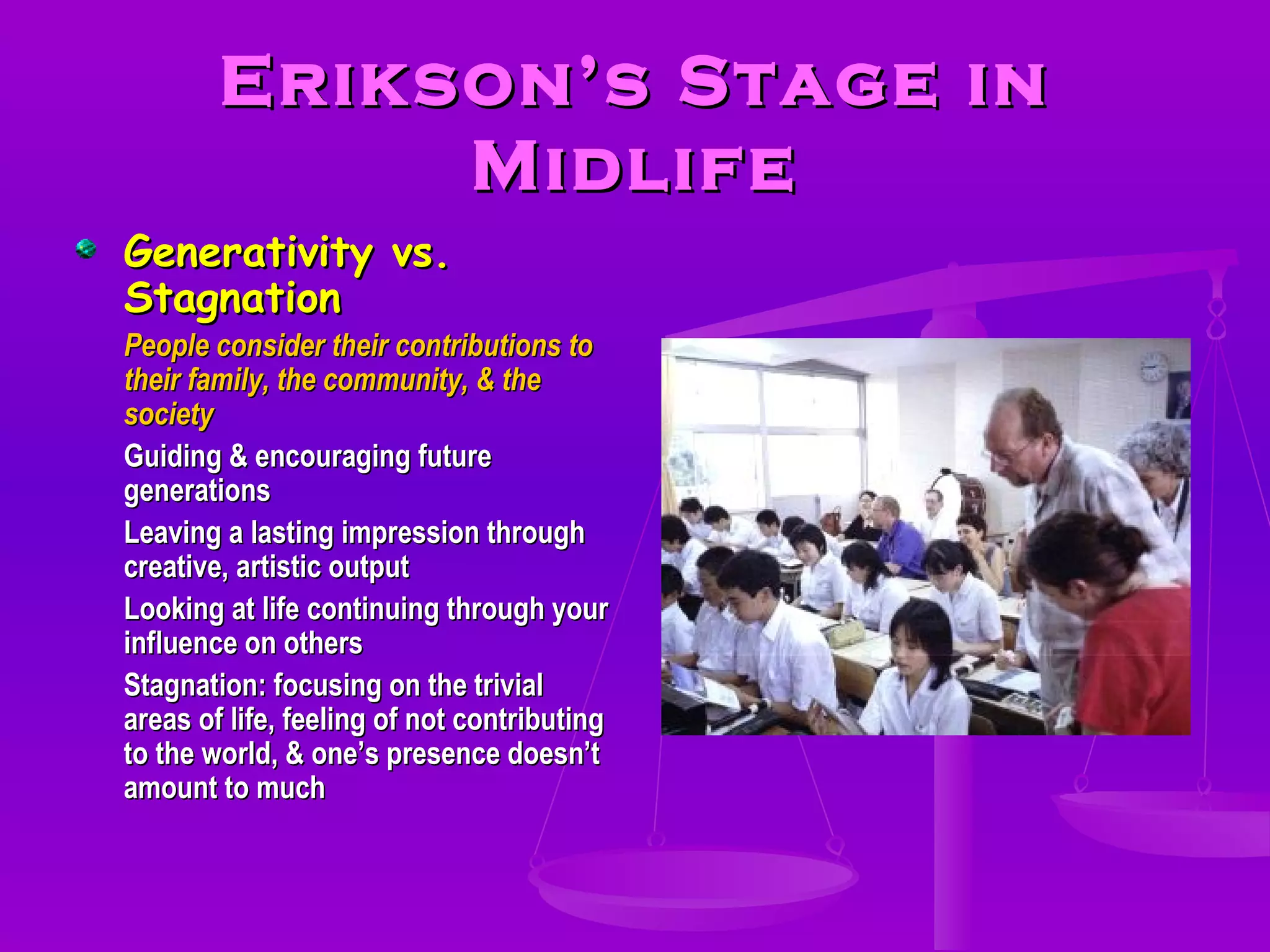
Erikson’s Stage in Midlife Generativity vs. Stagnation People consider their contributions to their family, the community, & the society Guiding & encouraging future generations Leaving a lasting impression through creative, artistic output Looking at life continuing through your influence on others Stagnation: focusing on the trivial areas of life, feeling of not contributing to the world, & one’s presence doesn’t amount to much
Other Views of Midlife Vaillant Keeping the meaning vs. rigidity Adults seek to extract the meaning from their lives by accepting the strengths & weaknesses of others The rigid become more isolated from others Gould Adults pass through 7 stages associated with specific age periods In late 30s-early 40s there’s an urgency to achieve goals & this reality propels them into adulthood Levinson Adult men pass through a series of stages beginning in early adulthood & going through midlife Early adulthood is leaving the family & pursuing the dream By late 30s, they settle down & establish themselves in career & family Between 40 & 45 is time of “midlife transition,” a time of questioning themselves & their life May lead to a “midlife crisis”
Perspectives on Adult Personality Development Normative Crisis Model Personality develops in terms of fairly universal stages, tied to a sequence of age-related crises Critics say that stage models are outdated, coming from a time when gender roles were more rigid Life Events Model The timing of a particular event in an adult’s life, rather than age per se, determine the course of personality development An event at age 21 & the same event at 39 would cause the same emotional feelings Adulthood is not a time of passivity but of continued psychological growth
The “Big Five” The Five Factor Model Paul Costa, Jr. & Robert McCrae Organizes personality traits into opposing factors and describes differences in personality using five categories. These traits have been see in cultures as widely divergent as American, German, Portuguese, Hebrew, Chinese, Korean, and Japanese. Factor  Description of Traits  Extraversion vs.  Sociable vs. Withdrawn Introversion Fun-loving vs. Sober Friendly vs. Aloof Adventurous vs. Cautious Neuroticism vs. Anxious vs. Relaxed Stability Insecure vs. Secure Emotional vs. Calm Self-pitying vs. Content Openness vs. Closed Original vs. Conventional To Experience Imaginative vs. Down-to-Earth Broad vs. Narrow Interests Open vs. Closed to New Ideas Agreeableness vs. Good-natured vs. Irritable Antagonism Soft-hearted vs. Ruthless Courteous vs. Rude Sympathetic vs. Tough-minded Conscientiousness vs. Well-organized vs. Disorderly Undirectedness Dependable vs. Undependable Hardworking vs. Lazy Ambitious vs. Easygoing
The Family in Midlife Marriage Satisfaction declines after marriage & falls to the lowest after childbirth Begins to climb after child’s teens & reaches highest when they leave See spouse as “best friend” & marriage as a long-term commitment See spouse as growing more interesting over the years Sex life, though less frequent, is more satisfying
The Family in Midlife Satisfaction keeps falling 1 in 8 women divorce after 40 Reasons: 1. Spending less time together 2. Feel more concern for personal happiness & leave the marriage 3. Divorce is more accepted now 4. Wives feel less dependent on their husbands economically & emotionally 5. Feelings of romance & passion subside 6. Stress in the household with both parents working 75%-80% remarry within 2-5 years Less than 1/3 of women over 40 remarry
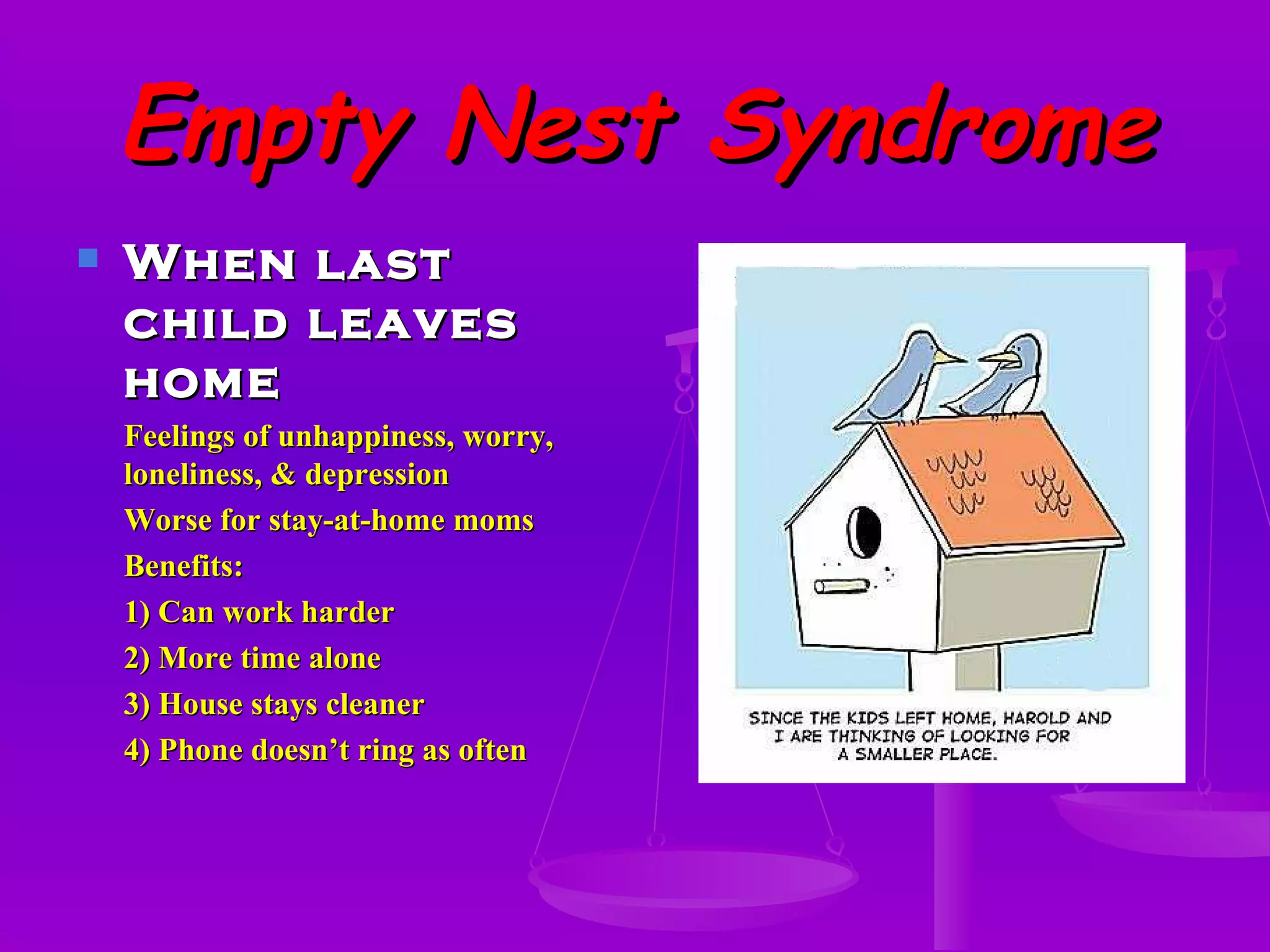
Empty Nest Syndrome When last child leaves home Feelings of unhappiness, worry, loneliness, & depression Worse for stay-at-home moms Benefits: 1) Can work harder 2) More time alone 3) House stays cleaner 4) Phone doesn’t ring as often
Boomerang Children Young adults return to live with middle age parents Reasons: 1. Unable to find work 2. Difficult to make ends meet 3. Break-up of marriage Men are more likely to come back than women Parents give sons more freedom Parents’ reactions are both + & -
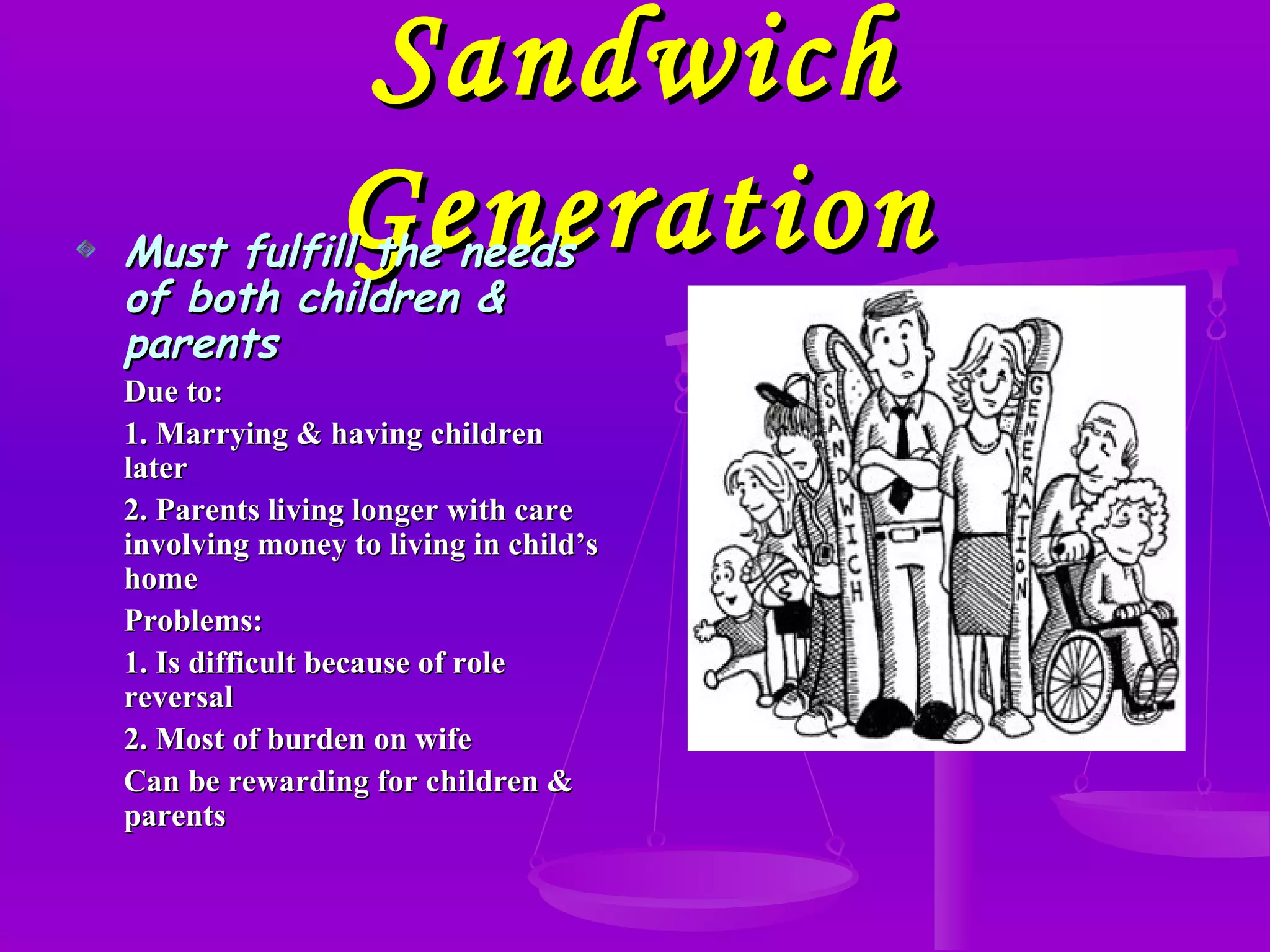
Sandwich Generation Must fulfill the needs of both children & parents Due to: 1. Marrying & having children later 2. Parents living longer with care involving money to living in child’s home Problems: 1. Is difficult because of role reversal 2. Most of burden on wife Can be rewarding for children & parents
Work & Leisure Midlife is time of highest productivity, success, & money Midlife workers care more about the here-&-now qualities of work The older the worker the more overall job satisfaction they experience Job satisfaction is not universal Burnout (experience of dissatisfaction, disillusionment, frustration, & weariness from the job) can occur “ Downsizing” can occur leaving one unemployed with ageism occurring Voluntary job change may occur Due to little satisfaction with the old job Achieved the challenges of the old job No longer enjoy what they do
Work & Leisure Middle-age adults have 70 hours a week for leisure time Average middle-age adult watches 15 hours of TV per week Spend about 6 hours a week socializing Some volunteer their time U.S., Japan, & Western Europe have fast-paced lives
Friendships   Friendships in adulthood follow 5 identifiable stages: Acquaintanceship, Buildup, Continuation, Deterioration, & Ending If a friendship ends it depends mostly on availability of alternative relationships
Friendships People tend to have more acquaintances during young adulthood than later on Friendships important because, in part, life satisfaction is highly related to the quantity & quality of friends Friendships play a major role in determining how much we enjoy life 3 broad themes that underlie adult friendships The emotional basis of the friendship Refers to self-disclosure & expressions of intimacy, appreciation, affection, & support all of which are based on trust, loyalty, & communications
Friendships The shared or communal nature of the friendship Friends participate in or support activities of mutual interest Sociability & compatibility Friends keep us entertained & are sources of amusement, fun, & recreation
Friendships Gender differences in friendships Women tend to base friendships on more intimate emotional sharing & use friendships as a means to confide in others Getting together takes the form of discussing personal matters Have much more experience with intimate sharing early in life, & are more comfortable with vulnerability Men tend to base friendships on shared activities or interests Go to sporting events or talk sports with friends Competition is often part of friendships

G & D Ch. 14

  • 1.
    Chapter 14 SocioemotionalDevelopment in Middle Adulthood
  • 2.
    Erikson’s Stage inMidlife Generativity vs. Stagnation People consider their contributions to their family, the community, & the society Guiding & encouraging future generations Leaving a lasting impression through creative, artistic output Looking at life continuing through your influence on others Stagnation: focusing on the trivial areas of life, feeling of not contributing to the world, & one’s presence doesn’t amount to much
  • 3.
    Other Views ofMidlife Vaillant Keeping the meaning vs. rigidity Adults seek to extract the meaning from their lives by accepting the strengths & weaknesses of others The rigid become more isolated from others Gould Adults pass through 7 stages associated with specific age periods In late 30s-early 40s there’s an urgency to achieve goals & this reality propels them into adulthood Levinson Adult men pass through a series of stages beginning in early adulthood & going through midlife Early adulthood is leaving the family & pursuing the dream By late 30s, they settle down & establish themselves in career & family Between 40 & 45 is time of “midlife transition,” a time of questioning themselves & their life May lead to a “midlife crisis”
  • 4.
    Perspectives on AdultPersonality Development Normative Crisis Model Personality develops in terms of fairly universal stages, tied to a sequence of age-related crises Critics say that stage models are outdated, coming from a time when gender roles were more rigid Life Events Model The timing of a particular event in an adult’s life, rather than age per se, determine the course of personality development An event at age 21 & the same event at 39 would cause the same emotional feelings Adulthood is not a time of passivity but of continued psychological growth
  • 5.
    The “Big Five”The Five Factor Model Paul Costa, Jr. & Robert McCrae Organizes personality traits into opposing factors and describes differences in personality using five categories. These traits have been see in cultures as widely divergent as American, German, Portuguese, Hebrew, Chinese, Korean, and Japanese. Factor Description of Traits  Extraversion vs. Sociable vs. Withdrawn Introversion Fun-loving vs. Sober Friendly vs. Aloof Adventurous vs. Cautious Neuroticism vs. Anxious vs. Relaxed Stability Insecure vs. Secure Emotional vs. Calm Self-pitying vs. Content Openness vs. Closed Original vs. Conventional To Experience Imaginative vs. Down-to-Earth Broad vs. Narrow Interests Open vs. Closed to New Ideas Agreeableness vs. Good-natured vs. Irritable Antagonism Soft-hearted vs. Ruthless Courteous vs. Rude Sympathetic vs. Tough-minded Conscientiousness vs. Well-organized vs. Disorderly Undirectedness Dependable vs. Undependable Hardworking vs. Lazy Ambitious vs. Easygoing
  • 6.
    The Family inMidlife Marriage Satisfaction declines after marriage & falls to the lowest after childbirth Begins to climb after child’s teens & reaches highest when they leave See spouse as “best friend” & marriage as a long-term commitment See spouse as growing more interesting over the years Sex life, though less frequent, is more satisfying
  • 7.
    The Family inMidlife Satisfaction keeps falling 1 in 8 women divorce after 40 Reasons: 1. Spending less time together 2. Feel more concern for personal happiness & leave the marriage 3. Divorce is more accepted now 4. Wives feel less dependent on their husbands economically & emotionally 5. Feelings of romance & passion subside 6. Stress in the household with both parents working 75%-80% remarry within 2-5 years Less than 1/3 of women over 40 remarry
  • 8.
    Empty Nest SyndromeWhen last child leaves home Feelings of unhappiness, worry, loneliness, & depression Worse for stay-at-home moms Benefits: 1) Can work harder 2) More time alone 3) House stays cleaner 4) Phone doesn’t ring as often
  • 9.
    Boomerang Children Youngadults return to live with middle age parents Reasons: 1. Unable to find work 2. Difficult to make ends meet 3. Break-up of marriage Men are more likely to come back than women Parents give sons more freedom Parents’ reactions are both + & -
  • 10.
    Sandwich Generation Mustfulfill the needs of both children & parents Due to: 1. Marrying & having children later 2. Parents living longer with care involving money to living in child’s home Problems: 1. Is difficult because of role reversal 2. Most of burden on wife Can be rewarding for children & parents
  • 11.
    Work & LeisureMidlife is time of highest productivity, success, & money Midlife workers care more about the here-&-now qualities of work The older the worker the more overall job satisfaction they experience Job satisfaction is not universal Burnout (experience of dissatisfaction, disillusionment, frustration, & weariness from the job) can occur “ Downsizing” can occur leaving one unemployed with ageism occurring Voluntary job change may occur Due to little satisfaction with the old job Achieved the challenges of the old job No longer enjoy what they do
  • 12.
    Work & LeisureMiddle-age adults have 70 hours a week for leisure time Average middle-age adult watches 15 hours of TV per week Spend about 6 hours a week socializing Some volunteer their time U.S., Japan, & Western Europe have fast-paced lives
  • 13.
    Friendships Friendships in adulthood follow 5 identifiable stages: Acquaintanceship, Buildup, Continuation, Deterioration, & Ending If a friendship ends it depends mostly on availability of alternative relationships
  • 14.
    Friendships People tendto have more acquaintances during young adulthood than later on Friendships important because, in part, life satisfaction is highly related to the quantity & quality of friends Friendships play a major role in determining how much we enjoy life 3 broad themes that underlie adult friendships The emotional basis of the friendship Refers to self-disclosure & expressions of intimacy, appreciation, affection, & support all of which are based on trust, loyalty, & communications
  • 15.
    Friendships The sharedor communal nature of the friendship Friends participate in or support activities of mutual interest Sociability & compatibility Friends keep us entertained & are sources of amusement, fun, & recreation
  • 16.
    Friendships Gender differencesin friendships Women tend to base friendships on more intimate emotional sharing & use friendships as a means to confide in others Getting together takes the form of discussing personal matters Have much more experience with intimate sharing early in life, & are more comfortable with vulnerability Men tend to base friendships on shared activities or interests Go to sporting events or talk sports with friends Competition is often part of friendships