SOCIAL ASPECTS OF
        AGING


Prepared by:
               Group 1
Importance:
• People communicate with one
  another all the time and not only
  with words but through various
  other means as well.
    Example:
               “We are appreciated or
               accepted by others through a
               smile, clap, or pat on the
               shoulder”
• Our social life takes into account the
  language we use, the gestures we make
  the interaction and relationships we have
  with one another.


Social aspects of life include the support we
give and concerned moves we make to help
one another especially those in distress.
The social aspects of life:
• Make us share with others
• Make us consider others as our alter ego.
• Interlink individuals
• Make us care for the needy, oppressed,
  abandoned, aged, and those who have no
  one to care for them.
• Allow us to recognize the dignity of every
  human being.
• Help us mix with everyone.
Different manifestations of
social behavior of the aging
          person
Manifestations of a socially
healthy aging person
• Happy to growing older and able to
  manage the aging syndrome with dignity
  and simplicity.
• Has a sense of humor
• Can mix with any group
• Open to share what he/she has in all
  aspect.
• Does not entertain false rumors
• Maintains good personal hygiene
•Find ways and means to be busy
•Enjoys life
•Honest about his/her feelings
•Stay connected with friends and relatives

Manifestations of a socially
unhealthy aging person
 •Cranky and cantankerous
 •Sensitive and narrow-minded
 •Quick tempered, irritated and complain
 •Cannot get along with others
 •Feeling of being neglected by everyone and
         isolates himself
 •Demands respect, attention seeker
•Neglects personal grooming, old fashioned
•Feeling of insecurity and afraid of death through
         words
•Afraid to be alone
•Greedy to grab anything you give/offer with
critical comments accompanying acceptance
OLD AGE AND THE ELDERLY HAVE A
 VARIETY OF EXPECTATIONS AND
  NAMES. . . .FEW ARE POSITIVE
    •   GEEZER        •   TWILIGHT YEARS
    •   BORING        •   EMPTY YEARS
    •   OLD BATTLE-AX •   GOLDEN YEARS
    •   USELESS       •   TIME OF OUR LIFE
    •   OUT OF TOUCH •    TIME OF LOSS
    •   SMELLY        •   TIME OF PAIN
    •   SENILE        •   DEPENDENT
    •   RESPECTED     •   DEMANDING
    •   DEMENTED      •   LOSS OF AUTONOMY
THESE CAN ALL REPRESENT ELDERLY
PEOPLE WHOM WE KNOW, BUT THEY
  DON’T REPRESENT ALL ELDERLY
• Elderly are as diverse a group as any other
  age group

• The affect of aging on each person’s life is
  dependent upon that unique individual

• some generalizations can be made about
  attitudes of aging based on a person’s cultural
  background. . . . . . .
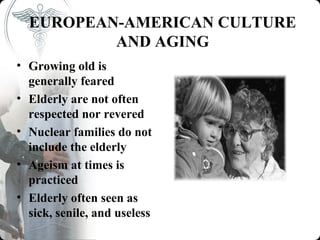
EUROPEAN-AMERICAN CULTURE
          AND AGING
• Growing old is
  generally feared
• Elderly are not often
  respected nor revered
• Nuclear families do not
  include the elderly
• Ageism at times is
  practiced
• Elderly often seen as
  sick, senile, and useless
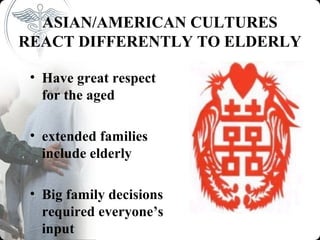
ASIAN/AMERICAN CULTURES
REACT DIFFERENTLY TO ELDERLY

 • Have great respect
   for the aged

 • extended families
   include elderly

 • Big family decisions
   required everyone’s
   input
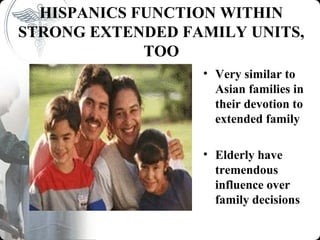
HISPANICS FUNCTION WITHIN
STRONG EXTENDED FAMILY UNITS,
             TOO
                  • Very similar to
                    Asian families in
                    their devotion to
                    extended family

                  • Elderly have
                    tremendous
                    influence over
                    family decisions
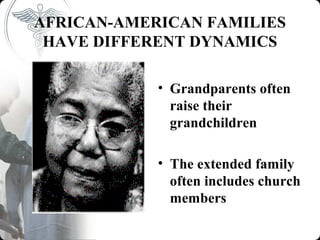
AFRICAN-AMERICAN FAMILIES
 HAVE DIFFERENT DYNAMICS

            • Grandparents often
              raise their
              grandchildren

            • The extended family
              often includes church
              members
MYTHS OF AGING

INVESTIGATING - MYTHS
THAT EXIST IN AMERICAN
       CULTURE
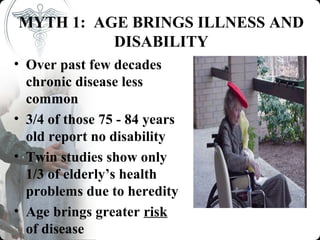
MYTH 1: AGE BRINGS ILLNESS AND
          DISABILITY
• Over past few decades
  chronic disease less
  common
• 3/4 of those 75 - 84 years
  old report no disability
• Twin studies show only
  1/3 of elderly’s health
  problems due to heredity
• Age brings greater risk
  of disease
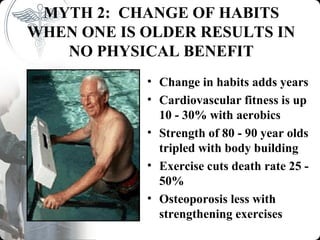
MYTH 2: CHANGE OF HABITS
WHEN ONE IS OLDER RESULTS IN
   NO PHYSICAL BENEFIT
            • Change in habits adds years
            • Cardiovascular fitness is up
              10 - 30% with aerobics
            • Strength of 80 - 90 year olds
              tripled with body building
            • Exercise cuts death rate 25 -
              50%
            • Osteoporosis less with
              strengthening exercises
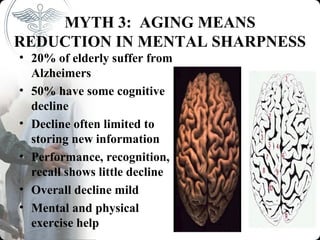
MYTH 3: AGING MEANS
REDUCTION IN MENTAL SHARPNESS
• 20% of elderly suffer from
  Alzheimers
• 50% have some cognitive
  decline
• Decline often limited to
  storing new information
• Performance, recognition,
  recall shows little decline
• Overall decline mild
• Mental and physical
  exercise help
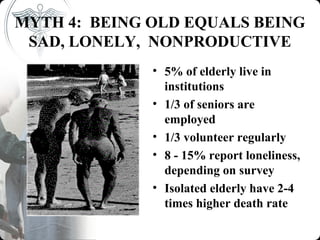
MYTH 4: BEING OLD EQUALS BEING
 SAD, LONELY, NONPRODUCTIVE
              • 5% of elderly live in
                institutions
              • 1/3 of seniors are
                employed
              • 1/3 volunteer regularly
              • 8 - 15% report loneliness,
                depending on survey
              • Isolated elderly have 2-4
                times higher death rate
MYTH 4: DEPRESSION AND SUICIDE
          IN ELDERLY
            • Depression present, but not
              often diagnosed in elderly
            • Depression blamed for
              increased suicide rate in elderly
            • White males over 65 at greatest
              risk
            • Women attempt more suicide,
              men succeed three times more
              often
            • Elderly suicide is twice the
              national average
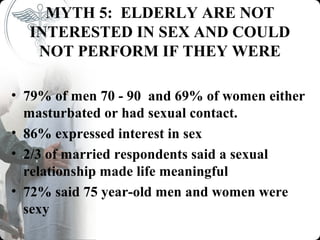
MYTH 5: ELDERLY ARE NOT
  INTERESTED IN SEX AND COULD
   NOT PERFORM IF THEY WERE

• 79% of men 70 - 90 and 69% of women either
  masturbated or had sexual contact.
• 86% expressed interest in sex
• 2/3 of married respondents said a sexual
  relationship made life meaningful
• 72% said 75 year-old men and women were
  sexy
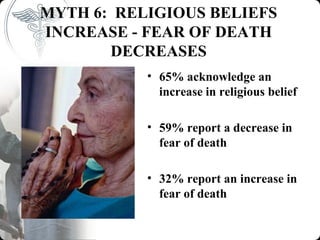
MYTH 6: RELIGIOUS BELIEFS
INCREASE - FEAR OF DEATH
       DECREASES
           • 65% acknowledge an
             increase in religious belief

           • 59% report a decrease in
             fear of death

           • 32% report an increase in
             fear of death
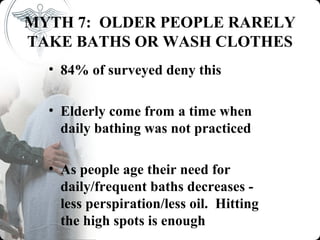
MYTH 7: OLDER PEOPLE RARELY
TAKE BATHS OR WASH CLOTHES
  • 84% of surveyed deny this

  • Elderly come from a time when
    daily bathing was not practiced

  • As people age their need for
    daily/frequent baths decreases -
    less perspiration/less oil. Hitting
    the high spots is enough
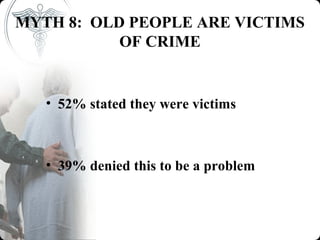
MYTH 8: OLD PEOPLE ARE VICTIMS
           OF CRIME


   • 52% stated they were victims


   • 39% denied this to be a problem
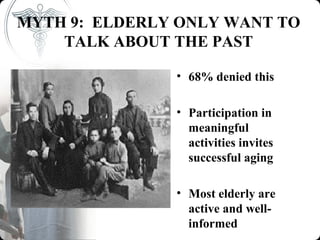
MYTH 9: ELDERLY ONLY WANT TO
    TALK ABOUT THE PAST

               • 68% denied this

               • Participation in
                 meaningful
                 activities invites
                 successful aging

               • Most elderly are
                 active and well-
                 informed
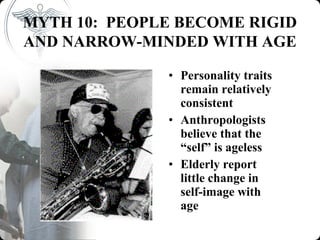
MYTH 10: PEOPLE BECOME RIGID
AND NARROW-MINDED WITH AGE

              • Personality traits
                remain relatively
                consistent
              • Anthropologists
                believe that the
                “self” is ageless
              • Elderly report
                little change in
                self-image with
                age
WHAT IS SUCCESSFUL
       AGING?

Basically, it is finding purpose
and acceptance with life as it is
 - with little regret or remorse
FIVE FCTORS OF SUCCESSFUL
              AGING
• LIFE SATISFACTION: rewarding, few
  regrets, positive attitude about past and
  future
• SOCIAL SUPPORT SYSTEM: network of
  family and friends
• GOOD PHYSICAL AND MENTAL
  HEALTH
• FINANCIAL SECURITY
• PERSONAL CONTROL OVER ONE’S
  LIFE: independence, dignity, and self-worth

Social aspects of_aging

  • 1.
    SOCIAL ASPECTS OF AGING Prepared by: Group 1
  • 2.
    Importance: • People communicatewith one another all the time and not only with words but through various other means as well. Example: “We are appreciated or accepted by others through a smile, clap, or pat on the shoulder”
  • 3.
    • Our sociallife takes into account the language we use, the gestures we make the interaction and relationships we have with one another. Social aspects of life include the support we give and concerned moves we make to help one another especially those in distress.
  • 4.
    The social aspectsof life: • Make us share with others • Make us consider others as our alter ego. • Interlink individuals • Make us care for the needy, oppressed, abandoned, aged, and those who have no one to care for them. • Allow us to recognize the dignity of every human being. • Help us mix with everyone.
  • 5.
    Different manifestations of socialbehavior of the aging person
  • 6.
    Manifestations of asocially healthy aging person • Happy to growing older and able to manage the aging syndrome with dignity and simplicity. • Has a sense of humor • Can mix with any group • Open to share what he/she has in all aspect. • Does not entertain false rumors • Maintains good personal hygiene
  • 7.
    •Find ways andmeans to be busy •Enjoys life •Honest about his/her feelings •Stay connected with friends and relatives Manifestations of a socially unhealthy aging person •Cranky and cantankerous •Sensitive and narrow-minded •Quick tempered, irritated and complain •Cannot get along with others •Feeling of being neglected by everyone and isolates himself •Demands respect, attention seeker
  • 8.
    •Neglects personal grooming,old fashioned •Feeling of insecurity and afraid of death through words •Afraid to be alone •Greedy to grab anything you give/offer with critical comments accompanying acceptance
  • 9.
    OLD AGE ANDTHE ELDERLY HAVE A VARIETY OF EXPECTATIONS AND NAMES. . . .FEW ARE POSITIVE • GEEZER • TWILIGHT YEARS • BORING • EMPTY YEARS • OLD BATTLE-AX • GOLDEN YEARS • USELESS • TIME OF OUR LIFE • OUT OF TOUCH • TIME OF LOSS • SMELLY • TIME OF PAIN • SENILE • DEPENDENT • RESPECTED • DEMANDING • DEMENTED • LOSS OF AUTONOMY
  • 10.
    THESE CAN ALLREPRESENT ELDERLY PEOPLE WHOM WE KNOW, BUT THEY DON’T REPRESENT ALL ELDERLY • Elderly are as diverse a group as any other age group • The affect of aging on each person’s life is dependent upon that unique individual • some generalizations can be made about attitudes of aging based on a person’s cultural background. . . . . . .
  • 11.
    EUROPEAN-AMERICAN CULTURE AND AGING • Growing old is generally feared • Elderly are not often respected nor revered • Nuclear families do not include the elderly • Ageism at times is practiced • Elderly often seen as sick, senile, and useless
  • 12.
    ASIAN/AMERICAN CULTURES REACT DIFFERENTLYTO ELDERLY • Have great respect for the aged • extended families include elderly • Big family decisions required everyone’s input
  • 13.
    HISPANICS FUNCTION WITHIN STRONGEXTENDED FAMILY UNITS, TOO • Very similar to Asian families in their devotion to extended family • Elderly have tremendous influence over family decisions
  • 14.
    AFRICAN-AMERICAN FAMILIES HAVEDIFFERENT DYNAMICS • Grandparents often raise their grandchildren • The extended family often includes church members
  • 15.
    MYTHS OF AGING INVESTIGATING- MYTHS THAT EXIST IN AMERICAN CULTURE
  • 16.
    MYTH 1: AGEBRINGS ILLNESS AND DISABILITY • Over past few decades chronic disease less common • 3/4 of those 75 - 84 years old report no disability • Twin studies show only 1/3 of elderly’s health problems due to heredity • Age brings greater risk of disease
  • 17.
    MYTH 2: CHANGEOF HABITS WHEN ONE IS OLDER RESULTS IN NO PHYSICAL BENEFIT • Change in habits adds years • Cardiovascular fitness is up 10 - 30% with aerobics • Strength of 80 - 90 year olds tripled with body building • Exercise cuts death rate 25 - 50% • Osteoporosis less with strengthening exercises
  • 18.
    MYTH 3: AGINGMEANS REDUCTION IN MENTAL SHARPNESS • 20% of elderly suffer from Alzheimers • 50% have some cognitive decline • Decline often limited to storing new information • Performance, recognition, recall shows little decline • Overall decline mild • Mental and physical exercise help
  • 19.
    MYTH 4: BEINGOLD EQUALS BEING SAD, LONELY, NONPRODUCTIVE • 5% of elderly live in institutions • 1/3 of seniors are employed • 1/3 volunteer regularly • 8 - 15% report loneliness, depending on survey • Isolated elderly have 2-4 times higher death rate
  • 20.
    MYTH 4: DEPRESSIONAND SUICIDE IN ELDERLY • Depression present, but not often diagnosed in elderly • Depression blamed for increased suicide rate in elderly • White males over 65 at greatest risk • Women attempt more suicide, men succeed three times more often • Elderly suicide is twice the national average
  • 21.
    MYTH 5: ELDERLYARE NOT INTERESTED IN SEX AND COULD NOT PERFORM IF THEY WERE • 79% of men 70 - 90 and 69% of women either masturbated or had sexual contact. • 86% expressed interest in sex • 2/3 of married respondents said a sexual relationship made life meaningful • 72% said 75 year-old men and women were sexy
  • 22.
    MYTH 6: RELIGIOUSBELIEFS INCREASE - FEAR OF DEATH DECREASES • 65% acknowledge an increase in religious belief • 59% report a decrease in fear of death • 32% report an increase in fear of death
  • 23.
    MYTH 7: OLDERPEOPLE RARELY TAKE BATHS OR WASH CLOTHES • 84% of surveyed deny this • Elderly come from a time when daily bathing was not practiced • As people age their need for daily/frequent baths decreases - less perspiration/less oil. Hitting the high spots is enough
  • 24.
    MYTH 8: OLDPEOPLE ARE VICTIMS OF CRIME • 52% stated they were victims • 39% denied this to be a problem
  • 25.
    MYTH 9: ELDERLYONLY WANT TO TALK ABOUT THE PAST • 68% denied this • Participation in meaningful activities invites successful aging • Most elderly are active and well- informed
  • 26.
    MYTH 10: PEOPLEBECOME RIGID AND NARROW-MINDED WITH AGE • Personality traits remain relatively consistent • Anthropologists believe that the “self” is ageless • Elderly report little change in self-image with age
  • 27.
    WHAT IS SUCCESSFUL AGING? Basically, it is finding purpose and acceptance with life as it is - with little regret or remorse
  • 28.
    FIVE FCTORS OFSUCCESSFUL AGING • LIFE SATISFACTION: rewarding, few regrets, positive attitude about past and future • SOCIAL SUPPORT SYSTEM: network of family and friends • GOOD PHYSICAL AND MENTAL HEALTH • FINANCIAL SECURITY • PERSONAL CONTROL OVER ONE’S LIFE: independence, dignity, and self-worth