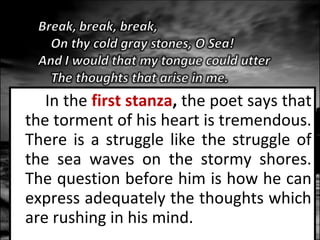
In the first stanza, the poet says that
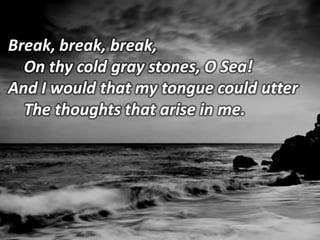
the torment of his heart is tremendous.
There is a struggle like the struggle of
the sea waves on the stormy shores.
The question before him is how he can
express adequately the thoughts which
are rushing in his mind.
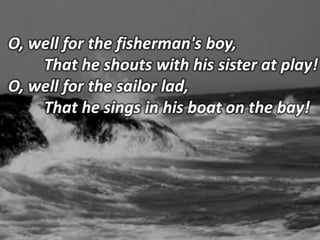
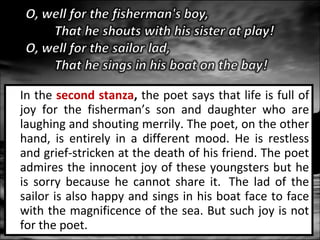
In the second stanza, the poet says that life is full of
joy for the fisherman’s son and daughter who are
laughing and shouting merrily. The poet, on the other
hand, is entirely in a different mood. He is restless
and grief-stricken at the death of his friend. The poet
admires the innocent joy of these youngsters but he
is sorry because he cannot share it. The lad of the
sailor is also happy and sings in his boat face to face
with the magnificence of the sea. But such joy is not
for the poet.
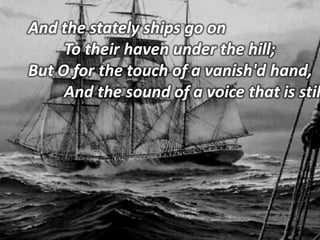
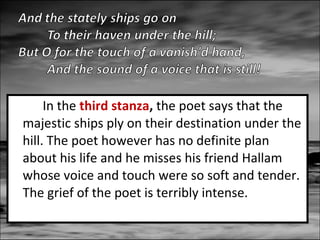
In the third stanza, the poet says that the
majestic ships ply on their destination under the
hill. The poet however has no definite plan
about his life and he misses his friend Hallam
whose voice and touch were so soft and tender.
The grief of the poet is terribly intense.
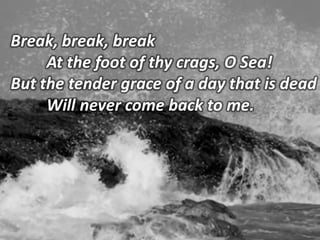
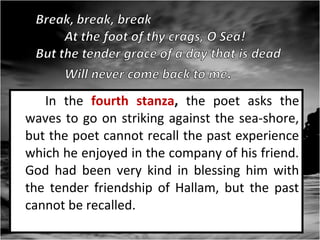
In the fourth stanza, the poet asks the
waves to go on striking against the sea-shore,
but the poet cannot recall the past experience
which he enjoyed in the company of his friend.
God had been very kind in blessing him with
the tender friendship of Hallam, but the past
cannot be recalled.
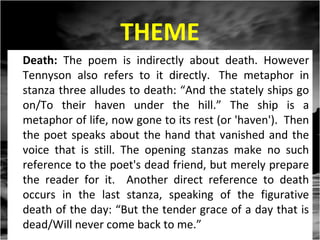
THEME
Death: The poem is indirectly about death. However
Tennyson also refers to it directly. The metaphor in
stanza three alludes to death: “And the stately ships go
on/To their haven under the hill.” The ship is a
metaphor of life, now gone to its rest (or 'haven'). Then
the poet speaks about the hand that vanished and the
voice that is still. The opening stanzas make no such
reference to the poet's dead friend, but merely prepare
the reader for it. Another direct reference to death
occurs in the last stanza, speaking of the figurative
death of the day: “But the tender grace of a day that is
dead/Will never come back to me.”
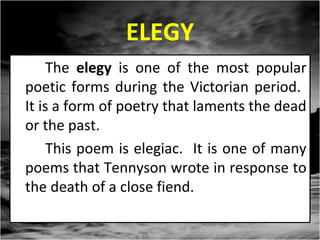
ELEGY
The elegy is one of the most popular
poetic forms during the Victorian period.
It is a form of poetry that laments the dead
or the past.
This poem is elegiac. It is one of many
poems that Tennyson wrote in response to
the death of a close fiend.
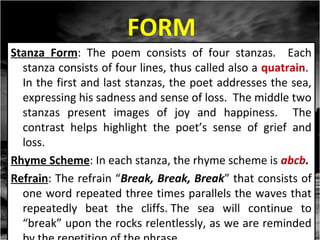
FORM
Stanza Form: The poem consists of four stanzas. Each
stanza consists of four lines, thus called also a quatrain.
In the first and last stanzas, the poet addresses the sea,
expressing his sadness and sense of loss. The middle two
stanzas present images of joy and happiness. The
contrast helps highlight the poet’s sense of grief and
loss.
Rhyme Scheme: In each stanza, the rhyme scheme is abcb.
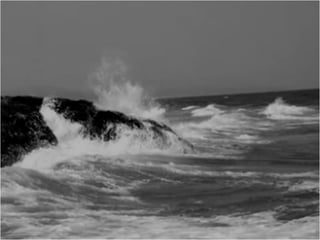
Refrain: The refrain “Break, Break, Break” that consists of
one word repeated three times parallels the waves that
repeatedly beat the cliffs. The sea will continue to
“break” upon the rocks relentlessly, as we are reminded
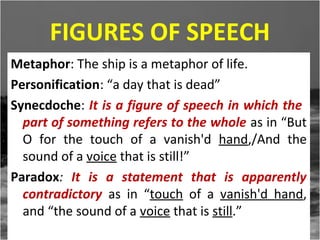
FIGURES OF SPEECH
Metaphor: The ship is a metaphor of life.
Personification: “a day that is dead”
Synecdoche: It is a figure of speech in which the
part of something refers to the whole as in “But
O for the touch of a vanish'd hand,/And the
sound of a voice that is still!”
Paradox: It is a statement that is apparently
contradictory as in “touch of a vanish'd hand,
and “the sound of a voice that is still.”
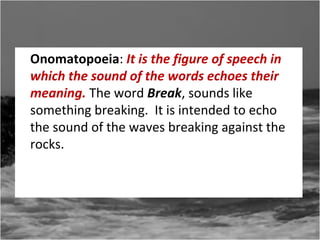
Onomatopoeia: It is the figure of speech in
which the sound of the words echoes their
meaning. The word Break, sounds like
something breaking. It is intended to echo
the sound of the waves breaking against the
rocks.
The Poem As an Example of Victorian Poetry
 The Elegiac Tone
This poem is an elegy. The elegy is one of the most
popular poetic forms in the period, a form of poetry that
laments the dead or the past.
 The Sense of Spiritual Doubt
The Victorian period was a period of religious doubt. The
conflict between science and religion resulted in people’s
sense of doubt about the validity of their beliefs. Darwin’s
theory of evolution, in particular, led to a crisis of faith and
spiritual doubt among so many people. The poem reveals a
secular rather than a religious attitude towards death. The
poet’s attitude towards death is characterized by a sense of
total loss and despair, rather than acceptance and comfort
based on belief in life after death and hope of immortality.
Tennyson's "Break, break, break"

Tennyson's "Break, break, break"

  • 8.
    In the firststanza, the poet says that the torment of his heart is tremendous. There is a struggle like the struggle of the sea waves on the stormy shores. The question before him is how he can express adequately the thoughts which are rushing in his mind.
  • 9.
    In the secondstanza, the poet says that life is full of joy for the fisherman’s son and daughter who are laughing and shouting merrily. The poet, on the other hand, is entirely in a different mood. He is restless and grief-stricken at the death of his friend. The poet admires the innocent joy of these youngsters but he is sorry because he cannot share it. The lad of the sailor is also happy and sings in his boat face to face with the magnificence of the sea. But such joy is not for the poet.
  • 10.
    In the thirdstanza, the poet says that the majestic ships ply on their destination under the hill. The poet however has no definite plan about his life and he misses his friend Hallam whose voice and touch were so soft and tender. The grief of the poet is terribly intense.
  • 11.
    In the fourthstanza, the poet asks the waves to go on striking against the sea-shore, but the poet cannot recall the past experience which he enjoyed in the company of his friend. God had been very kind in blessing him with the tender friendship of Hallam, but the past cannot be recalled.
  • 12.
    THEME Death: The poemis indirectly about death. However Tennyson also refers to it directly. The metaphor in stanza three alludes to death: “And the stately ships go on/To their haven under the hill.” The ship is a metaphor of life, now gone to its rest (or 'haven'). Then the poet speaks about the hand that vanished and the voice that is still. The opening stanzas make no such reference to the poet's dead friend, but merely prepare the reader for it. Another direct reference to death occurs in the last stanza, speaking of the figurative death of the day: “But the tender grace of a day that is dead/Will never come back to me.”
  • 13.
    ELEGY The elegy isone of the most popular poetic forms during the Victorian period. It is a form of poetry that laments the dead or the past. This poem is elegiac. It is one of many poems that Tennyson wrote in response to the death of a close fiend.
  • 14.
    FORM Stanza Form: Thepoem consists of four stanzas. Each stanza consists of four lines, thus called also a quatrain. In the first and last stanzas, the poet addresses the sea, expressing his sadness and sense of loss. The middle two stanzas present images of joy and happiness. The contrast helps highlight the poet’s sense of grief and loss. Rhyme Scheme: In each stanza, the rhyme scheme is abcb. Refrain: The refrain “Break, Break, Break” that consists of one word repeated three times parallels the waves that repeatedly beat the cliffs. The sea will continue to “break” upon the rocks relentlessly, as we are reminded
  • 15.
    FIGURES OF SPEECH Metaphor:The ship is a metaphor of life. Personification: “a day that is dead” Synecdoche: It is a figure of speech in which the part of something refers to the whole as in “But O for the touch of a vanish'd hand,/And the sound of a voice that is still!” Paradox: It is a statement that is apparently contradictory as in “touch of a vanish'd hand, and “the sound of a voice that is still.”
  • 16.
    Onomatopoeia: It isthe figure of speech in which the sound of the words echoes their meaning. The word Break, sounds like something breaking. It is intended to echo the sound of the waves breaking against the rocks.
  • 17.
    The Poem Asan Example of Victorian Poetry  The Elegiac Tone This poem is an elegy. The elegy is one of the most popular poetic forms in the period, a form of poetry that laments the dead or the past.  The Sense of Spiritual Doubt The Victorian period was a period of religious doubt. The conflict between science and religion resulted in people’s sense of doubt about the validity of their beliefs. Darwin’s theory of evolution, in particular, led to a crisis of faith and spiritual doubt among so many people. The poem reveals a secular rather than a religious attitude towards death. The poet’s attitude towards death is characterized by a sense of total loss and despair, rather than acceptance and comfort based on belief in life after death and hope of immortality.