Kathleen Stassen Berger


                  Part VII              Chapter Twenty-Two

    Adulthood: Psychosocial Development

Ages and Stages

Intimacy

Generativity


                  Prepared by Madeleine Lacefield            1
                           Tattoon, M.A.
Adulthood: Psychosocial Development
• emotional reactions to events in
  adulthood are fluid
• marriage, parenthood, divorce, and the
  empty nest, each sometimes joyous and
  sometimes not, are ages and stages of
  adult development


                                       2
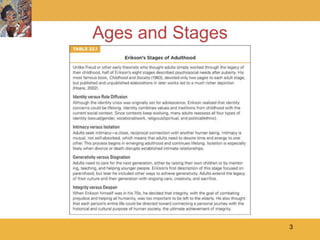
Ages and Stages


                  3
Ages and Stages
• The Social Clock
  – refers to the idea that the stages of life,
    and the behaviors ―appropriate‖ to them,
    are set by social standards rather than
    by biological maturation—for instance,
    ‖middle age‖ begins when the culture
    believes it does, rather than at a
    particular age in all cultures

                                              4
Ages and Stages
• Culture, Cohort, and SES
  – culture
     • the patterns of behavior that are passed from one
       generation to the next, groups have their own culture—
       values, customs, clothes, dwellings, cuisine,
       assumptions--people are influenced by more than one
       culture
  – cohort
     • people born within a few years of one another--these
       people are affected by the same: values, events,
       technologies, culture
  – socioeconomic status (SES)
     • ―social class‖--more than money, occupation, education,
       place of residence--includes advantages and
       disadvantages

                                                                 5
Ages and Stages
• The ―Midlife Crisis‖
  – a period of unusual anxiety, radical
    reexamination, and sudden
    transformation that is widely associated
    with middle age but which actually has
    more to do with developmental history
    than with chronological age


                                               6
Ages and Stages
• Personality Throughout Adulthood
  – personality is a major source of
    continuity providing coherence and
    identity, allowing people to know
    themselves and be known


                                         7
Ages and Stages
• The Big Five
  – the five basic clusters of personality traits that
    remain quite stable throughout adulthood—
    openness, conscientiousness, extroversion,
    agreeableness and neuroticism
  – ecological niche
     • the particular lifestyle and social context adults
       settle into that are compatible with their individual
       personality needs and interests


                                                          8
Ages and Stages
• Culture and Personality
  – personality variations are more evident
    between one person and another in the
    same nation than between one nation
    and another


                                              9
Ages and Stages
• Gender Convergence
  – a tendency for men and women to
    become more similar as they move
    through middle age


                                       10
Intimacy
• intimacy needs are lifelong
• adults meet their social needs for social
  connection with relatives, friends,
  coworkers, and romantic partners
  – social convoy
  – collectively, the family members, friends,
    acquaintances, and even strangers who move
    through life with an individual


                                              11
Intimacy
• Friends
  – typically the most supportive members
    of the social convoy, because they are
    chosen
  – research study found that friendships
    tend to improve with age


                                             12
Intimacy
• Protection Against Stress
  – allostatic load
    • the total, combined burden, of stress and
      disease that an individual must cope with


                                             13
Intimacy
• Gender Differences
  – linked lives
    • the notion that family members tend to
      share all aspects of each other’s lives,
      from triumph to tragedy


                                                 14
Intimacy
• Family Bonds
  – household
    • a group of people who live together in
      one dwelling and share its common
      spaces, such as kitchen and living room


                                                15
Intimacy
• A Developmental View
  – familism
    • the idea that family members should
      support one another because family
      unity is more important than individual
      freedom and success or failure


                                                16
Intimacy
• Adult Siblings
  – fictive kin
    • a term used to describe someone who
      becomes accepted as part of a family to
      whom he or she has no blood
      relationship


                                                17
Intimacy
• Marriage
  – a public commitment to one long-term
    sexual partner
  – adults seek committed sexual
    partnerships to help meet their needs for
    intimacy, to raise children, share
    resources, and provide care


                                           18
Intimacy
• Marriage and Happiness
  – from a developmental perspective,
    marriage is useful
  – adults thrive if another person is
    committed to caring for them; married
    people are a littler happier, healthier and
    richer than unmarried people


                                              19
Intimacy
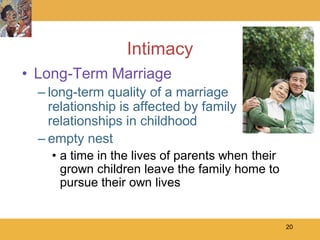
• Long-Term Marriage
  – long-term quality of a marriage
    relationship is affected by family
    relationships in childhood
  – empty nest
    • a time in the lives of parents when their
      grown children leave the family home to
      pursue their own lives


                                                  20
Intimacy
• Homosexual Partners
  – everything that applies to heterosexual
    partners applies to homosexual partners
    who make a commitment to each other


                                          21
Intimacy
• Divorce
  – marriages never ends in a vacuum—they are
    influenced by the social and political context
• Divorce Rates
  – the power of the social context is evident in
    variations in divorce rates
• Over the Years, Divorce and Remarriage
  – divorce is most likely to occur within the first
    five years
  – for long-term marriages, divorce is less likely
    but more devastating when it happens

                                                       22
Generativity
• after intimacy comes generativity,
  – generativity versus stagnation
    • when adults seek to be productive in a
      caring way, usually through work or
      parenthood (Erikson)
  – generativity comes with maturity–age is
    not a necessary marker


                                               23
Generativity
• Caregiving
  – Erikson wrote, a mature adult ―needs to be
    needed‖
  – some caregiving is physical
  – but much is psychological
  – kinkeeper
       – the person who takes primary responsibility for
         celebrating family achievements, gathering the family
         together, and keeping in touch with family members
         who do not live nearby


                                                             24
Generativity
• Caring for Children
  – bearing and raising children is labor
    intensive
  – the insistence on dramatizing the
    dependence of children on adults often
    blinds us to the dependence of the older
    generation on the young one


                                           25
Generativity
• Many paths to parenthood
  – a parental alliance assumes two cooperating
    parents
  – children can develop well in any family
  – 1/3 of North American adults become
    stepparents, adoptive parents, or foster
    parents at some point in their lives
  – the social construction about ―real‖ parents is
    misleading


                                                      26
Generativity
– Caregiving for Aging Parents
  • sandwich generation
    – a term for the generation of middle-aged
      people who are supposedly ―squeezed‖ by
      the needs of the younger and older
      generations—some adults do feel pressured
      by these obligations, but most are not
      burdened by them, either because they enjoy
      fulfilling them or because they choose to take
      on only some of them, or none


                                                  27
Generativity
• Employment
  – Many benefits
    • extrinsic rewards of work
      – the tangible rewards, usually in the form of
        compensation, that one receives for a job (e.g., salary,
        benefits, pension)
    • intrinsic rewards of work
      – the intangible benefits one receives from a job (e.g.
        job satisfaction, self-esteem, pride) that come from
        within oneself


                                                                28
Generativity
• Human Needs
 – it is crucial to learn how new work
   conditions support development—in the
   functions of family caregiving, personal
   creativity, satisfaction, and esteem and
   mentoring of other workers


                                          29
Generativity
• Diversity
  – benefit of modern economy is increased
    diversity
    • more employed women and minority
      groups
    • higher employment rates have helped
      with those once shut out


                                            30

Psych 41 (Chapter 22)Pdf

  • 1.
    Kathleen Stassen Berger Part VII Chapter Twenty-Two Adulthood: Psychosocial Development Ages and Stages Intimacy Generativity Prepared by Madeleine Lacefield 1 Tattoon, M.A.
  • 2.
    Adulthood: Psychosocial Development •emotional reactions to events in adulthood are fluid • marriage, parenthood, divorce, and the empty nest, each sometimes joyous and sometimes not, are ages and stages of adult development 2
  • 3.
  • 4.
    Ages and Stages •The Social Clock – refers to the idea that the stages of life, and the behaviors ―appropriate‖ to them, are set by social standards rather than by biological maturation—for instance, ‖middle age‖ begins when the culture believes it does, rather than at a particular age in all cultures 4
  • 5.
    Ages and Stages •Culture, Cohort, and SES – culture • the patterns of behavior that are passed from one generation to the next, groups have their own culture— values, customs, clothes, dwellings, cuisine, assumptions--people are influenced by more than one culture – cohort • people born within a few years of one another--these people are affected by the same: values, events, technologies, culture – socioeconomic status (SES) • ―social class‖--more than money, occupation, education, place of residence--includes advantages and disadvantages 5
  • 6.
    Ages and Stages •The ―Midlife Crisis‖ – a period of unusual anxiety, radical reexamination, and sudden transformation that is widely associated with middle age but which actually has more to do with developmental history than with chronological age 6
  • 7.
    Ages and Stages •Personality Throughout Adulthood – personality is a major source of continuity providing coherence and identity, allowing people to know themselves and be known 7
  • 8.
    Ages and Stages •The Big Five – the five basic clusters of personality traits that remain quite stable throughout adulthood— openness, conscientiousness, extroversion, agreeableness and neuroticism – ecological niche • the particular lifestyle and social context adults settle into that are compatible with their individual personality needs and interests 8
  • 9.
    Ages and Stages •Culture and Personality – personality variations are more evident between one person and another in the same nation than between one nation and another 9
  • 10.
    Ages and Stages •Gender Convergence – a tendency for men and women to become more similar as they move through middle age 10
  • 11.
    Intimacy • intimacy needsare lifelong • adults meet their social needs for social connection with relatives, friends, coworkers, and romantic partners – social convoy – collectively, the family members, friends, acquaintances, and even strangers who move through life with an individual 11
  • 12.
    Intimacy • Friends – typically the most supportive members of the social convoy, because they are chosen – research study found that friendships tend to improve with age 12
  • 13.
    Intimacy • Protection AgainstStress – allostatic load • the total, combined burden, of stress and disease that an individual must cope with 13
  • 14.
    Intimacy • Gender Differences – linked lives • the notion that family members tend to share all aspects of each other’s lives, from triumph to tragedy 14
  • 15.
    Intimacy • Family Bonds – household • a group of people who live together in one dwelling and share its common spaces, such as kitchen and living room 15
  • 16.
    Intimacy • A DevelopmentalView – familism • the idea that family members should support one another because family unity is more important than individual freedom and success or failure 16
  • 17.
    Intimacy • Adult Siblings – fictive kin • a term used to describe someone who becomes accepted as part of a family to whom he or she has no blood relationship 17
  • 18.
    Intimacy • Marriage – a public commitment to one long-term sexual partner – adults seek committed sexual partnerships to help meet their needs for intimacy, to raise children, share resources, and provide care 18
  • 19.
    Intimacy • Marriage andHappiness – from a developmental perspective, marriage is useful – adults thrive if another person is committed to caring for them; married people are a littler happier, healthier and richer than unmarried people 19
  • 20.
    Intimacy • Long-Term Marriage – long-term quality of a marriage relationship is affected by family relationships in childhood – empty nest • a time in the lives of parents when their grown children leave the family home to pursue their own lives 20
  • 21.
    Intimacy • Homosexual Partners – everything that applies to heterosexual partners applies to homosexual partners who make a commitment to each other 21
  • 22.
    Intimacy • Divorce – marriages never ends in a vacuum—they are influenced by the social and political context • Divorce Rates – the power of the social context is evident in variations in divorce rates • Over the Years, Divorce and Remarriage – divorce is most likely to occur within the first five years – for long-term marriages, divorce is less likely but more devastating when it happens 22
  • 23.
    Generativity • after intimacycomes generativity, – generativity versus stagnation • when adults seek to be productive in a caring way, usually through work or parenthood (Erikson) – generativity comes with maturity–age is not a necessary marker 23
  • 24.
    Generativity • Caregiving – Erikson wrote, a mature adult ―needs to be needed‖ – some caregiving is physical – but much is psychological – kinkeeper – the person who takes primary responsibility for celebrating family achievements, gathering the family together, and keeping in touch with family members who do not live nearby 24
  • 25.
    Generativity • Caring forChildren – bearing and raising children is labor intensive – the insistence on dramatizing the dependence of children on adults often blinds us to the dependence of the older generation on the young one 25
  • 26.
    Generativity • Many pathsto parenthood – a parental alliance assumes two cooperating parents – children can develop well in any family – 1/3 of North American adults become stepparents, adoptive parents, or foster parents at some point in their lives – the social construction about ―real‖ parents is misleading 26
  • 27.
    Generativity – Caregiving forAging Parents • sandwich generation – a term for the generation of middle-aged people who are supposedly ―squeezed‖ by the needs of the younger and older generations—some adults do feel pressured by these obligations, but most are not burdened by them, either because they enjoy fulfilling them or because they choose to take on only some of them, or none 27
  • 28.
    Generativity • Employment – Many benefits • extrinsic rewards of work – the tangible rewards, usually in the form of compensation, that one receives for a job (e.g., salary, benefits, pension) • intrinsic rewards of work – the intangible benefits one receives from a job (e.g. job satisfaction, self-esteem, pride) that come from within oneself 28
  • 29.
    Generativity • Human Needs – it is crucial to learn how new work conditions support development—in the functions of family caregiving, personal creativity, satisfaction, and esteem and mentoring of other workers 29
  • 30.
    Generativity • Diversity – benefit of modern economy is increased diversity • more employed women and minority groups • higher employment rates have helped with those once shut out 30