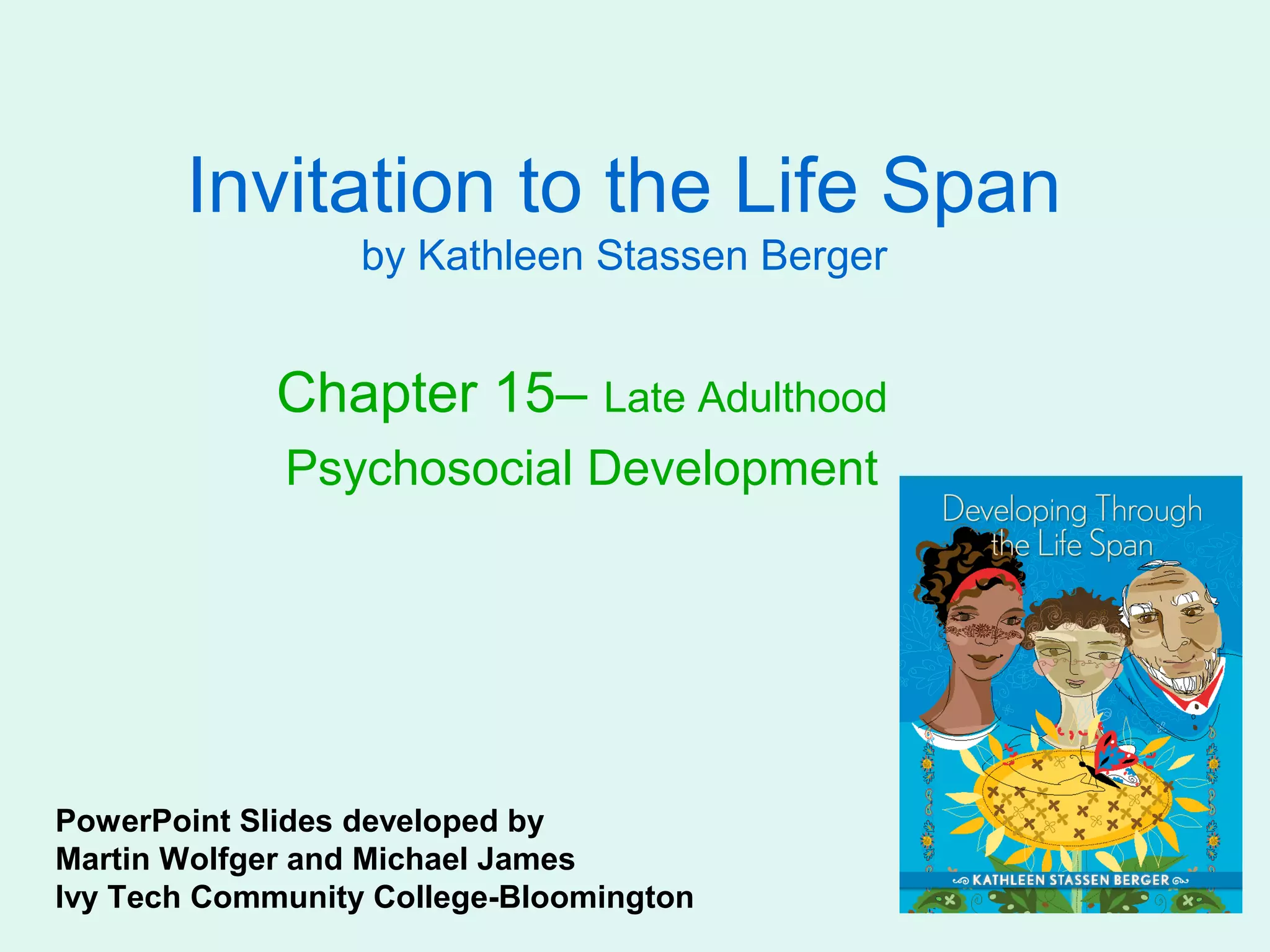
Invitation to the Life Span
                  by Kathleen Stassen Berger


             Chapter 15– Late Adulthood
             Psychosocial Development


PowerPoint Slides developed by
Martin Wolfger and Michael James
Ivy Tech Community College-Bloomington
Theories of Late Adulthood
• Development is more diverse in late
  adulthood than at any other age.
• Some elderly people run marathons and
  lead nations, while others are no longer
  able to move or think.
• Many social scientists have tried to
  understand these variations as well as the
  general course of old age.
Theories of Late Adulthood
• Self Theories
  – Theories of late adulthood that emphasize the
    core self, or the search to maintain one’s
    integrity and identity.
• Integrity versus despair
  – The final stage of Erik Erikson’s
    developmental sequence, in which older
    adults seek to integrate their unique
    experiences with their vision of community.
Theories of Late Adulthood
– Most older people consider their personalities
  and attitudes to have remained quite stable
  over their life span, even as they recognize
  the physical changes of their bodies.
– Objects and places become more precious in
  late adulthood than they were earlier, as a
  way to hold on to identity.
  • The tendency to cling to familiar places and
    possessions may be problematic if it leads to
    compulsive hoarding.
Theories of Late Adulthood
• Continuity theory
  – The theory that each person experiences the
    changes of late adulthood and behaves
    toward others in a way that is consistent with
    his or her behavior in earlier periods of life.
     • In this perspective, each innovation is a new
       expression of the old self.
     • One source of continuity is temperament.
     • The Big Five personality traits (see Chapter 13)
       are maintained throughout old age as in younger
       years.
Theories of Late Adulthood
• Selective optimization with compensation
  is central to self theories.
• Positivity effect
  – The tendency for elderly people to perceive,
    prefer, and remember positive images and
    experiences more than negative ones.
  – Selective memory is a way to compensate for
    whatever troubles occur.
  – Unpleasant experiences are reinterpreted as
    inconsequential.
Theories of Late Adulthood
• Self-perception normally tilts toward
  integrity rather than despair.
• Research on what people hope for
  themselves (the ideal self ) and how they
  perceive themselves (the real self) finds
  that, with age, the two selves come closer
  together.
• As self theory contends, self-acceptance
  leads to happiness.
Theories of Late Adulthood
• Stratification Theories
  – Theories that emphasize that social forces,
    particularly those related to a person’s social
    stratum, or social category, limit individual
    choices and affect a person’s ability to
    function in late adulthood as past stratification
    continues to limit life in various ways.
Theories of Late Adulthood
– STRATIFICATION BY AGE
   • Industrialized nations segregate elderly people,
     gradually shunting them out of the mainstream of
     society as they grow older.
   • Segregation by age harms everyone because it
     creates socialization deficits for members of all age
     groups.
Theories of Late Adulthood
– disengagement theory
  • The view that aging makes a person’s social
    sphere increasingly narrow, resulting in role
    relinquishment, withdrawal, and passivity.
– activity theory
  • The view that elderly people want and need to
    remain active in a variety of social spheres—with
    relatives, friends, and community groups—and
    become withdrawn only unwillingly, as a result of
    ageism.
Activities in Late Adulthood
• Work
  – The activities of older people are intense and
    varied.
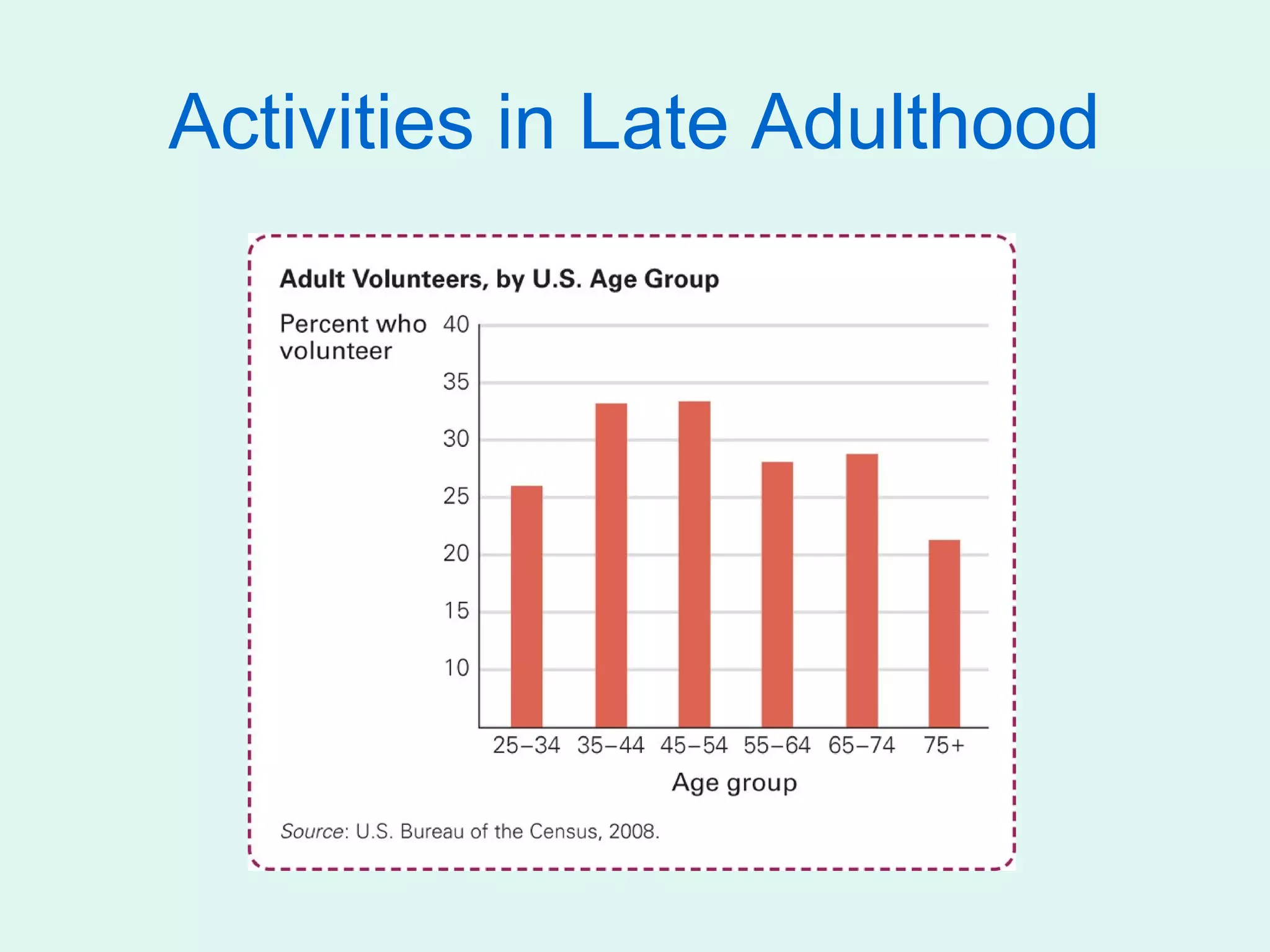
  – The psychological benefits of work can be
    obtained through volunteer work.
  – Work provides social support and status,
    boosting self-esteem.
  – For many people, employment allows
    generativity.
Activities in Late Adulthood
• Besides needing the money, some employees
  over age 65 stay on the job because they
  appreciate the social recognition and self-
  fulfillment that work brings.
• Many people once believed that older adults
  were healthier and happier when they were
  employed than when they were unemployed and
  that retirement led to illness and death.
• Only when retirement is precipitated by poor
  health or fading competence does it correlate
  with illness.
Activities in Late Adulthood
• Home, Sweet Home
  – One of the favorite activities of many retirees
    is caring for their own homes.
  – In keeping up with household tasks and
    maintaining their property, many older people
    demonstrate that they prefer to age in place.
  – They want to stay in the same dwelling where
    they lived as younger adults, adjusting but not
    leaving when health fades.
Activities in Late Adulthood
• Naturally Occurring Retirement
  Community (NORC)
  – A neighborhood or apartment complex whose
    population is mostly retired people who
    moved to the location as younger adults and
    never left.
  – An important reason for both aging in place
    and NORCs is the social convoy, the result of
    years of close relationships.
Activities in Late Adulthood
• Continuing Education
  – About one out of five U.S. adults age 66 and
    older was enrolled in some kind of continuing
    education in 2005.
  – Most elderly students are motivated primarily
    by a desire for personal or social
    improvement.
  – In some ways, late adulthood is an ideal time
    for learning.
Activities in Late Adulthood
• Religious Involvement
  – Older adults are less likely to attend religious
    services than are the middle-aged.
  – But, faith increases with age, as do praying
    and other religious practices.
  – Religious institutions fulfill many needs, and a
    nearby house of worship is one reason
    American elders prefer to age in place.
Activities in Late Adulthood
• Political Activism
  – Fewer older people turn out for massive
    rallies and only about 2 percent volunteer in
    political campaigns.
  – More older people write letters to their elected
    representatives, vote, and identify with a
    political party.
  – Many government policies affect the elderly,
    especially those regarding housing, pensions,
    prescription drugs, and medical costs.
Friends and Relatives
• Long-Term Partnerships
  – Spouses buffer each other against the
    problems of old age, thus extending life.
  – Married older adults are healthier, wealthier,
    and happier than unmarried people their age.
• Shared Laughter
  – One characteristic of long-married couples is
    that they often mirror each other’s moods.
  – Thanks to the positivity effect, the mood is
    often one of joy.
Friends and Relatives
• One of the amazing aspects of long-term
  relationships is how interdependent the
  partners become over time.
• Another aspect of long marriages also
  suggests mutual respect.
• Generally, older spouses accept each
  other’s frailties, assisting with the partner’s
  physical and psychological needs.
Friends and Relatives
• THE IMPACT OF RETIREMENT
   – In addition to relinquishing the work role,
     retirees must usually adjust the marriage
     interaction, now that they will be spending
     more time at home with their spouse.
   – This increased interaction sometimes
     precipitates relationship conflicts.
Friends and Relatives
• DEATH OF A SPOUSE
 – Another common event that long-married
   older adults must face is the death of their
   spouse.
 – Adjustment to being widowed is especially
   difficult during the first two years after the
   death.
 – Because women tend to marry older men, the
   average married woman experiences 4 to 10
   years of widowhood and the average man,
   none.
Friends and Relatives
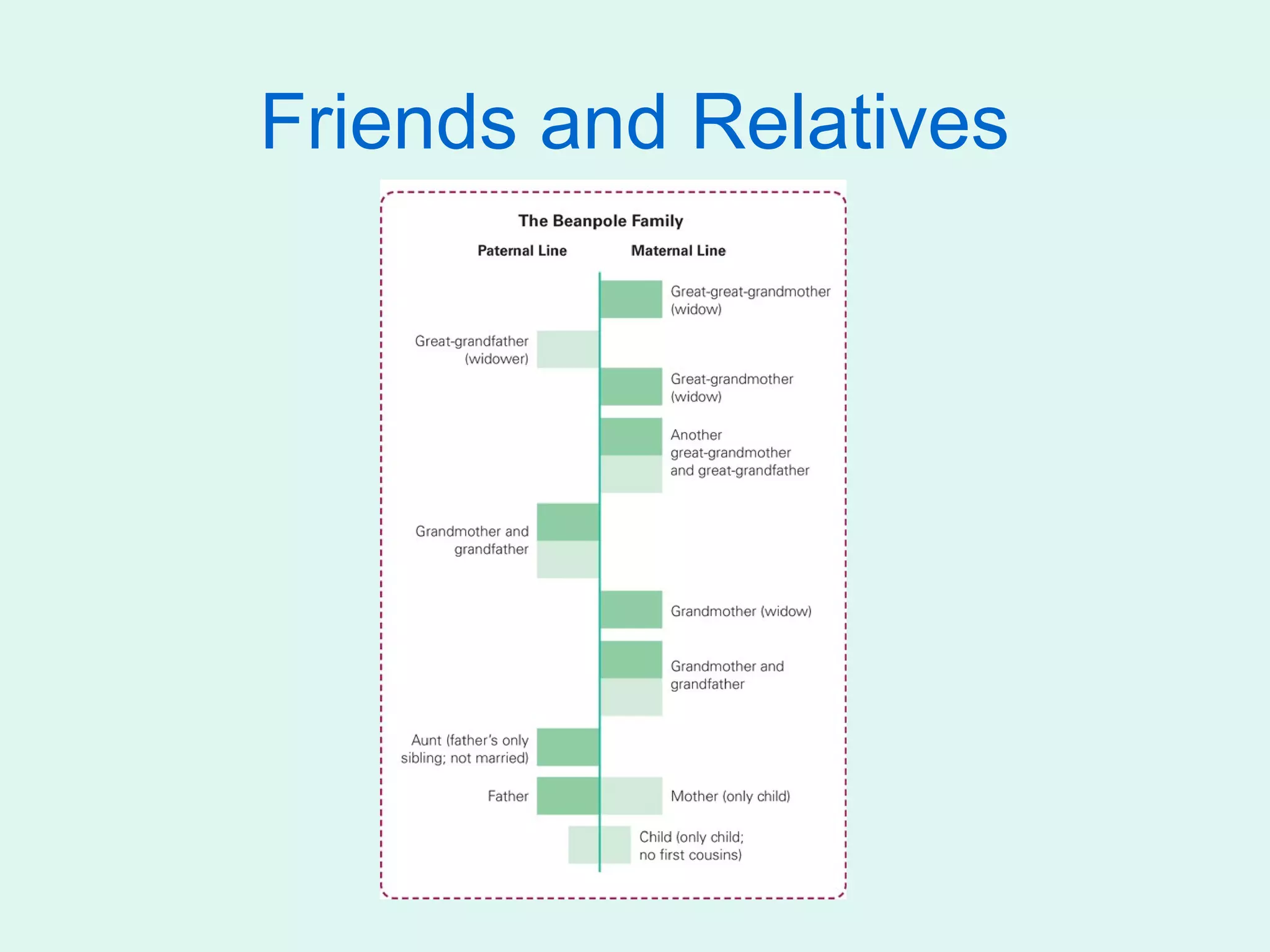
• Relationships with Younger Generations
  – In past centuries, most adults died before
    their grandchildren were born.
  – Today, some families span five generations.
  – Beanpole family
    • multiple generations but only a few members in
      each one
Friends and Relatives
– Although elderly people’s relationships with
  members of younger generations are usually
  positive, they can also include tension and
  conflict.
– Few older adults stop parenting simply
  because their children are grown.
– Adult children also imagine parental
  disapproval, even if it is not outwardly
  expressed.
Friends and Relatives
  – Feelings of familism prompt siblings, cousins,
    and even more distant relatives to seek out
    one another.
• Filial responsibility
  – The obligation of adult children to care for
    their aging parents.
  – A major goal among adults in the United
    States is to be self-sufficient.
  – Adult children may be more willing to offer
    support than their parents are to receive it.
Friends and Relatives
– Extensive research has found that
  relationships between parents and adult
  children are affected by many factors:
  • Assistance arises from need and from the ability to
    provide.
  • Frequency of contact is related to geographical
    proximity, not affection.
  • Love is influenced by the interaction remembered
    from childhood.
  • Sons feel stronger obligation; daughters feel
    stronger affection.
Friends and Relatives
• Grandchildren
  – Most (85 percent) elders over age 65 are
    grandparents.
  – Factors influencing the nature of the
    grandparent-grandchild relationship:
    •   personality
    •   ethnicity
    •   national background
    •   past family interactions
    •   age and the personality of the child
Friends and Relatives
• In the United States, contemporary
  grandparents follow one of four
  approaches to dealing with their
  grandchildren:
  – Remote grandparents (sometimes called distant grandparents)
    are emotionally distant from their grandchildren.
  – Companionate grandparents (sometimes called “fun-loving”
    grandparents) entertain and “spoil” their grandchildren.
  – Involved grandparents are active in the day-to-day lives of their
    grandchildren.
  – Surrogate parents raise their grandchildren, usually because
    the parents are unable or unwilling to do so.
Friends and Relatives
• Friends
  – Many middle-aged adults, married and
    unmarried, have no children.
  – Elderly people who have spent a lifetime
    without a spouse usually have friendships,
    activities, and social connections.
  – All the research finds that older adults need at
    least one close companion.
The Frail Elderly
• Frail elderly
  – People over age 65, and often over age 85,
    who are physically infirm, very ill, or
    cognitively disabled.
  – Most older adults become frail if they live long
    enough.
  – Frailty is most common in the months
    preceding death.
The Frail Elderly
• Activities of Daily Life
  – Actions that are important to independent living,
    typically identified as five tasks of self-care:
      • eating
      • bathing,
      • toileting
      • dressing
      • transferring from a bed to a chair
  – Inability to perform any of these tasks is a sign of
    frailty.
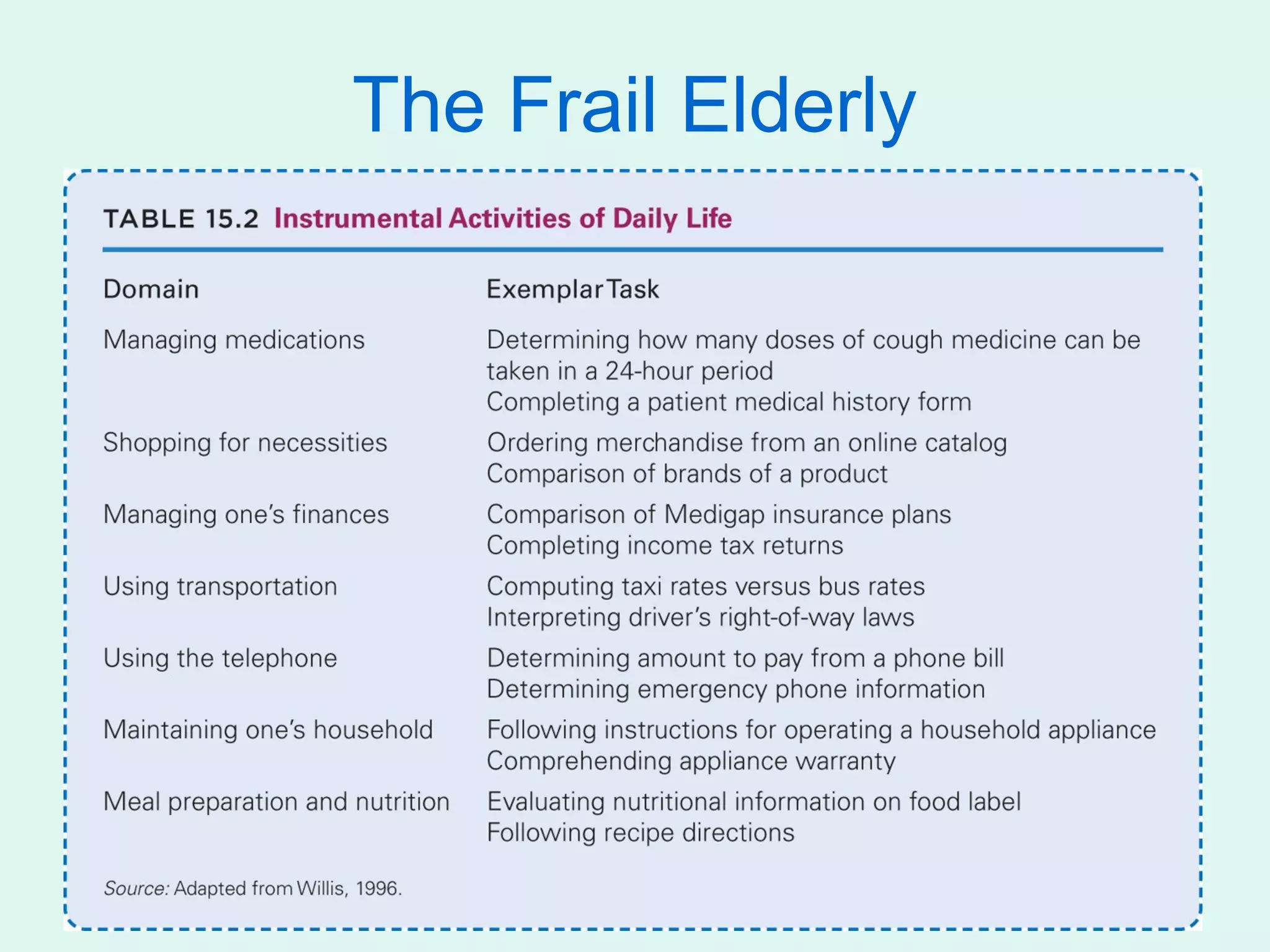
The Frail Elderly
• Instrumental activities of daily life
  (IADLs)
  – Actions (for example, paying bills and driving
    a car) that are important to independent living
    and that require some intellectual competence
    and forethought.
  – The ability to perform these tasks may be
    even more critical to self-sufficiency than ADL
    ability.
The Frail Elderly
The Frail Elderly
• Caring for the Frail Elderly
  – Family caregivers experience substantial
    stress.
  – Their health may suffer, and their risk of
    depression increases, especially if the care
    receiver has dementia.
  – In the United States, the spouse is the usual
    caregiver.
The Frail Elderly
– Even in ideal circumstances with community
  support, family caregiving can present
  problems:
  • If one adult child is the primary caregiver, other
    siblings tend to feel relief or jealousy.
  • Care receivers and caregivers often disagree
    about schedules, menus, doctor visits, and so on.
  • Resentments on both sides disrupt mutual
    affection and appreciation.
  • Public agencies rarely provide services unless an
    emergency arises.
The Frail Elderly
– When caregiving results in resentment and
  social isolation, the risk of depression, poor
  health, and abuse escalates.
– Abuse is likely when:
   • the care receiver is a feeble person who suffers
     severe memory loss
   • the caregiver is a drug-addicted relative
   • care occurs in an isolated place
   • visitors are few and far between
The Frail Elderly
– Most research finds that:
   • about 5 percent of elders say they are abused
   • up to one-fourth of all elders are vulnerable but do not report
     abuse.
– Elders who are mistreated by family members are
  ashamed to admit it.
– Outright abuse is now rare in nursing homes.
– In the United States, the trend over the past 20 years
  has been toward fewer nursing-home residents
  (currently about 1.5 million people nationwide).
The Frail Elderly
• Assisted living
  – A living arrangement for elderly people that
    combines privacy and independence with
    medical supervision.
  – Assisted-living facilities range from group
    homes for three or four elderly people to large
    apartment or townhouse developments for
    hundreds of residents.

Ch15

  • 1.
    Invitation to theLife Span by Kathleen Stassen Berger Chapter 15– Late Adulthood Psychosocial Development PowerPoint Slides developed by Martin Wolfger and Michael James Ivy Tech Community College-Bloomington
  • 2.
    Theories of LateAdulthood • Development is more diverse in late adulthood than at any other age. • Some elderly people run marathons and lead nations, while others are no longer able to move or think. • Many social scientists have tried to understand these variations as well as the general course of old age.
  • 3.
    Theories of LateAdulthood • Self Theories – Theories of late adulthood that emphasize the core self, or the search to maintain one’s integrity and identity. • Integrity versus despair – The final stage of Erik Erikson’s developmental sequence, in which older adults seek to integrate their unique experiences with their vision of community.
  • 4.
    Theories of LateAdulthood – Most older people consider their personalities and attitudes to have remained quite stable over their life span, even as they recognize the physical changes of their bodies. – Objects and places become more precious in late adulthood than they were earlier, as a way to hold on to identity. • The tendency to cling to familiar places and possessions may be problematic if it leads to compulsive hoarding.
  • 5.
    Theories of LateAdulthood • Continuity theory – The theory that each person experiences the changes of late adulthood and behaves toward others in a way that is consistent with his or her behavior in earlier periods of life. • In this perspective, each innovation is a new expression of the old self. • One source of continuity is temperament. • The Big Five personality traits (see Chapter 13) are maintained throughout old age as in younger years.
  • 6.
    Theories of LateAdulthood • Selective optimization with compensation is central to self theories. • Positivity effect – The tendency for elderly people to perceive, prefer, and remember positive images and experiences more than negative ones. – Selective memory is a way to compensate for whatever troubles occur. – Unpleasant experiences are reinterpreted as inconsequential.
  • 7.
    Theories of LateAdulthood • Self-perception normally tilts toward integrity rather than despair. • Research on what people hope for themselves (the ideal self ) and how they perceive themselves (the real self) finds that, with age, the two selves come closer together. • As self theory contends, self-acceptance leads to happiness.
  • 8.
    Theories of LateAdulthood • Stratification Theories – Theories that emphasize that social forces, particularly those related to a person’s social stratum, or social category, limit individual choices and affect a person’s ability to function in late adulthood as past stratification continues to limit life in various ways.
  • 9.
    Theories of LateAdulthood – STRATIFICATION BY AGE • Industrialized nations segregate elderly people, gradually shunting them out of the mainstream of society as they grow older. • Segregation by age harms everyone because it creates socialization deficits for members of all age groups.
  • 10.
    Theories of LateAdulthood – disengagement theory • The view that aging makes a person’s social sphere increasingly narrow, resulting in role relinquishment, withdrawal, and passivity. – activity theory • The view that elderly people want and need to remain active in a variety of social spheres—with relatives, friends, and community groups—and become withdrawn only unwillingly, as a result of ageism.
  • 11.
    Activities in LateAdulthood • Work – The activities of older people are intense and varied. – The psychological benefits of work can be obtained through volunteer work. – Work provides social support and status, boosting self-esteem. – For many people, employment allows generativity.
  • 12.
    Activities in LateAdulthood • Besides needing the money, some employees over age 65 stay on the job because they appreciate the social recognition and self- fulfillment that work brings. • Many people once believed that older adults were healthier and happier when they were employed than when they were unemployed and that retirement led to illness and death. • Only when retirement is precipitated by poor health or fading competence does it correlate with illness.
  • 13.
  • 14.
    Activities in LateAdulthood • Home, Sweet Home – One of the favorite activities of many retirees is caring for their own homes. – In keeping up with household tasks and maintaining their property, many older people demonstrate that they prefer to age in place. – They want to stay in the same dwelling where they lived as younger adults, adjusting but not leaving when health fades.
  • 15.
    Activities in LateAdulthood • Naturally Occurring Retirement Community (NORC) – A neighborhood or apartment complex whose population is mostly retired people who moved to the location as younger adults and never left. – An important reason for both aging in place and NORCs is the social convoy, the result of years of close relationships.
  • 16.
    Activities in LateAdulthood • Continuing Education – About one out of five U.S. adults age 66 and older was enrolled in some kind of continuing education in 2005. – Most elderly students are motivated primarily by a desire for personal or social improvement. – In some ways, late adulthood is an ideal time for learning.
  • 17.
    Activities in LateAdulthood • Religious Involvement – Older adults are less likely to attend religious services than are the middle-aged. – But, faith increases with age, as do praying and other religious practices. – Religious institutions fulfill many needs, and a nearby house of worship is one reason American elders prefer to age in place.
  • 18.
    Activities in LateAdulthood • Political Activism – Fewer older people turn out for massive rallies and only about 2 percent volunteer in political campaigns. – More older people write letters to their elected representatives, vote, and identify with a political party. – Many government policies affect the elderly, especially those regarding housing, pensions, prescription drugs, and medical costs.
  • 19.
    Friends and Relatives •Long-Term Partnerships – Spouses buffer each other against the problems of old age, thus extending life. – Married older adults are healthier, wealthier, and happier than unmarried people their age. • Shared Laughter – One characteristic of long-married couples is that they often mirror each other’s moods. – Thanks to the positivity effect, the mood is often one of joy.
  • 20.
    Friends and Relatives •One of the amazing aspects of long-term relationships is how interdependent the partners become over time. • Another aspect of long marriages also suggests mutual respect. • Generally, older spouses accept each other’s frailties, assisting with the partner’s physical and psychological needs.
  • 21.
    Friends and Relatives •THE IMPACT OF RETIREMENT – In addition to relinquishing the work role, retirees must usually adjust the marriage interaction, now that they will be spending more time at home with their spouse. – This increased interaction sometimes precipitates relationship conflicts.
  • 22.
    Friends and Relatives •DEATH OF A SPOUSE – Another common event that long-married older adults must face is the death of their spouse. – Adjustment to being widowed is especially difficult during the first two years after the death. – Because women tend to marry older men, the average married woman experiences 4 to 10 years of widowhood and the average man, none.
  • 23.
    Friends and Relatives •Relationships with Younger Generations – In past centuries, most adults died before their grandchildren were born. – Today, some families span five generations. – Beanpole family • multiple generations but only a few members in each one
  • 24.
    Friends and Relatives –Although elderly people’s relationships with members of younger generations are usually positive, they can also include tension and conflict. – Few older adults stop parenting simply because their children are grown. – Adult children also imagine parental disapproval, even if it is not outwardly expressed.
  • 25.
  • 26.
    Friends and Relatives – Feelings of familism prompt siblings, cousins, and even more distant relatives to seek out one another. • Filial responsibility – The obligation of adult children to care for their aging parents. – A major goal among adults in the United States is to be self-sufficient. – Adult children may be more willing to offer support than their parents are to receive it.
  • 27.
    Friends and Relatives –Extensive research has found that relationships between parents and adult children are affected by many factors: • Assistance arises from need and from the ability to provide. • Frequency of contact is related to geographical proximity, not affection. • Love is influenced by the interaction remembered from childhood. • Sons feel stronger obligation; daughters feel stronger affection.
  • 28.
    Friends and Relatives •Grandchildren – Most (85 percent) elders over age 65 are grandparents. – Factors influencing the nature of the grandparent-grandchild relationship: • personality • ethnicity • national background • past family interactions • age and the personality of the child
  • 29.
    Friends and Relatives •In the United States, contemporary grandparents follow one of four approaches to dealing with their grandchildren: – Remote grandparents (sometimes called distant grandparents) are emotionally distant from their grandchildren. – Companionate grandparents (sometimes called “fun-loving” grandparents) entertain and “spoil” their grandchildren. – Involved grandparents are active in the day-to-day lives of their grandchildren. – Surrogate parents raise their grandchildren, usually because the parents are unable or unwilling to do so.
  • 30.
    Friends and Relatives •Friends – Many middle-aged adults, married and unmarried, have no children. – Elderly people who have spent a lifetime without a spouse usually have friendships, activities, and social connections. – All the research finds that older adults need at least one close companion.
  • 31.
    The Frail Elderly •Frail elderly – People over age 65, and often over age 85, who are physically infirm, very ill, or cognitively disabled. – Most older adults become frail if they live long enough. – Frailty is most common in the months preceding death.
  • 32.
    The Frail Elderly •Activities of Daily Life – Actions that are important to independent living, typically identified as five tasks of self-care: • eating • bathing, • toileting • dressing • transferring from a bed to a chair – Inability to perform any of these tasks is a sign of frailty.
  • 33.
    The Frail Elderly •Instrumental activities of daily life (IADLs) – Actions (for example, paying bills and driving a car) that are important to independent living and that require some intellectual competence and forethought. – The ability to perform these tasks may be even more critical to self-sufficiency than ADL ability.
  • 34.
  • 35.
    The Frail Elderly •Caring for the Frail Elderly – Family caregivers experience substantial stress. – Their health may suffer, and their risk of depression increases, especially if the care receiver has dementia. – In the United States, the spouse is the usual caregiver.
  • 36.
    The Frail Elderly –Even in ideal circumstances with community support, family caregiving can present problems: • If one adult child is the primary caregiver, other siblings tend to feel relief or jealousy. • Care receivers and caregivers often disagree about schedules, menus, doctor visits, and so on. • Resentments on both sides disrupt mutual affection and appreciation. • Public agencies rarely provide services unless an emergency arises.
  • 37.
    The Frail Elderly –When caregiving results in resentment and social isolation, the risk of depression, poor health, and abuse escalates. – Abuse is likely when: • the care receiver is a feeble person who suffers severe memory loss • the caregiver is a drug-addicted relative • care occurs in an isolated place • visitors are few and far between
  • 38.
    The Frail Elderly –Most research finds that: • about 5 percent of elders say they are abused • up to one-fourth of all elders are vulnerable but do not report abuse. – Elders who are mistreated by family members are ashamed to admit it. – Outright abuse is now rare in nursing homes. – In the United States, the trend over the past 20 years has been toward fewer nursing-home residents (currently about 1.5 million people nationwide).
  • 39.
    The Frail Elderly •Assisted living – A living arrangement for elderly people that combines privacy and independence with medical supervision. – Assisted-living facilities range from group homes for three or four elderly people to large apartment or townhouse developments for hundreds of residents.