UNIT: 07
ADULTHOOD
by
Nisar Hashmi
OBJECTIVES
• At the end of this presentation the students
will be able to:
• Define adulthood.
• Explain Early , middle and late adulthood.
• Discuss Interpersonal relationships (work and
family)
• Describe Erickson’s intimacy vs. isolation stage
Explore Mid-life crises and life satisfaction
ADULTHOOD
• Derived from Latin word “Adutus” means
grown to full size and length or matured. In
Psychology Adulthood is defined as: “The time
frame of growth when physical maturation has
been attained and specific biologic, mental,
cultural, individual characteristics, and various
other developments concerned with getting
older have taken place .
The Nature Of Development
• Development: pattern of change in human
capabilities that begins at conception and
continues through the life span The pattern of
development is the product of:
• Physical processes: changes in individual’s
biological nature
• Cognitive processes: changes in individual’s
thinking, intelligence and language
• Socio-emotional processes: changes in
individual’s relationships with other people,
emotions, and personality
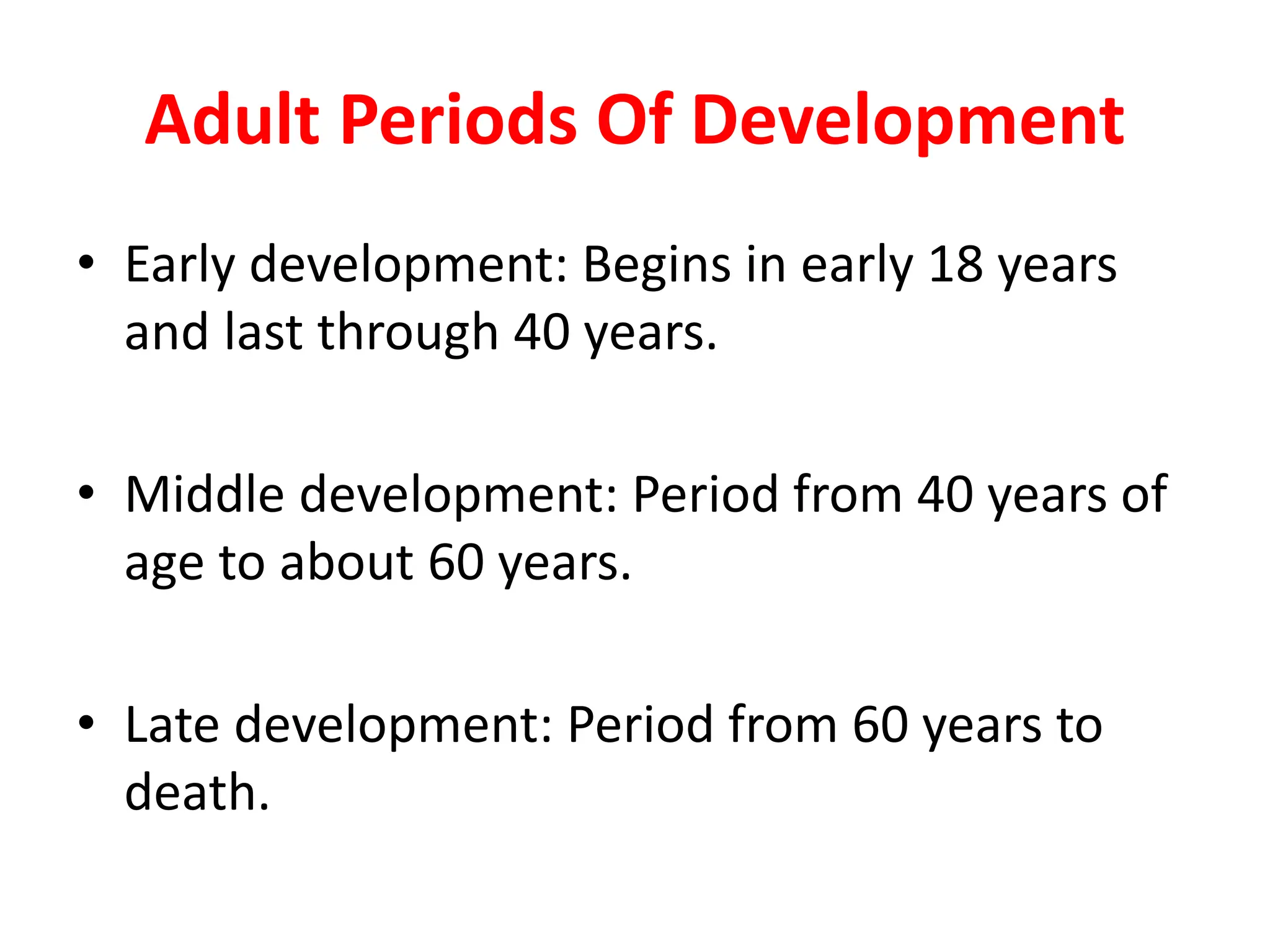
Adult Periods Of Development
• Early development: Begins in early 18 years
and last through 40 years.
• Middle development: Period from 40 years of
age to about 60 years.
• Late development: Period from 60 years to
death.
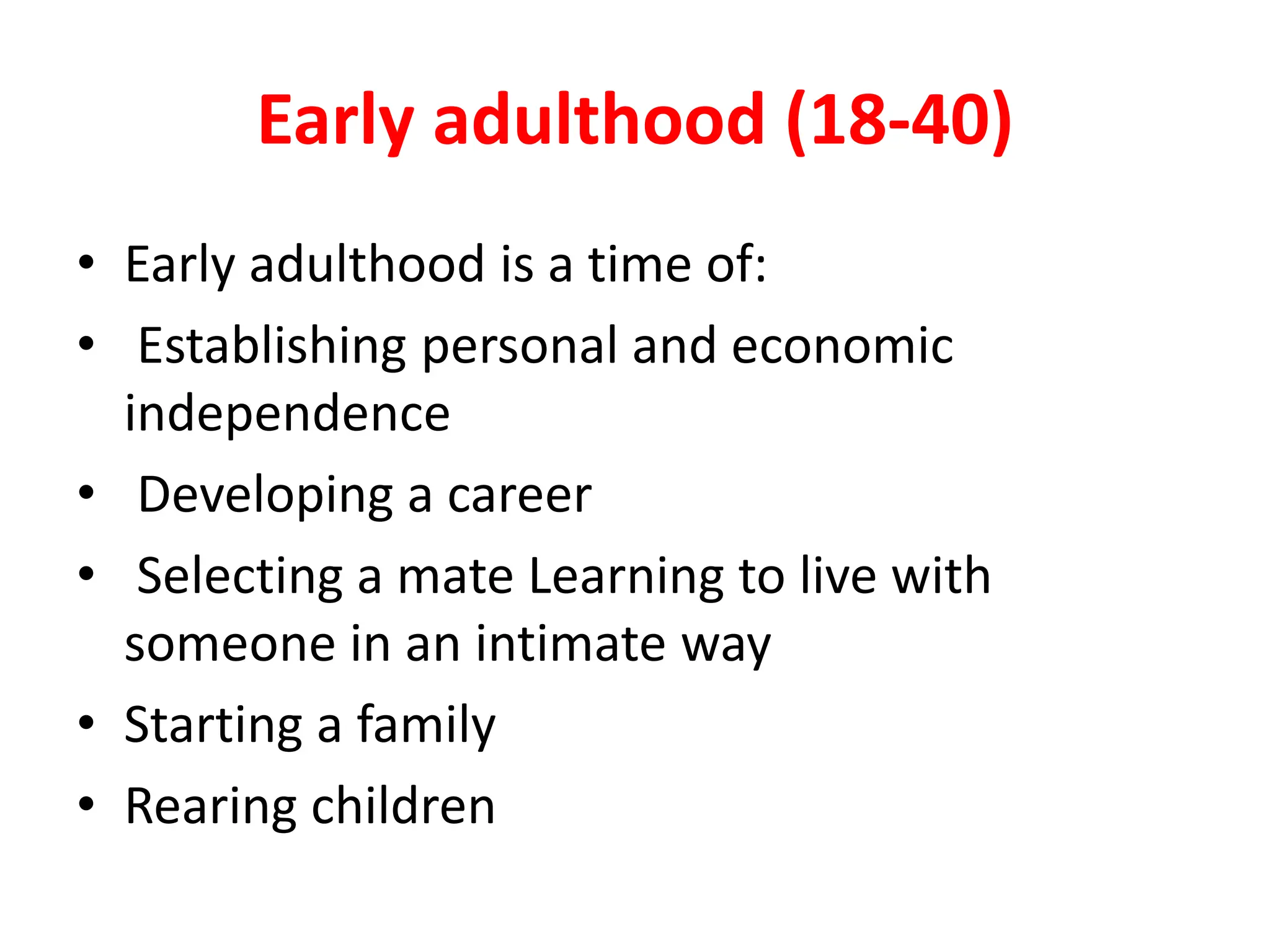
Early adulthood (18-40)
• Early adulthood is a time of:
• Establishing personal and economic
independence
• Developing a career
• Selecting a mate Learning to live with
someone in an intimate way
• Starting a family
• Rearing children
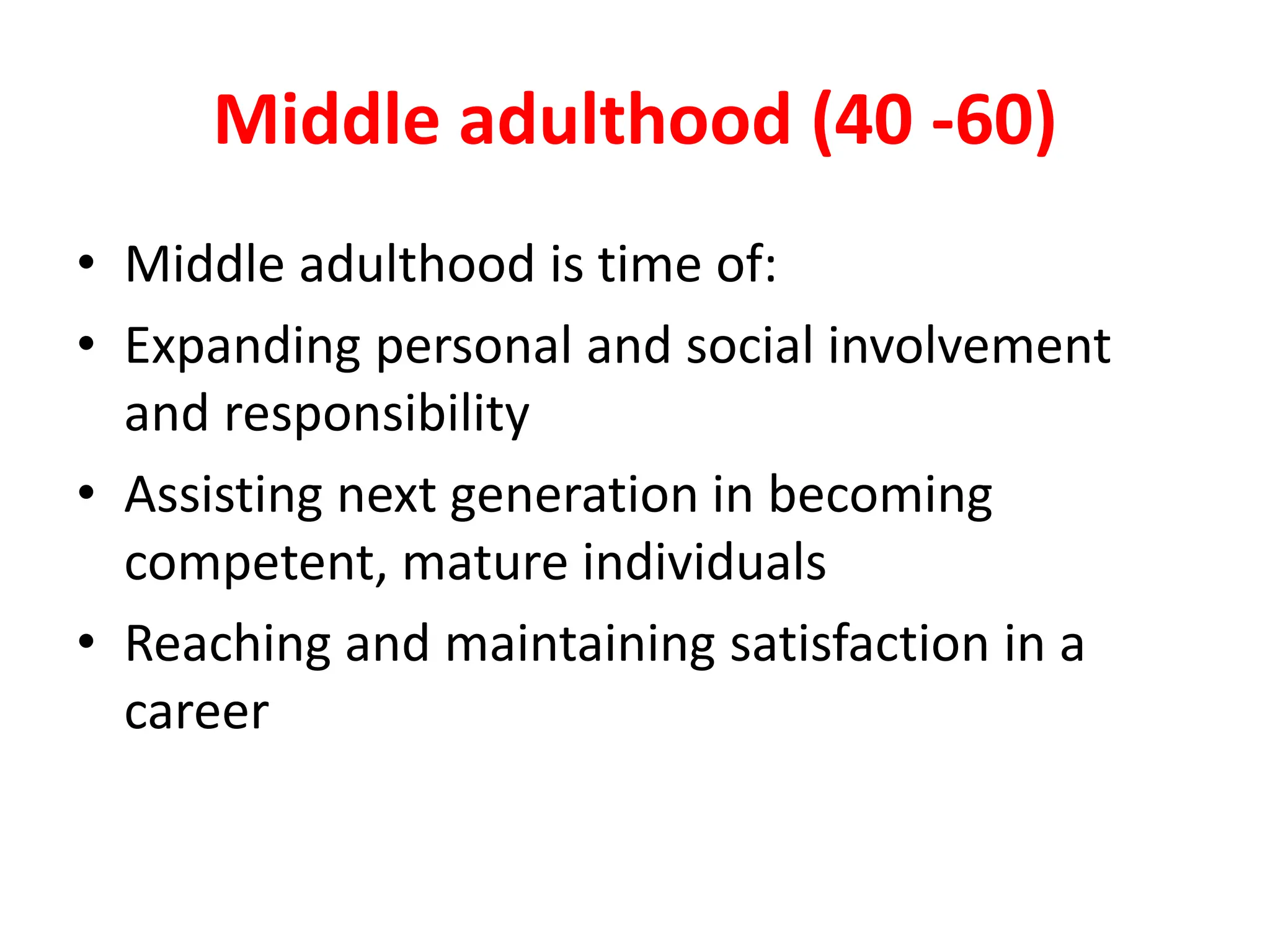
Middle adulthood (40 -60)
• Middle adulthood is time of:
• Expanding personal and social involvement
and responsibility
• Assisting next generation in becoming
competent, mature individuals
• Reaching and maintaining satisfaction in a
career
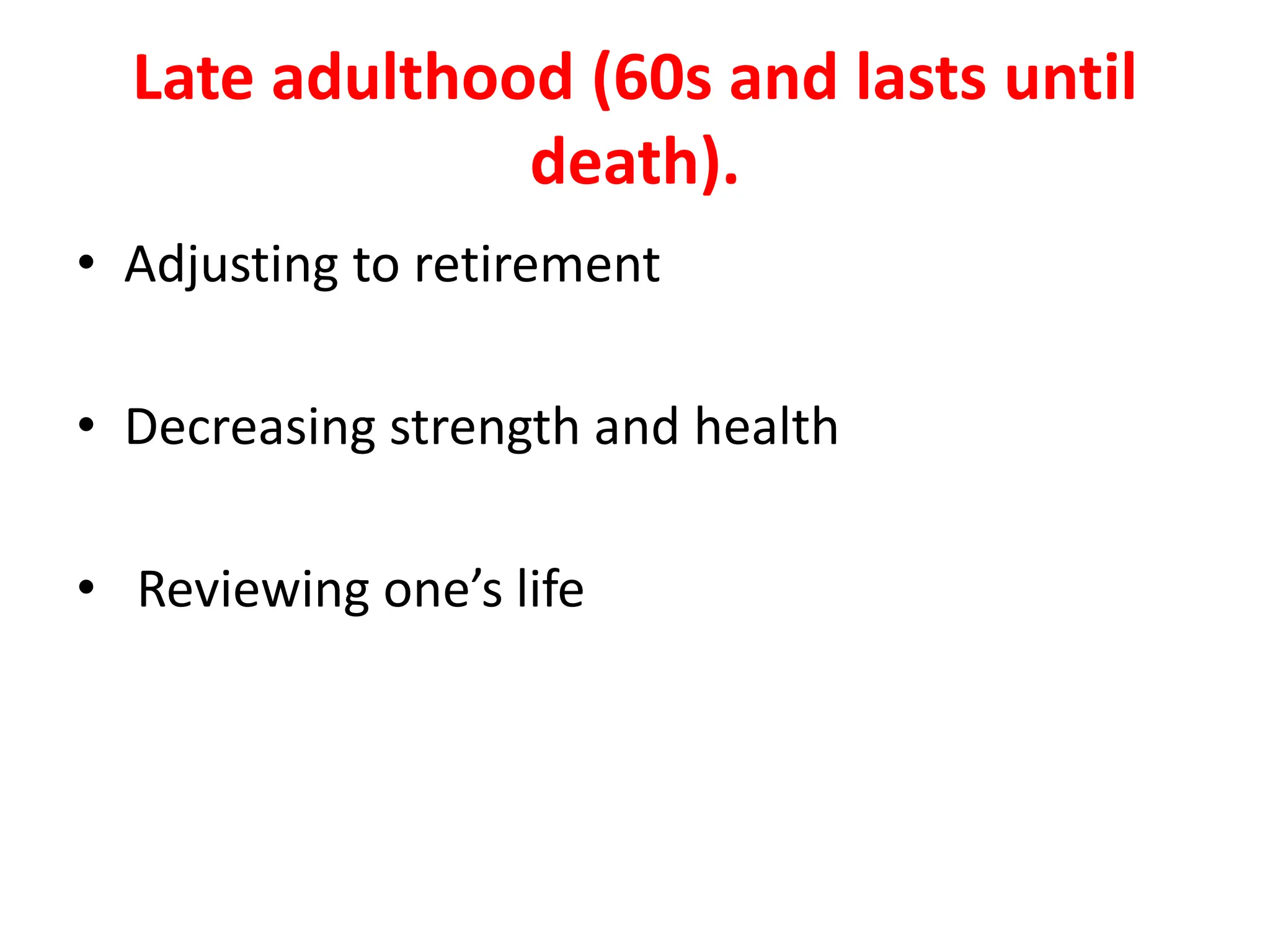
Late adulthood (60s and lasts until
death).
• Adjusting to retirement
• Decreasing strength and health
• Reviewing one’s life
Interpersonal Relationships (work and
family
• Positive relationships with significant others in
our adult years have been found to contribute
to a state of well-being.
• An interpersonal relationship is a strong,
deep, or close association or acquaintanceship
between two or more people.
• Relationships change and grow; they may
either improve or dissolve over time
Continue…
• The association between two people can be
based on various factors—love, solidarity,
business, or any other context that requires two
(or more) people to interact.
• Interpersonal relationships are dynamic systems
that change continuously during their existence.
• They tend to grow and improve gradually as
people get to know each other and become
closer emotionally, or they gradually deteriorate
as people drift apart.
Theories of Adult Development
• Daniel Levinson's Seasons of Life Theory
• George Vaillant's Adult Tasks Theory
• Bernice Neugarten's Social Clock Theory
• Malcolm Adult Learning Theory – Andragogy
• Erick Erickson Theory of Development
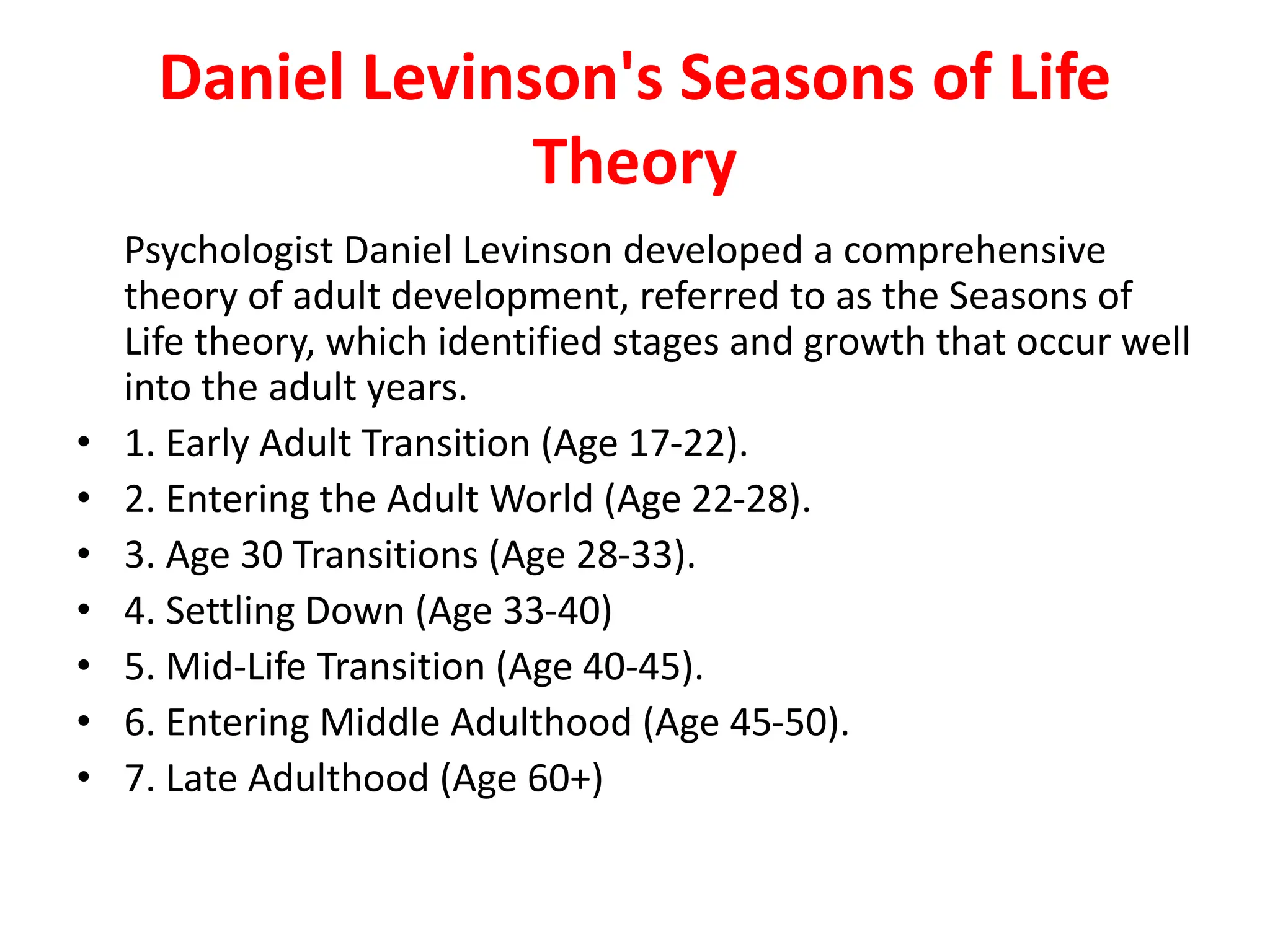
Daniel Levinson's Seasons of Life
Theory
Psychologist Daniel Levinson developed a comprehensive
theory of adult development, referred to as the Seasons of
Life theory, which identified stages and growth that occur well
into the adult years.
• 1. Early Adult Transition (Age 17-22).
• 2. Entering the Adult World (Age 22-28).
• 3. Age 30 Transitions (Age 28-33).
• 4. Settling Down (Age 33-40)
• 5. Mid-Life Transition (Age 40-45).
• 6. Entering Middle Adulthood (Age 45-50).
• 7. Late Adulthood (Age 60+)
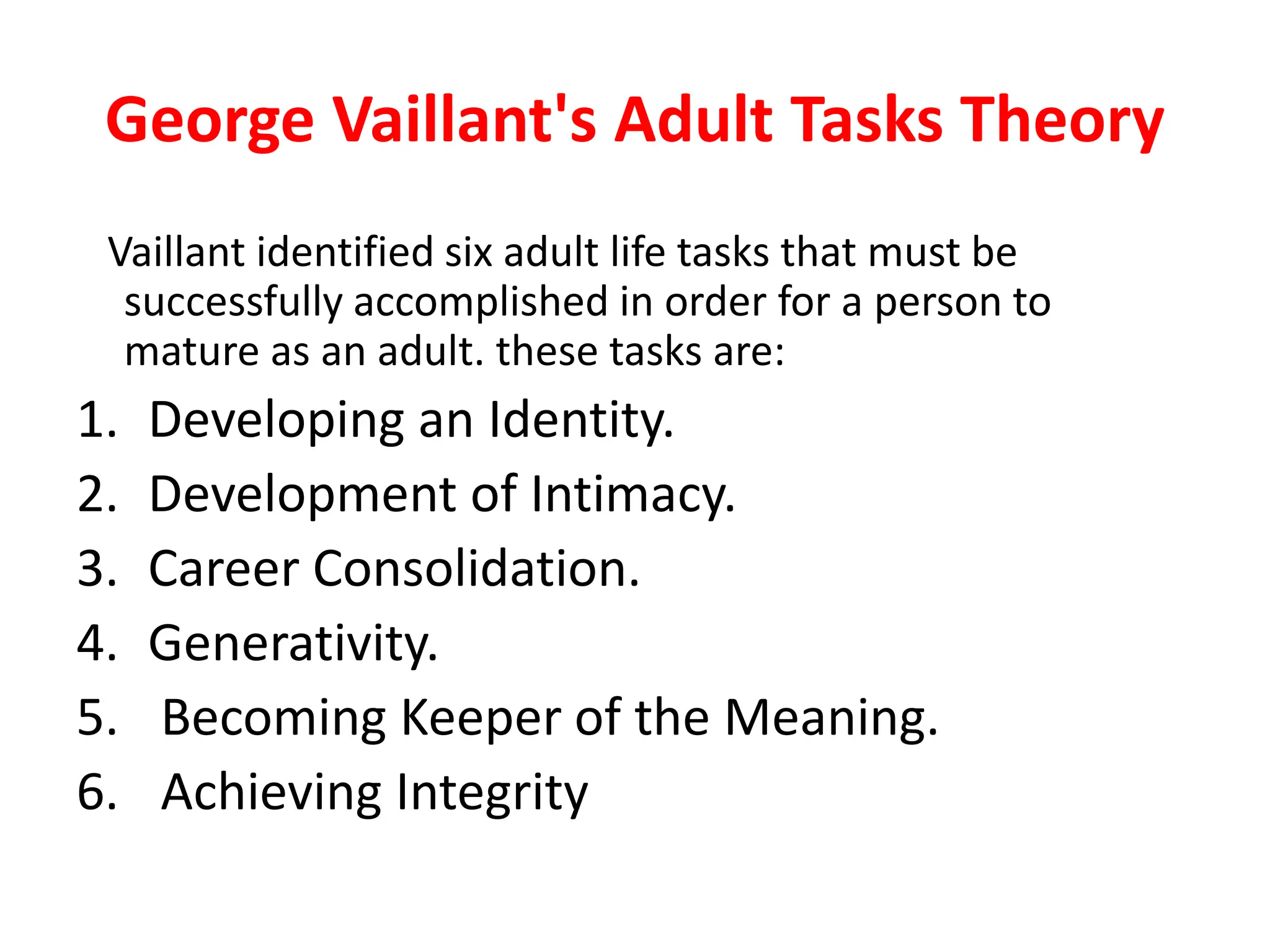
George Vaillant's Adult Tasks Theory
Vaillant identified six adult life tasks that must be
successfully accomplished in order for a person to
mature as an adult. these tasks are:
1. Developing an Identity.
2. Development of Intimacy.
3. Career Consolidation.
4. Generativity.
5. Becoming Keeper of the Meaning.
6. Achieving Integrity
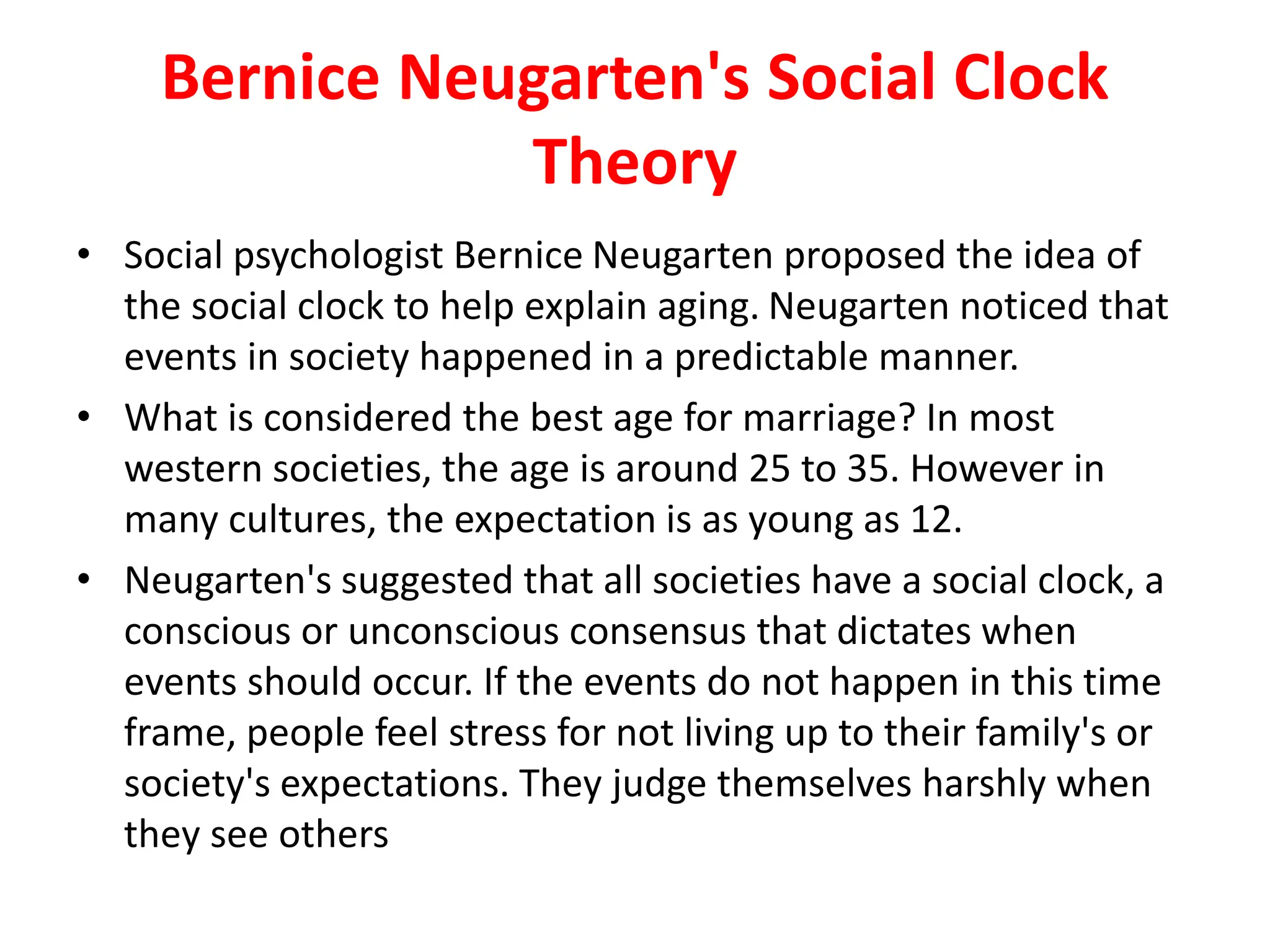
Bernice Neugarten's Social Clock
Theory
• Social psychologist Bernice Neugarten proposed the idea of
the social clock to help explain aging. Neugarten noticed that
events in society happened in a predictable manner.
• What is considered the best age for marriage? In most
western societies, the age is around 25 to 35. However in
many cultures, the expectation is as young as 12.
• Neugarten's suggested that all societies have a social clock, a
conscious or unconscious consensus that dictates when
events should occur. If the events do not happen in this time
frame, people feel stress for not living up to their family's or
society's expectations. They judge themselves harshly when
they see others
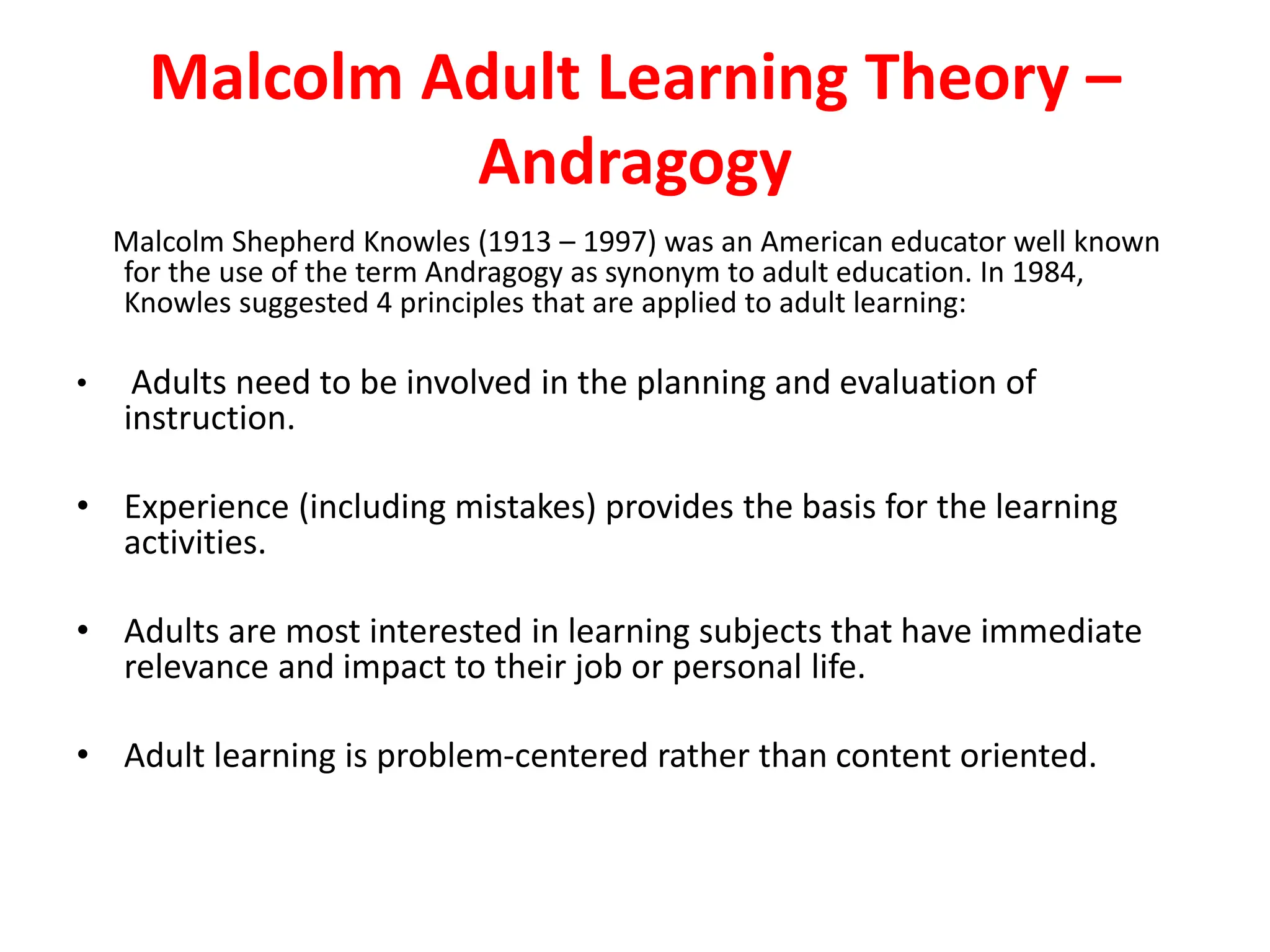
Malcolm Adult Learning Theory –
Andragogy
Malcolm Shepherd Knowles (1913 – 1997) was an American educator well known
for the use of the term Andragogy as synonym to adult education. In 1984,
Knowles suggested 4 principles that are applied to adult learning:
• Adults need to be involved in the planning and evaluation of
instruction.
• Experience (including mistakes) provides the basis for the learning
activities.
• Adults are most interested in learning subjects that have immediate
relevance and impact to their job or personal life.
• Adult learning is problem-centered rather than content oriented.
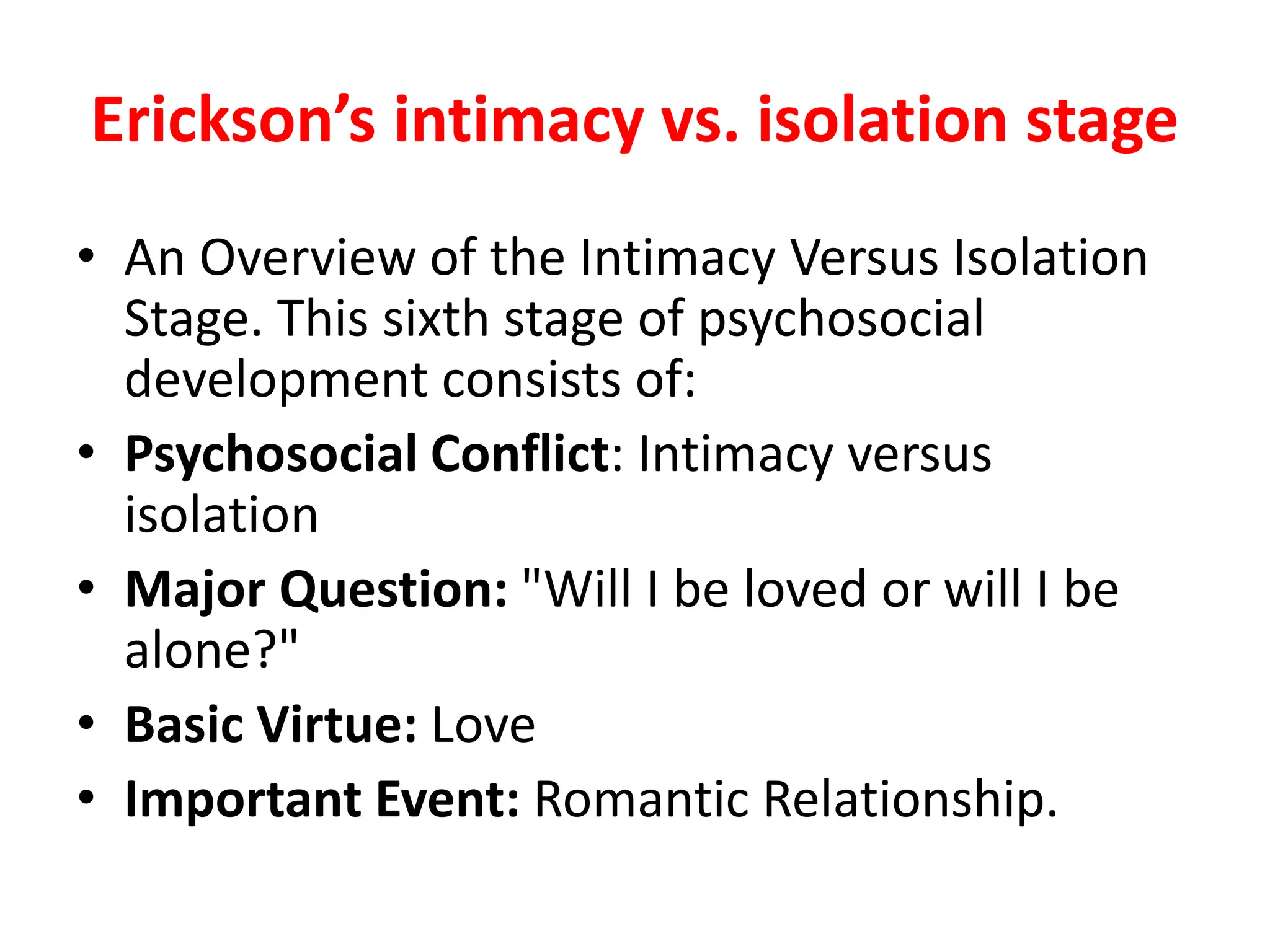
Erickson’s intimacy vs. isolation stage
• An Overview of the Intimacy Versus Isolation
Stage. This sixth stage of psychosocial
development consists of:
• Psychosocial Conflict: Intimacy versus
isolation
• Major Question: "Will I be loved or will I be
alone?"
• Basic Virtue: Love
• Important Event: Romantic Relationship.
Continue…
• It is important to remember that each stage
contributes to the next. For example, Erikson
believed that having a fully formed sense of self
(established during the identity versus confusion
stage) is essential to being able to form intimate
relationships.
• Studies have demonstrated that those with a
poor sense of self-tend to have less committed
relationships and are more likely to suffer
emotional isolation, loneliness, and depression.
Signs of a Midlife Crisis
• Desire to change career or job
• Exploring new religious experience
• Increase in alcohol and drug use, food intake,
and other compulsions
• Significant decrease or increase in sexual desire
• Sexual affairs
• Greatly decreased or increased ambition
• Buying (but not excessively) things that make you
feel good.
Continue…
• Exhaustion, boredom, or discontentment with
life or with a lifestyle (including people and
things) that previously provided fulfillment.
• Frantic energy; feeling restless and wanting to
do something completely different.
• Self-questioning.
• Confusion about who you are or where your
life is going.
• Divorce in midlife.
Continue…
• Life regrets—opportunities that weren’t
pursued
• Seeking a new direction in life
• Daydreaming
• Irritability, unexpected anger
• Persistent sadness
Ways To Control Midlife Crises
1. Nurture Yourself.
2. Identify Sources Of Stress
3. Set up a support group
4. Exercise
5. Eat a healthy diet.
6. Accept help when it’s offered.
Continue…
7. Positive Social Relationships
8. Good Marriage
9. Mastery of Multiple Roles
10. Learn to release your frustrations
11. Get enough sleep
12. Keep a sense of humor.

Adulthood Unit no 7.pptx developmental p

  • 1.
  • 2.
    OBJECTIVES • At theend of this presentation the students will be able to: • Define adulthood. • Explain Early , middle and late adulthood. • Discuss Interpersonal relationships (work and family) • Describe Erickson’s intimacy vs. isolation stage Explore Mid-life crises and life satisfaction
  • 3.
    ADULTHOOD • Derived fromLatin word “Adutus” means grown to full size and length or matured. In Psychology Adulthood is defined as: “The time frame of growth when physical maturation has been attained and specific biologic, mental, cultural, individual characteristics, and various other developments concerned with getting older have taken place .
  • 4.
    The Nature OfDevelopment • Development: pattern of change in human capabilities that begins at conception and continues through the life span The pattern of development is the product of: • Physical processes: changes in individual’s biological nature • Cognitive processes: changes in individual’s thinking, intelligence and language • Socio-emotional processes: changes in individual’s relationships with other people, emotions, and personality
  • 5.
    Adult Periods OfDevelopment • Early development: Begins in early 18 years and last through 40 years. • Middle development: Period from 40 years of age to about 60 years. • Late development: Period from 60 years to death.
  • 6.
    Early adulthood (18-40) •Early adulthood is a time of: • Establishing personal and economic independence • Developing a career • Selecting a mate Learning to live with someone in an intimate way • Starting a family • Rearing children
  • 7.
    Middle adulthood (40-60) • Middle adulthood is time of: • Expanding personal and social involvement and responsibility • Assisting next generation in becoming competent, mature individuals • Reaching and maintaining satisfaction in a career
  • 8.
    Late adulthood (60sand lasts until death). • Adjusting to retirement • Decreasing strength and health • Reviewing one’s life
  • 9.
    Interpersonal Relationships (workand family • Positive relationships with significant others in our adult years have been found to contribute to a state of well-being. • An interpersonal relationship is a strong, deep, or close association or acquaintanceship between two or more people. • Relationships change and grow; they may either improve or dissolve over time
  • 10.
    Continue… • The associationbetween two people can be based on various factors—love, solidarity, business, or any other context that requires two (or more) people to interact. • Interpersonal relationships are dynamic systems that change continuously during their existence. • They tend to grow and improve gradually as people get to know each other and become closer emotionally, or they gradually deteriorate as people drift apart.
  • 11.
    Theories of AdultDevelopment • Daniel Levinson's Seasons of Life Theory • George Vaillant's Adult Tasks Theory • Bernice Neugarten's Social Clock Theory • Malcolm Adult Learning Theory – Andragogy • Erick Erickson Theory of Development
  • 12.
    Daniel Levinson's Seasonsof Life Theory Psychologist Daniel Levinson developed a comprehensive theory of adult development, referred to as the Seasons of Life theory, which identified stages and growth that occur well into the adult years. • 1. Early Adult Transition (Age 17-22). • 2. Entering the Adult World (Age 22-28). • 3. Age 30 Transitions (Age 28-33). • 4. Settling Down (Age 33-40) • 5. Mid-Life Transition (Age 40-45). • 6. Entering Middle Adulthood (Age 45-50). • 7. Late Adulthood (Age 60+)
  • 13.
    George Vaillant's AdultTasks Theory Vaillant identified six adult life tasks that must be successfully accomplished in order for a person to mature as an adult. these tasks are: 1. Developing an Identity. 2. Development of Intimacy. 3. Career Consolidation. 4. Generativity. 5. Becoming Keeper of the Meaning. 6. Achieving Integrity
  • 14.
    Bernice Neugarten's SocialClock Theory • Social psychologist Bernice Neugarten proposed the idea of the social clock to help explain aging. Neugarten noticed that events in society happened in a predictable manner. • What is considered the best age for marriage? In most western societies, the age is around 25 to 35. However in many cultures, the expectation is as young as 12. • Neugarten's suggested that all societies have a social clock, a conscious or unconscious consensus that dictates when events should occur. If the events do not happen in this time frame, people feel stress for not living up to their family's or society's expectations. They judge themselves harshly when they see others
  • 15.
    Malcolm Adult LearningTheory – Andragogy Malcolm Shepherd Knowles (1913 – 1997) was an American educator well known for the use of the term Andragogy as synonym to adult education. In 1984, Knowles suggested 4 principles that are applied to adult learning: • Adults need to be involved in the planning and evaluation of instruction. • Experience (including mistakes) provides the basis for the learning activities. • Adults are most interested in learning subjects that have immediate relevance and impact to their job or personal life. • Adult learning is problem-centered rather than content oriented.
  • 16.
    Erickson’s intimacy vs.isolation stage • An Overview of the Intimacy Versus Isolation Stage. This sixth stage of psychosocial development consists of: • Psychosocial Conflict: Intimacy versus isolation • Major Question: "Will I be loved or will I be alone?" • Basic Virtue: Love • Important Event: Romantic Relationship.
  • 17.
    Continue… • It isimportant to remember that each stage contributes to the next. For example, Erikson believed that having a fully formed sense of self (established during the identity versus confusion stage) is essential to being able to form intimate relationships. • Studies have demonstrated that those with a poor sense of self-tend to have less committed relationships and are more likely to suffer emotional isolation, loneliness, and depression.
  • 18.
    Signs of aMidlife Crisis • Desire to change career or job • Exploring new religious experience • Increase in alcohol and drug use, food intake, and other compulsions • Significant decrease or increase in sexual desire • Sexual affairs • Greatly decreased or increased ambition • Buying (but not excessively) things that make you feel good.
  • 19.
    Continue… • Exhaustion, boredom,or discontentment with life or with a lifestyle (including people and things) that previously provided fulfillment. • Frantic energy; feeling restless and wanting to do something completely different. • Self-questioning. • Confusion about who you are or where your life is going. • Divorce in midlife.
  • 20.
    Continue… • Life regrets—opportunitiesthat weren’t pursued • Seeking a new direction in life • Daydreaming • Irritability, unexpected anger • Persistent sadness
  • 21.
    Ways To ControlMidlife Crises 1. Nurture Yourself. 2. Identify Sources Of Stress 3. Set up a support group 4. Exercise 5. Eat a healthy diet. 6. Accept help when it’s offered.
  • 22.
    Continue… 7. Positive SocialRelationships 8. Good Marriage 9. Mastery of Multiple Roles 10. Learn to release your frustrations 11. Get enough sleep 12. Keep a sense of humor.