Kathleen Stassen Berger


                      Part I             Chapter Three


 Heredity and Environment
The Genetic Code

From One Cell to Many

From Genotype to Phenotype

Chromosomal and Genetic
Abnormalities
                   Prepared by Madeleine Lacefield       1
                            Tattoon, M.A.
The Genetic Code
• “Genes play a leading role in the
  drama of human development, yet
  they rarely take center stage. Genes
  are pervasive and powerful, but they
  are also hidden and elusive.”


                                         2
What Genes Are
• DNA (deoxyribonucleic acid)
   – Molecule that contains the chemical instructions for cells
     to manufacture various proteins.

   – Chromosome
      • a molecule of DNA that contains the instructions to make
        proteins
      • Humans have 46 chromosomes (23 pairs), and about 25,000
        genes.
   – Genome
      • the code for making a human being

• Every person has a slightly different code, but the human
  genome is 99.5% the same for any 2 people.


                                                                   3
What Genes Are
• Genes are as section of
  chromosomes and the basic unit for
  the transmission of heredity,
  consisting of a string of chemicals
  that code for the manufacture of
  certain proteins.


                                        4
The Beginnings of Life
“…development begins at conception…each
   human reproductive cell or gamete,
   contains 23 chromosomes, half of that
   person’s 46…”

gamete
   A reproductive cell; that is, a sperm or
   ovum that can produce a new individual if it
   combines with a gamete from the other sex
   to make a zygote

                                              5
The Beginnings of Life
• Matching Genes
  – conception occurs in the usual way
    • zygote
      – the single cell formed from the fusing of two
        gametes, a sperm and an ovum
    • genotype
      – An organism’s entire genetic inheritance, or
        genetic potential


                                                        6
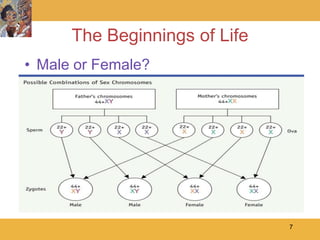
The Beginnings of Life
• Male or Female?


                               7
From One Cell to Many
– phenotype
  • the observable characteristic of a
    person, including appearance,
    personality, intelligence, and all other
    traits


                                               8
From One Cell to Many
• New Cells, New Functions
  – Gene-Gene Interactions
     • occurs through cell differentiation, gene-gene
       (polygenic), and gene-environment interaction
  – Multifactorial
     • refers to a trait that is affected by many factors, both
       genetic and environmental
  – The Human Genome Project is an international effort to
    map the entire human genome
     • researchers have found that humans have only about
       25,000 genes, 99% of which are present in the genomes
       of other creatures as well


                                                                  9
From One Cell to Many
• Additive Heredity
  – an allele is a slight, normal variation of a
    particular gene
• some alleles are…
  – additive genes combine to make a
    phenotype


                                               10
From One Cell to Many
• Dominant-Recessive Heredity
  – the interaction of a pair of alleles in such a
    way that the phenotype reveals the influence
    of one allele (the dominant gene) more than
    that of the other (the recessive gene)
  – a special case of the dominant-recessive
    pattern occurs with genes that are x-linked,
    located on the x chromosome


                                                     11
From One Cell to Many
• More Complications
  – A small alteration in the sequence of
    base pairs or several extra repetitions in
    one triplet ma be inconsequential or
    may cascade to create a major problem


                                             12
From One Cell to Many
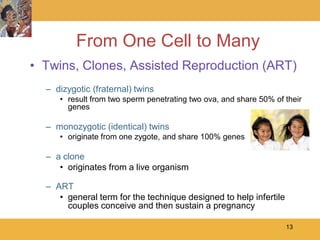
• Twins, Clones, Assisted Reproduction (ART)
  – dizygotic (fraternal) twins
     • result from two sperm penetrating two ova, and share 50% of their
       genes

  – monozygotic (identical) twins
     • originate from one zygote, and share 100% genes

  – a clone
     • originates from a live organism

  – ART
     • general term for the technique designed to help infertile
       couples conceive and then sustain a pregnancy

                                                                   13
From One Cell to Many
• Assisted Reproduction (ART)
  – general term for the technique designed to
    help infertile couples conceive and then
    sustain a pregnancy


                                          14
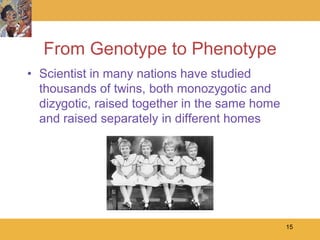
From Genotype to Phenotype
• Scientist in many nations have studied
  thousands of twins, both monozygotic and
  dizygotic, raised together in the same home
  and raised separately in different homes


                                                15
From Genotype to Phenotype
• Genes affect every aspect of human
  behavior, including social and cognitive
  behavior

• Most environmental influences on
  children raised in the same home are
  not shared


                                         16
From Genotype to Phenotype
• Each child’s genes elicit other people’s
  responses, and these responses shape
  development. In other words, a child’s
  environment is partly the result of his or
  her genes.

• Children, adolescents, and especially
  adults choose environments that are
  compatible with their genes (called niche-
  picking), and thus genetic influences in
  adulthood
                                               17
From Genotype to Phenotype
• Carrier
  – a person whose genotype includes a gene that
    is not expressed in the phenotype…such an
    unexpressed gene occurs in half of the
    carrier’s gametes and thus is passed on to half
    of the carrier’s children, who will most likely be
    carriers, too…
  – Generally, only when the gene is inherited
    from both parents does the characteristic
    appear in the phenotype.

                                                    18
From Genotype to Phenotype
• Addiction
  – …inherited biochemistry making people
    vulnerable to various addition…
  – …any one can abuse drugs or
    alcohol…but genes create an addictive
    pull that can be overpowering, extremely
    weak, or somewhere in between…


                                          19
From Genotype to Phenotype
• Visual Acuity
  – New borns cannot focus more than 2 feet
    away
  – Children see better each year until about
    age 8
  – Many adolescents become nearsighted
    when eyeball shape changes
  – Vision is more likely to improve than to
    worsen until age 40

                                            20
From Genotype to Phenotype
• Visual Acuity
  – In middle age, the elasticity of the lens
    decrease and the eyeball shape change
    again, so that many people become
    farsighted and need reading glasses
  – Among the old, eye diseases, including
    cataracts, are common
  – About 10 percent of people over age 90 are
    blind

                                            21
From Genotype to Phenotype
• Nearsightedness and Genes
  – If children have a vision problem it is most
    often myopia (nearsightedness)
  – Nearsightedness is a symptom in more than
    150 genetic syndromes
  – Caused by physical trauma or illness, such as
    the rubella virus, or poor nutrition (such as
    vitamin A deficiency
  – These factors cause “high” nearsightedness,
    so severe that it can lead to blindness
                                                22
From Genotype to Phenotype
• Culture and Cohort
  – genes are not the major cause of poor
    vision
    • historical and multicultural research finds
      that environment also influences
      nearsightedness
      – if diet is deficient of vitamin A


                                                    23
From Genotype to Phenotype
• Practical Application
  – developmental application of nature-
    nurture interaction
    • family history of genetic problems
    • someone inherited a problem
      – alcoholism in the genes
      – lack of outdoor play


                                           24
From Genotype to Phenotype
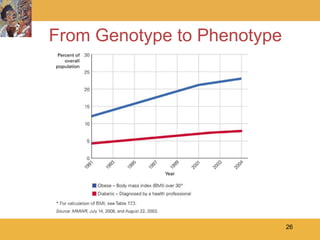
• Practical Application
  – type 2 diabetes (adult-onset diabetes)
    • a chronic disease which the body does
      not produce enough insulin to
      adequately metabolize carbohydrate
      (glucose)… it typically developed in
      people aged 50 - 60…today it often
      appears in younger people
  – begins when a person is vulnerable and
    has more body fat than is ideal

                                              25
From Genotype to Phenotype


                             26
Chromosomal and Genetic Abnormalities
• abnormalities caused by identifiable problems…those
  with an extra chromosome or a single gene
   – study of these problems is relevant to the study of
     development…
      • providing insight into the complexities of nature and
        nurture
      • knowing their origins helps limit these effects
      • information combats the prejudice that surrounds
        such problems


                                                        27
Chromosomal and Genetic Abnormalities
• Not Exactly 46 Chromosomes
  – a variable that most often correlates with
    chromosomal abnormalities is the age of the
    mother
  – occur not only in the formation of gametes but
    also in their early duplication
  – mosaic is having a condition (mosaicism) that
    involves having a mixture of cells, some
    normal and some with an odd number of
    chromosomes or a sense of missing genes

                                                 28
Chromosomal and Genetic Abnormalities
• Down Syndrome
  – a condition in which a person has 47
    chromosomes instead of the usual 46, with
    three rather than two chromosomes at the
    21st position
  – people with Down Syndrome typically
    have distinctive characteristics, including
    unusual facial features, heart abnormities,
    and language difficulties


                                              29
Chromosomal and Genetic Abnormalities
• Abnormalities of the 23rd Pair
  – humans have at least 44 autosomes and
    one X chromosome
    • an embryo cannot develop without an X
      chromosome
    • an odd number of X chromosomes impairs
      cognition and psychosocial development
      and sexual maturation
    • if a child has three sex chromosomes
      instead of two he/she may seem normal
      until puberty

                                               30
Chromosomal and Genetic Abnormalities
• Dominant-Gene Disorders
  – everyone carries genes or alleles that
    could produce serous diseases or
    handicaps in the next generation
  – 7,000 single-gene disorders
    • their dominant effects are apparent in the
      phenotype


                                                   31
Chromosomal and Genetic Abnormalities
• Fragile X Syndrome
  – a genetic disorder in which part of the X
    chromosome seems to be attached to the
    rest of it by a very thin string of molecules
  – the actual cause is too many repetitions of
    a particular part of a gene’s code


                                                    32
Chromosomal and Genetic Abnormalities
• Recessive-Gene Disorder
  – most recessive disorders are not X-linked
  – double recessive patterns are lethal…one
    recessive gene is protective
  – sometimes a person who carried a lethal
    gene has many descendants who marry
    each other… the genetic disease then
    becomes common in that group


                                                33
Chromosomal and Genetic Abnormalities
• Genetic Counseling and Testing
  – consultation and testing by trained experts
    that enable individuals to learn about their
    genetic heritage, including harmful
    conditions that they might pass along to
    any children they may conceive


                                               34
Chromosomal and Genetic Abnormalities
• Who Should Get Counseling, and When?
  – genetic counseling
    • consultation and testing by trained experts
      that enable individuals to learn about their
      genetic heritage, including harmful conditions
      that they might pass along to any children
      they may conceive


                                                 35
Chromosomal and Genetic Abnormalities
• Is knowledge Always Power?
  – Genetic counselors, scientist, and the
    general public usually favor testing
    • having some information is better than
      having none
  – high risk individuals (who might hear bad
    news) do not always want to know
    • the truth might jeopardize their marriage,
      their insurance coverage, or their chance of
      parenthood
                                                 36
Chromosomal and Genetic Abnormalities
• Coping with Uncertainty
  – much is uncertain in genetic testing and
    counseling
  – those who learn that they have a harmful
    dominant gene have new information, as
    well as new uncertainties
  – interaction of genes and the environment
    makes development overt the life span
    unpredictable, even if the genes are known

                                             37

Chapter 3 (Psych 41)Pdf

  • 1.
    Kathleen Stassen Berger Part I Chapter Three Heredity and Environment The Genetic Code From One Cell to Many From Genotype to Phenotype Chromosomal and Genetic Abnormalities Prepared by Madeleine Lacefield 1 Tattoon, M.A.
  • 2.
    The Genetic Code •“Genes play a leading role in the drama of human development, yet they rarely take center stage. Genes are pervasive and powerful, but they are also hidden and elusive.” 2
  • 3.
    What Genes Are •DNA (deoxyribonucleic acid) – Molecule that contains the chemical instructions for cells to manufacture various proteins. – Chromosome • a molecule of DNA that contains the instructions to make proteins • Humans have 46 chromosomes (23 pairs), and about 25,000 genes. – Genome • the code for making a human being • Every person has a slightly different code, but the human genome is 99.5% the same for any 2 people. 3
  • 4.
    What Genes Are •Genes are as section of chromosomes and the basic unit for the transmission of heredity, consisting of a string of chemicals that code for the manufacture of certain proteins. 4
  • 5.
    The Beginnings ofLife “…development begins at conception…each human reproductive cell or gamete, contains 23 chromosomes, half of that person’s 46…” gamete A reproductive cell; that is, a sperm or ovum that can produce a new individual if it combines with a gamete from the other sex to make a zygote 5
  • 6.
    The Beginnings ofLife • Matching Genes – conception occurs in the usual way • zygote – the single cell formed from the fusing of two gametes, a sperm and an ovum • genotype – An organism’s entire genetic inheritance, or genetic potential 6
  • 7.
    The Beginnings ofLife • Male or Female? 7
  • 8.
    From One Cellto Many – phenotype • the observable characteristic of a person, including appearance, personality, intelligence, and all other traits 8
  • 9.
    From One Cellto Many • New Cells, New Functions – Gene-Gene Interactions • occurs through cell differentiation, gene-gene (polygenic), and gene-environment interaction – Multifactorial • refers to a trait that is affected by many factors, both genetic and environmental – The Human Genome Project is an international effort to map the entire human genome • researchers have found that humans have only about 25,000 genes, 99% of which are present in the genomes of other creatures as well 9
  • 10.
    From One Cellto Many • Additive Heredity – an allele is a slight, normal variation of a particular gene • some alleles are… – additive genes combine to make a phenotype 10
  • 11.
    From One Cellto Many • Dominant-Recessive Heredity – the interaction of a pair of alleles in such a way that the phenotype reveals the influence of one allele (the dominant gene) more than that of the other (the recessive gene) – a special case of the dominant-recessive pattern occurs with genes that are x-linked, located on the x chromosome 11
  • 12.
    From One Cellto Many • More Complications – A small alteration in the sequence of base pairs or several extra repetitions in one triplet ma be inconsequential or may cascade to create a major problem 12
  • 13.
    From One Cellto Many • Twins, Clones, Assisted Reproduction (ART) – dizygotic (fraternal) twins • result from two sperm penetrating two ova, and share 50% of their genes – monozygotic (identical) twins • originate from one zygote, and share 100% genes – a clone • originates from a live organism – ART • general term for the technique designed to help infertile couples conceive and then sustain a pregnancy 13
  • 14.
    From One Cellto Many • Assisted Reproduction (ART) – general term for the technique designed to help infertile couples conceive and then sustain a pregnancy 14
  • 15.
    From Genotype toPhenotype • Scientist in many nations have studied thousands of twins, both monozygotic and dizygotic, raised together in the same home and raised separately in different homes 15
  • 16.
    From Genotype toPhenotype • Genes affect every aspect of human behavior, including social and cognitive behavior • Most environmental influences on children raised in the same home are not shared 16
  • 17.
    From Genotype toPhenotype • Each child’s genes elicit other people’s responses, and these responses shape development. In other words, a child’s environment is partly the result of his or her genes. • Children, adolescents, and especially adults choose environments that are compatible with their genes (called niche- picking), and thus genetic influences in adulthood 17
  • 18.
    From Genotype toPhenotype • Carrier – a person whose genotype includes a gene that is not expressed in the phenotype…such an unexpressed gene occurs in half of the carrier’s gametes and thus is passed on to half of the carrier’s children, who will most likely be carriers, too… – Generally, only when the gene is inherited from both parents does the characteristic appear in the phenotype. 18
  • 19.
    From Genotype toPhenotype • Addiction – …inherited biochemistry making people vulnerable to various addition… – …any one can abuse drugs or alcohol…but genes create an addictive pull that can be overpowering, extremely weak, or somewhere in between… 19
  • 20.
    From Genotype toPhenotype • Visual Acuity – New borns cannot focus more than 2 feet away – Children see better each year until about age 8 – Many adolescents become nearsighted when eyeball shape changes – Vision is more likely to improve than to worsen until age 40 20
  • 21.
    From Genotype toPhenotype • Visual Acuity – In middle age, the elasticity of the lens decrease and the eyeball shape change again, so that many people become farsighted and need reading glasses – Among the old, eye diseases, including cataracts, are common – About 10 percent of people over age 90 are blind 21
  • 22.
    From Genotype toPhenotype • Nearsightedness and Genes – If children have a vision problem it is most often myopia (nearsightedness) – Nearsightedness is a symptom in more than 150 genetic syndromes – Caused by physical trauma or illness, such as the rubella virus, or poor nutrition (such as vitamin A deficiency – These factors cause “high” nearsightedness, so severe that it can lead to blindness 22
  • 23.
    From Genotype toPhenotype • Culture and Cohort – genes are not the major cause of poor vision • historical and multicultural research finds that environment also influences nearsightedness – if diet is deficient of vitamin A 23
  • 24.
    From Genotype toPhenotype • Practical Application – developmental application of nature- nurture interaction • family history of genetic problems • someone inherited a problem – alcoholism in the genes – lack of outdoor play 24
  • 25.
    From Genotype toPhenotype • Practical Application – type 2 diabetes (adult-onset diabetes) • a chronic disease which the body does not produce enough insulin to adequately metabolize carbohydrate (glucose)… it typically developed in people aged 50 - 60…today it often appears in younger people – begins when a person is vulnerable and has more body fat than is ideal 25
  • 26.
    From Genotype toPhenotype 26
  • 27.
    Chromosomal and GeneticAbnormalities • abnormalities caused by identifiable problems…those with an extra chromosome or a single gene – study of these problems is relevant to the study of development… • providing insight into the complexities of nature and nurture • knowing their origins helps limit these effects • information combats the prejudice that surrounds such problems 27
  • 28.
    Chromosomal and GeneticAbnormalities • Not Exactly 46 Chromosomes – a variable that most often correlates with chromosomal abnormalities is the age of the mother – occur not only in the formation of gametes but also in their early duplication – mosaic is having a condition (mosaicism) that involves having a mixture of cells, some normal and some with an odd number of chromosomes or a sense of missing genes 28
  • 29.
    Chromosomal and GeneticAbnormalities • Down Syndrome – a condition in which a person has 47 chromosomes instead of the usual 46, with three rather than two chromosomes at the 21st position – people with Down Syndrome typically have distinctive characteristics, including unusual facial features, heart abnormities, and language difficulties 29
  • 30.
    Chromosomal and GeneticAbnormalities • Abnormalities of the 23rd Pair – humans have at least 44 autosomes and one X chromosome • an embryo cannot develop without an X chromosome • an odd number of X chromosomes impairs cognition and psychosocial development and sexual maturation • if a child has three sex chromosomes instead of two he/she may seem normal until puberty 30
  • 31.
    Chromosomal and GeneticAbnormalities • Dominant-Gene Disorders – everyone carries genes or alleles that could produce serous diseases or handicaps in the next generation – 7,000 single-gene disorders • their dominant effects are apparent in the phenotype 31
  • 32.
    Chromosomal and GeneticAbnormalities • Fragile X Syndrome – a genetic disorder in which part of the X chromosome seems to be attached to the rest of it by a very thin string of molecules – the actual cause is too many repetitions of a particular part of a gene’s code 32
  • 33.
    Chromosomal and GeneticAbnormalities • Recessive-Gene Disorder – most recessive disorders are not X-linked – double recessive patterns are lethal…one recessive gene is protective – sometimes a person who carried a lethal gene has many descendants who marry each other… the genetic disease then becomes common in that group 33
  • 34.
    Chromosomal and GeneticAbnormalities • Genetic Counseling and Testing – consultation and testing by trained experts that enable individuals to learn about their genetic heritage, including harmful conditions that they might pass along to any children they may conceive 34
  • 35.
    Chromosomal and GeneticAbnormalities • Who Should Get Counseling, and When? – genetic counseling • consultation and testing by trained experts that enable individuals to learn about their genetic heritage, including harmful conditions that they might pass along to any children they may conceive 35
  • 36.
    Chromosomal and GeneticAbnormalities • Is knowledge Always Power? – Genetic counselors, scientist, and the general public usually favor testing • having some information is better than having none – high risk individuals (who might hear bad news) do not always want to know • the truth might jeopardize their marriage, their insurance coverage, or their chance of parenthood 36
  • 37.
    Chromosomal and GeneticAbnormalities • Coping with Uncertainty – much is uncertain in genetic testing and counseling – those who learn that they have a harmful dominant gene have new information, as well as new uncertainties – interaction of genes and the environment makes development overt the life span unpredictable, even if the genes are known 37