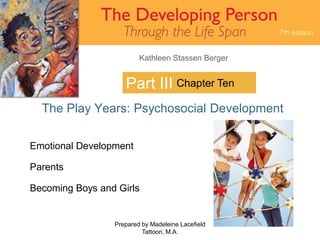
Kathleen Stassen Berger


                    Part III Chapter Ten
  The Play Years: Psychosocial Development

Emotional Development

Parents

Becoming Boys and Girls


                 Prepared by Madeleine Lacefield   1
                          Tattoon, M.A.
The Play Years: Psychosocial Development

• 2 to 6-year-old transformation
• maturation and motivation are crucial;
  so are emotion and experiences.
• psychosocial development is
  multifaceted, involving genes, gender,
  parents, peers, and culture


                                       2
Emotional Development
• Learning when and how to express
  emotions is the preeminent psychosocial
  accomplishment between the ages of 2
  and 6 years
• emotional regulation
  – the ability to control when and how emotions
    are expressed
  – This is the most important psychosocial
    development to occur between the ages
    of 2 and 6 though it contains throughout life

                                                    3
Emotional Development
• Initiative Versus Guilt
  – Erickson’s third psychosocial crisis
     • children begin new activities and feel guilty
       when they fail
  – self-esteem
     • how a person evaluates his or her own worth,
       either in specific (e.g., intelligence,
       attractiveness) or overall
  – self-concept
     • a person’s understanding of who he or she is
       – Self-concept includes appearance, personality, and various
         traits

                                                                      4
Emotional Development
• Pride
  – ―Erickson recognized that typical 3 – 5-year-
    olds have immodest and quite positive self-
    concepts, holding themselves in high self-
    esteem.‖
  – longer attention span—they have a purpose
    for what they do
  – self-esteem and concentration are connected
    with maturation (but are not the cause)
  – feeling proud of oneself is the foundation for
    practice and then mastery

                                                     5
Emotional Development
• Guilt and Shame
  – guilt
    • people blame themselves because they
      have done something wrong
  – shame
    • people feel that others are blaming them
  – guilt and shame often occur together,
    but don’t necessarily go hand in hand

                                                 6
Emotional Development
• Intrinsic Motivation
  – goals or drives that come from inside a
    person, such as the need to feel smart
    or competent—this contracts with
    external motivation, the need for
    rewards from outside, such as material
    possessions or someone else’s esteem


                                              7
Emotional Development
• Psychopathology
  – illness or disorder (-pathology) that
    involves the mind (psycho-)
  – the first signs in children usually involve
    emotions that seem to overwhelm the
    child
  – emotional regulation begins with
    impulse control
                                                  8
Emotional Development
• Emotional Balance
  – without adequate control, emotions overpower
    children
  – externalizing problems
    • difficulty with emotional regulation that involves
      outwardly expressing emotions in uncontrolled
      ways, such as by lashing out in impulsive anger
      or attacking other people or things
  – internalizing problems
    • difficulty with emotional regulation that involves
      turning one’s emotional distress inward, as by
      feeling excessively guilty, ashamed, or
      worthless

                                                           9
Emotional Development
• Differences in Early Care
  – neurological damage can occur during early
    development
     • prenatally
       – If a pregnant woman is stresses, ill, or a heavy drug
         user
     • in infancy
       – if an infant is chronically malnourished, injured, or
         frightened
     • extensive stress can kill some neurons and stop
       others from developing properly

                                                                 10
Emotional Development
• Differences in Early Care
  – early care can prevent or worsen innate
    problems with emotional control
  – the harm of poor caregiving is evident in
    maltreated 4 – 6-year-olds.
  – if neglect or abuse occurs in the first few
    years it is more likely to cause
    internalizing or externalizing problems
    than mistreatment that begins when the
    child is older
                                              11
Emotional Development
• Empathy and Antipathy
  – empathy
    • the ability to understand the emotions of
      another person, especially when those
      emotions differ from one’s own
  – antipathy
    • feelings of anger, distrust, dislike, or
      even hatred toward another person

                                                 12
Emotional Development
• Leading to Behavior
  – prosocial behavior
    • feelings and acting in ways that are
      helpful and kind, without obvious benefit
      to one self
  – antisocial behavior
    • feelings and acting in ways that are
      deliberately hurtful or destructive to
      another person

                                               13
Emotional Development

• Aggression
  ―The gradual regulation of emotions and
    emergence of antipathy is nowhere
    more apparent than in the most
    antisocial behavior of all, active
    aggression, which occurs when a child’s
    dislike erupts into action."


                                          14
Emotional Development
• Aggression
  – instrumental aggression
    • hurtful behavior that is intended to get or keep
      something that another person has
  – reactive aggression
    • an impulsive retaliaton for another person’s
      intentional or accidental actions, verbal or physical
  – bullying aggression
    • unprovoked, repeated physical or verbal attack,
      especially on victims who are unlikely to defend
      themselves
                                                         15
Emotional Development

• Aggression
  – bullying
    • is not always physical; it can be verbal or
      relational when the goal is to disrupt a
      child’s friendship
    • physical aggression declines over the
      preschool and school-age years, but
      verbal attacks may increase (so might
      relational aggression)

                                                16
Parents

the primary influence on the young child’s
  emotions--including brain maturation
  and culture
  – parents differ a great deal in what they
    believe about children and how they act
    with them


                                           17
Parents
• Parenting Style
  – Diana Baumrind (1967, 1972) studied 100
    preschooler, in California (middle class,
    European Americans—the cohort and
    cultural limitations of this sample were not
    obvious at the time.)
    • parents differed on four important dimensions
       – expressions of warmth
       – strategies for discipline
       – communication
       – expectations for maturity

                                                      18
Parents
• Baumrind’s Three Patterns of Parenting
    • authoritarian parenting
       – child rearing with high behavioral standards,
         punishment of misconduct, and low
         communication
     • permissive parenting
       – child rearing with high nurturance and
         communication but rare punishment,
         guidance, or control
     • authoritative parenting
       – child rearing in which the parents set limits
         but listen to the child and are flexible

                                                         19
Parents
• Cultural Variations
     • effective Chinese, Caribbean, and African
        American parents are often stricter than
        effective parents of northern or western
        European backgrounds
     • Japanese mothers tend to use reasoning,
        empathy and expressions of disappointment to
        control their children more than North American
        mothers do
  – it is important to acknowledge that multicultural
    and international research has found that
    specific discipline methods and family rules are
    less important then parental warmth, support
    and concern

                                                      20
Parents
• Discipline and Punishment
  – discipline varies a great deal from family
    to family, culture to culture
  – ideal parents anticipate misbehavior and
    guide their children towards patterns
    that will help them lifelong
  – disciplinary techniques do not work
    quickly or automatically to teach desired
    behavior

                                             21
Parents
• Discipline and Punishment
  – first step is clarity
    • what is expected
       – each family needs to decide its goals and
         make them explicit for the child
  – second step is to remember
    • what the child is able to do
       – parents forget how immature children’s
         control over their bodies and minds is


                                                     22
Parents
• Discipline and Punishment
  – time-out
    • an adult requires the child to sit quietly apart
      from other people for a few minutes—for young
      children, one minute per year of age
  – withdrawal of love
    • when the parent expresses disappointment or
      looks sternly a the child, as if the child were no
      longer loveable
  – induction
    • the parents talk with the child, getting the child
      to understand why the behavior was wrong

                                                           23
Parents
• The Challenge of Media
  – many parent allow television watching
    and/or computers because they keep
    children engaged
  – parents often ignore the possible impact
    on the emotionally immure child who is
    dazzled by fast-moving images
  – experts advise parents to minimize
    media exposure
                                           24
Parenting
• The Importance
  of Content
  – most young
    children spend
    more than three
    hours a day using
    some sort of
    media

                           25
Parenting
• The Importance of Content
  – almost every home has at least two televisions
  – ―What do children see?‖
  – attempts to limit or restrict children’s watching
    have limited success
  – evidence from every perspective confirm that
    violence is pervasive, children who watch
    violence on television become more violent


                                                   26
Parenting
• The Effects on Family Life
  – the worst effect of the media is how it
    interferes with family life
  – the more media a family uses, the less
    time they spend together
  – media reduces the amount of time
    children spend in imaginative and social
    play, thus on learning

                                           27
Becoming Boys and Girls
• sex differences
  – biological differences between males
    and females, in organs, hormones, and
    body type
• gender differences
  – differences in the roles and behavior of
    males and females that originate in the
    culture

                                               28
Becoming Boys and Girls
• Theories of Gender Differences
  – experts and parents disagree about what
    proportion of observed gender differences is
    biological and what proportion is
    environmental
  – neuroscientists tend to look for male-female
    brain differences, and they find many
  – sociologist tend to look for male-female,
    family, and culture patterns, and they also find
    many

                                                   29
Becoming Boys and Girls
• Psychoanalytic Theory
  – phallic stage
    • Freud’s third stage of development,
      when the penis becomes the focus of
      concern and pleasure
  – oedipus complex
    • the unconscious desire of young boys is
      to replace their father and win their
      mother’s exclusive love

                                            30
Becoming Boys and Girls
• Psychoanalytic Theory
  – superego
     • in psychoanalytic theory, the judgmental part of
       the personality that internalizes the moral
       standards of the parents
  – electra complex
     • the unconscious desire of girls to replace their
       mother and win their father’s exclusive love
  – identification
       – an attempt to defend one’s self-concept by taking on
         the behaviors and attitudes of someone else

                                                                31
Becoming Boys and Girls
• Behaviorism
  – belief that virtually all
    roles are learned and
    therefore result from
    nurture, not nature
  – gender distinctions are
    the product of ongoing
    reinforcement and
    punishment

                                32
Becoming Boys and Girls
• Cognitive Theory
  – focuses on children’s understanding:
    • of the way a child intellectually grasps a specific
      issue or value
  – children develop concepts about their
    experience
    • developing a gender schema, a type of
      cognitive schema or general belief—the
      understanding of sex differences


                                                       33
Becoming Boys and Girls
• Sociocultural Theory
  – proponents point our that many
    traditional cultures enforce gender
    distinctions with dramatic stores, taboos,
    and terminology
  – adult activities and dress are strictly
    separate by gender, girls and boys
    attend sex-separated schools and
    virtually never play together

                                            34
Becoming Boys and Girls
• Sociocultural Theory
  – every culture has powerful values and
    attitudes regarding preferred behavior
    for men and women and every culture
    teaches these values to its young, even
    thorough the particular task assigned
    may vary
  – androgyny
    • a balance, within a person,
      of traditionally male and
      female psychological
      characteristics

                                              35
Becoming Boys and Girls
• Epigenetic Theory
  – that our traits and behaviors are the result of
    interactions between genes and early
    experiences… not just for individual but for the
    human race as a whole
  – gender differences based in genetics are
    supported by recent research in neurobiology
  – there are dozen of biological differences
    between the male and female brain

                                                  36
Becoming Boys and Girls
• Gender and Destiny
  – lead in two opposite directions…
    • gender differences are rooted in biology
    • biology is not destiny--children are
      shaped by their experiences
  – given nature and nurture, both these
    conclusions are valid


                                                 37
Becoming Boys and Girls
• Gender and Destiny
  – ―Since human behavior is plastic, what gender
    patterns should children learn?‖
  – answers vary among developmentalist,
    mothers, fathers, and cultures
  – if children respond to their own inclinations,
    some might choose behavior, express
    emotions, and develop talents that are taboo,
    even punished in certain cultures

                                                 38

Chapter 10 (Psych 41)Pdf

  • 1.
    Kathleen Stassen Berger Part III Chapter Ten The Play Years: Psychosocial Development Emotional Development Parents Becoming Boys and Girls Prepared by Madeleine Lacefield 1 Tattoon, M.A.
  • 2.
    The Play Years:Psychosocial Development • 2 to 6-year-old transformation • maturation and motivation are crucial; so are emotion and experiences. • psychosocial development is multifaceted, involving genes, gender, parents, peers, and culture 2
  • 3.
    Emotional Development • Learningwhen and how to express emotions is the preeminent psychosocial accomplishment between the ages of 2 and 6 years • emotional regulation – the ability to control when and how emotions are expressed – This is the most important psychosocial development to occur between the ages of 2 and 6 though it contains throughout life 3
  • 4.
    Emotional Development • InitiativeVersus Guilt – Erickson’s third psychosocial crisis • children begin new activities and feel guilty when they fail – self-esteem • how a person evaluates his or her own worth, either in specific (e.g., intelligence, attractiveness) or overall – self-concept • a person’s understanding of who he or she is – Self-concept includes appearance, personality, and various traits 4
  • 5.
    Emotional Development • Pride – ―Erickson recognized that typical 3 – 5-year- olds have immodest and quite positive self- concepts, holding themselves in high self- esteem.‖ – longer attention span—they have a purpose for what they do – self-esteem and concentration are connected with maturation (but are not the cause) – feeling proud of oneself is the foundation for practice and then mastery 5
  • 6.
    Emotional Development • Guiltand Shame – guilt • people blame themselves because they have done something wrong – shame • people feel that others are blaming them – guilt and shame often occur together, but don’t necessarily go hand in hand 6
  • 7.
    Emotional Development • IntrinsicMotivation – goals or drives that come from inside a person, such as the need to feel smart or competent—this contracts with external motivation, the need for rewards from outside, such as material possessions or someone else’s esteem 7
  • 8.
    Emotional Development • Psychopathology – illness or disorder (-pathology) that involves the mind (psycho-) – the first signs in children usually involve emotions that seem to overwhelm the child – emotional regulation begins with impulse control 8
  • 9.
    Emotional Development • EmotionalBalance – without adequate control, emotions overpower children – externalizing problems • difficulty with emotional regulation that involves outwardly expressing emotions in uncontrolled ways, such as by lashing out in impulsive anger or attacking other people or things – internalizing problems • difficulty with emotional regulation that involves turning one’s emotional distress inward, as by feeling excessively guilty, ashamed, or worthless 9
  • 10.
    Emotional Development • Differencesin Early Care – neurological damage can occur during early development • prenatally – If a pregnant woman is stresses, ill, or a heavy drug user • in infancy – if an infant is chronically malnourished, injured, or frightened • extensive stress can kill some neurons and stop others from developing properly 10
  • 11.
    Emotional Development • Differencesin Early Care – early care can prevent or worsen innate problems with emotional control – the harm of poor caregiving is evident in maltreated 4 – 6-year-olds. – if neglect or abuse occurs in the first few years it is more likely to cause internalizing or externalizing problems than mistreatment that begins when the child is older 11
  • 12.
    Emotional Development • Empathyand Antipathy – empathy • the ability to understand the emotions of another person, especially when those emotions differ from one’s own – antipathy • feelings of anger, distrust, dislike, or even hatred toward another person 12
  • 13.
    Emotional Development • Leadingto Behavior – prosocial behavior • feelings and acting in ways that are helpful and kind, without obvious benefit to one self – antisocial behavior • feelings and acting in ways that are deliberately hurtful or destructive to another person 13
  • 14.
    Emotional Development • Aggression ―The gradual regulation of emotions and emergence of antipathy is nowhere more apparent than in the most antisocial behavior of all, active aggression, which occurs when a child’s dislike erupts into action." 14
  • 15.
    Emotional Development • Aggression – instrumental aggression • hurtful behavior that is intended to get or keep something that another person has – reactive aggression • an impulsive retaliaton for another person’s intentional or accidental actions, verbal or physical – bullying aggression • unprovoked, repeated physical or verbal attack, especially on victims who are unlikely to defend themselves 15
  • 16.
    Emotional Development • Aggression – bullying • is not always physical; it can be verbal or relational when the goal is to disrupt a child’s friendship • physical aggression declines over the preschool and school-age years, but verbal attacks may increase (so might relational aggression) 16
  • 17.
    Parents the primary influenceon the young child’s emotions--including brain maturation and culture – parents differ a great deal in what they believe about children and how they act with them 17
  • 18.
    Parents • Parenting Style – Diana Baumrind (1967, 1972) studied 100 preschooler, in California (middle class, European Americans—the cohort and cultural limitations of this sample were not obvious at the time.) • parents differed on four important dimensions – expressions of warmth – strategies for discipline – communication – expectations for maturity 18
  • 19.
    Parents • Baumrind’s ThreePatterns of Parenting • authoritarian parenting – child rearing with high behavioral standards, punishment of misconduct, and low communication • permissive parenting – child rearing with high nurturance and communication but rare punishment, guidance, or control • authoritative parenting – child rearing in which the parents set limits but listen to the child and are flexible 19
  • 20.
    Parents • Cultural Variations • effective Chinese, Caribbean, and African American parents are often stricter than effective parents of northern or western European backgrounds • Japanese mothers tend to use reasoning, empathy and expressions of disappointment to control their children more than North American mothers do – it is important to acknowledge that multicultural and international research has found that specific discipline methods and family rules are less important then parental warmth, support and concern 20
  • 21.
    Parents • Discipline andPunishment – discipline varies a great deal from family to family, culture to culture – ideal parents anticipate misbehavior and guide their children towards patterns that will help them lifelong – disciplinary techniques do not work quickly or automatically to teach desired behavior 21
  • 22.
    Parents • Discipline andPunishment – first step is clarity • what is expected – each family needs to decide its goals and make them explicit for the child – second step is to remember • what the child is able to do – parents forget how immature children’s control over their bodies and minds is 22
  • 23.
    Parents • Discipline andPunishment – time-out • an adult requires the child to sit quietly apart from other people for a few minutes—for young children, one minute per year of age – withdrawal of love • when the parent expresses disappointment or looks sternly a the child, as if the child were no longer loveable – induction • the parents talk with the child, getting the child to understand why the behavior was wrong 23
  • 24.
    Parents • The Challengeof Media – many parent allow television watching and/or computers because they keep children engaged – parents often ignore the possible impact on the emotionally immure child who is dazzled by fast-moving images – experts advise parents to minimize media exposure 24
  • 25.
    Parenting • The Importance of Content – most young children spend more than three hours a day using some sort of media 25
  • 26.
    Parenting • The Importanceof Content – almost every home has at least two televisions – ―What do children see?‖ – attempts to limit or restrict children’s watching have limited success – evidence from every perspective confirm that violence is pervasive, children who watch violence on television become more violent 26
  • 27.
    Parenting • The Effectson Family Life – the worst effect of the media is how it interferes with family life – the more media a family uses, the less time they spend together – media reduces the amount of time children spend in imaginative and social play, thus on learning 27
  • 28.
    Becoming Boys andGirls • sex differences – biological differences between males and females, in organs, hormones, and body type • gender differences – differences in the roles and behavior of males and females that originate in the culture 28
  • 29.
    Becoming Boys andGirls • Theories of Gender Differences – experts and parents disagree about what proportion of observed gender differences is biological and what proportion is environmental – neuroscientists tend to look for male-female brain differences, and they find many – sociologist tend to look for male-female, family, and culture patterns, and they also find many 29
  • 30.
    Becoming Boys andGirls • Psychoanalytic Theory – phallic stage • Freud’s third stage of development, when the penis becomes the focus of concern and pleasure – oedipus complex • the unconscious desire of young boys is to replace their father and win their mother’s exclusive love 30
  • 31.
    Becoming Boys andGirls • Psychoanalytic Theory – superego • in psychoanalytic theory, the judgmental part of the personality that internalizes the moral standards of the parents – electra complex • the unconscious desire of girls to replace their mother and win their father’s exclusive love – identification – an attempt to defend one’s self-concept by taking on the behaviors and attitudes of someone else 31
  • 32.
    Becoming Boys andGirls • Behaviorism – belief that virtually all roles are learned and therefore result from nurture, not nature – gender distinctions are the product of ongoing reinforcement and punishment 32
  • 33.
    Becoming Boys andGirls • Cognitive Theory – focuses on children’s understanding: • of the way a child intellectually grasps a specific issue or value – children develop concepts about their experience • developing a gender schema, a type of cognitive schema or general belief—the understanding of sex differences 33
  • 34.
    Becoming Boys andGirls • Sociocultural Theory – proponents point our that many traditional cultures enforce gender distinctions with dramatic stores, taboos, and terminology – adult activities and dress are strictly separate by gender, girls and boys attend sex-separated schools and virtually never play together 34
  • 35.
    Becoming Boys andGirls • Sociocultural Theory – every culture has powerful values and attitudes regarding preferred behavior for men and women and every culture teaches these values to its young, even thorough the particular task assigned may vary – androgyny • a balance, within a person, of traditionally male and female psychological characteristics 35
  • 36.
    Becoming Boys andGirls • Epigenetic Theory – that our traits and behaviors are the result of interactions between genes and early experiences… not just for individual but for the human race as a whole – gender differences based in genetics are supported by recent research in neurobiology – there are dozen of biological differences between the male and female brain 36
  • 37.
    Becoming Boys andGirls • Gender and Destiny – lead in two opposite directions… • gender differences are rooted in biology • biology is not destiny--children are shaped by their experiences – given nature and nurture, both these conclusions are valid 37
  • 38.
    Becoming Boys andGirls • Gender and Destiny – ―Since human behavior is plastic, what gender patterns should children learn?‖ – answers vary among developmentalist, mothers, fathers, and cultures – if children respond to their own inclinations, some might choose behavior, express emotions, and develop talents that are taboo, even punished in certain cultures 38