Communication
 between cultures                                                            8TH EDITION


        Chapter 3
   The Deep Structure of Culture:
   Lessons from the Family


                 Chapter 3 The Deep Structure of Culture: Lessons Learned from
© Cengage 2012                                                                             1
                                          the Family
Key Ideas
• Social Institutions and deep structures of
  culture
• The family’s influence on culture
• Cultural variants in family interaction


  © Cengage 2012   Chapter 3 The Deep Structure of Culture: Lessons Learned from the Family   2
Social Institutions and Deep Structure

• Deep structure is conscious and unconscious
  assumptions of how world works
   – Unifies collective actions
   – Deals with significant universal questions
• Influenced by social institutions
   – Family (clans)
   – State (community)
   – Religion (worldview/0

  © Cengage 2012   Chapter 3 The Deep Structure of Culture: Lessons Learned from the Family   3
Social institutions and deep structure

• Carry the culture’s most important messages
   – Right and wrong
   – Fate of power or free choice
   – Loyalties
   – Where you should reside
   – Preparing for death
• Carry enduring messages
• Carry messages that are deeply felt
  © Cengage 2012   Chapter 3 The Deep Structure of Culture: Lessons Learned from the Family   4
Social institutions and deep structure

• Carry messages that deal with personal
  identity
   – Variety of identities
      based on “I” / based on “we”
   – Ethnic and cultural identities
      views we share with our in-groups
   – Membership in family, faith, community identifies
     us


  © Cengage 2012   Chapter 3 The Deep Structure of Culture: Lessons Learned from the Family   5
Family
• The importance of family
   – First and chief socializing agent
   – Oldest, most fundamental of all human
     institutions
   – Most basic unit of society, most basic unit of
       government
   – Universal


  © Cengage 2012   Chapter 3 The Deep Structure of Culture: Lessons Learned from the Family   6
Family defined
 A family is any sexually expressive or
parent-child or other kin relationship in
which people—usually related by ancestry,
marriage, or adoption—(1) form an
economic unit and care for any young, (2)
consider their identity to be significantly
attached to the group, and (3) commit to
maintaining that group over time.
(Lamanna and Riedman 2009, p.26)
© Cengage 2012   Chapter 3 The Deep Structure of Culture: Lessons Learned from the Family   7
Forms of Family
• Nuclear - two-generation: parent/child
   – common in developed nations
   – elderly reside in retirement communities, nursing
     homes; to take in aged parents regarded as
     economic burden, threat to household’s privacy,
     independence
   – exploration and creativity encouraged


  © Cengage 2012   Chapter 3 The Deep Structure of Culture: Lessons Learned from the Family   8
Forms of Family
• Extended - includes grandparents, relatives
   – common in developing and underdeveloped
     nations
   – collection of relatives gathered for economic
     reasons
   – share workload of raising the children
   – more obedience, more organized around rules


  © Cengage 2012   Chapter 3 The Deep Structure of Culture: Lessons Learned from the Family   9
Forms of Family
• Alternate forms
   – Family of orientation - family you’re born into
       Family formed with mate - marriage, life
       partnership


  © Cengage 2012   Chapter 3 The Deep Structure of Culture: Lessons Learned from the Family   10
Transforming families in the U.S.
• Social Changes
   –   Economic changes
   –   Technological innovations
   –   Demographics
   –   Gender roles and opportunities for women

 U.S. Census Bureau reports that the number of children
 under the age of 18 living with both parents declined
 between 2000 and 2010.
 Stanford University study calculates that more than
 7% of America’s 59 million married couples are
 interracial (compared to under 2% in 1970)
  © Cengage 2012   Chapter 3 The Deep Structure of Culture: Lessons Learned from the Family   11
Transforming families in the U.S.
• New family types
   – Traditional” married couples
   – Children living with one parent
   – A heterosexual woman and man who have
     cohabited and have children, but have never
     married
   – Two gay men or two lesbians who have adopted a
     child
   – A single woman or man who has adopted a child
       (Andersen and Taylor 2011, pp. 319-323)


  © Cengage 2012   Chapter 3 The Deep Structure of Culture: Lessons Learned from the Family   12
Globalization and families
• Mass media
   – New technologies offer family members different
     set of value
   – Families struggle to blend traditional patterns
     with new ones
• Migration
   – To escape poverty, wage-earners separated for
     long period
   – Personal closeness of family deteriorates due to
     absence
   – Core family values affected
  © Cengage 2012   Chapter 3 The Deep Structure of Culture: Lessons Learned from the Family   13
Functions of the family
• Reproduction - allows a culture to perpetuate
  itself
• Economic - providing for practical needs
• Socialization - teaching important traditions
  and social skills as well as values and morals
• Identity - most important social identity;
  precursor to all others


  © Cengage 2012    Chapter 3 The Deep Structure of Culture: Lessons Learned from the Family   14
Communication, culture and family

• The family is both the product of
  communication and the context in which
  communication takes place
• The family teaches many communication
  skills
   – Introduces people to language
   – Tells people how to employ language


  © Cengage 2012   Chapter 3 The Deep Structure of Culture: Lessons Learned from the Family   15
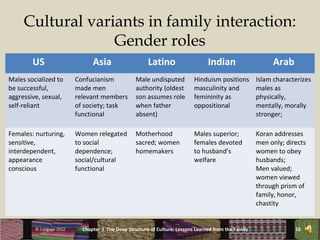
Cultural variants in family interaction:
                  Gender roles
        US                      Asia                    Latino                    Indian                    Arab
Males socialized to       Confucianism             Male undisputed          Hinduism positions         Islam characterizes
be successful,            made men                 authority (oldest        masculinity and            males as
aggressive, sexual,       relevant members         son assumes role         femininity as              physically,
self-reliant              of society; task         when father              oppositional               mentally, morally
                          functional               absent)                                             stronger;

Females: nurturing,       Women relegated          Motherhood               Males superior;            Koran addresses
sensitive,                to social                sacred; women            females devoted            men only; directs
interdependent,           dependence;              homemakers               to husband’s               women to obey
appearance                social/cultural                                   welfare                    husbands;
conscious                 functional                                                                   Men valued;
                                                                                                       women viewed
                                                                                                       through prism of
                                                                                                       family, honor,
                                                                                                       chastity


         © Cengage 2012     Chapter 3 The Deep Structure of Culture: Lessons Learned from the Family                16
Cultural variants in family interaction:
             Gender roles
• Westernization and globalization changing
  gender roles
   – Women increasingly incorporated into world
     economy
   – Must guard against applying Western standards
     to all


  © Cengage 2012   Chapter 3 The Deep Structure of Culture: Lessons Learned from the Family   17
Individualism and Collectivism
• Dimension or continuum along which a
 culture is placed
  – Individualistic cultures value individual over
     group self-motivation, autonomy, independent
     thinking
   – Collectivists share intense feelings of dependence,
     loyalty collective interests of the group placed
     before personal harmony sought; disapproval
     avoided


  © Cengage 2012   Chapter 3 The Deep Structure of Culture: Lessons Learned from the Family   18
Individualism and Collectivism
• Individualism and the family
   – Emphasis on independence and individual
     autonomy
   – Mother and child are distinct
   – Child is encouraged to leave the nest
   – Child encouraged to think for themselves


  © Cengage 2012   Chapter 3 The Deep Structure of Culture: Lessons Learned from the Family   19
Individualism and Collectivism
• Collectivism and the family
   – Family interdependence is stressed
   – Extended families rely on each other for care of
     children, friendship and support
   – The family is ahead of the individual


  © Cengage 2012   Chapter 3 The Deep Structure of Culture: Lessons Learned from the Family   20
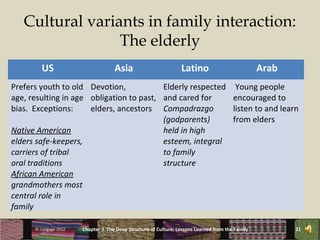
Cultural variants in family interaction:
                 The elderly
         US                         Asia                         Latino                           Arab
Prefers youth to old Devotion,            Elderly respected Young people
age, resulting in age obligation to past, and cared for     encouraged to
bias. Exceptions:     elders, ancestors Compadrazgo         listen to and learn
                                          (godparents)      from elders
Native American                           held in high
elders safe-keepers,                      esteem, integral
carriers of tribal                        to family
oral traditions                           structure
African American
grandmothers most
central role in
family

      © Cengage 2012   Chapter 3 The Deep Structure of Culture: Lessons Learned from the Family          21
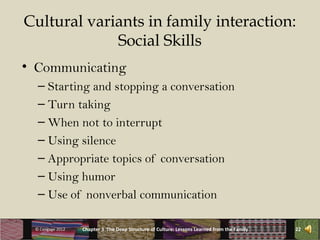
Cultural variants in family interaction:
             Social Skills
• Communicating
  – Starting and stopping a conversation
  – Turn taking
  – When not to interrupt
  – Using silence
  – Appropriate topics of conversation
  – Using humor
  – Use of nonverbal communication

 © Cengage 2012   Chapter 3 The Deep Structure of Culture: Lessons Learned from the Family   22
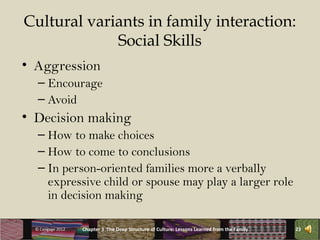
Cultural variants in family interaction:
             Social Skills
• Aggression
   – Encourage
   – Avoid
• Decision making
   – How to make choices
   – How to come to conclusions
   – In person-oriented families more a verbally
     expressive child or spouse may play a larger role
     in decision making

  © Cengage 2012   Chapter 3 The Deep Structure of Culture: Lessons Learned from the Family   23
Communication
 between cultures                                                            8TH EDITION


        Chapter 3
   The Deep Structure of Culture:
   Lessons from the Family


                 Chapter 3 The Deep Structure of Culture: Lessons Learned from
© Cengage 2012                                                                             24
                                          the Family

Com 108 Ch3 narration

  • 1.
    Communication between cultures 8TH EDITION Chapter 3 The Deep Structure of Culture: Lessons from the Family Chapter 3 The Deep Structure of Culture: Lessons Learned from © Cengage 2012 1 the Family
  • 2.
    Key Ideas • SocialInstitutions and deep structures of culture • The family’s influence on culture • Cultural variants in family interaction © Cengage 2012 Chapter 3 The Deep Structure of Culture: Lessons Learned from the Family 2
  • 3.
    Social Institutions andDeep Structure • Deep structure is conscious and unconscious assumptions of how world works – Unifies collective actions – Deals with significant universal questions • Influenced by social institutions – Family (clans) – State (community) – Religion (worldview/0 © Cengage 2012 Chapter 3 The Deep Structure of Culture: Lessons Learned from the Family 3
  • 4.
    Social institutions anddeep structure • Carry the culture’s most important messages – Right and wrong – Fate of power or free choice – Loyalties – Where you should reside – Preparing for death • Carry enduring messages • Carry messages that are deeply felt © Cengage 2012 Chapter 3 The Deep Structure of Culture: Lessons Learned from the Family 4
  • 5.
    Social institutions anddeep structure • Carry messages that deal with personal identity – Variety of identities based on “I” / based on “we” – Ethnic and cultural identities views we share with our in-groups – Membership in family, faith, community identifies us © Cengage 2012 Chapter 3 The Deep Structure of Culture: Lessons Learned from the Family 5
  • 6.
    Family • The importanceof family – First and chief socializing agent – Oldest, most fundamental of all human institutions – Most basic unit of society, most basic unit of government – Universal © Cengage 2012 Chapter 3 The Deep Structure of Culture: Lessons Learned from the Family 6
  • 7.
    Family defined Afamily is any sexually expressive or parent-child or other kin relationship in which people—usually related by ancestry, marriage, or adoption—(1) form an economic unit and care for any young, (2) consider their identity to be significantly attached to the group, and (3) commit to maintaining that group over time. (Lamanna and Riedman 2009, p.26) © Cengage 2012 Chapter 3 The Deep Structure of Culture: Lessons Learned from the Family 7
  • 8.
    Forms of Family •Nuclear - two-generation: parent/child – common in developed nations – elderly reside in retirement communities, nursing homes; to take in aged parents regarded as economic burden, threat to household’s privacy, independence – exploration and creativity encouraged © Cengage 2012 Chapter 3 The Deep Structure of Culture: Lessons Learned from the Family 8
  • 9.
    Forms of Family •Extended - includes grandparents, relatives – common in developing and underdeveloped nations – collection of relatives gathered for economic reasons – share workload of raising the children – more obedience, more organized around rules © Cengage 2012 Chapter 3 The Deep Structure of Culture: Lessons Learned from the Family 9
  • 10.
    Forms of Family •Alternate forms – Family of orientation - family you’re born into Family formed with mate - marriage, life partnership © Cengage 2012 Chapter 3 The Deep Structure of Culture: Lessons Learned from the Family 10
  • 11.
    Transforming families inthe U.S. • Social Changes – Economic changes – Technological innovations – Demographics – Gender roles and opportunities for women U.S. Census Bureau reports that the number of children under the age of 18 living with both parents declined between 2000 and 2010. Stanford University study calculates that more than 7% of America’s 59 million married couples are interracial (compared to under 2% in 1970) © Cengage 2012 Chapter 3 The Deep Structure of Culture: Lessons Learned from the Family 11
  • 12.
    Transforming families inthe U.S. • New family types – Traditional” married couples – Children living with one parent – A heterosexual woman and man who have cohabited and have children, but have never married – Two gay men or two lesbians who have adopted a child – A single woman or man who has adopted a child (Andersen and Taylor 2011, pp. 319-323) © Cengage 2012 Chapter 3 The Deep Structure of Culture: Lessons Learned from the Family 12
  • 13.
    Globalization and families •Mass media – New technologies offer family members different set of value – Families struggle to blend traditional patterns with new ones • Migration – To escape poverty, wage-earners separated for long period – Personal closeness of family deteriorates due to absence – Core family values affected © Cengage 2012 Chapter 3 The Deep Structure of Culture: Lessons Learned from the Family 13
  • 14.
    Functions of thefamily • Reproduction - allows a culture to perpetuate itself • Economic - providing for practical needs • Socialization - teaching important traditions and social skills as well as values and morals • Identity - most important social identity; precursor to all others © Cengage 2012 Chapter 3 The Deep Structure of Culture: Lessons Learned from the Family 14
  • 15.
    Communication, culture andfamily • The family is both the product of communication and the context in which communication takes place • The family teaches many communication skills – Introduces people to language – Tells people how to employ language © Cengage 2012 Chapter 3 The Deep Structure of Culture: Lessons Learned from the Family 15
  • 16.
    Cultural variants infamily interaction: Gender roles US Asia Latino Indian Arab Males socialized to Confucianism Male undisputed Hinduism positions Islam characterizes be successful, made men authority (oldest masculinity and males as aggressive, sexual, relevant members son assumes role femininity as physically, self-reliant of society; task when father oppositional mentally, morally functional absent) stronger; Females: nurturing, Women relegated Motherhood Males superior; Koran addresses sensitive, to social sacred; women females devoted men only; directs interdependent, dependence; homemakers to husband’s women to obey appearance social/cultural welfare husbands; conscious functional Men valued; women viewed through prism of family, honor, chastity © Cengage 2012 Chapter 3 The Deep Structure of Culture: Lessons Learned from the Family 16
  • 17.
    Cultural variants infamily interaction: Gender roles • Westernization and globalization changing gender roles – Women increasingly incorporated into world economy – Must guard against applying Western standards to all © Cengage 2012 Chapter 3 The Deep Structure of Culture: Lessons Learned from the Family 17
  • 18.
    Individualism and Collectivism •Dimension or continuum along which a culture is placed – Individualistic cultures value individual over group self-motivation, autonomy, independent thinking – Collectivists share intense feelings of dependence, loyalty collective interests of the group placed before personal harmony sought; disapproval avoided © Cengage 2012 Chapter 3 The Deep Structure of Culture: Lessons Learned from the Family 18
  • 19.
    Individualism and Collectivism •Individualism and the family – Emphasis on independence and individual autonomy – Mother and child are distinct – Child is encouraged to leave the nest – Child encouraged to think for themselves © Cengage 2012 Chapter 3 The Deep Structure of Culture: Lessons Learned from the Family 19
  • 20.
    Individualism and Collectivism •Collectivism and the family – Family interdependence is stressed – Extended families rely on each other for care of children, friendship and support – The family is ahead of the individual © Cengage 2012 Chapter 3 The Deep Structure of Culture: Lessons Learned from the Family 20
  • 21.
    Cultural variants infamily interaction: The elderly US Asia Latino Arab Prefers youth to old Devotion, Elderly respected Young people age, resulting in age obligation to past, and cared for encouraged to bias. Exceptions: elders, ancestors Compadrazgo listen to and learn (godparents) from elders Native American held in high elders safe-keepers, esteem, integral carriers of tribal to family oral traditions structure African American grandmothers most central role in family © Cengage 2012 Chapter 3 The Deep Structure of Culture: Lessons Learned from the Family 21
  • 22.
    Cultural variants infamily interaction: Social Skills • Communicating – Starting and stopping a conversation – Turn taking – When not to interrupt – Using silence – Appropriate topics of conversation – Using humor – Use of nonverbal communication © Cengage 2012 Chapter 3 The Deep Structure of Culture: Lessons Learned from the Family 22
  • 23.
    Cultural variants infamily interaction: Social Skills • Aggression – Encourage – Avoid • Decision making – How to make choices – How to come to conclusions – In person-oriented families more a verbally expressive child or spouse may play a larger role in decision making © Cengage 2012 Chapter 3 The Deep Structure of Culture: Lessons Learned from the Family 23
  • 24.
    Communication between cultures 8TH EDITION Chapter 3 The Deep Structure of Culture: Lessons from the Family Chapter 3 The Deep Structure of Culture: Lessons Learned from © Cengage 2012 24 the Family