VET 2204
Appraising and using evidence in
practice
Aims and objectives
In this session we’ll be developing literature searching skills with the
ultimate goal of undertaking a literature review.
During the session we will:
• Discuss the use of literature reviews in evidence based practice.
• Develop techniques for effective and thorough literature searching
• Explore some specialist sources for finding research articles
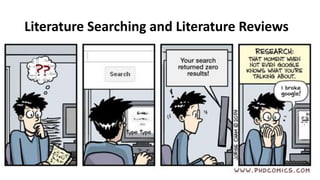
Literature Searching and Literature Reviews
What is literature?
• In an academic context, literature does not mean great works of
fiction, but the information that has be written on a particular
subject.
• Literature can be a book, a book chapter, a journal article, a
conference paper, a newspaper, a government report, a webpage, a
thesis...
What is a literature search?
• Before you can write your literature review, you need to find out
what’s out there. To do this you need to do a literature search.
• A literature search is a systematic, comprehensive or thorough search
of all types of literature in your topic.
• The information can be contained in books, journal articles, reports,
case studies, policy documents, conference proceedings etc.
• A literature search will enable you to find out what has already been
written in your subject area and enable you to identify the main
trends.
What is a literature review?
• A literature review is a search and evaluation of the
available literature in your given subject or chosen topic area. It
documents the state of the art with respect to the subject or topic
you are writing about.
• It surveys the literature in your chosen area of study.
• It is a critical account of what has been written within your chosen
area of research
• It should highlight both widespread agreement, as well as debate and
controversy in previous research
• The emphasis is interpretation of primary research articles.

A literature review has four main objectives
• It surveys the literature in your chosen area of study
• It brings together the information in that literature into a
summary
• It critically analyses the information gathered by identifying
gaps in current knowledge; by showing limitations of theories
and points of view; and by formulating areas for further research
and reviewing areas of controversy
• It presents the literature in an organised way
Why write a literature review?
• Because you have to!
• Allows you to show that you are building on a foundation of existing
knowledge and ideas
• Demonstrates the depth of your knowledge about your research.
• Identifies the important works in your area and shows that you’ve
read them
• Demonstrates your research skills
• Identifies information and ideas that may be relevant to your project
Stages of writing a literature review
• Define the topic area of investigation.
• Identify your keywords
• Locate the key literature – this is the literature search
• Assess the relevance of the literature search
• Access the most relevant material
• Critically analyse and evaluate the literature
• Structuring and writing the literature review
Key points to remember
• It is not a descriptive list.
• It is not a book by book and article by article summary.
• It is not a survey of every single thing that’s ever been written about
your topic.
• It must be defined by an overall concept i.e. essay question, research
project or objective.
• It must tell the reader what knowledge and ideas have been
established and agreed in your area and outline their strengths and
weaknesses.
How to do a literature search
• Define your terms
• Search creatively
• Identify relevant quality academic information sources
• Journals
• Books
• Conference papers
• Databases
• Use the library
• Keep a note of the sources you have used . You will need to reference
them
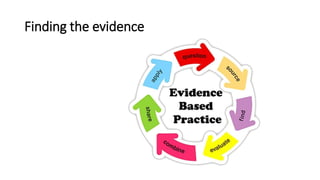
Finding the evidence
What is evidence?
• Evidence is anything that you see, experience, read, or are told that
causes you to believe that something is true or has really happened.
• You will need to provide evidence to support any arguments made in
your assignments
• The evidence is the information from your literature search and your
references
What is Evidence-Based Practice?
‘Evidence-based decisions combine clinical expertise, the most relevant
and best available scientific evidence, patient circumstances and
owners’ values. This is what we mean by Evidence-based Veterinary
Medicine (EBVM).’
RCVS (2017) ‘What is EBVM?’ https://knowledge.rcvs.org.uk/evidence-based-veterinary-
medicine/what-is-ebvm/
Key steps to make a clinical decision
1. Convert information needs into answerable
questions
2. Track down the best evidence with which to answer
them
3. Critically appraise the evidence for validity
4. Apply the results to clinical practice
5. Evaluate performance
Building a search
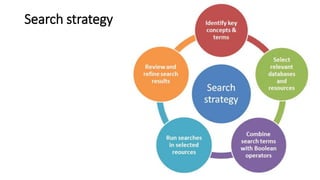
Search strategy
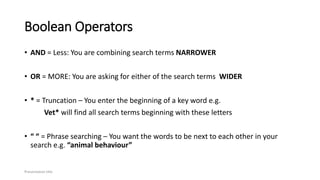
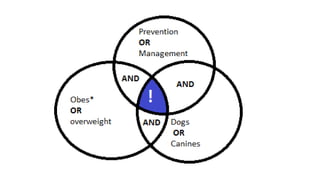
Boolean Operators
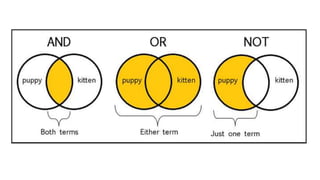
• AND = Less: You are combining search terms NARROWER
• OR = MORE: You are asking for either of the search terms WIDER
• * = Truncation – You enter the beginning of a key word e.g.
Vet* will find all search terms beginning with these letters
• “ “ = Phrase searching – You want the words to be next to each other in your
search e.g. “animal behaviour”
Presentation title
Searching with students!
http://www.flickr.com/photos/rossjamesparker/89414788/
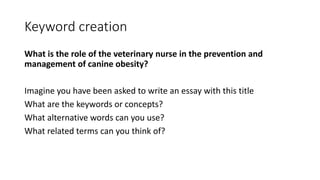
Keyword creation
What is the role of the veterinary nurse in the prevention and
management of canine obesity?
Imagine you have been asked to write an essay with this title
What are the keywords or concepts?
What alternative words can you use?
What related terms can you think of?
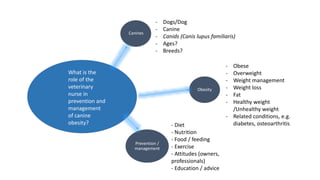
What is the
role of the
veterinary
nurse in
prevention and
management
of canine
obesity?
Canines
Obesity
Prevention /
management
- Dogs/Dog
- Canine
- Canids (Canis lupus familiaris)
- Ages?
- Breeds?
- Obese
- Overweight
- Weight management
- Weight loss
- Fat
- Healthy weight
/Unhealthy weight
- Related conditions, e.g.
diabetes, osteoarthritis
- Diet
- Nutrition
- Food / feeding
- Exercise
- Attitudes (owners,
professionals)
- Education / advice
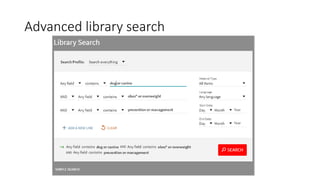
Advanced library search
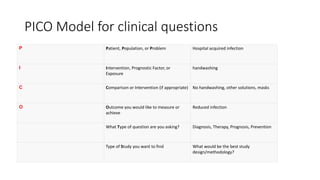
PICO Model for clinical questions
P Patient, Population, or Problem Hospital acquired infection
I Intervention, Prognostic Factor, or
Exposure
handwashing
C Comparison or Intervention (if appropriate) No handwashing, other solutions, masks
O Outcome you would like to measure or
achieve
Reduced infection
What Type of question are you asking? Diagnosis, Therapy, Prognosis, Prevention
Type of Study you want to find What would be the best study
design/methodology?
Evaluating resources
• So you’ve found some information!!
• But is it any good……
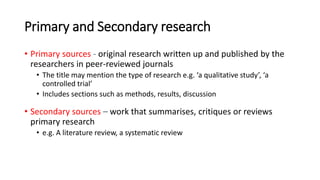
Primary and Secondary research
• Primary sources - original research written up and published by the
researchers in peer-reviewed journals
• The title may mention the type of research e.g. ‘a qualitative study’, ‘a
controlled trial’
• Includes sections such as methods, results, discussion
• Secondary sources – work that summarises, critiques or reviews
primary research
• e.g. A literature review, a systematic review
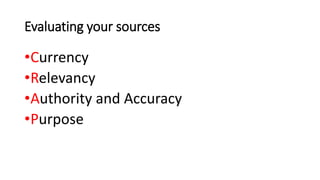
Evaluating your sources
•Currency
•Relevancy
•Authority and Accuracy
•Purpose
Currency
• When was the information published or posted?
• Has the information been revised or updated?
• Are you using the most recent version or edition?
• Does your topic require current information, or will older
sources work as well?
Accuracy/Authority
• Is the information supported by evidence (e.g. references, research data)?
• Has the information been reviewed or refereed?
• Can you verify any of the information in another source or from personal
knowledge?
• Are there spelling, grammar or typographical errors?
• Who is the author/publisher/source/sponsor?
• What are the author's credentials or organisational affiliations?
• Is the author qualified to write on the topic?
• Is there contact information, such as a publisher or email address?
• Does the URL reveal anything about the author or source? examples: .com
.edu .gov .org .net
Reliable Resources
With all the information out there
what can you trust……
Sources for Searches
Google Scholar
VET2204
Databases
• VetMed
• PubMed – Veterinary Science
• CABI
• Web of Science
• CINAHL
• Science Direct
• http://libguides.mdx.ac.uk/vetnursing/journalsdatabases
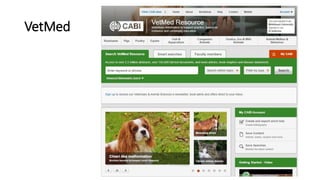
VetMed
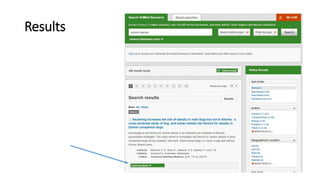
Results
Tips on literature database searching
• Keep records of the searches that you do
• Develop a consistent strategy for handling the results of your
searches.
• Consider using bibliographic software like RefWorks to manage your
references
• Use the export function provided by many databases to transfer
records directly into your own reference library
• Copy and paste relevant records into a text document to retain search
results
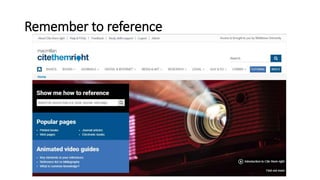
Remember to reference
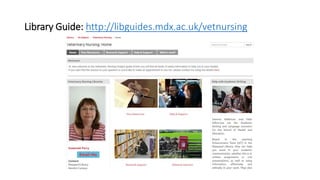
Library Guide: http://libguides.mdx.ac.uk/vetnursing
Any questions?
VET2204 Appraising and using evidence in practice (2021)

VET2204 Appraising and using evidence in practice (2021)

  • 1.
    VET 2204 Appraising andusing evidence in practice
  • 2.
    Aims and objectives Inthis session we’ll be developing literature searching skills with the ultimate goal of undertaking a literature review. During the session we will: • Discuss the use of literature reviews in evidence based practice. • Develop techniques for effective and thorough literature searching • Explore some specialist sources for finding research articles
  • 3.
    Literature Searching andLiterature Reviews
  • 4.
    What is literature? •In an academic context, literature does not mean great works of fiction, but the information that has be written on a particular subject. • Literature can be a book, a book chapter, a journal article, a conference paper, a newspaper, a government report, a webpage, a thesis...
  • 5.
    What is aliterature search? • Before you can write your literature review, you need to find out what’s out there. To do this you need to do a literature search. • A literature search is a systematic, comprehensive or thorough search of all types of literature in your topic. • The information can be contained in books, journal articles, reports, case studies, policy documents, conference proceedings etc. • A literature search will enable you to find out what has already been written in your subject area and enable you to identify the main trends.
  • 6.
    What is aliterature review? • A literature review is a search and evaluation of the available literature in your given subject or chosen topic area. It documents the state of the art with respect to the subject or topic you are writing about. • It surveys the literature in your chosen area of study. • It is a critical account of what has been written within your chosen area of research • It should highlight both widespread agreement, as well as debate and controversy in previous research • The emphasis is interpretation of primary research articles.
  • 7.
    A literature reviewhas four main objectives • It surveys the literature in your chosen area of study • It brings together the information in that literature into a summary • It critically analyses the information gathered by identifying gaps in current knowledge; by showing limitations of theories and points of view; and by formulating areas for further research and reviewing areas of controversy • It presents the literature in an organised way
  • 8.
    Why write aliterature review? • Because you have to! • Allows you to show that you are building on a foundation of existing knowledge and ideas • Demonstrates the depth of your knowledge about your research. • Identifies the important works in your area and shows that you’ve read them • Demonstrates your research skills • Identifies information and ideas that may be relevant to your project
  • 9.
    Stages of writinga literature review • Define the topic area of investigation. • Identify your keywords • Locate the key literature – this is the literature search • Assess the relevance of the literature search • Access the most relevant material • Critically analyse and evaluate the literature • Structuring and writing the literature review
  • 10.
    Key points toremember • It is not a descriptive list. • It is not a book by book and article by article summary. • It is not a survey of every single thing that’s ever been written about your topic. • It must be defined by an overall concept i.e. essay question, research project or objective. • It must tell the reader what knowledge and ideas have been established and agreed in your area and outline their strengths and weaknesses.
  • 11.
    How to doa literature search • Define your terms • Search creatively • Identify relevant quality academic information sources • Journals • Books • Conference papers • Databases • Use the library • Keep a note of the sources you have used . You will need to reference them
  • 12.
  • 13.
    What is evidence? •Evidence is anything that you see, experience, read, or are told that causes you to believe that something is true or has really happened. • You will need to provide evidence to support any arguments made in your assignments • The evidence is the information from your literature search and your references
  • 14.
    What is Evidence-BasedPractice? ‘Evidence-based decisions combine clinical expertise, the most relevant and best available scientific evidence, patient circumstances and owners’ values. This is what we mean by Evidence-based Veterinary Medicine (EBVM).’ RCVS (2017) ‘What is EBVM?’ https://knowledge.rcvs.org.uk/evidence-based-veterinary- medicine/what-is-ebvm/
  • 15.
    Key steps tomake a clinical decision 1. Convert information needs into answerable questions 2. Track down the best evidence with which to answer them 3. Critically appraise the evidence for validity 4. Apply the results to clinical practice 5. Evaluate performance
  • 16.
  • 17.
  • 18.
    Boolean Operators • AND= Less: You are combining search terms NARROWER • OR = MORE: You are asking for either of the search terms WIDER • * = Truncation – You enter the beginning of a key word e.g. Vet* will find all search terms beginning with these letters • “ “ = Phrase searching – You want the words to be next to each other in your search e.g. “animal behaviour” Presentation title
  • 20.
  • 22.
  • 23.
    Keyword creation What isthe role of the veterinary nurse in the prevention and management of canine obesity? Imagine you have been asked to write an essay with this title What are the keywords or concepts? What alternative words can you use? What related terms can you think of?
  • 24.
    What is the roleof the veterinary nurse in prevention and management of canine obesity? Canines Obesity Prevention / management - Dogs/Dog - Canine - Canids (Canis lupus familiaris) - Ages? - Breeds? - Obese - Overweight - Weight management - Weight loss - Fat - Healthy weight /Unhealthy weight - Related conditions, e.g. diabetes, osteoarthritis - Diet - Nutrition - Food / feeding - Exercise - Attitudes (owners, professionals) - Education / advice
  • 26.
  • 27.
    PICO Model forclinical questions P Patient, Population, or Problem Hospital acquired infection I Intervention, Prognostic Factor, or Exposure handwashing C Comparison or Intervention (if appropriate) No handwashing, other solutions, masks O Outcome you would like to measure or achieve Reduced infection What Type of question are you asking? Diagnosis, Therapy, Prognosis, Prevention Type of Study you want to find What would be the best study design/methodology?
  • 28.
    Evaluating resources • Soyou’ve found some information!! • But is it any good……
  • 29.
    Primary and Secondaryresearch • Primary sources - original research written up and published by the researchers in peer-reviewed journals • The title may mention the type of research e.g. ‘a qualitative study’, ‘a controlled trial’ • Includes sections such as methods, results, discussion • Secondary sources – work that summarises, critiques or reviews primary research • e.g. A literature review, a systematic review
  • 30.
  • 31.
    Currency • When wasthe information published or posted? • Has the information been revised or updated? • Are you using the most recent version or edition? • Does your topic require current information, or will older sources work as well?
  • 32.
    Accuracy/Authority • Is theinformation supported by evidence (e.g. references, research data)? • Has the information been reviewed or refereed? • Can you verify any of the information in another source or from personal knowledge? • Are there spelling, grammar or typographical errors? • Who is the author/publisher/source/sponsor? • What are the author's credentials or organisational affiliations? • Is the author qualified to write on the topic? • Is there contact information, such as a publisher or email address? • Does the URL reveal anything about the author or source? examples: .com .edu .gov .org .net
  • 33.
    Reliable Resources With allthe information out there what can you trust……
  • 35.
  • 36.
  • 38.
  • 41.
    Databases • VetMed • PubMed– Veterinary Science • CABI • Web of Science • CINAHL • Science Direct • http://libguides.mdx.ac.uk/vetnursing/journalsdatabases
  • 43.
  • 44.
  • 45.
    Tips on literaturedatabase searching • Keep records of the searches that you do • Develop a consistent strategy for handling the results of your searches. • Consider using bibliographic software like RefWorks to manage your references • Use the export function provided by many databases to transfer records directly into your own reference library • Copy and paste relevant records into a text document to retain search results
  • 46.
  • 47.
  • 48.

Editor's Notes

  • #4 As the cartoon says “the moment when not even Google knows what you’re talking about!!
  • #5 In an academic context, literature does not mean great works of fiction, but the information that has be written on a particular subject. Literature can be a book, a book chapter, a journal article, a conference paper, a newspaper, a government report, a webpage, a thesis...
  • #6 Before you can write your literature review, you need to find out what’s out there. To do this you need to do a literature search. A literature search is a systematic, comprehensive or thorough search of all types of literature in your topic.  The information  can be contained in books, journal articles, reports, case studies, policy documents, conference proceedings etc. A literature search will enable you to find out what has already been written in your subject area and enable you to identify the main trends. 
  • #7 A literature review shows your readers that you have an in-depth grasp of your subject; and that you understand where your own research fits into and adds to an existing body of agreed knowledge. A literature review can be a short introductory section of a research article or a report or policy paper that focuses on recent research. Or, in the case of dissertations, theses, and review articles, it can be an extensive review of all relevant research.
  • #8 demonstrates a familiarity with a body of knowledge and establishes the credibility of your work; summarises prior research and says how your project is linked to it; integrates and summarises what is known about a subject; demonstrates that you have learnt from others and that your research is a starting point for new ideas.
  • #10 Defining the topic - should be done with your tutor Identifying your keywords – think about using subject dictionaries and thesaurus Complete your literature search Evaluate what material you have find against your topic and any other essential criteria e.g. currency and relevancy
  • #11 A literature review should be structured like any other essay: it should have an introduction, a middle or main body, and a conclusion.
  • #12 Define your terms - The first thing to do is to define your topic or research project; or, if you have been given a set question, make sure you understand it. Ask yourself what the key concepts are. Don’t type your assignment title into Google! Compile a list of keywords – and synonyms for them – this will help you to develop a research strategy. – Do you know what a synonym is? Use a range of resources not just the obvious ones – you can look at human medical databases, biological ones, general science ones not just “your” databases
  • #14 Think about evidence you use in every day situations. Shopping reviews, Which consumer advice, product information
  • #15 This is the definition of EBVM by the Royal College of Veterinary Surgeons Even though it might seem that every veterinary decision is already based on this principle, EBVM aims to make the decision-making process easier, quicker, and less prone to bias or interference from poor quality studies.
  • #16 There are five key steps to follow when using evidence based best practice to make a clinical decision
  • #18 Cyclical repeating process You won’t get it right first time! You will be constantly making adjustments Finding and Using new key words Finding and Using different databases Keep a note of the keywords you have used – Print or save your search history. Make sure you are not asked to show your search history as part of your assignment Do you remember Boolean operators?
  • #20 Courtesy of Ohio University
  • #21 Ok time for some exercise! I am going to do a search using humans…. I am going to say a word and I want you to stand up if it applies to you and stay standing until I say a new word which doesn’t apply to you STUDENT JEANS TRAINERS PHONE LEFT HANDED SPEAKS RUSSIAN
  • #22 What is a Keyword? They are the main concepts in the topic? Are there other words/phrases for the same ideas? Not all authors will use the same terminology! Americans may spell things differently
  • #23 Do this verbally – done in 1st year so should remember it so don’t do any writing down What can you see in the picture…fruit If type ‘fruit’ into database will get millions of hits, how can you break it down ie. search for something more specific to get more manageable results Can you be more specific ie. Type of fruit: apples, oranges, bananas etc Location: Stall, market, outdoor market, fruit market, Britain Detail: boxes, signs, astroturf, prices, colour of fruit, lights, pound £ signs, special offer etc People in background: old, young, male, female > stall holder, customers, browsers etc Think of related subjects eg. retail, commercial, financial, point-of-sale Shopping, shops, fish/meat/clothes market, shopping centres, high street Town, city, centre, British town Nutrition: vits and mins Also: Words with more than one meaning Orange or Blackberry: fruit NOT telephone Apple: fruit NOT computer Thinking beyond the obvious, looking for the detail that might make a difference.
  • #24 Handout work sheet to write down concepts and alternative keywords 5 mins? Can use online dictionaries or thesaurus Do they know what a thesaurus is? Nursing care components – search for those instead
  • #26 The perfect article!
  • #27 There is an advanced search option in MDX Library Search It looks very similar to a commercial database search screen This is how you would enter this search in to the advanced search option in library search
  • #28 What does PICO mean? PICO The PICO process (or framework) is a mnemonic used in evidence based practice (and specifically Evidence Based Medicine) to frame and answer a clinical or health care related question. The PICO framework is also used to develop literature search strategies, for instance in systematic reviews. P – Populations/People/Patient/Problem I – Intervention(s) C – Comparison O – Outcome
  • #30 Ask if they know the difference
  • #31 We are going to focus on currency and authority
  • #32 How can you judge Currency of academic journal articles?
  • #33 How can you judge Authority of academic journal articles?
  • #35 Possibly if group v large 3 A3 posters for Trustworthy, Risky, Be suspicious and have 3 volunteers to stand holding the posters then we hand out the cards randomly and get student to read out their card, discuss and go up and give their card to the person holding the poster Or use one set of cards per group and feedback Sources game Magazine (A regular publication aimed at a profession, business or interest....trade/popular) Good: Latest news: events, jobs, products etc, concise info, easy to obtain Bad: lacks detail, can be bias, old issues hard to come by Standards (An agreed, often legally binding level of quality or way of doing something....regional, Nat, Internat, profession/sector) Good: Created by experts, confidence Company/market research report (Well researched overview of a company or product market. Could contain future trends, financial data, competitors and SWOT analysis) Good: Up-to-date: latest research/data, Insider information: information not freely available elsewhere, objective, accurate Bad: Hard to locate Webpage Good: All subjects covered, easy to use, mobile Bad: accuracy, no editorial control, anyone can add information, provenance Newspapers Good: Daily information ie. up-to-date, edited, current issues accessible Bad: Sensationalist, biased (unbalanced), harder to get back issues Conference proceedings (Collof aca papers distributed after a conference, cont the contributions made by researchers, academics etc) Good: Up-to-date: latest research, ideas, thinking on a subject, focussed/specialist, stringent quality control Bad: Too specific Journals Good: Up-to-date, Focussed: specialist subject areas, quality Bad: Too specific Books Good: overview, background knowledge, edited/quality Bad: Currency, detailed/specific information
  • #36 What resources do you use to find information?
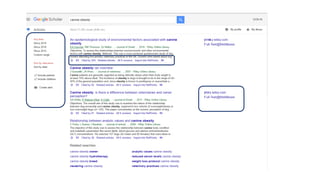
  • #38 Have students used google scholar Mention saving Citations References Creating references Find journal articles, theses, books, and more, from academic publishers, professional societies, online repositories, universities and other web sites. Search across many disciplines Locate the full-text document through your library or on the web Keep up with recent developments in any area of research Save items in a personal library
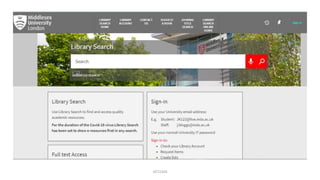
  • #39 Library Search – used it, know what it is, what it covers? Sign in to access e-resources
  • #40 Remind them about refining options Reference Save searches Refworks Peer reviewed online resources Also advanced search
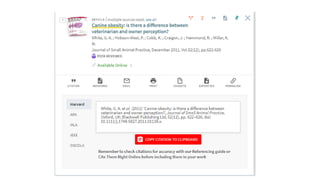
  • #41 Show reference Ask if they know the difference between citation and reference list Cite them right online
  • #42 Commercial databases MDX won’t have everything Interlibrary loans available for students £3 admin charge per item – heavily subsidised by MDX Can use other university libraries via SCONUL programme
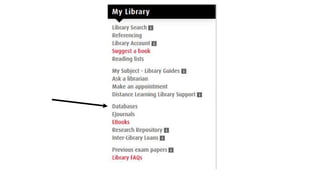
  • #43 Access databases via MyUniHub – MyStudy – MyLibrary and select databases Get student to go to this page
  • #44 Get the students to try out the databases Video tutorial Advanced search option Again commercial database we won’t have everything
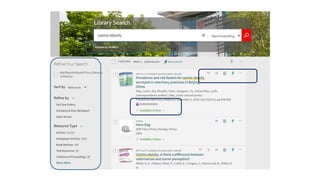
  • #45 Mention the Find in my library button to see if MDX have the article
  • #47 Remind them about always using cite them right to check their references Read basics pages to get started and for info about quotes, paraphrasing and summarising
  • #48 Subject library guide for vet nursing Can contact the librarian Look at the various tabs for more information http://libguides.mdx.ac.uk/vetnursing/evidencebased