Seizure VS Epilepsy
(Mayo Clinic, Roland D Thijs et al 2019,Lancet)
A seizure is a sudden, uncontrollable
electrical disturbance in brain,
which can cause change in your
behaviour, moments or feelings, and
in levels of consciousness.
Epilepsy is defined as two
unprovoked seizures
occurring more than 24
hrs apart.
Hysterical fit
Dissociative
attacks
Psychogenic
seizures
Non epileptic
conversion
seizures
Pseudo
epileptic attacks
Pseudo-
epilepsy
Psycho seizures
Functional
seizures
Non-epileptic
attack disorder
Pseudo-seizures
Hystero
epilepsy
sadi-Pooya AA, Brigo F, Mildon B, Nicholson TR. Terminology for psychogenic non-epileptic seizures: Making the
case for "functional seizures". Epilepsy Behav. 2020;104:106895
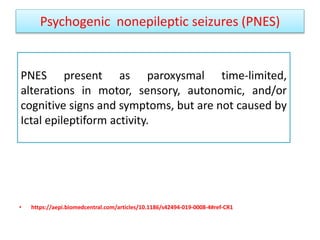
However the term adopted by the International League Against Epilepsy (ILAE) is
Psychogenic nonepileptic seizures (PNES)
• https://aepi.biomedcentral.com/articles/10.1186/s42494-019-0008-4#ref-CR1
PNES present as paroxysmal time-limited,
alterations in motor, sensory, autonomic, and/or
cognitive signs and symptoms, but are not caused by
Ictal epileptiform activity.
Prevalence
The prevalence of PNES was found to be 2.9/1000 population in a study in
rural India,
Currently estimated as 2-50/100,000 in the general population.
The prevalence of coexistent epilepsy and pseudo seizures is estimated
around 5%-40%.
GENDER
WOMEN: 70% OF DIAGNOSED PNES
MEN: 30% OF DIAGNOSED PNES
AGE
TYPICALLY BEGIN IN YOUNG ADULTHOOD
CAN OCCUR IN CHILDREN AND ELDERLY
A misdiagnosis can lead to:
• •
Dangerous interventions in the emergency room, (e.g. being "loaded up" with
powerful drugs and being intubated.
PATIENTS WITH PNES USUALLY TAKE ANTIEPILEPTIC DRUGS UNNECESSARILY FOR
MANY YEARS BEFORE THE DIAGNOSIS IS REVISED.
THIS EXPOSES PATIENTS TO UNTOWARD EFFECTS OF MEDICATION WITH NO BENEFIT
TO THEM WHATSOEVER.
SOME PATIENTS MAY RECEIVE IV MEDICATIONS FOR STATUS EPILEPTICUS THAT MAY
HAVE RESULTED IN INTUBATION AND POSSIBLE ADMISSION TO ICU.
EXPOSED THE PATIENT AND FAMILY TO A HIGH LEVEL OF STRESS WITH NO PROSPECT
OF RELIEF FROM THE PROBLEM.
UNNECESSARY MEDICAL COSTS/NEUROLOGISTS SERVICES/INPATIENT HOSPITAL DAYS
IMAGING/ EXTENDED EEG MONITORING AND VIDEO MONITORING
Pseudo seizure
(PNES)
True Seizure
HISTORY
(a)
Pattern
absence of any estabilished
pattern
Stereotyped pattern
(b)
Precipitant
Obvious emotional precipitant
and occurrence in presence of
others
May be there but less obvious and presence of
others not associated
(c)
Occurrence in sleep
Not there
May occur
OBSERVATIONS
(a)
Onset
Gradual Abrupt
(b)
Duration
Time variable but longer (10-15
min)
Short duration upto 1-2 minutes
(c)
Consciousness
Usually preserved with bilateral
motor activity.
May be fluctuating but some
response to pain
Lost and unresponsive to pain
(d)
Aura
Aura unusual except for symptoms
of hyperventilation
Aura usual
(e)
may have moan, cry, scream or
weep
Monotonous epileptic cry
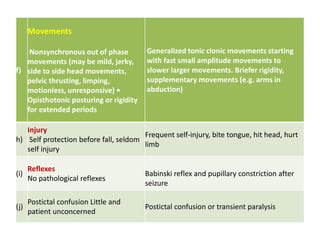
f)
Movements
Nonsynchronous out of phase
movements (may be mild, jerky,
side to side head movements,
pelvic thrusting, limping,
motionless, unresponsive) •
Opisthotonic posturing or rigidity
for extended periods
Generalized tonic clonic movements starting
with fast small amplitude movements to
slower larger movements. Briefer rigidity,
supplementary movements (e.g. arms in
abduction)
h)
Injury
Self protection before fall, seldom
self injury
Frequent self-injury, bite tongue, hit head, hurt
limb
(i)
Reflexes
No pathological reflexes
Babinski reflex and pupillary constriction after
seizure
(j)
Postictal confusion Little and
patient unconcerned
Postictal confusion or transient paralysis
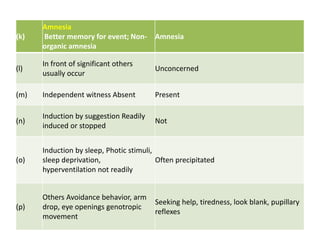
(k)
Amnesia
Better memory for event; Non-
organic amnesia
Amnesia
(l)
In front of significant others
usually occur
Unconcerned
(m) Independent witness Absent Present
(n)
Induction by suggestion Readily
induced or stopped
Not
(o)
Induction by sleep, Photic stimuli,
sleep deprivation,
hyperventilation not readily
Often precipitated
(p)
Others Avoidance behavior, arm
drop, eye openings genotropic
movement
Seeking help, tiredness, look blank, pupillary
reflexes
TESTING
(a)
pH immediately after attack
Normal
May change
(b) Creatinine kinase after attack NormalRises (significant if positive)
(c) Prolactin after attack Normal Rises (significant if positive)(16)
(d)
EEG
No epileptic form discharge,
maintenance of alpha rhythm with
only discontinuous muscle activity
record during attack and absence of
slowing with immediate
reappearance of previous occurred
alpha rhythm
• EEG may be abnormal in 10-
53%(14) and prompt clinical and EEG
recovery from a generalized
convulsive episode.
• Epileptic changes in majority (VEEG
preferred) Takes time to recovery (VEEG
useful)
(e)
Provocative methods Psychiatric
interview, suggestion, placebo
medication or hypnosis
Hyperventilation, photic stimuli or sleep
deprivation
Diagnosis ??
Rule out
possible
physical/organic
causes including
epilepsy.
Detailed clinical
history
Medical/Neurologi
cal/ psychiatric
Ask everything
about
pre/during and
post episode.
Laboratory
Studies
Imaging
EEG
Management
•
•
Patient
Education Family Education
MOST IMPORTANT
STEP IS DELIVERING
THE DIAGNOSIS TO
THE PATIENT AND
FAMILY
MAY COMMENT “ARE
YOU ACCUSING ME
OF FAKING?” OR “ARE
YOU SAYING I’M
CRAZY?”
UNLESS PATIENT AND
THEIR FAMILY
UNDERSTAND THE
DIAGNOSIS, THEY
WILL NOT FOLLOW
THROUGH WITH
TREATMENT
Mx contd
• Selective Serotonin Inhibitors Has Shown A Reduction In
Pnes.
• Use Of Psychotropic Medications To Treat Comorbid
Anxiety And Depressive Disorders Is Appropriate
• The Secondary Gain (Attention Received From
Surroundings) Should Be Immediately Stopped.
• Cognitive Behavioral Therapy Has Been Helpful In Reducing
Pnes
• Supportive psychotherapy and confrontation has been
found useful in over 75% patients.
• If A Psychiatrist Is Skeptical About The Diagnosis Of Pnes, A
Consultation With The Neurologist To View The Video
Recording May Be More Helpful Than A Written Report
Pseudoseizures ppt.pptx

Pseudoseizures ppt.pptx

  • 2.
    Seizure VS Epilepsy (MayoClinic, Roland D Thijs et al 2019,Lancet) A seizure is a sudden, uncontrollable electrical disturbance in brain, which can cause change in your behaviour, moments or feelings, and in levels of consciousness. Epilepsy is defined as two unprovoked seizures occurring more than 24 hrs apart.
  • 3.
    Hysterical fit Dissociative attacks Psychogenic seizures Non epileptic conversion seizures Pseudo epilepticattacks Pseudo- epilepsy Psycho seizures Functional seizures Non-epileptic attack disorder Pseudo-seizures Hystero epilepsy
  • 4.
    sadi-Pooya AA, BrigoF, Mildon B, Nicholson TR. Terminology for psychogenic non-epileptic seizures: Making the case for "functional seizures". Epilepsy Behav. 2020;104:106895 However the term adopted by the International League Against Epilepsy (ILAE) is
  • 5.
    Psychogenic nonepileptic seizures(PNES) • https://aepi.biomedcentral.com/articles/10.1186/s42494-019-0008-4#ref-CR1 PNES present as paroxysmal time-limited, alterations in motor, sensory, autonomic, and/or cognitive signs and symptoms, but are not caused by Ictal epileptiform activity.
  • 6.
    Prevalence The prevalence ofPNES was found to be 2.9/1000 population in a study in rural India, Currently estimated as 2-50/100,000 in the general population. The prevalence of coexistent epilepsy and pseudo seizures is estimated around 5%-40%. GENDER WOMEN: 70% OF DIAGNOSED PNES MEN: 30% OF DIAGNOSED PNES AGE TYPICALLY BEGIN IN YOUNG ADULTHOOD CAN OCCUR IN CHILDREN AND ELDERLY
  • 7.
    A misdiagnosis canlead to: • • Dangerous interventions in the emergency room, (e.g. being "loaded up" with powerful drugs and being intubated. PATIENTS WITH PNES USUALLY TAKE ANTIEPILEPTIC DRUGS UNNECESSARILY FOR MANY YEARS BEFORE THE DIAGNOSIS IS REVISED. THIS EXPOSES PATIENTS TO UNTOWARD EFFECTS OF MEDICATION WITH NO BENEFIT TO THEM WHATSOEVER. SOME PATIENTS MAY RECEIVE IV MEDICATIONS FOR STATUS EPILEPTICUS THAT MAY HAVE RESULTED IN INTUBATION AND POSSIBLE ADMISSION TO ICU. EXPOSED THE PATIENT AND FAMILY TO A HIGH LEVEL OF STRESS WITH NO PROSPECT OF RELIEF FROM THE PROBLEM. UNNECESSARY MEDICAL COSTS/NEUROLOGISTS SERVICES/INPATIENT HOSPITAL DAYS IMAGING/ EXTENDED EEG MONITORING AND VIDEO MONITORING
  • 9.
    Pseudo seizure (PNES) True Seizure HISTORY (a) Pattern absenceof any estabilished pattern Stereotyped pattern (b) Precipitant Obvious emotional precipitant and occurrence in presence of others May be there but less obvious and presence of others not associated (c) Occurrence in sleep Not there May occur
  • 10.
    OBSERVATIONS (a) Onset Gradual Abrupt (b) Duration Time variablebut longer (10-15 min) Short duration upto 1-2 minutes (c) Consciousness Usually preserved with bilateral motor activity. May be fluctuating but some response to pain Lost and unresponsive to pain (d) Aura Aura unusual except for symptoms of hyperventilation Aura usual (e) may have moan, cry, scream or weep Monotonous epileptic cry
  • 11.
    f) Movements Nonsynchronous out ofphase movements (may be mild, jerky, side to side head movements, pelvic thrusting, limping, motionless, unresponsive) • Opisthotonic posturing or rigidity for extended periods Generalized tonic clonic movements starting with fast small amplitude movements to slower larger movements. Briefer rigidity, supplementary movements (e.g. arms in abduction) h) Injury Self protection before fall, seldom self injury Frequent self-injury, bite tongue, hit head, hurt limb (i) Reflexes No pathological reflexes Babinski reflex and pupillary constriction after seizure (j) Postictal confusion Little and patient unconcerned Postictal confusion or transient paralysis
  • 12.
    (k) Amnesia Better memory forevent; Non- organic amnesia Amnesia (l) In front of significant others usually occur Unconcerned (m) Independent witness Absent Present (n) Induction by suggestion Readily induced or stopped Not (o) Induction by sleep, Photic stimuli, sleep deprivation, hyperventilation not readily Often precipitated (p) Others Avoidance behavior, arm drop, eye openings genotropic movement Seeking help, tiredness, look blank, pupillary reflexes
  • 13.
    TESTING (a) pH immediately afterattack Normal May change (b) Creatinine kinase after attack NormalRises (significant if positive) (c) Prolactin after attack Normal Rises (significant if positive)(16) (d) EEG No epileptic form discharge, maintenance of alpha rhythm with only discontinuous muscle activity record during attack and absence of slowing with immediate reappearance of previous occurred alpha rhythm • EEG may be abnormal in 10- 53%(14) and prompt clinical and EEG recovery from a generalized convulsive episode. • Epileptic changes in majority (VEEG preferred) Takes time to recovery (VEEG useful) (e) Provocative methods Psychiatric interview, suggestion, placebo medication or hypnosis Hyperventilation, photic stimuli or sleep deprivation
  • 14.
    Diagnosis ?? Rule out possible physical/organic causesincluding epilepsy. Detailed clinical history Medical/Neurologi cal/ psychiatric Ask everything about pre/during and post episode. Laboratory Studies Imaging EEG
  • 15.
    Management • • Patient Education Family Education MOSTIMPORTANT STEP IS DELIVERING THE DIAGNOSIS TO THE PATIENT AND FAMILY MAY COMMENT “ARE YOU ACCUSING ME OF FAKING?” OR “ARE YOU SAYING I’M CRAZY?” UNLESS PATIENT AND THEIR FAMILY UNDERSTAND THE DIAGNOSIS, THEY WILL NOT FOLLOW THROUGH WITH TREATMENT
  • 16.
    Mx contd • SelectiveSerotonin Inhibitors Has Shown A Reduction In Pnes. • Use Of Psychotropic Medications To Treat Comorbid Anxiety And Depressive Disorders Is Appropriate • The Secondary Gain (Attention Received From Surroundings) Should Be Immediately Stopped. • Cognitive Behavioral Therapy Has Been Helpful In Reducing Pnes • Supportive psychotherapy and confrontation has been found useful in over 75% patients. • If A Psychiatrist Is Skeptical About The Diagnosis Of Pnes, A Consultation With The Neurologist To View The Video Recording May Be More Helpful Than A Written Report