D E E P A K K R I S H N A
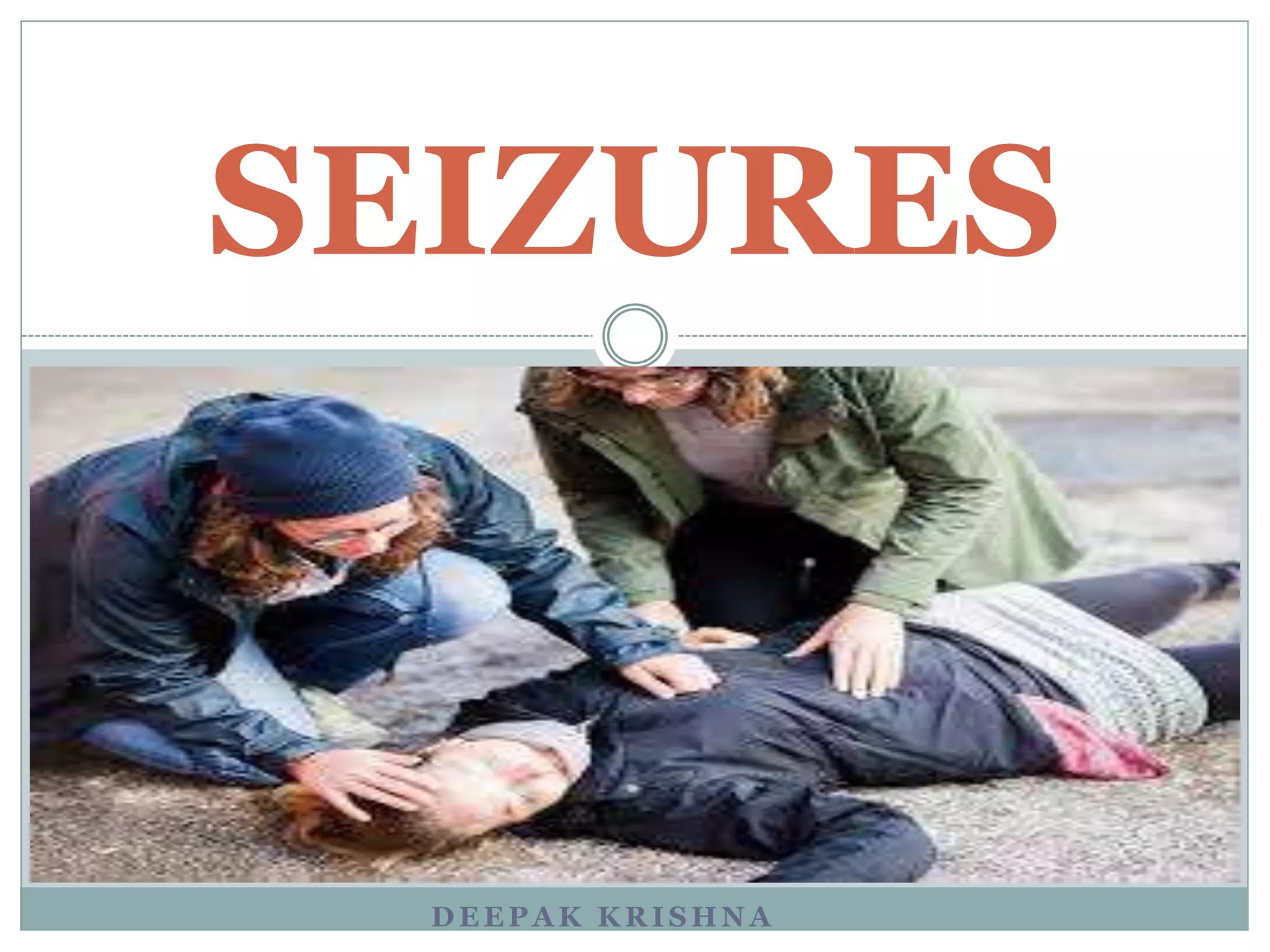
SEIZURES
DEFINITION
Seizure is a paroxysmal,
uncontrolled electrical discharge
of neurons in the brain that
interrupts normal function. It is
Often symptoms of underlying
illness.
Epilepsy
 Epilepsy is a recurrent seizure
disorder characterized by abnormal
electrical discharge from brain, often
in the cerebral cortex.”
Or
 Epilepsy is a chronic seizures
disorder with recurrent &
unprovoked seizures.
Etiology
Idiopathic
Agent factor:
 Exposure to toxins, e.g. lead,
infection &neurologic injury.
Fever
Cont…
Host factor:
• Age: Most common onset of epilepsy is before
the age of 20 years. It is higher during the first
year of life & at the onset of puberty.
• Genetic factor (inheritance)
• CVA
• Birth hypoxia
• Brain tumor & abscess
• Congenital abnormalities
• Trauma
• Environmental Factors:
• Air pollution ( carbon-mono-oxide & lead
poisoning).
• Some factors or events may precipitate the
seizures.
• Unskilled handling at the time of birth
causing brain injury & birth asphyxia.
• Intrauterine infections.
• Emotional disturbances & environmental
stressors.
• Drugs & alcohol intoxication.
Pathophysiology
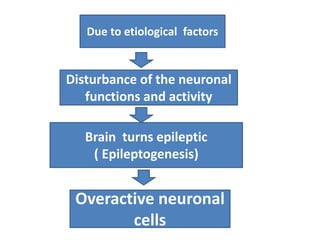
Due to etiological factors
Disturbance of the neuronal
functions and activity
Brain turns epileptic
( Epileptogenesis)
Overactive neuronal
cells
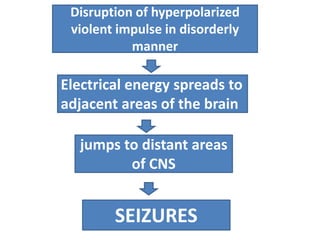
Disruption of hyperpolarized
violent impulse in disorderly
manner
Electrical energy spreads to
adjacent areas of the brain
SEIZURES
jumps to distant areas
of CNS
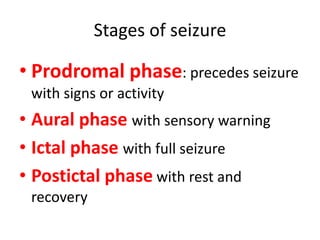
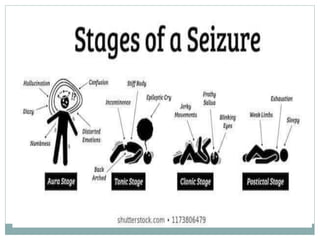
Stages of seizure
• Prodromal phase: precedes seizure
with signs or activity
• Aural phase with sensory warning
• Ictal phase with full seizure
• Postictal phase with rest and
recovery
Clinical Manifestations
• Clinical manifestation in epilepsy
range from starting episodes to
prolonged convulsions with loss of
consciousness. The clinical
manifestations vary according to
the part of the brain involved.
Classification of seizures & related
clinical manifestations:
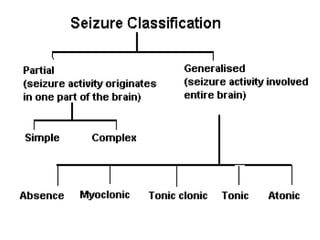
• Partial seizures:
•When seizures appears to
result from abnormal
activity in just one part of
the brain.
a. Simple partial seizures
• They have elementary or simple
symptoms & there is no loss of
consciousness in this. The patient may
experience only a finger or hand shake,
mouth may jerk uncontrollably he/she
may talk unintelligibly, may feel dizziness
or may experience unusual or unpleasant
sight, sound, odors or tastes.
b. Complex partial seizures
• The patient’s consciousness is altered
during the event. The seizures may
begin with an aura. Patient may have
no movement or moves automatically
but inappropriately for time & place;
may experience excessive emotions of
fear, anger, elation or irritability & does
not remember the episodes when it is
over.
Generalized seizures
• Generalized seizures involve both the
hemispheres of the brain. There is
intense rigidity of the entire body,
followed by alternate of muscles
relaxation & contraction.
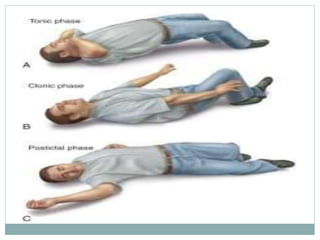
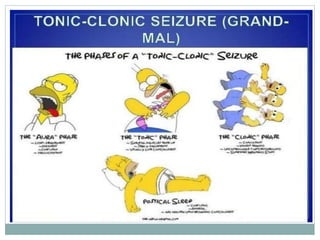
TONIC-CLONIC SEIZURE(GRANDMAL)
• The most common generalized
seizure. It is characterized by loss of
consciousness and falling to the
ground if the patient is upright,
followed by stiffening of the body for
10 to 20 seconds and subsequent
jerking of the extremities for another
30 to 40 seconds.
• Cyanosis, excessive salivation, tongue
or cheek biting and incontinence may
accompany the seizure.
• In postictal phase the patient usually
has muscle soreness, is very tired and
may sleep for several hours. Some
patients may not feel normal for
several hours or days after seizure.
The patient has no memory of the
seizure.
TYPICAL ABSENCE SEIZURE (PETITMAL)
• It usually occurs in children. Typical
clinical manifestations is a brief
staring spell that last only a few
seconds, so it often occurs unnoticed.
there is a brief loss of consciousness.
Absence seizure can often be
precipitated by hyperventilation and
flashing lights.
ATYPICAL ABSENCE SEIZURE
• It is characterized by a staring
spell accompanied by other signs
and symptoms, including brief
warnings, peculiar behavior
during the seizure or confusion
after the seizure.
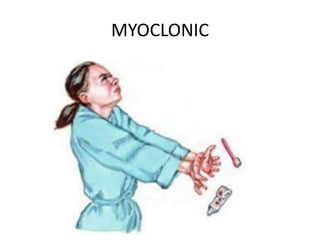
MYOCLONIC SEIZURE
• It is characterized by a sudden
,excessive jerk of the body or
extremities. The jerk may be
forceful enough to hurl the
person to the ground. These
seizure are very brief and may
occur in clusters.
MYOCLONIC
TONIC SEIZURE
• It involves a sudden onset of
maintained increased tone in the
extensor muscle . These patient
often fall and may cause injury.
CLONIC SEIZURE
• Seizure begin with loss of
consciousness and sudden loss
of muscle tone, followed by
limb jerking that may or may
not be symmetric.
ATONIC SEIZURE (DROP ATTACK)
• It involves either a tonic episode or a
paroxysmal loss of muscle tone and begins
suddenly with the person falling to the
ground. Consciousness usually return by the
time the person hits the ground, and normal
activity can be resumed immediately. The
patients with this type of seizure are at
greater risk of head injury often have to wear
protective helmets.
DIAGNOSTIC EVALUATION
• A complete seizure profile and history taking
• Physical examination including neurologic
examination & description of seizure activity.
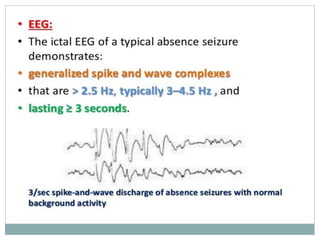
• Major diagnostic tool is EEG
(electroencephalogram). This test assists in:
Locating the focus of abnormal electrical
discharges, if present.
Establishing a diagnosis of epilepsy.
Identifying the specific type of seizures.
• ECG.
• CT scan & MRI are used to rule out brain
lesions that can trigger seizures.
• PET (positron emission tomography) & SPECT
(single photon emission computed
tomography) may be helpful to measure
cerebral blood in clients undergoing surgery
for epilepsy.
• Lab studies may rule out other causes for the
seizures: RBS, CBC, KFT, LFT, Lumbar puncture,
etc.
MEDICAL MANAGEMENT
• carbamazepine (Tegretol)
• clonazepam (Klonopin)
• ethosuximide (Zarontin)
• phenobarbital (Luminal)
• phenytoin (Dilantin)
• oxacarbazepine (Trileptal)
• primidone (Mysoline)
• tiagabine (Gabitril)
• topiramate (Topamax)
• valproate (Depakote, Depakene)
• zonisamide (Zonegran, Excegran)
•felbamate (Felbatol)
•gabapentin (Neurotonin)
•lamotrigine (Lamictal)
•levetiracetam (Keppra)
OTHER TREATMENT
• A KETOGENIC OR MODIFIED
ATKINS DIET( LOW
CARBOHYDATE DIET)
• VAGAL NERVE STIMULATION
(VNS)
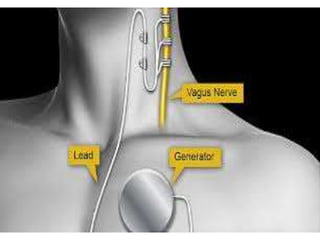
VAGAL NERVE STIMULATION
• VNS is a palliative technique that
involves surgical implantation of
a stimulating device. It is
currently indicated for patient
older than 12 years with
medically partial seizure that are
not treated surgically.
SURGICAL MANGEMENT
• LOBECTOMY
• LESIONECTOMY
NURSING
MANAGEMENT
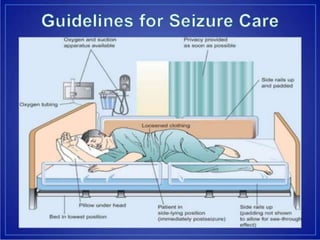
Nursing Care During a Seizure
• Provide privacy and protect the patient from
curious on-lookers. (The patient who has an
aura [warning of an impending seizure] may
have time to seek a safe, private place.)
• Ease the patient to the floor, if possible.
• Protect the head with a pad to prevent injury
(from striking a hard surface).
• Loosen constrictive clothing.
• Push aside any furniture that may injure the
patient during the seizure.
• If the patient is in bed, remove pillows and raise
side rails.
• If an aura precedes the seizure, insert an oral
airway to reduce the possibility of the tongue or
cheek being bitten.
• Do not attempt to pry open jaws that are clenched
in a spasm to insert anything. Broken teeth and
injury to the lips and tongue may result from such
an action.
• No attempt should be made to restrain the patient
during the seizure because muscular contractions
are strong and restraint can produce injury.
CONT…
• If possible, place the patient on one side
with head flexed forward, which allows
the tongue to fall forward and facilitates
drainage of saliva and mucus. If suction is
available, use it if necessary to clear
secretions.
Nursing Care After the Seizure
• Keep the patient on one side to prevent
aspiration. Make sure the airway is patent.
• There is usually a period of confusion after a
grand mal seizure.
• A short apneic period may occur during or
immediately after a generalized seizure.
• The patient, on awakening, should be reoriented
to the environment.
• If the patient becomes agitated after a seizure
(postictal), use calm persuasion and gentle
restraint.
NURSING DIAGNOSES
1. Risk for injury related to seizure
activity
2. Fear related to the possibility of
seizures
3. Ineffective individual coping related
to stresses imposed by epilepsy
4. Deficient knowledge related to
epilepsy and its control
COMPLICATIONS
•STATUS EPILEPTICUS
• It is characterized by at least 30 min of
repetitive seizure activity with out return to
consciousness.
• In other words, it is state in which a person
has continuous seizures lasting at least 30
min.
Cont..
• This is medical emergency and
requires prompt intervention to
prevent irreversible neurological
damage.
• Abrupt cessation of
anticonvulsant therapy is the
usual cause of status epilepticus.

Seizures

  • 1.
    D E EP A K K R I S H N A SEIZURES
  • 2.
    DEFINITION Seizure is aparoxysmal, uncontrolled electrical discharge of neurons in the brain that interrupts normal function. It is Often symptoms of underlying illness.
  • 3.
    Epilepsy  Epilepsy isa recurrent seizure disorder characterized by abnormal electrical discharge from brain, often in the cerebral cortex.” Or  Epilepsy is a chronic seizures disorder with recurrent & unprovoked seizures.
  • 4.
    Etiology Idiopathic Agent factor:  Exposureto toxins, e.g. lead, infection &neurologic injury. Fever
  • 5.
    Cont… Host factor: • Age:Most common onset of epilepsy is before the age of 20 years. It is higher during the first year of life & at the onset of puberty. • Genetic factor (inheritance) • CVA • Birth hypoxia • Brain tumor & abscess • Congenital abnormalities • Trauma
  • 6.
    • Environmental Factors: •Air pollution ( carbon-mono-oxide & lead poisoning). • Some factors or events may precipitate the seizures. • Unskilled handling at the time of birth causing brain injury & birth asphyxia. • Intrauterine infections. • Emotional disturbances & environmental stressors. • Drugs & alcohol intoxication.
  • 7.
  • 8.
    Due to etiologicalfactors Disturbance of the neuronal functions and activity Brain turns epileptic ( Epileptogenesis) Overactive neuronal cells
  • 9.
    Disruption of hyperpolarized violentimpulse in disorderly manner Electrical energy spreads to adjacent areas of the brain SEIZURES jumps to distant areas of CNS
  • 10.
    Stages of seizure •Prodromal phase: precedes seizure with signs or activity • Aural phase with sensory warning • Ictal phase with full seizure • Postictal phase with rest and recovery
  • 13.
    Clinical Manifestations • Clinicalmanifestation in epilepsy range from starting episodes to prolonged convulsions with loss of consciousness. The clinical manifestations vary according to the part of the brain involved.
  • 14.
    Classification of seizures& related clinical manifestations: • Partial seizures: •When seizures appears to result from abnormal activity in just one part of the brain.
  • 15.
    a. Simple partialseizures • They have elementary or simple symptoms & there is no loss of consciousness in this. The patient may experience only a finger or hand shake, mouth may jerk uncontrollably he/she may talk unintelligibly, may feel dizziness or may experience unusual or unpleasant sight, sound, odors or tastes.
  • 16.
    b. Complex partialseizures • The patient’s consciousness is altered during the event. The seizures may begin with an aura. Patient may have no movement or moves automatically but inappropriately for time & place; may experience excessive emotions of fear, anger, elation or irritability & does not remember the episodes when it is over.
  • 17.
    Generalized seizures • Generalizedseizures involve both the hemispheres of the brain. There is intense rigidity of the entire body, followed by alternate of muscles relaxation & contraction.
  • 18.
    TONIC-CLONIC SEIZURE(GRANDMAL) • Themost common generalized seizure. It is characterized by loss of consciousness and falling to the ground if the patient is upright, followed by stiffening of the body for 10 to 20 seconds and subsequent jerking of the extremities for another 30 to 40 seconds.
  • 19.
    • Cyanosis, excessivesalivation, tongue or cheek biting and incontinence may accompany the seizure. • In postictal phase the patient usually has muscle soreness, is very tired and may sleep for several hours. Some patients may not feel normal for several hours or days after seizure. The patient has no memory of the seizure.
  • 22.
    TYPICAL ABSENCE SEIZURE(PETITMAL) • It usually occurs in children. Typical clinical manifestations is a brief staring spell that last only a few seconds, so it often occurs unnoticed. there is a brief loss of consciousness. Absence seizure can often be precipitated by hyperventilation and flashing lights.
  • 24.
    ATYPICAL ABSENCE SEIZURE •It is characterized by a staring spell accompanied by other signs and symptoms, including brief warnings, peculiar behavior during the seizure or confusion after the seizure.
  • 25.
    MYOCLONIC SEIZURE • Itis characterized by a sudden ,excessive jerk of the body or extremities. The jerk may be forceful enough to hurl the person to the ground. These seizure are very brief and may occur in clusters.
  • 26.
  • 27.
    TONIC SEIZURE • Itinvolves a sudden onset of maintained increased tone in the extensor muscle . These patient often fall and may cause injury.
  • 28.
    CLONIC SEIZURE • Seizurebegin with loss of consciousness and sudden loss of muscle tone, followed by limb jerking that may or may not be symmetric.
  • 29.
    ATONIC SEIZURE (DROPATTACK) • It involves either a tonic episode or a paroxysmal loss of muscle tone and begins suddenly with the person falling to the ground. Consciousness usually return by the time the person hits the ground, and normal activity can be resumed immediately. The patients with this type of seizure are at greater risk of head injury often have to wear protective helmets.
  • 30.
    DIAGNOSTIC EVALUATION • Acomplete seizure profile and history taking • Physical examination including neurologic examination & description of seizure activity. • Major diagnostic tool is EEG (electroencephalogram). This test assists in: Locating the focus of abnormal electrical discharges, if present. Establishing a diagnosis of epilepsy. Identifying the specific type of seizures.
  • 31.
    • ECG. • CTscan & MRI are used to rule out brain lesions that can trigger seizures. • PET (positron emission tomography) & SPECT (single photon emission computed tomography) may be helpful to measure cerebral blood in clients undergoing surgery for epilepsy. • Lab studies may rule out other causes for the seizures: RBS, CBC, KFT, LFT, Lumbar puncture, etc.
  • 32.
    MEDICAL MANAGEMENT • carbamazepine(Tegretol) • clonazepam (Klonopin) • ethosuximide (Zarontin) • phenobarbital (Luminal) • phenytoin (Dilantin)
  • 33.
    • oxacarbazepine (Trileptal) •primidone (Mysoline) • tiagabine (Gabitril) • topiramate (Topamax) • valproate (Depakote, Depakene) • zonisamide (Zonegran, Excegran)
  • 34.
  • 35.
    OTHER TREATMENT • AKETOGENIC OR MODIFIED ATKINS DIET( LOW CARBOHYDATE DIET) • VAGAL NERVE STIMULATION (VNS)
  • 36.
    VAGAL NERVE STIMULATION •VNS is a palliative technique that involves surgical implantation of a stimulating device. It is currently indicated for patient older than 12 years with medically partial seizure that are not treated surgically.
  • 38.
  • 39.
  • 40.
    Nursing Care Duringa Seizure • Provide privacy and protect the patient from curious on-lookers. (The patient who has an aura [warning of an impending seizure] may have time to seek a safe, private place.) • Ease the patient to the floor, if possible. • Protect the head with a pad to prevent injury (from striking a hard surface). • Loosen constrictive clothing.
  • 41.
    • Push asideany furniture that may injure the patient during the seizure. • If the patient is in bed, remove pillows and raise side rails. • If an aura precedes the seizure, insert an oral airway to reduce the possibility of the tongue or cheek being bitten. • Do not attempt to pry open jaws that are clenched in a spasm to insert anything. Broken teeth and injury to the lips and tongue may result from such an action. • No attempt should be made to restrain the patient during the seizure because muscular contractions are strong and restraint can produce injury.
  • 42.
    CONT… • If possible,place the patient on one side with head flexed forward, which allows the tongue to fall forward and facilitates drainage of saliva and mucus. If suction is available, use it if necessary to clear secretions.
  • 44.
    Nursing Care Afterthe Seizure • Keep the patient on one side to prevent aspiration. Make sure the airway is patent. • There is usually a period of confusion after a grand mal seizure. • A short apneic period may occur during or immediately after a generalized seizure. • The patient, on awakening, should be reoriented to the environment. • If the patient becomes agitated after a seizure (postictal), use calm persuasion and gentle restraint.
  • 45.
    NURSING DIAGNOSES 1. Riskfor injury related to seizure activity 2. Fear related to the possibility of seizures 3. Ineffective individual coping related to stresses imposed by epilepsy 4. Deficient knowledge related to epilepsy and its control
  • 46.
    COMPLICATIONS •STATUS EPILEPTICUS • Itis characterized by at least 30 min of repetitive seizure activity with out return to consciousness. • In other words, it is state in which a person has continuous seizures lasting at least 30 min.
  • 47.
    Cont.. • This ismedical emergency and requires prompt intervention to prevent irreversible neurological damage. • Abrupt cessation of anticonvulsant therapy is the usual cause of status epilepticus.