Dr. Ajaz Ahmad Suhaff
 The word suicide derives from a Latin word
sue (of oneself) & Cide or cidium (a killing).
 Major public health problem
 Nearly 1 million people worldwide commit
suicide each year.
 Every 40 seconds a person dies by suicide
somewhere on the globe.
 India reported about 381 suicides daily for the
year of 2019, marking an increase of nearly 3.4%
suicide deaths as compared to 2018.
 [ a report by the National Crime Records Bureau said].
How does the word
‘Suicide’
Make you feel?
Do any of these attitudes apply to you?
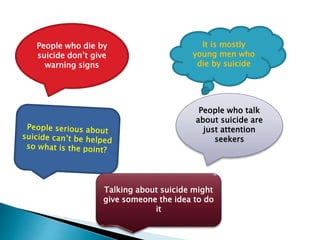
People who die by
suicide don’t give
warning signs
It is mostly
young men who
die by suicide
People who talk
about suicide are
just attention
seekers
Talking about suicide might
give someone the idea to do
it
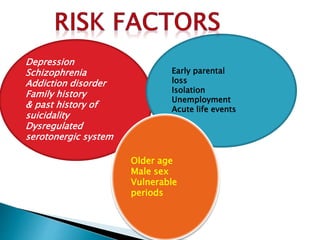
Depression
Schizophrenia
Addiction disorder
Family history
& past history of
suicidality
Dysregulated
serotonergic system
Early parental
loss
Isolation
Unemployment
Acute life events
Older age
Male sex
Vulnerable
periods
 “First Suicidal Attempt Due To Fear of
COVID-19. A Case Report from Kashmir”,
International Journal of Medical Science and
Advanced Clinical Research (IJMACR) - May-
June - 2020, Vol – 3, Issue -3, P. No. 119 –
123.
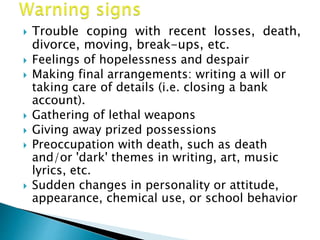
 Trouble coping with recent losses, death,
divorce, moving, break-ups, etc.
 Feelings of hopelessness and despair
 Making final arrangements: writing a will or
taking care of details (i.e. closing a bank
account).
 Gathering of lethal weapons
 Giving away prized possessions
 Preoccupation with death, such as death
and/or 'dark' themes in writing, art, music
lyrics, etc.
 Sudden changes in personality or attitude,
appearance, chemical use, or school behavior
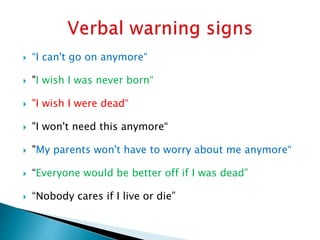
 “I can't go on anymore“
 "I wish I was never born“
 "I wish I were dead“
 "I won't need this anymore“
 "My parents won't have to worry about me anymore“
 “Everyone would be better off if I was dead”
 “Nobody cares if I live or die”
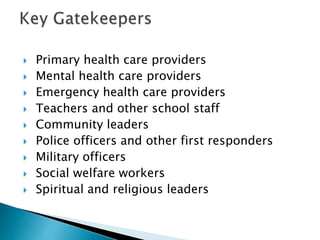
 Primary health care providers
 Mental health care providers
 Emergency health care providers
 Teachers and other school staff
 Community leaders
 Police officers and other first responders
 Military officers
 Social welfare workers
 Spiritual and religious leaders
 Primary.
 Secondary.
 Tertiary.
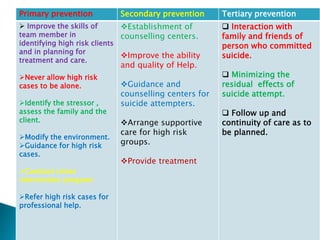
Primary prevention Secondary prevention Tertiary prevention
 Improve the skills of
team member in
identifying high risk clients
and in planning for
treatment and care.
Never allow high risk
cases to be alone.
Identify the stressor ,
assess the family and the
client.
Modify the environment.
Guidance for high risk
cases.
Conduct crises
intervention program.
Refer high risk cases for
professional help.
Establishment of
counselling centers.
Improve the ability
and quality of Help.
Guidance and
counselling centers for
suicide attempters.
Arrange supportive
care for high risk
groups.
Provide treatment
 Interaction with
family and friends of
person who committed
suicide.
 Minimizing the
residual effects of
suicide attempt.
 Follow up and
continuity of care as to
be planned.
1.Increasing public awareness
2.Campaign to reduce stigma
3 . Regulating formulations, packaging and
sale of pesticides
4.Regulation of over-the-counter medication
Intervention at community level
 Report Responsibly.
 Avoid romanticizing suicide, which can have a profound effect on at
risk teens.
 Refrain from detailed descriptions of the method of death.
 Do not portray suicide as an inexplicable act. Suicide has causes,
even if these causes are not immediately obvious.
 Be aware of the implications of language about suicide.
 Do not let the glamour of celebrity suicides obscure the reality of the
act. A celebrity’s suicide should be reported as a tragedy, not as a
model for others.
 309 IPC –used to penalize attempted suicide with up to
one year of imprisonment or with fine, or with both.
 Abetment of suicide is punishable under sec. 306 IPC.
 As per Mental Health care Act, 2017 clause 115,
attempted suicide has been decriminalized, .
 The relevant provision of the Mental Healthcare Act, 2017 states, "Notwithstanding anything contained
in section 309 of the Indian Penal Code any person who attempts to commit suicide shall be presumed,
unless proved otherwise, to have severe stress and shall not be tried and punished under the said
Code.“
Suicide prevention

Suicide prevention

  • 1.
  • 2.
     The wordsuicide derives from a Latin word sue (of oneself) & Cide or cidium (a killing).  Major public health problem
  • 3.
     Nearly 1million people worldwide commit suicide each year.  Every 40 seconds a person dies by suicide somewhere on the globe.  India reported about 381 suicides daily for the year of 2019, marking an increase of nearly 3.4% suicide deaths as compared to 2018.  [ a report by the National Crime Records Bureau said].
  • 4.
    How does theword ‘Suicide’ Make you feel? Do any of these attitudes apply to you?
  • 5.
    People who dieby suicide don’t give warning signs It is mostly young men who die by suicide People who talk about suicide are just attention seekers Talking about suicide might give someone the idea to do it
  • 8.
    Depression Schizophrenia Addiction disorder Family history &past history of suicidality Dysregulated serotonergic system Early parental loss Isolation Unemployment Acute life events Older age Male sex Vulnerable periods
  • 9.
     “First SuicidalAttempt Due To Fear of COVID-19. A Case Report from Kashmir”, International Journal of Medical Science and Advanced Clinical Research (IJMACR) - May- June - 2020, Vol – 3, Issue -3, P. No. 119 – 123.
  • 10.
     Trouble copingwith recent losses, death, divorce, moving, break-ups, etc.  Feelings of hopelessness and despair  Making final arrangements: writing a will or taking care of details (i.e. closing a bank account).  Gathering of lethal weapons  Giving away prized possessions  Preoccupation with death, such as death and/or 'dark' themes in writing, art, music lyrics, etc.  Sudden changes in personality or attitude, appearance, chemical use, or school behavior
  • 11.
     “I can'tgo on anymore“  "I wish I was never born“  "I wish I were dead“  "I won't need this anymore“  "My parents won't have to worry about me anymore“  “Everyone would be better off if I was dead”  “Nobody cares if I live or die”
  • 12.
     Primary healthcare providers  Mental health care providers  Emergency health care providers  Teachers and other school staff  Community leaders  Police officers and other first responders  Military officers  Social welfare workers  Spiritual and religious leaders
  • 13.
  • 14.
    Primary prevention Secondaryprevention Tertiary prevention  Improve the skills of team member in identifying high risk clients and in planning for treatment and care. Never allow high risk cases to be alone. Identify the stressor , assess the family and the client. Modify the environment. Guidance for high risk cases. Conduct crises intervention program. Refer high risk cases for professional help. Establishment of counselling centers. Improve the ability and quality of Help. Guidance and counselling centers for suicide attempters. Arrange supportive care for high risk groups. Provide treatment  Interaction with family and friends of person who committed suicide.  Minimizing the residual effects of suicide attempt.  Follow up and continuity of care as to be planned.
  • 15.
    1.Increasing public awareness 2.Campaignto reduce stigma 3 . Regulating formulations, packaging and sale of pesticides 4.Regulation of over-the-counter medication Intervention at community level
  • 16.
     Report Responsibly. Avoid romanticizing suicide, which can have a profound effect on at risk teens.  Refrain from detailed descriptions of the method of death.  Do not portray suicide as an inexplicable act. Suicide has causes, even if these causes are not immediately obvious.  Be aware of the implications of language about suicide.  Do not let the glamour of celebrity suicides obscure the reality of the act. A celebrity’s suicide should be reported as a tragedy, not as a model for others.
  • 17.
     309 IPC–used to penalize attempted suicide with up to one year of imprisonment or with fine, or with both.  Abetment of suicide is punishable under sec. 306 IPC.  As per Mental Health care Act, 2017 clause 115, attempted suicide has been decriminalized, .  The relevant provision of the Mental Healthcare Act, 2017 states, "Notwithstanding anything contained in section 309 of the Indian Penal Code any person who attempts to commit suicide shall be presumed, unless proved otherwise, to have severe stress and shall not be tried and punished under the said Code.“