Dermatological problems in older people
Pruritus
Linda Nazarko Nurse consultant
https://uk.linkedin.com/in/linda-nazarko-1952a746
8th
March 2016
Aims and objectives
To be aware of:
 Why ageing increases vulnerability to skin
conditions
 The value of listening to the patient
 The importance of history taking
 The value of physical examination
 How to nail the diagnosis
 Determining treatment options
 The value of nurses practicing at advanced
level
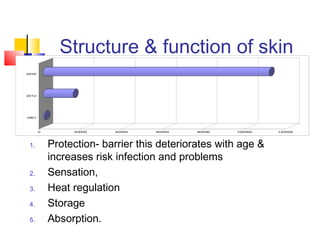
Structure & function of skin
1. Protection- barrier this deteriorates with age &
increases risk infection and problems
2. Sensation,
3. Heat regulation
4. Storage
5. Absorption.
0 20000 40000 60000 80000 100000 120000
1961
2012
2035
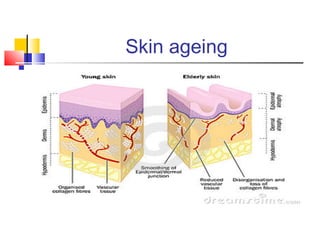
Skin ageing
Skin problems & ageing
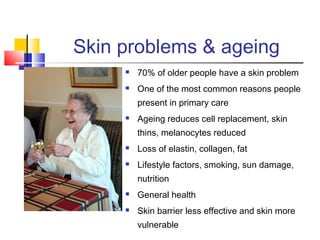
 70% of older people have a skin problem
 One of the most common reasons people
present in primary care
 Ageing reduces cell replacement, skin
thins, melanocytes reduced
 Loss of elastin, collagen, fat
 Lifestyle factors, smoking, sun damage,
nutrition
 General health
 Skin barrier less effective and skin more
vulnerable
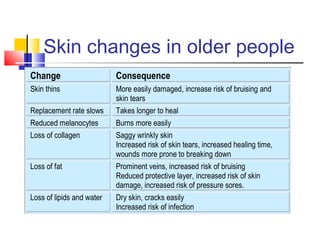
Skin changes in older people
Change Consequence
Skin thins More easily damaged, increase risk of bruising and
skin tears
Replacement rate slows Takes longer to heal
Reduced melanocytes Burns more easily
Loss of collagen Saggy wrinkly skin
Increased risk of skin tears, increased healing time,
wounds more prone to breaking down
Loss of fat Prominent veins, increased risk of bruising
Reduced protective layer, increased risk of skin
damage, increased risk of pressure sores.
Loss of lipids and water Dry skin, cracks easily
Increased risk of infection
Clinical presentation
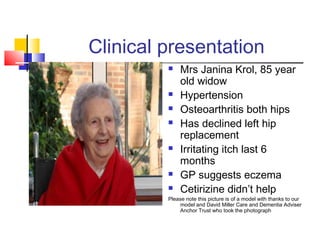
 Mrs Janina Krol, 85 year
old widow
 Hypertension
 Osteoarthritis both hips
 Has declined left hip
replacement
 Irritating itch last 6
months
 GP suggests eczema
 Cetirizine didn’t help
Please note this picture is of a model with thanks to our
model and David Miller Care and Dementia Adviser
Anchor Trust who took the photograph
Calgary- Cambridge Model
Medical and social history
 Widowed, living alone, caring family
 Attends church, great grandson recently
Christened
 Shops and goes to hair dressers
 Declined hip replacement for OA left hip
uses wheelchair for distances
 Hypertension
 Itching and miserable
Presenting problems
 Declining mobility due to hip
pain
 Doesn’t want a hip replacement
 Hypertension
 Itch affecting sleep and making
her miserable
Mrs Krol’s perspective
“ I’d like some therapy as I’m
struggling to get out of the chair. I
want to be able to get in & out of the
car, shop and meet friends at church.
This itching is driving me mad and
affecting my sleep. If only I could
sleep”
Mrs Newton’s hopes and
aspirations
“ A good night’s sleep. I’m exhausted,
haven’t slept in months. Its getting me
down.
To be able to walk a bit better, I’m
struggling to get out of my chair and I’m
getting stiffer and stiffer”
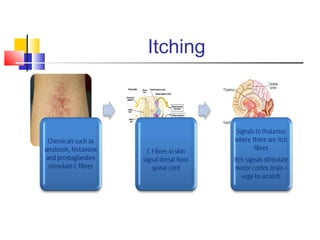
Pruritus
 Pruritus is derived from the Latin verb
prurire which means to itch.
 Pruritus is the most common skin
problem in older people.
 Itching may be caused by dry skin but
in 50% of cases itching has an
underlying systemic cause

Itching
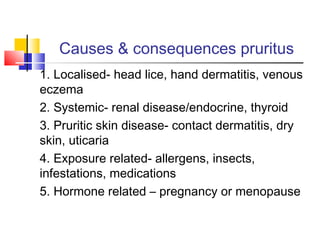
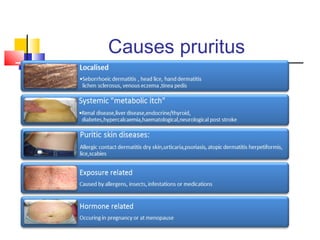
Causes & consequences pruritus
1. Localised- head lice, hand dermatitis, venous
eczema
2. Systemic- renal disease/endocrine, thyroid
3. Pruritic skin disease- contact dermatitis, dry
skin, uticaria
4. Exposure related- allergens, insects,
infestations, medications
5. Hormone related – pregnancy or menopause
Causes pruritus
The importance of history
 Onset, provocation, palliation and
comorbidities
 Onset – fast likely infestation, medication,
allergy. Slow – systemic
 Provocation- dry skin bathing, scabies worse
evening and night
 Is anyone else itching?
 New medication? Herbal, OTC, Chinese
Physical examination
 Widespread or localised itch?
 Local consider contact dermatitis,
rubber, nickel, fragrance, preservatives
 Widespread consider systemic causes
 Check for rash
 Check for scratch marks
Clinical findings
 Intense itch
 Worse when she’s hot and in the evening
 Generalised rash, hands, webs of fingers,
wrists, elbows, front of chest, between
shoulder blades and around waist
 Dry crusted scabs& areas fresh bleeding
 Small black dots visible with magnifying glass
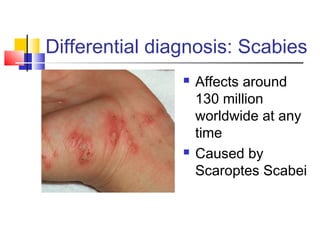
Differential diagnosis: Scabies
 Affects around
130 million
worldwide at any
time
 Caused by
Scaroptes Scabei
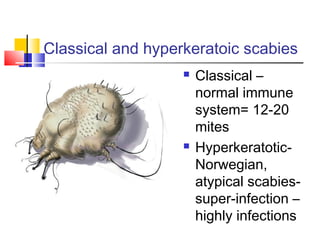
Classical and hyperkeratoic scabies
 Classical –
normal immune
system= 12-20
mites
 Hyperkeratotic-
Norwegian,
atypical scabies-
super-infection –
highly infections
Mode transmission
 Prolonged skin contact- 5-10 minutes- crawls
one to another
 Burrows into skin within 30 minutes
 Lays eggs, two a day
 Around 4-6 weeks after contact symptoms
appear- itch then rash
 Mite tunnels show fine dark or silvery lines
 Itch caused by reaction to faeces of mite
Diagnosis
 Can be difficult
 Skin scraping with blunt scalpel and
checked under microscope
 For non experts press selotape over
lesion and peel off – send to lab
Treatment considerations
 Type of scabies
 Is the person at home, in a care home
or a hospital
 Is this a single case or an outbreak
 Do contacts need to be treated
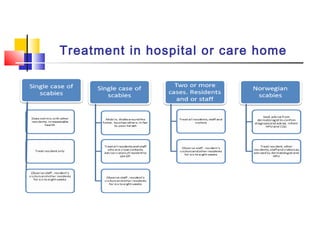
Treatment in hospital or care home
Classical scabies
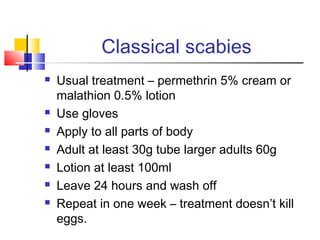
 Usual treatment – permethrin 5% cream or
malathion 0.5% lotion
 Use gloves
 Apply to all parts of body
 Adult at least 30g tube larger adults 60g
 Lotion at least 100ml
 Leave 24 hours and wash off
 Repeat in one week – treatment doesn’t kill
eggs.
Norwegian scabies
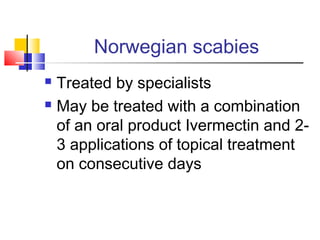
 Treated by specialists
 May be treated with a combination
of an oral product Ivermectin and 2-
3 applications of topical treatment
on consecutive days
Laundry?
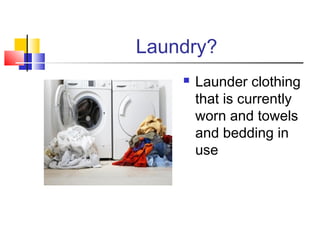
 Launder clothing
that is currently
worn and towels
and bedding in
use
Aims of treatment
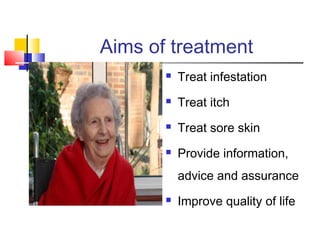
 Treat infestation
 Treat itch
 Treat sore skin
 Provide information,
advice and assurance
 Improve quality of life
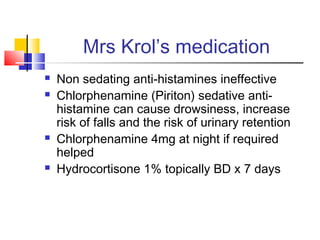
Mrs Krol’s medication
 Non sedating anti-histamines ineffective
 Chlorphenamine (Piriton) sedative anti-
histamine can cause drowsiness, increase
risk of falls and the risk of urinary retention
 Chlorphenamine 4mg at night if required
helped
 Hydrocortisone 1% topically BD x 7 days
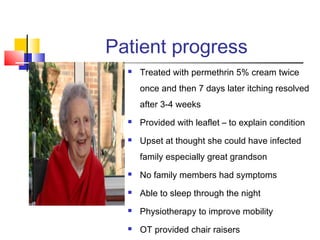
Patient progress
 Treated with permethrin 5% cream twice
once and then 7 days later itching resolved
after 3-4 weeks
 Provided with leaflet – to explain condition
 Upset at thought she could have infected
family especially great grandson
 No family members had symptoms
 Able to sleep through the night
 Physiotherapy to improve mobility
 OT provided chair raisers
Making a difference: The value of
nurses practicing at advanced level
“I thought I was just going to get
worse and worse but now once
more I have hope and can have a
good life”
Take home messages
 We use evidence based practice because it
works
 All patients regardless of age, cognitive
status or discharge destination deserve the
dignity of a diagnosis
 Working with the patient can enable us to
help the person to have the best possible
quality of life
 And that’s why we do what we do and why we
make a difference
Thank you for listening
Any questions?

Pruritus

  • 1.
    Dermatological problems inolder people Pruritus Linda Nazarko Nurse consultant https://uk.linkedin.com/in/linda-nazarko-1952a746 8th March 2016
  • 2.
    Aims and objectives Tobe aware of:  Why ageing increases vulnerability to skin conditions  The value of listening to the patient  The importance of history taking  The value of physical examination  How to nail the diagnosis  Determining treatment options  The value of nurses practicing at advanced level
  • 3.
    Structure & functionof skin 1. Protection- barrier this deteriorates with age & increases risk infection and problems 2. Sensation, 3. Heat regulation 4. Storage 5. Absorption. 0 20000 40000 60000 80000 100000 120000 1961 2012 2035
  • 4.
  • 5.
    Skin problems &ageing  70% of older people have a skin problem  One of the most common reasons people present in primary care  Ageing reduces cell replacement, skin thins, melanocytes reduced  Loss of elastin, collagen, fat  Lifestyle factors, smoking, sun damage, nutrition  General health  Skin barrier less effective and skin more vulnerable
  • 6.
    Skin changes inolder people Change Consequence Skin thins More easily damaged, increase risk of bruising and skin tears Replacement rate slows Takes longer to heal Reduced melanocytes Burns more easily Loss of collagen Saggy wrinkly skin Increased risk of skin tears, increased healing time, wounds more prone to breaking down Loss of fat Prominent veins, increased risk of bruising Reduced protective layer, increased risk of skin damage, increased risk of pressure sores. Loss of lipids and water Dry skin, cracks easily Increased risk of infection
  • 7.
    Clinical presentation  MrsJanina Krol, 85 year old widow  Hypertension  Osteoarthritis both hips  Has declined left hip replacement  Irritating itch last 6 months  GP suggests eczema  Cetirizine didn’t help Please note this picture is of a model with thanks to our model and David Miller Care and Dementia Adviser Anchor Trust who took the photograph
  • 8.
  • 9.
    Medical and socialhistory  Widowed, living alone, caring family  Attends church, great grandson recently Christened  Shops and goes to hair dressers  Declined hip replacement for OA left hip uses wheelchair for distances  Hypertension  Itching and miserable
  • 10.
    Presenting problems  Decliningmobility due to hip pain  Doesn’t want a hip replacement  Hypertension  Itch affecting sleep and making her miserable
  • 11.
    Mrs Krol’s perspective “I’d like some therapy as I’m struggling to get out of the chair. I want to be able to get in & out of the car, shop and meet friends at church. This itching is driving me mad and affecting my sleep. If only I could sleep”
  • 12.
    Mrs Newton’s hopesand aspirations “ A good night’s sleep. I’m exhausted, haven’t slept in months. Its getting me down. To be able to walk a bit better, I’m struggling to get out of my chair and I’m getting stiffer and stiffer”
  • 13.
    Pruritus  Pruritus isderived from the Latin verb prurire which means to itch.  Pruritus is the most common skin problem in older people.  Itching may be caused by dry skin but in 50% of cases itching has an underlying systemic cause 
  • 14.
  • 15.
    Causes & consequencespruritus 1. Localised- head lice, hand dermatitis, venous eczema 2. Systemic- renal disease/endocrine, thyroid 3. Pruritic skin disease- contact dermatitis, dry skin, uticaria 4. Exposure related- allergens, insects, infestations, medications 5. Hormone related – pregnancy or menopause
  • 16.
  • 17.
    The importance ofhistory  Onset, provocation, palliation and comorbidities  Onset – fast likely infestation, medication, allergy. Slow – systemic  Provocation- dry skin bathing, scabies worse evening and night  Is anyone else itching?  New medication? Herbal, OTC, Chinese
  • 18.
    Physical examination  Widespreador localised itch?  Local consider contact dermatitis, rubber, nickel, fragrance, preservatives  Widespread consider systemic causes  Check for rash  Check for scratch marks
  • 19.
    Clinical findings  Intenseitch  Worse when she’s hot and in the evening  Generalised rash, hands, webs of fingers, wrists, elbows, front of chest, between shoulder blades and around waist  Dry crusted scabs& areas fresh bleeding  Small black dots visible with magnifying glass
  • 20.
    Differential diagnosis: Scabies Affects around 130 million worldwide at any time  Caused by Scaroptes Scabei
  • 21.
    Classical and hyperkeratoicscabies  Classical – normal immune system= 12-20 mites  Hyperkeratotic- Norwegian, atypical scabies- super-infection – highly infections
  • 22.
    Mode transmission  Prolongedskin contact- 5-10 minutes- crawls one to another  Burrows into skin within 30 minutes  Lays eggs, two a day  Around 4-6 weeks after contact symptoms appear- itch then rash  Mite tunnels show fine dark or silvery lines  Itch caused by reaction to faeces of mite
  • 23.
    Diagnosis  Can bedifficult  Skin scraping with blunt scalpel and checked under microscope  For non experts press selotape over lesion and peel off – send to lab
  • 24.
    Treatment considerations  Typeof scabies  Is the person at home, in a care home or a hospital  Is this a single case or an outbreak  Do contacts need to be treated
  • 25.
  • 26.
    Classical scabies  Usualtreatment – permethrin 5% cream or malathion 0.5% lotion  Use gloves  Apply to all parts of body  Adult at least 30g tube larger adults 60g  Lotion at least 100ml  Leave 24 hours and wash off  Repeat in one week – treatment doesn’t kill eggs.
  • 27.
    Norwegian scabies  Treatedby specialists  May be treated with a combination of an oral product Ivermectin and 2- 3 applications of topical treatment on consecutive days
  • 28.
    Laundry?  Launder clothing thatis currently worn and towels and bedding in use
  • 29.
    Aims of treatment Treat infestation  Treat itch  Treat sore skin  Provide information, advice and assurance  Improve quality of life
  • 30.
    Mrs Krol’s medication Non sedating anti-histamines ineffective  Chlorphenamine (Piriton) sedative anti- histamine can cause drowsiness, increase risk of falls and the risk of urinary retention  Chlorphenamine 4mg at night if required helped  Hydrocortisone 1% topically BD x 7 days
  • 31.
    Patient progress  Treatedwith permethrin 5% cream twice once and then 7 days later itching resolved after 3-4 weeks  Provided with leaflet – to explain condition  Upset at thought she could have infected family especially great grandson  No family members had symptoms  Able to sleep through the night  Physiotherapy to improve mobility  OT provided chair raisers
  • 32.
    Making a difference:The value of nurses practicing at advanced level “I thought I was just going to get worse and worse but now once more I have hope and can have a good life”
  • 33.
    Take home messages We use evidence based practice because it works  All patients regardless of age, cognitive status or discharge destination deserve the dignity of a diagnosis  Working with the patient can enable us to help the person to have the best possible quality of life  And that’s why we do what we do and why we make a difference
  • 34.
    Thank you forlistening Any questions?