Competency development and revalidation
for advanced nursing practice
Linda Nazarko
MSc, PgDip, PgCert, BSc(Hons), RN, NIP, OBE, FRCN
London 11th
March 2016
,
Aims
 To enable those managing nurses practicing
at specialist and advanced level to understand
the components of advanced practice and how
they can support nurses
 To enable nurses who are developing into
advanced practitioners to understand what
skills, knowledge and support they will require.
 To enable nurses practicing at specialist and
advanced levels to maintain and develop their
skills
 To enable nurses practicing at specialist and
advanced levels to prepare for re-validation
Learning objectives
To be aware of how to :
 Develop competence and confidence in accurate
assessment & diagnoses
 Provide nurses with suitable education and training
 Enable to develop competency
 Maintain competency in assessment, diagnosis &
prescribing
 Move beyond competency to capability
 Enable setting up & development of nurse led services
 Develop protocols & guidelines
 Prepare for appraisal & revalidation
What is competency?
“Nurses and nursing staff have up-to-
date knowledge and skills, and use
these with intelligence, insight and
understanding in line with the
needs of each individual in their
care”.
RCN (2012)
What does competency
mean?
 The ability to
combine technical
skills with
humanistic care
 Combining the art &
the science of
nursing
Defining advanced nursing practice
“A registered nurse who has command of an
expert knowledge base and clinical
competence, is able to make complex clinical
decisions using expert clinical judgement, is
an essential member of an interdependent
health care team and whose role is
determined by the context in which s/he
practices”
NMC 2007
Components of advanced
practice
Core competencies advanced practice
 Practicing autonomously
 Making decisions and being accountable
 Admitting and discharging patients
 Ability to take a clinical history
 Ability to physically examine patient
 Ability to determine diagnosis
 Ability to determine when onward referral is
required
 Ability to prescribe
Generic clinical competencies
 Practicing autonomously
 Making decisions and being accountable
 Admitting and discharging patients
 Ability to take a clinical history
 Ability to physically examine patient
 Ability to determine diagnosis
 Ability to determine when onward referral is required
 Ability to prescribe
Narrow or broad specialisms
 Competencies should be related to the area of
practice.
 Specialism may be narrow and deep, e.g. diabetes,
cardiology
 Specialism may be broad such as gerontology, nurse
practitioners.
Specific clinical competencies
 Competencies specific to your service
 Competencies related to where your service
is delivered
 Competencies specific to the client group
Combining theory and practice
Education and training
Building on assessment & diagnostic
skills
 Practice!
 Working with more experienced practitioners
 Reading
 Using “You Tube” and other media.
 Visiting, shadowing
Aim to look back at where you are now
and see how far you have come.
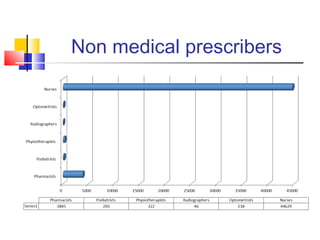
Non medical prescribers
Where do nurse NMPs work?
Supporting new prescribers
 Remember writing your first prescription
is scary
 Grow nurture and support staff
 Help staff to develop, gain skills and
confidence
None of us are born experts
Becoming a confident & competent prescriber
 Prescribe
 Check everything three times
 Find a an experienced prescriber
“buddy”
 If possible get your buddy to check your
prescribing until you gain confidence
Maintaining & enhancing skills
 Find a mentor
 Work with others to audit prescribing
 Find out what you don’t know
 Fill the gaps
 Join or form an NMP group
 Read
 Attend conferences
 Organise your own conference
 Speak at conferences
Ways to use an NMP group
 To audit practice
 To develop skills- learn from experts
 To keep up to date with new medicines
 To keep up to date with alerts
 To share skills and knowledge
 To support each other
 To educate and enable
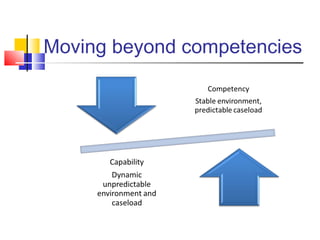
Moving beyond competencies
Setting up nurse led services
 Proposals
 Working up business case
 Showing benefits
 Winning hearts, minds and funding
 Minimising KPIs
 Maximising improvement
Protocols and guidelines
 You may not be the
first to explore this
territory
 Find out what exists,
adapt and develop
 Share new work by
publishing and at
conferences
What protocols and guidelines
 Admission/entry criteria
 Exclusion criteria
 Referral forms/protocols
 Escalation criteria
 Referral to other services
 Pathways, how often to see patient
 Follow up
 Discharge
 KPIs and reporting
Capability expert practice
“the combination of skills, knowledge,
values and self-esteem which enables
individuals to manage change, be
flexible and move beyond competency”
(O’Connell et al, 2014)
Appraisal of nurses practicing at advanced level
 Job description should spell out what the nurse actually
does
 If prescribing this should be in JD
 Appraiser should if possible have expertise in nurse’s
area of practice
 Nurse consultants currently under-utilised in management
of specialist nurses
Questions to ask when appraising
 How are you using
your advanced skills?
 How are you
maintaining?
 What barriers are you
facing?
 What do you most
enjoy?
 What can we do to
support?
Advanced Practitioner Role
 A new type of nurse
 Not a nurse at all
 An evolution of the nursing role
 Remains unregulated
Revalidation
 Aim to demonstrate how you meet all four
domains
 Use your hours log
 Use your CPD ensure relevant to scope of
practice
 Use your reflections ensure relevant and
demonstrate learning.
 Use the process to drive your
practice forward
Précis of a reflection
Mrs Baker, 93, is px Sertaline and suffers
severe postural hypotension. Efforts to
address not successful and changed to
Citalopram with effect.
Unable to ascertain if sertraline caused or
merely worsened existing postural
hypotension
Précis reflection (2)
 Nurse led unit did not routinely check
L/S BP in those who had not fallen
 Change in practice – all patients have
L/S BP checked x 48 hours and not just
those who have fallen
Nazarko (2016). Pain, sadness and ageing
http://www.magonlinelibrary.com/doi/10.12968/
npre.2016.14.2.94
Fundamental nursing
"Nursing is rooted from the needs of humanity
and is founded on the ideal of service. And
that, “the nurse is temporarily the
consciousness of the unconscious, the
love of life for the suicidal, the leg of the
amputee, the eyes of the newly blind, a
means of locomotion for the infant,
knowledge and confidence for the mother
and the mouthpiece for those too weak or
withdrawn to speak”
The fundamentals of nursing
The unique function of the nurse is to assist the
individual, sick or well, in the performance of
those activities contributing to health or its
recovery (or to peaceful death) that he would
perform unaided if he had the necessary
strength, will, or knowledge. And to do this in
such a way as to help him gain independence
as rapidly as possible.”
Henderson V. (1966), The Nature of Nursing: 15: Macmillan Publishing, New York.
The value of nursing
 Goes beyond the medical model
 Nurse with the hands, the heart and the head
 Develop a partnership a with the unique
human being
 Value the person’s perspective, hopes and
aspirations
 Enables us to provide humanistic care and
support
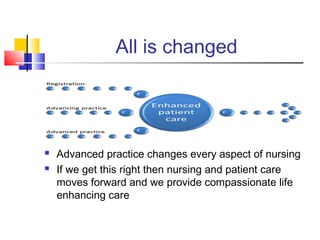
All is changed
 Advanced practice changes every aspect of nursing
 If we get this right then nursing and patient care
moves forward and we provide compassionate life
enhancing care
The art and science
Art – trusting relationships. We meet people in
their darkest hours and they share their
hopes, fears and aspirations
Science – working out what can be done to aid
recovery or come to terms with changes
Art is in working with the person through these
times
The art and science combine to provide kind,
compassionate humane care.
Advanced nursing practice
 Contributes to
developing nursing
 Enables us to nurse
with the hands, the
heart and the head
 Enriches the lives of
those we care for
and our lives
Thank you for listening
Any questions?

March 2016 Competency development for advanced nursing

  • 1.
    Competency development andrevalidation for advanced nursing practice Linda Nazarko MSc, PgDip, PgCert, BSc(Hons), RN, NIP, OBE, FRCN London 11th March 2016 ,
  • 2.
    Aims  To enablethose managing nurses practicing at specialist and advanced level to understand the components of advanced practice and how they can support nurses  To enable nurses who are developing into advanced practitioners to understand what skills, knowledge and support they will require.  To enable nurses practicing at specialist and advanced levels to maintain and develop their skills  To enable nurses practicing at specialist and advanced levels to prepare for re-validation
  • 3.
    Learning objectives To beaware of how to :  Develop competence and confidence in accurate assessment & diagnoses  Provide nurses with suitable education and training  Enable to develop competency  Maintain competency in assessment, diagnosis & prescribing  Move beyond competency to capability  Enable setting up & development of nurse led services  Develop protocols & guidelines  Prepare for appraisal & revalidation
  • 4.
    What is competency? “Nursesand nursing staff have up-to- date knowledge and skills, and use these with intelligence, insight and understanding in line with the needs of each individual in their care”. RCN (2012)
  • 5.
    What does competency mean? The ability to combine technical skills with humanistic care  Combining the art & the science of nursing
  • 6.
    Defining advanced nursingpractice “A registered nurse who has command of an expert knowledge base and clinical competence, is able to make complex clinical decisions using expert clinical judgement, is an essential member of an interdependent health care team and whose role is determined by the context in which s/he practices” NMC 2007
  • 7.
  • 8.
    Core competencies advancedpractice  Practicing autonomously  Making decisions and being accountable  Admitting and discharging patients  Ability to take a clinical history  Ability to physically examine patient  Ability to determine diagnosis  Ability to determine when onward referral is required  Ability to prescribe
  • 9.
    Generic clinical competencies Practicing autonomously  Making decisions and being accountable  Admitting and discharging patients  Ability to take a clinical history  Ability to physically examine patient  Ability to determine diagnosis  Ability to determine when onward referral is required  Ability to prescribe
  • 10.
    Narrow or broadspecialisms  Competencies should be related to the area of practice.  Specialism may be narrow and deep, e.g. diabetes, cardiology  Specialism may be broad such as gerontology, nurse practitioners.
  • 11.
    Specific clinical competencies Competencies specific to your service  Competencies related to where your service is delivered  Competencies specific to the client group
  • 12.
  • 13.
  • 14.
    Building on assessment& diagnostic skills  Practice!  Working with more experienced practitioners  Reading  Using “You Tube” and other media.  Visiting, shadowing Aim to look back at where you are now and see how far you have come.
  • 15.
  • 16.
    Where do nurseNMPs work?
  • 17.
    Supporting new prescribers Remember writing your first prescription is scary  Grow nurture and support staff  Help staff to develop, gain skills and confidence None of us are born experts
  • 18.
    Becoming a confident& competent prescriber  Prescribe  Check everything three times  Find a an experienced prescriber “buddy”  If possible get your buddy to check your prescribing until you gain confidence
  • 19.
    Maintaining & enhancingskills  Find a mentor  Work with others to audit prescribing  Find out what you don’t know  Fill the gaps  Join or form an NMP group  Read  Attend conferences  Organise your own conference  Speak at conferences
  • 20.
    Ways to usean NMP group  To audit practice  To develop skills- learn from experts  To keep up to date with new medicines  To keep up to date with alerts  To share skills and knowledge  To support each other  To educate and enable
  • 22.
  • 23.
    Setting up nurseled services  Proposals  Working up business case  Showing benefits  Winning hearts, minds and funding  Minimising KPIs  Maximising improvement
  • 24.
    Protocols and guidelines You may not be the first to explore this territory  Find out what exists, adapt and develop  Share new work by publishing and at conferences
  • 25.
    What protocols andguidelines  Admission/entry criteria  Exclusion criteria  Referral forms/protocols  Escalation criteria  Referral to other services  Pathways, how often to see patient  Follow up  Discharge  KPIs and reporting
  • 26.
    Capability expert practice “thecombination of skills, knowledge, values and self-esteem which enables individuals to manage change, be flexible and move beyond competency” (O’Connell et al, 2014)
  • 27.
    Appraisal of nursespracticing at advanced level  Job description should spell out what the nurse actually does  If prescribing this should be in JD  Appraiser should if possible have expertise in nurse’s area of practice  Nurse consultants currently under-utilised in management of specialist nurses
  • 28.
    Questions to askwhen appraising  How are you using your advanced skills?  How are you maintaining?  What barriers are you facing?  What do you most enjoy?  What can we do to support?
  • 29.
    Advanced Practitioner Role A new type of nurse  Not a nurse at all  An evolution of the nursing role  Remains unregulated
  • 30.
    Revalidation  Aim todemonstrate how you meet all four domains  Use your hours log  Use your CPD ensure relevant to scope of practice  Use your reflections ensure relevant and demonstrate learning.  Use the process to drive your practice forward
  • 31.
    Précis of areflection Mrs Baker, 93, is px Sertaline and suffers severe postural hypotension. Efforts to address not successful and changed to Citalopram with effect. Unable to ascertain if sertraline caused or merely worsened existing postural hypotension
  • 32.
    Précis reflection (2) Nurse led unit did not routinely check L/S BP in those who had not fallen  Change in practice – all patients have L/S BP checked x 48 hours and not just those who have fallen Nazarko (2016). Pain, sadness and ageing http://www.magonlinelibrary.com/doi/10.12968/ npre.2016.14.2.94
  • 33.
    Fundamental nursing "Nursing isrooted from the needs of humanity and is founded on the ideal of service. And that, “the nurse is temporarily the consciousness of the unconscious, the love of life for the suicidal, the leg of the amputee, the eyes of the newly blind, a means of locomotion for the infant, knowledge and confidence for the mother and the mouthpiece for those too weak or withdrawn to speak”
  • 34.
    The fundamentals ofnursing The unique function of the nurse is to assist the individual, sick or well, in the performance of those activities contributing to health or its recovery (or to peaceful death) that he would perform unaided if he had the necessary strength, will, or knowledge. And to do this in such a way as to help him gain independence as rapidly as possible.” Henderson V. (1966), The Nature of Nursing: 15: Macmillan Publishing, New York.
  • 35.
    The value ofnursing  Goes beyond the medical model  Nurse with the hands, the heart and the head  Develop a partnership a with the unique human being  Value the person’s perspective, hopes and aspirations  Enables us to provide humanistic care and support
  • 36.
    All is changed Advanced practice changes every aspect of nursing  If we get this right then nursing and patient care moves forward and we provide compassionate life enhancing care
  • 37.
    The art andscience Art – trusting relationships. We meet people in their darkest hours and they share their hopes, fears and aspirations Science – working out what can be done to aid recovery or come to terms with changes Art is in working with the person through these times The art and science combine to provide kind, compassionate humane care.
  • 38.
    Advanced nursing practice Contributes to developing nursing  Enables us to nurse with the hands, the heart and the head  Enriches the lives of those we care for and our lives
  • 39.
    Thank you forlistening Any questions?

Editor's Notes