TEMPORIZATION &TEMPORIZATION &
PROVISIONALPROVISIONAL
RESTORATIONS INRESTORATIONS IN
FIXED PARTIALFIXED PARTIAL
RESTORATIONSRESTORATIONS
INDIAN DENTAL ACADEMY
Leader in continuing dental education
www.indiandentalacademy.com
www.indiandentalacademy.comwww.indiandentalacademy.com
PROVISIONAL RESTORATION
{TEMPORARY RESTORATION,TEMPORARISATION}:
It is defined as a fixed or removal prosthesis designed
to enhance esthetics stabilization and function for a
limited period of time after a which it is to be replaced
by definitive prosthesis.
www.indiandentalacademy.comwww.indiandentalacademy.com
The word provisional means established for the time
being pending a permanent arrangement . This type of a
restoration has also been known for many years as
temporary restoration .
www.indiandentalacademy.comwww.indiandentalacademy.com
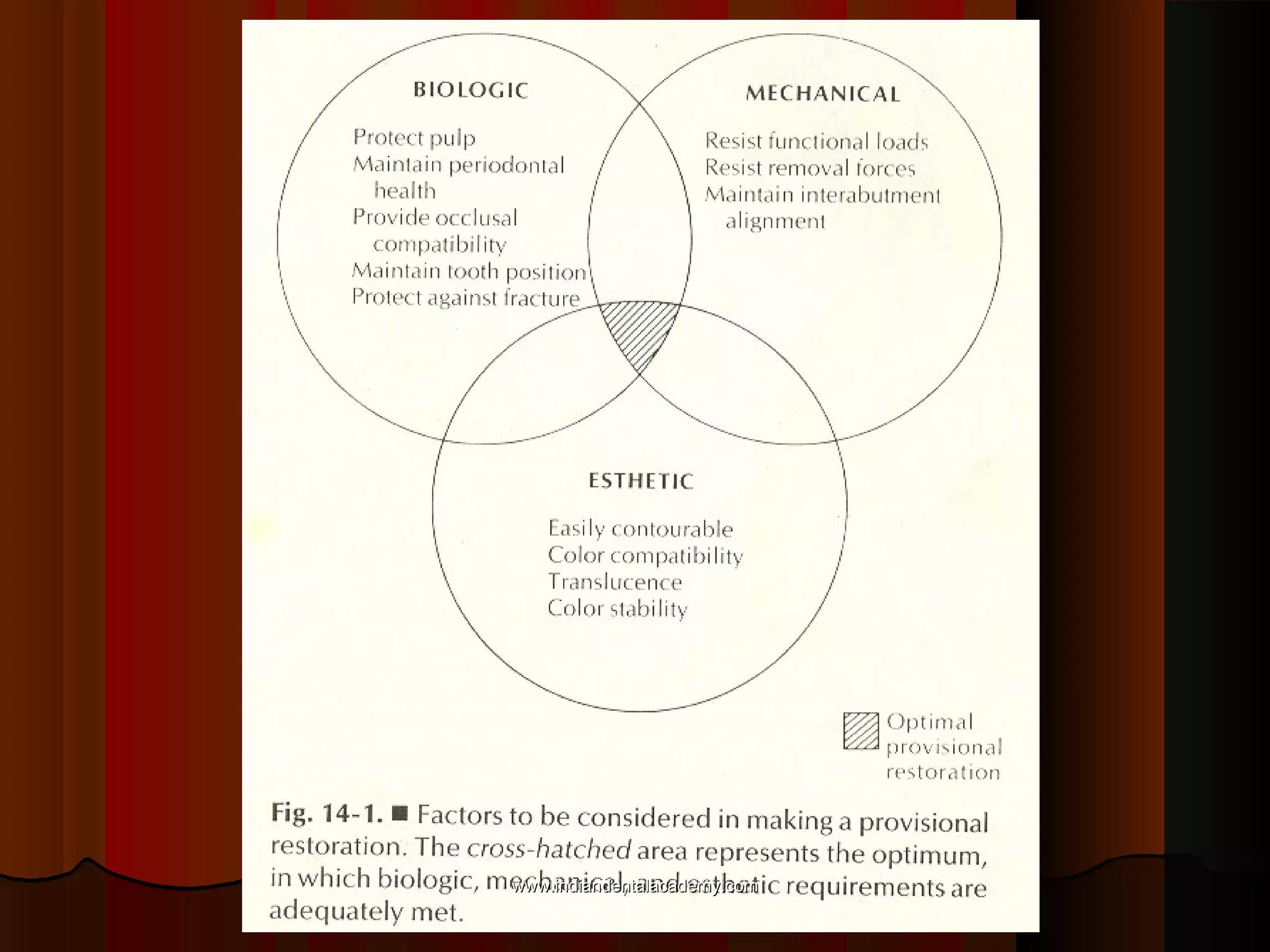
The criteria for a provisional material are as follows
1. Convenient handling: adequate working time,easily
moldability, rapid setting time.
2. Bicompatibility: nontoxic, nonallergic, nonexothermic
3. .Dimensional stability during solidification .
4. Ease of contouring and polishing .
www.indiandentalacademy.comwww.indiandentalacademy.com
5.Adequate strength and abrasion strength.
6.Goodappearance,transclucent,colorcontrollable,
colour stable.
7.Good patient acceptance,non irritating ,odorless.
8.Ease of adding to or reparing .
9.Chemical compatibility with provisional luting
agent.
www.indiandentalacademy.comwww.indiandentalacademy.com
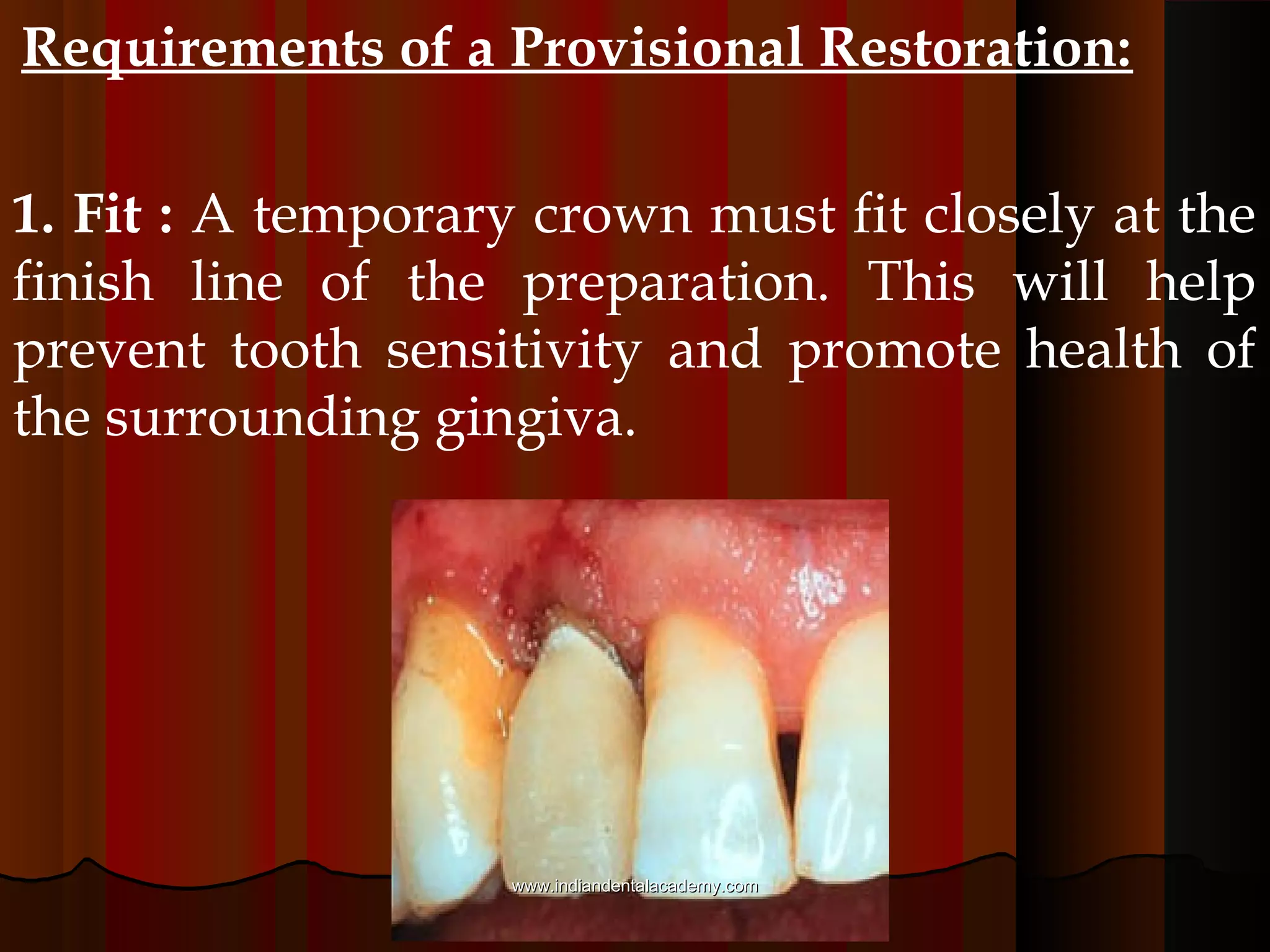
Requirements of a Provisional Restoration:
1. Fit : A temporary crown must fit closely at the
finish line of the preparation. This will help
prevent tooth sensitivity and promote health of
the surrounding gingiva.
www.indiandentalacademy.comwww.indiandentalacademy.com
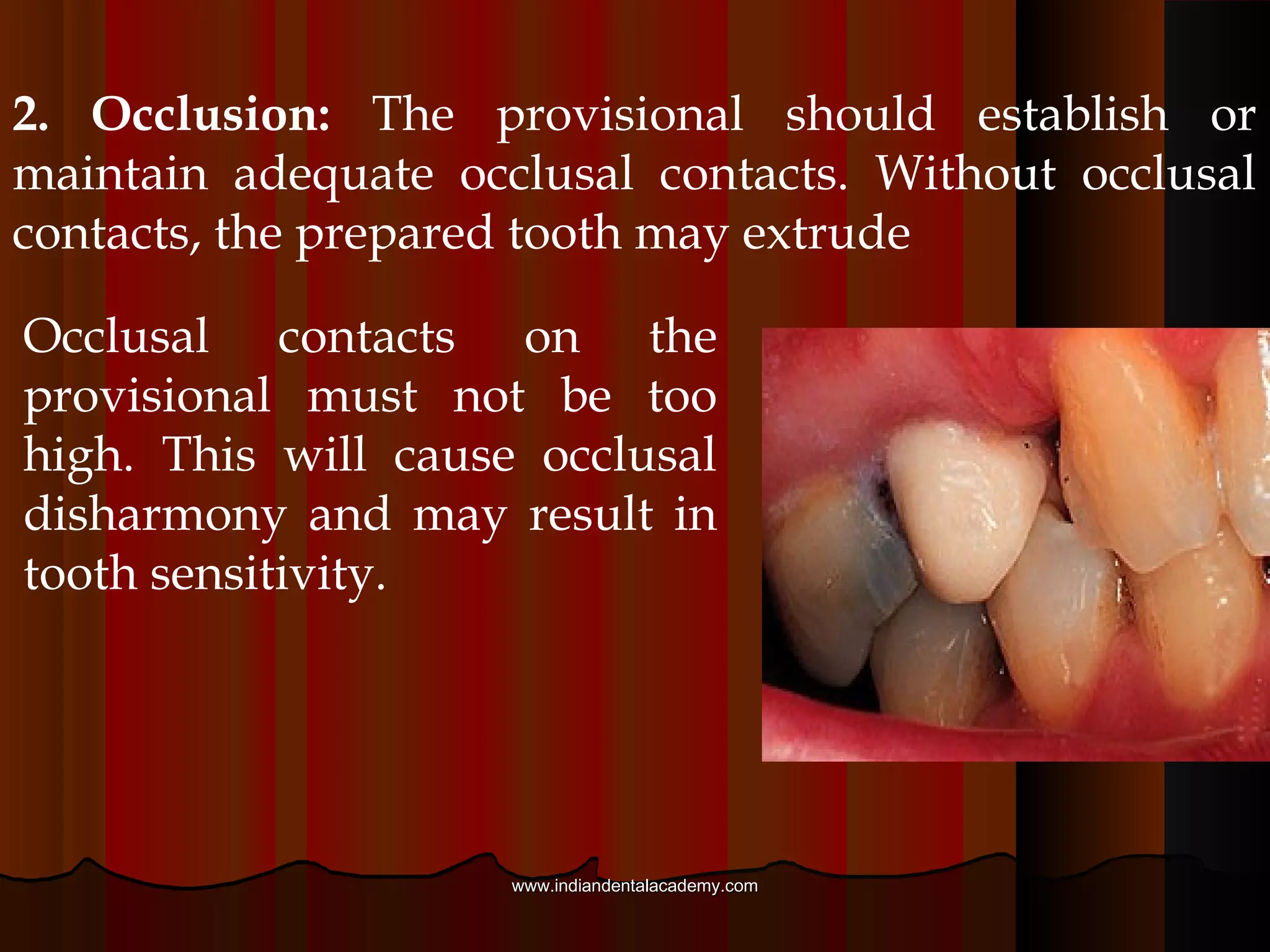
2. Occlusion: The provisional should establish or
maintain adequate occlusal contacts. Without occlusal
contacts, the prepared tooth may extrude
Occlusal contacts on the
provisional must not be too
high. This will cause occlusal
disharmony and may result in
tooth sensitivity.
www.indiandentalacademy.comwww.indiandentalacademy.com
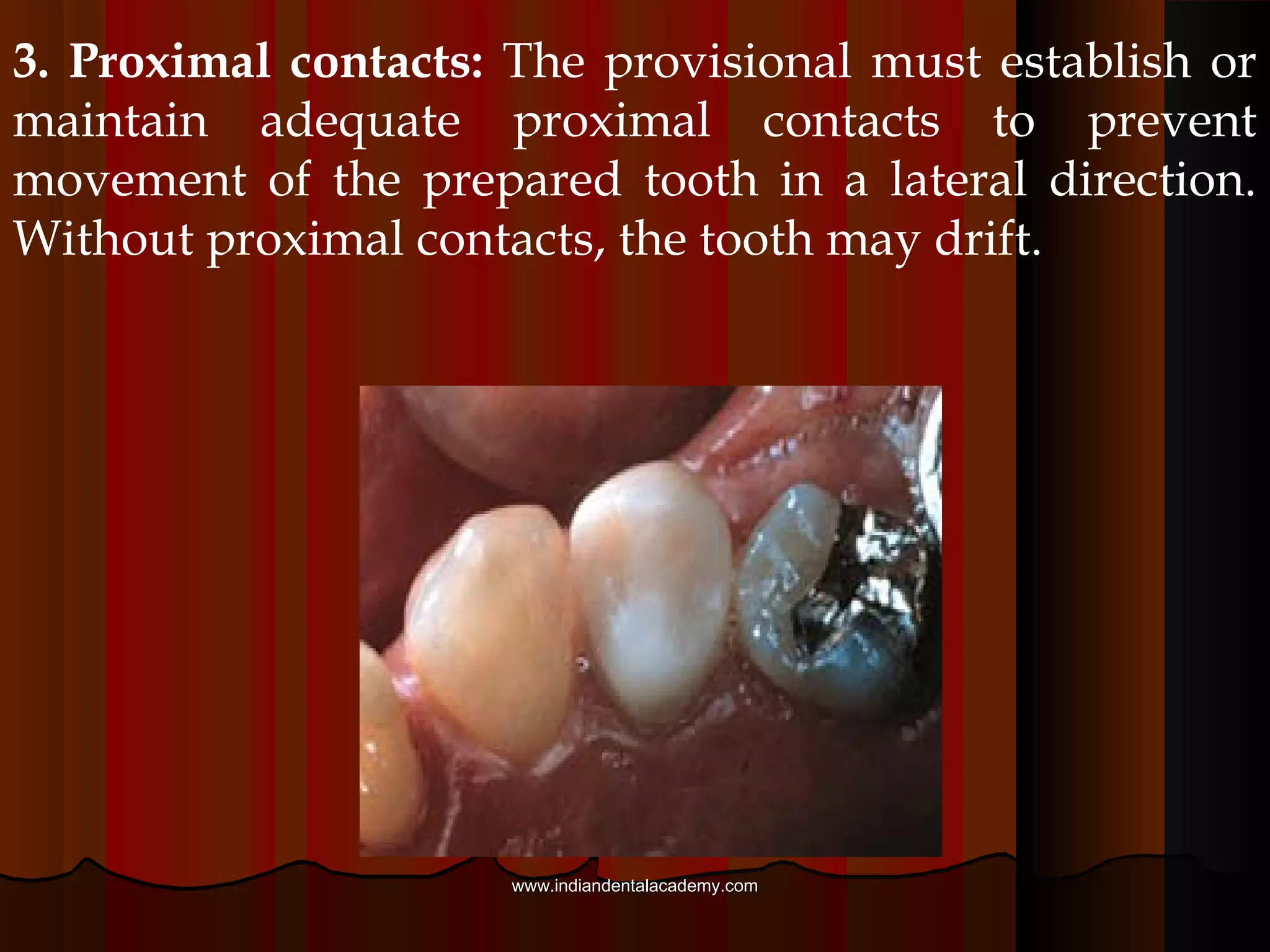
3. Proximal contacts: The provisional must establish or
maintain adequate proximal contacts to prevent
movement of the prepared tooth in a lateral direction.
Without proximal contacts, the tooth may drift.
www.indiandentalacademy.comwww.indiandentalacademy.com
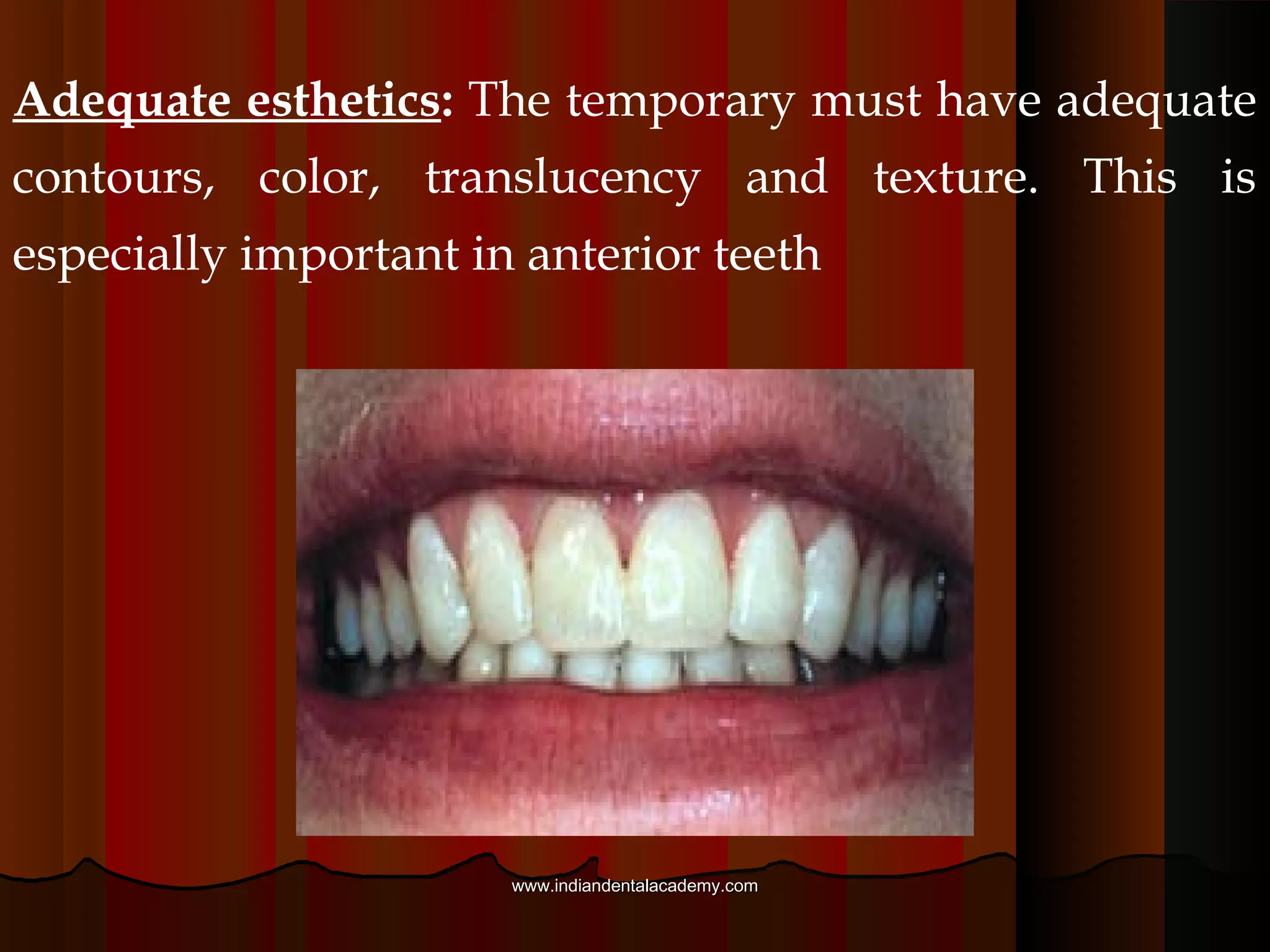
Adequate esthetics: The temporary must have adequate
contours, color, translucency and texture. This is
especially important in anterior teeth
www.indiandentalacademy.comwww.indiandentalacademy.com
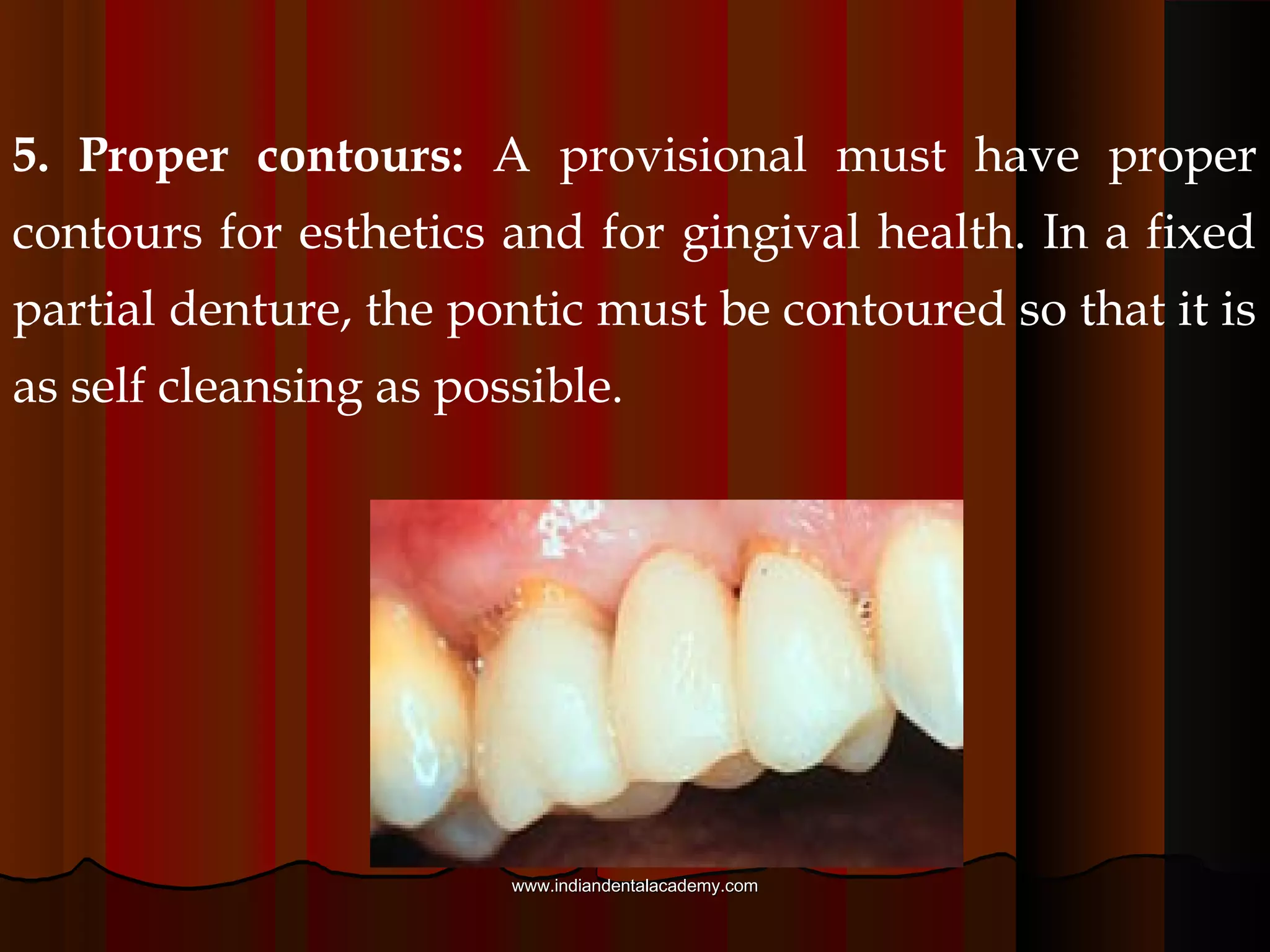
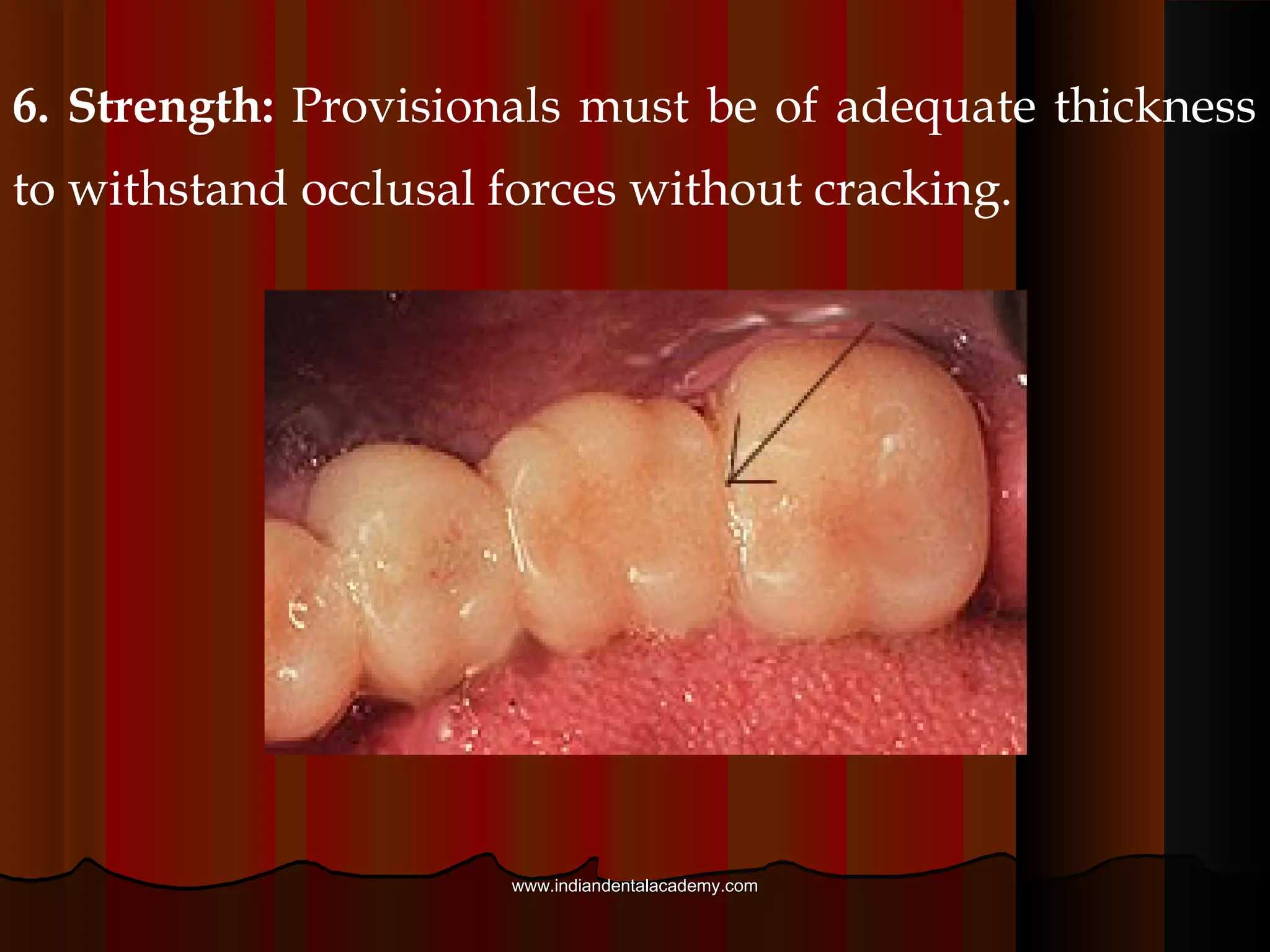
5. Proper contours: A provisional must have proper
contours for esthetics and for gingival health. In a fixed
partial denture, the pontic must be contoured so that it is
as self cleansing as possible.
www.indiandentalacademy.comwww.indiandentalacademy.com
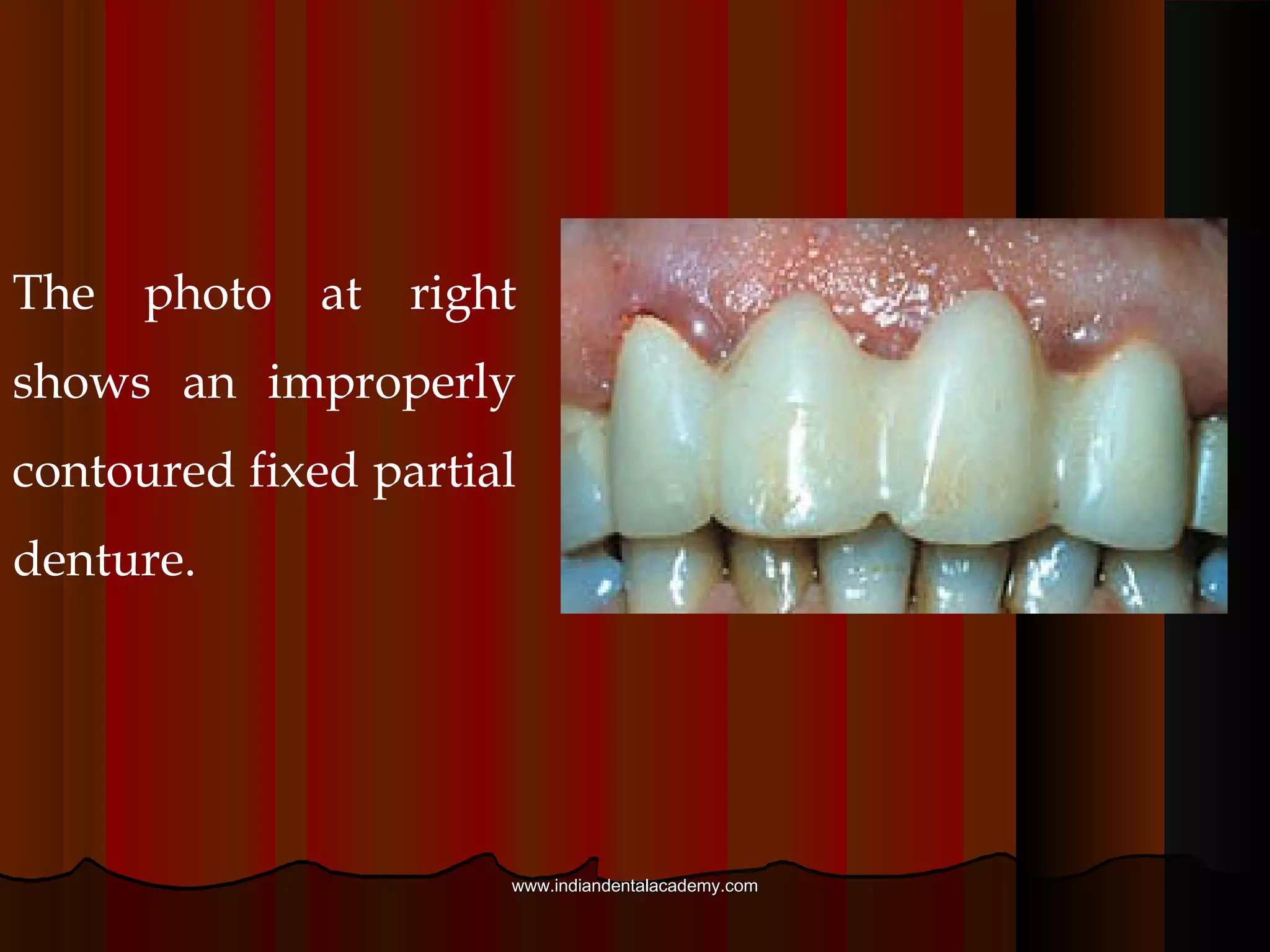
The photo at right
shows an improperly
contoured fixed partial
denture.
www.indiandentalacademy.comwww.indiandentalacademy.com
6. Strength: Provisionals must be of adequate thickness
to withstand occlusal forces without cracking.
www.indiandentalacademy.comwww.indiandentalacademy.com
Material used to fabricate provisional
restorations can be classified as acrylics or resin
composites. Subcategories are based on method
of polymerization (e.g., chemically activated,
light activated, dual activated).
www.indiandentalacademy.comwww.indiandentalacademy.com
AcrylicsAcrylics :
They are the most commonly used materials today
for both single-unit and multiple-unit restorations. due
to their low cost, esthetics, and versatility.
They produce acceptable short-term provisionals
but tend to discolor over time. Other disadvantages are
an objectionable odor, significant shrinkage and heat
generation during setting, and messiness during mixing.
www.indiandentalacademy.comwww.indiandentalacademy.com
The three types of acrylics used are :
1. polymethyl methacrylates
2. poly-R’ methacrylates(where R’ represents either
ethyl,vinyl,or isobutyl groups), and
3. epimines.
www.indiandentalacademy.comwww.indiandentalacademy.com
Preformed materials
Preformed provisional crowns or matrices usually
consist of tooth-shaped shells of plastic, cellulose acetate,
or metal. They are commonly relined with acrylic resin
to provide a more custom fit before cementation, but the
plastic and metal crown shells can also be cemented
directly onto prepared teeth using a stiff luting material
following adjustment.
www.indiandentalacademy.comwww.indiandentalacademy.com
Metal
Metal provisional materials are generally esthetically
limited to posterior restorations. Aluminum shells
provide quick tooth adaptation due to the softness and
ductility of the material, but this same positive quality
can also promote rapid wear that results in perforation
in function and or extrusion of teeth.
www.indiandentalacademy.comwww.indiandentalacademy.com
Pulpal response
Dental pulp inflammation can be caused by either
thermal or chemical insult resulting from materials used
to produce direct provisional restorations.
Hypersensitivity
Hypersensitivity from provisional materials has
been reported but appears to be rare.
www.indiandentalacademy.comwww.indiandentalacademy.com
Provisional luting materials
Provisional luting agents should possess good
mechanical properties, low solubility, and tooth adhesion
to resist bacterial and molecular penetration. The most
important function of these materials is to provide an
adequate seal between the provisional restoration and
prepared tooth. This is necessary to prevent marginal
leakage and pulpal irritation.
www.indiandentalacademy.comwww.indiandentalacademy.com
There are a variety of luting materials used for
interim purposes. The most commonly used luting
materials include :
(1)Calcium hydroxide
(2) Zinc - oxide and eugenol
(3) Non - eugenol materials.
Generally, all of these possess poor mechanical
properties that likely worsen over time.
www.indiandentalacademy.comwww.indiandentalacademy.com
This can have a negative influence on marginal leakage
but also provides an advantage by allowing easier
dislodgment and removal of provisional restorations
from teeth.
The retentive requirements for provisional luting
materials are that they be strong enough to retain a
provisional restoration during the course of treatment
but allow easy restoration removal when required. This
necessity for good retentive and sealing quality and easy
restoration retrieval may lead to a compromise in
material behavior, particularly regarding mechanical
properties.
www.indiandentalacademy.comwww.indiandentalacademy.com
Types of provisional restorations:
Many different types of procedures are used to construct
provisional. Provisional construction can be
categorized into two main methods:
1. Custom temporaries - those that are made with a
matrix derived from the original tooth or a modified
diagnostic cast. Custom temporaries can be
constructed in three different manners:
2. Direct: these are constructed with a matrix lined with
provisional material that is placed directly on the
prepared tooth www.indiandentalacademy.comwww.indiandentalacademy.com
www.indiandentalacademy.comwww.indiandentalacademy.com

Provisional restn

  • 1.
    TEMPORIZATION &TEMPORIZATION & PROVISIONALPROVISIONAL RESTORATIONSINRESTORATIONS IN FIXED PARTIALFIXED PARTIAL RESTORATIONSRESTORATIONS INDIAN DENTAL ACADEMY Leader in continuing dental education www.indiandentalacademy.com www.indiandentalacademy.comwww.indiandentalacademy.com
  • 2.
    PROVISIONAL RESTORATION {TEMPORARY RESTORATION,TEMPORARISATION}: Itis defined as a fixed or removal prosthesis designed to enhance esthetics stabilization and function for a limited period of time after a which it is to be replaced by definitive prosthesis. www.indiandentalacademy.comwww.indiandentalacademy.com
  • 3.
    The word provisionalmeans established for the time being pending a permanent arrangement . This type of a restoration has also been known for many years as temporary restoration . www.indiandentalacademy.comwww.indiandentalacademy.com
  • 4.
  • 5.
    The criteria fora provisional material are as follows 1. Convenient handling: adequate working time,easily moldability, rapid setting time. 2. Bicompatibility: nontoxic, nonallergic, nonexothermic 3. .Dimensional stability during solidification . 4. Ease of contouring and polishing . www.indiandentalacademy.comwww.indiandentalacademy.com
  • 6.
    5.Adequate strength andabrasion strength. 6.Goodappearance,transclucent,colorcontrollable, colour stable. 7.Good patient acceptance,non irritating ,odorless. 8.Ease of adding to or reparing . 9.Chemical compatibility with provisional luting agent. www.indiandentalacademy.comwww.indiandentalacademy.com
  • 7.
  • 8.
    Requirements of aProvisional Restoration: 1. Fit : A temporary crown must fit closely at the finish line of the preparation. This will help prevent tooth sensitivity and promote health of the surrounding gingiva. www.indiandentalacademy.comwww.indiandentalacademy.com
  • 9.
    2. Occlusion: Theprovisional should establish or maintain adequate occlusal contacts. Without occlusal contacts, the prepared tooth may extrude Occlusal contacts on the provisional must not be too high. This will cause occlusal disharmony and may result in tooth sensitivity. www.indiandentalacademy.comwww.indiandentalacademy.com
  • 10.
    3. Proximal contacts:The provisional must establish or maintain adequate proximal contacts to prevent movement of the prepared tooth in a lateral direction. Without proximal contacts, the tooth may drift. www.indiandentalacademy.comwww.indiandentalacademy.com
  • 11.
    Adequate esthetics: Thetemporary must have adequate contours, color, translucency and texture. This is especially important in anterior teeth www.indiandentalacademy.comwww.indiandentalacademy.com
  • 12.
    5. Proper contours:A provisional must have proper contours for esthetics and for gingival health. In a fixed partial denture, the pontic must be contoured so that it is as self cleansing as possible. www.indiandentalacademy.comwww.indiandentalacademy.com
  • 13.
    The photo atright shows an improperly contoured fixed partial denture. www.indiandentalacademy.comwww.indiandentalacademy.com
  • 14.
    6. Strength: Provisionalsmust be of adequate thickness to withstand occlusal forces without cracking. www.indiandentalacademy.comwww.indiandentalacademy.com
  • 15.
    Material used tofabricate provisional restorations can be classified as acrylics or resin composites. Subcategories are based on method of polymerization (e.g., chemically activated, light activated, dual activated). www.indiandentalacademy.comwww.indiandentalacademy.com
  • 16.
    AcrylicsAcrylics : They arethe most commonly used materials today for both single-unit and multiple-unit restorations. due to their low cost, esthetics, and versatility. They produce acceptable short-term provisionals but tend to discolor over time. Other disadvantages are an objectionable odor, significant shrinkage and heat generation during setting, and messiness during mixing. www.indiandentalacademy.comwww.indiandentalacademy.com
  • 17.
    The three typesof acrylics used are : 1. polymethyl methacrylates 2. poly-R’ methacrylates(where R’ represents either ethyl,vinyl,or isobutyl groups), and 3. epimines. www.indiandentalacademy.comwww.indiandentalacademy.com
  • 18.
    Preformed materials Preformed provisionalcrowns or matrices usually consist of tooth-shaped shells of plastic, cellulose acetate, or metal. They are commonly relined with acrylic resin to provide a more custom fit before cementation, but the plastic and metal crown shells can also be cemented directly onto prepared teeth using a stiff luting material following adjustment. www.indiandentalacademy.comwww.indiandentalacademy.com
  • 19.
    Metal Metal provisional materialsare generally esthetically limited to posterior restorations. Aluminum shells provide quick tooth adaptation due to the softness and ductility of the material, but this same positive quality can also promote rapid wear that results in perforation in function and or extrusion of teeth. www.indiandentalacademy.comwww.indiandentalacademy.com
  • 20.
    Pulpal response Dental pulpinflammation can be caused by either thermal or chemical insult resulting from materials used to produce direct provisional restorations. Hypersensitivity Hypersensitivity from provisional materials has been reported but appears to be rare. www.indiandentalacademy.comwww.indiandentalacademy.com
  • 21.
    Provisional luting materials Provisionalluting agents should possess good mechanical properties, low solubility, and tooth adhesion to resist bacterial and molecular penetration. The most important function of these materials is to provide an adequate seal between the provisional restoration and prepared tooth. This is necessary to prevent marginal leakage and pulpal irritation. www.indiandentalacademy.comwww.indiandentalacademy.com
  • 22.
    There are avariety of luting materials used for interim purposes. The most commonly used luting materials include : (1)Calcium hydroxide (2) Zinc - oxide and eugenol (3) Non - eugenol materials. Generally, all of these possess poor mechanical properties that likely worsen over time. www.indiandentalacademy.comwww.indiandentalacademy.com
  • 23.
    This can havea negative influence on marginal leakage but also provides an advantage by allowing easier dislodgment and removal of provisional restorations from teeth. The retentive requirements for provisional luting materials are that they be strong enough to retain a provisional restoration during the course of treatment but allow easy restoration removal when required. This necessity for good retentive and sealing quality and easy restoration retrieval may lead to a compromise in material behavior, particularly regarding mechanical properties. www.indiandentalacademy.comwww.indiandentalacademy.com
  • 24.
    Types of provisionalrestorations: Many different types of procedures are used to construct provisional. Provisional construction can be categorized into two main methods: 1. Custom temporaries - those that are made with a matrix derived from the original tooth or a modified diagnostic cast. Custom temporaries can be constructed in three different manners: 2. Direct: these are constructed with a matrix lined with provisional material that is placed directly on the prepared tooth www.indiandentalacademy.comwww.indiandentalacademy.com
  • 25.