Cementation in Fixed
Prosthodontics
BY :
ABDEL RAHMEN M. ABDEL HAMEED
Content
Clinical importance
Bonding mechanisms
Classification of luting
cements
Ideal criteria of luting
cements
Cement selection
Cementation
Special consideration:
Content
Clinical importance
Bonding mechanisms
Classification of luting
cements
Ideal criteria of luting
cements
Cement selection
Cementation
Special consideration:
Clinical importance
Content
Clinical importance
Bonding mechanisms
Classification of luting
cements
Ideal criteria of luting
cements
Cement selection
Cementation
Special consideration:
Bonding Mechanisms
Mechanical bonding
Molecular Adhesion
Micromechanical
bonding
Bonding Mechanisms
Mechanical bonding
Molecular Adhesion
Micromechanical
bonding
Mechanical bonding:
Bonding Mechanisms
Mechanical bonding
Molecular Adhesion
Micromechanical
bonding
Molecular Adhesion
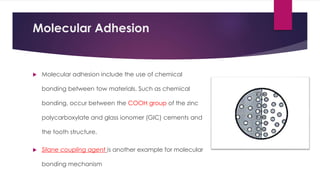
 Molecular adhesion include the use of chemical
bonding between tow materials. Such as chemical
bonding, occur between the COOH group of the zinc
polycarboxylate and glass ionomer (GIC) cements and
the tooth structure.
 Silane coupling agent is another example for molecular
bonding mechanism
Bonding Mechanisms
Mechanical bonding
Molecular Adhesion
Micromechanical
bonding
Micromechanical bonding
 This mechanism use the microstructure of the tooth structure to provide retention.
 The bond strength of micromechanical bonding mechanism sometimes
exceed the cohesive bond of enamel.
 Ceramics can be etched with hydrophloric acid and silanated, before
using resin cement with it. Metals also can be prepared by electrolytic
etching, chemical etching or sandblasting before using the resin cement
with it.
Content
Clinical importance
Bonding mechanisms
Classification of luting
cements
Ideal criteria of luting
cements
Cement selection
Cementation
Special consideration:
Classification of luting cements
According to the
duration in clinical
performance
definitive
Provisional
According to
reaction
mechanism
acid base
reaction
polymerization
reaction
Content
Clinical importance
Bonding mechanisms
Classification of luting
cements
Ideal criteria of luting
cements
Cement selection
Cementation
Special consideration:
Ideal criteria of luting cements
 Physical properties
 Biocompatibility
 Sealing and Anticariogenic Activity
 Adhesion
 Mechanical properties
 Fatigue strength
 Fracture toughness
 Elastic Modulus
 Wear
 Handling and radiopoacity
 Ease of use
 long working time
 short setting time
 Radiopoacity
 Esthetic
Content
Clinical importance
Bonding mechanisms
Classification of luting
cements
Ideal criteria of luting
cements
Cement selection
Cementation
Special consideration:
Cement selection
Zinc phosphate cement
Zinc polycarboxylate
cement
Glass Ionomer cements
Zinc oxide eugenol
cements:
Resin cements
Resin modified glass
ionomer
Cement selection
Zinc phosphate cement
Zinc polycarboxylate
cement
Glass Ionomer cements
Zinc oxide eugenol
cements:
Resin cements
Resin modified glass
ionomer
Zinc phosphate cement
 Compressive strength (st): 96-110 Mpa
 Tensile st: 9.3 Mpa
 PH during cementation: 3.5
 Film thickness: 10-20 um
Cement selection
Zinc phosphate cement
Zinc polycarboxylate
cement
Glass Ionomer cements
Zinc oxide eugenol
cements:
Resin cements
Resin modified glass
ionomer
Zinc polycarboxylate cement
 Compressive st: 50-80 Mpa
 Tensile St: 7-10 Mpa
 Bond strength to tooth structure: 9 Mpa
for Enamel and 3.3 Mpa for Dentin.
 PH during cementation: 4.8
 Film thickness: 13-20 um
Cement selection
Zinc phosphate cement
Zinc polycarboxylate
cement
Glass Ionomer cements
Zinc oxide eugenol
cements:
Resin cements
Resin modified glass
ionomer
Glass Ionomer cements
 Compressive st: 127 Mpa
 Tensile st: 8Mpa
 Bond st to tooth structure: 9 Mpa for enamel and 3 Mpa for
dentin
 Film thickness: 9.5 – 16 um
 advantages
 fluoride
 Bond to tooth structure
 good esthetic properties
 less soluble than zinc phosphate cement
 GIC is 65% more retentive than zinc phosphate cement.
 disadvantages
 high acidity
 sensitive to both moisture and dehydration
 . GIC is translucent
Cement selection
Zinc phosphate cement
Zinc polycarboxylate
cement
Glass Ionomer cements
Zinc oxide eugenol
cements:
Resin cements
Resin modified glass
ionomer
Zinc oxide eugenol cements:
Cement selection
Zinc phosphate cement
Zinc polycarboxylate
cement
Glass Ionomer cements
Zinc oxide eugenol
cements
Resin cements
Resin modified glass
ionomer
Resin cements
 Compressive st: 200-250 Mpa
 Tensile st: 40-50Mpa
 Film thickness: 25 um
 Solubility in water: Insoluble
 Resin cements are composed of organic matrix such as BISGMA or UDMA
and inorganic fillers
 Advantages
 high mechanical properties
 good seal abilities
 good bond strength
 no solubility
 excellent esthetic
 disadvantages
 polymerization shrinkage
 pulpal irritation
 difficulty of removing the hardening
excess cements.
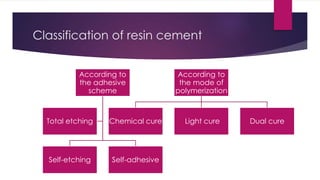
Classification of resin cement
According to
the adhesive
scheme
Self-etching Self-adhesive
Total etching
According to
the mode of
polymerization
Chemical cure Light cure Dual cure
Total etching resin cements
 use three step bonding technique
 Acid etching
 Bonding
 Cement application
Self-etching
 The bonding agent is applied directly to
the tooth structure and cured, and then
the resin cement is applied.
Self-adhesive resin cements
 The adhesive resin cement can be applied
directly to the tooth structure. It provide the best
retention with dentin.
Cement selection
Zinc phosphate cement
Zinc polycarboxylate
cement
Glass Ionomer cements
Zinc oxide eugenol
cements
Resin cements
Resin modified glass
ionomer
Resin modified glass ionomer
 Compressive st: 150 Mpa
 Tensile st: 25-35 Mpa
 Film thickness: 20 um
 Resin modified glass ionomer
combine the strength and the
insolubility advantages of the resin
cements and the fluoride release of
the GIC
Content
Clinical importance
Bonding mechanisms
Classification of luting
cements
Ideal criteria of luting
cements
Cement selection
Cementation
Special consideration:
Cementation
Cementation with Zinc
phosphate cement
Cementation with Zinc
polycarboxylate cement
Cementation with glass
ionomer cements
Cementation with resin
cements
Cementation
Cementation with Zinc
phosphate cement
Cementation with Zinc
polycarboxylate cement
Cementation with glass
ionomer cements
Cementation with resin
cements
Cementation with Zinc phosphate
cement
 tips for cementation :
 Complete isolation is necessary during the whole
process.
 Vital teeth ---> two layers of varnish or bonding agent
should be applied first.
 Non-vital teeth ---> No need for varnish.
 Liquid/Powder Proportions: six drop of liquid for each
crown.
 Do not dispense the liquid until just before mixing.
 Divide the powder in small increments each
of 3 mm thickness.
 Mixing time is 10-20 seconds for each
increment.
 Mix in circular motion.
 Mix over wide area of the glass slab
 introduce the powder slowly in to the liquid
 check the consistency
 Bruch the cement inside the fitting surface
 grooves, pins, and inlays ---> fill them before
seating the restoration
 If necessary use the retraction cord in the
sulcus.
 seat the restoration
 ask the patient to close over a plastic wafer
 Leave the cement to fully set then remove the
excess.
Cementation
Cementation with Zinc
phosphate cement
Cementation with Zinc
polycarboxylate cement
Cementation with glass
ionomer cements
Cementation with resin
cements
Cementation with Zinc
polycarboxylate cement
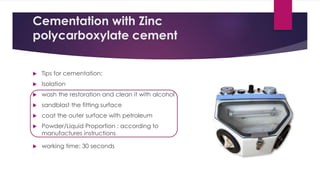
 Tips for cementation:
 Isolation
 wash the restoration and clean it with alcohol
 sandblast the fitting surface
 coat the outer surface with petroleum
 Powder/Liquid Proportion : according to
manufactures instructions
 working time: 30 seconds
 brush the cement inside the restoration, seat
the restoration, ask the patient to bite over
aplastic wafer
 setting time: 3 minutes
 Remove the excess either before or after the
cement become rubbery.
Cementation
Cementation with Zinc
phosphate cement
Cementation with Zinc
polycarboxylate cement
Cementation with glass
ionomer cements
Cementation with resin
cements
Cementation with glass ionomer
cements
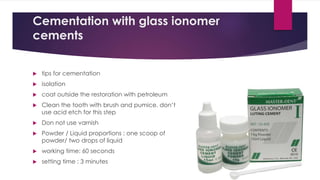
 tips for cementation
 isolation
 coat outside the restoration with petroleum
 Clean the tooth with brush and pumice. don’t
use acid etch for this step
 Don not use varnish
 Powder / Liquid proportions : one scoop of
powder/ two drops of liquid
 working time: 60 seconds
 setting time : 3 minutes
 mix rapidly until the mix become creamy
 capsule form is now available in the market
 Brush the restoration with the cement; seat the
restoration, ask the patient to occlude over the
plastic wafer.
 Wait until the cement become brittle but before
complete setting and remove the excess
cement.
 Coat the crown margin with varnish or petroleum
Cementation
Cementation with Zinc
phosphate cement
Cementation with Zinc
polycarboxylate cement
Cementation with glass
ionomer cements
Cementation with resin
cements
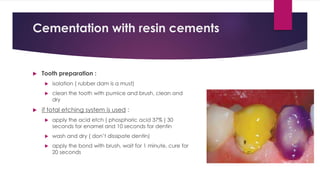
Cementation with resin cements
 Tooth preparation :
 isolation ( rubber dam is a must)
 clean the tooth with pumice and brush, clean and
dry
 if total etching system is used :
 apply the acid etch ( phosphoric acid 37% ) 30
seconds for enamel and 10 seconds for dentin
 wash and dry ( don’t dissipate dentin)
 apply the bond with brush, wait for 1 minute, cure for
20 seconds
 if self-etching system is used
 apply the self-etching bond , wait for 1 minutes and
cure
 If total etching system will be used the tooth not need
any preparation more than cleaning with brush.
 treatment of the fitting surface of the restoration :
 The fitting surface of the restoration is treated
before receiving the resin cement by two ways
 Roughening the surface to increase the surface
area and create a microspores In the restoration
surface
 Increase the wettability of the restoration surface
with silane coupling agent.
 Roughnining of the fitting surface can be
achieved by various techniques depending on
the type of the restoration.
Content
Clinical importance
Bonding mechanisms
Classification of luting
cements
Ideal criteria of luting
cements
Cement selection
Cementation
Special consideration:
Cementation of ceramic
restorations
Bonding of resin to
zirconia:
Cementation of posts
Cementation of partial
coverage restoration
Cementation of the gold
alloy:
Special consideration:
Cementation of ceramic
restorations
Bonding of resin to
zirconia:
Cementation of posts
Cementation of partial
coverage restoration
Cementation of the gold
alloy:
Cementation of ceramic restorations
 tooth preparation
 restoration preparation differ according to the type of the ceramic material:
 Feld spathic porcelain ( HF + S )
 Lucite reinforced ceramics (IPS Empress): ( sand + S )
 Lithium disilicate (IPS Emax( ( Sand + HF + S )
 Zirconia
 Lava ( Silica )
 Cercon ( Silica + MDP )
 other types such as IPS Emax zircad and Ketana (Phosphoric acid monomer containing primer)
Special consideration:
Cementation of ceramic
restorations
Bonding of resin to
zirconia:
Cementation of posts
Cementation of partial
coverage restoration
Cementation of the gold
alloy:
Bonding of resin to zirconia:
 sandblasting and silanation of zirconia
 Plasma spraying
 Porcelain particles infusion
Special consideration:
Cementation of ceramic
restorations
Bonding of resin to
zirconia:
Cementation of posts
Cementation of partial
coverage restoration
Cementation of the gold
alloy:
Cementation of posts
 Metallic posts
 Fiber posts
Special consideration:
Cementation of ceramic
restorations
Bonding of resin to
zirconia:
Cementation of posts
Cementation of partial
coverage restoration
Cementation of the gold
alloy:
Cementation of partial coverage
restoration
Special consideration:
Cementation of ceramic
restorations
Bonding of resin to
zirconia:
Cementation of posts
Cementation of partial
coverage restoration
Cementation of the gold
alloy:
Cementation of the gold alloy:
cementation in Fixed prosthodontics

cementation in Fixed prosthodontics

  • 1.
    Cementation in Fixed Prosthodontics BY: ABDEL RAHMEN M. ABDEL HAMEED
  • 2.
    Content Clinical importance Bonding mechanisms Classificationof luting cements Ideal criteria of luting cements Cement selection Cementation Special consideration:
  • 3.
    Content Clinical importance Bonding mechanisms Classificationof luting cements Ideal criteria of luting cements Cement selection Cementation Special consideration:
  • 4.
  • 5.
    Content Clinical importance Bonding mechanisms Classificationof luting cements Ideal criteria of luting cements Cement selection Cementation Special consideration:
  • 6.
    Bonding Mechanisms Mechanical bonding MolecularAdhesion Micromechanical bonding
  • 7.
    Bonding Mechanisms Mechanical bonding MolecularAdhesion Micromechanical bonding
  • 8.
  • 9.
    Bonding Mechanisms Mechanical bonding MolecularAdhesion Micromechanical bonding
  • 10.
    Molecular Adhesion  Molecularadhesion include the use of chemical bonding between tow materials. Such as chemical bonding, occur between the COOH group of the zinc polycarboxylate and glass ionomer (GIC) cements and the tooth structure.  Silane coupling agent is another example for molecular bonding mechanism
  • 11.
    Bonding Mechanisms Mechanical bonding MolecularAdhesion Micromechanical bonding
  • 12.
    Micromechanical bonding  Thismechanism use the microstructure of the tooth structure to provide retention.
  • 13.
     The bondstrength of micromechanical bonding mechanism sometimes exceed the cohesive bond of enamel.  Ceramics can be etched with hydrophloric acid and silanated, before using resin cement with it. Metals also can be prepared by electrolytic etching, chemical etching or sandblasting before using the resin cement with it.
  • 14.
    Content Clinical importance Bonding mechanisms Classificationof luting cements Ideal criteria of luting cements Cement selection Cementation Special consideration:
  • 15.
    Classification of lutingcements According to the duration in clinical performance definitive Provisional According to reaction mechanism acid base reaction polymerization reaction
  • 16.
    Content Clinical importance Bonding mechanisms Classificationof luting cements Ideal criteria of luting cements Cement selection Cementation Special consideration:
  • 17.
    Ideal criteria ofluting cements  Physical properties  Biocompatibility  Sealing and Anticariogenic Activity  Adhesion
  • 18.
     Mechanical properties Fatigue strength  Fracture toughness  Elastic Modulus  Wear
  • 19.
     Handling andradiopoacity  Ease of use  long working time  short setting time  Radiopoacity  Esthetic
  • 20.
    Content Clinical importance Bonding mechanisms Classificationof luting cements Ideal criteria of luting cements Cement selection Cementation Special consideration:
  • 21.
    Cement selection Zinc phosphatecement Zinc polycarboxylate cement Glass Ionomer cements Zinc oxide eugenol cements: Resin cements Resin modified glass ionomer
  • 22.
    Cement selection Zinc phosphatecement Zinc polycarboxylate cement Glass Ionomer cements Zinc oxide eugenol cements: Resin cements Resin modified glass ionomer
  • 23.
    Zinc phosphate cement Compressive strength (st): 96-110 Mpa  Tensile st: 9.3 Mpa  PH during cementation: 3.5  Film thickness: 10-20 um
  • 24.
    Cement selection Zinc phosphatecement Zinc polycarboxylate cement Glass Ionomer cements Zinc oxide eugenol cements: Resin cements Resin modified glass ionomer
  • 25.
    Zinc polycarboxylate cement Compressive st: 50-80 Mpa  Tensile St: 7-10 Mpa  Bond strength to tooth structure: 9 Mpa for Enamel and 3.3 Mpa for Dentin.  PH during cementation: 4.8  Film thickness: 13-20 um
  • 26.
    Cement selection Zinc phosphatecement Zinc polycarboxylate cement Glass Ionomer cements Zinc oxide eugenol cements: Resin cements Resin modified glass ionomer
  • 27.
    Glass Ionomer cements Compressive st: 127 Mpa  Tensile st: 8Mpa  Bond st to tooth structure: 9 Mpa for enamel and 3 Mpa for dentin  Film thickness: 9.5 – 16 um
  • 28.
     advantages  fluoride Bond to tooth structure  good esthetic properties  less soluble than zinc phosphate cement  GIC is 65% more retentive than zinc phosphate cement.
  • 29.
     disadvantages  highacidity  sensitive to both moisture and dehydration  . GIC is translucent
  • 30.
    Cement selection Zinc phosphatecement Zinc polycarboxylate cement Glass Ionomer cements Zinc oxide eugenol cements: Resin cements Resin modified glass ionomer
  • 31.
  • 32.
    Cement selection Zinc phosphatecement Zinc polycarboxylate cement Glass Ionomer cements Zinc oxide eugenol cements Resin cements Resin modified glass ionomer
  • 33.
    Resin cements  Compressivest: 200-250 Mpa  Tensile st: 40-50Mpa  Film thickness: 25 um  Solubility in water: Insoluble
  • 34.
     Resin cementsare composed of organic matrix such as BISGMA or UDMA and inorganic fillers  Advantages  high mechanical properties  good seal abilities  good bond strength  no solubility  excellent esthetic
  • 35.
     disadvantages  polymerizationshrinkage  pulpal irritation  difficulty of removing the hardening excess cements.
  • 36.
    Classification of resincement According to the adhesive scheme Self-etching Self-adhesive Total etching According to the mode of polymerization Chemical cure Light cure Dual cure
  • 37.
    Total etching resincements  use three step bonding technique  Acid etching  Bonding  Cement application
  • 38.
    Self-etching  The bondingagent is applied directly to the tooth structure and cured, and then the resin cement is applied.
  • 39.
    Self-adhesive resin cements The adhesive resin cement can be applied directly to the tooth structure. It provide the best retention with dentin.
  • 40.
    Cement selection Zinc phosphatecement Zinc polycarboxylate cement Glass Ionomer cements Zinc oxide eugenol cements Resin cements Resin modified glass ionomer
  • 41.
    Resin modified glassionomer  Compressive st: 150 Mpa  Tensile st: 25-35 Mpa  Film thickness: 20 um  Resin modified glass ionomer combine the strength and the insolubility advantages of the resin cements and the fluoride release of the GIC
  • 42.
    Content Clinical importance Bonding mechanisms Classificationof luting cements Ideal criteria of luting cements Cement selection Cementation Special consideration:
  • 43.
    Cementation Cementation with Zinc phosphatecement Cementation with Zinc polycarboxylate cement Cementation with glass ionomer cements Cementation with resin cements
  • 44.
    Cementation Cementation with Zinc phosphatecement Cementation with Zinc polycarboxylate cement Cementation with glass ionomer cements Cementation with resin cements
  • 45.
    Cementation with Zincphosphate cement  tips for cementation :  Complete isolation is necessary during the whole process.  Vital teeth ---> two layers of varnish or bonding agent should be applied first.  Non-vital teeth ---> No need for varnish.  Liquid/Powder Proportions: six drop of liquid for each crown.  Do not dispense the liquid until just before mixing.
  • 46.
     Divide thepowder in small increments each of 3 mm thickness.  Mixing time is 10-20 seconds for each increment.  Mix in circular motion.  Mix over wide area of the glass slab  introduce the powder slowly in to the liquid  check the consistency  Bruch the cement inside the fitting surface
  • 47.
     grooves, pins,and inlays ---> fill them before seating the restoration  If necessary use the retraction cord in the sulcus.  seat the restoration  ask the patient to close over a plastic wafer  Leave the cement to fully set then remove the excess.
  • 48.
    Cementation Cementation with Zinc phosphatecement Cementation with Zinc polycarboxylate cement Cementation with glass ionomer cements Cementation with resin cements
  • 49.
    Cementation with Zinc polycarboxylatecement  Tips for cementation:  Isolation  wash the restoration and clean it with alcohol  sandblast the fitting surface  coat the outer surface with petroleum  Powder/Liquid Proportion : according to manufactures instructions  working time: 30 seconds
  • 50.
     brush thecement inside the restoration, seat the restoration, ask the patient to bite over aplastic wafer  setting time: 3 minutes  Remove the excess either before or after the cement become rubbery.
  • 51.
    Cementation Cementation with Zinc phosphatecement Cementation with Zinc polycarboxylate cement Cementation with glass ionomer cements Cementation with resin cements
  • 52.
    Cementation with glassionomer cements  tips for cementation  isolation  coat outside the restoration with petroleum  Clean the tooth with brush and pumice. don’t use acid etch for this step  Don not use varnish  Powder / Liquid proportions : one scoop of powder/ two drops of liquid  working time: 60 seconds  setting time : 3 minutes
  • 53.
     mix rapidlyuntil the mix become creamy  capsule form is now available in the market  Brush the restoration with the cement; seat the restoration, ask the patient to occlude over the plastic wafer.  Wait until the cement become brittle but before complete setting and remove the excess cement.  Coat the crown margin with varnish or petroleum
  • 54.
    Cementation Cementation with Zinc phosphatecement Cementation with Zinc polycarboxylate cement Cementation with glass ionomer cements Cementation with resin cements
  • 55.
    Cementation with resincements  Tooth preparation :  isolation ( rubber dam is a must)  clean the tooth with pumice and brush, clean and dry  if total etching system is used :  apply the acid etch ( phosphoric acid 37% ) 30 seconds for enamel and 10 seconds for dentin  wash and dry ( don’t dissipate dentin)  apply the bond with brush, wait for 1 minute, cure for 20 seconds
  • 56.
     if self-etchingsystem is used  apply the self-etching bond , wait for 1 minutes and cure  If total etching system will be used the tooth not need any preparation more than cleaning with brush.
  • 57.
     treatment ofthe fitting surface of the restoration :  The fitting surface of the restoration is treated before receiving the resin cement by two ways  Roughening the surface to increase the surface area and create a microspores In the restoration surface  Increase the wettability of the restoration surface with silane coupling agent.  Roughnining of the fitting surface can be achieved by various techniques depending on the type of the restoration.
  • 58.
    Content Clinical importance Bonding mechanisms Classificationof luting cements Ideal criteria of luting cements Cement selection Cementation Special consideration:
  • 59.
    Special consideration: Cementation ofceramic restorations Bonding of resin to zirconia: Cementation of posts Cementation of partial coverage restoration Cementation of the gold alloy:
  • 60.
    Special consideration: Cementation ofceramic restorations Bonding of resin to zirconia: Cementation of posts Cementation of partial coverage restoration Cementation of the gold alloy:
  • 61.
    Cementation of ceramicrestorations  tooth preparation  restoration preparation differ according to the type of the ceramic material:  Feld spathic porcelain ( HF + S )  Lucite reinforced ceramics (IPS Empress): ( sand + S )  Lithium disilicate (IPS Emax( ( Sand + HF + S )  Zirconia  Lava ( Silica )  Cercon ( Silica + MDP )  other types such as IPS Emax zircad and Ketana (Phosphoric acid monomer containing primer)
  • 62.
    Special consideration: Cementation ofceramic restorations Bonding of resin to zirconia: Cementation of posts Cementation of partial coverage restoration Cementation of the gold alloy:
  • 63.
    Bonding of resinto zirconia:  sandblasting and silanation of zirconia  Plasma spraying  Porcelain particles infusion
  • 64.
    Special consideration: Cementation ofceramic restorations Bonding of resin to zirconia: Cementation of posts Cementation of partial coverage restoration Cementation of the gold alloy:
  • 65.
    Cementation of posts Metallic posts  Fiber posts
  • 66.
    Special consideration: Cementation ofceramic restorations Bonding of resin to zirconia: Cementation of posts Cementation of partial coverage restoration Cementation of the gold alloy:
  • 67.
    Cementation of partialcoverage restoration
  • 68.
    Special consideration: Cementation ofceramic restorations Bonding of resin to zirconia: Cementation of posts Cementation of partial coverage restoration Cementation of the gold alloy:
  • 69.
    Cementation of thegold alloy: