REINO PROTOCTISTA
PROTOZOOS
ALGAS
HONGOS MUCILAGINOSOS
REINO PROTOCTISTA
Figure 28-01
REINO PROTOCTISTA
AMEBOZOOS SEUDÓPODOS
LOBULADOS
LOBULADOS
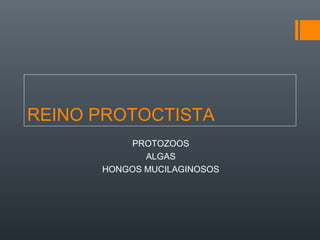
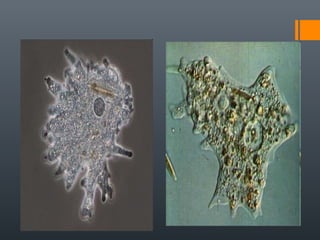
GMNAMEBAS
GMNAMEBAS
ENTAMOEBAS
ENTAMOEBAS
HONGOS MUCILAGINOSOS
LE 28-24

Pseudopodia
40 µm
SARCODINOS
Entamoeba histolytica
LE 28-25

Physarum polycephalum

4 cm
LE 28-26

Feeding
plasmodium
Zygote
(2n)

Mature
plasmodium
(preparing to fruit)
Young
sporangium

SYNGAMY

1 mm

Amoeboid cells
(n)

Mature
sporangium
Key

Flagellated cells
(n)

Germinating
spore

Spores
(n)

MEIOSIS
Stalk

Haploid (n)
Diploid (2n)
LE 28-27

SYNGAMY

Emerging
amoeba

Spores
(n)

600 µm

SEXUAL
REPRODUCTION

Amebas solitarias
Estadio de
alimentación

Cuerpos
fructíferos

ASEXUAL
REPRODUCTION
Amebas conglomeradas

Zygote
(2n)

MEIOSIS

Amoebas
Key
Haploid (n)
Diploid (2n)

Conglomerado
En vías de migración

200 µm
CICLO DE VIDA DE Dictyostelium, un hongo mucilaginoso celular
CERCOZOOS
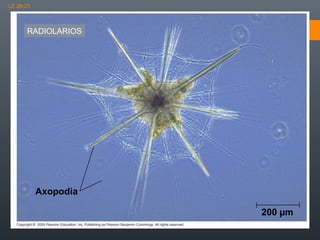
FORAMINIFEROS Y RADIOLARIOS
FORAMINIFEROS RADIOLARIOS
LE 28-22

20 µm
FORAMINÍFEROS

Globigerina
ACANTILADOS DE DOVER
LE 28-23

RADIOLARIOS

Axopodia
200 µm
EUGLENOZOOS
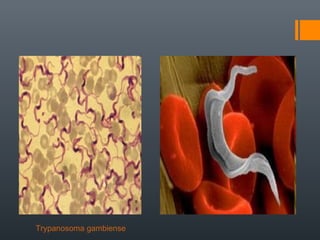
 CINETOPLÁSTIDOS
 EUGLÉNIDOS
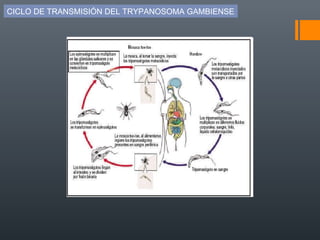
Trypanosoma gambiense
LE 28-7

9 µm
CICLO DE TRANSMISIÓN DEL TRYPANOSOMA GAMBIENSE
LE 28-8

FLAGELO LARGO

EMANCHA OCULAR
O ESTIGMA

DETECTOR DE LUZ

FLAGELO CORTO

Euglena (LM)

Nucleus

VACUOLA CONTRÁCTIL

5 µm

Plasma membrane
Chloroplast

EUGLENA
Pellicle

EUGLENA
ALVEOLADOS SACOS DEBAJO
DE LA MEMBRANA PLASMÁTICA
 DINOFLAGELADOS
 APICOMPLEXOS
 CILIADOS
LE 28-2b

100 µm

Ceratium tripos, a unicellular marine
dinoflagellate (LM)
LE 28-10

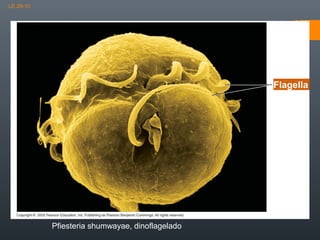
3 µm

Flagella

Pfiesteria shumwayae, dinoflagelado
CILIADOS
Paramecium
REPRODUCCIÓN SEXUAL: CONJUGACIÓN
LE 28-12a

FEEDING, WASTE REMOVAL, AND WATER BALANCE
Contractile
vacuole

Paramecium, like other freshwater
protists, constantly takes in water
by osmosis from the hypotonic
environment. Bladderlike contractile
vacuoles accumulate excess water
from radial canals and periodically
expel it through the plasma membrane.

Paramecium feeds mainly on bacteria.
Rows of cilia along a funnel-shaped oral
groove move food into the cell mouth,
where the food is engulfed into food
vacuoles by phagocytosis.
Oral groove
Cell mouth

Thousands of cilia cover the
surface of Paramecium.
50 µm

Food vacuoles combine with lysosomes.
As the food is digested, the vacuoles
follow a looping path through the cell.

Micronucleus
Macronucleus

The undigested contents of food
vacuoles are released when the
vacuoles fuse with a specialized
region of the plasma membrane
that functions as an anal pore.
LE 28-12

FEEDING, WASTE REMOVAL, AND WATER BALANCE
Paramecium, like other freshwater
protists, constantly takes in water
by osmosis from the hypotonic
environment. Bladderlike
contractile vacuoles accumulate
excess water from radial canals
and periodically expel it through
the plasma membrane.

Contractile
vacuole

Paramecium feeds mainly on bacteria.
Rows of cilia along a funnel-shaped oral
groove move food into the cell mouth,
where the food is engulfed into food
vacuoles by phagocytosis.
Oral groove
Cell mouth

Thousands of cilia cover the
surface of Paramecium.

Food vacuoles combine with lysosomes.
As the food is digested, the vacuoles
follow a looping path through the cell.

50 µm

Micronucleus
The undigested contents of food
vacuoles are released when the
vacuoles fuse with a specialized
region of the plasma membrane
that functions as an anal pore.

Macronucleus

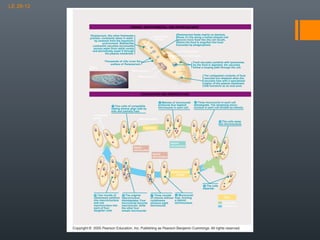
CONJUGATION AND REPRODUCTION
Meiosis of micronuclei
produces four haploid
micronuclei in each cell.

Two cells of compatible
mating strains align side by
side and partially fuse.
Compatible
mates

Three micronuclei in each cell
disintegrate. The remaining micronucleus in each cell divides by mitosis.

Macronucleus

The cells swap
one micronucleus.

MEIOSIS

Haploid
micronucleus

Diploid
micronucleus
Diploid
micronucleus

MICRONUCLEAR
FUSION

The cells
separate.
Two rounds of
cytokinesis partition
one maccronucleus
and one
macronucleus into
each of four
daughter cells.

The original
macronucleus
disintegrates. Four
micronuclei become
macronuclei, while
the other four
remain micronuclei.

Micronuclei
Three rounds
of mitosis without fuse, forming
a diploid
cytokinesis
micronucleus.
produce eight
micronuclei.

Key
Conjugation
Reproduction
LE 28-12b

CONJUGATION AND REPRODUCTION
Meiosis of micronuclei
Three micronuclei in each cell
produces four haploid
disintegrate. The remaining micromicronuclei in each cell. nucleus in each cell divides by mitosis.

Two cells of compatible
mating strains align side by
side and partially fuse.
Compatible
mates

Macronucleus

The cells swap
one micronucleus.

MEIOSIS

Haploid
micronucleus

Diploid
micronucleus
Diploid
micronucleus

MICRONUCLEAR
FUSION

The cells
separate.
Two rounds of
cytokinesis
partition one
macronucleus and
one macronucleus
into each of four
daughter cells.

The original
macronucleus
disintegrates. Four
micronuclei become
macronuclei, while
the other four
remain micronuclei.

Three rounds
Micronuclei
of mitosis
fuse, forming
without
a diploid
cytokinesis
micronucleus.
produce eight
micronuclei.

Key
Conjugation
Reproduction
Stentor
LE 28-2a

Stentor,

100 µm

Stentor
Vorticella
Plasmodium malariae
LE 28-11

Inside mosquito

Inside human
Merozoito

esporozoitos
(n)

HIGADO
hepatocito

Oooquiste
MEIOSIS
Cigoto
(2n)

Apex
Merozoito
(n)

Red blood
cell

0.5 µm

Glóbulos rojos

FERTILIZATION
Key

Gametes
Gametocytes
(n)

Haploid (n)
Diploid (2n)
ESPOROZOOS
Estramenópilos flagelos pilosos y
lisos
 Ovomicetos (mohos de agua y especies cercanas)
 Diatomeas
 Algas doradas
 Algas pardas
LE 28-13

Hairy
flagellum
Smooth
flagellum

5 µm

Synura petersenii
LE 28-14_3

Oogonium

Germ tube

Egg nucleus (n)
Cyst

Antheridial hypha
with sperm nuclei (n)

MEIOSIS

ASEXUAL
REPRODUCTION
Zoospore
(2n)
FERTILIZATION

Zygote
germination
Zoosporangium
(2n)
Key
Haploid (n)
Diploid (2n)

SEXUAL
REPRODUCTION

Zygotes
(2n)
LE 28-16

ALGAS UNICELULARES

ALGA
S

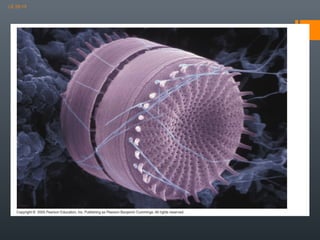
DIATOMEAS
50 µm
3 µm

LE 28-15
LE 28-17

Dynobrion alga dorada formadora de colonias en agua dulce

25 µm
LE 28-18

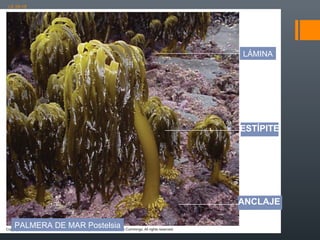
LÁMINA

ESTÍPITE

ANCLAJE
PALMERA DE MAR Postelsia
Figure 28-19

Selva de kelp. Macrocystis
LE 28-21

C
I
C
L
O

Key
Haploid (n)
Diploid (2n)
Sporangia

D
E

esporangio

V
I
D
A
D
E
L
A
M
I
N
A
R
I
A

MEIOSIS

zoosporas

Zoospores

Esporofito
2n

Femenino

Esporofito en vías
De desarrollo

Gametophytes
(n)

Zygote
(2n)
Gametofito femenino
maduro
(n)

FERTILIZATION

Egg

oosfera

masculino

anterozoide
Algas verdes y rojas
LE 28-2d

500 µm

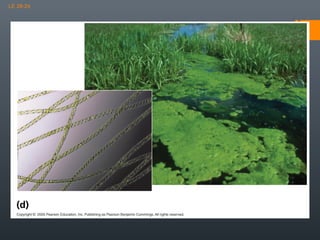
Spirogyra, a filamentous freshwater green alga (insert LM)
LE 28-2c

4 cm

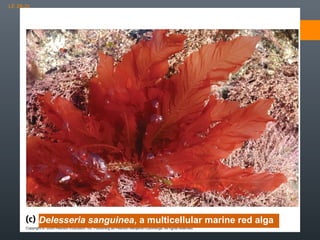
Delesseria sanguinea, a multicellular marine red alga
LE 28-20

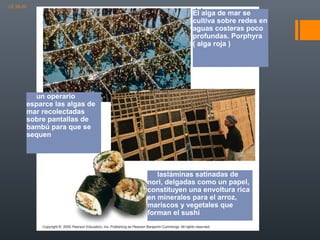
El alga de mar se
cultiva sobre redes en
aguas costeras poco
profundas. Porphyra
( alga roja )

un operario
esparce las algas de
mar recolectadas
sobre pantallas de
bambú para que se
sequen

lasláminas satinadas de
nori, delgadas como un papel,
constituyen una envoltura rica
en minerales para el arroz,
mariscos y vegetales que
forman el sushi
LE 28-28

Dulse (Palmaria palmata). This
edible species has a “leafy” form.

A coralline alga. The cells walls of
corralline algae are hardened by
calcium carbonate. Some coralline
algae are members of the biological
communities called coral reefs.

Bonnemaisonia hamifera, a
filamentous red alga.

Palmaria palmata
Figure 28-29
LE 28-30

20 µm

50 µm

Volox, a colonial freshwater chlorophyte. The colony is a
hollow ball whose wall is composed of hundreds or
thousands of biflagellated cells (see inset LM) embedded in
a gelatinous matrix. The cells are usually connected by
strands of cytoplasm; if isolated, these cells cannot
reproduce. The large colonies seen here will eventually
release the small “daughter” colonies within them (LM).

Calperpa, an
inter-tidal
chlorophyte. The
branched filaments
lack cross-walls and
thus are
multinucleate. In
effect, the thallus is
one huge “supercell.”

Ulva, or sea lettuce. This edible seaweed has a
multicellular thallus differentiated into leaflike
blades and a rootlike holdfast that anchors the
alga against turbulent waves and tides.
LE 28-31

Flagella

1 µm

Cell wall

Nucleus

Zoospores

Regions
of single
chloroplast

Key
Haploid (n)
Diploid (2n)

ASEXUAL
REPRODUCTION

SYNGAMY

Mature cell
(n)
SEXUAL
REPRODUCTION

MEIOSIS

Zygote
(2n)
LE 28-3
Plastid

Dinoflagellates

Secondary
endosymbiosis

Apicomplexans

Red algae
Cyanobacterium

Primary
endosymbiosis

Stramenopiles

Secondary
endosymbiosis

Heterotrophic
eukaryote

Plastid

Euglenids
Secondary
endosymbiosis

Green algae

Chlorarachniophytes
Euglenozoa

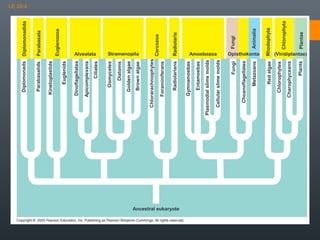
Parabasala

Alveolata

Ancestral eukaryote

Plants

Charophyceans

Chlorophytes

Animalia

Plantae

Chlorophyta

Rhodophyta

(Opisthokonta)
Red algae

Metazoans

Choanoflagellates

Fungi

Radiolaria
Amoebozoa
Fungi

Cellular slime molds

Plasmodial slime molds

Entamoebas

Gymnamoebas

Radiolarians

Foraminiferans

Chlorarachniophytes

Brown algae

Golden algae

Diatoms

Cercozoa

Oomycetes

Ciliates

Apicomplexans

Stramenopila

Dinoflagellates

Euglenids

Kinetoplastids

Parabasalids

Diplomonads Diplomonadida

LE 28-4

(Viridiplantae)
LE 28-5a

Giardia intestinalis, a diplomonad (colorized SEM)

5 µm
LE 28-5b

Flagella

Undulating membrane

5 µm

Trichomonas vaginalis, a parabasalid (colorized SEM)
LE 28-6

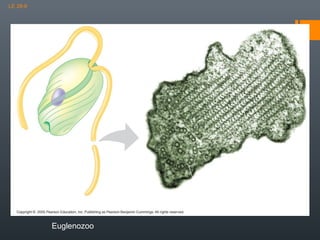
Flagella
0.2 µm

Crystalline rod

Ring of microtubules
Euglenozoo
LE 28-9

0.2 µm

Flagellum

Alveoli
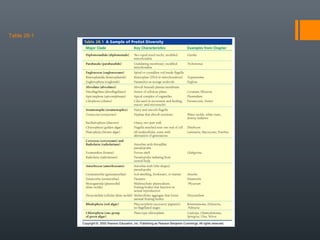
Table 28-1

Protozoos y algas