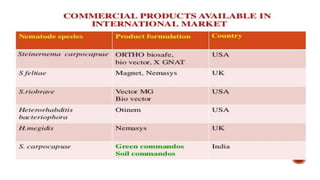
By Shariqa Aisha.
University of Kashmir
Department of Bioresources
Outline
 Introduction
 History
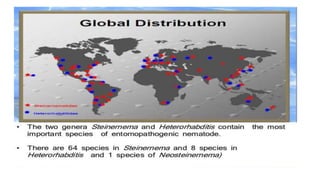
 Global Distribution
 Pathogenicity
 Life cycle
 Mode of Action
 Host Range
 Mode of Application
 Advantages
 Limitations
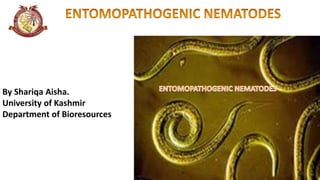
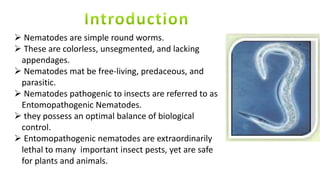
 Nematodes are simple round worms.
 These are colorless, unsegmented, and lacking
appendages.
 Nematodes mat be free-living, predaceous, and
parasitic.
 Nematodes pathogenic to insects are referred to as
Entomopathogenic Nematodes.
 they possess an optimal balance of biological
control.
 Entomopathogenic nematodes are extraordinarily
lethal to many important insect pests, yet are safe
for plants and animals.
 The first Entomopathogenic Nematode was described by Steiner in
1923 as Aplectana kraussei ( Steinernema kraussei).
 In 1928, Dutky found Neoaplectana carpocapsae.
 In 1929, Steiner gave the systematic position of second
entomopathogenic nematode, Neoaplectana glaseri.
 Heterorhabiditis bacteriophora, was first time described In 1976 by
Pionar.
 The infective juvenile (IJ) stage, were found to transmit a specific Gram-
negative baterium in the anterior intestine to the homeceol of insect
hosts ( Poinar et. Al 1977).
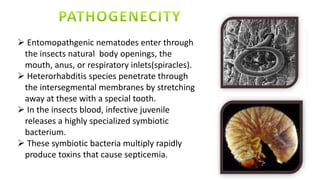
 Entomopathgenic nematodes enter through
the insects natural body openings, the
mouth, anus, or respiratory inlets(spiracles).
 Heterorhabditis species penetrate through
the intersegmental membranes by stretching
away at these with a special tooth.
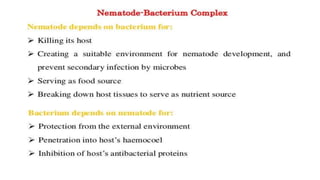
 In the insects blood, infective juvenile
releases a highly specialized symbiotic
bacterium.
 These symbiotic bacteria multiply rapidly
produce toxins that cause septicemia.
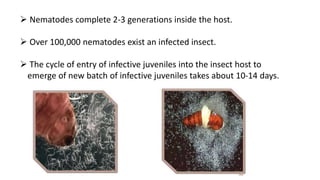
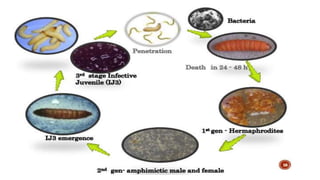
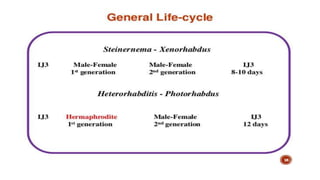
 Nematodes complete 2-3 generations inside the host.
 Over 100,000 nematodes exist an infected insect.
 The cycle of entry of infective juveniles into the insect host to
emerge of new batch of infective juveniles takes about 10-14 days.
 Simple life-cycle includes the egg, four juvenile stages
and an adult.
 Infective juvenile ( third stage) called dauer larvae is
resistant to environmental conditions.
 EPN locate their insect hosts in the soil by detecting
chemical cues such as excretory products and
carbobdioxide gradient.
 One generation from egg to egg typically takers from
4-7 days.
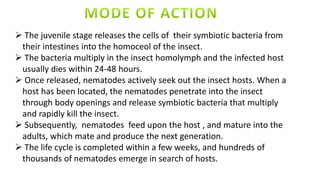
 The juvenile stage releases the cells of their symbiotic bacteria from
their intestines into the homoceol of the insect.
 The bacteria multiply in the insect homolymph and the infected host
usually dies within 24-48 hours.
 Once released, nematodes actively seek out the insect hosts. When a
host has been located, the nematodes penetrate into the insect
through body openings and release symbiotic bacteria that multiply
and rapidly kill the insect.
 Subsequently, nematodes feed upon the host , and mature into the
adults, which mate and produce the next generation.
 The life cycle is completed within a few weeks, and hundreds of
thousands of nematodes emerge in search of hosts.
 In laboratory tests, S. carpocapsae alone infected more than 250 species of
insects from over 75 families in 11 orders.
 Some nematode species may search for hosts at or near soil surface( e.g., S.
carpocapsae and S. scapterisci).
 Others are adapted to search deeper in the soil profile “ cruiser” ( e.g., H.
bacteriophora and S. glaseri).
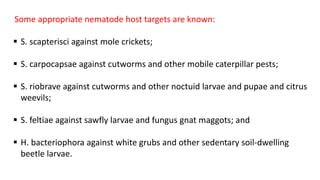
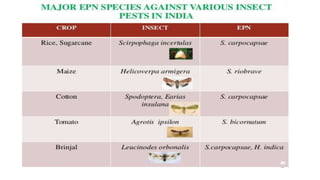
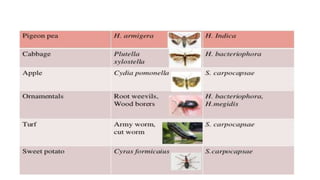
Some appropriate nematode host targets are known:
 S. scapterisci against mole crickets;
 S. carpocapsae against cutworms and other mobile caterpillar pests;
 S. riobrave against cutworms and other noctuid larvae and pupae and citrus
weevils;
 S. feltiae against sawfly larvae and fungus gnat maggots; and
 H. bacteriophora against white grubs and other sedentary soil-dwelling
beetle larvae.
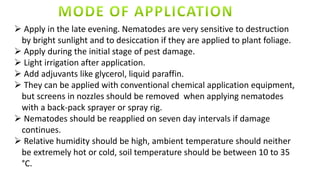
 Apply in the late evening. Nematodes are very sensitive to destruction
by bright sunlight and to desiccation if they are applied to plant foliage.
 Apply during the initial stage of pest damage.
 Light irrigation after application.
 Add adjuvants like glycerol, liquid paraffin.
 They can be applied with conventional chemical application equipment,
but screens in nozzles should be removed when applying nematodes
with a back-pack sprayer or spray rig.
 Nematodes should be reapplied on seven day intervals if damage
continues.
 Relative humidity should be high, ambient temperature should neither
be extremely hot or cold, soil temperature should be between 10 to 35
°C.
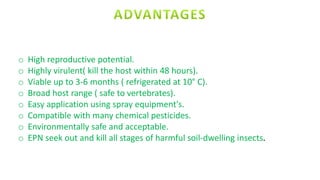
o High reproductive potential.
o Highly virulent( kill the host within 48 hours).
o Viable up to 3-6 months ( refrigerated at 10° C).
o Broad host range ( safe to vertebrates).
o Easy application using spray equipment's.
o Compatible with many chemical pesticides.
o Environmentally safe and acceptable.
o EPN seek out and kill all stages of harmful soil-dwelling insects.
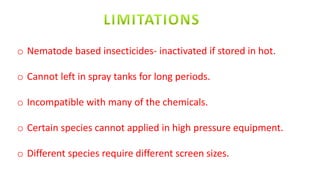
o Nematode based insecticides- inactivated if stored in hot.
o Cannot left in spray tanks for long periods.
o Incompatible with many of the chemicals.
o Certain species cannot applied in high pressure equipment.
o Different species require different screen sizes.
Entomopathogenenic nematodes

Entomopathogenenic nematodes

  • 1.
    By Shariqa Aisha. Universityof Kashmir Department of Bioresources
  • 2.
    Outline  Introduction  History Global Distribution  Pathogenicity  Life cycle  Mode of Action  Host Range  Mode of Application  Advantages  Limitations
  • 3.
     Nematodes aresimple round worms.  These are colorless, unsegmented, and lacking appendages.  Nematodes mat be free-living, predaceous, and parasitic.  Nematodes pathogenic to insects are referred to as Entomopathogenic Nematodes.  they possess an optimal balance of biological control.  Entomopathogenic nematodes are extraordinarily lethal to many important insect pests, yet are safe for plants and animals.
  • 4.
     The firstEntomopathogenic Nematode was described by Steiner in 1923 as Aplectana kraussei ( Steinernema kraussei).  In 1928, Dutky found Neoaplectana carpocapsae.  In 1929, Steiner gave the systematic position of second entomopathogenic nematode, Neoaplectana glaseri.  Heterorhabiditis bacteriophora, was first time described In 1976 by Pionar.  The infective juvenile (IJ) stage, were found to transmit a specific Gram- negative baterium in the anterior intestine to the homeceol of insect hosts ( Poinar et. Al 1977).
  • 6.
     Entomopathgenic nematodesenter through the insects natural body openings, the mouth, anus, or respiratory inlets(spiracles).  Heterorhabditis species penetrate through the intersegmental membranes by stretching away at these with a special tooth.  In the insects blood, infective juvenile releases a highly specialized symbiotic bacterium.  These symbiotic bacteria multiply rapidly produce toxins that cause septicemia.
  • 7.
     Nematodes complete2-3 generations inside the host.  Over 100,000 nematodes exist an infected insect.  The cycle of entry of infective juveniles into the insect host to emerge of new batch of infective juveniles takes about 10-14 days.
  • 9.
     Simple life-cycleincludes the egg, four juvenile stages and an adult.  Infective juvenile ( third stage) called dauer larvae is resistant to environmental conditions.  EPN locate their insect hosts in the soil by detecting chemical cues such as excretory products and carbobdioxide gradient.  One generation from egg to egg typically takers from 4-7 days.
  • 12.
     The juvenilestage releases the cells of their symbiotic bacteria from their intestines into the homoceol of the insect.  The bacteria multiply in the insect homolymph and the infected host usually dies within 24-48 hours.  Once released, nematodes actively seek out the insect hosts. When a host has been located, the nematodes penetrate into the insect through body openings and release symbiotic bacteria that multiply and rapidly kill the insect.  Subsequently, nematodes feed upon the host , and mature into the adults, which mate and produce the next generation.  The life cycle is completed within a few weeks, and hundreds of thousands of nematodes emerge in search of hosts.
  • 14.
     In laboratorytests, S. carpocapsae alone infected more than 250 species of insects from over 75 families in 11 orders.  Some nematode species may search for hosts at or near soil surface( e.g., S. carpocapsae and S. scapterisci).  Others are adapted to search deeper in the soil profile “ cruiser” ( e.g., H. bacteriophora and S. glaseri).
  • 15.
    Some appropriate nematodehost targets are known:  S. scapterisci against mole crickets;  S. carpocapsae against cutworms and other mobile caterpillar pests;  S. riobrave against cutworms and other noctuid larvae and pupae and citrus weevils;  S. feltiae against sawfly larvae and fungus gnat maggots; and  H. bacteriophora against white grubs and other sedentary soil-dwelling beetle larvae.
  • 19.
     Apply inthe late evening. Nematodes are very sensitive to destruction by bright sunlight and to desiccation if they are applied to plant foliage.  Apply during the initial stage of pest damage.  Light irrigation after application.  Add adjuvants like glycerol, liquid paraffin.  They can be applied with conventional chemical application equipment, but screens in nozzles should be removed when applying nematodes with a back-pack sprayer or spray rig.  Nematodes should be reapplied on seven day intervals if damage continues.  Relative humidity should be high, ambient temperature should neither be extremely hot or cold, soil temperature should be between 10 to 35 °C.
  • 20.
    o High reproductivepotential. o Highly virulent( kill the host within 48 hours). o Viable up to 3-6 months ( refrigerated at 10° C). o Broad host range ( safe to vertebrates). o Easy application using spray equipment's. o Compatible with many chemical pesticides. o Environmentally safe and acceptable. o EPN seek out and kill all stages of harmful soil-dwelling insects.
  • 21.
    o Nematode basedinsecticides- inactivated if stored in hot. o Cannot left in spray tanks for long periods. o Incompatible with many of the chemicals. o Certain species cannot applied in high pressure equipment. o Different species require different screen sizes.