

17. Eukaryotes:
Protista
Protista
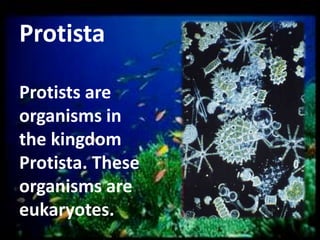
Protists are
organisms in
the kingdom
Protista. These
organisms are
eukaryotes.
I. Unicellular Algae
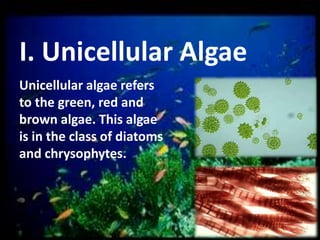
Unicellular algae refers
to the green, red and
brown algae. This algae
is in the class of diatoms
and chrysophytes.
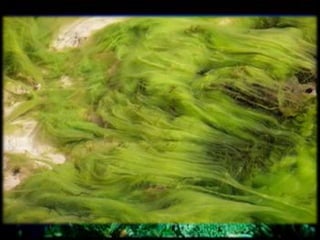
Spirogyra
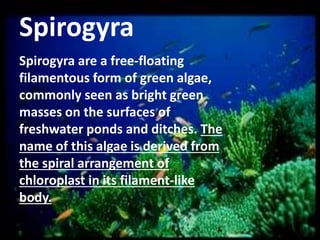
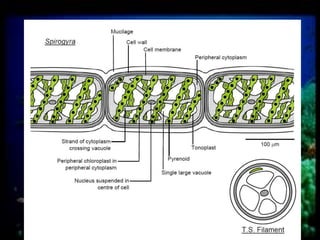
Spirogyra are a free-floating
filamentous form of green algae,
commonly seen as bright green
masses on the surfaces of
freshwater ponds and ditches. The
name of this algae is derived from
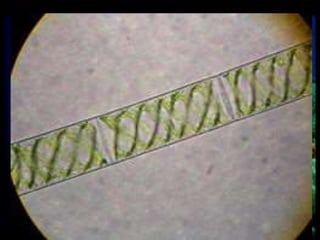
the spiral arrangement of
chloroplast in its filament-like
body.
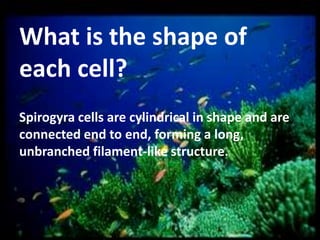
What is the shape of
each cell?
Spirogyra cells are cylindrical in shape and are
connected end to end, forming a long,
unbranched filament-like structure.
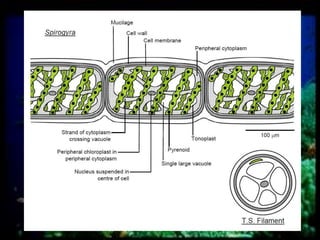
What occupies most of
the volume of the cell?
A large vacuole occupies
most of the volume of the
cell
Conjugation
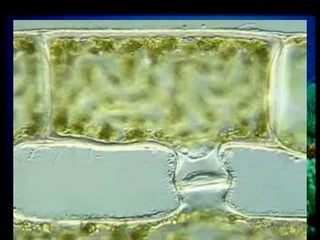
In scalariform conjugation, the cells of adjacent
filaments develop small tube-like structures called
'conjugation tubes', which fuse together to form a
'conjugation canal'. The cytoplasm of the male cell
flows through this canal to the female cell and fuses
with the latter's cytoplasm. The next step is the fusion
of gametes (mature sexual reproductive cell with a
single set of unpaired chromosomes) to form the
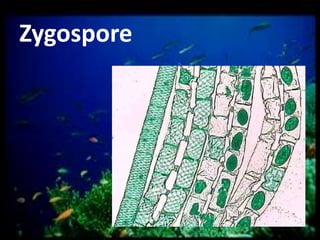
zygospore. The zygospore, which is thick-walled, is
brownish in color and is oval or circular in shape. The
spores are released to form new filaments. This type of
conjugation gives the algae a ladder-like appearance,
due to the interlinking of filaments.
Isogamete
Isogamete - A
gamete that has
the same size and
structure as the
one with which it
unites.
Zygospore
Chrysophyta – Golden
brown algae
a division of mostly freshwater
eukaryotic algae having the
chlorophyll masked by brown or
yellow pigment; yellow-green and
golden-brown algae and diatoms
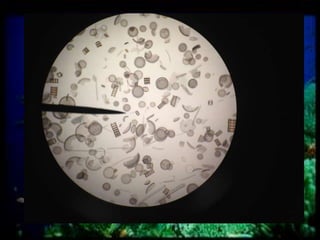
Diatoms
Diatoms are delicate unicellular
organisms that have a yellow-brown
chloroplast that enables them to
photosynthesize. Their cell walls are
made of silica almost like a glass house.
The construction of the cell wall, called
the frustule, consists of two valves that
fit into each other like a little pill box.
Diatoms
•Diatoms have many shapes
•Their accessory pigments fucoxanthin
and β (beta) carotene give them a
characteristic golden color.
•Color is more obvious on the center
portion.
II. Euglenoids
Euglenoids are single cellular
organisms with euglena like features.
They do not have cellwall but do
possess pellicle. They have flagella
and occur in fresh water. They have
specific euglenoid movements which
are creeping movements followed by
contraction and expansion of the
body. Reproduction is acoomplished
by means of binary fission
Euglena
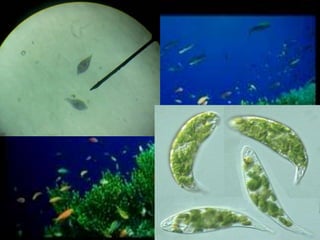
Euglena is a single-celled
microscopic algae. It is a unique
organism that can accumulate
nutrients by photosynthesis and
move like an animal by twisting
itself.
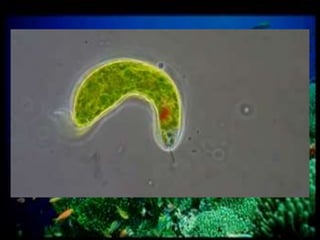
Euglena is discoidal in shape.
However, it can also be ovate,
elongate or U-shaped.
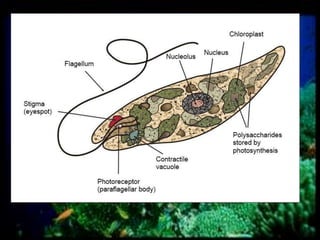
•Euglena move by a flagellum (plural ‚ flagella),
which is a long whip-like structure that acts
like a little motor. The flagellum is located on
the anterior (front) end, and twirls in such a
way as to pull the cell through the water.
•Toward the posterior of the cell is a star-like
structure: the contractile vacuole. This
organelle helps the cell remove excess water,
and without it the euglena could take in some
much water due to osmosis that the cell would
explode.
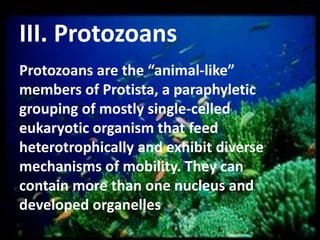
III. Protozoans
Protozoans are the “animal-like”
members of Protista, a paraphyletic
grouping of mostly single-celled
eukaryotic organism that feed
heterotrophically and exhibit diverse
mechanisms of mobility. They can
contain more than one nucleus and
developed organelles
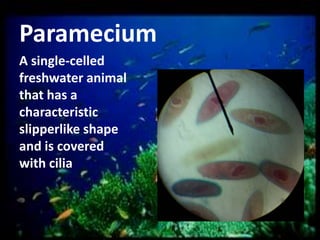
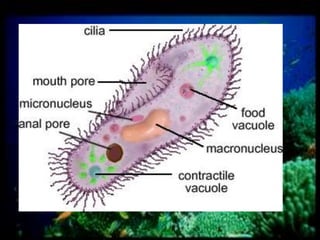
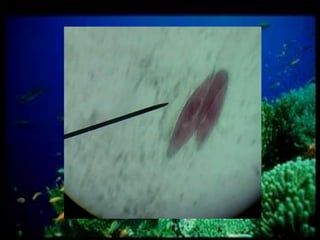
Paramecium
A single-celled
freshwater animal
that has a
characteristic
slipperlike shape
and is covered
with cilia
Conjugation
sexual process in which two
organisms of the same species
exchange nuclear material during a
temporary union completely transfer
one organism’s contents to the other
organism or fuse together to form
one organism
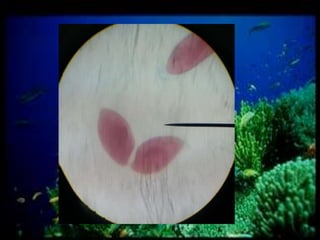
Binary fission
•Asexual
means of
reproduction
of paramecium
•Macronucleus
is more visible
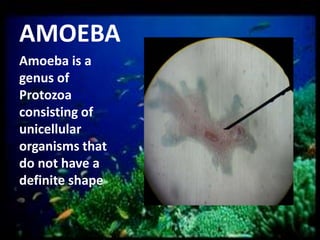
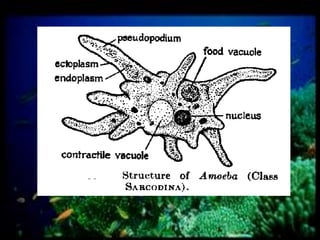
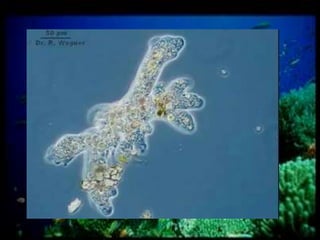
AMOEBA
Amoeba is a
genus of
Protozoa
consisting of
unicellular
organisms that
do not have a
definite shape
Experiment 17 PROTISTA

Experiment 17 PROTISTA

  • 1.
  • 2.
    Protista Protists are organisms in thekingdom Protista. These organisms are eukaryotes.
  • 3.
    I. Unicellular Algae Unicellularalgae refers to the green, red and brown algae. This algae is in the class of diatoms and chrysophytes.
  • 4.
    Spirogyra Spirogyra are afree-floating filamentous form of green algae, commonly seen as bright green masses on the surfaces of freshwater ponds and ditches. The name of this algae is derived from the spiral arrangement of chloroplast in its filament-like body.
  • 7.
    What is theshape of each cell? Spirogyra cells are cylindrical in shape and are connected end to end, forming a long, unbranched filament-like structure.
  • 9.
    What occupies mostof the volume of the cell? A large vacuole occupies most of the volume of the cell
  • 11.
    Conjugation In scalariform conjugation,the cells of adjacent filaments develop small tube-like structures called 'conjugation tubes', which fuse together to form a 'conjugation canal'. The cytoplasm of the male cell flows through this canal to the female cell and fuses with the latter's cytoplasm. The next step is the fusion of gametes (mature sexual reproductive cell with a single set of unpaired chromosomes) to form the zygospore. The zygospore, which is thick-walled, is brownish in color and is oval or circular in shape. The spores are released to form new filaments. This type of conjugation gives the algae a ladder-like appearance, due to the interlinking of filaments.
  • 13.
    Isogamete Isogamete - A gametethat has the same size and structure as the one with which it unites.
  • 14.
  • 15.
    Chrysophyta – Golden brownalgae a division of mostly freshwater eukaryotic algae having the chlorophyll masked by brown or yellow pigment; yellow-green and golden-brown algae and diatoms
  • 16.
    Diatoms Diatoms are delicateunicellular organisms that have a yellow-brown chloroplast that enables them to photosynthesize. Their cell walls are made of silica almost like a glass house. The construction of the cell wall, called the frustule, consists of two valves that fit into each other like a little pill box.
  • 18.
    Diatoms •Diatoms have manyshapes •Their accessory pigments fucoxanthin and β (beta) carotene give them a characteristic golden color. •Color is more obvious on the center portion.
  • 19.
    II. Euglenoids Euglenoids aresingle cellular organisms with euglena like features. They do not have cellwall but do possess pellicle. They have flagella and occur in fresh water. They have specific euglenoid movements which are creeping movements followed by contraction and expansion of the body. Reproduction is acoomplished by means of binary fission
  • 20.
    Euglena Euglena is asingle-celled microscopic algae. It is a unique organism that can accumulate nutrients by photosynthesis and move like an animal by twisting itself. Euglena is discoidal in shape. However, it can also be ovate, elongate or U-shaped.
  • 23.
    •Euglena move bya flagellum (plural ‚ flagella), which is a long whip-like structure that acts like a little motor. The flagellum is located on the anterior (front) end, and twirls in such a way as to pull the cell through the water. •Toward the posterior of the cell is a star-like structure: the contractile vacuole. This organelle helps the cell remove excess water, and without it the euglena could take in some much water due to osmosis that the cell would explode.
  • 25.
    III. Protozoans Protozoans arethe “animal-like” members of Protista, a paraphyletic grouping of mostly single-celled eukaryotic organism that feed heterotrophically and exhibit diverse mechanisms of mobility. They can contain more than one nucleus and developed organelles
  • 26.
    Paramecium A single-celled freshwater animal thathas a characteristic slipperlike shape and is covered with cilia
  • 28.
    Conjugation sexual process inwhich two organisms of the same species exchange nuclear material during a temporary union completely transfer one organism’s contents to the other organism or fuse together to form one organism
  • 30.
    Binary fission •Asexual means of reproduction ofparamecium •Macronucleus is more visible
  • 32.
    AMOEBA Amoeba is a genusof Protozoa consisting of unicellular organisms that do not have a definite shape