Chapter 15 Interior Routing Protocols
1
Chapter 15Chapter 15
Interior Routing Protocols
Chapter 15 Interior Routing Protocols
2
IntroductionIntroduction
Routing protocols essential to operation of
an internet
Routers forward IP datagrams from one
router to another on path from source to
destination
Router must have idea of topology of
internet
Routing protocols provide this information
Chapter 15 Interior Routing Protocols
3
Internet Routing PrinciplesInternet Routing Principles
Routers receive and forward datagrams
Make routing decisions based on
knowledge of topology and conditions on
internet
Decisions based on some least cost
criterion (chapter 14)
Chapter 15 Interior Routing Protocols
4
Fixed RoutingFixed Routing
Single permanent route configured for
each source-destination pair
– Routes fixed
– May change when topology changes
– Link cost not based on dynamic data
– Based on estimated traffic volumes or capacity
of link
Chapter 15 Interior Routing Protocols
5
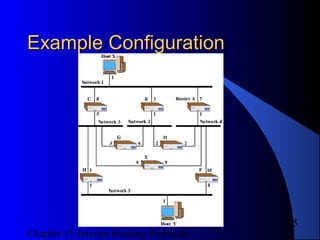
Example ConfigurationExample Configuration
Chapter 15 Interior Routing Protocols
6
Discussion of ExampleDiscussion of Example
5 networks, 8 routers
Link cost for output side of each router for
each network
– Next slide shows how fixed cost routing may
be implemented
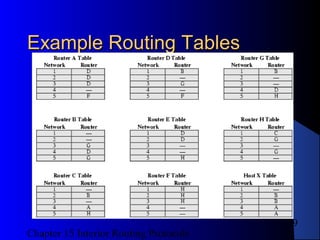
Each router has routing table
Chapter 15 Interior Routing Protocols
7
Routing TableRouting Table
 One required for each router
 Entry for each network
– Not for each destination
– Routing only needs network portion
 Once datagram reaches router attached to
destination network, that router can deliver to
host
 IP address typically has network and host portion
 Each entry shows next node on route
– Not whole route
Chapter 15 Interior Routing Protocols
8
Routing Tables in HostsRouting Tables in Hosts
May also exist in hosts
– If attached to single network with single router
then not needed
 All traffic must go through that router (called the
gateway)
– If multiple routers attached to network, host
needs table saying which to use
Chapter 15 Interior Routing Protocols
9
Example Routing TablesExample Routing Tables
Chapter 15 Interior Routing Protocols
10
Adaptive RoutingAdaptive Routing
As conditions on internet changes, routes
may change
– Failure
 Can route round problems
– Congestion
 Can route round congestion
 Avoid, or at least not add to further congestion
Chapter 15 Interior Routing Protocols
11
Drawbacks of Adaptive RoutingDrawbacks of Adaptive Routing
 More complex routing decisions
– Router processing increases
 Depends on information collected in one place but used
in another
– More information exchanged improves routing decisions but
increases overhead
 May react two fast causing congestion through
oscillation
 May react to slow, being irrelevant
 Can produce pathologies
– Fluttering
– Looping
Chapter 15 Interior Routing Protocols
12
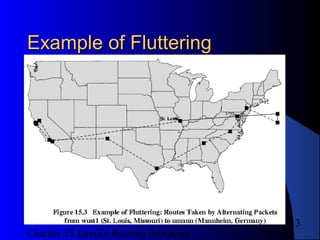
FlutteringFluttering
Rapid oscillation in routing
Due to router attempting load balancing or
splitting
– Splitting traffic among a number of routes
– May result in successive packets bound for
same destination taking very different routes
(see next slide)
Chapter 15 Interior Routing Protocols
13
Example of FlutteringExample of Fluttering
Chapter 15 Interior Routing Protocols
14
Problems with FlutteringProblems with Fluttering
 If in one direction only, route characteristics may
differ in the two directions
– Including timing and error characteristics
 Confuses management and troubleshooting applications that
measure these
 Difficulty estimating round trip times
 TCP packets arrive out of order
– Spurious retransmission
– Duplicate acknowledgements
Chapter 15 Interior Routing Protocols
15
LoopingLooping
Packet forwarded by router eventually
returns to that router
Algorithms designed to prevent looping
May occur when changes in connectivity
not propagated fast enough to all other
routers
Chapter 15 Interior Routing Protocols
16
Adaptive Routing AdvantagesAdaptive Routing Advantages
Improve performance as seen by user
Can aid congestion control
Benefits depend on soundness of design
Adaptive routing very complex
– Continual evolution of protocols
Chapter 15 Interior Routing Protocols
17
Classification of AdaptiveClassification of Adaptive
Routing StrategiesRouting Strategies
 Based on information sources
– Local
 E.g. route each datagram to network with shortest queue
 Balance loads on networks
 May not be heading in correct direction
– Include preferred direction
 Rarely used
– Adjacent nodes
 Distance vector algorithms
– All nodes
 Link-state algorithms
 Both need routing protocol to exchange information
Chapter 15 Interior Routing Protocols
18
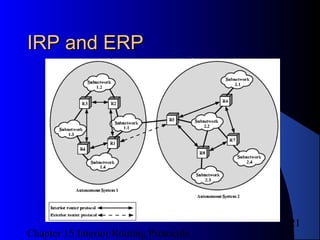
Autonomous Systems (AS)Autonomous Systems (AS)
Group of routers exchanging information
via common routing protocol
Set of routers and networks managed by
single organization
Connected
– Except in time of failure
Chapter 15 Interior Routing Protocols
19
Interior Routing Protocol (IRP)Interior Routing Protocol (IRP)
 Passes routing information between routers
within AS
 Does not need to be implemented outside AS
– Allows IRP to be tailored
 May be different algorithms and routing
information in different connected AS
 Need minimum information from other
connected AS
– At least one router in each AS must talk
– Use Exterior Routing Protocol (ERP)
Chapter 15 Interior Routing Protocols
20
Exterior Routing Protocol (ERP)Exterior Routing Protocol (ERP)
Pass less information than IRP
Router in first system determines route to
target AS
Routers in target AS then co-operate to
deliver datagram
ERP does not deal with details within
target AS
Chapter 15 Interior Routing Protocols
21
IRP and ERPIRP and ERP
Chapter 15 Interior Routing Protocols
22
Routing Information ProtocolRouting Information Protocol
(RIP)(RIP)
Simple
Suitable for small internets
Widely used
Uses Distance vector routing
Chapter 15 Interior Routing Protocols
23
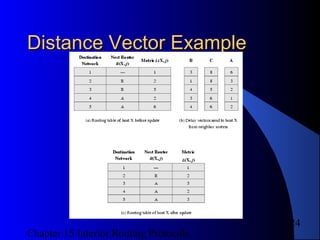
Distance Vector RoutingDistance Vector Routing
 Each node exchange information with neighbors
– Directly connected by same network
 Each node maintains three vectors
– Link cost
– Distance vector
– Next hop vector
 Every 30 seconds, exchange distance vector with
neighbors
 Use this to update distance and next hop vector
Chapter 15 Interior Routing Protocols
24
Distance Vector ExampleDistance Vector Example
Chapter 15 Interior Routing Protocols
25
Distributed Bellman-FordDistributed Bellman-Ford
 RIP is a distributed version of Bellman-Ford
 Original routing algorithm in ARPANET
 Each simultaneous exchange of vectors between
routers is equivalent to one iteration of step 2
 In fact, asynchronous exchange used
– At start-up, get vectors from neighbors
 Gives initial routing
– By own timer, update every 30 seconds
– Changes are propagated across network
– Routing converges within finite time
 Proportional to number of routers
Chapter 15 Interior Routing Protocols
26
RIP Details –RIP Details –
Incremental UpdateIncremental Update
Updates do not arrive from neighbors
within small time window
RIP packets use UDP
Tables updated after receipt of individual
distance vector
– Add any new destination network
– Replace existing routes with small delay ones
– If update from router R, update all routes
using R as next hop
Chapter 15 Interior Routing Protocols
27
RIP Details –RIP Details –
Topology ChangeTopology Change
If no updates received from a router within
180 seconds, mark route invalid
– Assumes router crash or network connection
unstable
– Set distance value to infinity
 Actually 16
Chapter 15 Interior Routing Protocols
28
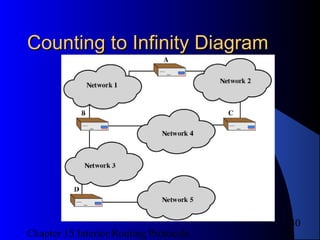
Counting to Infinity Problem (1)Counting to Infinity Problem (1)
 Slow convergence may cause:
 All link costs 1
 B has distance to network 5 as 2, next hop D
 A & C have distance 3 and next hop B
Chapter 15 Interior Routing Protocols
29
Counting to Infinity Problem (2)Counting to Infinity Problem (2)
 Suppose router D fails:
– B determines network 5 no longer reachable via D
 Sets distance to 4 based on report from A or C
– At next update, B tells A and C this
– A and C receive this and increment their network 5 distance to 5
 4 from B plus 1 to reach B
– B receives distance count 5 and assumes network 5 is 6 away
– Repeat until reach infinity (16)
– Takes 8 to 16 minutes to resolve
Chapter 15 Interior Routing Protocols
30
Counting to Infinity DiagramCounting to Infinity Diagram
Chapter 15 Interior Routing Protocols
31
Split HorizonSplit Horizon
 Counting to infinity problem caused by
misunderstanding between B and A, and B and C
– Each thinks it can reach network 5 via the other
 Split Horizon rule says do not send information
about a route back in the direction it came from
– Router sending information is nearer destination than
you
– Erroneous route now eliminated within time out
period (180 seconds)
Chapter 15 Interior Routing Protocols
32
Poisoned ReversePoisoned Reverse
Send updates with hop count of 16 to
neighbors for route learned from those
neighbors
– If two routers have routes pointing at each
other advertising reverse route with metric 16
breaks loop immediately
Chapter 15 Interior Routing Protocols
33
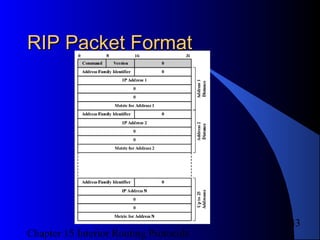
RIP Packet FormatRIP Packet Format
Chapter 15 Interior Routing Protocols
34
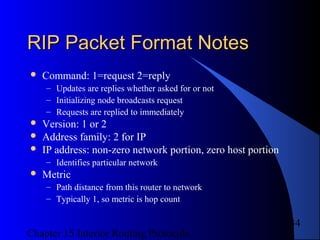
RIP Packet Format NotesRIP Packet Format Notes
 Command: 1=request 2=reply
– Updates are replies whether asked for or not
– Initializing node broadcasts request
– Requests are replied to immediately
 Version: 1 or 2
 Address family: 2 for IP
 IP address: non-zero network portion, zero host portion
– Identifies particular network
 Metric
– Path distance from this router to network
– Typically 1, so metric is hop count
Chapter 15 Interior Routing Protocols
35
RIP LimitationsRIP Limitations
 Destinations with metric more than 15 are
unreachable
– If larger metric allowed, convergence becomes
lengthy
 Simple metric leads to sub-optimal routing tables
– Packets sent over slower links
 Accept RIP updates from any device
– Misconfigured device can disrupt entire configuration
Chapter 15 Interior Routing Protocols
36
Open Shortest Path FirstOpen Shortest Path First
(OSPF)(OSPF)
RIP limited in large internets
OSPF preferred interior routing protocol
for TCP/IP based internets
Link state routing used
Chapter 15 Interior Routing Protocols
37
Link State RoutingLink State Routing
 When initialized, router determines link cost on
each interface
 Router advertises these costs to all other routers
in topology
 Router monitors its costs
– When changes occurs, costs are re-advertised
 Each router constructs topology and calculates
shortest path to each destination network
 Not distributed version of routing algorithm
 Can use any algorithm
– Dijkstra
Chapter 15 Interior Routing Protocols
38
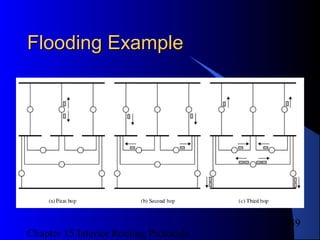
FloodingFlooding
 Packet sent by source router to every neighbor
 Incoming packet resent to all outgoing links except
source link
 Duplicate packets already transmitted are discarded
– Prevent incessant retransmission
 All possible routes tried so packet will get through if
route exists
– Highly robust
 At least one packet follows minimum delay route
– Reach all routers quickly
 All nodes connected to source are visited
– All routers get information to build routing table
 High traffic load
Chapter 15 Interior Routing Protocols
39
Flooding ExampleFlooding Example
Chapter 15 Interior Routing Protocols
40
OSPF OverviewOSPF Overview
Router maintains descriptions of state of
local links
Transmits updated state information to all
routers it knows about
Router receiving update must
acknowledge
– Lots of traffic generated
Each router maintains database
– Directed graph
Chapter 15 Interior Routing Protocols
41
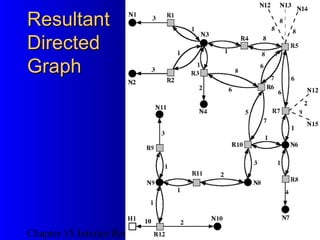
Router Database GraphRouter Database Graph
 Vertices
– Router
– Network
 Transit
 Stub
 Edges
– Connecting two routers
– Connecting router to network
 Built using link state information from other
routers
Chapter 15 Interior Routing Protocols
42
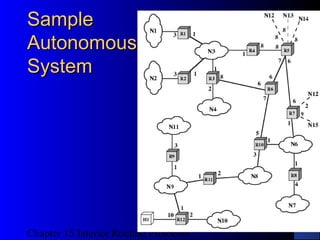
SampleSample
AutonomousAutonomous
SystemSystem
Chapter 15 Interior Routing Protocols
43
ResultantResultant
DirectedDirected
GraphGraph
Chapter 15 Interior Routing Protocols
44
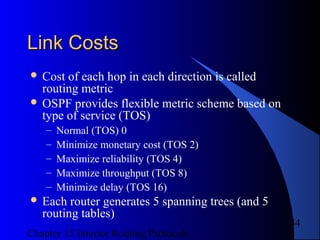
Link CostsLink Costs
 Cost of each hop in each direction is called
routing metric
 OSPF provides flexible metric scheme based on
type of service (TOS)
– Normal (TOS) 0
– Minimize monetary cost (TOS 2)
– Maximize reliability (TOS 4)
– Maximize throughput (TOS 8)
– Minimize delay (TOS 16)
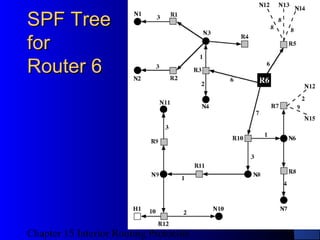
 Each router generates 5 spanning trees (and 5
routing tables)
Chapter 15 Interior Routing Protocols
45
SPF TreeSPF Tree
forfor
Router 6Router 6
Chapter 15 Interior Routing Protocols
46
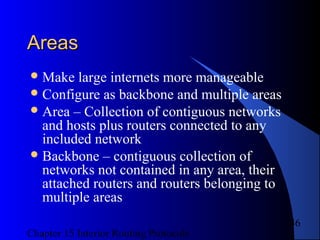
AreasAreas
Make large internets more manageable
Configure as backbone and multiple areas
Area – Collection of contiguous networks
and hosts plus routers connected to any
included network
Backbone – contiguous collection of
networks not contained in any area, their
attached routers and routers belonging to
multiple areas
Chapter 15 Interior Routing Protocols
47
Operation of AreasOperation of Areas
Each are runs a separate copy of the link
state algorithm
– Topological database and graph of just that
area
– Link state information broadcast to other
routers in area
– Reduces traffic
– Intra-area routing relies solely on local link
state information
Chapter 15 Interior Routing Protocols
48
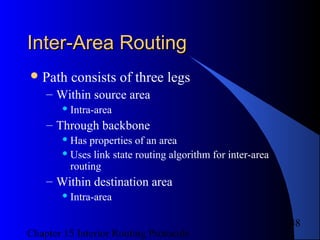
Inter-Area RoutingInter-Area Routing
Path consists of three legs
– Within source area
 Intra-area
– Through backbone
 Has properties of an area
 Uses link state routing algorithm for inter-area
routing
– Within destination area
 Intra-area
Chapter 15 Interior Routing Protocols
49
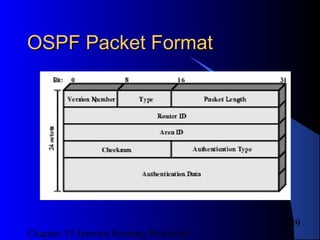
OSPF Packet FormatOSPF Packet Format
Chapter 15 Interior Routing Protocols
50
Packet Format NotesPacket Format Notes
 Version number: 2 is current
 Type: one of 5, see next slide
 Packet length: in octets including header
 Router id: this packet’s source, 32 bit
 Area id: Area to which source router belongs
 Authentication type: null, simple password or
encryption
 Authentication data: used by authentication
procedure
Chapter 15 Interior Routing Protocols
51
OSPF Packet TypesOSPF Packet Types
Hello: used in neighbor discovery
Database description: Defines set of link
state information present in each router’s
database
Link state request
Link state update
Link state acknowledgement

Interior Routing Protocols Chapter 15

  • 1.
    Chapter 15 InteriorRouting Protocols 1 Chapter 15Chapter 15 Interior Routing Protocols
  • 2.
    Chapter 15 InteriorRouting Protocols 2 IntroductionIntroduction Routing protocols essential to operation of an internet Routers forward IP datagrams from one router to another on path from source to destination Router must have idea of topology of internet Routing protocols provide this information
  • 3.
    Chapter 15 InteriorRouting Protocols 3 Internet Routing PrinciplesInternet Routing Principles Routers receive and forward datagrams Make routing decisions based on knowledge of topology and conditions on internet Decisions based on some least cost criterion (chapter 14)
  • 4.
    Chapter 15 InteriorRouting Protocols 4 Fixed RoutingFixed Routing Single permanent route configured for each source-destination pair – Routes fixed – May change when topology changes – Link cost not based on dynamic data – Based on estimated traffic volumes or capacity of link
  • 5.
    Chapter 15 InteriorRouting Protocols 5 Example ConfigurationExample Configuration
  • 6.
    Chapter 15 InteriorRouting Protocols 6 Discussion of ExampleDiscussion of Example 5 networks, 8 routers Link cost for output side of each router for each network – Next slide shows how fixed cost routing may be implemented Each router has routing table
  • 7.
    Chapter 15 InteriorRouting Protocols 7 Routing TableRouting Table  One required for each router  Entry for each network – Not for each destination – Routing only needs network portion  Once datagram reaches router attached to destination network, that router can deliver to host  IP address typically has network and host portion  Each entry shows next node on route – Not whole route
  • 8.
    Chapter 15 InteriorRouting Protocols 8 Routing Tables in HostsRouting Tables in Hosts May also exist in hosts – If attached to single network with single router then not needed  All traffic must go through that router (called the gateway) – If multiple routers attached to network, host needs table saying which to use
  • 9.
    Chapter 15 InteriorRouting Protocols 9 Example Routing TablesExample Routing Tables
  • 10.
    Chapter 15 InteriorRouting Protocols 10 Adaptive RoutingAdaptive Routing As conditions on internet changes, routes may change – Failure  Can route round problems – Congestion  Can route round congestion  Avoid, or at least not add to further congestion
  • 11.
    Chapter 15 InteriorRouting Protocols 11 Drawbacks of Adaptive RoutingDrawbacks of Adaptive Routing  More complex routing decisions – Router processing increases  Depends on information collected in one place but used in another – More information exchanged improves routing decisions but increases overhead  May react two fast causing congestion through oscillation  May react to slow, being irrelevant  Can produce pathologies – Fluttering – Looping
  • 12.
    Chapter 15 InteriorRouting Protocols 12 FlutteringFluttering Rapid oscillation in routing Due to router attempting load balancing or splitting – Splitting traffic among a number of routes – May result in successive packets bound for same destination taking very different routes (see next slide)
  • 13.
    Chapter 15 InteriorRouting Protocols 13 Example of FlutteringExample of Fluttering
  • 14.
    Chapter 15 InteriorRouting Protocols 14 Problems with FlutteringProblems with Fluttering  If in one direction only, route characteristics may differ in the two directions – Including timing and error characteristics  Confuses management and troubleshooting applications that measure these  Difficulty estimating round trip times  TCP packets arrive out of order – Spurious retransmission – Duplicate acknowledgements
  • 15.
    Chapter 15 InteriorRouting Protocols 15 LoopingLooping Packet forwarded by router eventually returns to that router Algorithms designed to prevent looping May occur when changes in connectivity not propagated fast enough to all other routers
  • 16.
    Chapter 15 InteriorRouting Protocols 16 Adaptive Routing AdvantagesAdaptive Routing Advantages Improve performance as seen by user Can aid congestion control Benefits depend on soundness of design Adaptive routing very complex – Continual evolution of protocols
  • 17.
    Chapter 15 InteriorRouting Protocols 17 Classification of AdaptiveClassification of Adaptive Routing StrategiesRouting Strategies  Based on information sources – Local  E.g. route each datagram to network with shortest queue  Balance loads on networks  May not be heading in correct direction – Include preferred direction  Rarely used – Adjacent nodes  Distance vector algorithms – All nodes  Link-state algorithms  Both need routing protocol to exchange information
  • 18.
    Chapter 15 InteriorRouting Protocols 18 Autonomous Systems (AS)Autonomous Systems (AS) Group of routers exchanging information via common routing protocol Set of routers and networks managed by single organization Connected – Except in time of failure
  • 19.
    Chapter 15 InteriorRouting Protocols 19 Interior Routing Protocol (IRP)Interior Routing Protocol (IRP)  Passes routing information between routers within AS  Does not need to be implemented outside AS – Allows IRP to be tailored  May be different algorithms and routing information in different connected AS  Need minimum information from other connected AS – At least one router in each AS must talk – Use Exterior Routing Protocol (ERP)
  • 20.
    Chapter 15 InteriorRouting Protocols 20 Exterior Routing Protocol (ERP)Exterior Routing Protocol (ERP) Pass less information than IRP Router in first system determines route to target AS Routers in target AS then co-operate to deliver datagram ERP does not deal with details within target AS
  • 21.
    Chapter 15 InteriorRouting Protocols 21 IRP and ERPIRP and ERP
  • 22.
    Chapter 15 InteriorRouting Protocols 22 Routing Information ProtocolRouting Information Protocol (RIP)(RIP) Simple Suitable for small internets Widely used Uses Distance vector routing
  • 23.
    Chapter 15 InteriorRouting Protocols 23 Distance Vector RoutingDistance Vector Routing  Each node exchange information with neighbors – Directly connected by same network  Each node maintains three vectors – Link cost – Distance vector – Next hop vector  Every 30 seconds, exchange distance vector with neighbors  Use this to update distance and next hop vector
  • 24.
    Chapter 15 InteriorRouting Protocols 24 Distance Vector ExampleDistance Vector Example
  • 25.
    Chapter 15 InteriorRouting Protocols 25 Distributed Bellman-FordDistributed Bellman-Ford  RIP is a distributed version of Bellman-Ford  Original routing algorithm in ARPANET  Each simultaneous exchange of vectors between routers is equivalent to one iteration of step 2  In fact, asynchronous exchange used – At start-up, get vectors from neighbors  Gives initial routing – By own timer, update every 30 seconds – Changes are propagated across network – Routing converges within finite time  Proportional to number of routers
  • 26.
    Chapter 15 InteriorRouting Protocols 26 RIP Details –RIP Details – Incremental UpdateIncremental Update Updates do not arrive from neighbors within small time window RIP packets use UDP Tables updated after receipt of individual distance vector – Add any new destination network – Replace existing routes with small delay ones – If update from router R, update all routes using R as next hop
  • 27.
    Chapter 15 InteriorRouting Protocols 27 RIP Details –RIP Details – Topology ChangeTopology Change If no updates received from a router within 180 seconds, mark route invalid – Assumes router crash or network connection unstable – Set distance value to infinity  Actually 16
  • 28.
    Chapter 15 InteriorRouting Protocols 28 Counting to Infinity Problem (1)Counting to Infinity Problem (1)  Slow convergence may cause:  All link costs 1  B has distance to network 5 as 2, next hop D  A & C have distance 3 and next hop B
  • 29.
    Chapter 15 InteriorRouting Protocols 29 Counting to Infinity Problem (2)Counting to Infinity Problem (2)  Suppose router D fails: – B determines network 5 no longer reachable via D  Sets distance to 4 based on report from A or C – At next update, B tells A and C this – A and C receive this and increment their network 5 distance to 5  4 from B plus 1 to reach B – B receives distance count 5 and assumes network 5 is 6 away – Repeat until reach infinity (16) – Takes 8 to 16 minutes to resolve
  • 30.
    Chapter 15 InteriorRouting Protocols 30 Counting to Infinity DiagramCounting to Infinity Diagram
  • 31.
    Chapter 15 InteriorRouting Protocols 31 Split HorizonSplit Horizon  Counting to infinity problem caused by misunderstanding between B and A, and B and C – Each thinks it can reach network 5 via the other  Split Horizon rule says do not send information about a route back in the direction it came from – Router sending information is nearer destination than you – Erroneous route now eliminated within time out period (180 seconds)
  • 32.
    Chapter 15 InteriorRouting Protocols 32 Poisoned ReversePoisoned Reverse Send updates with hop count of 16 to neighbors for route learned from those neighbors – If two routers have routes pointing at each other advertising reverse route with metric 16 breaks loop immediately
  • 33.
    Chapter 15 InteriorRouting Protocols 33 RIP Packet FormatRIP Packet Format
  • 34.
    Chapter 15 InteriorRouting Protocols 34 RIP Packet Format NotesRIP Packet Format Notes  Command: 1=request 2=reply – Updates are replies whether asked for or not – Initializing node broadcasts request – Requests are replied to immediately  Version: 1 or 2  Address family: 2 for IP  IP address: non-zero network portion, zero host portion – Identifies particular network  Metric – Path distance from this router to network – Typically 1, so metric is hop count
  • 35.
    Chapter 15 InteriorRouting Protocols 35 RIP LimitationsRIP Limitations  Destinations with metric more than 15 are unreachable – If larger metric allowed, convergence becomes lengthy  Simple metric leads to sub-optimal routing tables – Packets sent over slower links  Accept RIP updates from any device – Misconfigured device can disrupt entire configuration
  • 36.
    Chapter 15 InteriorRouting Protocols 36 Open Shortest Path FirstOpen Shortest Path First (OSPF)(OSPF) RIP limited in large internets OSPF preferred interior routing protocol for TCP/IP based internets Link state routing used
  • 37.
    Chapter 15 InteriorRouting Protocols 37 Link State RoutingLink State Routing  When initialized, router determines link cost on each interface  Router advertises these costs to all other routers in topology  Router monitors its costs – When changes occurs, costs are re-advertised  Each router constructs topology and calculates shortest path to each destination network  Not distributed version of routing algorithm  Can use any algorithm – Dijkstra
  • 38.
    Chapter 15 InteriorRouting Protocols 38 FloodingFlooding  Packet sent by source router to every neighbor  Incoming packet resent to all outgoing links except source link  Duplicate packets already transmitted are discarded – Prevent incessant retransmission  All possible routes tried so packet will get through if route exists – Highly robust  At least one packet follows minimum delay route – Reach all routers quickly  All nodes connected to source are visited – All routers get information to build routing table  High traffic load
  • 39.
    Chapter 15 InteriorRouting Protocols 39 Flooding ExampleFlooding Example
  • 40.
    Chapter 15 InteriorRouting Protocols 40 OSPF OverviewOSPF Overview Router maintains descriptions of state of local links Transmits updated state information to all routers it knows about Router receiving update must acknowledge – Lots of traffic generated Each router maintains database – Directed graph
  • 41.
    Chapter 15 InteriorRouting Protocols 41 Router Database GraphRouter Database Graph  Vertices – Router – Network  Transit  Stub  Edges – Connecting two routers – Connecting router to network  Built using link state information from other routers
  • 42.
    Chapter 15 InteriorRouting Protocols 42 SampleSample AutonomousAutonomous SystemSystem
  • 43.
    Chapter 15 InteriorRouting Protocols 43 ResultantResultant DirectedDirected GraphGraph
  • 44.
    Chapter 15 InteriorRouting Protocols 44 Link CostsLink Costs  Cost of each hop in each direction is called routing metric  OSPF provides flexible metric scheme based on type of service (TOS) – Normal (TOS) 0 – Minimize monetary cost (TOS 2) – Maximize reliability (TOS 4) – Maximize throughput (TOS 8) – Minimize delay (TOS 16)  Each router generates 5 spanning trees (and 5 routing tables)
  • 45.
    Chapter 15 InteriorRouting Protocols 45 SPF TreeSPF Tree forfor Router 6Router 6
  • 46.
    Chapter 15 InteriorRouting Protocols 46 AreasAreas Make large internets more manageable Configure as backbone and multiple areas Area – Collection of contiguous networks and hosts plus routers connected to any included network Backbone – contiguous collection of networks not contained in any area, their attached routers and routers belonging to multiple areas
  • 47.
    Chapter 15 InteriorRouting Protocols 47 Operation of AreasOperation of Areas Each are runs a separate copy of the link state algorithm – Topological database and graph of just that area – Link state information broadcast to other routers in area – Reduces traffic – Intra-area routing relies solely on local link state information
  • 48.
    Chapter 15 InteriorRouting Protocols 48 Inter-Area RoutingInter-Area Routing Path consists of three legs – Within source area  Intra-area – Through backbone  Has properties of an area  Uses link state routing algorithm for inter-area routing – Within destination area  Intra-area
  • 49.
    Chapter 15 InteriorRouting Protocols 49 OSPF Packet FormatOSPF Packet Format
  • 50.
    Chapter 15 InteriorRouting Protocols 50 Packet Format NotesPacket Format Notes  Version number: 2 is current  Type: one of 5, see next slide  Packet length: in octets including header  Router id: this packet’s source, 32 bit  Area id: Area to which source router belongs  Authentication type: null, simple password or encryption  Authentication data: used by authentication procedure
  • 51.
    Chapter 15 InteriorRouting Protocols 51 OSPF Packet TypesOSPF Packet Types Hello: used in neighbor discovery Database description: Defines set of link state information present in each router’s database Link state request Link state update Link state acknowledgement