
Vector engineering and Codon Bias
BY: Ms Renuka Vyawahare
M.E Biotechnology
Vector Engineering
 The expression level of a gene largely depends upon how efficiently it is transcribed .
 Transcription of any gene take place when the RNA polymerase complex interacts with
promoter sequence, move along the gene from a 5 ′ to 3′ direction, giving rise to a RNA
transcript and finally dissociating from the gene at the transcription terminal signal,
freeing the transcript for eventual translation.
 In order to maximize the expression of heterologous genes , those genes that are taken
from different organisms and being expressed in bacterial , yeast , animal or plant cells ,
it is necessary to design a cloning vector , which allows optimal transcription of the
genes . Such vectors are called expression vectors.
 The construction of such vector is called vector engineering.
Vector Characterestics
Origin of replication
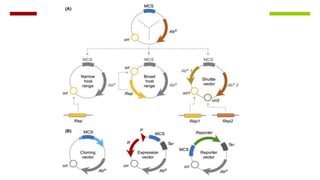
 The first component is the origin of replication (ori) that will be recognized by the
cellular replication machinery and will also define the number of copies of a given
plasmid in the cell.
 Replication origins are usually recognized by their specific organism in what is
called the narrow-host-range vectors, but there is also a category of broad-host-
range vectors that contain origins capable of replicating in more than one species
or genus, since they encode the protein that recognizes their own replication origin
inside the plasmid.
Vector Characterestics
Origin of replication
 Vectors called ‘shuttle vectors’ that contain two different origins and two different
selection markers so they can be transformed into two distinct organisms.
 If the final plasmid has a proper origin of replication for the host, the genetic
material inserted in the organisms is stable and can replicate autonomously.
Vector Characterestics
Selection marker,
 Any gene allowing a selective advantage to the positive
transformants, ranging from auxotrophy (corresponding to a
metabolic enzyme missing in the host genome) to drug resistance.
 Also, a multiple cloning site (MCS) is usually added to facilitate
cloning of the desired DNA, containing several sites recognized by
different restriction enzymes.
Vector Classification
 Cloning vectors
Used to make numerous copies of a DNA of interest, keeping them stable inside a host
organism.
 Expression vectors
Used to produce large amounts of a protein of interest; they usually contain a regulator
and a target promoter that controls the expression of the gene encoding that protein (.
Vector Characterestics
 Reporter vectors,
It is possible to place the promoter of the gene of interest to modulate a reporter
protein, which can be fluorescent, luminescent or enzymatic, such as the ß-
galactosidase assay, among others.
These reporter vectors allow in vivo analysis of gene expression kinetics throughout the
organism’s growth, allowing sophisticated studies even at the single-cell level
Vector design
 Enhanced and easy-to-use molecular tools, mastering the principles
and technologies of vector design has become a fundamental
challenge.
 The recent advances in DNA manipulation techniques such as
automated DNA synthesis, sequencing and assembly have been
combined with the synthetic biology framework, providing new
perspectives on vector design and construction
Development of vectors to engineer
bacteria
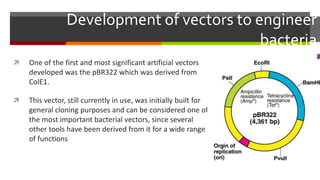
 One of the first and most significant artificial vectors
developed was the pBR322 which was derived from
ColE1.
 This vector, still currently in use, was initially built for
general cloning purposes and can be considered one of
the most important bacterial vectors, since several
other tools have been derived from it for a wide range
of functions
Development of vectors to engineer
bacteria
Some structural and functional modifications include :
 The addition of new restriction sites
 Differentiation or change of selection marker,
 Increased stability,
 Change in the copy number
 Addition of a signal peptide to facilitate protein secretion
 Change in the origin for one of a shuttle vector, allowing vector propagation in different
hosts
Vectors for quick and easy heterologous
protein expression
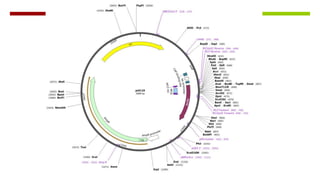
 The pUC-series vectors are mainly composed of a lac promoter–operator
and require compatible hosts for a-complementation (blue/white screening
system that allows recovering of functional b-galactosidase LacZ).
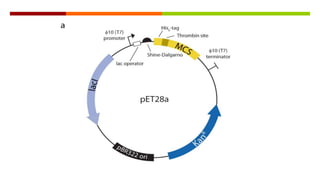
 The pET-series vectors, which were also derived from pBR322 and pGEX are
widely used because they are high copy number expression vectors that
contain protein tags that facilitate the subsequent purification of the
desired protein.
Evolution of vector engineering for fungi
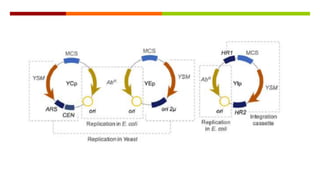
 Plasmids used to transform Saccharomyces can be divided into three groups:
1. Yeast centromeric plasmids (ycps),
2. Yeast episomal plasmids (yeps) and
3. Yeast integrative plasmids (yips).
Evolution of vector engineering for fungi
 The YCps need autonomously replicating sequences (ARS) and centromeric
sequences (CEN) where kinetochore complexes attach, thus behaving like a
microchromosome.
 The YEps are based on the endogenous 2l plasmid mentioned above with addition
of a bacterial origin of replication and selection marker, yeast selection marker and
the expression cassette.
 Yeast Integrative plasmids (Yips), homologous regions (labelled as HR1 and HR2) to
the host chromosome allow the integration of the target region through
homologous recombination events.
Evolution of vector engineering for fungi
 All of these vectors were considerably large (some more than
10 kb) and had no more than 10 unique restriction sites for
cloning.
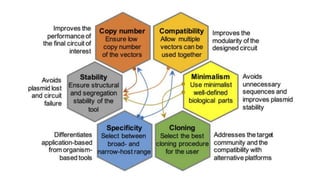
perspectives in vector design
 Copy number control
Circuits implemented in low copy exhibit enhanced performance
compared to those placed in multicopy.
Since vector engineering usually requires the modification of the
ori of replication or of its surrounding area, special care must be
taken to determine if those changes modify the copy number of
the final vector.
perspectives in vector design
 Plasmid incompatibility
The use of multiple plasmids to implement complex synthetic circuits is a very attractive approach
since it allows the optimization of the whole system in a modular way.
However, while bacterial plasmids use diverse mechanisms for autonomous DNA replication,
some of these require the same host machinery.
As a result, many origins of replications belong to the same incompatibility group, which means
that they cannot be stably maintained simultaneously in the same host.
Therefore, it is imperative to consider plasmid incompatibility groups when designing novel
genetic tools.
perspectives in vector design
 Plasmid structural and segregation stability
The structural and segregation stability of the vectors were intensively investigated and
researchers reported that many natural plasmids presented spontaneous loss during cell
division (segregation instability) or displayed profound rearrangements in their structures
and loss of DNA segments
perspectives in vector design
 Use of minimalist, fully characterized parts
The use of minimalist DNA fragments is also a good practice in vector design to allow
the final tool to be as minimal as possible.
This is manageable for bacterial plasmids but is not trivial for vectors designed for
yeast and filamentous fungi, for example, where there is a lack of consistent
information regarding minimal regulatory elements.
For those cases, the characterization of the individual biological parts is crucial for the
use of the appropriate fragments and to ensure the reliability of the final tool.
Perspectives in vector design
 Universal versus case-specific platforms
The dualism between universality vs. specificity is best represented
by broad- and narrow-host-range vectors.
This is particularly important as the field of synthetic biology moves
into real applications where non-model organisms may be required
Perspectives in vector design
 Selection of appropriate circuit-cloning methods
When designing novel genetic tools, it is imperative to consider
the final target community and their preferences.
While the initial progress in plasmid engineering was built upon
the use of restriction enzymes and DNA ligase, restriction-free
methods are becoming more and more popular in the synthetic
biology community
Codon optimization
 It is one of the key step in achieving the high level expression of the target
gene.
 There are some key factors consideration including transcription and
translation efficiency, gene synthesis and protein folding.
 Codon optimization : introducing synonymous mutations that favor efficient
soluble protein expression.
Codon optimization
 tRNA Abundance
 Owing to different tRNA identifies several synonymous codons
and the content of these synonymous codons is different,
therefore the efficiency of translation also depends on the no. of
tRNA.
 Preferred codons are those that can base pair optimally with the
most abundant tRNA.
Codon optimization
 tRNA Abundance
 Generally this involves Watson-Crick pairing or, when bases are
modified in the tRNA, some modification in optimal binding
occur.
Codon optimization
 Codon usage bias
 There are obvious biases of synonymous codons in bacteria,
E.coli, yeast and some expression system of higher biological.
 This can directly affect the efficiency of translation.
 So when one gene is expressed in a heterologous system, the
codon usage bias should be taken into account.

In vitro transcription and translation
 In vitro transcription and in vitro translation replicate the processes of RNA
and protein synthesis outside of the cellular environment.
 In vitro RNA transcription reactions are generally used for two distinct
purposes: the synthesis of labeled probes, and the synthesis of large
amounts of unlabeled RNA.
 Capped RNA synthesized in transcription reactions is also used for
microinjection, in vitro translation, and transfection.
In vitro transcription and translation
 In vitro translation is a technique that enables researchers to rapidly
express and manufacture small amounts of functional proteins for a
variety of applications.
 Applications
• Rapid identification of gene products,
• Localization of mutations through synthesis of truncated gene products,
protein folding studies.
• Incorporation of modified or unnatural amino acids for functional studies.
Cell-Free Expression Systems
 The most frequently used cell-free translation systems consist of extracts from rabbit
reticulocytes, wheat germ and Escherichia coli.
 All are prepared as crude extracts containing all the macromolecular components (70S or
80S ribosomes, tRNAs, aminoacyl-tRNA synthetases, initiation, elongation and termination
factors, etc.) required for translation of exogenous RNA.
 To ensure efficient translation, each extract must be supplemented with amino acids,
energy sources (ATP, GTP), energy regenerating systems (creatine phosphate and creatine
phosphokinase for eukaryotic systems, and phosphoenol pyruvate and pyruvate kinase for
the E. coli lysate), and other co-factors (Mg2+, K+, etc.).
Translation Systems
Rabbit Reticulocyte Lysate
 Rabbit reticulocyte lysate is a highly efficient in vitro eukaryotic protein synthesis
system used for translation of exogenous RNAs (either natural or generated in vitro).
 In vivo, reticulocytes are highly specialized cells primarily responsible for the synthesis
of hemoglobin, which represents more than 90% of the protein made in the
reticulocyte.
 These immature red cells have already lost their nuclei, but contain adequate mRNA,
as well as complete translation machinery, for extensive globin synthesis. The
endogenous globin mRNA can be eliminated by incubation with Ca2+-dependent
micrococcal nuclease, which is later inactivated by chelation of the Ca2+ by EGTA.
Translation Systems
Rabbit Reticulocyte Lysate
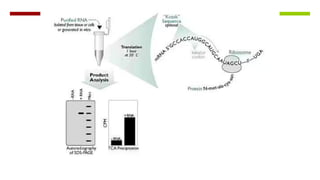
 This type of lysate is the most widely used RNA-
dependent cell-free system because of its low
background and its efficient utilization of
exogenous RNAs even at low concentrations (Figure
1). Exogenous proteins are synthesized at a rate
close to that observed in intact reticulocyte cells.
Vector Engineering.pptx

Vector Engineering.pptx

  • 1.
     Vector engineering andCodon Bias BY: Ms Renuka Vyawahare M.E Biotechnology
  • 2.
    Vector Engineering  Theexpression level of a gene largely depends upon how efficiently it is transcribed .  Transcription of any gene take place when the RNA polymerase complex interacts with promoter sequence, move along the gene from a 5 ′ to 3′ direction, giving rise to a RNA transcript and finally dissociating from the gene at the transcription terminal signal, freeing the transcript for eventual translation.  In order to maximize the expression of heterologous genes , those genes that are taken from different organisms and being expressed in bacterial , yeast , animal or plant cells , it is necessary to design a cloning vector , which allows optimal transcription of the genes . Such vectors are called expression vectors.  The construction of such vector is called vector engineering.
  • 3.
    Vector Characterestics Origin ofreplication  The first component is the origin of replication (ori) that will be recognized by the cellular replication machinery and will also define the number of copies of a given plasmid in the cell.  Replication origins are usually recognized by their specific organism in what is called the narrow-host-range vectors, but there is also a category of broad-host- range vectors that contain origins capable of replicating in more than one species or genus, since they encode the protein that recognizes their own replication origin inside the plasmid.
  • 4.
    Vector Characterestics Origin ofreplication  Vectors called ‘shuttle vectors’ that contain two different origins and two different selection markers so they can be transformed into two distinct organisms.  If the final plasmid has a proper origin of replication for the host, the genetic material inserted in the organisms is stable and can replicate autonomously.
  • 5.
    Vector Characterestics Selection marker, Any gene allowing a selective advantage to the positive transformants, ranging from auxotrophy (corresponding to a metabolic enzyme missing in the host genome) to drug resistance.  Also, a multiple cloning site (MCS) is usually added to facilitate cloning of the desired DNA, containing several sites recognized by different restriction enzymes.
  • 6.
    Vector Classification  Cloningvectors Used to make numerous copies of a DNA of interest, keeping them stable inside a host organism.  Expression vectors Used to produce large amounts of a protein of interest; they usually contain a regulator and a target promoter that controls the expression of the gene encoding that protein (.
  • 7.
    Vector Characterestics  Reportervectors, It is possible to place the promoter of the gene of interest to modulate a reporter protein, which can be fluorescent, luminescent or enzymatic, such as the ß- galactosidase assay, among others. These reporter vectors allow in vivo analysis of gene expression kinetics throughout the organism’s growth, allowing sophisticated studies even at the single-cell level
  • 9.
    Vector design  Enhancedand easy-to-use molecular tools, mastering the principles and technologies of vector design has become a fundamental challenge.  The recent advances in DNA manipulation techniques such as automated DNA synthesis, sequencing and assembly have been combined with the synthetic biology framework, providing new perspectives on vector design and construction
  • 10.
    Development of vectorsto engineer bacteria  One of the first and most significant artificial vectors developed was the pBR322 which was derived from ColE1.  This vector, still currently in use, was initially built for general cloning purposes and can be considered one of the most important bacterial vectors, since several other tools have been derived from it for a wide range of functions
  • 11.
    Development of vectorsto engineer bacteria Some structural and functional modifications include :  The addition of new restriction sites  Differentiation or change of selection marker,  Increased stability,  Change in the copy number  Addition of a signal peptide to facilitate protein secretion  Change in the origin for one of a shuttle vector, allowing vector propagation in different hosts
  • 12.
    Vectors for quickand easy heterologous protein expression  The pUC-series vectors are mainly composed of a lac promoter–operator and require compatible hosts for a-complementation (blue/white screening system that allows recovering of functional b-galactosidase LacZ).  The pET-series vectors, which were also derived from pBR322 and pGEX are widely used because they are high copy number expression vectors that contain protein tags that facilitate the subsequent purification of the desired protein.
  • 15.
    Evolution of vectorengineering for fungi  Plasmids used to transform Saccharomyces can be divided into three groups: 1. Yeast centromeric plasmids (ycps), 2. Yeast episomal plasmids (yeps) and 3. Yeast integrative plasmids (yips).
  • 16.
    Evolution of vectorengineering for fungi  The YCps need autonomously replicating sequences (ARS) and centromeric sequences (CEN) where kinetochore complexes attach, thus behaving like a microchromosome.  The YEps are based on the endogenous 2l plasmid mentioned above with addition of a bacterial origin of replication and selection marker, yeast selection marker and the expression cassette.  Yeast Integrative plasmids (Yips), homologous regions (labelled as HR1 and HR2) to the host chromosome allow the integration of the target region through homologous recombination events.
  • 18.
    Evolution of vectorengineering for fungi  All of these vectors were considerably large (some more than 10 kb) and had no more than 10 unique restriction sites for cloning.
  • 19.
    perspectives in vectordesign  Copy number control Circuits implemented in low copy exhibit enhanced performance compared to those placed in multicopy. Since vector engineering usually requires the modification of the ori of replication or of its surrounding area, special care must be taken to determine if those changes modify the copy number of the final vector.
  • 20.
    perspectives in vectordesign  Plasmid incompatibility The use of multiple plasmids to implement complex synthetic circuits is a very attractive approach since it allows the optimization of the whole system in a modular way. However, while bacterial plasmids use diverse mechanisms for autonomous DNA replication, some of these require the same host machinery. As a result, many origins of replications belong to the same incompatibility group, which means that they cannot be stably maintained simultaneously in the same host. Therefore, it is imperative to consider plasmid incompatibility groups when designing novel genetic tools.
  • 21.
    perspectives in vectordesign  Plasmid structural and segregation stability The structural and segregation stability of the vectors were intensively investigated and researchers reported that many natural plasmids presented spontaneous loss during cell division (segregation instability) or displayed profound rearrangements in their structures and loss of DNA segments
  • 22.
    perspectives in vectordesign  Use of minimalist, fully characterized parts The use of minimalist DNA fragments is also a good practice in vector design to allow the final tool to be as minimal as possible. This is manageable for bacterial plasmids but is not trivial for vectors designed for yeast and filamentous fungi, for example, where there is a lack of consistent information regarding minimal regulatory elements. For those cases, the characterization of the individual biological parts is crucial for the use of the appropriate fragments and to ensure the reliability of the final tool.
  • 23.
    Perspectives in vectordesign  Universal versus case-specific platforms The dualism between universality vs. specificity is best represented by broad- and narrow-host-range vectors. This is particularly important as the field of synthetic biology moves into real applications where non-model organisms may be required
  • 24.
    Perspectives in vectordesign  Selection of appropriate circuit-cloning methods When designing novel genetic tools, it is imperative to consider the final target community and their preferences. While the initial progress in plasmid engineering was built upon the use of restriction enzymes and DNA ligase, restriction-free methods are becoming more and more popular in the synthetic biology community
  • 26.
    Codon optimization  Itis one of the key step in achieving the high level expression of the target gene.  There are some key factors consideration including transcription and translation efficiency, gene synthesis and protein folding.  Codon optimization : introducing synonymous mutations that favor efficient soluble protein expression.
  • 27.
    Codon optimization  tRNAAbundance  Owing to different tRNA identifies several synonymous codons and the content of these synonymous codons is different, therefore the efficiency of translation also depends on the no. of tRNA.  Preferred codons are those that can base pair optimally with the most abundant tRNA.
  • 28.
    Codon optimization  tRNAAbundance  Generally this involves Watson-Crick pairing or, when bases are modified in the tRNA, some modification in optimal binding occur.
  • 29.
    Codon optimization  Codonusage bias  There are obvious biases of synonymous codons in bacteria, E.coli, yeast and some expression system of higher biological.  This can directly affect the efficiency of translation.  So when one gene is expressed in a heterologous system, the codon usage bias should be taken into account.
  • 30.
  • 31.
    In vitro transcriptionand translation  In vitro transcription and in vitro translation replicate the processes of RNA and protein synthesis outside of the cellular environment.  In vitro RNA transcription reactions are generally used for two distinct purposes: the synthesis of labeled probes, and the synthesis of large amounts of unlabeled RNA.  Capped RNA synthesized in transcription reactions is also used for microinjection, in vitro translation, and transfection.
  • 32.
    In vitro transcriptionand translation  In vitro translation is a technique that enables researchers to rapidly express and manufacture small amounts of functional proteins for a variety of applications.  Applications • Rapid identification of gene products, • Localization of mutations through synthesis of truncated gene products, protein folding studies. • Incorporation of modified or unnatural amino acids for functional studies.
  • 33.
    Cell-Free Expression Systems The most frequently used cell-free translation systems consist of extracts from rabbit reticulocytes, wheat germ and Escherichia coli.  All are prepared as crude extracts containing all the macromolecular components (70S or 80S ribosomes, tRNAs, aminoacyl-tRNA synthetases, initiation, elongation and termination factors, etc.) required for translation of exogenous RNA.  To ensure efficient translation, each extract must be supplemented with amino acids, energy sources (ATP, GTP), energy regenerating systems (creatine phosphate and creatine phosphokinase for eukaryotic systems, and phosphoenol pyruvate and pyruvate kinase for the E. coli lysate), and other co-factors (Mg2+, K+, etc.).
  • 34.
    Translation Systems Rabbit ReticulocyteLysate  Rabbit reticulocyte lysate is a highly efficient in vitro eukaryotic protein synthesis system used for translation of exogenous RNAs (either natural or generated in vitro).  In vivo, reticulocytes are highly specialized cells primarily responsible for the synthesis of hemoglobin, which represents more than 90% of the protein made in the reticulocyte.  These immature red cells have already lost their nuclei, but contain adequate mRNA, as well as complete translation machinery, for extensive globin synthesis. The endogenous globin mRNA can be eliminated by incubation with Ca2+-dependent micrococcal nuclease, which is later inactivated by chelation of the Ca2+ by EGTA.
  • 35.
    Translation Systems Rabbit ReticulocyteLysate  This type of lysate is the most widely used RNA- dependent cell-free system because of its low background and its efficient utilization of exogenous RNAs even at low concentrations (Figure 1). Exogenous proteins are synthesized at a rate close to that observed in intact reticulocyte cells.