Peptides and Proteins
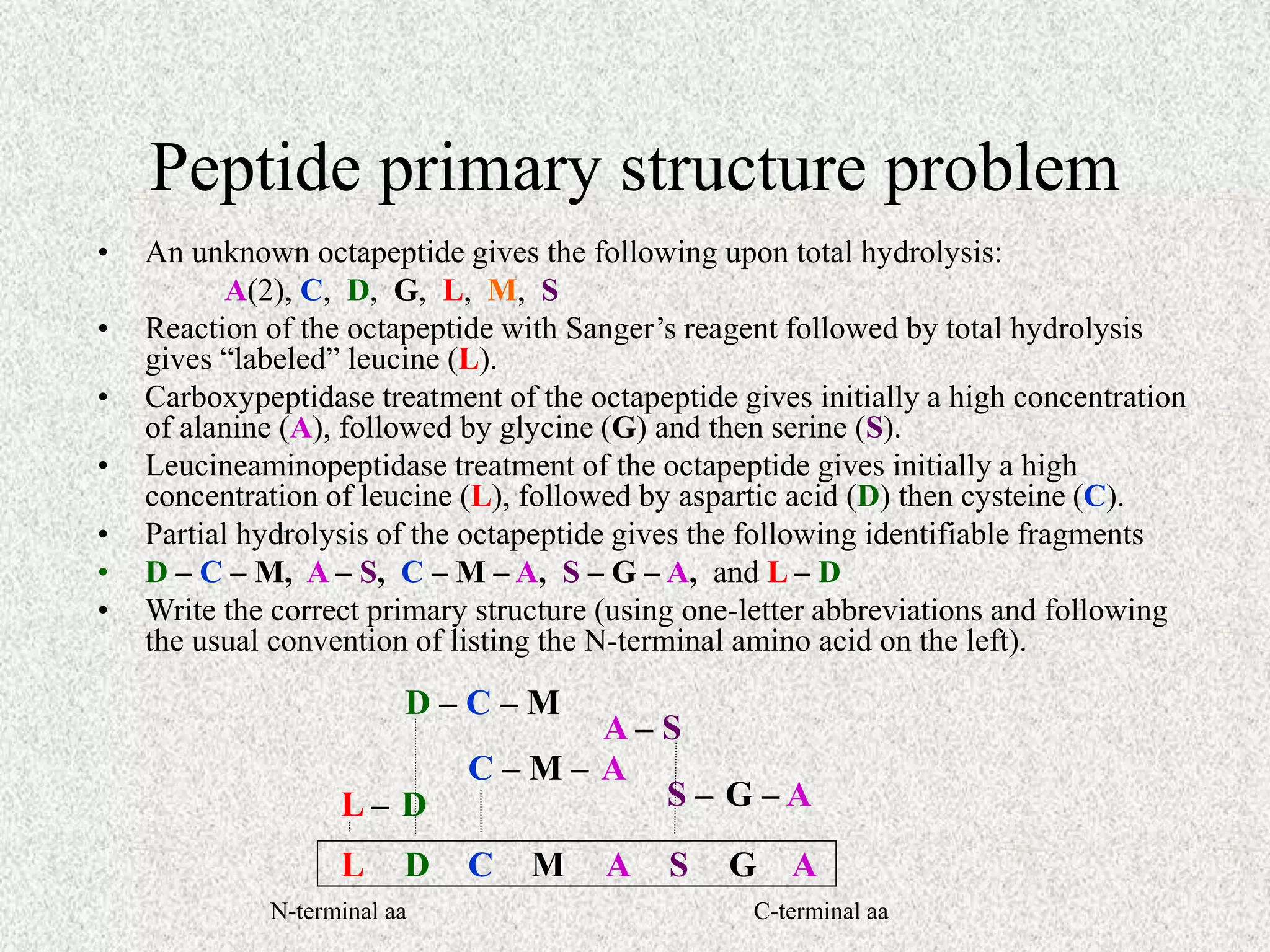
Peptide primary structure problem
• An unknown octapeptide gives the following upon total hydrolysis:
A(2), C, D, G, L, M, S
• Reaction of the octapeptide with Sanger’s reagent followed by total hydrolysis
gives “labeled” leucine (L).
• Carboxypeptidase treatment of the octapeptide gives initially a high concentration
of alanine (A), followed by glycine (G) and then serine (S).
• Leucineaminopeptidase treatment of the octapeptide gives initially a high
concentration of leucine (L), followed by aspartic acid (D) then cysteine (C).
• Partial hydrolysis of the octapeptide gives the following identifiable fragments
• D – C – M, A – S, C – M – A, S – G – A, and L – D
• Write the correct primary structure (using one-letter abbreviations and following
the usual convention of listing the N-terminal amino acid on the left).
L A
G
S
D C
N-terminal aa C-terminal aa
M A
D – C – M
C – M – A
S – G – A
A – S
L – D
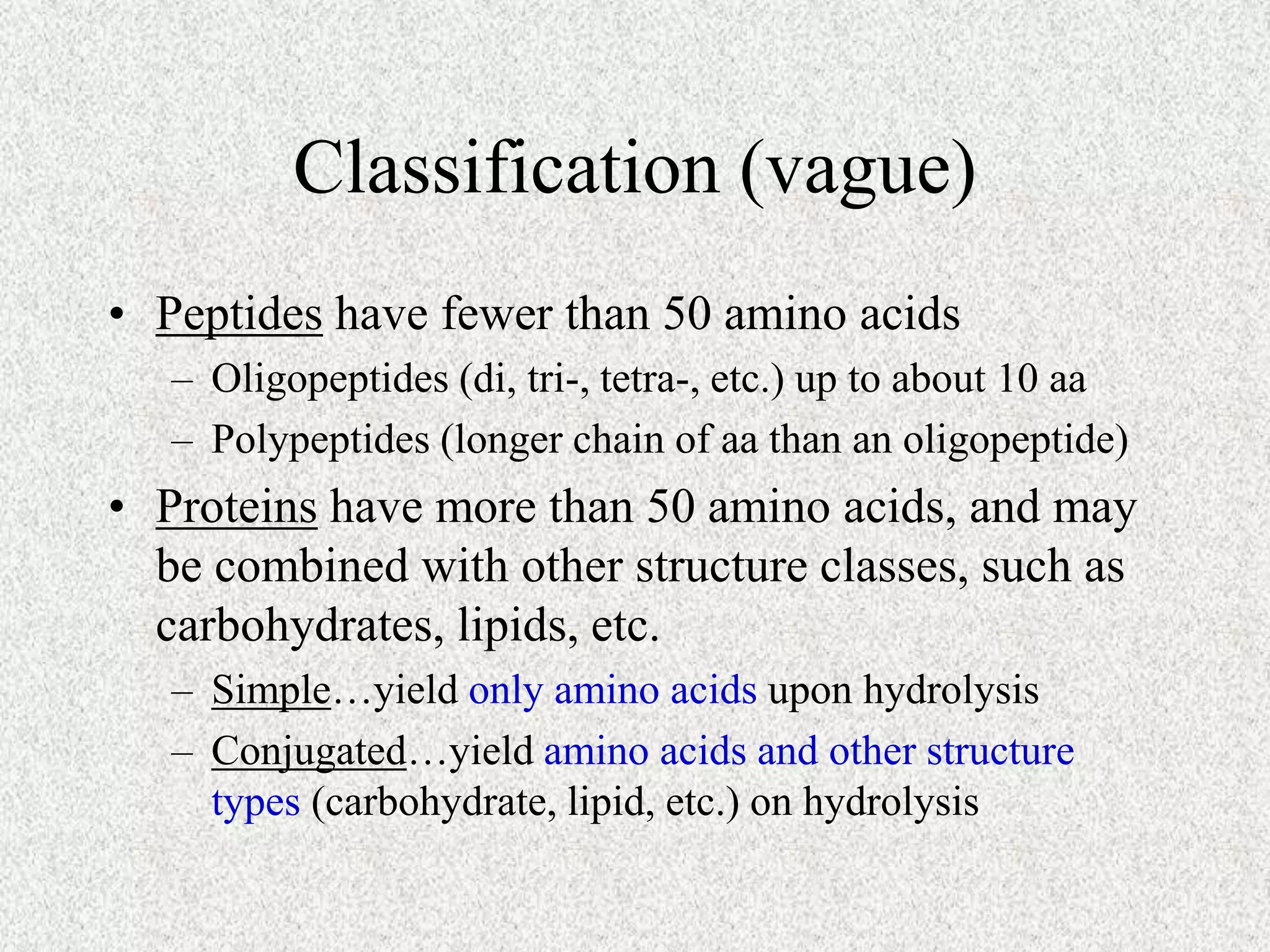
Classification (vague)
• Peptides have fewer than 50 amino acids
– Oligopeptides (di, tri-, tetra-, etc.) up to about 10 aa
– Polypeptides (longer chain of aa than an oligopeptide)
• Proteins have more than 50 amino acids, and may
be combined with other structure classes, such as
carbohydrates, lipids, etc.
– Simple…yield only amino acids upon hydrolysis
– Conjugated…yield amino acids and other structure
types (carbohydrate, lipid, etc.) on hydrolysis
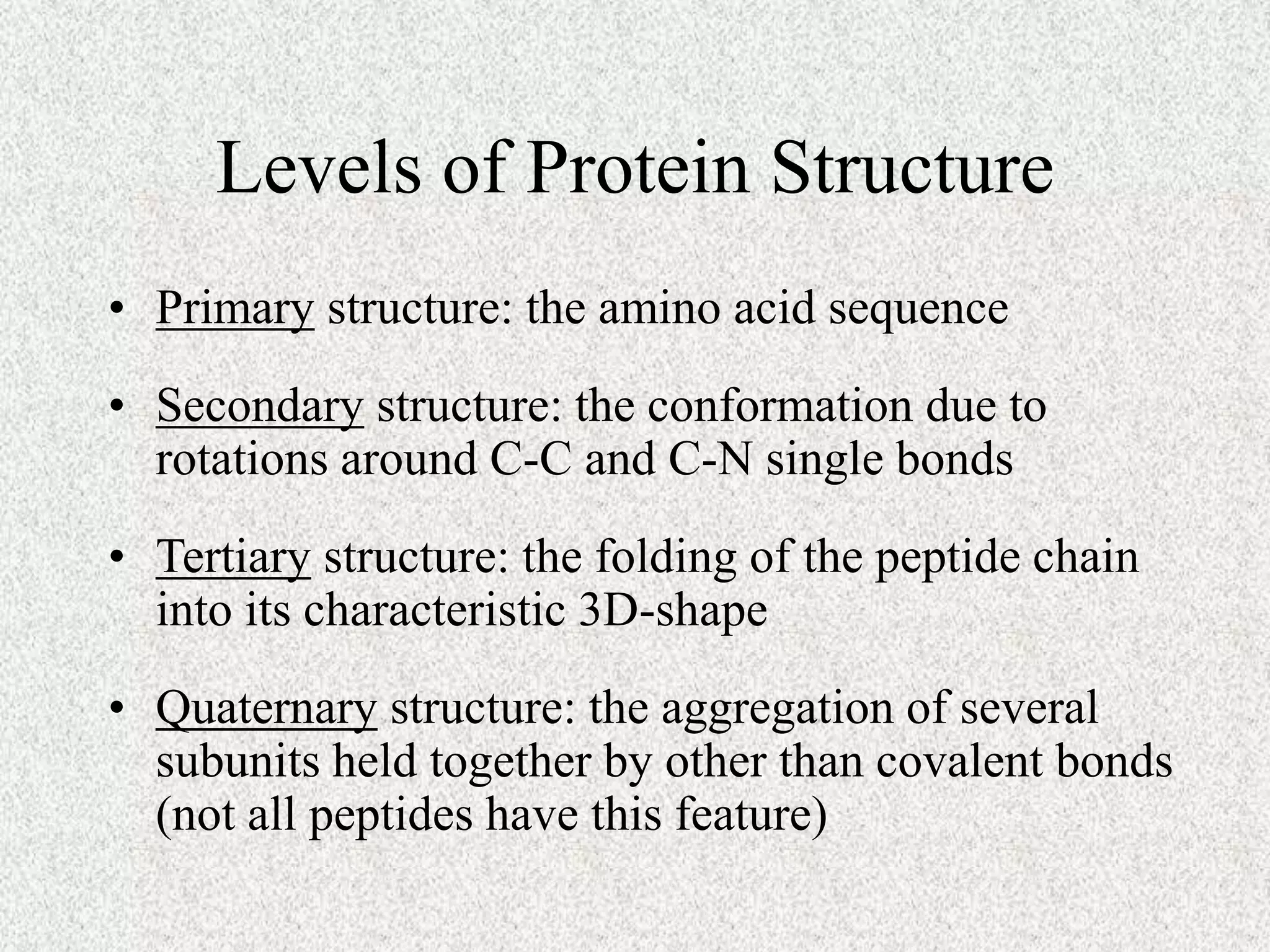
Levels of Protein Structure
• Primary structure: the amino acid sequence
• Secondary structure: the conformation due to
rotations around C-C and C-N single bonds
• Tertiary structure: the folding of the peptide chain
into its characteristic 3D-shape
• Quaternary structure: the aggregation of several
subunits held together by other than covalent bonds
(not all peptides have this feature)
Primary Structure
• the amino acid sequence, written from the N-
terminal (on the left) to the C-terminal (on the
right). Formerly abbreviated using three-letter
abbreviations: Ala, Gly, Phe, Val, etc.; now we use
one-letter abbreviations: A, G, F, V.
Ala – Gly – Phe – Val
or
A-G-F-V
Secondary Structure
• the 3-D arrangement (conformation) of segments
of a peptide/protein chain due to rotation around
C-C and C-N bonds


N
H
C O
R
H
C
O C
H
N
Secondary Structure
• There are several named conformations due to
common typical combinations of rotation angles
around C-N () and C-C () bonds:
 
– a-helix -58º -47º
– b-pleated sheet ( -140º 135º
– hairpin turns are sharp curves in the peptide
chain, often due to proline residues
)
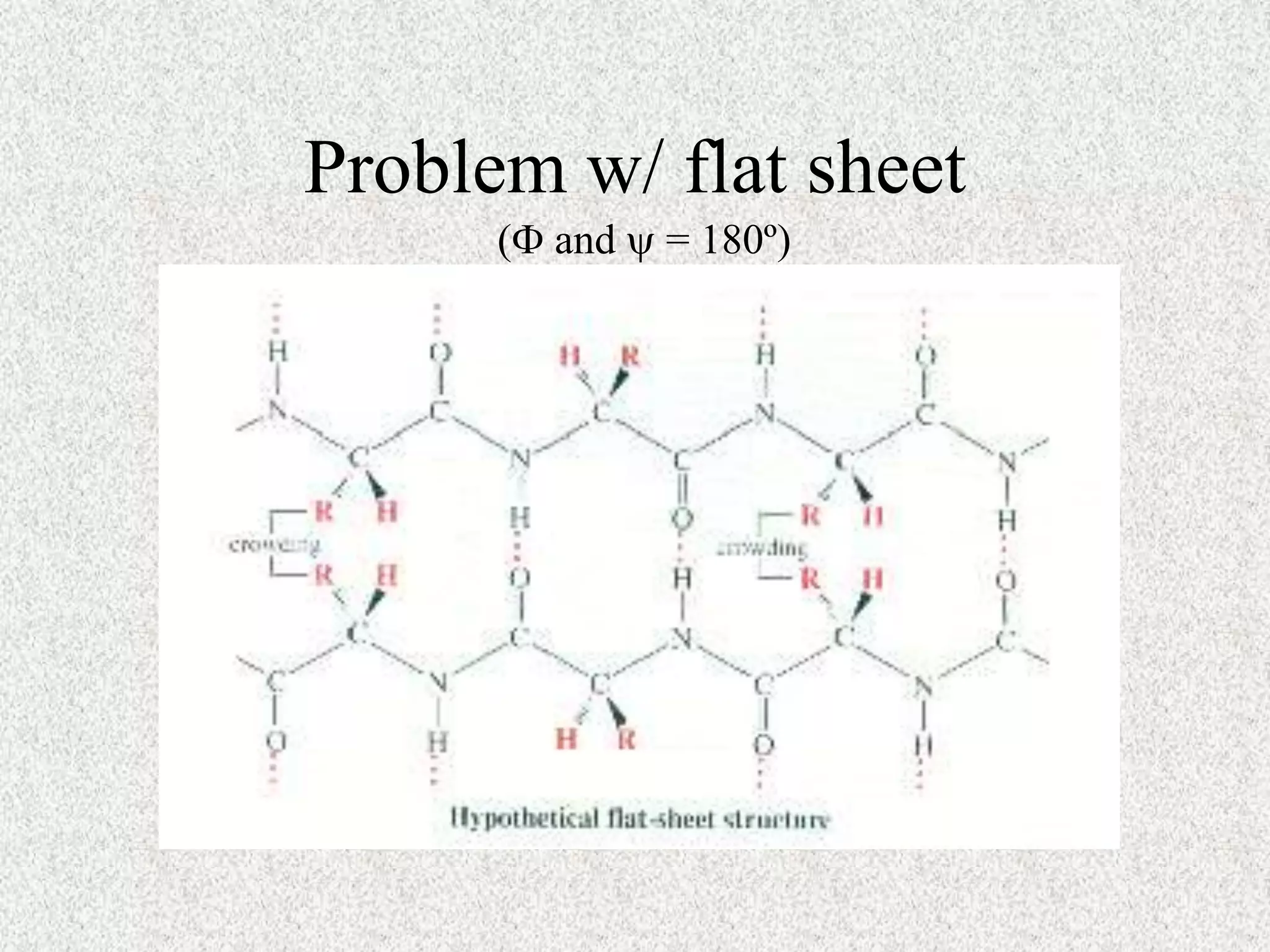
Problem w/ flat sheet
(F and  = 180º)
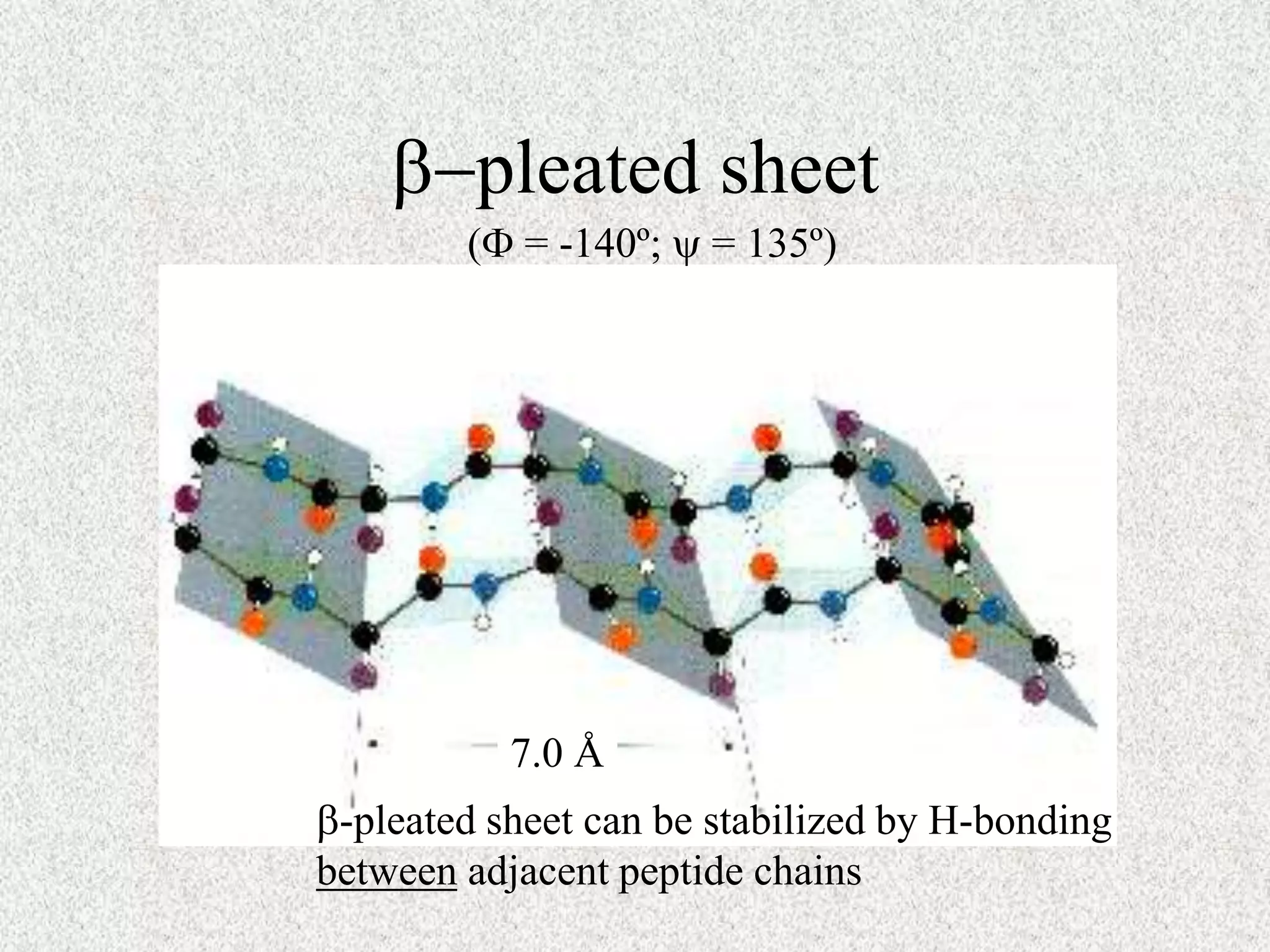
b-pleated sheet
7.0 Å
(F = -140º;  = 135º)
b-pleated sheet can be stabilized by H-bonding
between adjacent peptide chains
a-helix
(F = -58º;  = -47º)
a-helix is stabilized by H-bonding
within a peptide chain
Tertiary and Quaternary Structure
• Tertiary structure: the coiling or folding pattern of
single polypeptide chains
– Many individual shapes, but generally fall into one of
two categories:
• Fibrous (insoluble; generally function as structural component)
• Globular (soluble; coiled into compact, spherical shapes, with
hydrophobic groups oriented inward and hydrophilic groups
oriented outward toward the aqueous environment of the cell)
• Quaternary structure: non-covalent aggregation of
two or more protein molecules and possibly other
structures into functional units.
(examples will be shown in WebLab Viewer Lite)
Functions of Proteins
• Hemoglobin: the oxygen-carrying molecule in the
blood
• Insulin: regulates glucose metabolism
• HIV protease: cleaves peptide bonds of large protein
to allow activation of HIV virus within host cell
• Carboxypeptidase: digestive enzyme that hydrolyzes
peptides into their component amino acids
• Keratin: provides structure of wool, hair, fingernails,
and feathers

PeptidesandProteins.ppt

  • 1.
  • 2.
    Peptide primary structureproblem • An unknown octapeptide gives the following upon total hydrolysis: A(2), C, D, G, L, M, S • Reaction of the octapeptide with Sanger’s reagent followed by total hydrolysis gives “labeled” leucine (L). • Carboxypeptidase treatment of the octapeptide gives initially a high concentration of alanine (A), followed by glycine (G) and then serine (S). • Leucineaminopeptidase treatment of the octapeptide gives initially a high concentration of leucine (L), followed by aspartic acid (D) then cysteine (C). • Partial hydrolysis of the octapeptide gives the following identifiable fragments • D – C – M, A – S, C – M – A, S – G – A, and L – D • Write the correct primary structure (using one-letter abbreviations and following the usual convention of listing the N-terminal amino acid on the left). L A G S D C N-terminal aa C-terminal aa M A D – C – M C – M – A S – G – A A – S L – D
  • 3.
    Classification (vague) • Peptideshave fewer than 50 amino acids – Oligopeptides (di, tri-, tetra-, etc.) up to about 10 aa – Polypeptides (longer chain of aa than an oligopeptide) • Proteins have more than 50 amino acids, and may be combined with other structure classes, such as carbohydrates, lipids, etc. – Simple…yield only amino acids upon hydrolysis – Conjugated…yield amino acids and other structure types (carbohydrate, lipid, etc.) on hydrolysis
  • 4.
    Levels of ProteinStructure • Primary structure: the amino acid sequence • Secondary structure: the conformation due to rotations around C-C and C-N single bonds • Tertiary structure: the folding of the peptide chain into its characteristic 3D-shape • Quaternary structure: the aggregation of several subunits held together by other than covalent bonds (not all peptides have this feature)
  • 5.
    Primary Structure • theamino acid sequence, written from the N- terminal (on the left) to the C-terminal (on the right). Formerly abbreviated using three-letter abbreviations: Ala, Gly, Phe, Val, etc.; now we use one-letter abbreviations: A, G, F, V. Ala – Gly – Phe – Val or A-G-F-V
  • 6.
    Secondary Structure • the3-D arrangement (conformation) of segments of a peptide/protein chain due to rotation around C-C and C-N bonds   N H C O R H C O C H N
  • 7.
    Secondary Structure • Thereare several named conformations due to common typical combinations of rotation angles around C-N () and C-C () bonds:   – a-helix -58º -47º – b-pleated sheet ( -140º 135º – hairpin turns are sharp curves in the peptide chain, often due to proline residues )
  • 8.
    Problem w/ flatsheet (F and  = 180º)
  • 9.
    b-pleated sheet 7.0 Å (F= -140º;  = 135º) b-pleated sheet can be stabilized by H-bonding between adjacent peptide chains
  • 10.
    a-helix (F = -58º; = -47º) a-helix is stabilized by H-bonding within a peptide chain
  • 11.
    Tertiary and QuaternaryStructure • Tertiary structure: the coiling or folding pattern of single polypeptide chains – Many individual shapes, but generally fall into one of two categories: • Fibrous (insoluble; generally function as structural component) • Globular (soluble; coiled into compact, spherical shapes, with hydrophobic groups oriented inward and hydrophilic groups oriented outward toward the aqueous environment of the cell) • Quaternary structure: non-covalent aggregation of two or more protein molecules and possibly other structures into functional units. (examples will be shown in WebLab Viewer Lite)
  • 12.
    Functions of Proteins •Hemoglobin: the oxygen-carrying molecule in the blood • Insulin: regulates glucose metabolism • HIV protease: cleaves peptide bonds of large protein to allow activation of HIV virus within host cell • Carboxypeptidase: digestive enzyme that hydrolyzes peptides into their component amino acids • Keratin: provides structure of wool, hair, fingernails, and feathers