@RanjanKBora
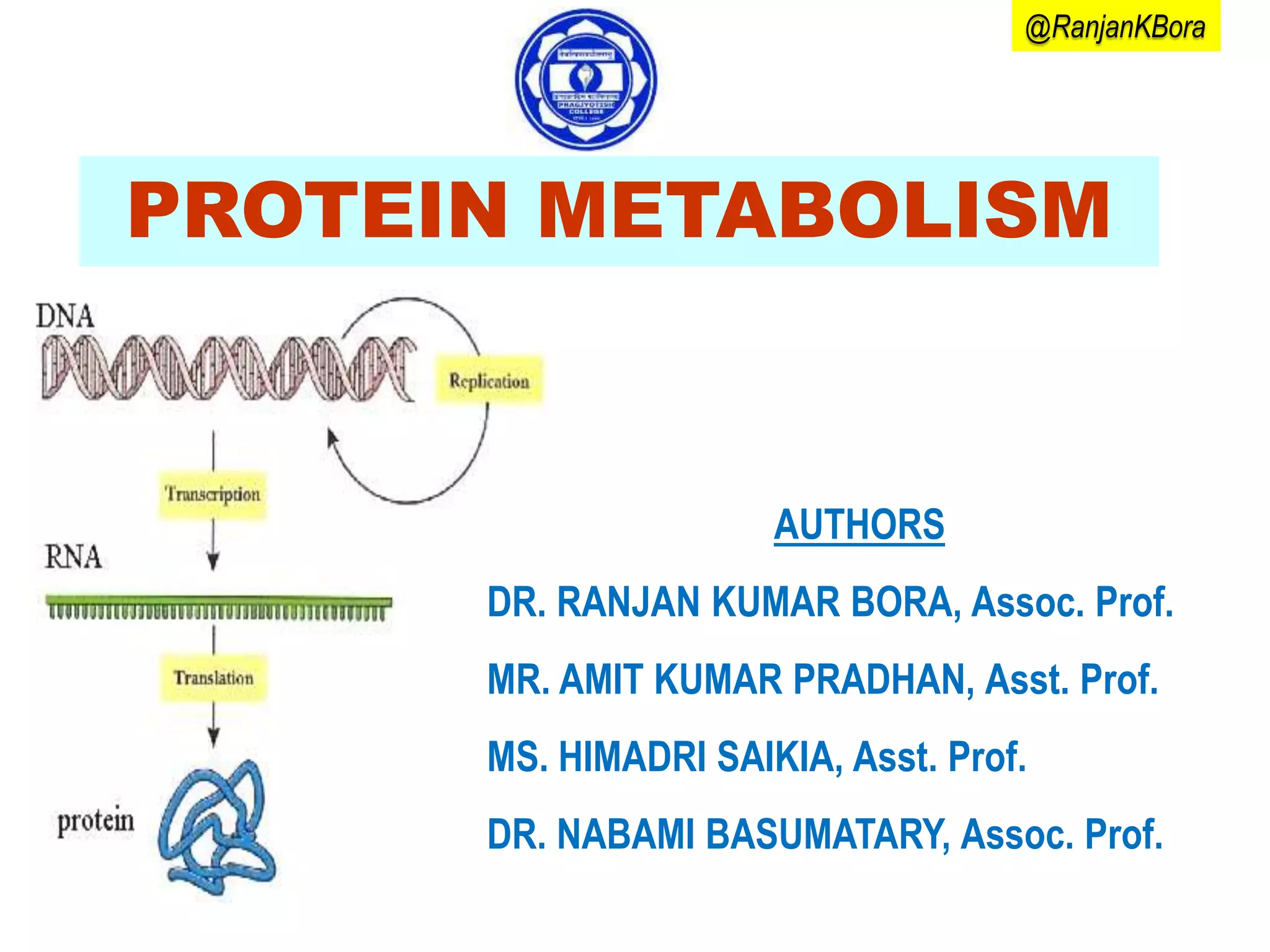
PROTEIN METABOLISM
AUTHORS
DR. RANJAN KUMAR BORA, Assoc. Prof.
MR. AMIT KUMAR PRADHAN, Asst. Prof.
MS. HIMADRI SAIKIA, Asst. Prof.
DR. NABAMI BASUMATARY, Assoc. Prof.
@RanjanKBora
Proteins are regarded as the most important
constituents of all living organisms as they play
important role in their life.
a) Form the structural framework of the cell
b) Maintain osmotic balance
c) Catalyse biochemical reactions
d) Regulate metabolism
e) Help in storage
f) Act as oxygen carrier
g) Form the colloidal system in protoplasm
h) Transport lipids as lipoproteins
i) Act as storage proteins (proteinoplas)
@RanjanKBora
 All the information required for live is stored in the
Nucleic acid ad more particularly the DNA
 The information in a genome (DNA molecule) is not
transmitted directly to a protein synthesizing system.
 This information is first transcribed into a mRNA
and then is translated into protein
Characteristic feature of Proteins
• Proteins are naturally occurring highly complex organic compounds of
colloidal nature. They have very high molecular weight and are
optically active with no definite melting points
• Made up of C, H, O, N and S. Some may contain Fe and P.
C= 50-55%, H= 6.5-7.3%, N= 15-19%, O= 21.9-24%, S= 0-2.8%
• Polymer of amino acids bind by α-amino group of one molecule and
carboxyl group of another. This bonds are called peptide bond.
• may contain disulphide linkage, H- bonds and Vander Wall forces
@RanjanKBora
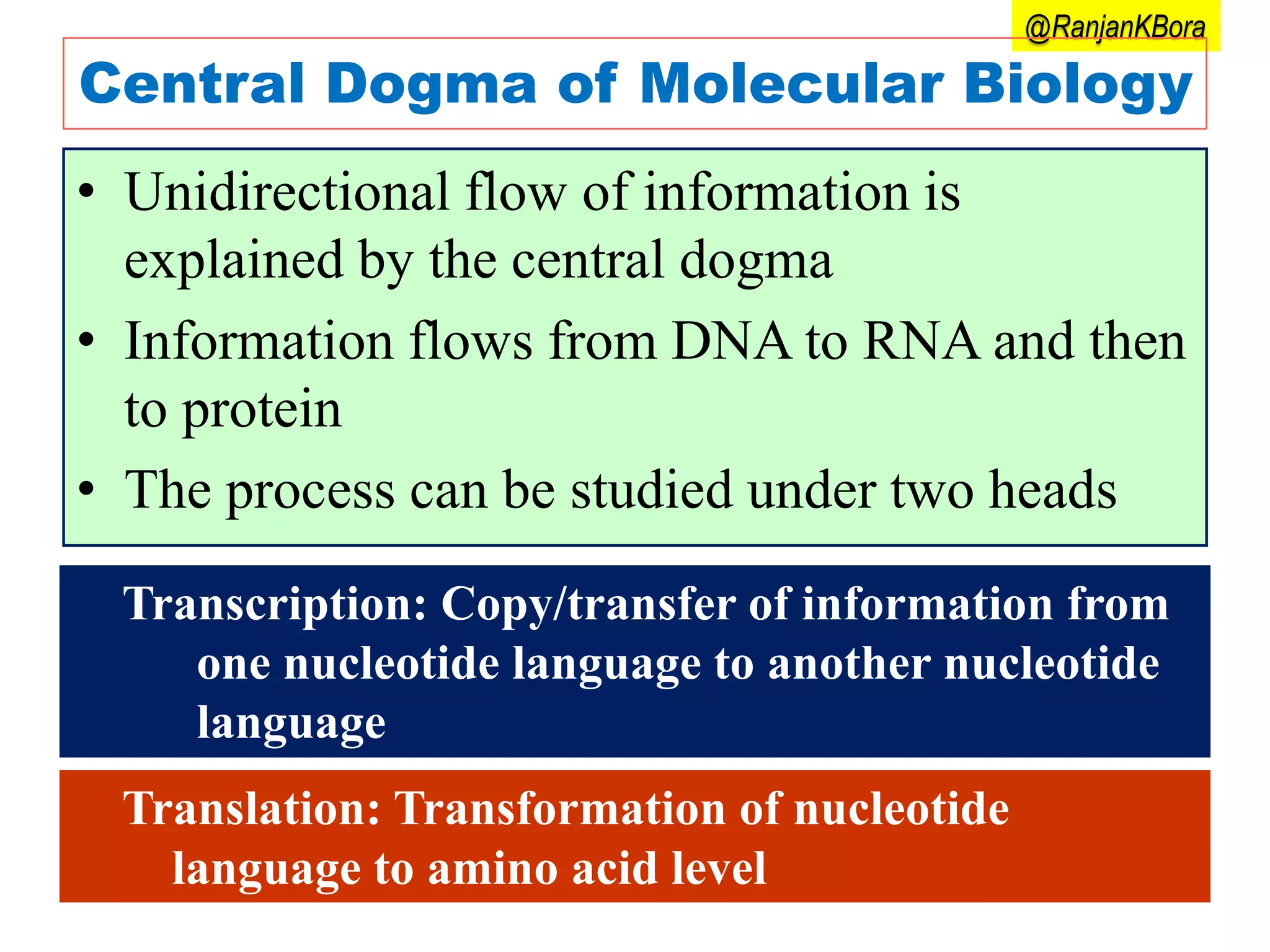
Central Dogma of Molecular Biology
• Unidirectional flow of information is
explained by the central dogma
• Information flows from DNA to RNA and then
to protein
• The process can be studied under two heads
Transcription: Copy/transfer of information from
one nucleotide language to another nucleotide
language
Translation: Transformation of nucleotide
language to amino acid level
@RanjanKBora
Biosynthesis of Proteins
Unidirectional Flow
DNA RNA Protein
Circular Flow
DNA
RNA RNA
Protein
Reverse Flow
RNA DNA RNA Protein
Transcription Translation
Transcription TranslationReverse
Transcriptase
@RanjanKBora
Transcription RNA
Polymerase
RNA
Unwinding of two
DNA strand
One strand of DNA
being Transcripted
3’
5’
5’
3’
α
α
β
β’
σ
RNA Polymerase
Mg2+
Source: NCBI
@RanjanKBora
The required genetic information stored in the DNA to
synthesize a protein is first transcribed to mRNA
• A DNA dependent RNA Polymerase catalyses the formation of
phosphodiester linkage between ribonucleosides with the
simultaneous release of pyrophsphate.
• Does not require a primer
• Of the two DNA strands, usually 3/ 5/ strand (sense strand) act
as the template and 5/ 3/ strand is not copied (anti sense)
• RNA molecules grow from 5/ end in 5/ 3/
• In bacteria RNA polymerase is made up of 4 different
polypeptide chains Ϭ β β’ α2
• β β’ α2 called core enzyme and Ϭ is loosely arranged called Ϭ
factor
• Ϭ factor helps in recognition of promoter site
• The ρ factor helps termination of the RNA chain
@RanjanKBora
Source: Plant Physiology-S K Verma
@RanjanKBora
Maturation of mRNA from HnRNA
Source: Introduction to Plant Biochemistry- Godwin & Mercer
@RanjanKBora
TRANSLATIONS
AA + ATP (AA-AMP)Enz + PP
 Amino acids are the building blocks of proteins (α
polypeptide helix)
 Amino acids are carried by t-RNA to the site of
protein synthesis that is Ribosome
PyrophosphateAminoacyl AMP-
Enzyme Complex
Aminoacyl synthetase
Mg2+
Activation of Amino Acid
20 amino acid in the cytoplasm and in inactive state
Activation with ATP in presence of specific enzyme
aminoacyl synthetase
@RanjanKBora
Transfer of Activated Amino acid to tRNA
Aminoacyl-AMP-Enzyme Complex collide with specific
tRNA.
Carboxyl group of amino acid residue of Aminoacyl-
AMP enzyme Complex is attached to CCA end of the
tRNA.
• As each tRNA is specific for a particular amino acid
hence there are 20 different types of tRNA for 20
amino acids
(AA-AMP)Enz + tRNA AA-tRNA+ AMP+ Enzyme
Aminoacyl-AMP
enzyme Complex
Aminoacyl-tRNA
@RanjanKBora
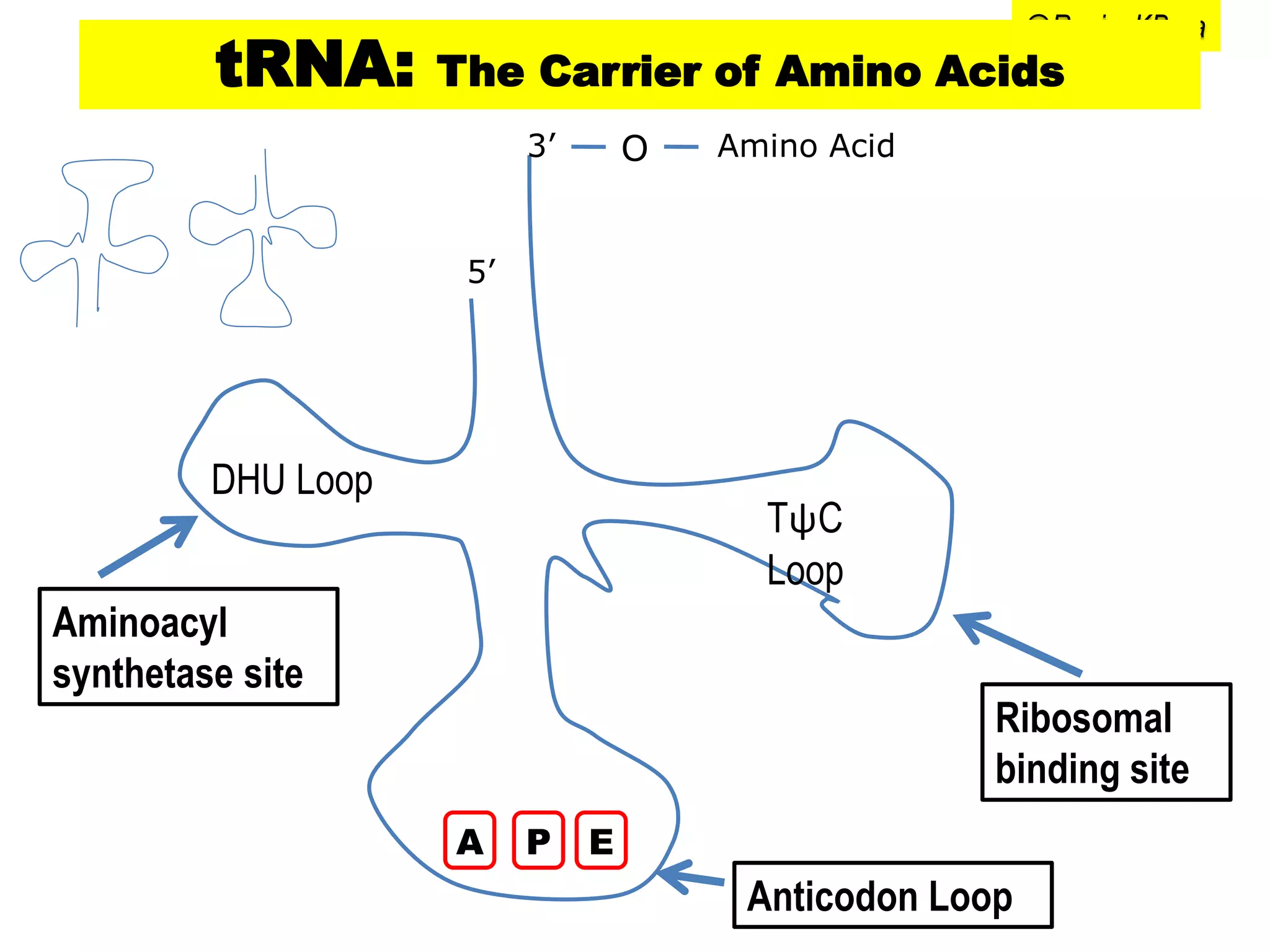
A P E
3’
5’
O Amino Acid
TѱC
Loop
DHU Loop
Anticodon Loop
Aminoacyl
synthetase site
Ribosomal
binding site
tRNA: The Carrier of Amino Acids
@RanjanKBora
t-RNAf
Met Alanyl t-RNA
@RanjanKBora
@RanjanKBora
Properties of Genetic Code
Code is Triplet
Code is Non-overlaping
Code is Commaless
Code is Non-ambiguous
Code is universal
Code is Degenerate e.g. Leucine (UUA,
UUG, CUU, CUC, CUA,CUG)
@RanjanKBora
Initiation of Polypeptide
• The initiation of polypeptide chain always starts with
amino acid methionine
• Methionine is coded by AUG
• In Prokaryotes two types of tRNAs for methionine
• tRNA f
mat (formylatable) and tRNA m
mat (non-
formylatable)
• tRNA f
mat deposite Methionine as the first amino acid
to the polypetide chain
• tRNA m
mat helps deposition of methionine at
intercalary position.
@RanjanKBora
Formation of met-tRNA f
met
Methionine + ATP (Met-AMP)Enz1 + PP
(Met-AMP)Enz1+ tRNAf
met Met-tRNAf
met+ AMP+ Enz1
• Formation of formyl-methionyl tRNA f
met :
The formylation of met-tRNAf
met is mediated by
enzyme transformylase in presence of
formltetrahydrofolic acid (f-THFA)
Methionine acyl
synthetase, Mg 2+
Met + tRNAf
met + f-THFA f-met-tRNAf
met
Transformylase
@RanjanKBora
Attachment of mRNA (5
⸝
end) with 30S
subunit of Ribosome
• Ribosomes occur in dissociated forms 50S and 30S
(Prokaryotes) and 40S and 60S in Eukaryotes
• 5
⸝
endof mRNA carrying AUG triplet codon, binds
with 30S ribosomal subunits of 30S in presence of
Initiaton F3 protein factor(IF3)
mRNA + 30S 30s-mRNA
IF3
A U G A C G U U U C G A G U C AA G
5
⸝
3
⸝
30S Rinosomal
subunit
@RanjanKBora
Formation of Initiation Complex: attachment of
f-met-tRNAf
met with 30S-mRNA
Association of Ribosomal subunits
30S ribosomal subunit of initiation complex (30S-mRNA-f-
met-tRNAf
met
) associates with 50S ribosomal subunits to
form 70S ribosome.
The union of ribosomal subunits require Mg 2+ at 0.001M
Three proteinaceous factor namely IF1, IF2 and IF3 prevents the
binding together of the 50S and 30S ribosomal subunits in the
absence of mRNA
30S-mRNA + f-met-tRNAf
met
30S-mRNA-f-met-tRNAf
metGTP
IF1, IF2, IF3
@RanjanKBora
A U G A C G U U U C G A G U C A A G
I I I I I I I I I I I I I I I I I I
UAC
AA1(f-Met)
mRNA
30S subunit
50S subunit
f-met-tRNAf
met
Formation of Initiation Complex
@RanjanKBora
Elongation of Polypeptide
 Elongation of polypeptide chain occurs at 50S subunit.
 50S subunit has two binding sites - aminoacyl site (A
site) and peptidyle site (P site)
 Binding of AA-tRNA at aminoacyl site of ribosome.
 The tRNAs carrying activated amino acids first enter
int A site.
 The entrance of AA-tRNA require energy provided by
GTP and a Transfer Factor (TF or EF-Tu)
After the formation of 70S-mRNA-f-met-tRNAf
met
complex, the
polypeptide chain elongates by regular addition of amino acids.
@RanjanKBora
 AA-tRNA-GTP-EF-Tu complex formed and deposites
AA-tRNA at A site with liberation of GDP
 GTP-EF-Tu can bind all aminoacyl-tRNA except the
f-met-tRNAf
met
 Binding takes place only when the tRNA has
complementary codon to that of mRNA
 Correct amino acid carrying tRNA binds with A site
and later transfer to P site of 50S ribosomal subunit
 f-met-tRNAf
met
is always found in P site leaving A site open
for entry of new amino acid
@RanjanKBora
Formation of peptide (-CO-NH) bond
• Formation of peptide bond takes place between the
free carboxylic group (-C00H) of the peptidyl tRNA at
P site and the free amino group (-NH2) of aminoacyl
tRNA at the A site
• Reaction catalysed by Peptidyl transferase with
liberation of one water molecule
• After formation of peptide bond, the tRNA at P site
deacylated and tRNA at A site carries the growing
polypeoptide
• The enzyme which cause transfer of aminoacids are
called transferase I, transferase II and so on
@RanjanKBora
@RanjanKBora
Translocation of peptidyl tRNA from A site
to P site
• Transferase I kicks off tRNA from formyl methionine
(AA1) and flips the AA1 to the aminoacyl-tRNA (AA2-
tRNA) bound at A site
• Aminoacyl tRNA (AA1-AA2-tRNA) present at A site
now converted to peptidyl tRNA and shifted to P site
with the help of transferase II or translocase or G factor
• Relative movement of ribosome over the mRNA for
one genetic code
• This movement make open A site for entry of new
amino acyl-tRNA
• The process continues till the end codon
@RanjanKBora
Chain Termination
• When the synthesis of polypeptide chain is completed
according to the codons of mRNA, the chain
termination occurs.
• The process of chain termination occurs due presence
of any one of the terminator codons.
• Terminator codons: UAA, UAG and UGA
• The polypeptide chain is released with the help of two
releasing factor R1 and R2
• Now the ribosome dissociates into 30S and 50S
subunits
• The deformylase causes the removal of formyl group
of methionine from the chain
@RanjanKBora
Translation - animation
@RanjanKBora
DR. RANJAN KUMAR BORA DR. NABAMI BASUMATARY
Associate Professor Associate Professor
Department of Botany Department of Botany
Pragjyotish College, Guwahati BN College, Dhubri
AMIT KUMAR PRADHAN HIMADRI SAIKIA
Assistant Professor Assistant Professor
Department of Botany, Department of Botany,
Pragjyotish College Guwahati Pragjyotish College Guwahati
@RanjanKBora

Protein metabolism

  • 1.
    @RanjanKBora PROTEIN METABOLISM AUTHORS DR. RANJANKUMAR BORA, Assoc. Prof. MR. AMIT KUMAR PRADHAN, Asst. Prof. MS. HIMADRI SAIKIA, Asst. Prof. DR. NABAMI BASUMATARY, Assoc. Prof.
  • 2.
    @RanjanKBora Proteins are regardedas the most important constituents of all living organisms as they play important role in their life. a) Form the structural framework of the cell b) Maintain osmotic balance c) Catalyse biochemical reactions d) Regulate metabolism e) Help in storage f) Act as oxygen carrier g) Form the colloidal system in protoplasm h) Transport lipids as lipoproteins i) Act as storage proteins (proteinoplas)
  • 3.
    @RanjanKBora  All theinformation required for live is stored in the Nucleic acid ad more particularly the DNA  The information in a genome (DNA molecule) is not transmitted directly to a protein synthesizing system.  This information is first transcribed into a mRNA and then is translated into protein Characteristic feature of Proteins • Proteins are naturally occurring highly complex organic compounds of colloidal nature. They have very high molecular weight and are optically active with no definite melting points • Made up of C, H, O, N and S. Some may contain Fe and P. C= 50-55%, H= 6.5-7.3%, N= 15-19%, O= 21.9-24%, S= 0-2.8% • Polymer of amino acids bind by α-amino group of one molecule and carboxyl group of another. This bonds are called peptide bond. • may contain disulphide linkage, H- bonds and Vander Wall forces
  • 4.
    @RanjanKBora Central Dogma ofMolecular Biology • Unidirectional flow of information is explained by the central dogma • Information flows from DNA to RNA and then to protein • The process can be studied under two heads Transcription: Copy/transfer of information from one nucleotide language to another nucleotide language Translation: Transformation of nucleotide language to amino acid level
  • 5.
    @RanjanKBora Biosynthesis of Proteins UnidirectionalFlow DNA RNA Protein Circular Flow DNA RNA RNA Protein Reverse Flow RNA DNA RNA Protein Transcription Translation Transcription TranslationReverse Transcriptase
  • 6.
    @RanjanKBora Transcription RNA Polymerase RNA Unwinding oftwo DNA strand One strand of DNA being Transcripted 3’ 5’ 5’ 3’ α α β β’ σ RNA Polymerase Mg2+ Source: NCBI
  • 7.
    @RanjanKBora The required geneticinformation stored in the DNA to synthesize a protein is first transcribed to mRNA • A DNA dependent RNA Polymerase catalyses the formation of phosphodiester linkage between ribonucleosides with the simultaneous release of pyrophsphate. • Does not require a primer • Of the two DNA strands, usually 3/ 5/ strand (sense strand) act as the template and 5/ 3/ strand is not copied (anti sense) • RNA molecules grow from 5/ end in 5/ 3/ • In bacteria RNA polymerase is made up of 4 different polypeptide chains Ϭ β β’ α2 • β β’ α2 called core enzyme and Ϭ is loosely arranged called Ϭ factor • Ϭ factor helps in recognition of promoter site • The ρ factor helps termination of the RNA chain
  • 8.
  • 9.
    @RanjanKBora Maturation of mRNAfrom HnRNA Source: Introduction to Plant Biochemistry- Godwin & Mercer
  • 10.
    @RanjanKBora TRANSLATIONS AA + ATP(AA-AMP)Enz + PP  Amino acids are the building blocks of proteins (α polypeptide helix)  Amino acids are carried by t-RNA to the site of protein synthesis that is Ribosome PyrophosphateAminoacyl AMP- Enzyme Complex Aminoacyl synthetase Mg2+ Activation of Amino Acid 20 amino acid in the cytoplasm and in inactive state Activation with ATP in presence of specific enzyme aminoacyl synthetase
  • 11.
    @RanjanKBora Transfer of ActivatedAmino acid to tRNA Aminoacyl-AMP-Enzyme Complex collide with specific tRNA. Carboxyl group of amino acid residue of Aminoacyl- AMP enzyme Complex is attached to CCA end of the tRNA. • As each tRNA is specific for a particular amino acid hence there are 20 different types of tRNA for 20 amino acids (AA-AMP)Enz + tRNA AA-tRNA+ AMP+ Enzyme Aminoacyl-AMP enzyme Complex Aminoacyl-tRNA
  • 12.
    @RanjanKBora A P E 3’ 5’ OAmino Acid TѱC Loop DHU Loop Anticodon Loop Aminoacyl synthetase site Ribosomal binding site tRNA: The Carrier of Amino Acids
  • 13.
  • 14.
  • 15.
    @RanjanKBora Properties of GeneticCode Code is Triplet Code is Non-overlaping Code is Commaless Code is Non-ambiguous Code is universal Code is Degenerate e.g. Leucine (UUA, UUG, CUU, CUC, CUA,CUG)
  • 16.
    @RanjanKBora Initiation of Polypeptide •The initiation of polypeptide chain always starts with amino acid methionine • Methionine is coded by AUG • In Prokaryotes two types of tRNAs for methionine • tRNA f mat (formylatable) and tRNA m mat (non- formylatable) • tRNA f mat deposite Methionine as the first amino acid to the polypetide chain • tRNA m mat helps deposition of methionine at intercalary position.
  • 17.
    @RanjanKBora Formation of met-tRNAf met Methionine + ATP (Met-AMP)Enz1 + PP (Met-AMP)Enz1+ tRNAf met Met-tRNAf met+ AMP+ Enz1 • Formation of formyl-methionyl tRNA f met : The formylation of met-tRNAf met is mediated by enzyme transformylase in presence of formltetrahydrofolic acid (f-THFA) Methionine acyl synthetase, Mg 2+ Met + tRNAf met + f-THFA f-met-tRNAf met Transformylase
  • 18.
    @RanjanKBora Attachment of mRNA(5 ⸝ end) with 30S subunit of Ribosome • Ribosomes occur in dissociated forms 50S and 30S (Prokaryotes) and 40S and 60S in Eukaryotes • 5 ⸝ endof mRNA carrying AUG triplet codon, binds with 30S ribosomal subunits of 30S in presence of Initiaton F3 protein factor(IF3) mRNA + 30S 30s-mRNA IF3 A U G A C G U U U C G A G U C AA G 5 ⸝ 3 ⸝ 30S Rinosomal subunit
  • 19.
    @RanjanKBora Formation of InitiationComplex: attachment of f-met-tRNAf met with 30S-mRNA Association of Ribosomal subunits 30S ribosomal subunit of initiation complex (30S-mRNA-f- met-tRNAf met ) associates with 50S ribosomal subunits to form 70S ribosome. The union of ribosomal subunits require Mg 2+ at 0.001M Three proteinaceous factor namely IF1, IF2 and IF3 prevents the binding together of the 50S and 30S ribosomal subunits in the absence of mRNA 30S-mRNA + f-met-tRNAf met 30S-mRNA-f-met-tRNAf metGTP IF1, IF2, IF3
  • 20.
    @RanjanKBora A U GA C G U U U C G A G U C A A G I I I I I I I I I I I I I I I I I I UAC AA1(f-Met) mRNA 30S subunit 50S subunit f-met-tRNAf met Formation of Initiation Complex
  • 21.
    @RanjanKBora Elongation of Polypeptide Elongation of polypeptide chain occurs at 50S subunit.  50S subunit has two binding sites - aminoacyl site (A site) and peptidyle site (P site)  Binding of AA-tRNA at aminoacyl site of ribosome.  The tRNAs carrying activated amino acids first enter int A site.  The entrance of AA-tRNA require energy provided by GTP and a Transfer Factor (TF or EF-Tu) After the formation of 70S-mRNA-f-met-tRNAf met complex, the polypeptide chain elongates by regular addition of amino acids.
  • 22.
    @RanjanKBora  AA-tRNA-GTP-EF-Tu complexformed and deposites AA-tRNA at A site with liberation of GDP  GTP-EF-Tu can bind all aminoacyl-tRNA except the f-met-tRNAf met  Binding takes place only when the tRNA has complementary codon to that of mRNA  Correct amino acid carrying tRNA binds with A site and later transfer to P site of 50S ribosomal subunit  f-met-tRNAf met is always found in P site leaving A site open for entry of new amino acid
  • 23.
    @RanjanKBora Formation of peptide(-CO-NH) bond • Formation of peptide bond takes place between the free carboxylic group (-C00H) of the peptidyl tRNA at P site and the free amino group (-NH2) of aminoacyl tRNA at the A site • Reaction catalysed by Peptidyl transferase with liberation of one water molecule • After formation of peptide bond, the tRNA at P site deacylated and tRNA at A site carries the growing polypeoptide • The enzyme which cause transfer of aminoacids are called transferase I, transferase II and so on
  • 24.
  • 25.
    @RanjanKBora Translocation of peptidyltRNA from A site to P site • Transferase I kicks off tRNA from formyl methionine (AA1) and flips the AA1 to the aminoacyl-tRNA (AA2- tRNA) bound at A site • Aminoacyl tRNA (AA1-AA2-tRNA) present at A site now converted to peptidyl tRNA and shifted to P site with the help of transferase II or translocase or G factor • Relative movement of ribosome over the mRNA for one genetic code • This movement make open A site for entry of new amino acyl-tRNA • The process continues till the end codon
  • 26.
    @RanjanKBora Chain Termination • Whenthe synthesis of polypeptide chain is completed according to the codons of mRNA, the chain termination occurs. • The process of chain termination occurs due presence of any one of the terminator codons. • Terminator codons: UAA, UAG and UGA • The polypeptide chain is released with the help of two releasing factor R1 and R2 • Now the ribosome dissociates into 30S and 50S subunits • The deformylase causes the removal of formyl group of methionine from the chain
  • 27.
  • 28.
    @RanjanKBora DR. RANJAN KUMARBORA DR. NABAMI BASUMATARY Associate Professor Associate Professor Department of Botany Department of Botany Pragjyotish College, Guwahati BN College, Dhubri AMIT KUMAR PRADHAN HIMADRI SAIKIA Assistant Professor Assistant Professor Department of Botany, Department of Botany, Pragjyotish College Guwahati Pragjyotish College Guwahati
  • 29.