PROTECTED CULTIVATION
Submitted To :
MANJU VERMA
Asst. professor
Horticulture
Submitted By :
Kartik Phulwariya
Khushbu Dotaniya
B.Sc Ag(Hons.)Part IInd sem IInd
2023 - 2024
TOPIC
COLLEGE OF AGRICULTURE
NAGAUR
AU JODHPUR
With globalization of markets,
shrinking land and climate change,
the protected cultivation of high
value crops has emerged as the
single most important technology for
ensuring:
• High productivity
• Improved quality and
INTRODUCTION
PROTECTED
CULTIVATION
Protected cultivation is a process of
growing crops in a controlled
environment.
This means that the temperature,
humidity, light and other factors
can be regulated as per the
requirement of the crop
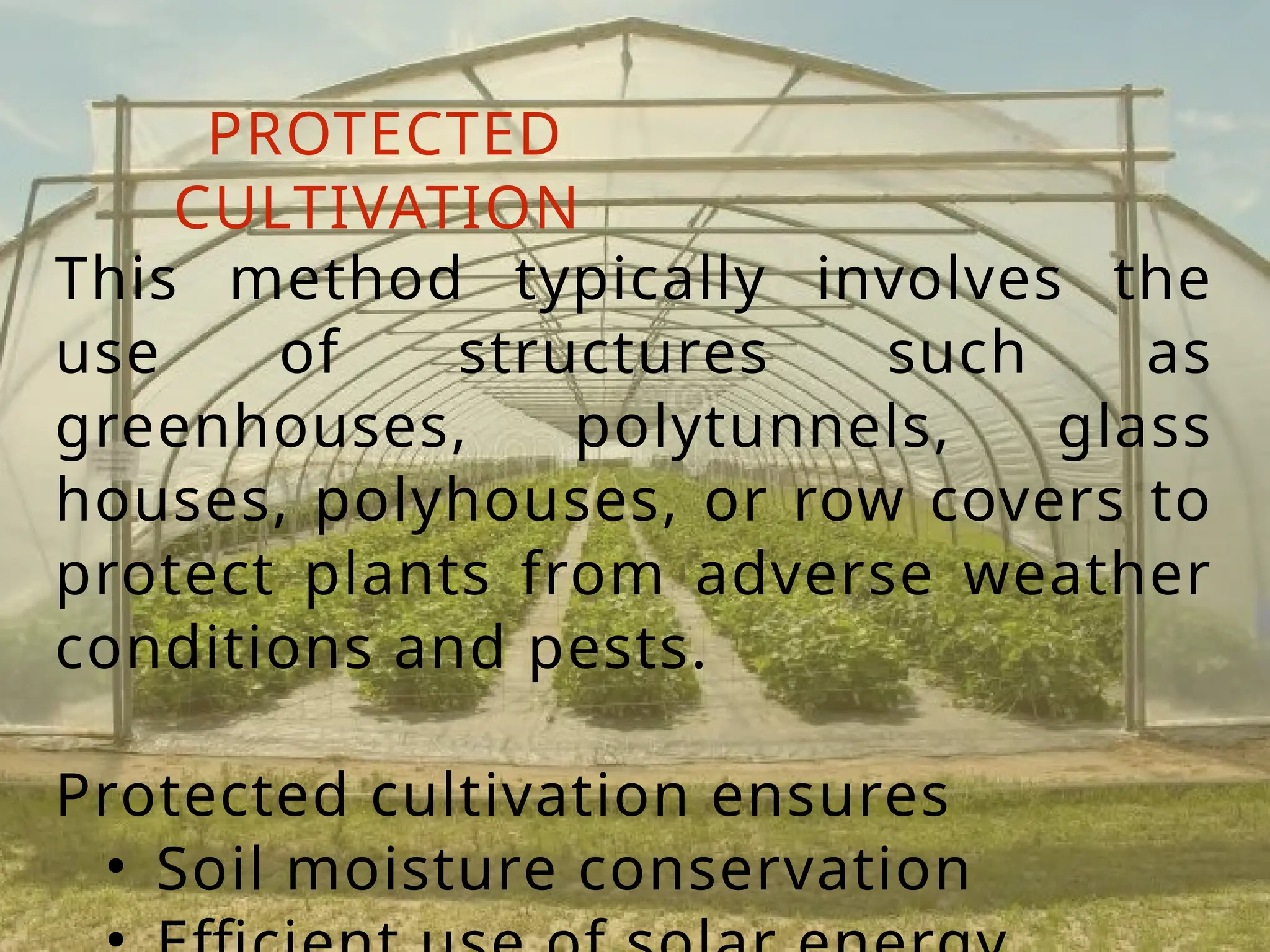
This method typically involves the
use of structures such as
greenhouses, polytunnels, glass
houses, polyhouses, or row covers to
protect plants from adverse weather
conditions and pests.
Protected cultivation ensures
• Soil moisture conservation
PROTECTED
CULTIVATION
Types of Protected Structures
The commonly used protected structures are as follows
Low Tunnel:
Also called ‘miniature greenhouses’
• low tunnels generally cover rows of plants in
the field and, therefore, they are also known as
row covers.
• Clean plastic films or nets are stretched over
low wire hoops (arcs up to 1.0 m high) to
protect plants against frost, wind, insects and
pests.
• The hoops are made of steel wires or bamboo
strips or cane.
• These hoops are covered by polythene sheets of
Walk-in tunnel
• It is a temporary structure made by
using GI pipes or bamboo and is
covered with different cladding
materials depending upon the season
in which the cultivation is proposed.
• Walk-in tunnels are used for off-
season cultivation of vegetables and
flower seedlings.
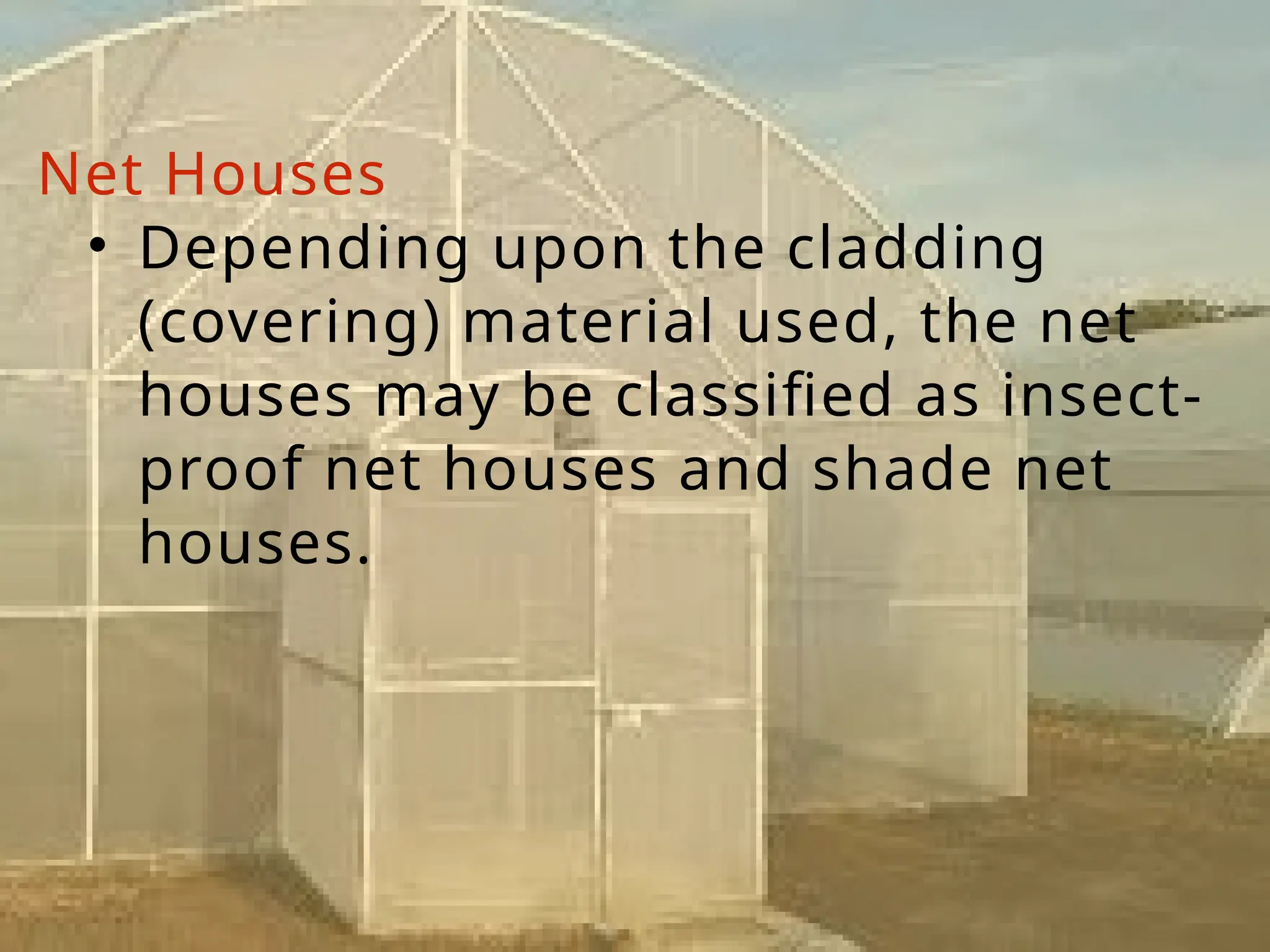
Net Houses
• Depending upon the cladding
(covering) material used, the net
houses may be classified as insect-
proof net houses and shade net
houses.
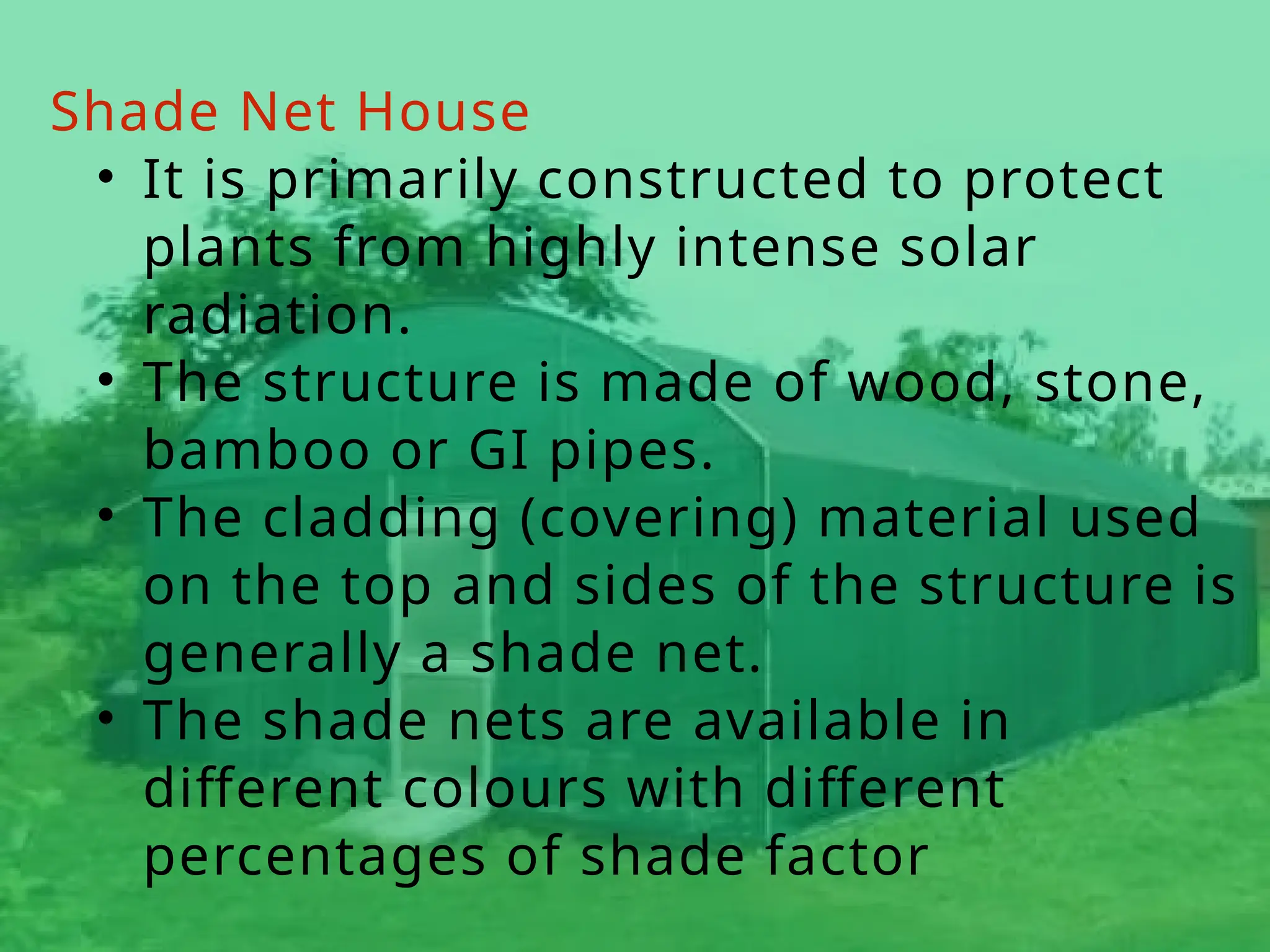
Shade Net House
• It is primarily constructed to protect
plants from highly intense solar
radiation.
• The structure is made of wood, stone,
bamboo or GI pipes.
• The cladding (covering) material used
on the top and sides of the structure is
generally a shade net.
• The shade nets are available in
different colours with different
percentages of shade factor
A greenhouse is a building, room, or area
with a glass roof and walls that's used to
grow plants, especially tender plants or
plants out of season.
Greenhouses are usually climate-controlled
and enclosed by glass or multiple layers of
plastic. During the day, sunlight warms the
plants and air inside the greenhouse. The
glass traps the heat from radiating back to
space, keeping the greenhouse warm even
in winter.
GREEN
HOUSE
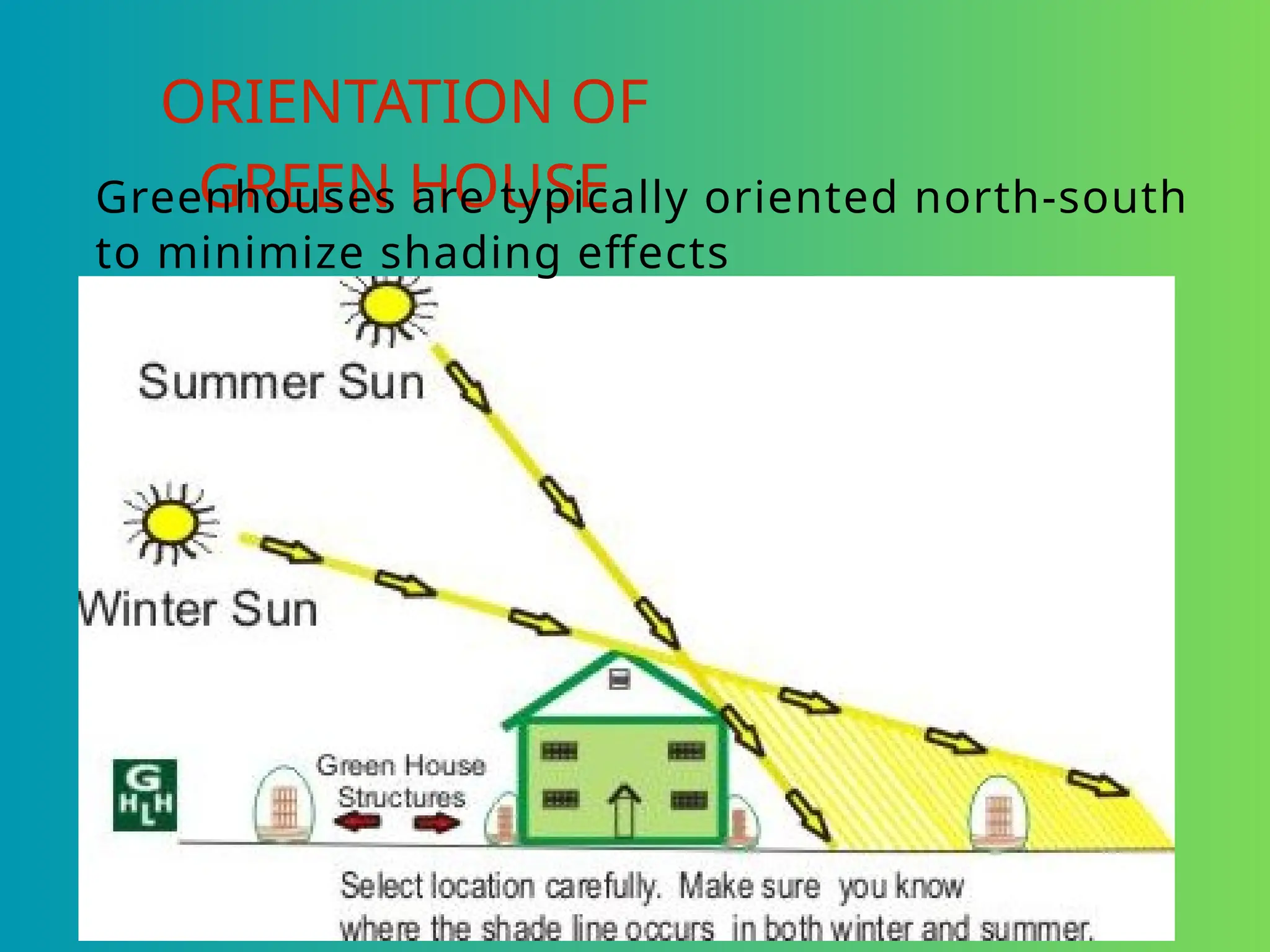
ORIENTATION OF
GREEN HOUSE
Greenhouses are typically oriented north-south
to minimize shading effects
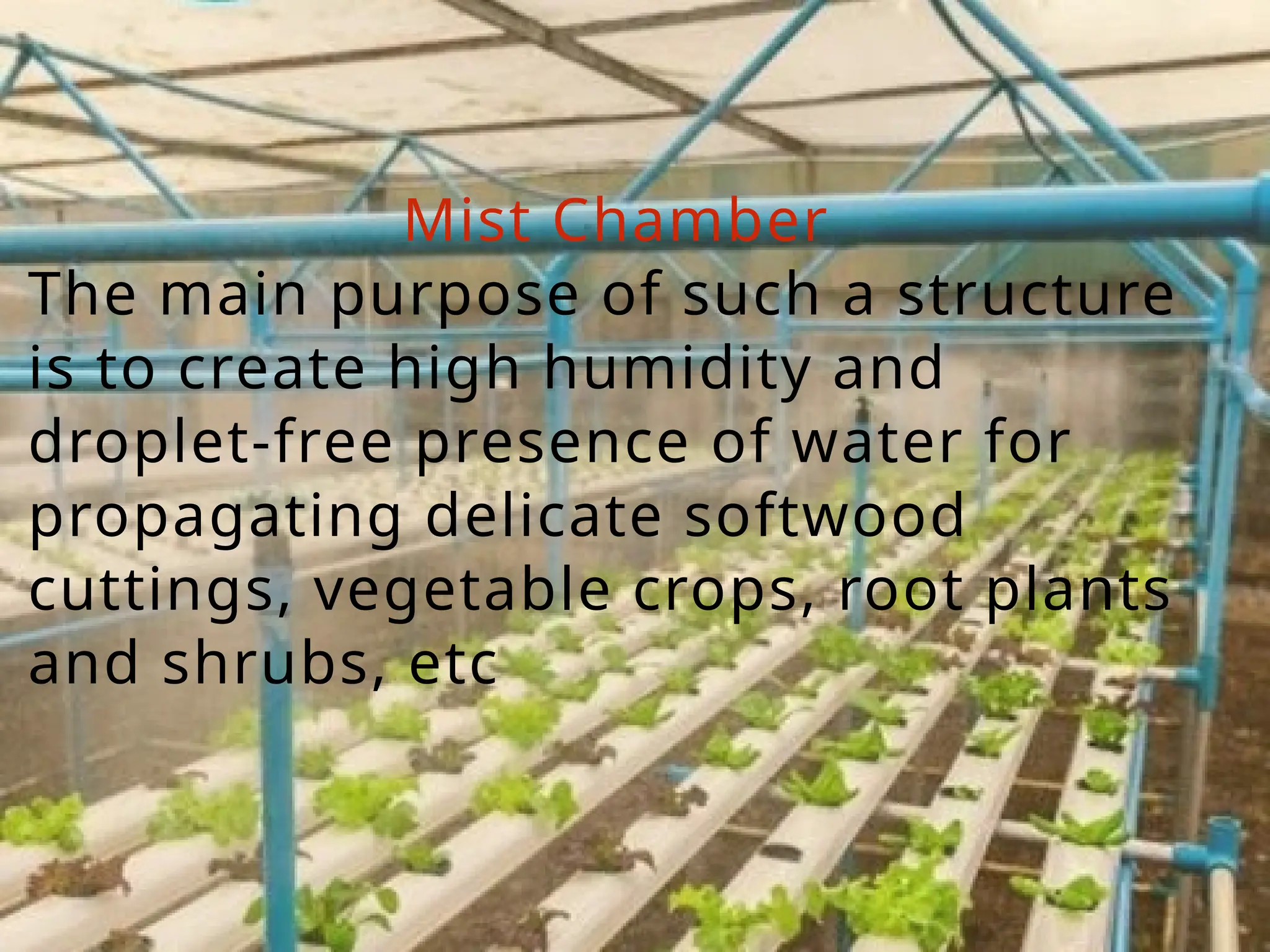
Mist Chamber
The main purpose of such a structure
is to create high humidity and
droplet-free presence of water for
propagating delicate softwood
cuttings, vegetable crops, root plants
and shrubs, etc
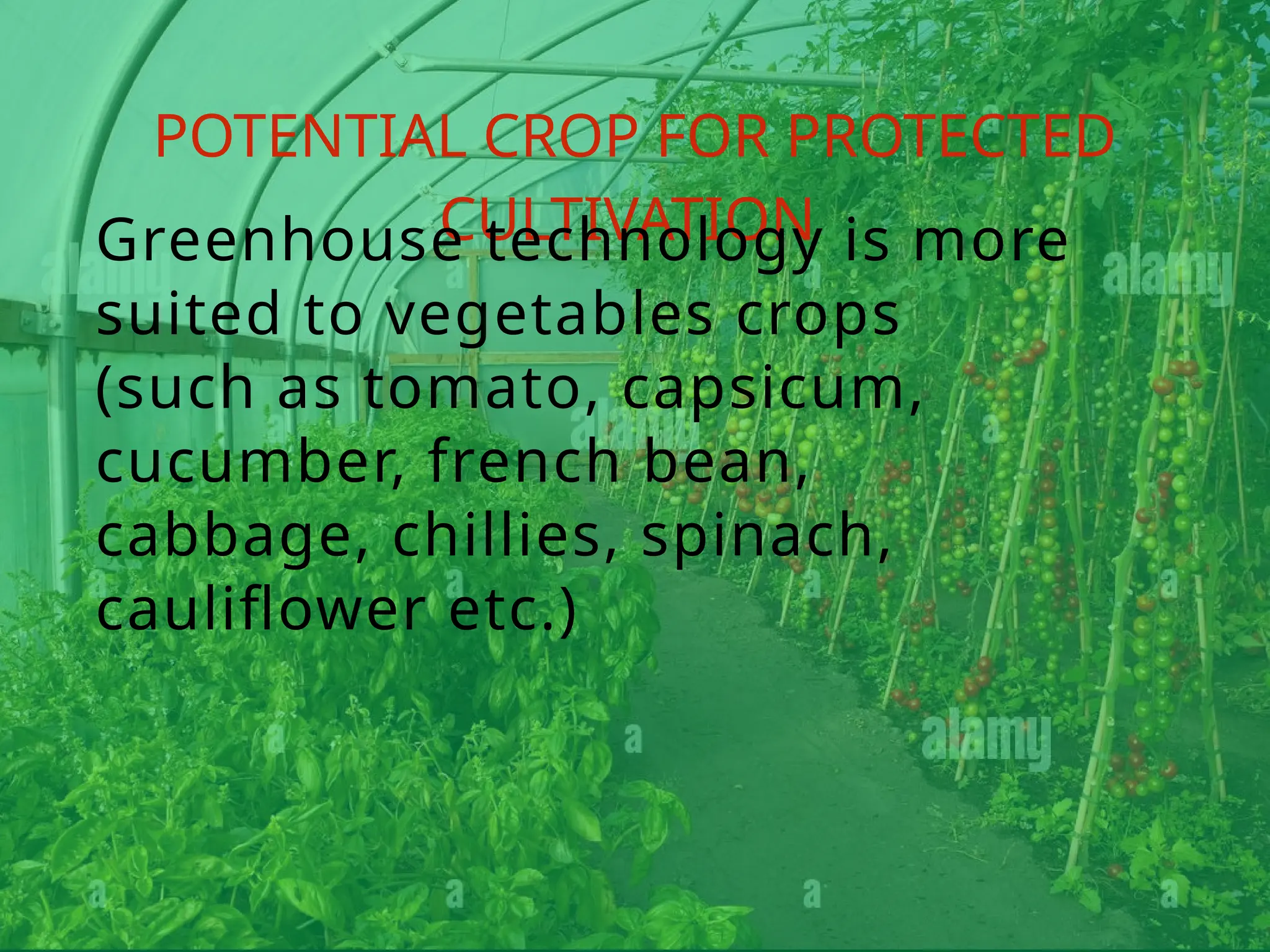
POTENTIAL CROP FOR PROTECTED
CULTIVATION
Greenhouse technology is more
suited to vegetables crops
(such as tomato, capsicum,
cucumber, french bean,
cabbage, chillies, spinach,
cauliflower etc.)
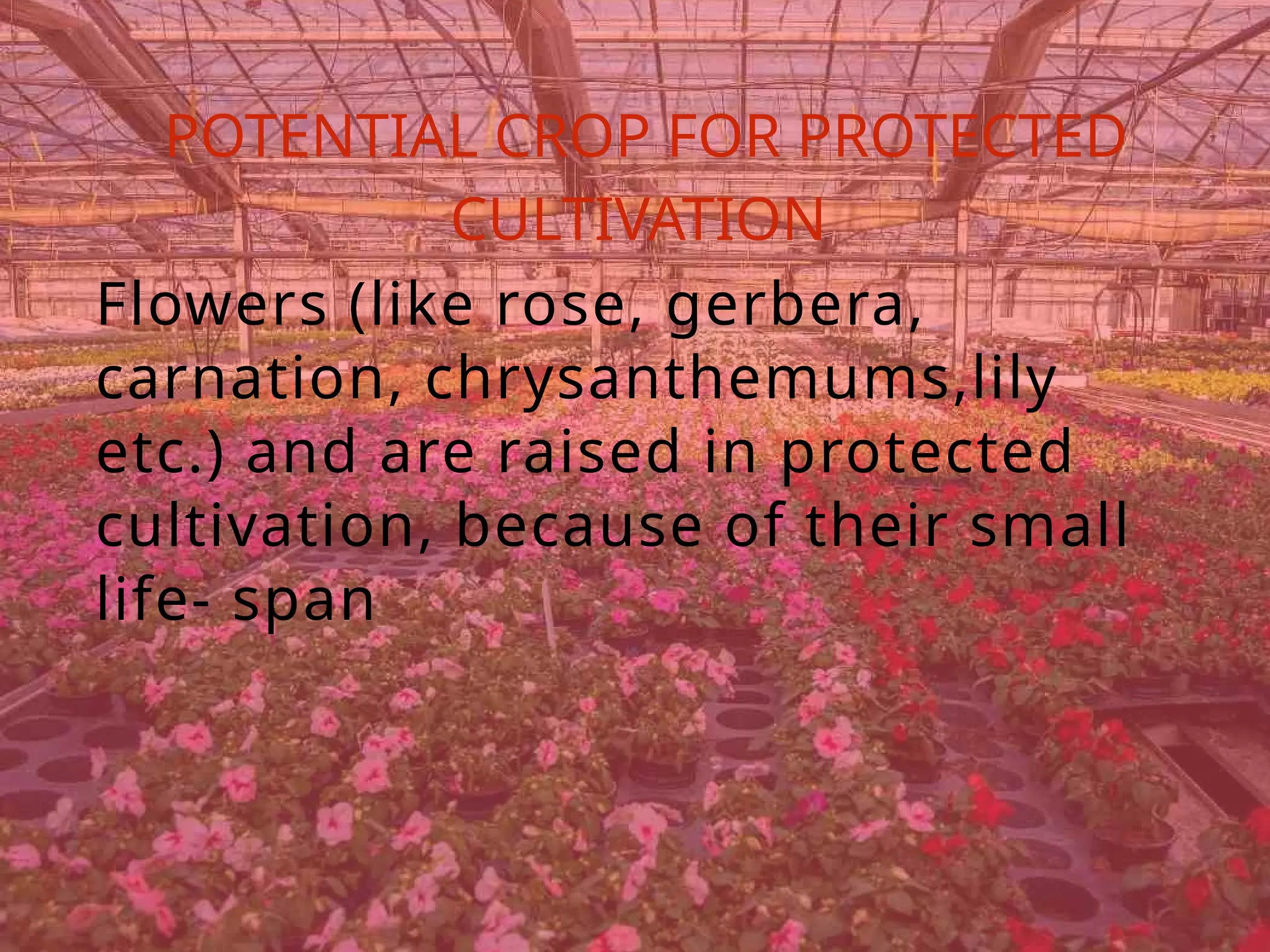
POTENTIAL CROP FOR PROTECTED
CULTIVATION
Flowers (like rose, gerbera,
carnation, chrysanthemums,lily
etc.) and are raised in protected
cultivation, because of their small
life- span
NEED FOR PROTECTED
CULTIVATION
• Higher yield
• Year-round cultivation
• Better quality
• Off-season production
• Assured production
• Generate self-employment for
educated rural youth in the farm
sector
• Least pesticide residues
• Controlled pollination
• Easier plant protection
• Weed free cultivation
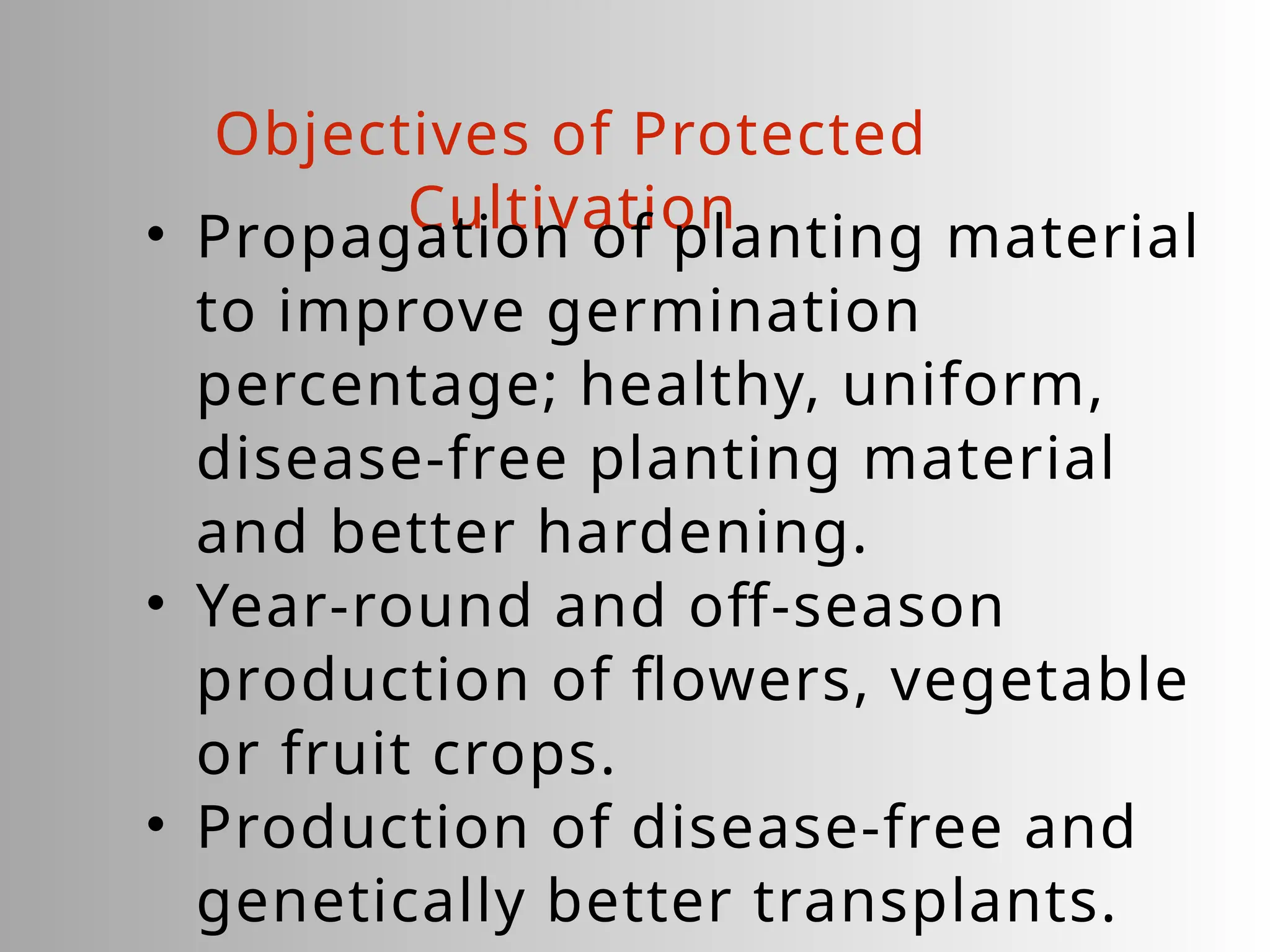
Objectives of Protected
Cultivation
• Protection of plants from abiotic
stress such as temperature,
excess/deficit water, hot and
cold
waves, and biotic factors such as
pest and disease incidences, etc
• Efficient water use with
minimum weed infestation.
• Enhancing productivity per unit
area.
Objectives of Protected
Cultivation
• Propagation of planting material
to improve germination
percentage; healthy, uniform,
disease-free planting material
and better hardening.
• Year-round and off-season
production of flowers, vegetable
or fruit crops.
• Production of disease-free and
genetically better transplants.
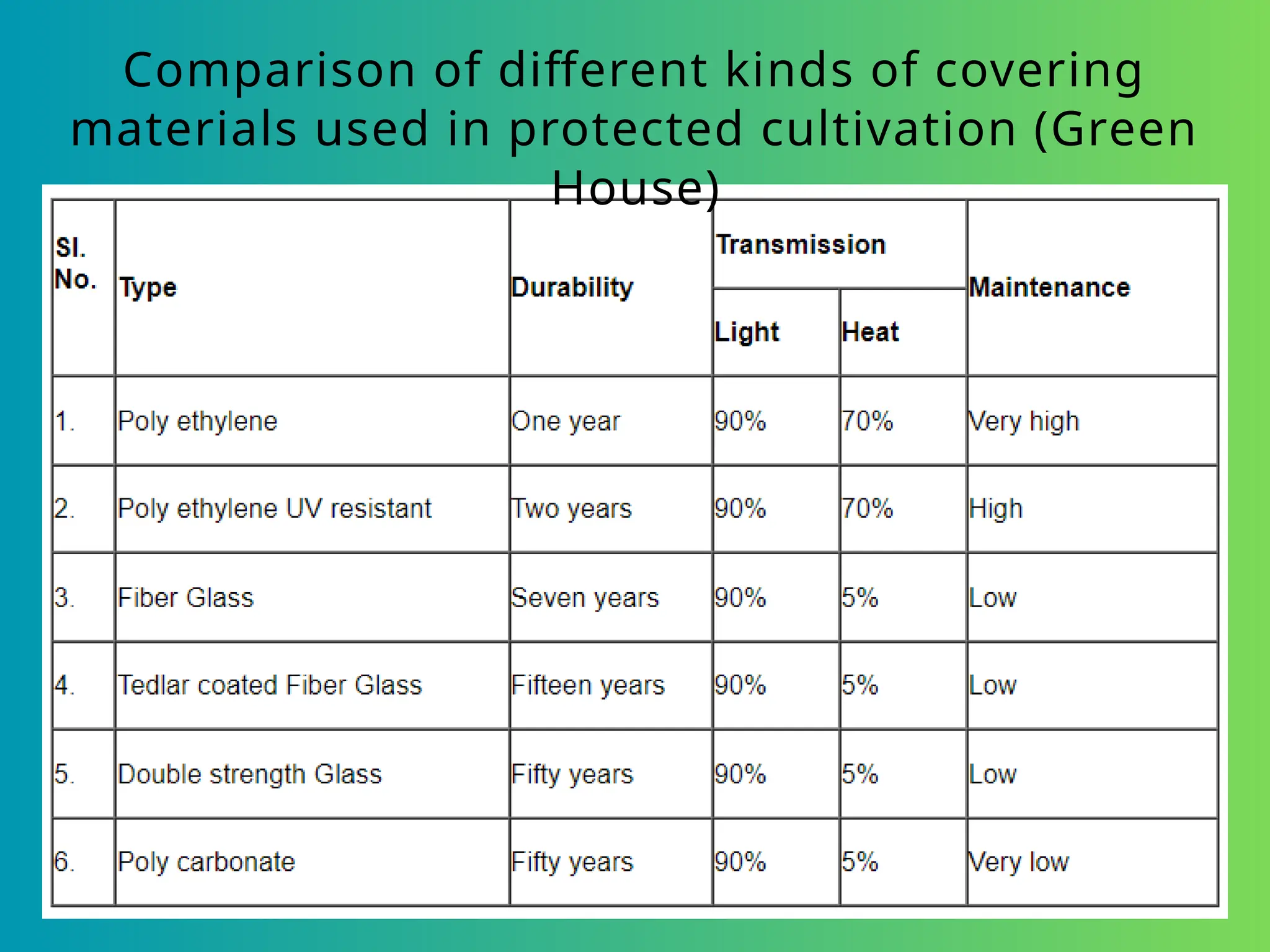
Comparison of different kinds of covering
materials used in protected cultivation (Green
House)
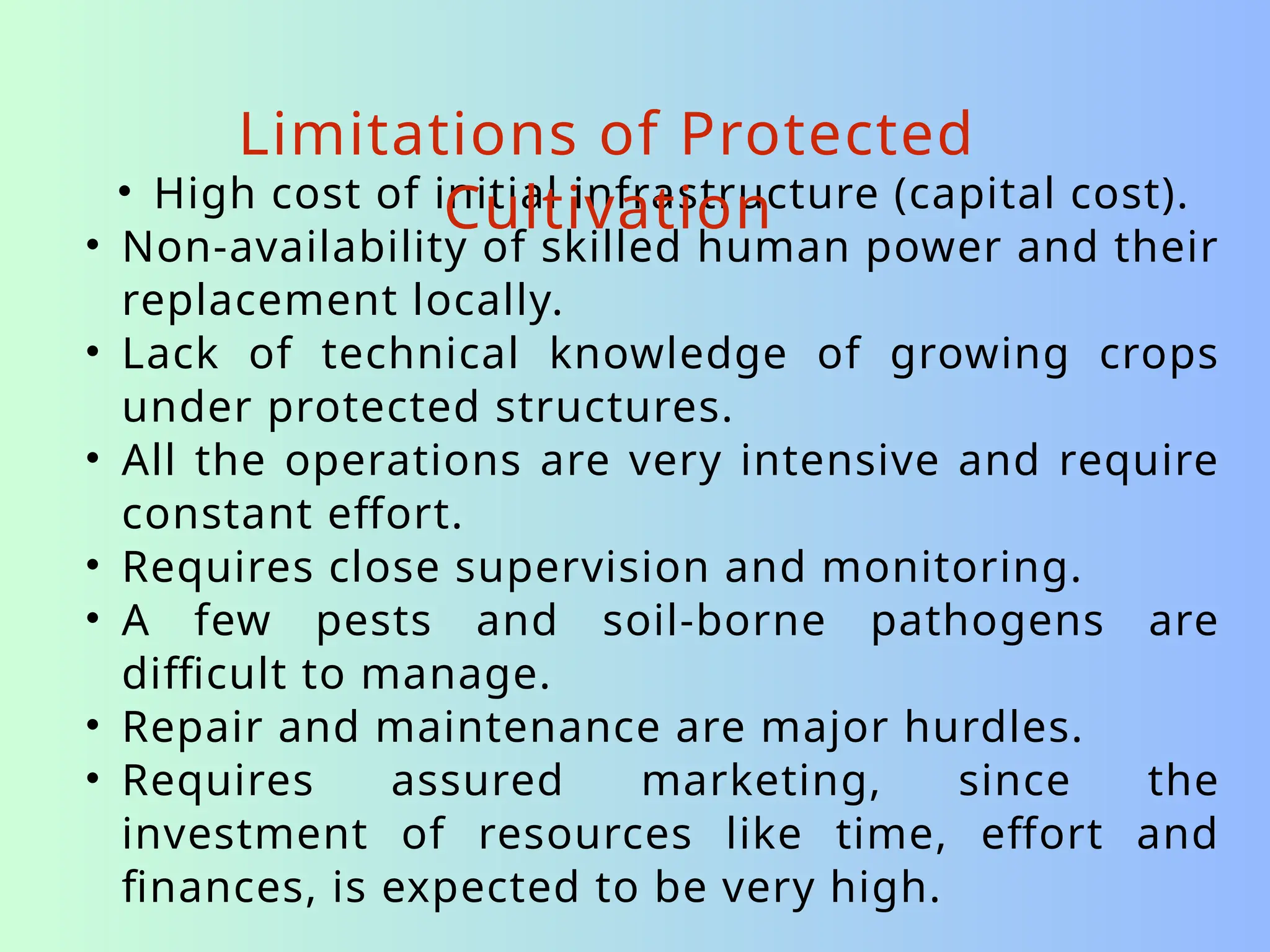
• High cost of initial infrastructure (capital cost).
• Non-availability of skilled human power and their
replacement locally.
• Lack of technical knowledge of growing crops
under protected structures.
• All the operations are very intensive and require
constant effort.
• Requires close supervision and monitoring.
• A few pests and soil-borne pathogens are
difficult to manage.
• Repair and maintenance are major hurdles.
• Requires assured marketing, since the
investment of resources like time, effort and
finances, is expected to be very high.
Limitations of Protected
Cultivation
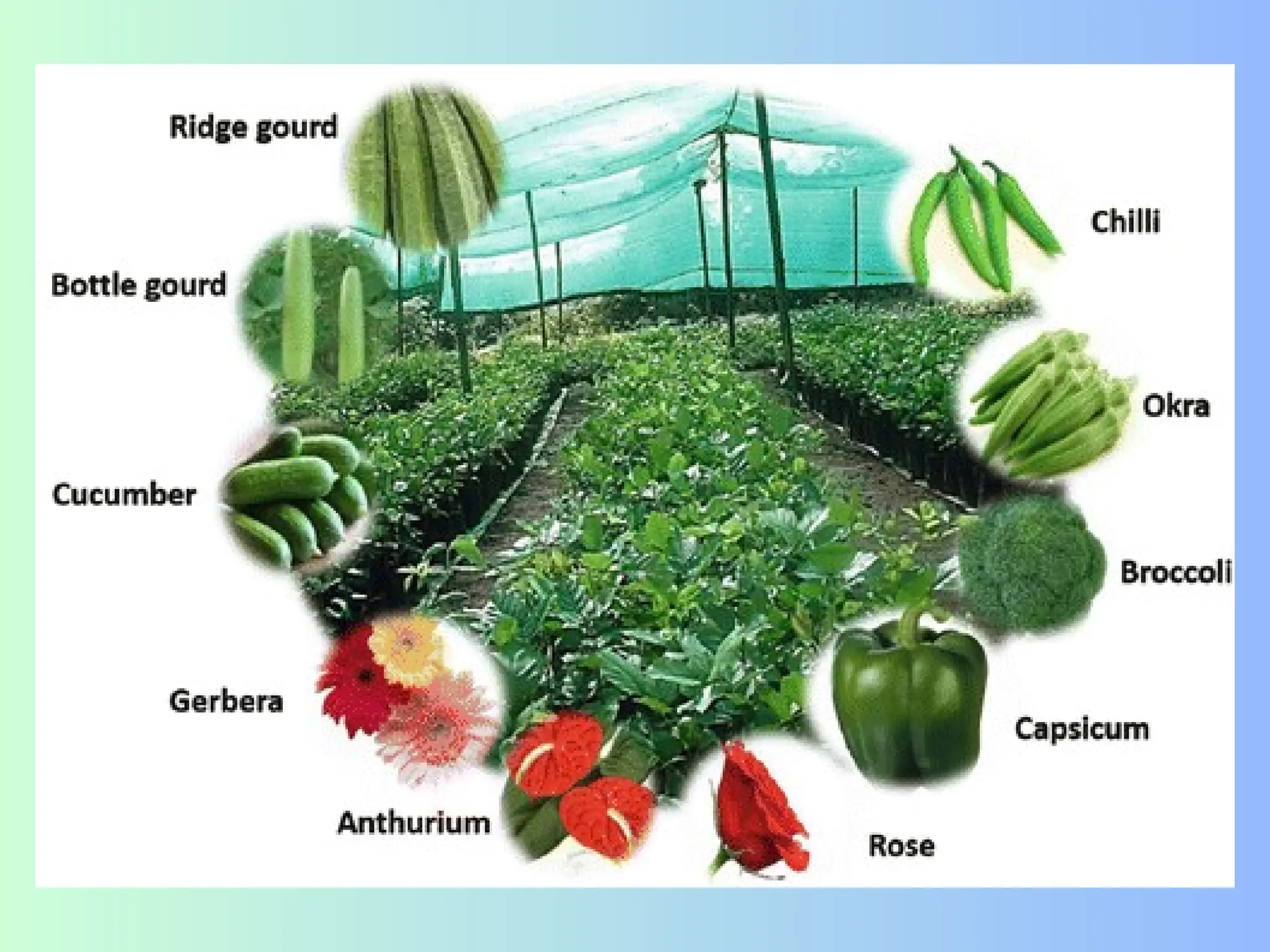
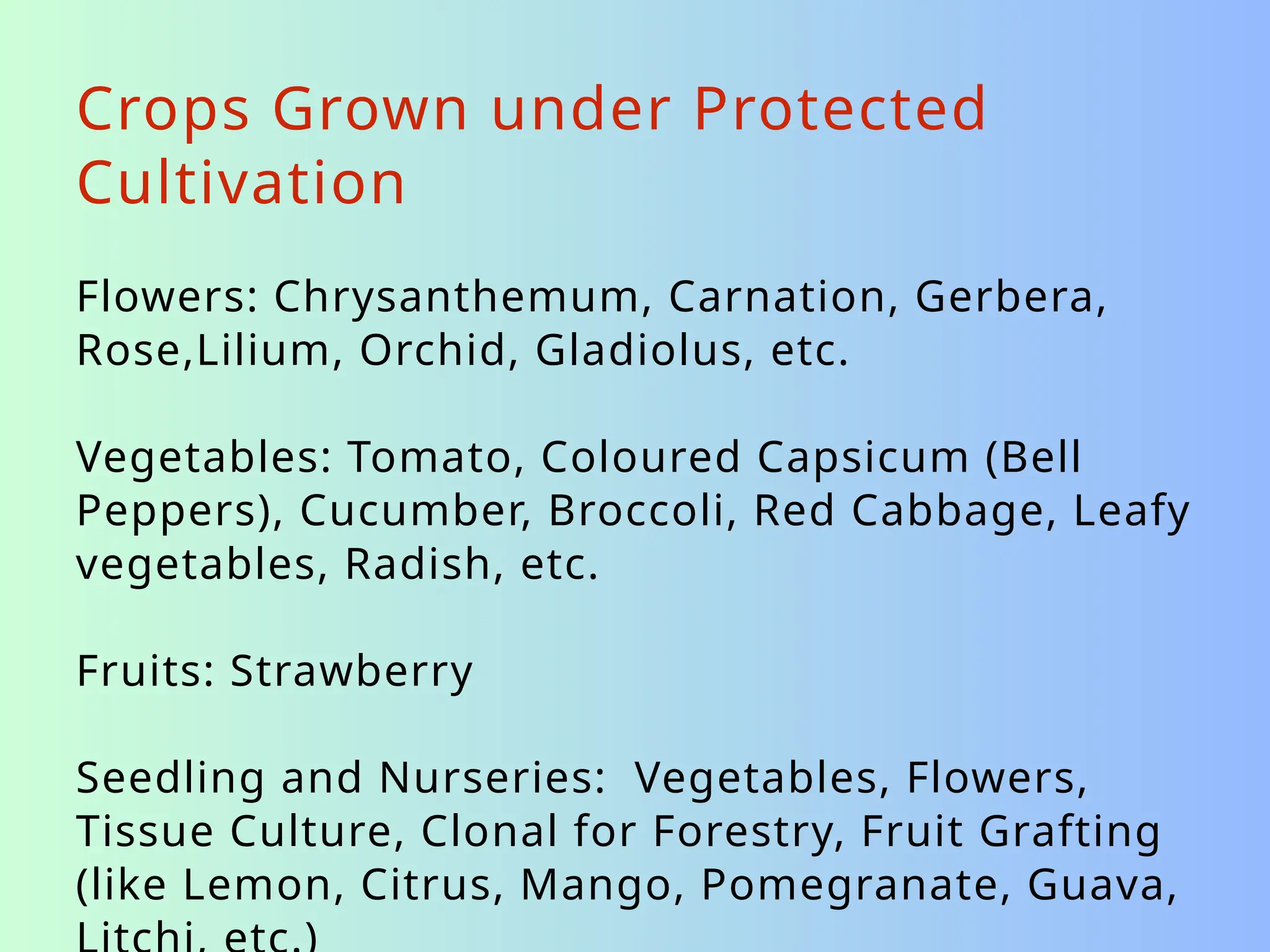
Crops Grown under Protected
Cultivation
Flowers: Chrysanthemum, Carnation, Gerbera,
Rose,Lilium, Orchid, Gladiolus, etc.
Vegetables: Tomato, Coloured Capsicum (Bell
Peppers), Cucumber, Broccoli, Red Cabbage, Leafy
vegetables, Radish, etc.
Fruits: Strawberry
Seedling and Nurseries: Vegetables, Flowers,
Tissue Culture, Clonal for Forestry, Fruit Grafting
(like Lemon, Citrus, Mango, Pomegranate, Guava,
Site Selection for Protected
Cultivation
The criteria for site selection in case of
protected cultivation structures like shade net
houses and greenhouses are as follows:
• Exposure to ample sunlight:
• Appropriate distance from a low-lying area
• Levelled ground surface
• Availability of sufficient land for future
expansion
• Easy availability of labourers in surrounding
area
• Good communication facilities
• Plantation of windbreaks
Continue....
• pH and electrical conductivity of soil: It
should have a pH of 6.0–6.5 and electrical
conductivity should be less than 0.5 dS/m.
• Availability of continuous source of good
quality water in sufficient volume
• Continuous supply of electricity
• Good transportation facilities
Protected Cultivation in Hi-Tech Horticulture

Protected Cultivation in Hi-Tech Horticulture

  • 1.
    PROTECTED CULTIVATION Submitted To: MANJU VERMA Asst. professor Horticulture Submitted By : Kartik Phulwariya Khushbu Dotaniya B.Sc Ag(Hons.)Part IInd sem IInd 2023 - 2024 TOPIC COLLEGE OF AGRICULTURE NAGAUR AU JODHPUR
  • 2.
    With globalization ofmarkets, shrinking land and climate change, the protected cultivation of high value crops has emerged as the single most important technology for ensuring: • High productivity • Improved quality and INTRODUCTION
  • 3.
    PROTECTED CULTIVATION Protected cultivation isa process of growing crops in a controlled environment. This means that the temperature, humidity, light and other factors can be regulated as per the requirement of the crop
  • 4.
    This method typicallyinvolves the use of structures such as greenhouses, polytunnels, glass houses, polyhouses, or row covers to protect plants from adverse weather conditions and pests. Protected cultivation ensures • Soil moisture conservation PROTECTED CULTIVATION
  • 5.
    Types of ProtectedStructures The commonly used protected structures are as follows Low Tunnel: Also called ‘miniature greenhouses’ • low tunnels generally cover rows of plants in the field and, therefore, they are also known as row covers. • Clean plastic films or nets are stretched over low wire hoops (arcs up to 1.0 m high) to protect plants against frost, wind, insects and pests. • The hoops are made of steel wires or bamboo strips or cane. • These hoops are covered by polythene sheets of
  • 6.
    Walk-in tunnel • Itis a temporary structure made by using GI pipes or bamboo and is covered with different cladding materials depending upon the season in which the cultivation is proposed. • Walk-in tunnels are used for off- season cultivation of vegetables and flower seedlings.
  • 7.
    Net Houses • Dependingupon the cladding (covering) material used, the net houses may be classified as insect- proof net houses and shade net houses.
  • 8.
    Shade Net House •It is primarily constructed to protect plants from highly intense solar radiation. • The structure is made of wood, stone, bamboo or GI pipes. • The cladding (covering) material used on the top and sides of the structure is generally a shade net. • The shade nets are available in different colours with different percentages of shade factor
  • 9.
    A greenhouse isa building, room, or area with a glass roof and walls that's used to grow plants, especially tender plants or plants out of season. Greenhouses are usually climate-controlled and enclosed by glass or multiple layers of plastic. During the day, sunlight warms the plants and air inside the greenhouse. The glass traps the heat from radiating back to space, keeping the greenhouse warm even in winter. GREEN HOUSE
  • 10.
    ORIENTATION OF GREEN HOUSE Greenhousesare typically oriented north-south to minimize shading effects
  • 11.
    Mist Chamber The mainpurpose of such a structure is to create high humidity and droplet-free presence of water for propagating delicate softwood cuttings, vegetable crops, root plants and shrubs, etc
  • 12.
    POTENTIAL CROP FORPROTECTED CULTIVATION Greenhouse technology is more suited to vegetables crops (such as tomato, capsicum, cucumber, french bean, cabbage, chillies, spinach, cauliflower etc.)
  • 14.
    POTENTIAL CROP FORPROTECTED CULTIVATION Flowers (like rose, gerbera, carnation, chrysanthemums,lily etc.) and are raised in protected cultivation, because of their small life- span
  • 15.
    NEED FOR PROTECTED CULTIVATION •Higher yield • Year-round cultivation • Better quality • Off-season production • Assured production • Generate self-employment for educated rural youth in the farm sector • Least pesticide residues • Controlled pollination • Easier plant protection • Weed free cultivation
  • 16.
    Objectives of Protected Cultivation •Protection of plants from abiotic stress such as temperature, excess/deficit water, hot and cold waves, and biotic factors such as pest and disease incidences, etc • Efficient water use with minimum weed infestation. • Enhancing productivity per unit area.
  • 17.
    Objectives of Protected Cultivation •Propagation of planting material to improve germination percentage; healthy, uniform, disease-free planting material and better hardening. • Year-round and off-season production of flowers, vegetable or fruit crops. • Production of disease-free and genetically better transplants.
  • 18.
    Comparison of differentkinds of covering materials used in protected cultivation (Green House)
  • 19.
    • High costof initial infrastructure (capital cost). • Non-availability of skilled human power and their replacement locally. • Lack of technical knowledge of growing crops under protected structures. • All the operations are very intensive and require constant effort. • Requires close supervision and monitoring. • A few pests and soil-borne pathogens are difficult to manage. • Repair and maintenance are major hurdles. • Requires assured marketing, since the investment of resources like time, effort and finances, is expected to be very high. Limitations of Protected Cultivation
  • 20.
    Crops Grown underProtected Cultivation Flowers: Chrysanthemum, Carnation, Gerbera, Rose,Lilium, Orchid, Gladiolus, etc. Vegetables: Tomato, Coloured Capsicum (Bell Peppers), Cucumber, Broccoli, Red Cabbage, Leafy vegetables, Radish, etc. Fruits: Strawberry Seedling and Nurseries: Vegetables, Flowers, Tissue Culture, Clonal for Forestry, Fruit Grafting (like Lemon, Citrus, Mango, Pomegranate, Guava,
  • 21.
    Site Selection forProtected Cultivation The criteria for site selection in case of protected cultivation structures like shade net houses and greenhouses are as follows: • Exposure to ample sunlight: • Appropriate distance from a low-lying area • Levelled ground surface • Availability of sufficient land for future expansion • Easy availability of labourers in surrounding area • Good communication facilities • Plantation of windbreaks
  • 22.
    Continue.... • pH andelectrical conductivity of soil: It should have a pH of 6.0–6.5 and electrical conductivity should be less than 0.5 dS/m. • Availability of continuous source of good quality water in sufficient volume • Continuous supply of electricity • Good transportation facilities