APPLICATION AND
REMOVAL OF PROSTHESIS
ORTHOTICS & PROSTHETICS
• Orthotics and Prosthetics is an allied health
profession that provides evaluation, fabrication
and custom fitting of artificial limbs and
orthopedic braces.
• Prosthetics is a unit of rehabilitation medicine
dealing with the replacement of whole or a part
of a missing extrimity with an artificial device.the
device so manufactured is called a prosthesis.
• Orthosis and prosthesis are designed to facilitate
mobilization and to maximize the patient’s quality
of life.
PROSTHESIS
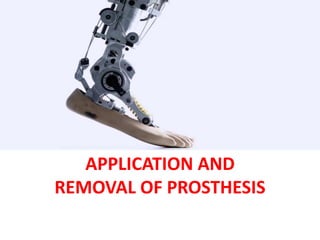
A prosthesis is a device designed to replace a
missing part of the body or to make a part of the
body work better.
Diseased or missing eyes, arms, hands, legs, or
joints are commonly replaced by prosthetic
devices.
A prosthesis is a mechanical device and as such
requires regular maintenance and care. If there
is any unusual sign (visible, audible or
functional) it should be inspected by a
prosthetist as soon as possible.
PROSTHESIS
Types of prosthesis
1. Postoperative pros.
2. Initial pros.
3. Preparatory pros.
4. Definitive pros.
5. Special use pros.
OBJECTIVE
• Recovery
• Amplify adaptability to new environments
• Orient condition knowledge and coping skills
• Enhance functional potential
• Gather skills to ensure safe return to home
environments
• Improve awareness
• Invigorate & revitalize self-belief to regain
independence
• Re-establish poise in family and social roles
The patient/family will:
• Mourn limb loss appropriately.
• Learn proper use and care of the residual limb
and prosthesis.
• Achieve maximum independence through
prosthetic use, adaptive equipment, or
retraining of skills.
• Establish a positive self-image
SKIN CARE
The prosthetist, nurse and the physician collaborate
to provide instructions related to skin care and care
of prosthesis.
 Wash your limb with mild soap and water every day and pat
dry with a soft towel. Be patient and allow it to dry
completely. If this is not don’t, your will be at risk. for
fungal growth that could lead to infection or abrasion.
 Check your limb for red pressure patches that last more than
a few minutes after your remove your prosthesis; these may
be a sign that the socket needs checking. If left untended
there red patches may results in skin breakdown. Check for
skin breakdown twice a day, if you cannot see the end of
your residual limb use a mirror, this is particularly
important for people with diabetes.
PROSTHETIC CARE
 Wash anything that makes skin contact (liners, socks, inside of
socket, etc.) everyday with mild soap and water and allow
plenty of time to dry. Follow manufacturer’s instructions for
care of liners. Unless specifically instructed, do not use any
alcohol or unknown chemicals. If your socket is too big or too
small, visit your prosthesis immediately.
 Make sure your shoe height is correct for your prosthesis or
your alignment will be wrong, putting a strain on your residual
limb and surrounding joints. Remember the fit of your
prosthesis changes during the day so add socks when needed.
If you are having trouble with the prosthesis or liner, do not
make your own adjustments or alter the prosthesis. Call your
prosthetist immediately.
EDUCATION
 Check your stump daily: Look for redness, blisters, or swelling. If
you see any of these changes, stop using your prosthesis and contact
your caregiver right away. Stop using the prosthesis and tell your
caregiver if it causes pain.
 Clean inside the socket daily: You may use a damp soapy cloth to
remove sweat and dirt, then a clean damp cloth to remove the soap.
Dry the socket well with a dry cloth.
 Wear your prosthesis as directed: You may need to wear your
prosthesis all the time during the first few months after you get it.
 See your caregiver regularly: Go to follow-up visits with your
caregiver so he can check your progress. Your prosthesis may need
to be adjusted several times before it fits well. Tell your caregiver if
you have problems with how it fits. Never try to fix or adjust your
prosthesis on your own.
 Keep your prosthesis socket clean
 Annual visits to the prosthetists are recommended for
necessary adjustments.
 Consult a prosthetist if there are any problems with the
prosthesis.do not to make adjustment yourself.
 Many older adults have one or more chronic health
problems,this factor should be considered when choosing a
prosthetic devise.
 A patient with diabetes is prone to circulation problems
and poor wound healing and may need a prosthesis with
extra padding.
 many of have decreased appetites, their nutritional status
may poor. Emphasizing high calorie and high protein intake
is essential to promote healing and to maintain strength.
• Prosthesis can be cosmetic,functional and body
powered.
• In general the more distal the amputation,the
more functional the individual is with the use of a
prosthesis.
• This is because more normal the limb proximally
controls the prosthesis better.
• Device is applied too tightly or too loosely or if it
is adjusted improperly,that may leads to skin
brakdown,or skin problems and pressure ulcers
Prosthesis

Prosthesis

  • 1.
  • 2.
    ORTHOTICS & PROSTHETICS •Orthotics and Prosthetics is an allied health profession that provides evaluation, fabrication and custom fitting of artificial limbs and orthopedic braces. • Prosthetics is a unit of rehabilitation medicine dealing with the replacement of whole or a part of a missing extrimity with an artificial device.the device so manufactured is called a prosthesis. • Orthosis and prosthesis are designed to facilitate mobilization and to maximize the patient’s quality of life.
  • 3.
    PROSTHESIS A prosthesis isa device designed to replace a missing part of the body or to make a part of the body work better. Diseased or missing eyes, arms, hands, legs, or joints are commonly replaced by prosthetic devices. A prosthesis is a mechanical device and as such requires regular maintenance and care. If there is any unusual sign (visible, audible or functional) it should be inspected by a prosthetist as soon as possible.
  • 4.
    PROSTHESIS Types of prosthesis 1.Postoperative pros. 2. Initial pros. 3. Preparatory pros. 4. Definitive pros. 5. Special use pros.
  • 5.
    OBJECTIVE • Recovery • Amplifyadaptability to new environments • Orient condition knowledge and coping skills • Enhance functional potential • Gather skills to ensure safe return to home environments • Improve awareness • Invigorate & revitalize self-belief to regain independence • Re-establish poise in family and social roles
  • 6.
    The patient/family will: •Mourn limb loss appropriately. • Learn proper use and care of the residual limb and prosthesis. • Achieve maximum independence through prosthetic use, adaptive equipment, or retraining of skills. • Establish a positive self-image
  • 8.
    SKIN CARE The prosthetist,nurse and the physician collaborate to provide instructions related to skin care and care of prosthesis.  Wash your limb with mild soap and water every day and pat dry with a soft towel. Be patient and allow it to dry completely. If this is not don’t, your will be at risk. for fungal growth that could lead to infection or abrasion.  Check your limb for red pressure patches that last more than a few minutes after your remove your prosthesis; these may be a sign that the socket needs checking. If left untended there red patches may results in skin breakdown. Check for skin breakdown twice a day, if you cannot see the end of your residual limb use a mirror, this is particularly important for people with diabetes.
  • 9.
    PROSTHETIC CARE  Washanything that makes skin contact (liners, socks, inside of socket, etc.) everyday with mild soap and water and allow plenty of time to dry. Follow manufacturer’s instructions for care of liners. Unless specifically instructed, do not use any alcohol or unknown chemicals. If your socket is too big or too small, visit your prosthesis immediately.  Make sure your shoe height is correct for your prosthesis or your alignment will be wrong, putting a strain on your residual limb and surrounding joints. Remember the fit of your prosthesis changes during the day so add socks when needed. If you are having trouble with the prosthesis or liner, do not make your own adjustments or alter the prosthesis. Call your prosthetist immediately.
  • 10.
    EDUCATION  Check yourstump daily: Look for redness, blisters, or swelling. If you see any of these changes, stop using your prosthesis and contact your caregiver right away. Stop using the prosthesis and tell your caregiver if it causes pain.  Clean inside the socket daily: You may use a damp soapy cloth to remove sweat and dirt, then a clean damp cloth to remove the soap. Dry the socket well with a dry cloth.  Wear your prosthesis as directed: You may need to wear your prosthesis all the time during the first few months after you get it.  See your caregiver regularly: Go to follow-up visits with your caregiver so he can check your progress. Your prosthesis may need to be adjusted several times before it fits well. Tell your caregiver if you have problems with how it fits. Never try to fix or adjust your prosthesis on your own.
  • 11.
     Keep yourprosthesis socket clean  Annual visits to the prosthetists are recommended for necessary adjustments.  Consult a prosthetist if there are any problems with the prosthesis.do not to make adjustment yourself.  Many older adults have one or more chronic health problems,this factor should be considered when choosing a prosthetic devise.  A patient with diabetes is prone to circulation problems and poor wound healing and may need a prosthesis with extra padding.  many of have decreased appetites, their nutritional status may poor. Emphasizing high calorie and high protein intake is essential to promote healing and to maintain strength.
  • 12.
    • Prosthesis canbe cosmetic,functional and body powered. • In general the more distal the amputation,the more functional the individual is with the use of a prosthesis. • This is because more normal the limb proximally controls the prosthesis better. • Device is applied too tightly or too loosely or if it is adjusted improperly,that may leads to skin brakdown,or skin problems and pressure ulcers