Prostatitis ,Chronic pelvic pain
syndrome and interstitial cystitis
1
PROSTATITIS
• The first description of prostatitis dates to 1838 by
Verdies.
• Treatment by prostate massage was described by
Posner of Berlin in 1893
• Krieger and Weidner (2003) contend that the
contemporary history of prostatitis began with a
letter to the editor published in the Journal of
Urology in 1978 by George Drach et al. (1978). This
is described as the first scientific recommendations
for a systematic classification of patients with
symptoms of prostatitis
3
Dept of Urology, GRH
and KMC, Chennai.
Meares and Stamey (1968)
• The diagnosis was based on the microscopic
examination and quantitative cultures of segmented
urogenital tract specimens described by Meares
and Stamey (1968) and four categories presented:
(1) acute bacterial prostatitis with acute infection,
(2) chronic bacterial prostatitis with recurrent
episodes of bacteriuria by the same organism,
• (3) chronic bacterial prostatitis in which patients
had symptoms of prostatitis, negative cultures, and
inflammatory cells, and
• (4) prostatodynia, with symptoms of prostatitis
including “prostatic discomfort” but no recognizable
infection or inflammation.
4
Dept of Urology, GRH
and KMC, Chennai.
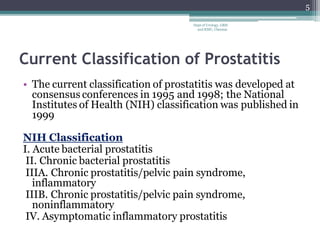
Current Classification of Prostatitis
• The current classification of prostatitis was developed at
consensus conferences in 1995 and 1998; the National
Institutes of Health (NIH) classification was published in
1999
NIH Classification
I. Acute bacterial prostatitis
II. Chronic bacterial prostatitis
IIIA. Chronic prostatitis/pelvic pain syndrome,
inflammatory
IIIB. Chronic prostatitis/pelvic pain syndrome,
noninflammatory
IV. Asymptomatic inflammatory prostatitis
5
Dept of Urology, GRH
and KMC, Chennai.
• The NIH definition of category III CP/CPPS as
adopted by the Chronic Prostatitis Research
Network is that of symptoms of pain or discomfort
in the pelvis for at least 3 of the previous 6 months .
• Several exclusion criteria are also included, such
as demonstration of uropathogenic bacteria detected
by standard microbiologic methods, urogenital
cancer, prior radiation or che-motherapy, urethral
stricture, or neurologic disease affecting the bladder
(Schaeffer et al., 2002b)
6
Dept of Urology, GRH
and KMC, Chennai.
Histopathology: Histology
• The term prostatitis can refer to the presence of
inflammation on a histology examination of the
prostate or is also used to describe clinical
syndromes manifest by genitourinary
discomfort or pain described in the NIH
classification.
7
Dept of Urology, GRH
and KMC, Chennai.
• A classification system proposed by Nickel et al.
recommended reporting inflammation in prostatitis
by its anatomic location in the prostate, either
• glandular (within a duct/gland epithelium or
lumen),
• periglandular (lies within stroma but centered
around ducts and glands and approaches 50 micro
m or less), or
• stromal (in the stroma and >50 micro m from a
gland)
8
Dept of Urology, GRH
and KMC, Chennai.
Extent of inflammation is defined as
• focal (<10%),
• multifocal (10%–50%), or
• diffuse (> 50%).
Grade
• 1) or mild (individual inflammatory cells separated by
distinct spaces, <100 cells);
• 2) or moderate (confluent sheets of cell with no tissue
destruction or lymphoid follicles, 100–300 cells); and
• 3) or severe (confluent sheets of inflammatory cells with
tissue destruction or nodule formation, 100–500 cells)
9
Dept of Urology, GRH
and KMC, Chennai.
Associated entities
• corpora amylacea, which form from the
deposition of prostatic secretions around
sloughed epithelial cells; they do not usually
cause inflammation unless they cause
obstruction.
• Prostate calculi may contribute to
inflammation by causing local obstruction or by
providing a nidus for bacterial growth
10
Dept of Urology, GRH
and KMC, Chennai.
Specific Cases of Prostatic
Inflammation
Granulomatous Prostatitis
• Granulomatous prostatitis is diagnosed by the
histologic finding of epithelioid granulomas with or
without other infla.
• It is commonly found on specimens from trans-
urethral resections and prostate biopsies .
• The most widely accepted grading system
categorizes granulomatous prostatitis as
▫ specific,
▫ nonspecific,
▫ after transurethral resection of the prostate (TURP),
▫ and allergic granulomatous prostatitis
11
Dept of Urology, GRH
and KMC, Chennai.
• It is commonly seen after intravesical Bacillus
Calmette-Guerin (BCG) therapy for bladder
cancer and can cause transient elevated levels of
prostate-specific antigen (PSA) .
• Tuberculosis can also cause granulomatous
prostatitis .
12
Dept of Urology, GRH
and KMC, Chennai.
Immunoglobulin G Subclass 4 (IgG4)
• Prostatitis has been described from IgG4-related
disease (IgG4-RD).
• fibroinflammatory disease with multiorgan
involvement characterized by several features:
tendency to form tumorlike lesions at multiple sites,
▫ dense infiltrate of lymphocytes and
▫ IgG4 +plasma cells,
▫ characteristic pattern of fibrosis, and
▫ often,but not always, elevated levels of serum IgG4
▫ responded to corticosteroids
13
Dept of Urology, GRH
and KMC, Chennai.
Category I Prostatitis: Acute Bacterial
Prostatitis
• affects men age 20 to 40 years but also has a
second peak in men over the age of 60
• Causes
▫ ascending urethral infection
▫ Direct seeding from a prostate biopsy
▫ intraprostatic reflux of infected urine
▫ Hematogenous dissemination
14
Dept of Urology, GRH
and KMC, Chennai.
Risk factors
▫ unprotected sexual intercourse, specifically insertive
anal intercourse,
▫ phimosis,
▫ condom catheter use,
▫ indwelling urethral catheters,
▫ and urinary tract instrumentation, including
endoscopic procedures and prostate biopsy .
▫ Dysfunctional voiding and disorders causing urinary
stasis, including distal urethral stricture and BPH,
▫ after an episode of bacterial cystitis or epididymo-
orchitis
▫ complications of clean intermittent catheterization
15
Dept of Urology, GRH
and KMC, Chennai.
The presentation
▫ acute symptoms of a urinary tract infection (UTI),
characteristically including urinary frequency and
dysuria
▫ Urinary retention
▫ systemic infection, such as malaise, fever, and
myalgias
▫ Sepsis
▫ Acute prostatitis should be considered in any
man who presents with a febrile UTI. Febrile
UTI in men can be from pyelonephritis, acute
cystitis, or prostatitis.
16
Dept of Urology, GRH
and KMC, Chennai.
Microbiology
• The most common causative organism is
Escherichia coli, implicated in 65% to 80% of cases .
• Other common gram-negative organisms include
Pseudomonas aeruginosa, Proteus mirabilis, and
Klebsiella and Serratia spp.
• Enterococcus spp ,
• Neisseria gonorrhoeae in sexually active young
men .
• Mycobacterium tuberculosis is a rare cause of
prostatitis and is usually associated with
immunodeficiency
17
Dept of Urology, GRH
and KMC, Chennai.
• An important concept that has emerged is the
difference in bacterial cause of prostatitis and
antibiotic susceptibility depending on the cause
wheter it is
• community acquired (E. coli ) or
• was nosocomial (P. aeruginosa, enterococci, or
S. aureus and has greater antimicrobial
resistance and clinical failures ) .
18
Dept of Urology, GRH
and KMC, Chennai.
• Further distinctions are noted, depending on whether the
acute prostatitis is
• Spontaneous (E. coli ) or
• occurs after lower urinary tract instrumentation(predomi-
nantly E. coli but have a much higher prevalence of
Pseudomonas spp. (20%) and have a higher risk of prostate
abscess ) or
• prostate biopsy (E. coli, but these bacteria are more
resistant to fluoroquinolones, more likely to have ESBL-
producing bacteria, and more likely to have positive blood
cultures )
• Thus the antibiotic selection for acute prostatitis
must take into con-sideration the route of infection.
19
Dept of Urology, GRH
and KMC, Chennai.
Evaluation
• History :LUTS such as frequency urgency and
dysuria are common
• Associated signs of bacteremia and sepsis can be
present, including fever, chills, and sweats
• assess for possible complicating factors such as
diabetes, HIV, neurologic disease, and recent
antibiotic use .
20
Dept of Urology, GRH
and KMC, Chennai.
• O/E
• A palpable bladder may indicate urinary retention.
• Acute prostatitis is the one situation in which one
may palpate a truly “boggy” prostate from edema
from inflammation.
• The prostate is tender and swollen in 60% to 90% of
cases.
• Caution should be used to avoid aggressive
palpation that could lead to bacterial dissemination
and sepsis
21
Dept of Urology, GRH
and KMC, Chennai.
• Laboratory tests
• CBC,
• urinalysis, and
• midstream urine culture. Urine culture is
positive in 60% to 85% of cases .
• If the patient has a urethral discharge, urine can
be sent for nuclear amplification tests for
gonorrhea or chlamydia,
• Renal function tests.
22
Dept of Urology, GRH
and KMC, Chennai.
• postvoid residual urine should be made to rule
out urinary retention, preferably noninvasively
with an ultrasound
• Imaging studies are generally not indicated
unless a prostate abscess is suspected (
transrectal ultrasound or CT scan )
• no role for prostate biopsy for acute prostatitis.
23
Dept of Urology, GRH
and KMC, Chennai.
Treatment.
• Patients with systemic signs of infection need
admission for IV antibiotics, hydration, and
monitoring of laboratory studies .
• treated as an outpatient if they have no signs of
systemic illness, can tolerate oral intake, and do
not have urinary retention .
• Antibiotics are the mainstay of therapy
24
Dept of Urology, GRH
and KMC, Chennai.
• Recent EAU guidelines on treating UTIs recommend
the parenteral administration of high-dose
bactericidal antibiotics such as a broad-spectrum
penicillin, third-generation cephalosporin, or a
fluoroquinolone.
• In initial therapy, any of these can be combined
with an aminoglycoside .
• Given the rates of resistance to quinolones and the
incidence of ESBL bacteria seen in these cases, a
strong argument can be made to use a carbapenem
antibiotic in men presenting with fever and
prostatitis after a transrectal prostate biopsy
25
Dept of Urology, GRH
and KMC, Chennai.
• Update of the American Urological Association
White Paper on the prevention and treatment of
complications after prostate biopsy, which states
patients who have a fever after prostate biopsy
should:
▫ Not be offered fluoroquinolones or (TMP-SMX).
▫ Be managed with aggressive rescuscitation and broad
spectrum antibiotic coverage carbepenems ,amikacin
or 2nd and 3 rd generation cephalosporins (after urine
and blood culture reports)
▫ Once pt fit to be discharged, an oral fluoroquinolone
can be offered,
26
Dept of Urology, GRH
and KMC, Chennai.
• recommended to reculture the urine after 1 week to
make sure the bacteria has been cleared .
• 2 weeks of ciprofloxacin sufficient .
• tuberculous prostatitis is with anti-TB chemotherapy for
at least 6 months .
• Adjuncts to Antibiotic Therapy. nonsteroidal anti-
inflammatory medications , alpha-blockers if they have
LUTS .
• For short-term care, straight catheterization or a brief
period of urethral catheterization may be attempted .
Not every author agrees with this, however , but for long-
term bladder drainage, a suprapubic catheter is
recommended.
27
Dept of Urology, GRH
and KMC, Chennai.
Prostatic Abscess
• suspected in men with high fever or a history of
immunosuppression such as diabetes or HIV or
who do not respond to initial therapy after 48
hours .
28
Dept of Urology, GRH
and KMC, Chennai.
Risk factors include
• history of prior catheter use,
• history of genitourinary surgery,
• increasing age and increased medical co-morbidities,
• indwelling catheter,
• instrumentation of the lower urinary tract,
• bladder outlet obstruction,
• acute and chronic bacterial prostatitis,
• chronic renal failure,
• hemodialysis,
• biopsy of the prostate,
• diabetes,
• cirrhosis, and
• HIV
29
Dept of Urology, GRH
and KMC, Chennai.
• Imaging :transrectal ultrasound or CT scan .
• CT offers the advantage of clarity of location and preoperative
planning, as well as identification of any spread beyond the
prostate .
• less than 1 to 2 cm may be treated conservatively with
antibiotics .
• In men with progression of symptoms, treatment is indicated.
Localized lesions, or those that are very peripheral, can be
treated by percutaneous drainage under ultrasound guidance .
• Lesions that do not respond to initial percutaneous drainage
or lesions too large to adequately drain percutaneously should
be taken for TURP to unroof the abscess .
• Rare cases of abscess that extend beyond the prostate may
require open surgical treatment .
30
Dept of Urology, GRH
and KMC, Chennai.
31
Dept of Urology, GRH
and KMC, Chennai.
Category II: Chronic Bacterial
Prostatitis
• is characterized by recurrent urinary tract
infections with the same organism .
• The symptoms of dysuria and pain generally
respond to antibiotic treatment, and, unlike men
with category III CP/CPPS, they are then
relatively asymptomatic between episodes .
32
Dept of Urology, GRH
and KMC, Chennai.
• Bacteria-Causing Category II Prostatitis ,
E. coli, Pseudomo-nas, Proteus, Klebsiella, and
Enterobacter spp
Role of Chlamydia in Prostatitis? still
controversial .
33
Dept of Urology, GRH
and KMC, Chennai.
Diagnosis and Evaluation.
• made by the pre-massage and post-massage test
(or two-glass test).
• The patient provides a midstream pre-massage
urine specimen and a urine specimen (initial 10
mL) after prostatic massage to obtain expressed
prostatic secretions (EPS) (Nickel et al., 2006).
These specimens are then sent for culture .
Shortcomings:
▫ EPS is not examined which is often the best
specimen
34
Dept of Urology, GRH
and KMC, Chennai.
Two-glass Test
35
Dept of Urology, GRH
and KMC, Chennai.
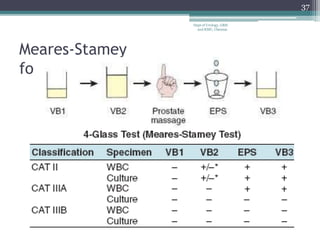
• The previous method was the “four-glass test” as
described by Meares and Stamey which includes
the first voided urine looking for urethral
bacteria (VB1),
• the mid-stream urine (VB2),
• collection of the prostate fluid itself for culture
(EPS)
• post-massage urine for EPS (VB3), and
36
Dept of Urology, GRH
and KMC, Chennai.
Meares-Stamey
four-glass test
37
Dept of Urology, GRH
and KMC, Chennai.
• men with human immunodeficiency virus (HIV),
cultures should be sent not only for the usual
bacteria but also for more atypical organisms.
• no recommended diagnostic cutoff points for
bacterial counts between the two specimens
obtained, but some clinics use a 10-fold increase
in the post-massage urine as being diagnostic of
CP II.
38
Dept of Urology, GRH
and KMC, Chennai.
• should be assessed for hematuria.
• If present in the setting of infection, it should be
rechecked 4 to 6 weeks after resolution of infection
to look for resolution of the hematuria.
• Persistent hematuria should prompt an evaluation.
• Abdominal examination- to rule out other causes of
abdominal/suprapubic pain .
• Scrotal examination- inflammation and possible
infection such as the epididymis and testis .
• digital rectal examination
39
Dept of Urology, GRH
and KMC, Chennai.
• assess for bladder outlet obstruction and urinary
retention.
• A postvoid residual urine of more than 180 mL
has been correlated with increased risk of
infection.
• Men younger than 45 yr old do not need
imaging but need assessment for a urethral
stricture.
40
Dept of Urology, GRH
and KMC, Chennai.
• Urethral strictures can occur with a UTI in up to
41% of cases
• Imaging is recommended for men with a UTI
and history of diabetes, chronic kidney disease,
stones, voiding difficulties, neurologic disease,
poor response to antibiotics, infection with urea-
splitting bacteria, or hematuria more than 1
month after the infection
41
Dept of Urology, GRH
and KMC, Chennai.
Treatment of Chronic Bacterial
Prostatitis (Category II)
• limited to antibiotics that can penetrate the
prostate and achieve therapeutic levels .
• Quinolones have excellent prostate
penetration .
• Others with good penetration tetracyclines
,macrolides and trimethoprim,
42
Dept of Urology, GRH
and KMC, Chennai.
• EAU has guidelines
• Fluoroquinolones such as ciprofloxacin and
levofloxacin are the anti-biotics of choice .
• Duration of treatment is based on expert opinion;
the recommendation is 4 to 6 weeks .
• in cases in which the bacteria are resistant to
fluoroquinolones but susceptible to TMP-SMX, a 3-
month course of TMP-SMX can be given .
• For chlamydial prostatitis, azithromycin was
superior to Cipro and equivalent to clarithromycin.
• Beyond Quinolones. netilmicin, cefoxitin ,
Piperacillin-tazobactam
43
Dept of Urology, GRH
and KMC, Chennai.
44
Dept of Urology, GRH
and KMC, Chennai.
CP II in HIV/Immunocompromised
Patients.
• In patients who are already treated with highly
active antiretroviral therapy (HAART) and are still
persistently immunocompromised, lifetime
suppressive antimicrobials have been recommended
to risk progression to prostatic abscess .
• Duration is approximately 6 months after this titrate
to smallest dose.
• refractory to medical therapy, TURP has been used
with results of 52% to 67% of patients responding to
TURP down to the surgical capsule
Adjunct treatments for refractory
chronic bacterial prostatitis
• When antibiotic therapy fails to eradicate
infection, the patient can be started on a daily
dose of an antibiotic targeting an identified
bacterial isolate.
45
Dept of Urology, GRH
and KMC, Chennai.
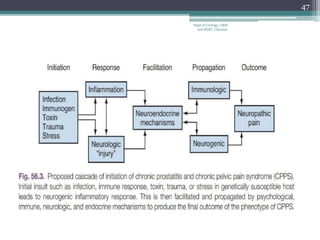
Etiology
• Despite a concerted research effort in the past
20 years, the cause and much of the
pathogenesis of CP/CPPS remain unknown .
• hypothesis is that an insult such as infection,
stress, or trauma in a genetically susceptible
individual leads to neurogenic inflammation,
which is maintained by these other factors
46
Dept of Urology, GRH
and KMC, Chennai.
47
Dept of Urology, GRH
and KMC, Chennai.
Infection
• A history of prior sexually transmitted disease
(STD) increases the odds of prostatitis by 1.8
times .But no active infection seen.
• Burkholderia cenocepacia overrepresented in
the CP/CPPS patients
48
Dept of Urology, GRH
and KMC, Chennai.
Inflammation
• autoimmune response with increased
lymphoproliferative response to prostate
antigens .
• These include a region of the prostatic acid
phosphatase molecule, PSA, and human seminal
vesicle secretory protein 2 (SVS2) .
• Levels of the chemokines monocyte
chemoattractant protein-1 and macrophage
inflammatory protein-1-alpha and IL-17 are
elevated
49
Dept of Urology, GRH
and KMC, Chennai.
Neurologic Causes
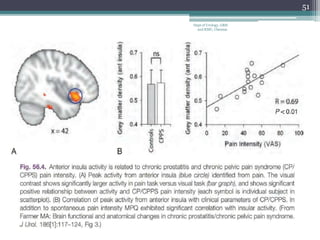
• Central sensitization
• differences in the relationship of gray and white
matter
• lower white matter tract density in areas of
perception, integration of sensory information
and pain modulation .
• decreased connectivity between motor areas
involved in pelvic floor control and the right
posterior insula, an area involved in pain
processing and sympathetic autonomic control .
50
Dept of Urology, GRH
and KMC, Chennai.
51
Dept of Urology, GRH
and KMC, Chennai.
Pelvic Floor Dysfunction
• have pathological tenderness of the striated pelvic
floor muscle and
• poor to absent function in ability to relax the pelvic
floor efficiently with a single or repetitive effort .
• An electromyogram (EMG) study of the pelvic floor
in these patients showed that , men with CP/CPPS
had
(1) greater preliminary resting hypertonicity and
instability and
(2) lowered voluntary endurance contraction amplitude
52
Dept of Urology, GRH
and KMC, Chennai.
Psychosocial Factors
• Greater perceived stress is associated with greater
pain intensity and disability
• Helplessness and catastrophizing predict overall
pain along with urinary symptoms and depression.
• association of pain intensity with catastrophizing,
perceived stress, and low satisfaction with
relationships including sexual functioning.
• men who reported experiencing sexual, emotional,
or physical abuse were at increased risk for
symptoms of CP/CPPS.
53
Dept of Urology, GRH
and KMC, Chennai.
Endocrine Abnormalities
• Alterations of the hypothalamic-pituitary-
adrenal axis;
• Greater cortisol rise in men with CPPS.
• Lower baseline adrenocorticotropic hormone
(ACTH) level and
• Blunted ACTH rise in response to stress .
54
Dept of Urology, GRH
and KMC, Chennai.
Genetics
• The conclusion is that familial factors, either
shared environmental factors or genetic factors,
play a large role in the relationship between
CP/CPPS and COPC.
• lifetime physician diagnosis of CP/CPPS with so-
called chronic overlapping pain conditions
(COPC), including fibromyalgia, chronic fatigue
syndrome, irritable bowel syndrome (IBS),
temporo-mandibular disorder, tension
headaches, and migraine headaches.
55
Dept of Urology, GRH
and KMC, Chennai.
Biomarkers
• nerve growth factor (NGF)
• pain severity was significantly positively
associated with concentrations of matrix
metallopeptidase 9 (MMP-9) and MMP-
9/NGAL (neutrophil gelatinase-associated
lipocalin) complex, and urinary severity was
significantly positively associated with MMP-9,
MMP-9/NGAL complex, and VEGF-R1
56
Dept of Urology, GRH
and KMC, Chennai.
Abnormal Sensory Processing
• generalized or global abnormality of sensory
processing.
• increased pain sensitivity compared with healthy
contr
57
Dept of Urology, GRH
and KMC, Chennai.
Symptoms in Chronic Prostatitis and
Chronic Pelvic Pain Syndrome
• The symptom that distinguishes category III
prostatitis CP/CPPS from other conditions such as
BPH is pain.
• most severe symptom was pain in the pelvic region
(m/c perineum), followed by urinary frequency and
obstructive voiding symptoms.
• In 1999 the NIH set out to develop a symptom score
.The resulting index included three domains:
pain(pain in the perineum, lower
abdomen/suprapubic area, testes, penis, pain with
ejaculation, and dysuria ), urinary symptoms,
and quality of life
58
Dept of Urology, GRH
and KMC, Chennai.
Summary of Findings From the
Multidisciplinary Approach to Pelvic
Pain Study
1. Patients who have pain beyond the pelvis have more
severe symptoms than those with pelvic pain only.
2. Men with COPC have more severe symptoms than
those with only urologic symptoms. the most
common being IBS .
3. Patients with bladder-focused symptoms (bladder
pain with filling and painful urgency) report more
severe symptoms than those who do not have
bladder symptoms.
4. Pain and urinary symptoms should not be
measured together as part of a composite score.
59
Dept of Urology, GRH
and KMC, Chennai.
Sexual Dysfunction
• The prevalence of ED in men with CP/CPPS is
reported at 15% to 40% .
• Other symptoms of sexual dysfunction are
ejaculatory dysfunction/pain and premature
ejaculation
Anxiety and Depression
60
Dept of Urology, GRH
and KMC, Chennai.
Association With Other Medical
Diseases
• Cardiovascular Disease :most commonly
hypertension.
• Neurologic Disease :
▫ numbness and tingling in the limbs .
▫ vertebral disk disease/ surgery
61
Dept of Urology, GRH
and KMC, Chennai.
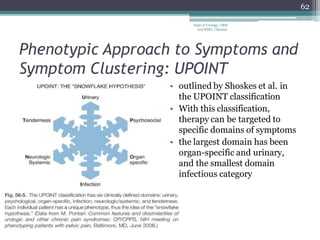
Phenotypic Approach to Symptoms and
Symptom Clustering: UPOINT
• outlined by Shoskes et al. in
the UPOINT classification
• With this classification,
therapy can be targeted to
specific domains of symptoms
• the largest domain has been
organ-specific and urinary,
and the smallest domain
infectious category
62
Dept of Urology, GRH
and KMC, Chennai.
Evaluation of Chronic Prostatitis and
Chronic Pelvic Pain Syndrome
• CP/CPPS is a diagnosis of exclusion, and the
evaluation must rule out identifiable causes of
pelvic pain .
• To meet the NIH consensus definition, patients
should not have active urethritis, urogenital
cancer, urinary tract disease, functionally
significant urethral stricture, or neurologic
disease affecting the bladder .
63
Dept of Urology, GRH
and KMC, Chennai.
• History :
• Assessment
▫ Pain. The National Institutes of Health Chronic
Prostatitis Symptom Index (NIH-CPSI) includes
sections on pain including location, frequency and
severity of pain, voiding symptoms, and interference/
quality of life .
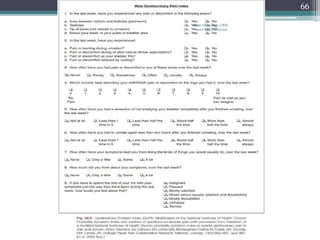
▫ A modification of the NIH-CPSI called the
Genitourinary Pain Index (GUPI) (Fig. 56.6) contains
two questions related to pain with bladder filling or
emptying and better captures bladder symptoms
64
Dept of Urology, GRH
and KMC, Chennai.
• Other Urologic Symptoms
▫ Voiding: The NIH-CPSI and GUPI list only two
questions on voiding dysfunction.
▫ The AUA symptom index can be useful to assess
these other voiding symptoms
▫ Sexual function: a history of erectile
dysfunction, libido, and ejaculatory problems.
65
Dept of Urology, GRH
and KMC, Chennai.
66
Dept of Urology, GRH
and KMC, Chennai.
Review of Symptoms
• Neurologic
• GI :IBS
• Rheumatologic :fibromyalgia and chronic
fatigue syndrome,
• Psychological symptoms :significant anxiety,
depression, and symptoms of obsessive
compulsive behavior
67
Dept of Urology, GRH
and KMC, Chennai.
Physical Examination
• Neurologic examination
• Abdominal examination
• Genitourinary examination An examination for
hernia, hydrocele, testicular masses, penile lesions, or
other findings of the genitalia should be performed.
• A rectal and prostate examination should be performed.
Rectal masses or hemorrhoids should be assessed.
• On rectal examination the prostate is tender in less than
half of men (Shoskes et al., 2008); severe tenderness
suggests acute prostatitis.
• Nodularity should not be attributed to inflammation and
should prompt a consideration of prostate cancer.
68
Dept of Urology, GRH
and KMC, Chennai.
• Muscle tenderness :During rectal
examination, palpation of the muscles lateral to
the prostate and extending to the coccyx can
identify myofascial trigger points and identify
patients that may benefit from pelvic floor
physical therapy and relaxation techniques
69
Dept of Urology, GRH
and KMC, Chennai.
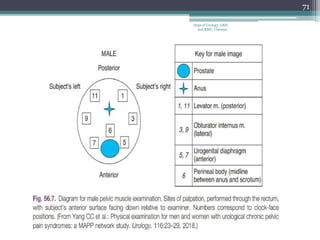
• The perineum was palpated midway between the
anus and inferior edge of the scrotum. The pelvic
floor muscles were palpated through the rectum:
the urogenital diaphragm muscles were palpated
anteriorly at the prostate apex; the obturator
muscles were palpated anteriorly and laterally;
the levator muscles were palpated posteriorly.
The figure from the study is helpful as a
roadmap to examination
70
Dept of Urology, GRH
and KMC, Chennai.
71
Dept of Urology, GRH
and KMC, Chennai.
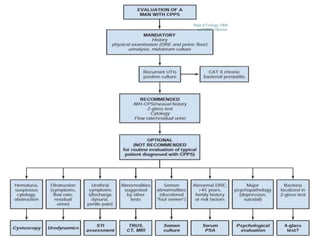
• Laboratory/Office Studies
72
Dept of Urology, GRH
and KMC, Chennai.
Dept of Urology, GRH
and KMC, Chennai.
Urinalysis
• Men should have a urinalysis to look for
unevaluated hematuria.
• A positive urine dip must be confirmed by finding 3
or more RBC per high-power field on a microscopic
evaluation of the urine .
Assessment for infection midstream urine sample
for culture ,
recommended by the International Consultation on
Urological Diseases (ICUD) is the two-glass test,
standard diagnostic method in men with recurrent
UTIs
74
Dept of Urology, GRH
and KMC, Chennai.
• Urine assessment for nontraditional
organisms
• Semen cultures are not recommended
• Urine cytology: optional but indicated in men
with irritative voiding symptoms
• Postvoid residual :checked by catheterization
or ultrasound to rule out urinary retention as a
cause of symptoms.
• Blood tests: APSA test is not indicated
75
Dept of Urology, GRH
and KMC, Chennai.
• Imaging studies are optional and may be appropriate in some
patients:
• CT scan of abdomen and pelvis: Patients with concomitant
abdominal pain may require imaging with CT to exclude an intra-
abdominal process such as chronic appendicitis or diverticulitis.
• Scrotal ultrasound: Testicular pain should be evaluated with a
scrotal ultrasound.
• Prostate ultrasound: Transrectal ultrasound has limited utility in
men with CP/CPPS .
• MRI of lumbar and sacral spine: Patients with signs and symptoms
of lumbar radiculopathy should be considered for MRI.
• Uroflowmetry: This is an optional study in the evaluation of CP/
CPPS. It may be helpful in a young male with complaints of
decreased force of stream as an investigation into stricture disease.
76
Dept of Urology, GRH
and KMC, Chennai.
• Urodynamics and cystoscopy:(Optional) used
in those who fail medical therapy and have
significant voiding symptoms, decreased
uroflowmetry, and or elevated postvoid residual
urine .
• Cystoscopy can be used in men with decreased
uroflow and/ or elevated postvoid residual urine to
evaluate for urethral stricture,and in pts with a
history of pain with bladder emptying and/or
relieved by bladder emptying suggestive of IC/BPS
because in a small set of these patients a Hunner’s
ulcer is present .
77
Dept of Urology, GRH
and KMC, Chennai.
• Prostate biopsy is not recommended for the
diagnosis of CP/ CPPS alone.
• Clinical phenotyping tool: UPOINT
78
Dept of Urology, GRH
and KMC, Chennai.
Treatment of Chronic Prostatitis and
Chronic Pelvic Pain Syndrome
Pharmacologic Treatment
• Antibiotic Treatment: Summary of Treatment
Recommendations recommendations from the European
Association of Urology , which were antimicrobial therapy
(quinolones or tetracyclines) over a minimum of 6 weeks in
treatment-naïve patients with a duration of CPPS less than 1
year,
• The group convened by Prostate Cancer UK adds that a
repeated course of antibiotic therapy (4 to 6 weeks) should be
offered if a bacterial source is confirmed or if there is a partial
response to the first course. Repeated courses of antibiotics in
the absence of a positive urine culture is not accepted therapy.
79
Dept of Urology, GRH
and KMC, Chennai.
• Alpha-Blocker Treatment:
• The ICUD study recommends alpha-blockers
for newly diagnosed, alpha-blocker–naive
patients who have voiding symptoms .
• The EAU guidelines recommend use of alpha-
blockers for patients with a duration of PPS less
than 1 year.
80
Dept of Urology, GRH
and KMC, Chennai.
• Anti-Inflammatory Therapy: In conclusion,
anti-inflammatory monotherapy is not
recommended but can be used as part of multimodal
therapy , but long-term side effects have to be
considered
• Reductase Inhibitors: they may be best used in
older patients with CP/CPPS who also have voiding
symptoms from BPH.
In Younger patients side effects must be considered.
reduced volume of ejaculate, erectile dysfunction,
and decrease in libido
81
Dept of Urology, GRH
and KMC, Chennai.
• Medications for Neuropathic Pain: pregabalin
, tricyclic antidepressants (Amitriptyline ).
• Phototherapy. pollen extract Cernilton for 12
weeks , Quercetin, a plant-derived bioflavonoid.
• Bladder Specific: Pentosan Polysulfate
Pentosan polysulfate (PPS) is a medication used to
treat symptoms of interstitial cystitis, thought to
work by augmenting the bladder’s layer of
glycosaminoglycans, which acts as a protective
barrier, It is recommended by the EAU guidelines
but with a strength rating of weak
82
Dept of Urology, GRH
and KMC, Chennai.
• Other Medications
• Mepartricin: reduces serum estrogen levels
and prostatic estrogen receptors in animal
models
• PDE5 Inhibitors useful to treat erectile
dysfunc-tion in men with CPPS at any age ,
Tadalafil can treat lower urinary tract
symptoms, erectile dysfunction, and possibly the
symptoms of CP/CPPS
83
Dept of Urology, GRH
and KMC, Chennai.
Other Treatments for Chronic Prostatitis
and Chronic Pelvic Pain Syndrome
• Conservative
• Lifestyle Changes: Diet and Exercise:
• Few are sensitivity to some foods. The most
common were spicy foods, coffee, tea, chili, and
alcoholic beverages.
• Items that improved symptoms included docusate,
psyllium (dietary fiber), water, herbal teas, and
polycarbophil (fiber laxative)
• There are no specific dietary recommendations for
all patients with CP/CPPS, and they should be
individualized based on the patient’s food
sensitivities
84
Dept of Urology, GRH
and KMC, Chennai.
• Stress Management/Psychological
Treatments: cognitive therapy
• Acupuncture: ameliorating effect on
neuropathic pain
85
Dept of Urology, GRH
and KMC, Chennai.
Minimally Invasive Therapies
• Pelvic Floor Physical Therapy and Skeletal
Muscle Relaxants: biofeedback and pelvic floor
retraining, or learning to selectively contract and then
relax the pelvic muscles ,
• studies from Stanford have reproduc-ibly shown a
benefit to combining myofascial trigger point release and
paradoxic relaxation training, essentially biofeedback
training.
• Referral to a physical therapist who is familiar
with pelvic floor PT techniques, if possible, is
recommended as the improvement after pelvic
floor PT appears to be better after therapy
received from specialized centers
86
Dept of Urology, GRH
and KMC, Chennai.
• Adjuncts to Pelvic Floor Physical Therapy:
For refractory cases of pelvic floor spasm, needling
of the area, either as dry needling or with the
injection of local anesthesia, or Botulinum toxin to
relax pressure points.
• Prostate Massage: evidence for a role of
repetitive prostatic massage as an adjunct in the
management of CP is, at most, “soft” but that the
practice could be considered as part of multimodal
therapy in selected patients .
• Circumcision
87
Dept of Urology, GRH
and KMC, Chennai.
Prostate-Specific Treatments
• Local Hyperthermia and Needle Ablation
▫ transrectal radiofrequency hyperthermia
▫ transurethral microwave thermotherapy
▫ Transurethral need ablation (TUNA),tried but not
recommended for treatment
Intraprostatic Injection of
Onabotulinumtoxin A. At a dose of 100 to
200 U there was significant benefit to the Botox
injection compared with saline
88
Dept of Urology, GRH
and KMC, Chennai.
89
Dept of Urology, GRH
and KMC, Chennai.
Surgical Therapy for Chronic Prostatitis
and Chronic Pelvic Pain Syndrome
• Surgical Therapy for Bladder Neck
Hypertrophy. Te and Kaplan reported significant
improvement in men with bladder neck
hypertrophy and symptoms of chronic prostatitis
treated with bladder neck incision.
• Neurostimulation. At this time, it appears
reasonable to offer percutaneous tibial nerve
stimulation (PTNS) as therapy in patients with CPPS
and Sacral nerve stimulation (SNS) in those with
pelvic pain who also have urinary frequency and
urgency.
• Electromagnetic Stimulation. In studies
patients sat on a chair with electromagnetic
energy for 30 minutes twice weekly for 6 weeks
showed improvements in symptoms.
• Cystoscopy and Fulguration of Hunner’s
Ulcer
• Not Recommended :Radical
Prostatectomy
90
Dept of Urology, GRH
and KMC, Chennai.
Treatment: Summary and Approach
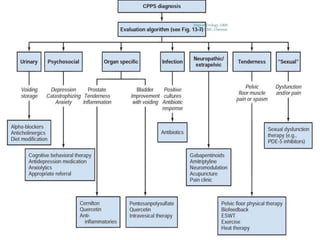
• A significant limitation to treatment of CP/CPPS is
that there are no positive clinical trials for
monotherapy in men with CP/CPPS ).
• Certainly therapy should start with the most
conservative treatments possible, including lifestyle
changes. Further therapy is best directed at
simultaneous multimodal therapy based on the
patient’s individual phenotype .
• The UPOINT classification offers a convenient
framework in which to plan treatment(s) and is
recommended in current guidelines for treatment
by the EAU and ICUD.
91
Dept of Urology, GRH
and KMC, Chennai.
• Finally, many if not most patients need to see
more than one type of specialist. This often
involves neurology, gastroenterology,
psychiatry/psychology, physical medicine, and
rehabilitation in addition to urology.
• Referral to a pain clinic, especially one with a
multimodal approach may also be helpful . A
referral to pain management specialists is also
recommended if a patient requires the use of
opioids.
92
Dept of Urology, GRH
and KMC, Chennai.
Dept of Urology, GRH
and KMC, Chennai.
BLADDER PAIN SYNDROME
94
Dept of Urology, GRH
and KMC, Chennai.
Historical aspects
• Joseph Parrish, a Philadelphia surgeon, described three
patients with severe lower urinary tract symptoms in the
absence of a bladder stone in 1836, and termed the disorder
tic douloureux of the bladder.
• Skene used the term interstitial cystitis to describe an
inflammation that had “destroyed the mucous membrane
partly or wholly and extended to the muscular parietes”
(Skene, 1887).
• Early in the 20th century, Hunner drew attention to the
disease, and the red, bleeding areas he described on the
bladder wall came to be called Hunner ulcers.
95
Dept of Urology, GRH
and KMC, Chennai.
• Hand (1949) three grades of disease, with grade 3 matching
the small-capacity, scarred bladder described by Hunner.
Sixty-nine percent of patients had grade 1 disease, and only
13% had grade 3.
• Walsh (1978) later coined the term glomerulations to describe
the petechial hemorrhages.
• In 2002, the International Continence Society (ICS) agreed on
the term ‘painful bladder syndrome’ (PBS) because IC was a
‘specific diagnosis that required confirmation by typical
cystoscopic and histologic features. Dept of Urology, GRH and KMC, Chennai.
96
• In 2004, the International Consultation on Incontinence (ICI)
argued against ‘painful bladder syndrome’ and for ‘bladder
pain syndrome (BPS)’ because ‘the former did not focus on
the actual symptom complex but instead on the
misconception of its pathology’. This suggested the
manifestation of bladder pain as part of a generalized
systemic disorder.
97
Dept of Urology, GRH
and KMC, Chennai.
Definition
• The American Urological Association (AUA) in 2011,
“An unpleasant sensation (pain, pressure, discomfort) perceived to
be related to the urinary bladder, associated with lower urinary tract
(LUT) symptoms of more than 6 weeks duration, in the absence of
infection or other identifiable causes”.
• “The European Society for the Study of Interstitial Cystitis
(ESSIC)”—bladder pain syndrome (BPS) is diagnosed on the basis of
chronic pelvic pain, pressure, or discomfort perceived to be related
to urinary bladder accompanied by at least one other urinary
symptom like persistent urge to void or urinary frequency.
Confusable diseases as the cause of the symptoms must be excluded.
98
Dept of Urology, GRH
and KMC, Chennai.
99
Dept of Urology, GRH
and KMC, Chennai.
• The International Continence Society(ICS) defines PBS as
‘suprapubic pain related to bladder filling, accompanied by
other symptoms such as increased daytime and night-time
frequency, in the absence of proven urinary infection or other
obvious pathology’.
• in 2013 ‘hypersensitive bladder’ (HB) was suggested as an
umbrella term since a substantial proportion of patients do
not complain of pain as would be suggested by BPS and PBS.
HB was defined as ‘increased bladder sensation, usually
associated with urinary frequency and nocturia, with or
without bladder pain’.
100
Dept of Urology, GRH
and KMC, Chennai.
Epidemiology
• Using standard case definitions with known sensitivity and
specificity values, few studies estimated that between 2.7%
and 6.5% of American women have bladder symptoms
consistent with a diagnosis of IC/BPS.
• Prevalence ranges from 52 to 500/100,000 in females
compared to 8-41/100,000 in males, and its incidence is
increasing globally.
• Twenty five years ago it was believed that BPS/IC did not exist
in India and it was a disease predominantly present in
Western world. Dept of Urology, GRH and KMC, Chennai.
101
• Now it is well established that PBS/ IC is not uncommon in
India and it is estimated that there are more than 1.25 million
patients with BPS/IC.
• The median age at presentation is 40 years.
• However, BPS may occur in children.
• BPS is more in white races .
• More in females approximately 90%.
Dept of Urology, GRH and KMC, Chennai.
102
Etiology
• There is no agreement on pathophysiology of BPS/IC, there
are however many theories.
Leaky epithelium glycosaminoglycan [glycosaminoglycan
(GAGs) theory
Occult infection
Neurogenic inflammation
 Mast cell activation
 Autoimmunity
Vascular
103
Dept of Urology, GRH
and KMC, Chennai.
Pathology
• The urothelial surface is lined by an impermeable bladder
surface mucin composed of sulfonated glycosaminoglycans
(GAGs) and glycoproteins.
• Permeability alterations that allow potassium ions to traverse
the urothelium, depolarize sensory and motor nerves, and
activate mast cells. This permeability dysfunction is
manifested by increased urea absorption and positive
potassium sensitivity tests in IC patients.
• Intercellular adhesion molecules, extracellular matrix, and the
cellular cytoskeleton may be important.
• Few patients have onset of their symptoms following episodes
of bacterial cystitis. Bacteria can become sequestered within
urothelial cells and cause permeability alterations.
104
Dept of Urology, GRH
and KMC, Chennai.
Neuro–Urothelial Interactions
• Urothelium acts as a “mechanical sensor" of bladder distension and
a “chemical sensor" of urine acidity, osmolality, and composition.
• C-fiber afferent nerves may mediate these functions.
• Substance P released by activated C-fiber afferents, is involved in
nociception in the central and peripheral nervous systems and also
functions as an inflammatory mediator.
• inflammatory cascade with mast cell activation and up-regulation of
adjacent nerves.
• increased Nerve growth factor (NGF) , further confirming the role of
neurogenic inflammation in IC.
105
Dept of Urology, GRH
and KMC, Chennai.
Mast Cell Activation
• Mastocytosis occurs in 30% to 65%.
• Contain vasoactive and inflammatory meditors.
• Play a central role in the pathogenesis of neuroinflammatory
conditions.
• An immunoglobulin E–mediated hypersensitivity reaction or
in response to substance P, cytokines, bacterial toxins,
allergens, toxins, and stress.
Dept of Urology, GRH and KMC, Chennai.
106
Autoimmunity and Infection
• IC/BPS has many features of an autoimmune disease—
▫ Chronicity.
▫ Exacerbations and remissions.
▫ Clinical response to steroids and immunosuppressives.
▫ High prevalence of antinuclear antibodies.
▫ Association with other autoimmune syndromes.
• Cultures in IC patients are routinely negative, and PCR
studies have not consistently identified bacterial genetic
material.
• However, an episode of cystitis can cause bladder dysfunction
that results in alterations in bladder permeability, neurogenic
up regulation and mast cell recruitment and activation.
107
Dept of Urology, GRH
and KMC, Chennai.
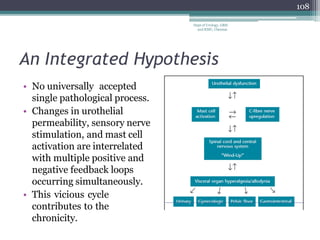
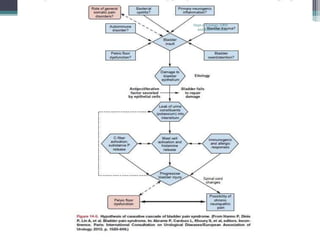
An Integrated Hypothesis
• No universally accepted
single pathological process.
• Changes in urothelial
permeability, sensory nerve
stimulation, and mast cell
activation are interrelated
with multiple positive and
negative feedback loops
occurring simultaneously.
• This vicious cycle
contributes to the
chronicity.
108
Dept of Urology, GRH
and KMC, Chennai.
Dept of Urology, GRH
and KMC, Chennai.
Associated disorders
• Depression (whether this is an association or effect of the
disorder is uncertain)
• Panic disorders (sometimes be a part of a familial syndrome
that includes IC, thyroid disorders, and other disorders of
possible autonomic or neuromuscular control)
• Migraine
• Fibromyalgia
• Chronic fatigue syndrome (CFS)
• IBS
• Vulvodynia
• sexual, behavioural or emotional consequences.
• Temporomandibular joint disorder
• Allergy, asthma and SLE.
• Sicca syndrome
110
Dept of Urology, GRH
and KMC, Chennai.
Diagnosis
• The diagnosis of BPS can be made on the basis of exclusion of
confusable diseases and confirmed by the recognition of the
presence of the specific combination of symptoms and signs of
BPS.
• If the main urinary symptoms are not explained by a single
diagnosis, the presence of a second diagnosis is possible.
• BPS may occur together with confusable diseases.
111
Dept of Urology, GRH
and KMC, Chennai.
PBS/IC Differential Diagnosis
• Recurrent UTI
• Detrusor instability, Overactive bladder
• Urethral Syndrome
• Neurogenic Bladder
• BOO
• Pelvic Floor dysfunction
• Radiation cystitis
• Vaginitis
• TB, Schistosomiasis
• Carcinoma in situ
• UB calculus/ lower ureteric calculus
• Chronic prostatitis
112
Dept of Urology, GRH
and KMC, Chennai.
• The basic assessment should include a
Careful history,
Physical examination
Laboratory examination
to rule in symptoms that characterize BPS and rule out other
confusable disorders.
• A thorough history should include characteristics of the pain,
any triggers (such as dietary factors), associated lower urinary
tract symptoms, and any symptoms related to the other pelvic
organs. Nature of the pain is important, with location
(suprapubic), description (pain, pressure or discomfort), and
exacerbating factors (increases with increasing bladder
content, relieved by voiding, and aggravated by food or drink).
• Previous pelvic operations, previous UTI, previous pelvic
radiation treatment, and autoimmune diseases.
113
Dept of Urology, GRH
and KMC, Chennai.
Physical examination
• A detailed physical examination of the abdomen, pelvis,
genitalia, and prostate in men should be performed.
• Specific attention to areas of tenderness.
• A musculoskeletal and focussed neurological examination
should be included, and pelvic floor muscle examination for
tenderness and trigger points should be included.
114
Dept of Urology, GRH
and KMC, Chennai.
Laboratory examination
• Urine routine anlysis and culture
• Urine cultures are usually negative,
frequently reveals pyuria.
although urinalysis
• Culture for TB should be included if sterile pyuria is present.
• BPS/IC should be considered in the differential diagnosis of
patients with symptoms of cystitis that are unresponsive to
antibiotics and/or culture-negative.
• BPS/IC needs to be considered in patients with symptoms of
the overactive bladder (with and without pain) who do not
115
Dept of Urology, GRH
and KMC, Chennai.
significantly higher
• Voiding diary- Although BPS patients may
voiding frequencies, smaller
have
voided
volumes, and narrower ranges of voided volume compared
with overactive bladder patients (Kim et al, 2014), one cannot
distinguish between the two syndromes based on a voiding
diary.
• Use of a frequency volume chart is recommended in the initial
evaluation.(The AUA guideline recommends a minimum one-
day and ESSIC guideline recommends a 3 day chart. )
116
Dept of Urology, GRH
and KMC, Chennai.
• Ultrasound/ pelvic imaging
No role in diagnosis.
Helps to rule out confusable disease.
Mandatory if patient also have hematuria.
117
Dept of Urology, GRH
and KMC, Chennai.
Role of cystoscopy
• No widely-accepted diagnostic cystoscopic features for BPS.
• Should be performed as part of the initial evaluation in order to
exclude other underlying pathology .
• The advantages
Photodocumentation of bladder inflammation
(glomerulations, submucosal hemorrhages, ulcers)
Bladder capacity determination, exclusion of other diseases.
Delineation of the degree and sub-type inflammation (if
biopsies are performed).
If done under anesthesia with bladder distention, important
in the identification of a Hunner lesion.
118
Dept of Urology, GRH
and KMC, Chennai.
• Glomerulations are not specific for BPS/IC (Erickson, 1995;
Waxman et al, 1998)
• Potentially significant when seen in conjunction with the
clinical criteria.
• Can be seen after radiation therapy, patients with carcinoma,
after exposure to toxic chemicals or chemotherapeutic agents.
• The AUA, ICI guidelines suggest hydrodistension is optional
as a diagnostic test due to conflicting evidence regarding its
utility, but may be appropriate in specific cases.
• Hydrodistension is therapeutic, with 20%–30% of patients
experiencing symptom relief for 3–6 months.
119
Dept of Urology, GRH
and KMC, Chennai.
• After filling to 80 cm of water pressure for 1 to 2
minutes, the bladder is drained and refilled. The
terminal portion of the effluent is often blood-
tinged.
• Reinspection will reveal the glomerulations that
develop throughout the bladder after distention
and are not usually seen during examination
without anesthesia
120
Dept of Urology, GRH
and KMC, Chennai.
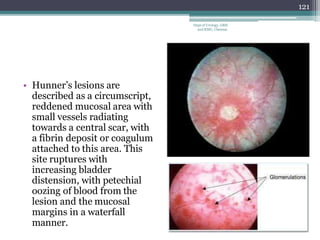
• Hunner’s lesions are
described as a circumscript,
reddened mucosal area with
small vessels radiating
towards a central scar, with
a fibrin deposit or coagulum
attached to this area. This
site ruptures with
increasing bladder
distension, with petechial
oozing of blood from the
lesion and the mucosal
margins in a waterfall
manner.
121
Dept of Urology, GRH
and KMC, Chennai.
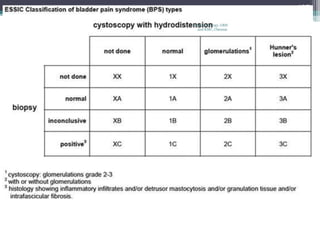
• Cystoscopic findings are classified by the ESSIC(Europian
Society for the study of IC) group as:
A.
B.
C.
Grade 0 - normal mucosa
Grade I - petechiae in at least two quadrants
Grade II - large submucosal bleeding (ecchymosis)
D. Grade III - diffuse global mucosal bleeding
E. Grade IV - mucosal disruption, with or without
bleeding/oedema.
The AUA and ICI guidelines suggest that cystoscopy is optional
as a diagnostic test for IC/BPS, but should be performed if
another pathological process is suspected.
122
Dept of Urology, GRH
and KMC, Chennai.
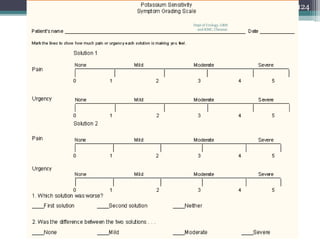
Intravesical Potassium Sensitivity
Test (Parson’s Test)
• By Parsons in 1994.
• Dilute solution of potassium (40 mEq in 100 mL of water) is
left in the bladder for 5 minutes.
• The patient then rates the degree of provocation with urgency
and frequency on a scale of 0 (no provocation) to 5 (marked
provocation).
• A positive test is defined by a change in score of 2 or more.
• 75% of patients with IC have a positive KCl test.
• The test is positive in detrusor instability (25%), radiation
cystitis (100%), and bacterial cystitis (100%).
123
Dept of Urology, GRH
and KMC, Chennai.
124
Dept of Urology, GRH
and KMC, Chennai.
• Intravesical local anaesthetic challenge test
• To determine whether pelvic pain is originating from the
bladder.
• This as an optional test for those cases in which there is
uncertainty as to whether pain is originating from the bladder
.
• This diagnostic test is not recommended by most of the
guidelines.
125
Dept of Urology, GRH
and KMC, Chennai.
Role of biopsy
• Bladder biopsy is not required for the diagnosis of IC, as there are
no pathognomonic histological features of the disease.
• Useful to stratify patients with specific pathogenetic pathways and
to exclude specific bladder diseases (eg, carcinoma-in-situ).
• Positive findings on biopsy were considered to be inflammatory
infiltrates, granulation tissue, detrusor mastocytosis, or
intrafascicular fibrosis.
• It is recommended that a total of 3 biopsies be taken from each
lateral wall and dome, as well as a separate biopsy from any other
abnormal lesions.
126
Dept of Urology, GRH
and KMC, Chennai.
127
Dept of Urology, GRH
and KMC, Chennai.
Urodynamics in BPS
• The current consensus is that urodynamic evaluation is not
required for diagnosis of IC but may provide useful
information regarding the differential diagnosis of painful
voiding disorders and the symptoms of the overactive bladder.
• The 14% incidence of urodynamic DO in the BPS/IC patients
(Nigro et al, 1997a) is probably close to what one might expect
in the general population if studied urodynamically
(Salavatore et al, 2003).
• Pain on bladder filling that reproduces the patient’s
symptoms is very suggestive of the diagnosis.
128
Dept of Urology, GRH
and KMC, Chennai.
• Poor Compliance in BPS patients, may be due to small
capacity bladder.
• The two problems(BPS and OAB) may coexist in 15% to 19%
of patients but the pathophysiology is possibly very different.
(Gajewski et al, 1997, Kirkemo et al, 1997)
• It is not uncommon to find evidence of outlet obstruction in
BPS/IC, which may be related to associated pelvic floor
dysfunction (Cameron and Gajewski, 2009).
129
Dept of Urology, GRH
and KMC, Chennai.
Markers
• Mast cell a possible diagnostic marker for IC.
• Twenty-seven mast cells per cubic millimeter is considered
indicative of mastocytosis.
• The results in the past have been very contradictory, and at
this time, in terms of the use of mast cell criteria in diagnosis,
remains uncertain.
• The urine APF (antiproliferative factor) may prove to be an
accurate marker of BPS/IC as It appears to have the highest
sensitivity and specificity of the variety of possible markers
tested.
• Chemokine-10 and -1, IL-6, and NGF also investigated and
found , 5 to 20-fold increase in BPS patients.
130
Dept of Urology, GRH
and KMC, Chennai.
Classification
Ulcerative
• The surface epithelium shows diffuse redness associated with
1 or more ulcerative patches surrounded by congested mucosa
(ie, Hunner ulcer).
• These ulcers may become apparent only after overdistention
which leads to fissures and cracks in the bladder epithelium.
• Less common and present in less than 10% of cases.
• More resistant to therapy.
• Ulcerative lesion may be transmural and associated with
marked inflammatory changes and fibrosis.
• Leads to progressive decrease in bladder capacity over time.
131
Dept of Urology, GRH
and KMC, Chennai.
Non-ulcerative
• Absent cystoscopic findings noted in the ulcerative type.
• After overdistention, glomerulations can be seen.
• Less severe.
132
Dept of Urology, GRH
and KMC, Chennai.
TREATMENT
• Principles of management of patients with BPS are to improve
quality of life and encourage realistic patient expectations.
• Spectrum disease with a wide array of presenting symptoms
and severities.
• Treatment is tailored to the individual patient.
• In most, single treatment modality is unsuccessful
• step-wise multimodal approach to therapy is often adopted.
starting with the most conservative.
133
Dept of Urology, GRH
and KMC, Chennai.
Conservative therapy
• Stress reduction, exercise, warm tub baths, and efforts by the
patient to maintain a normal lifestyle all contribute to overall
quality of life (Whitmore, 1994).
• Higher levels of stress were related to greater pain and
urgency in patients with IC (Rothrock et al, 2001).
• Biofeedback, soft-tissue massage, and other physical therapies
may aid in muscle relaxation of the pelvic floor.
• Acupuncture has been used for BPS/IC and many other
chronic pain syndromes.
134
Dept of Urology, GRH
and KMC, Chennai.
• Elaborate dietary restrictions are unsupported by any
literature.
• Many patients do find their symptoms are adversely affected
by specific foods and would do well to avoid them (Koziol et
al, 1993; Koziol, 1994).
• Often these include caffeine, alcohol, artificial sweeteners, hot
peppers, and beverages that might acidify the urine, such as
cranberry juice.
• There is currently no recommended IC/PBS diet beyond
avoidance of problem food items.
135
Dept of Urology, GRH
and KMC, Chennai.
• Pelvic Floor Physical Therapy
• Recommended as one of the early interventions for IC/PBS
according to recent .AUA guidelines
136
Dept of Urology, GRH
and KMC, Chennai.
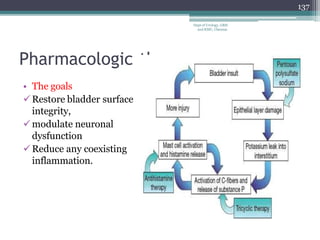
Pharmacologic
• The goals
Restore bladder surface
integrity,
modulate neuronal
dysfunction
Reduce any coexisting
inflammation.
therapy
137
Dept of Urology, GRH
and KMC, Chennai.
Sodium Pentosan Polysulfate
• Based on the theory of defective epithelial permeability
barrier(the GAG layer).
• PPS is a synthetic sulfated polysaccharide, similar in
structure to glycosaminoglycans (GAG) of the bladder
surface
• Heparin analogue, available in oral formulation (3% to 6% of
which is excreted into the urine).
• Only FDA approved drug in BPS. Recommended as a second-
line therapy for IC/PBS.
• Long-term experience with PPS in uncontrolled studies is
consistent with efficacy in a subset of patients (Al-Zahrani and
Gajewski 2011) that may drop below 30% of those initially
treated (Jepsen et al, 1998).
Dept of Urology, GRH and KMC, Chennai.
138
• Adverse events in less than 4% of patients at the dose of 100
mg three times daily (Hanno, 1997) and included reversible
alopecia, diarrhea, nausea, and rash.
• However, randomized controlled trials have shown mixed
results in its efficacy.
• A 3- to 6-month treatment trial is usually required to see
symptom improvement.
139
Dept of Urology, GRH
and KMC, Chennai.
• Amitriptyline
• Theoretically, tricyclic agents have actions that might tend to
stimulate predominantly β-adrenergic receptors in bladder
body smooth musculature, an action that would further
facilitate urine storage by decreasing the excitability of
smooth muscle.
• Titration is recommended starting at 25 mg and increasing to
75 – 100 mg.
• Benefits appear substantial/ not significant benefit (Yang et
al, 2014).
• Contraindicated in cardiac patients.
• Doses greater than 100 mg are associated with increased
relative risk of sudden cardiac death (Ray et al, 2004).
140
Dept of Urology, GRH
and KMC, Chennai.
• Antihistamines
• Cimetidine was speculated to improve symptoms via
competitive inhibition of the H2-receptor.
• Currently recognized as a second-line therapy according to
recent AUA guidelines.
• Despite contradictory evidence, due to its low side effect
profile and the potential benefit to a subset of IC/PBS
patients, hydroxyzine remains a second-line therapy for
IC/PBS.
• Other Antidepressent - none showed clinically
meaningful improvement of symptoms.
141
Dept of Urology, GRH
and KMC, Chennai.
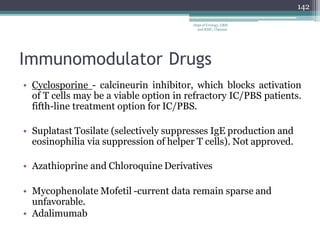
Immunomodulator Drugs
• Cyclosporine - calcineurin inhibitor, which blocks activation
of T cells may be a viable option in refractory IC/PBS patients.
fifth-line treatment option for IC/PBS.
• Suplatast Tosilate (selectively suppresses IgE production and
eosinophilia via suppression of helper T cells). Not approved.
• Azathioprine and Chloroquine Derivatives
• Mycophenolate Mofetil -current data remain sparse and
unfavorable.
• Adalimumab
142
Dept of Urology, GRH
and KMC, Chennai.
Others
• L- arginine
• Quercetin
• Methotrexate
• Montelucast
• Nifedipine
• Misoprostol
• Dextroamphetamine
• Phosphodiestrase inhibitors
143
Dept of Urology, GRH
and KMC, Chennai.
Analgesics
• Most patients can be helped markedly with medical pain
management using medications including antidepressants,
anticonvulsants, and opioids (Wesselmann et al, 1997).
• Many nonopioid analgesics including acetaminophen and the
nonsteroidal antiinflammatory drugs (NSAIDs) and even
antispasmodic agents (Rummans, 1994) have a place.
• Gabapentin, have efficacy in neuropathic pain disorders.
• It demonstrates synergism with morphine in neuropathic pain
and may give some benefit in CPPS and BPS/ IC (Sasaki et al,
2001).
• Pregabalin is also reported to be effective.
144
Dept of Urology, GRH
and KMC, Chennai.
Role of antibiotics
• No evidence to suggest that antibiotics have a place in the
therapy of BPS in the absence of a culture documented
infection.
• This Standard is not intended to prevent antibiotic
administration to antibiotic-naïve patients.
• It is focused on preventing repeated or chronic antibiotic
administration to patients for whom no relief was obtained in
an initial course.
• This Standard also is not intended to prevent prophylactic
antibiotic administration (e.g., nightly for several months) to
patients who present with recurrent UTIs and symptoms
suggestive of IC/BPS between infections.
145
Dept of Urology, GRH
and KMC, Chennai.
INTRAVESICAL THERAPIES
• Dimethyl Sulfoxide (DMSO)
• A mainstay of the treatment of BPS is the intravesical
instillation of 50% DMSO (Sant, 1987).
• DMSO actually desensitizes nociceptive pathways in the lower
urinary tract.
• Typical treatment regimens with weekly intravesical
instillations comprise a total of 4 – 8 treatments, of 50 cc 50%
DMSO instilled with 15 minute retention.
• Durable response rates have been documented up to 12
months.
• Efficacy rates ranged from 61% to 70%.
• Currently, AUA guidelines recommend intravesical DMSO as
a second-line therapy.
146
Dept of Urology, GRH
and KMC, Chennai.
Heparin
• Heparin is a sulfated polysaccharide that is thought to
augment the protective effect of the natural bladder surface
mucus GAG/proteoglycan layer.
• Also have anti-inflammatory properties, including inhibition
of angiogenesis and fibroblast proliferation.
• PPS , another GAG analogue,administered intravesically (300
mg twice weekly in 50 mL of normal saline) showed some
modest benefit in a small trial.
• Hyaluronic acid (nonsulfated GAG) has also been used
intravesically. 40 mg dissolved in 40 mL of normal saline
weekly for 4 to 6 weeks.
• Efficacy remains unproven in controlled and blinded trials.
147
Dept of Urology, GRH
and KMC, Chennai.
• Buffered Lidocaine - combination of 200 mg of lidocaine with
8.4% sodium bicarbonate (10 mL total solution) without
heparin showed a 30% response rate.
• once daily for 5 consecutive days with one hour retention.
• Intravesical alkalinised lignocaine for acute flare symptoms is
recommended for short-term improvement in symptoms .
• Statistically superior to a placebo cocktail.
• Combination Adding alkalinized lidocaine to the heparin
instillation provides better pain relief (Parsons, 2005). The
addition of 8 mL of 2% lidocaine and 4 mL of 8.4% sodium
bicarbonate may improve results (Welk and Teichman, 2008).
148
Dept of Urology, GRH
and KMC, Chennai.
• DMSO is often administered as part of an “intravesical
cocktail” (50 mL Rimso-50(DMSO) + 10 mg
Kenalog(Triamcinolone acetonide) + 44 mEq sodium
bicarbonate + 20,000 to 40,000 units intravesical heparin)
weekly for 6 weeks.
• Instillation of lidocaine/sodium bicarbonate and pentosan
polysulphate have both been given a grade A recommendation
by the EUA.
149
Dept of Urology, GRH
and KMC, Chennai.
Other intravesical therapies
• Silver nitrate is not used in the current treatment of BPS.
• Clorpactin - rarely used at the present time, and there is no
current literature on this therapy. It is not a part of any
guideline algorithm and has fallen out of favor.
150
Dept of Urology, GRH
and KMC, Chennai.
Intradetrusor therapies
• OnabotulinumtoxinA (BTX-A) injection
• Potent neurotoxin derived from the anaerobic bacterium
Clostridium botulinum.
• Acts by inhibiting the release of acetylcholine at the neuromuscular
junction.
• Also shown to reduce peripheral sensitization by inhibiting the
release of several neuronal signaling markers, including glutamate
and substance P.
• A randomized study looking at hydrodistension versus BTX-A plus
hydrodistension, demonstrated increased bladder capacity and long
term pain relief in patients who received the combined therapy.
• Limitations of the BTX-A data continue to be the variability in
treatment protocols and lack of randomized studies. Dept of Urology, GRH and KMC, Chennai.
151
• Reasonable treatment for BPS that is refractory to standard
conservative, oral, and intravesical treatment (Mangera et al, 2011;
Yokoyama et al,2012).
• When injected into the trigone in 10-unit aliquots (100 units total),
the risk of impaired bladder emptying seems to be minimized.
• Triamcinolone Submucosal injection of 10 mL of 40 mg/mL
triamcinolone acetonide injected in 0.5-mL aliquots was used for
the treatment of Hunner lesions in 30 patients (Cox et al, 2009).
Seventy percent of patients were very much improved, and duration
of improvement was estimated to be 7 to 12 months.
• BCG no place in the treatment of moderate to severe BPS/IC.
152
Dept of Urology, GRH
and KMC, Chennai.
Hydrodistension
• If first- and second-line treatments have not provided acceptable
symptom control.
• AUA guidelines recommend low-pressure (60 – 80 cm H20), short
duration (less than 10min) hydrodistension as a third-line therapy.
• After initial cystoscopic examination, distend the bladder for 1 to 2
minutes at a pressure of 80 cm H2O. The bladder is emptied and
then refilled to allow observation for glomerulations or ulceration.
• A therapeutic hydraulic distention follows for another 8 minutes.
Biopsy, if indicated, is performed after the second distention.
Dept of Urology, GRH and KMC, Chennai.
153
• High-pressure (>80 cm H20), long-duration hydrodistension
(>10 min) should be avoided given the risk of bladder rupture
and sepsis.
• Hydrodistension performed after instilling 10 mL of 4 %
lidocaine intravesically demonstrated safe and therapeutic
efficacy in IC/PBS patients in the office setting.
• Relief of symptoms for a subset of patients, that also decline
over time: at one month efficacy ranged from 30% to 54%; at
two to three months, from 18% to 56%; at five to six months,
from 0% to 7%.
154
Dept of Urology, GRH
and KMC, Chennai.
Fulguration of Hunner Ulcers
• fulguration of Hunner ulcers remains purely a treatment of
IC/PBS symptoms rather than the underlying disease process.
• In addition to fulguration, treatment of Hunner ulcers with
Nd:YAG laser can be considered .
• A single treatment of these lesions has demonstrated a lasting
response of between 7 – 12 months.
• Should not be used for glomerulation or in the nonulcerative
form of the disease.
• Thirdline treatment recommendation listed in the AUA
guidelines with Grade C clinical evidence. Dept of Urology, GRH and KMC, Chennai.
155
Neuromodulation
• Pain diversion by transcutaneous electrical nerve stimulation
(TENS) is routine in a variety of painful conditions.
• Electrical nerve stimulation in IC is to relieve pain by
stimulating myelinated afferents to activate segmental
inhibitory circuits.
• Electrode positioning immediately above the pubic
symphysis.
• High- or low frequency (2 to 50 Hz) TENS was employed for
30 -120 min.
• Pain improved more than frequency.
• Currently, neuromodulation is included as a fourth-line
therapy for IC/ PBS treatment in recent AUA guidelines.
• Percutaneous tibial nerve stimulation (PTNS) has also been
used for IC/PBS.
156
Dept of Urology, GRH
and KMC, Chennai.
• Sacral S3 nerve stimulation (SNS) is believed to block afferent
bladder activity in somatic pathways as well as interfere with
abnormal C-fiber activity.
• Acupuncture used to treat frequency, urgency, and dysuria
(Chang, 1988). Twenty-two of 26 patients treated at the SP 6
point had clinically symptomatic improvement. A study
looking at both acupuncture and TENS in IC showed limited
effects of both modalities (Geirsson et al, 1993).
157
Dept of Urology, GRH
and KMC, Chennai.
• Sympathectomy , intraspinal alcohol injections have been
used to treat, Differential sacral neurotomy Transvesical
infiltration of the pelvic plexuses with phenol was
• Most deinnervation procedures never gained popularity.
158
Dept of Urology, GRH
and KMC, Chennai.
Surgical Reconstruction/Urinary
Diversion
• An option after all trials of conservative treatment have failed.
• Typically surgical options are reserved for patients with low
anesthetic bladder capacity (<300 cc) and/ or Hunner ulcers,
extremely severe, unresponsive disease.
• Patients should be adequately counselled that pain relief is
not guaranteed, and that pain may persist even if the bladder
is removed. This is especially true for patients with non-ulcer
BPS, or a preserved trigone (supratrigonal cystectomy)
• The surgical procedures included ileal conduit, supratrigonal
cystectomy and ileocystoplasty, continent urinary diversion
(Kock pouch), continent orthotopic diversion, and
cecocystoplasty.
159
Dept of Urology, GRH
and KMC, Chennai.
160
Dept of Urology, GRH
and KMC, Chennai.
• Supratrigonal cystectomy and the formation of an
enterovesical anastomosis with bowel segments (substitution
cystoplasty).
• With regard to patient selection, the patients most likely to
fail are those who describe the urethra as the main site of
pain, those without Hunner's lesions and those with a larger
bladder capacity under anesthesia.
• Not all patients empty the bladder spontaneously after
substitution cystoplasty, and may need clean intermittent
catheterization.
• Removing the trigone increases the risk of urinary retention,
requiring intermittent catheterization.However, a preserved
trigone may be a source for persistent pain and recurrent
ulcers.
• Diversion
• Properly selected refractory patient, urinary diversion will
relieve frequency and nocturia and sometimes can relieve
pain.
• If frequency is perceived as a major problem, then diversion
can almost certainly improve quality of life.
• Pain can persist even after cystectomy, especially in nonulcer
IC/BPS.
• Total cystourethrectomy is recommended if the trigone is
affected by IC or in patients with chronicity such that
remission is considered extremely unlikely.
161
Dept of Urology, GRH
and KMC, Chennai.
162
Dept of Urology, GRH
and KMC, Chennai.

prostate-pnsnsnznznzrostatitis CPPS.pptx

  • 1.
    Prostatitis ,Chronic pelvicpain syndrome and interstitial cystitis 1
  • 2.
    PROSTATITIS • The firstdescription of prostatitis dates to 1838 by Verdies. • Treatment by prostate massage was described by Posner of Berlin in 1893 • Krieger and Weidner (2003) contend that the contemporary history of prostatitis began with a letter to the editor published in the Journal of Urology in 1978 by George Drach et al. (1978). This is described as the first scientific recommendations for a systematic classification of patients with symptoms of prostatitis 3 Dept of Urology, GRH and KMC, Chennai.
  • 3.
    Meares and Stamey(1968) • The diagnosis was based on the microscopic examination and quantitative cultures of segmented urogenital tract specimens described by Meares and Stamey (1968) and four categories presented: (1) acute bacterial prostatitis with acute infection, (2) chronic bacterial prostatitis with recurrent episodes of bacteriuria by the same organism, • (3) chronic bacterial prostatitis in which patients had symptoms of prostatitis, negative cultures, and inflammatory cells, and • (4) prostatodynia, with symptoms of prostatitis including “prostatic discomfort” but no recognizable infection or inflammation. 4 Dept of Urology, GRH and KMC, Chennai.
  • 4.
    Current Classification ofProstatitis • The current classification of prostatitis was developed at consensus conferences in 1995 and 1998; the National Institutes of Health (NIH) classification was published in 1999 NIH Classification I. Acute bacterial prostatitis II. Chronic bacterial prostatitis IIIA. Chronic prostatitis/pelvic pain syndrome, inflammatory IIIB. Chronic prostatitis/pelvic pain syndrome, noninflammatory IV. Asymptomatic inflammatory prostatitis 5 Dept of Urology, GRH and KMC, Chennai.
  • 5.
    • The NIHdefinition of category III CP/CPPS as adopted by the Chronic Prostatitis Research Network is that of symptoms of pain or discomfort in the pelvis for at least 3 of the previous 6 months . • Several exclusion criteria are also included, such as demonstration of uropathogenic bacteria detected by standard microbiologic methods, urogenital cancer, prior radiation or che-motherapy, urethral stricture, or neurologic disease affecting the bladder (Schaeffer et al., 2002b) 6 Dept of Urology, GRH and KMC, Chennai.
  • 6.
    Histopathology: Histology • Theterm prostatitis can refer to the presence of inflammation on a histology examination of the prostate or is also used to describe clinical syndromes manifest by genitourinary discomfort or pain described in the NIH classification. 7 Dept of Urology, GRH and KMC, Chennai.
  • 7.
    • A classificationsystem proposed by Nickel et al. recommended reporting inflammation in prostatitis by its anatomic location in the prostate, either • glandular (within a duct/gland epithelium or lumen), • periglandular (lies within stroma but centered around ducts and glands and approaches 50 micro m or less), or • stromal (in the stroma and >50 micro m from a gland) 8 Dept of Urology, GRH and KMC, Chennai.
  • 8.
    Extent of inflammationis defined as • focal (<10%), • multifocal (10%–50%), or • diffuse (> 50%). Grade • 1) or mild (individual inflammatory cells separated by distinct spaces, <100 cells); • 2) or moderate (confluent sheets of cell with no tissue destruction or lymphoid follicles, 100–300 cells); and • 3) or severe (confluent sheets of inflammatory cells with tissue destruction or nodule formation, 100–500 cells) 9 Dept of Urology, GRH and KMC, Chennai.
  • 9.
    Associated entities • corporaamylacea, which form from the deposition of prostatic secretions around sloughed epithelial cells; they do not usually cause inflammation unless they cause obstruction. • Prostate calculi may contribute to inflammation by causing local obstruction or by providing a nidus for bacterial growth 10 Dept of Urology, GRH and KMC, Chennai.
  • 10.
    Specific Cases ofProstatic Inflammation Granulomatous Prostatitis • Granulomatous prostatitis is diagnosed by the histologic finding of epithelioid granulomas with or without other infla. • It is commonly found on specimens from trans- urethral resections and prostate biopsies . • The most widely accepted grading system categorizes granulomatous prostatitis as ▫ specific, ▫ nonspecific, ▫ after transurethral resection of the prostate (TURP), ▫ and allergic granulomatous prostatitis 11 Dept of Urology, GRH and KMC, Chennai.
  • 11.
    • It iscommonly seen after intravesical Bacillus Calmette-Guerin (BCG) therapy for bladder cancer and can cause transient elevated levels of prostate-specific antigen (PSA) . • Tuberculosis can also cause granulomatous prostatitis . 12 Dept of Urology, GRH and KMC, Chennai.
  • 12.
    Immunoglobulin G Subclass4 (IgG4) • Prostatitis has been described from IgG4-related disease (IgG4-RD). • fibroinflammatory disease with multiorgan involvement characterized by several features: tendency to form tumorlike lesions at multiple sites, ▫ dense infiltrate of lymphocytes and ▫ IgG4 +plasma cells, ▫ characteristic pattern of fibrosis, and ▫ often,but not always, elevated levels of serum IgG4 ▫ responded to corticosteroids 13 Dept of Urology, GRH and KMC, Chennai.
  • 13.
    Category I Prostatitis:Acute Bacterial Prostatitis • affects men age 20 to 40 years but also has a second peak in men over the age of 60 • Causes ▫ ascending urethral infection ▫ Direct seeding from a prostate biopsy ▫ intraprostatic reflux of infected urine ▫ Hematogenous dissemination 14 Dept of Urology, GRH and KMC, Chennai.
  • 14.
    Risk factors ▫ unprotectedsexual intercourse, specifically insertive anal intercourse, ▫ phimosis, ▫ condom catheter use, ▫ indwelling urethral catheters, ▫ and urinary tract instrumentation, including endoscopic procedures and prostate biopsy . ▫ Dysfunctional voiding and disorders causing urinary stasis, including distal urethral stricture and BPH, ▫ after an episode of bacterial cystitis or epididymo- orchitis ▫ complications of clean intermittent catheterization 15 Dept of Urology, GRH and KMC, Chennai.
  • 15.
    The presentation ▫ acutesymptoms of a urinary tract infection (UTI), characteristically including urinary frequency and dysuria ▫ Urinary retention ▫ systemic infection, such as malaise, fever, and myalgias ▫ Sepsis ▫ Acute prostatitis should be considered in any man who presents with a febrile UTI. Febrile UTI in men can be from pyelonephritis, acute cystitis, or prostatitis. 16 Dept of Urology, GRH and KMC, Chennai.
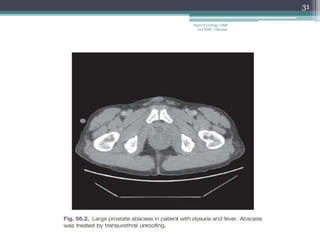
  • 16.
    Microbiology • The mostcommon causative organism is Escherichia coli, implicated in 65% to 80% of cases . • Other common gram-negative organisms include Pseudomonas aeruginosa, Proteus mirabilis, and Klebsiella and Serratia spp. • Enterococcus spp , • Neisseria gonorrhoeae in sexually active young men . • Mycobacterium tuberculosis is a rare cause of prostatitis and is usually associated with immunodeficiency 17 Dept of Urology, GRH and KMC, Chennai.
  • 17.
    • An importantconcept that has emerged is the difference in bacterial cause of prostatitis and antibiotic susceptibility depending on the cause wheter it is • community acquired (E. coli ) or • was nosocomial (P. aeruginosa, enterococci, or S. aureus and has greater antimicrobial resistance and clinical failures ) . 18 Dept of Urology, GRH and KMC, Chennai.
  • 18.
    • Further distinctionsare noted, depending on whether the acute prostatitis is • Spontaneous (E. coli ) or • occurs after lower urinary tract instrumentation(predomi- nantly E. coli but have a much higher prevalence of Pseudomonas spp. (20%) and have a higher risk of prostate abscess ) or • prostate biopsy (E. coli, but these bacteria are more resistant to fluoroquinolones, more likely to have ESBL- producing bacteria, and more likely to have positive blood cultures ) • Thus the antibiotic selection for acute prostatitis must take into con-sideration the route of infection. 19 Dept of Urology, GRH and KMC, Chennai.
  • 19.
    Evaluation • History :LUTSsuch as frequency urgency and dysuria are common • Associated signs of bacteremia and sepsis can be present, including fever, chills, and sweats • assess for possible complicating factors such as diabetes, HIV, neurologic disease, and recent antibiotic use . 20 Dept of Urology, GRH and KMC, Chennai.
  • 20.
    • O/E • Apalpable bladder may indicate urinary retention. • Acute prostatitis is the one situation in which one may palpate a truly “boggy” prostate from edema from inflammation. • The prostate is tender and swollen in 60% to 90% of cases. • Caution should be used to avoid aggressive palpation that could lead to bacterial dissemination and sepsis 21 Dept of Urology, GRH and KMC, Chennai.
  • 21.
    • Laboratory tests •CBC, • urinalysis, and • midstream urine culture. Urine culture is positive in 60% to 85% of cases . • If the patient has a urethral discharge, urine can be sent for nuclear amplification tests for gonorrhea or chlamydia, • Renal function tests. 22 Dept of Urology, GRH and KMC, Chennai.
  • 22.
    • postvoid residualurine should be made to rule out urinary retention, preferably noninvasively with an ultrasound • Imaging studies are generally not indicated unless a prostate abscess is suspected ( transrectal ultrasound or CT scan ) • no role for prostate biopsy for acute prostatitis. 23 Dept of Urology, GRH and KMC, Chennai.
  • 23.
    Treatment. • Patients withsystemic signs of infection need admission for IV antibiotics, hydration, and monitoring of laboratory studies . • treated as an outpatient if they have no signs of systemic illness, can tolerate oral intake, and do not have urinary retention . • Antibiotics are the mainstay of therapy 24 Dept of Urology, GRH and KMC, Chennai.
  • 24.
    • Recent EAUguidelines on treating UTIs recommend the parenteral administration of high-dose bactericidal antibiotics such as a broad-spectrum penicillin, third-generation cephalosporin, or a fluoroquinolone. • In initial therapy, any of these can be combined with an aminoglycoside . • Given the rates of resistance to quinolones and the incidence of ESBL bacteria seen in these cases, a strong argument can be made to use a carbapenem antibiotic in men presenting with fever and prostatitis after a transrectal prostate biopsy 25 Dept of Urology, GRH and KMC, Chennai.
  • 25.
    • Update ofthe American Urological Association White Paper on the prevention and treatment of complications after prostate biopsy, which states patients who have a fever after prostate biopsy should: ▫ Not be offered fluoroquinolones or (TMP-SMX). ▫ Be managed with aggressive rescuscitation and broad spectrum antibiotic coverage carbepenems ,amikacin or 2nd and 3 rd generation cephalosporins (after urine and blood culture reports) ▫ Once pt fit to be discharged, an oral fluoroquinolone can be offered, 26 Dept of Urology, GRH and KMC, Chennai.
  • 26.
    • recommended toreculture the urine after 1 week to make sure the bacteria has been cleared . • 2 weeks of ciprofloxacin sufficient . • tuberculous prostatitis is with anti-TB chemotherapy for at least 6 months . • Adjuncts to Antibiotic Therapy. nonsteroidal anti- inflammatory medications , alpha-blockers if they have LUTS . • For short-term care, straight catheterization or a brief period of urethral catheterization may be attempted . Not every author agrees with this, however , but for long- term bladder drainage, a suprapubic catheter is recommended. 27 Dept of Urology, GRH and KMC, Chennai.
  • 27.
    Prostatic Abscess • suspectedin men with high fever or a history of immunosuppression such as diabetes or HIV or who do not respond to initial therapy after 48 hours . 28 Dept of Urology, GRH and KMC, Chennai.
  • 28.
    Risk factors include •history of prior catheter use, • history of genitourinary surgery, • increasing age and increased medical co-morbidities, • indwelling catheter, • instrumentation of the lower urinary tract, • bladder outlet obstruction, • acute and chronic bacterial prostatitis, • chronic renal failure, • hemodialysis, • biopsy of the prostate, • diabetes, • cirrhosis, and • HIV 29 Dept of Urology, GRH and KMC, Chennai.
  • 29.
    • Imaging :transrectalultrasound or CT scan . • CT offers the advantage of clarity of location and preoperative planning, as well as identification of any spread beyond the prostate . • less than 1 to 2 cm may be treated conservatively with antibiotics . • In men with progression of symptoms, treatment is indicated. Localized lesions, or those that are very peripheral, can be treated by percutaneous drainage under ultrasound guidance . • Lesions that do not respond to initial percutaneous drainage or lesions too large to adequately drain percutaneously should be taken for TURP to unroof the abscess . • Rare cases of abscess that extend beyond the prostate may require open surgical treatment . 30 Dept of Urology, GRH and KMC, Chennai.
  • 30.
    31 Dept of Urology,GRH and KMC, Chennai.
  • 31.
    Category II: ChronicBacterial Prostatitis • is characterized by recurrent urinary tract infections with the same organism . • The symptoms of dysuria and pain generally respond to antibiotic treatment, and, unlike men with category III CP/CPPS, they are then relatively asymptomatic between episodes . 32 Dept of Urology, GRH and KMC, Chennai.
  • 32.
    • Bacteria-Causing CategoryII Prostatitis , E. coli, Pseudomo-nas, Proteus, Klebsiella, and Enterobacter spp Role of Chlamydia in Prostatitis? still controversial . 33 Dept of Urology, GRH and KMC, Chennai.
  • 33.
    Diagnosis and Evaluation. •made by the pre-massage and post-massage test (or two-glass test). • The patient provides a midstream pre-massage urine specimen and a urine specimen (initial 10 mL) after prostatic massage to obtain expressed prostatic secretions (EPS) (Nickel et al., 2006). These specimens are then sent for culture . Shortcomings: ▫ EPS is not examined which is often the best specimen 34 Dept of Urology, GRH and KMC, Chennai.
  • 34.
    Two-glass Test 35 Dept ofUrology, GRH and KMC, Chennai.
  • 35.
    • The previousmethod was the “four-glass test” as described by Meares and Stamey which includes the first voided urine looking for urethral bacteria (VB1), • the mid-stream urine (VB2), • collection of the prostate fluid itself for culture (EPS) • post-massage urine for EPS (VB3), and 36 Dept of Urology, GRH and KMC, Chennai.
  • 36.
    Meares-Stamey four-glass test 37 Dept ofUrology, GRH and KMC, Chennai.
  • 37.
    • men withhuman immunodeficiency virus (HIV), cultures should be sent not only for the usual bacteria but also for more atypical organisms. • no recommended diagnostic cutoff points for bacterial counts between the two specimens obtained, but some clinics use a 10-fold increase in the post-massage urine as being diagnostic of CP II. 38 Dept of Urology, GRH and KMC, Chennai.
  • 38.
    • should beassessed for hematuria. • If present in the setting of infection, it should be rechecked 4 to 6 weeks after resolution of infection to look for resolution of the hematuria. • Persistent hematuria should prompt an evaluation. • Abdominal examination- to rule out other causes of abdominal/suprapubic pain . • Scrotal examination- inflammation and possible infection such as the epididymis and testis . • digital rectal examination 39 Dept of Urology, GRH and KMC, Chennai.
  • 39.
    • assess forbladder outlet obstruction and urinary retention. • A postvoid residual urine of more than 180 mL has been correlated with increased risk of infection. • Men younger than 45 yr old do not need imaging but need assessment for a urethral stricture. 40 Dept of Urology, GRH and KMC, Chennai.
  • 40.
    • Urethral stricturescan occur with a UTI in up to 41% of cases • Imaging is recommended for men with a UTI and history of diabetes, chronic kidney disease, stones, voiding difficulties, neurologic disease, poor response to antibiotics, infection with urea- splitting bacteria, or hematuria more than 1 month after the infection 41 Dept of Urology, GRH and KMC, Chennai.
  • 41.
    Treatment of ChronicBacterial Prostatitis (Category II) • limited to antibiotics that can penetrate the prostate and achieve therapeutic levels . • Quinolones have excellent prostate penetration . • Others with good penetration tetracyclines ,macrolides and trimethoprim, 42 Dept of Urology, GRH and KMC, Chennai.
  • 42.
    • EAU hasguidelines • Fluoroquinolones such as ciprofloxacin and levofloxacin are the anti-biotics of choice . • Duration of treatment is based on expert opinion; the recommendation is 4 to 6 weeks . • in cases in which the bacteria are resistant to fluoroquinolones but susceptible to TMP-SMX, a 3- month course of TMP-SMX can be given . • For chlamydial prostatitis, azithromycin was superior to Cipro and equivalent to clarithromycin. • Beyond Quinolones. netilmicin, cefoxitin , Piperacillin-tazobactam 43 Dept of Urology, GRH and KMC, Chennai.
  • 43.
    44 Dept of Urology,GRH and KMC, Chennai. CP II in HIV/Immunocompromised Patients. • In patients who are already treated with highly active antiretroviral therapy (HAART) and are still persistently immunocompromised, lifetime suppressive antimicrobials have been recommended to risk progression to prostatic abscess . • Duration is approximately 6 months after this titrate to smallest dose. • refractory to medical therapy, TURP has been used with results of 52% to 67% of patients responding to TURP down to the surgical capsule
  • 44.
    Adjunct treatments forrefractory chronic bacterial prostatitis • When antibiotic therapy fails to eradicate infection, the patient can be started on a daily dose of an antibiotic targeting an identified bacterial isolate. 45 Dept of Urology, GRH and KMC, Chennai.
  • 45.
    Etiology • Despite aconcerted research effort in the past 20 years, the cause and much of the pathogenesis of CP/CPPS remain unknown . • hypothesis is that an insult such as infection, stress, or trauma in a genetically susceptible individual leads to neurogenic inflammation, which is maintained by these other factors 46 Dept of Urology, GRH and KMC, Chennai.
  • 46.
    47 Dept of Urology,GRH and KMC, Chennai.
  • 47.
    Infection • A historyof prior sexually transmitted disease (STD) increases the odds of prostatitis by 1.8 times .But no active infection seen. • Burkholderia cenocepacia overrepresented in the CP/CPPS patients 48 Dept of Urology, GRH and KMC, Chennai.
  • 48.
    Inflammation • autoimmune responsewith increased lymphoproliferative response to prostate antigens . • These include a region of the prostatic acid phosphatase molecule, PSA, and human seminal vesicle secretory protein 2 (SVS2) . • Levels of the chemokines monocyte chemoattractant protein-1 and macrophage inflammatory protein-1-alpha and IL-17 are elevated 49 Dept of Urology, GRH and KMC, Chennai.
  • 49.
    Neurologic Causes • Centralsensitization • differences in the relationship of gray and white matter • lower white matter tract density in areas of perception, integration of sensory information and pain modulation . • decreased connectivity between motor areas involved in pelvic floor control and the right posterior insula, an area involved in pain processing and sympathetic autonomic control . 50 Dept of Urology, GRH and KMC, Chennai.
  • 50.
    51 Dept of Urology,GRH and KMC, Chennai.
  • 51.
    Pelvic Floor Dysfunction •have pathological tenderness of the striated pelvic floor muscle and • poor to absent function in ability to relax the pelvic floor efficiently with a single or repetitive effort . • An electromyogram (EMG) study of the pelvic floor in these patients showed that , men with CP/CPPS had (1) greater preliminary resting hypertonicity and instability and (2) lowered voluntary endurance contraction amplitude 52 Dept of Urology, GRH and KMC, Chennai.
  • 52.
    Psychosocial Factors • Greaterperceived stress is associated with greater pain intensity and disability • Helplessness and catastrophizing predict overall pain along with urinary symptoms and depression. • association of pain intensity with catastrophizing, perceived stress, and low satisfaction with relationships including sexual functioning. • men who reported experiencing sexual, emotional, or physical abuse were at increased risk for symptoms of CP/CPPS. 53 Dept of Urology, GRH and KMC, Chennai.
  • 53.
    Endocrine Abnormalities • Alterationsof the hypothalamic-pituitary- adrenal axis; • Greater cortisol rise in men with CPPS. • Lower baseline adrenocorticotropic hormone (ACTH) level and • Blunted ACTH rise in response to stress . 54 Dept of Urology, GRH and KMC, Chennai.
  • 54.
    Genetics • The conclusionis that familial factors, either shared environmental factors or genetic factors, play a large role in the relationship between CP/CPPS and COPC. • lifetime physician diagnosis of CP/CPPS with so- called chronic overlapping pain conditions (COPC), including fibromyalgia, chronic fatigue syndrome, irritable bowel syndrome (IBS), temporo-mandibular disorder, tension headaches, and migraine headaches. 55 Dept of Urology, GRH and KMC, Chennai.
  • 55.
    Biomarkers • nerve growthfactor (NGF) • pain severity was significantly positively associated with concentrations of matrix metallopeptidase 9 (MMP-9) and MMP- 9/NGAL (neutrophil gelatinase-associated lipocalin) complex, and urinary severity was significantly positively associated with MMP-9, MMP-9/NGAL complex, and VEGF-R1 56 Dept of Urology, GRH and KMC, Chennai.
  • 56.
    Abnormal Sensory Processing •generalized or global abnormality of sensory processing. • increased pain sensitivity compared with healthy contr 57 Dept of Urology, GRH and KMC, Chennai.
  • 57.
    Symptoms in ChronicProstatitis and Chronic Pelvic Pain Syndrome • The symptom that distinguishes category III prostatitis CP/CPPS from other conditions such as BPH is pain. • most severe symptom was pain in the pelvic region (m/c perineum), followed by urinary frequency and obstructive voiding symptoms. • In 1999 the NIH set out to develop a symptom score .The resulting index included three domains: pain(pain in the perineum, lower abdomen/suprapubic area, testes, penis, pain with ejaculation, and dysuria ), urinary symptoms, and quality of life 58 Dept of Urology, GRH and KMC, Chennai.
  • 58.
    Summary of FindingsFrom the Multidisciplinary Approach to Pelvic Pain Study 1. Patients who have pain beyond the pelvis have more severe symptoms than those with pelvic pain only. 2. Men with COPC have more severe symptoms than those with only urologic symptoms. the most common being IBS . 3. Patients with bladder-focused symptoms (bladder pain with filling and painful urgency) report more severe symptoms than those who do not have bladder symptoms. 4. Pain and urinary symptoms should not be measured together as part of a composite score. 59 Dept of Urology, GRH and KMC, Chennai.
  • 59.
    Sexual Dysfunction • Theprevalence of ED in men with CP/CPPS is reported at 15% to 40% . • Other symptoms of sexual dysfunction are ejaculatory dysfunction/pain and premature ejaculation Anxiety and Depression 60 Dept of Urology, GRH and KMC, Chennai.
  • 60.
    Association With OtherMedical Diseases • Cardiovascular Disease :most commonly hypertension. • Neurologic Disease : ▫ numbness and tingling in the limbs . ▫ vertebral disk disease/ surgery 61 Dept of Urology, GRH and KMC, Chennai.
  • 61.
    Phenotypic Approach toSymptoms and Symptom Clustering: UPOINT • outlined by Shoskes et al. in the UPOINT classification • With this classification, therapy can be targeted to specific domains of symptoms • the largest domain has been organ-specific and urinary, and the smallest domain infectious category 62 Dept of Urology, GRH and KMC, Chennai.
  • 62.
    Evaluation of ChronicProstatitis and Chronic Pelvic Pain Syndrome • CP/CPPS is a diagnosis of exclusion, and the evaluation must rule out identifiable causes of pelvic pain . • To meet the NIH consensus definition, patients should not have active urethritis, urogenital cancer, urinary tract disease, functionally significant urethral stricture, or neurologic disease affecting the bladder . 63 Dept of Urology, GRH and KMC, Chennai.
  • 63.
    • History : •Assessment ▫ Pain. The National Institutes of Health Chronic Prostatitis Symptom Index (NIH-CPSI) includes sections on pain including location, frequency and severity of pain, voiding symptoms, and interference/ quality of life . ▫ A modification of the NIH-CPSI called the Genitourinary Pain Index (GUPI) (Fig. 56.6) contains two questions related to pain with bladder filling or emptying and better captures bladder symptoms 64 Dept of Urology, GRH and KMC, Chennai.
  • 64.
    • Other UrologicSymptoms ▫ Voiding: The NIH-CPSI and GUPI list only two questions on voiding dysfunction. ▫ The AUA symptom index can be useful to assess these other voiding symptoms ▫ Sexual function: a history of erectile dysfunction, libido, and ejaculatory problems. 65 Dept of Urology, GRH and KMC, Chennai.
  • 65.
    66 Dept of Urology,GRH and KMC, Chennai.
  • 66.
    Review of Symptoms •Neurologic • GI :IBS • Rheumatologic :fibromyalgia and chronic fatigue syndrome, • Psychological symptoms :significant anxiety, depression, and symptoms of obsessive compulsive behavior 67 Dept of Urology, GRH and KMC, Chennai.
  • 67.
    Physical Examination • Neurologicexamination • Abdominal examination • Genitourinary examination An examination for hernia, hydrocele, testicular masses, penile lesions, or other findings of the genitalia should be performed. • A rectal and prostate examination should be performed. Rectal masses or hemorrhoids should be assessed. • On rectal examination the prostate is tender in less than half of men (Shoskes et al., 2008); severe tenderness suggests acute prostatitis. • Nodularity should not be attributed to inflammation and should prompt a consideration of prostate cancer. 68 Dept of Urology, GRH and KMC, Chennai.
  • 68.
    • Muscle tenderness:During rectal examination, palpation of the muscles lateral to the prostate and extending to the coccyx can identify myofascial trigger points and identify patients that may benefit from pelvic floor physical therapy and relaxation techniques 69 Dept of Urology, GRH and KMC, Chennai.
  • 69.
    • The perineumwas palpated midway between the anus and inferior edge of the scrotum. The pelvic floor muscles were palpated through the rectum: the urogenital diaphragm muscles were palpated anteriorly at the prostate apex; the obturator muscles were palpated anteriorly and laterally; the levator muscles were palpated posteriorly. The figure from the study is helpful as a roadmap to examination 70 Dept of Urology, GRH and KMC, Chennai.
  • 70.
    71 Dept of Urology,GRH and KMC, Chennai.
  • 71.
    • Laboratory/Office Studies 72 Deptof Urology, GRH and KMC, Chennai.
  • 72.
    Dept of Urology,GRH and KMC, Chennai.
  • 73.
    Urinalysis • Men shouldhave a urinalysis to look for unevaluated hematuria. • A positive urine dip must be confirmed by finding 3 or more RBC per high-power field on a microscopic evaluation of the urine . Assessment for infection midstream urine sample for culture , recommended by the International Consultation on Urological Diseases (ICUD) is the two-glass test, standard diagnostic method in men with recurrent UTIs 74 Dept of Urology, GRH and KMC, Chennai.
  • 74.
    • Urine assessmentfor nontraditional organisms • Semen cultures are not recommended • Urine cytology: optional but indicated in men with irritative voiding symptoms • Postvoid residual :checked by catheterization or ultrasound to rule out urinary retention as a cause of symptoms. • Blood tests: APSA test is not indicated 75 Dept of Urology, GRH and KMC, Chennai.
  • 75.
    • Imaging studiesare optional and may be appropriate in some patients: • CT scan of abdomen and pelvis: Patients with concomitant abdominal pain may require imaging with CT to exclude an intra- abdominal process such as chronic appendicitis or diverticulitis. • Scrotal ultrasound: Testicular pain should be evaluated with a scrotal ultrasound. • Prostate ultrasound: Transrectal ultrasound has limited utility in men with CP/CPPS . • MRI of lumbar and sacral spine: Patients with signs and symptoms of lumbar radiculopathy should be considered for MRI. • Uroflowmetry: This is an optional study in the evaluation of CP/ CPPS. It may be helpful in a young male with complaints of decreased force of stream as an investigation into stricture disease. 76 Dept of Urology, GRH and KMC, Chennai.
  • 76.
    • Urodynamics andcystoscopy:(Optional) used in those who fail medical therapy and have significant voiding symptoms, decreased uroflowmetry, and or elevated postvoid residual urine . • Cystoscopy can be used in men with decreased uroflow and/ or elevated postvoid residual urine to evaluate for urethral stricture,and in pts with a history of pain with bladder emptying and/or relieved by bladder emptying suggestive of IC/BPS because in a small set of these patients a Hunner’s ulcer is present . 77 Dept of Urology, GRH and KMC, Chennai.
  • 77.
    • Prostate biopsyis not recommended for the diagnosis of CP/ CPPS alone. • Clinical phenotyping tool: UPOINT 78 Dept of Urology, GRH and KMC, Chennai.
  • 78.
    Treatment of ChronicProstatitis and Chronic Pelvic Pain Syndrome Pharmacologic Treatment • Antibiotic Treatment: Summary of Treatment Recommendations recommendations from the European Association of Urology , which were antimicrobial therapy (quinolones or tetracyclines) over a minimum of 6 weeks in treatment-naïve patients with a duration of CPPS less than 1 year, • The group convened by Prostate Cancer UK adds that a repeated course of antibiotic therapy (4 to 6 weeks) should be offered if a bacterial source is confirmed or if there is a partial response to the first course. Repeated courses of antibiotics in the absence of a positive urine culture is not accepted therapy. 79 Dept of Urology, GRH and KMC, Chennai.
  • 79.
    • Alpha-Blocker Treatment: •The ICUD study recommends alpha-blockers for newly diagnosed, alpha-blocker–naive patients who have voiding symptoms . • The EAU guidelines recommend use of alpha- blockers for patients with a duration of PPS less than 1 year. 80 Dept of Urology, GRH and KMC, Chennai.
  • 80.
    • Anti-Inflammatory Therapy:In conclusion, anti-inflammatory monotherapy is not recommended but can be used as part of multimodal therapy , but long-term side effects have to be considered • Reductase Inhibitors: they may be best used in older patients with CP/CPPS who also have voiding symptoms from BPH. In Younger patients side effects must be considered. reduced volume of ejaculate, erectile dysfunction, and decrease in libido 81 Dept of Urology, GRH and KMC, Chennai.
  • 81.
    • Medications forNeuropathic Pain: pregabalin , tricyclic antidepressants (Amitriptyline ). • Phototherapy. pollen extract Cernilton for 12 weeks , Quercetin, a plant-derived bioflavonoid. • Bladder Specific: Pentosan Polysulfate Pentosan polysulfate (PPS) is a medication used to treat symptoms of interstitial cystitis, thought to work by augmenting the bladder’s layer of glycosaminoglycans, which acts as a protective barrier, It is recommended by the EAU guidelines but with a strength rating of weak 82 Dept of Urology, GRH and KMC, Chennai.
  • 82.
    • Other Medications •Mepartricin: reduces serum estrogen levels and prostatic estrogen receptors in animal models • PDE5 Inhibitors useful to treat erectile dysfunc-tion in men with CPPS at any age , Tadalafil can treat lower urinary tract symptoms, erectile dysfunction, and possibly the symptoms of CP/CPPS 83 Dept of Urology, GRH and KMC, Chennai.
  • 83.
    Other Treatments forChronic Prostatitis and Chronic Pelvic Pain Syndrome • Conservative • Lifestyle Changes: Diet and Exercise: • Few are sensitivity to some foods. The most common were spicy foods, coffee, tea, chili, and alcoholic beverages. • Items that improved symptoms included docusate, psyllium (dietary fiber), water, herbal teas, and polycarbophil (fiber laxative) • There are no specific dietary recommendations for all patients with CP/CPPS, and they should be individualized based on the patient’s food sensitivities 84 Dept of Urology, GRH and KMC, Chennai.
  • 84.
    • Stress Management/Psychological Treatments:cognitive therapy • Acupuncture: ameliorating effect on neuropathic pain 85 Dept of Urology, GRH and KMC, Chennai.
  • 85.
    Minimally Invasive Therapies •Pelvic Floor Physical Therapy and Skeletal Muscle Relaxants: biofeedback and pelvic floor retraining, or learning to selectively contract and then relax the pelvic muscles , • studies from Stanford have reproduc-ibly shown a benefit to combining myofascial trigger point release and paradoxic relaxation training, essentially biofeedback training. • Referral to a physical therapist who is familiar with pelvic floor PT techniques, if possible, is recommended as the improvement after pelvic floor PT appears to be better after therapy received from specialized centers 86 Dept of Urology, GRH and KMC, Chennai.
  • 86.
    • Adjuncts toPelvic Floor Physical Therapy: For refractory cases of pelvic floor spasm, needling of the area, either as dry needling or with the injection of local anesthesia, or Botulinum toxin to relax pressure points. • Prostate Massage: evidence for a role of repetitive prostatic massage as an adjunct in the management of CP is, at most, “soft” but that the practice could be considered as part of multimodal therapy in selected patients . • Circumcision 87 Dept of Urology, GRH and KMC, Chennai.
  • 87.
    Prostate-Specific Treatments • LocalHyperthermia and Needle Ablation ▫ transrectal radiofrequency hyperthermia ▫ transurethral microwave thermotherapy ▫ Transurethral need ablation (TUNA),tried but not recommended for treatment Intraprostatic Injection of Onabotulinumtoxin A. At a dose of 100 to 200 U there was significant benefit to the Botox injection compared with saline 88 Dept of Urology, GRH and KMC, Chennai.
  • 88.
    89 Dept of Urology,GRH and KMC, Chennai. Surgical Therapy for Chronic Prostatitis and Chronic Pelvic Pain Syndrome • Surgical Therapy for Bladder Neck Hypertrophy. Te and Kaplan reported significant improvement in men with bladder neck hypertrophy and symptoms of chronic prostatitis treated with bladder neck incision. • Neurostimulation. At this time, it appears reasonable to offer percutaneous tibial nerve stimulation (PTNS) as therapy in patients with CPPS and Sacral nerve stimulation (SNS) in those with pelvic pain who also have urinary frequency and urgency.
  • 89.
    • Electromagnetic Stimulation.In studies patients sat on a chair with electromagnetic energy for 30 minutes twice weekly for 6 weeks showed improvements in symptoms. • Cystoscopy and Fulguration of Hunner’s Ulcer • Not Recommended :Radical Prostatectomy 90 Dept of Urology, GRH and KMC, Chennai.
  • 90.
    Treatment: Summary andApproach • A significant limitation to treatment of CP/CPPS is that there are no positive clinical trials for monotherapy in men with CP/CPPS ). • Certainly therapy should start with the most conservative treatments possible, including lifestyle changes. Further therapy is best directed at simultaneous multimodal therapy based on the patient’s individual phenotype . • The UPOINT classification offers a convenient framework in which to plan treatment(s) and is recommended in current guidelines for treatment by the EAU and ICUD. 91 Dept of Urology, GRH and KMC, Chennai.
  • 91.
    • Finally, manyif not most patients need to see more than one type of specialist. This often involves neurology, gastroenterology, psychiatry/psychology, physical medicine, and rehabilitation in addition to urology. • Referral to a pain clinic, especially one with a multimodal approach may also be helpful . A referral to pain management specialists is also recommended if a patient requires the use of opioids. 92 Dept of Urology, GRH and KMC, Chennai.
  • 92.
    Dept of Urology,GRH and KMC, Chennai.
  • 93.
    BLADDER PAIN SYNDROME 94 Deptof Urology, GRH and KMC, Chennai.
  • 94.
    Historical aspects • JosephParrish, a Philadelphia surgeon, described three patients with severe lower urinary tract symptoms in the absence of a bladder stone in 1836, and termed the disorder tic douloureux of the bladder. • Skene used the term interstitial cystitis to describe an inflammation that had “destroyed the mucous membrane partly or wholly and extended to the muscular parietes” (Skene, 1887). • Early in the 20th century, Hunner drew attention to the disease, and the red, bleeding areas he described on the bladder wall came to be called Hunner ulcers. 95 Dept of Urology, GRH and KMC, Chennai.
  • 95.
    • Hand (1949)three grades of disease, with grade 3 matching the small-capacity, scarred bladder described by Hunner. Sixty-nine percent of patients had grade 1 disease, and only 13% had grade 3. • Walsh (1978) later coined the term glomerulations to describe the petechial hemorrhages. • In 2002, the International Continence Society (ICS) agreed on the term ‘painful bladder syndrome’ (PBS) because IC was a ‘specific diagnosis that required confirmation by typical cystoscopic and histologic features. Dept of Urology, GRH and KMC, Chennai. 96
  • 96.
    • In 2004,the International Consultation on Incontinence (ICI) argued against ‘painful bladder syndrome’ and for ‘bladder pain syndrome (BPS)’ because ‘the former did not focus on the actual symptom complex but instead on the misconception of its pathology’. This suggested the manifestation of bladder pain as part of a generalized systemic disorder. 97 Dept of Urology, GRH and KMC, Chennai.
  • 97.
    Definition • The AmericanUrological Association (AUA) in 2011, “An unpleasant sensation (pain, pressure, discomfort) perceived to be related to the urinary bladder, associated with lower urinary tract (LUT) symptoms of more than 6 weeks duration, in the absence of infection or other identifiable causes”. • “The European Society for the Study of Interstitial Cystitis (ESSIC)”—bladder pain syndrome (BPS) is diagnosed on the basis of chronic pelvic pain, pressure, or discomfort perceived to be related to urinary bladder accompanied by at least one other urinary symptom like persistent urge to void or urinary frequency. Confusable diseases as the cause of the symptoms must be excluded. 98 Dept of Urology, GRH and KMC, Chennai.
  • 98.
    99 Dept of Urology,GRH and KMC, Chennai.
  • 99.
    • The InternationalContinence Society(ICS) defines PBS as ‘suprapubic pain related to bladder filling, accompanied by other symptoms such as increased daytime and night-time frequency, in the absence of proven urinary infection or other obvious pathology’. • in 2013 ‘hypersensitive bladder’ (HB) was suggested as an umbrella term since a substantial proportion of patients do not complain of pain as would be suggested by BPS and PBS. HB was defined as ‘increased bladder sensation, usually associated with urinary frequency and nocturia, with or without bladder pain’. 100 Dept of Urology, GRH and KMC, Chennai.
  • 100.
    Epidemiology • Using standardcase definitions with known sensitivity and specificity values, few studies estimated that between 2.7% and 6.5% of American women have bladder symptoms consistent with a diagnosis of IC/BPS. • Prevalence ranges from 52 to 500/100,000 in females compared to 8-41/100,000 in males, and its incidence is increasing globally. • Twenty five years ago it was believed that BPS/IC did not exist in India and it was a disease predominantly present in Western world. Dept of Urology, GRH and KMC, Chennai. 101
  • 101.
    • Now itis well established that PBS/ IC is not uncommon in India and it is estimated that there are more than 1.25 million patients with BPS/IC. • The median age at presentation is 40 years. • However, BPS may occur in children. • BPS is more in white races . • More in females approximately 90%. Dept of Urology, GRH and KMC, Chennai. 102
  • 102.
    Etiology • There isno agreement on pathophysiology of BPS/IC, there are however many theories. Leaky epithelium glycosaminoglycan [glycosaminoglycan (GAGs) theory Occult infection Neurogenic inflammation  Mast cell activation  Autoimmunity Vascular 103 Dept of Urology, GRH and KMC, Chennai.
  • 103.
    Pathology • The urothelialsurface is lined by an impermeable bladder surface mucin composed of sulfonated glycosaminoglycans (GAGs) and glycoproteins. • Permeability alterations that allow potassium ions to traverse the urothelium, depolarize sensory and motor nerves, and activate mast cells. This permeability dysfunction is manifested by increased urea absorption and positive potassium sensitivity tests in IC patients. • Intercellular adhesion molecules, extracellular matrix, and the cellular cytoskeleton may be important. • Few patients have onset of their symptoms following episodes of bacterial cystitis. Bacteria can become sequestered within urothelial cells and cause permeability alterations. 104 Dept of Urology, GRH and KMC, Chennai.
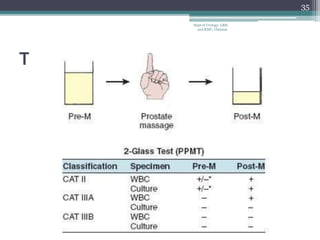
  • 104.
    Neuro–Urothelial Interactions • Urotheliumacts as a “mechanical sensor" of bladder distension and a “chemical sensor" of urine acidity, osmolality, and composition. • C-fiber afferent nerves may mediate these functions. • Substance P released by activated C-fiber afferents, is involved in nociception in the central and peripheral nervous systems and also functions as an inflammatory mediator. • inflammatory cascade with mast cell activation and up-regulation of adjacent nerves. • increased Nerve growth factor (NGF) , further confirming the role of neurogenic inflammation in IC. 105 Dept of Urology, GRH and KMC, Chennai.
  • 105.
    Mast Cell Activation •Mastocytosis occurs in 30% to 65%. • Contain vasoactive and inflammatory meditors. • Play a central role in the pathogenesis of neuroinflammatory conditions. • An immunoglobulin E–mediated hypersensitivity reaction or in response to substance P, cytokines, bacterial toxins, allergens, toxins, and stress. Dept of Urology, GRH and KMC, Chennai. 106
  • 106.
    Autoimmunity and Infection •IC/BPS has many features of an autoimmune disease— ▫ Chronicity. ▫ Exacerbations and remissions. ▫ Clinical response to steroids and immunosuppressives. ▫ High prevalence of antinuclear antibodies. ▫ Association with other autoimmune syndromes. • Cultures in IC patients are routinely negative, and PCR studies have not consistently identified bacterial genetic material. • However, an episode of cystitis can cause bladder dysfunction that results in alterations in bladder permeability, neurogenic up regulation and mast cell recruitment and activation. 107 Dept of Urology, GRH and KMC, Chennai.
  • 107.
    An Integrated Hypothesis •No universally accepted single pathological process. • Changes in urothelial permeability, sensory nerve stimulation, and mast cell activation are interrelated with multiple positive and negative feedback loops occurring simultaneously. • This vicious cycle contributes to the chronicity. 108 Dept of Urology, GRH and KMC, Chennai.
  • 108.
    Dept of Urology,GRH and KMC, Chennai.
  • 109.
    Associated disorders • Depression(whether this is an association or effect of the disorder is uncertain) • Panic disorders (sometimes be a part of a familial syndrome that includes IC, thyroid disorders, and other disorders of possible autonomic or neuromuscular control) • Migraine • Fibromyalgia • Chronic fatigue syndrome (CFS) • IBS • Vulvodynia • sexual, behavioural or emotional consequences. • Temporomandibular joint disorder • Allergy, asthma and SLE. • Sicca syndrome 110 Dept of Urology, GRH and KMC, Chennai.
  • 110.
    Diagnosis • The diagnosisof BPS can be made on the basis of exclusion of confusable diseases and confirmed by the recognition of the presence of the specific combination of symptoms and signs of BPS. • If the main urinary symptoms are not explained by a single diagnosis, the presence of a second diagnosis is possible. • BPS may occur together with confusable diseases. 111 Dept of Urology, GRH and KMC, Chennai.
  • 111.
    PBS/IC Differential Diagnosis •Recurrent UTI • Detrusor instability, Overactive bladder • Urethral Syndrome • Neurogenic Bladder • BOO • Pelvic Floor dysfunction • Radiation cystitis • Vaginitis • TB, Schistosomiasis • Carcinoma in situ • UB calculus/ lower ureteric calculus • Chronic prostatitis 112 Dept of Urology, GRH and KMC, Chennai.
  • 112.
    • The basicassessment should include a Careful history, Physical examination Laboratory examination to rule in symptoms that characterize BPS and rule out other confusable disorders. • A thorough history should include characteristics of the pain, any triggers (such as dietary factors), associated lower urinary tract symptoms, and any symptoms related to the other pelvic organs. Nature of the pain is important, with location (suprapubic), description (pain, pressure or discomfort), and exacerbating factors (increases with increasing bladder content, relieved by voiding, and aggravated by food or drink). • Previous pelvic operations, previous UTI, previous pelvic radiation treatment, and autoimmune diseases. 113 Dept of Urology, GRH and KMC, Chennai.
  • 113.
    Physical examination • Adetailed physical examination of the abdomen, pelvis, genitalia, and prostate in men should be performed. • Specific attention to areas of tenderness. • A musculoskeletal and focussed neurological examination should be included, and pelvic floor muscle examination for tenderness and trigger points should be included. 114 Dept of Urology, GRH and KMC, Chennai.
  • 114.
    Laboratory examination • Urineroutine anlysis and culture • Urine cultures are usually negative, frequently reveals pyuria. although urinalysis • Culture for TB should be included if sterile pyuria is present. • BPS/IC should be considered in the differential diagnosis of patients with symptoms of cystitis that are unresponsive to antibiotics and/or culture-negative. • BPS/IC needs to be considered in patients with symptoms of the overactive bladder (with and without pain) who do not 115 Dept of Urology, GRH and KMC, Chennai.
  • 115.
    significantly higher • Voidingdiary- Although BPS patients may voiding frequencies, smaller have voided volumes, and narrower ranges of voided volume compared with overactive bladder patients (Kim et al, 2014), one cannot distinguish between the two syndromes based on a voiding diary. • Use of a frequency volume chart is recommended in the initial evaluation.(The AUA guideline recommends a minimum one- day and ESSIC guideline recommends a 3 day chart. ) 116 Dept of Urology, GRH and KMC, Chennai.
  • 116.
    • Ultrasound/ pelvicimaging No role in diagnosis. Helps to rule out confusable disease. Mandatory if patient also have hematuria. 117 Dept of Urology, GRH and KMC, Chennai.
  • 117.
    Role of cystoscopy •No widely-accepted diagnostic cystoscopic features for BPS. • Should be performed as part of the initial evaluation in order to exclude other underlying pathology . • The advantages Photodocumentation of bladder inflammation (glomerulations, submucosal hemorrhages, ulcers) Bladder capacity determination, exclusion of other diseases. Delineation of the degree and sub-type inflammation (if biopsies are performed). If done under anesthesia with bladder distention, important in the identification of a Hunner lesion. 118 Dept of Urology, GRH and KMC, Chennai.
  • 118.
    • Glomerulations arenot specific for BPS/IC (Erickson, 1995; Waxman et al, 1998) • Potentially significant when seen in conjunction with the clinical criteria. • Can be seen after radiation therapy, patients with carcinoma, after exposure to toxic chemicals or chemotherapeutic agents. • The AUA, ICI guidelines suggest hydrodistension is optional as a diagnostic test due to conflicting evidence regarding its utility, but may be appropriate in specific cases. • Hydrodistension is therapeutic, with 20%–30% of patients experiencing symptom relief for 3–6 months. 119 Dept of Urology, GRH and KMC, Chennai.
  • 119.
    • After fillingto 80 cm of water pressure for 1 to 2 minutes, the bladder is drained and refilled. The terminal portion of the effluent is often blood- tinged. • Reinspection will reveal the glomerulations that develop throughout the bladder after distention and are not usually seen during examination without anesthesia 120 Dept of Urology, GRH and KMC, Chennai.
  • 120.
    • Hunner’s lesionsare described as a circumscript, reddened mucosal area with small vessels radiating towards a central scar, with a fibrin deposit or coagulum attached to this area. This site ruptures with increasing bladder distension, with petechial oozing of blood from the lesion and the mucosal margins in a waterfall manner. 121 Dept of Urology, GRH and KMC, Chennai.
  • 121.
    • Cystoscopic findingsare classified by the ESSIC(Europian Society for the study of IC) group as: A. B. C. Grade 0 - normal mucosa Grade I - petechiae in at least two quadrants Grade II - large submucosal bleeding (ecchymosis) D. Grade III - diffuse global mucosal bleeding E. Grade IV - mucosal disruption, with or without bleeding/oedema. The AUA and ICI guidelines suggest that cystoscopy is optional as a diagnostic test for IC/BPS, but should be performed if another pathological process is suspected. 122 Dept of Urology, GRH and KMC, Chennai.
  • 122.
    Intravesical Potassium Sensitivity Test(Parson’s Test) • By Parsons in 1994. • Dilute solution of potassium (40 mEq in 100 mL of water) is left in the bladder for 5 minutes. • The patient then rates the degree of provocation with urgency and frequency on a scale of 0 (no provocation) to 5 (marked provocation). • A positive test is defined by a change in score of 2 or more. • 75% of patients with IC have a positive KCl test. • The test is positive in detrusor instability (25%), radiation cystitis (100%), and bacterial cystitis (100%). 123 Dept of Urology, GRH and KMC, Chennai.
  • 123.
    124 Dept of Urology,GRH and KMC, Chennai.
  • 124.
    • Intravesical localanaesthetic challenge test • To determine whether pelvic pain is originating from the bladder. • This as an optional test for those cases in which there is uncertainty as to whether pain is originating from the bladder . • This diagnostic test is not recommended by most of the guidelines. 125 Dept of Urology, GRH and KMC, Chennai.
  • 125.
    Role of biopsy •Bladder biopsy is not required for the diagnosis of IC, as there are no pathognomonic histological features of the disease. • Useful to stratify patients with specific pathogenetic pathways and to exclude specific bladder diseases (eg, carcinoma-in-situ). • Positive findings on biopsy were considered to be inflammatory infiltrates, granulation tissue, detrusor mastocytosis, or intrafascicular fibrosis. • It is recommended that a total of 3 biopsies be taken from each lateral wall and dome, as well as a separate biopsy from any other abnormal lesions. 126 Dept of Urology, GRH and KMC, Chennai.
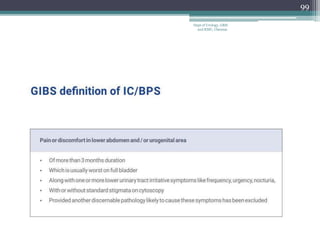
  • 126.
    127 Dept of Urology,GRH and KMC, Chennai.
  • 127.
    Urodynamics in BPS •The current consensus is that urodynamic evaluation is not required for diagnosis of IC but may provide useful information regarding the differential diagnosis of painful voiding disorders and the symptoms of the overactive bladder. • The 14% incidence of urodynamic DO in the BPS/IC patients (Nigro et al, 1997a) is probably close to what one might expect in the general population if studied urodynamically (Salavatore et al, 2003). • Pain on bladder filling that reproduces the patient’s symptoms is very suggestive of the diagnosis. 128 Dept of Urology, GRH and KMC, Chennai.
  • 128.
    • Poor Compliancein BPS patients, may be due to small capacity bladder. • The two problems(BPS and OAB) may coexist in 15% to 19% of patients but the pathophysiology is possibly very different. (Gajewski et al, 1997, Kirkemo et al, 1997) • It is not uncommon to find evidence of outlet obstruction in BPS/IC, which may be related to associated pelvic floor dysfunction (Cameron and Gajewski, 2009). 129 Dept of Urology, GRH and KMC, Chennai.
  • 129.
    Markers • Mast cella possible diagnostic marker for IC. • Twenty-seven mast cells per cubic millimeter is considered indicative of mastocytosis. • The results in the past have been very contradictory, and at this time, in terms of the use of mast cell criteria in diagnosis, remains uncertain. • The urine APF (antiproliferative factor) may prove to be an accurate marker of BPS/IC as It appears to have the highest sensitivity and specificity of the variety of possible markers tested. • Chemokine-10 and -1, IL-6, and NGF also investigated and found , 5 to 20-fold increase in BPS patients. 130 Dept of Urology, GRH and KMC, Chennai.
  • 130.
    Classification Ulcerative • The surfaceepithelium shows diffuse redness associated with 1 or more ulcerative patches surrounded by congested mucosa (ie, Hunner ulcer). • These ulcers may become apparent only after overdistention which leads to fissures and cracks in the bladder epithelium. • Less common and present in less than 10% of cases. • More resistant to therapy. • Ulcerative lesion may be transmural and associated with marked inflammatory changes and fibrosis. • Leads to progressive decrease in bladder capacity over time. 131 Dept of Urology, GRH and KMC, Chennai.
  • 131.
    Non-ulcerative • Absent cystoscopicfindings noted in the ulcerative type. • After overdistention, glomerulations can be seen. • Less severe. 132 Dept of Urology, GRH and KMC, Chennai.
  • 132.
    TREATMENT • Principles ofmanagement of patients with BPS are to improve quality of life and encourage realistic patient expectations. • Spectrum disease with a wide array of presenting symptoms and severities. • Treatment is tailored to the individual patient. • In most, single treatment modality is unsuccessful • step-wise multimodal approach to therapy is often adopted. starting with the most conservative. 133 Dept of Urology, GRH and KMC, Chennai.
  • 133.
    Conservative therapy • Stressreduction, exercise, warm tub baths, and efforts by the patient to maintain a normal lifestyle all contribute to overall quality of life (Whitmore, 1994). • Higher levels of stress were related to greater pain and urgency in patients with IC (Rothrock et al, 2001). • Biofeedback, soft-tissue massage, and other physical therapies may aid in muscle relaxation of the pelvic floor. • Acupuncture has been used for BPS/IC and many other chronic pain syndromes. 134 Dept of Urology, GRH and KMC, Chennai.
  • 134.
    • Elaborate dietaryrestrictions are unsupported by any literature. • Many patients do find their symptoms are adversely affected by specific foods and would do well to avoid them (Koziol et al, 1993; Koziol, 1994). • Often these include caffeine, alcohol, artificial sweeteners, hot peppers, and beverages that might acidify the urine, such as cranberry juice. • There is currently no recommended IC/PBS diet beyond avoidance of problem food items. 135 Dept of Urology, GRH and KMC, Chennai.
  • 135.
    • Pelvic FloorPhysical Therapy • Recommended as one of the early interventions for IC/PBS according to recent .AUA guidelines 136 Dept of Urology, GRH and KMC, Chennai.
  • 136.
    Pharmacologic • The goals Restorebladder surface integrity, modulate neuronal dysfunction Reduce any coexisting inflammation. therapy 137 Dept of Urology, GRH and KMC, Chennai.
  • 137.
    Sodium Pentosan Polysulfate •Based on the theory of defective epithelial permeability barrier(the GAG layer). • PPS is a synthetic sulfated polysaccharide, similar in structure to glycosaminoglycans (GAG) of the bladder surface • Heparin analogue, available in oral formulation (3% to 6% of which is excreted into the urine). • Only FDA approved drug in BPS. Recommended as a second- line therapy for IC/PBS. • Long-term experience with PPS in uncontrolled studies is consistent with efficacy in a subset of patients (Al-Zahrani and Gajewski 2011) that may drop below 30% of those initially treated (Jepsen et al, 1998). Dept of Urology, GRH and KMC, Chennai. 138
  • 138.
    • Adverse eventsin less than 4% of patients at the dose of 100 mg three times daily (Hanno, 1997) and included reversible alopecia, diarrhea, nausea, and rash. • However, randomized controlled trials have shown mixed results in its efficacy. • A 3- to 6-month treatment trial is usually required to see symptom improvement. 139 Dept of Urology, GRH and KMC, Chennai.
  • 139.
    • Amitriptyline • Theoretically,tricyclic agents have actions that might tend to stimulate predominantly β-adrenergic receptors in bladder body smooth musculature, an action that would further facilitate urine storage by decreasing the excitability of smooth muscle. • Titration is recommended starting at 25 mg and increasing to 75 – 100 mg. • Benefits appear substantial/ not significant benefit (Yang et al, 2014). • Contraindicated in cardiac patients. • Doses greater than 100 mg are associated with increased relative risk of sudden cardiac death (Ray et al, 2004). 140 Dept of Urology, GRH and KMC, Chennai.
  • 140.
    • Antihistamines • Cimetidinewas speculated to improve symptoms via competitive inhibition of the H2-receptor. • Currently recognized as a second-line therapy according to recent AUA guidelines. • Despite contradictory evidence, due to its low side effect profile and the potential benefit to a subset of IC/PBS patients, hydroxyzine remains a second-line therapy for IC/PBS. • Other Antidepressent - none showed clinically meaningful improvement of symptoms. 141 Dept of Urology, GRH and KMC, Chennai.
  • 141.
    Immunomodulator Drugs • Cyclosporine- calcineurin inhibitor, which blocks activation of T cells may be a viable option in refractory IC/PBS patients. fifth-line treatment option for IC/PBS. • Suplatast Tosilate (selectively suppresses IgE production and eosinophilia via suppression of helper T cells). Not approved. • Azathioprine and Chloroquine Derivatives • Mycophenolate Mofetil -current data remain sparse and unfavorable. • Adalimumab 142 Dept of Urology, GRH and KMC, Chennai.
  • 142.
    Others • L- arginine •Quercetin • Methotrexate • Montelucast • Nifedipine • Misoprostol • Dextroamphetamine • Phosphodiestrase inhibitors 143 Dept of Urology, GRH and KMC, Chennai.
  • 143.
    Analgesics • Most patientscan be helped markedly with medical pain management using medications including antidepressants, anticonvulsants, and opioids (Wesselmann et al, 1997). • Many nonopioid analgesics including acetaminophen and the nonsteroidal antiinflammatory drugs (NSAIDs) and even antispasmodic agents (Rummans, 1994) have a place. • Gabapentin, have efficacy in neuropathic pain disorders. • It demonstrates synergism with morphine in neuropathic pain and may give some benefit in CPPS and BPS/ IC (Sasaki et al, 2001). • Pregabalin is also reported to be effective. 144 Dept of Urology, GRH and KMC, Chennai.
  • 144.
    Role of antibiotics •No evidence to suggest that antibiotics have a place in the therapy of BPS in the absence of a culture documented infection. • This Standard is not intended to prevent antibiotic administration to antibiotic-naïve patients. • It is focused on preventing repeated or chronic antibiotic administration to patients for whom no relief was obtained in an initial course. • This Standard also is not intended to prevent prophylactic antibiotic administration (e.g., nightly for several months) to patients who present with recurrent UTIs and symptoms suggestive of IC/BPS between infections. 145 Dept of Urology, GRH and KMC, Chennai.
  • 145.
    INTRAVESICAL THERAPIES • DimethylSulfoxide (DMSO) • A mainstay of the treatment of BPS is the intravesical instillation of 50% DMSO (Sant, 1987). • DMSO actually desensitizes nociceptive pathways in the lower urinary tract. • Typical treatment regimens with weekly intravesical instillations comprise a total of 4 – 8 treatments, of 50 cc 50% DMSO instilled with 15 minute retention. • Durable response rates have been documented up to 12 months. • Efficacy rates ranged from 61% to 70%. • Currently, AUA guidelines recommend intravesical DMSO as a second-line therapy. 146 Dept of Urology, GRH and KMC, Chennai.
  • 146.
    Heparin • Heparin isa sulfated polysaccharide that is thought to augment the protective effect of the natural bladder surface mucus GAG/proteoglycan layer. • Also have anti-inflammatory properties, including inhibition of angiogenesis and fibroblast proliferation. • PPS , another GAG analogue,administered intravesically (300 mg twice weekly in 50 mL of normal saline) showed some modest benefit in a small trial. • Hyaluronic acid (nonsulfated GAG) has also been used intravesically. 40 mg dissolved in 40 mL of normal saline weekly for 4 to 6 weeks. • Efficacy remains unproven in controlled and blinded trials. 147 Dept of Urology, GRH and KMC, Chennai.
  • 147.
    • Buffered Lidocaine- combination of 200 mg of lidocaine with 8.4% sodium bicarbonate (10 mL total solution) without heparin showed a 30% response rate. • once daily for 5 consecutive days with one hour retention. • Intravesical alkalinised lignocaine for acute flare symptoms is recommended for short-term improvement in symptoms . • Statistically superior to a placebo cocktail. • Combination Adding alkalinized lidocaine to the heparin instillation provides better pain relief (Parsons, 2005). The addition of 8 mL of 2% lidocaine and 4 mL of 8.4% sodium bicarbonate may improve results (Welk and Teichman, 2008). 148 Dept of Urology, GRH and KMC, Chennai.
  • 148.
    • DMSO isoften administered as part of an “intravesical cocktail” (50 mL Rimso-50(DMSO) + 10 mg Kenalog(Triamcinolone acetonide) + 44 mEq sodium bicarbonate + 20,000 to 40,000 units intravesical heparin) weekly for 6 weeks. • Instillation of lidocaine/sodium bicarbonate and pentosan polysulphate have both been given a grade A recommendation by the EUA. 149 Dept of Urology, GRH and KMC, Chennai.
  • 149.
    Other intravesical therapies •Silver nitrate is not used in the current treatment of BPS. • Clorpactin - rarely used at the present time, and there is no current literature on this therapy. It is not a part of any guideline algorithm and has fallen out of favor. 150 Dept of Urology, GRH and KMC, Chennai.
  • 150.
    Intradetrusor therapies • OnabotulinumtoxinA(BTX-A) injection • Potent neurotoxin derived from the anaerobic bacterium Clostridium botulinum. • Acts by inhibiting the release of acetylcholine at the neuromuscular junction. • Also shown to reduce peripheral sensitization by inhibiting the release of several neuronal signaling markers, including glutamate and substance P. • A randomized study looking at hydrodistension versus BTX-A plus hydrodistension, demonstrated increased bladder capacity and long term pain relief in patients who received the combined therapy. • Limitations of the BTX-A data continue to be the variability in treatment protocols and lack of randomized studies. Dept of Urology, GRH and KMC, Chennai. 151
  • 151.
    • Reasonable treatmentfor BPS that is refractory to standard conservative, oral, and intravesical treatment (Mangera et al, 2011; Yokoyama et al,2012). • When injected into the trigone in 10-unit aliquots (100 units total), the risk of impaired bladder emptying seems to be minimized. • Triamcinolone Submucosal injection of 10 mL of 40 mg/mL triamcinolone acetonide injected in 0.5-mL aliquots was used for the treatment of Hunner lesions in 30 patients (Cox et al, 2009). Seventy percent of patients were very much improved, and duration of improvement was estimated to be 7 to 12 months. • BCG no place in the treatment of moderate to severe BPS/IC. 152 Dept of Urology, GRH and KMC, Chennai.
  • 152.
    Hydrodistension • If first-and second-line treatments have not provided acceptable symptom control. • AUA guidelines recommend low-pressure (60 – 80 cm H20), short duration (less than 10min) hydrodistension as a third-line therapy. • After initial cystoscopic examination, distend the bladder for 1 to 2 minutes at a pressure of 80 cm H2O. The bladder is emptied and then refilled to allow observation for glomerulations or ulceration. • A therapeutic hydraulic distention follows for another 8 minutes. Biopsy, if indicated, is performed after the second distention. Dept of Urology, GRH and KMC, Chennai. 153
  • 153.
    • High-pressure (>80cm H20), long-duration hydrodistension (>10 min) should be avoided given the risk of bladder rupture and sepsis. • Hydrodistension performed after instilling 10 mL of 4 % lidocaine intravesically demonstrated safe and therapeutic efficacy in IC/PBS patients in the office setting. • Relief of symptoms for a subset of patients, that also decline over time: at one month efficacy ranged from 30% to 54%; at two to three months, from 18% to 56%; at five to six months, from 0% to 7%. 154 Dept of Urology, GRH and KMC, Chennai.
  • 154.
    Fulguration of HunnerUlcers • fulguration of Hunner ulcers remains purely a treatment of IC/PBS symptoms rather than the underlying disease process. • In addition to fulguration, treatment of Hunner ulcers with Nd:YAG laser can be considered . • A single treatment of these lesions has demonstrated a lasting response of between 7 – 12 months. • Should not be used for glomerulation or in the nonulcerative form of the disease. • Thirdline treatment recommendation listed in the AUA guidelines with Grade C clinical evidence. Dept of Urology, GRH and KMC, Chennai. 155
  • 155.
    Neuromodulation • Pain diversionby transcutaneous electrical nerve stimulation (TENS) is routine in a variety of painful conditions. • Electrical nerve stimulation in IC is to relieve pain by stimulating myelinated afferents to activate segmental inhibitory circuits. • Electrode positioning immediately above the pubic symphysis. • High- or low frequency (2 to 50 Hz) TENS was employed for 30 -120 min. • Pain improved more than frequency. • Currently, neuromodulation is included as a fourth-line therapy for IC/ PBS treatment in recent AUA guidelines. • Percutaneous tibial nerve stimulation (PTNS) has also been used for IC/PBS. 156 Dept of Urology, GRH and KMC, Chennai.
  • 156.
    • Sacral S3nerve stimulation (SNS) is believed to block afferent bladder activity in somatic pathways as well as interfere with abnormal C-fiber activity. • Acupuncture used to treat frequency, urgency, and dysuria (Chang, 1988). Twenty-two of 26 patients treated at the SP 6 point had clinically symptomatic improvement. A study looking at both acupuncture and TENS in IC showed limited effects of both modalities (Geirsson et al, 1993). 157 Dept of Urology, GRH and KMC, Chennai.
  • 157.
    • Sympathectomy ,intraspinal alcohol injections have been used to treat, Differential sacral neurotomy Transvesical infiltration of the pelvic plexuses with phenol was • Most deinnervation procedures never gained popularity. 158 Dept of Urology, GRH and KMC, Chennai.
  • 158.
    Surgical Reconstruction/Urinary Diversion • Anoption after all trials of conservative treatment have failed. • Typically surgical options are reserved for patients with low anesthetic bladder capacity (<300 cc) and/ or Hunner ulcers, extremely severe, unresponsive disease. • Patients should be adequately counselled that pain relief is not guaranteed, and that pain may persist even if the bladder is removed. This is especially true for patients with non-ulcer BPS, or a preserved trigone (supratrigonal cystectomy) • The surgical procedures included ileal conduit, supratrigonal cystectomy and ileocystoplasty, continent urinary diversion (Kock pouch), continent orthotopic diversion, and cecocystoplasty. 159 Dept of Urology, GRH and KMC, Chennai.
  • 159.
    160 Dept of Urology,GRH and KMC, Chennai. • Supratrigonal cystectomy and the formation of an enterovesical anastomosis with bowel segments (substitution cystoplasty). • With regard to patient selection, the patients most likely to fail are those who describe the urethra as the main site of pain, those without Hunner's lesions and those with a larger bladder capacity under anesthesia. • Not all patients empty the bladder spontaneously after substitution cystoplasty, and may need clean intermittent catheterization. • Removing the trigone increases the risk of urinary retention, requiring intermittent catheterization.However, a preserved trigone may be a source for persistent pain and recurrent ulcers.
  • 160.
    • Diversion • Properlyselected refractory patient, urinary diversion will relieve frequency and nocturia and sometimes can relieve pain. • If frequency is perceived as a major problem, then diversion can almost certainly improve quality of life. • Pain can persist even after cystectomy, especially in nonulcer IC/BPS. • Total cystourethrectomy is recommended if the trigone is affected by IC or in patients with chronicity such that remission is considered extremely unlikely. 161 Dept of Urology, GRH and KMC, Chennai.
  • 161.
    162 Dept of Urology,GRH and KMC, Chennai.