By :Aous Abd Al-Jaleel khaleel
Candidat of I.B.M.S Uro.
Superviesd by: Prof. Dr. Saad Dakhil Farhan
Prostatic urethral lift
A minimally invasive treatment for
benign prostatic hyperplasia
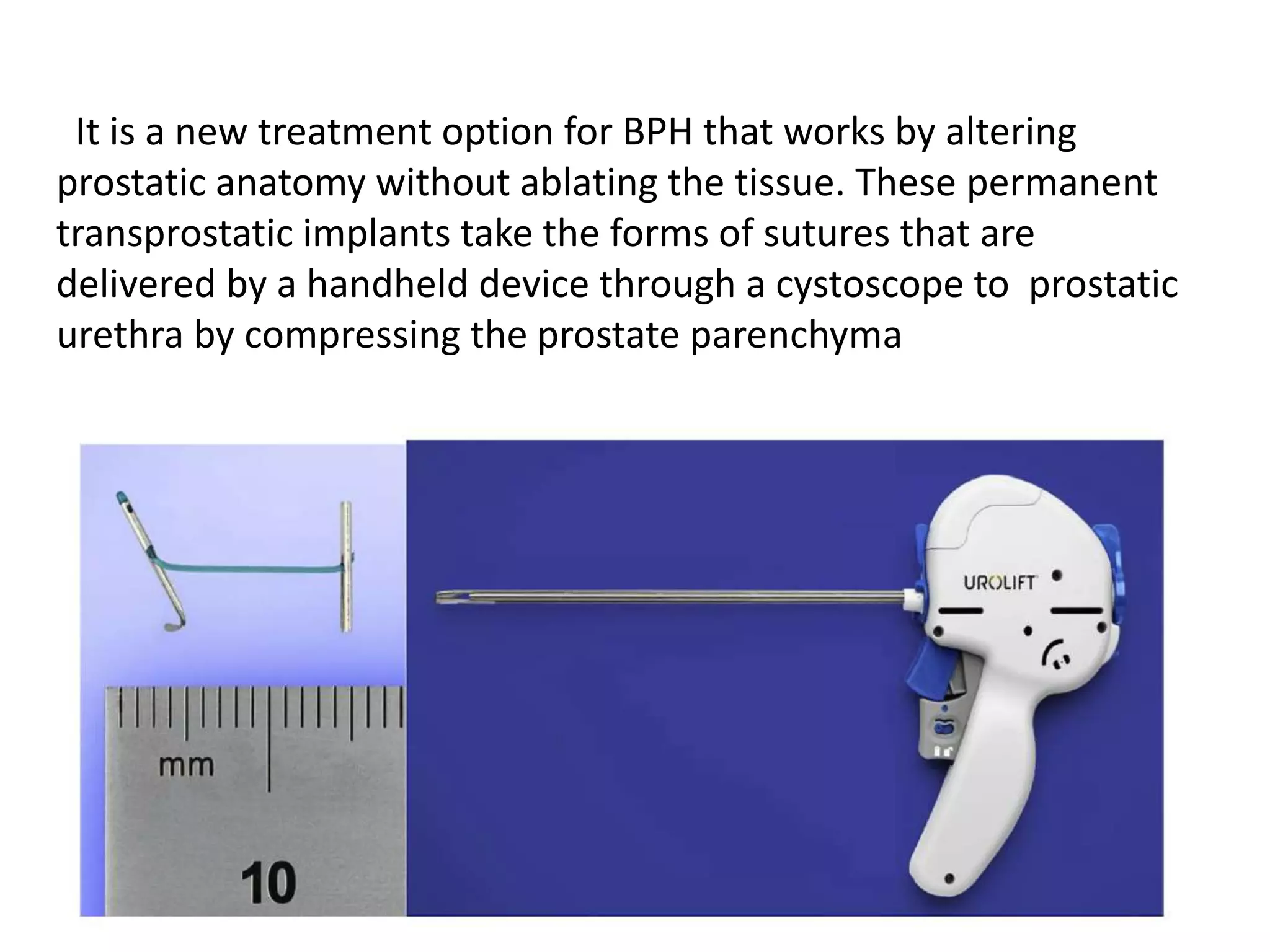
It is a new treatment option for BPH that works by altering
prostatic anatomy without ablating the tissue. These permanent
transprostatic implants take the forms of sutures that are
delivered by a handheld device through a cystoscope to prostatic
urethra by compressing the prostate parenchyma
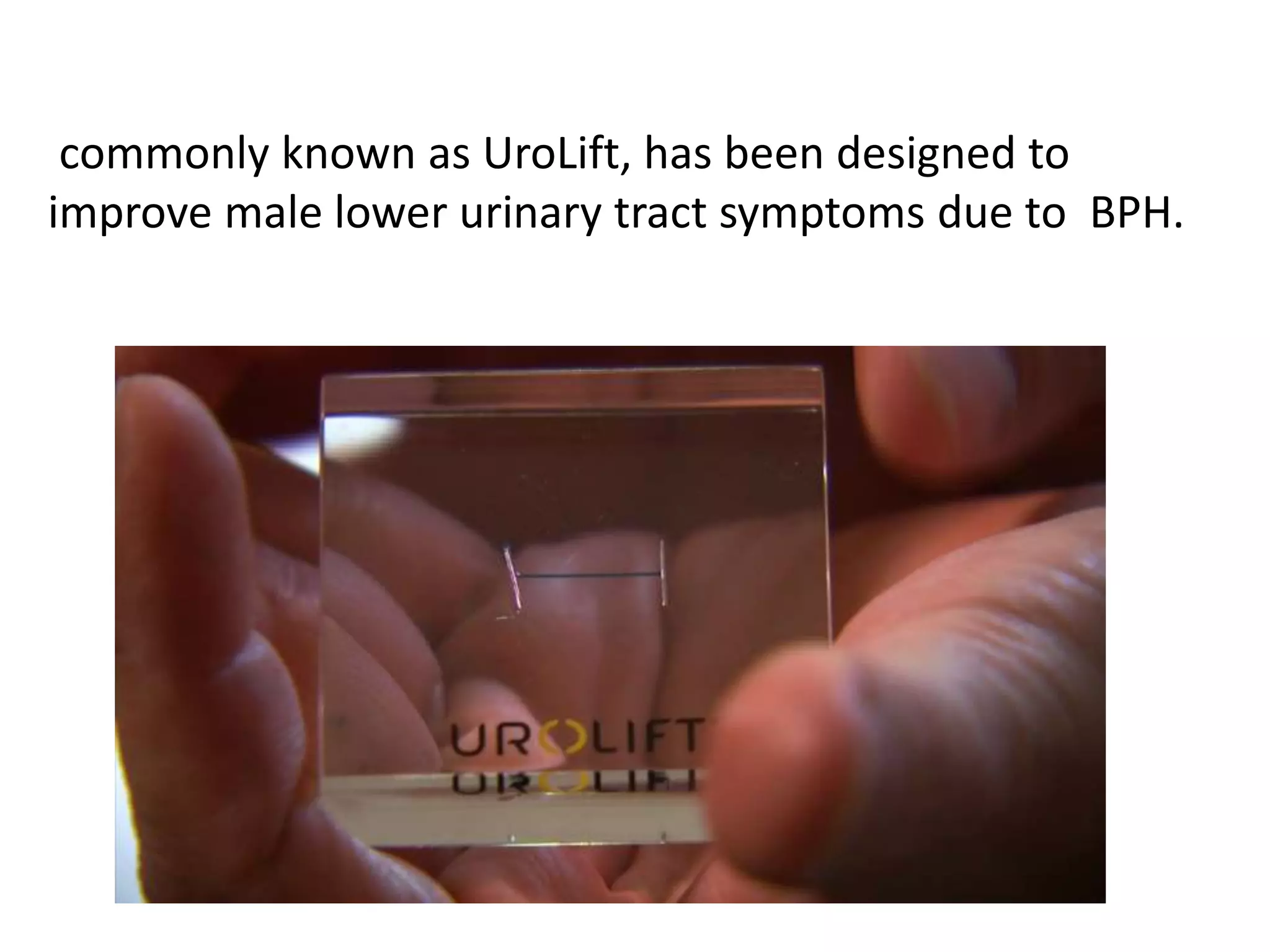
commonly known as UroLift, has been designed to
improve male lower urinary tract symptoms due to BPH.
• UroLift was introduced following a series of
planned studies that led to US Food and Drug
Administration approval in September 2013.
UroLift has recently been approved by the UK
National Institute for Clinical and Health
Excellence (September 2015) as effective and safe
and cost-effective for use in the UK health system.
The reasons behind Urolift innovation :
• Sexual Side Effects of BPH Treatment are Important
• Many men who are young with symptoms of enlarged prostate
• Many men who are older with symptoms of enlarged prostate
are sexually active
Benefits of transprostatic Implant :
• Rapid relief of symptoms within days of treatment.
• No need for daily medication .
• No risk of Erectile Dysfunction .
• No risk of Ejaculatory Dysfunction
• Out patient clinic
• Local anasthesia
The use of Urolift in treatment of Men with BPH.
• Men with Mild to Moderate Urinary Symptoms
• If moderate or good response to alpha-blockers,
Urolift is an option
• for men who prefer to avoid daily medications
• Men who progress on medical therapy for BPH
(symptoms worsen on flomax, proscar/avadart)
Who Should NOT Have Urolift:
• Abnormal DRE / elevated PSA.
• Men with complications that result from BPH that
are life-threatening:
• -Renal insufficiency
• -Recurrent UTI/Sepsis
Urolift is not a good option for the men with :
• Prostatic Bleeding
• which is hypervascularity and obstruction; very
friable tissue.
A prospective, randomized trial evaluated a total of
206 men, with 140 undergoing PUL and 66
undergoing a sham procedure (Roehrborn et al,
2013).
the study group was followed to 1 year.
The mean procedure time was 66 minutes, 99% of the
procedures were completed using local anesthesia.
Patients in the PUL group experienced IPSS reduction
from 22 at baseline to 18, 11, and 11 at 2 weeks, 3
months, and 12 months, respectively (all P < .001)
. improvement by 50% (11 points)
Maximum flow rates in the PUL group were improved
by 4.4 mL/sec at 3 months and 4.0 mL/sec at 1 year,
which were both statistically significant compared
with baseline.
Who is a Good Candidate for Urolift Procedure?
• Any age
• Any comorbidities – aspirin patients
• with cardiac, pulmonary disease.
• Should NOT have a UTI – pretreat UTI if
present
• Predominantly lateral prostatic lobe
obstruction
• Minimal or no median prostate lobe
obstruction
• Minimal or moderate PVR (<250 ml)
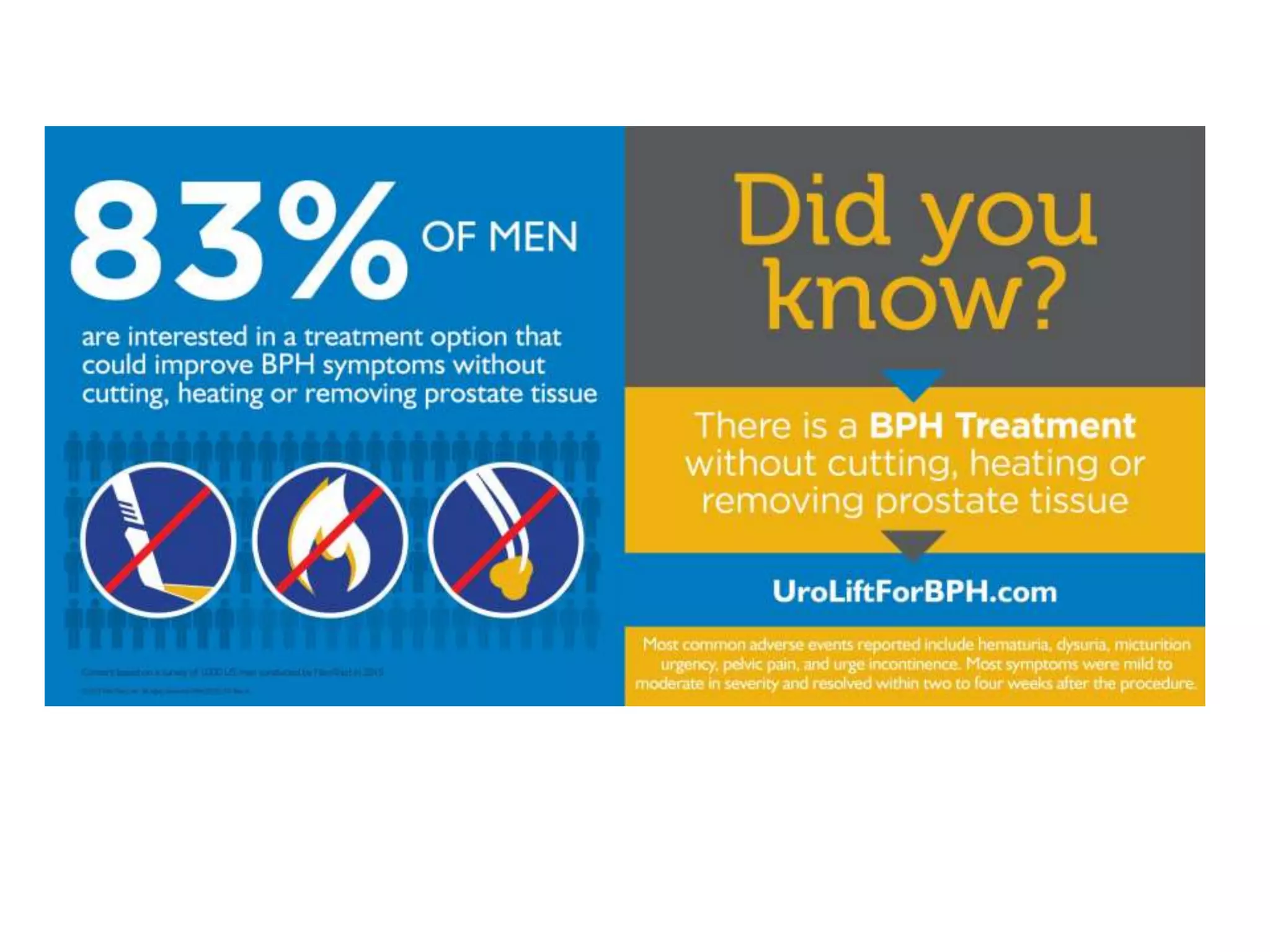
Side Effects of Urolift Implant :
Transient side effects lasting 1-2 weeks can occur
after cystoscopy and Urolift insertion. These side
effects include small amount of blood in urine,
frequent urination, mild burning with urination,
pelvic pain, urinary urgency and urge
incontinence. Symptoms typically resolve within
7-14 days after procedure. About 1% of patients
experience the symptoms 1 year after procedure.
Disadvantage :
Lack of Efficacy
Urolift is effective to 60-90% of patients.
However, 10% of patients require a different
surgical procedure within 3 years of treatmen.
Another 30% of patients either resume or start
medications for enlarged prostate after
treatment with Urolift.
Thank You
video

prostatic urethral lift

  • 1.
    By :Aous AbdAl-Jaleel khaleel Candidat of I.B.M.S Uro. Superviesd by: Prof. Dr. Saad Dakhil Farhan Prostatic urethral lift A minimally invasive treatment for benign prostatic hyperplasia
  • 2.
    It is anew treatment option for BPH that works by altering prostatic anatomy without ablating the tissue. These permanent transprostatic implants take the forms of sutures that are delivered by a handheld device through a cystoscope to prostatic urethra by compressing the prostate parenchyma
  • 3.
    commonly known asUroLift, has been designed to improve male lower urinary tract symptoms due to BPH.
  • 5.
    • UroLift wasintroduced following a series of planned studies that led to US Food and Drug Administration approval in September 2013. UroLift has recently been approved by the UK National Institute for Clinical and Health Excellence (September 2015) as effective and safe and cost-effective for use in the UK health system.
  • 6.
    The reasons behindUrolift innovation : • Sexual Side Effects of BPH Treatment are Important • Many men who are young with symptoms of enlarged prostate • Many men who are older with symptoms of enlarged prostate are sexually active
  • 7.
    Benefits of transprostaticImplant : • Rapid relief of symptoms within days of treatment. • No need for daily medication . • No risk of Erectile Dysfunction . • No risk of Ejaculatory Dysfunction • Out patient clinic • Local anasthesia
  • 9.
    The use ofUrolift in treatment of Men with BPH. • Men with Mild to Moderate Urinary Symptoms • If moderate or good response to alpha-blockers, Urolift is an option • for men who prefer to avoid daily medications • Men who progress on medical therapy for BPH (symptoms worsen on flomax, proscar/avadart)
  • 10.
    Who Should NOTHave Urolift: • Abnormal DRE / elevated PSA. • Men with complications that result from BPH that are life-threatening: • -Renal insufficiency • -Recurrent UTI/Sepsis Urolift is not a good option for the men with : • Prostatic Bleeding • which is hypervascularity and obstruction; very friable tissue.
  • 11.
    A prospective, randomizedtrial evaluated a total of 206 men, with 140 undergoing PUL and 66 undergoing a sham procedure (Roehrborn et al, 2013). the study group was followed to 1 year. The mean procedure time was 66 minutes, 99% of the procedures were completed using local anesthesia. Patients in the PUL group experienced IPSS reduction from 22 at baseline to 18, 11, and 11 at 2 weeks, 3 months, and 12 months, respectively (all P < .001) . improvement by 50% (11 points) Maximum flow rates in the PUL group were improved by 4.4 mL/sec at 3 months and 4.0 mL/sec at 1 year, which were both statistically significant compared with baseline.
  • 12.
    Who is aGood Candidate for Urolift Procedure? • Any age • Any comorbidities – aspirin patients • with cardiac, pulmonary disease. • Should NOT have a UTI – pretreat UTI if present • Predominantly lateral prostatic lobe obstruction • Minimal or no median prostate lobe obstruction • Minimal or moderate PVR (<250 ml)
  • 13.
    Side Effects ofUrolift Implant : Transient side effects lasting 1-2 weeks can occur after cystoscopy and Urolift insertion. These side effects include small amount of blood in urine, frequent urination, mild burning with urination, pelvic pain, urinary urgency and urge incontinence. Symptoms typically resolve within 7-14 days after procedure. About 1% of patients experience the symptoms 1 year after procedure.
  • 14.
    Disadvantage : Lack ofEfficacy Urolift is effective to 60-90% of patients. However, 10% of patients require a different surgical procedure within 3 years of treatmen. Another 30% of patients either resume or start medications for enlarged prostate after treatment with Urolift.
  • 15.