ْ‫ح‬َّ‫الر‬ ِ‫هللا‬ ِ‫م‬ْ‫س‬ِ‫ب‬
ِ‫ن‬ ٰ‫م‬
ِ‫م‬ْ‫ي‬ ِ‫ح‬َّ‫الر‬
IntheNameofAllah,MostGracious,MostMerciful.
U R O L O G Y
Business opportunities are
like buses. There's always
another one coming.
Richard Branson
Transurethral
Resection of
Prostate
(TURP)
Muhammad Nadeem Murtaza
Agenda
• Introduction
• Before the Procedure
• During the Procedure
• After the Procedure
• Risks
• Alternate Procedures
Introduction
A surgery used to treat urinary problems, caused by an
enlarged prostate such as benign prostatic hyperplasia
(BPH)
Removing the inside part of the prostate gland, using
electricity.
5
By inserting a resectoscope in your
urethra, so you don’t have any
incisions
Takes about 1 to 2 hours
An option for men who have
moderate to severe urinary problems
that haven't responded to
medication
TURP May Be Recommended If You
Have
6
• Difficulty emptying your
bladder
• Frequent urinary tract
infections
• Bleeding from the prostate
• Bladder stones with
prostate enlargement
• Extremely slow urination
• Damage to the kidneys
due to an inability to
urinate
• Getting up often at night to
urinate
• Bladder control issues due
to a large prostate
Equipment
•Antimicrobial prep
•Preoperative antibiotics
•Resectoscope with at least two wire
electrode loops
•Normal saline (bipolar), glycine,
sorbitol-mannitol, or otherwise
appropriate irrigation (monopolar)
•Large bore 3-way foley catheter
(typically 22 or 24 French with a 30cc
balloon
Equipment
•Continuous bladder irrigation (CBI)
tubing and connectors
•Sterile lubricant
•Foley bag (large)
•Catheter tipped syringe
•Catheter guide
•Bladder evacuator (Ellik or similar)
Personnel
9
Urologic surgeon –
performs the TURP
Anesthesia – maintains
anesthesia
Operating room nurse –
supports the surgeon
and anesthesia,
replaces irrigation bags,
obtains supplies as
needed, etc.
Surgical technician –
supports the surgeon,
prepares instruments,
empties the Ellik, etc.
Before the Procedure
10
The
following
steps are
always
taken
necessarily
before the
surgery
Complete physical exam
Treating and controlling diabetes, high blood pressure,
heart or lung problems, and other conditions
Get to know about the drugs, vitamins, and other
supplements, if patient is taking any.
11
Weeks Before Surgery
Ask the patient, to stop taking
medicines that can thin
blood, such as Aspirin,
Ibuprofen (Advil, Motrin),
Naproxen (Aleve, Naprosyn),
Vitamin E, Clopidogrel
(Plavix), Warfarin
(Coumadin), Apixaban
(Eliquis), and others.
On the day of Surgery
Tell patient NOT to eat or drink
anything after midnight the night
before surgery.
Advice patient to take the drugs
he have been told to take, with a
small sip of water.
Tell the patient when to arrive at
the hospital.
During the procedure
12
General or spinal anesthesia is used.
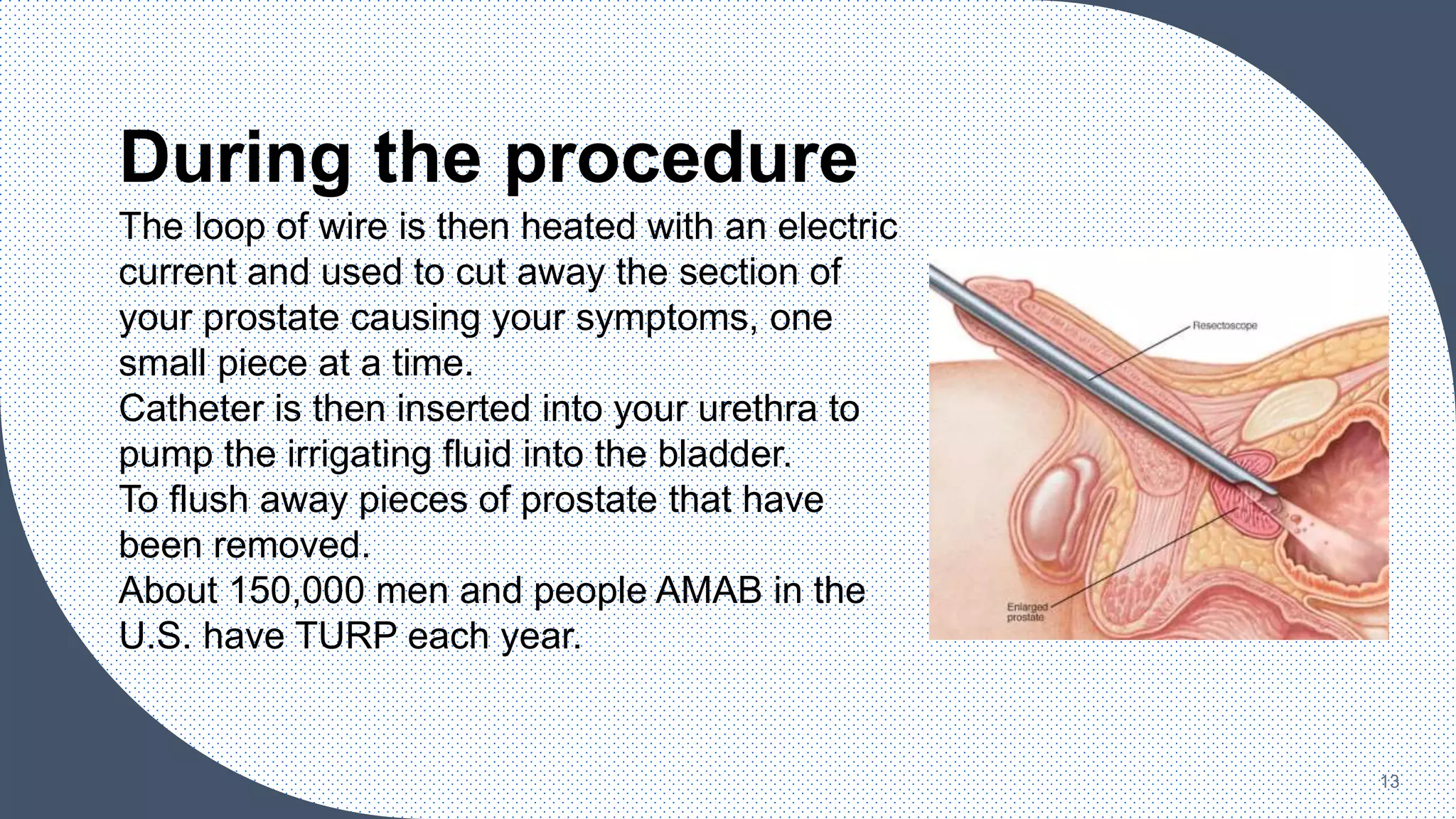
Resectoscope (a combined visual and surgical
thin metal tube containing a light, camera and
loop of wire) is inserted into the tip of your
penis
Extended through your urethra and into the
prostate area
Won't need to make any cuts (incisions) on the
outside of your body.
During the procedure
13
The loop of wire is then heated with an electric
current and used to cut away the section of
your prostate causing your symptoms, one
small piece at a time.
Catheter is then inserted into your urethra to
pump the irrigating fluid into the bladder.
To flush away pieces of prostate that have
been removed.
About 150,000 men and people AMAB in the
U.S. have TURP each year.
14
• Stay in the hospital for 1 to 3 days
• Will have a small tube, called a Foley
catheter, in your bladder to remove urine
(removed within 1 to 3 days)
• Bladder may be flushed with fluids (irrigated)
to keep it clear of clots
• urine will look bloody at first.
• Blood can also seep around the catheter
After the Procedure
15
• Help patient change positions in bed.
• Teach patient exercises to keep blood
flowing.
• Teach patient how to perform coughing and
deep breathing techniques. Patient should
do these every 3 to 4 hours.
• May need to wear tight stockings and use a
breathing device to keep your lungs clear
• May need medicine to relieve bladder
spasm.
After the Procedure
Risks
• Retrograde ejaculation
• Urinary incontinence
• Erectile dysfunction
• Urethral strictures
• Urinary tract infection (UTI)
• Urinary retention – the muscles that control the
bladder may be temporarily damaged
• Bleeding during or after the operation
TURP syndrome
17
Fluid used to wash the area around prostate during
procedure is absorbed into bloodstream.
Risk of TURP syndrome is estimated to be less than
1%
Initial symptoms of TURP syndrome include:
• feeling or being sick
• confusion and dizziness
• headache
• swelling of your tummy
• slow heartbeat
Alternative procedures
18
• PLASMA system – different instruments and
fluids are used to perform the procedure,
which is thought to lead to a lower risk of
TURP syndrome
• holmium laser enucleation of the prostate
(HoLEP) – a laser attached to a resectoscope
is used to cut away excess prostate tissue
• Prostatic urethral lift (UroLift)
19
• Transurethral resection or vaporisation of
the prostate (TUVP) – a thin tube called a
cystoscope is inserted into the urethra (the
tube that passes urine out of the body), and a
laser attached to the cystoscope fires pulses
of energy to cut or burn away prostate tissue
• Open prostatectomy is bigger operation
where a cut is made in your tummy to access
and remove the outer part of your prostate.
Thank You
20

Transurethral Resection of Prostrate (TURP).pptx

  • 1.
    ْ‫ح‬َّ‫الر‬ ِ‫هللا‬ ِ‫م‬ْ‫س‬ِ‫ب‬ ِ‫ن‬ٰ‫م‬ ِ‫م‬ْ‫ي‬ ِ‫ح‬َّ‫الر‬ IntheNameofAllah,MostGracious,MostMerciful. U R O L O G Y
  • 2.
    Business opportunities are likebuses. There's always another one coming. Richard Branson
  • 3.
  • 4.
    Agenda • Introduction • Beforethe Procedure • During the Procedure • After the Procedure • Risks • Alternate Procedures
  • 5.
    Introduction A surgery usedto treat urinary problems, caused by an enlarged prostate such as benign prostatic hyperplasia (BPH) Removing the inside part of the prostate gland, using electricity. 5 By inserting a resectoscope in your urethra, so you don’t have any incisions Takes about 1 to 2 hours An option for men who have moderate to severe urinary problems that haven't responded to medication
  • 6.
    TURP May BeRecommended If You Have 6 • Difficulty emptying your bladder • Frequent urinary tract infections • Bleeding from the prostate • Bladder stones with prostate enlargement • Extremely slow urination • Damage to the kidneys due to an inability to urinate • Getting up often at night to urinate • Bladder control issues due to a large prostate
  • 7.
    Equipment •Antimicrobial prep •Preoperative antibiotics •Resectoscopewith at least two wire electrode loops •Normal saline (bipolar), glycine, sorbitol-mannitol, or otherwise appropriate irrigation (monopolar) •Large bore 3-way foley catheter (typically 22 or 24 French with a 30cc balloon
  • 8.
    Equipment •Continuous bladder irrigation(CBI) tubing and connectors •Sterile lubricant •Foley bag (large) •Catheter tipped syringe •Catheter guide •Bladder evacuator (Ellik or similar)
  • 9.
    Personnel 9 Urologic surgeon – performsthe TURP Anesthesia – maintains anesthesia Operating room nurse – supports the surgeon and anesthesia, replaces irrigation bags, obtains supplies as needed, etc. Surgical technician – supports the surgeon, prepares instruments, empties the Ellik, etc.
  • 10.
    Before the Procedure 10 The following stepsare always taken necessarily before the surgery Complete physical exam Treating and controlling diabetes, high blood pressure, heart or lung problems, and other conditions Get to know about the drugs, vitamins, and other supplements, if patient is taking any.
  • 11.
    11 Weeks Before Surgery Askthe patient, to stop taking medicines that can thin blood, such as Aspirin, Ibuprofen (Advil, Motrin), Naproxen (Aleve, Naprosyn), Vitamin E, Clopidogrel (Plavix), Warfarin (Coumadin), Apixaban (Eliquis), and others. On the day of Surgery Tell patient NOT to eat or drink anything after midnight the night before surgery. Advice patient to take the drugs he have been told to take, with a small sip of water. Tell the patient when to arrive at the hospital.
  • 12.
    During the procedure 12 Generalor spinal anesthesia is used. Resectoscope (a combined visual and surgical thin metal tube containing a light, camera and loop of wire) is inserted into the tip of your penis Extended through your urethra and into the prostate area Won't need to make any cuts (incisions) on the outside of your body.
  • 13.
    During the procedure 13 Theloop of wire is then heated with an electric current and used to cut away the section of your prostate causing your symptoms, one small piece at a time. Catheter is then inserted into your urethra to pump the irrigating fluid into the bladder. To flush away pieces of prostate that have been removed. About 150,000 men and people AMAB in the U.S. have TURP each year.
  • 14.
    14 • Stay inthe hospital for 1 to 3 days • Will have a small tube, called a Foley catheter, in your bladder to remove urine (removed within 1 to 3 days) • Bladder may be flushed with fluids (irrigated) to keep it clear of clots • urine will look bloody at first. • Blood can also seep around the catheter After the Procedure
  • 15.
    15 • Help patientchange positions in bed. • Teach patient exercises to keep blood flowing. • Teach patient how to perform coughing and deep breathing techniques. Patient should do these every 3 to 4 hours. • May need to wear tight stockings and use a breathing device to keep your lungs clear • May need medicine to relieve bladder spasm. After the Procedure
  • 16.
    Risks • Retrograde ejaculation •Urinary incontinence • Erectile dysfunction • Urethral strictures • Urinary tract infection (UTI) • Urinary retention – the muscles that control the bladder may be temporarily damaged • Bleeding during or after the operation
  • 17.
    TURP syndrome 17 Fluid usedto wash the area around prostate during procedure is absorbed into bloodstream. Risk of TURP syndrome is estimated to be less than 1% Initial symptoms of TURP syndrome include: • feeling or being sick • confusion and dizziness • headache • swelling of your tummy • slow heartbeat
  • 18.
    Alternative procedures 18 • PLASMAsystem – different instruments and fluids are used to perform the procedure, which is thought to lead to a lower risk of TURP syndrome • holmium laser enucleation of the prostate (HoLEP) – a laser attached to a resectoscope is used to cut away excess prostate tissue • Prostatic urethral lift (UroLift)
  • 19.
    19 • Transurethral resectionor vaporisation of the prostate (TUVP) – a thin tube called a cystoscope is inserted into the urethra (the tube that passes urine out of the body), and a laser attached to the cystoscope fires pulses of energy to cut or burn away prostate tissue • Open prostatectomy is bigger operation where a cut is made in your tummy to access and remove the outer part of your prostate.
  • 20.