COLON CANCER
BY
DR Lamture Y.R
Professor in surgery
Datta Meghe institute of medical sciences
INTRODUCTION
• The 3rd most common malignancy worldwide ( ≥ 1.2 million new
cases annually).
• The incidence is greatest among males(37.4 per 100,000 vs. 29.9 per
100,000)
• 3rd leading cause of cancer-related deaths in US.
• An individual’s risk of developing cancer of the colon or rectum
increases with advancing age.
• Colorectal cancer occurs less frequently in the resource-poor world
than in resource-rich countries
ANATOMY
• The colon (large intestine) is 135 cm long, and is divided into caecum, ascending
colon, transverse colon, descending colon and sigmoid colon.
• The wall of the colon is composed of mucosa, submucosa, inner circular muscle
layer and outer longitudinal muscle layer which, in turn, is concen trated into 3
separate longitudinal strips—taeniae coli.
• Small pockets of fat fi lled peritoneum—appendices epiploicae is scattered all
over the colon except appendix, caecum and rectum.
• Haustra are sacculations between the taeniae.
• All the 3 above are important features of colon.
• Distended small and large intestine can be distinguished on an abdominal
radiograph as the small bowel has complete transverse markings caused by the
valvulae conniventes, while the colon has incomplete lines from the sacculation
caused by the taeniae.
BLOOD SUPPLY
• Iliocolic, right colic, and middle colic arteries which are branches
of superior mesenteric artery supply the colon from caecum to
splenic fl exure.
• Left colic, sigmoid, superior rectal arteries which are branches
of inferior mesenteric artery supply the descending and sigmoid
colon.
• The anastamotic arcade formed between the branches of
superior and inferior mesenteric arteries is called ‘arc of Riolan’.
• Venous drainage occurs into superior mesenteric vein (which
joins the splenic vein to form the portal vein) and inferior
mesenteric vein (drains into the splenic vein).
BLOOD SUPPLY
• Iliocolic, right colic, and middle
colic arteries which are branches
of superior mesenteric artery
supply the colon from caecum to
splenic fl exure.
• Left colic, sigmoid, superior rectal
arteries which are branches of
inferior mesenteric artery supply
the descending and sigmoid colon.
• The anastamotic arcade formed
between the branches of superior
and inferior mesenteric arteries is
called ‘arc of Riolan’.
• Venous drainage occurs into
superior mesenteric vein (which
joins the splenic vein to form the
portal vein) and inferior mesenteric
vein (drains into the splenic vein).
• Lymphatic Drainage
• Mucosa contains no lymph channels, so mucosal cancers rarely metastasize.
• Nodes are epicolic (located in the colonic wall), paracolic (located along the
inner margin), intermediate (located near mesenteric vessels), principal
(located near main mesenteric vesseles).
• Nerve Supply
• Colonic motility is under control of autonomic nervous system;
parasympathetic via vagi and pelvic nerves, sympathetic via superior and
inferior mesenteric ganglia.
AETIOLOGY OF COLON CANCER
• Diet:
• Red meat and saturated fat
• Cholesterol increases the bile acid concentration in the intestinal lumen which acts as cocarcinogen.
• High fibre diet protects the colon against cancer.
• Calcium in diet prevents colonic cancer by combining with bile salts and reducing bile salt concentration in the colon.
It directly acts on the colonic mucosal cells to reduce their proliferative potential.
• Diet with lack of fibre increases the risk. Diet with high fat increases the risk.
• Dietary vitamins A,C, E and zinc reduces the risk.
• Genetic:
• Carcinoma colon is more common in individuals with adenoma colon or with familial adenomatous polyposis(FAP),
Gardner’s syndrome, Turcot’s syndrome.
• Relatives of colonic cancer patient have got 2-4 times increased risk of developing carcinoma of colon.
ETIOLOGY
INCREASED INCIDENCE
• High-caloric diet
• High red meat consumption
• Overcooked red meat
• High saturated fats
• Excess alcohol consumption
• Cigarette smoking
• Sedentary lifestyle
• Obesity
• Diabetes
DECREASED INCIDENCE
• High-fibre diet
• Antioxidant vitamins
• Fresh fruit/vegetables
• Nonsteroidal anti-inflammatories
• Coffee
• High calcium
• High Magnesium
• Bisphosphonates
Etiology
• Long standing ulcerative colitis, Crohn’s disease has high risk of
colonic cancer. Crohn‘s disease is a premalignant condition but not as
much as ulcerative colitis.
• Alcohol and cigarette smoking
• Hereditary nonpolyposis colonic cancer (HNCC) has got high incidence
(25%) of synchronous and metachronous growth, so total colectomy
is needed.
• After cholecystectomy and ileal resection there is increased bile salts
and so more prone for carcinoma colon.
• Radiation increases the risk (mucinous type).
Pathogenesis
• Adenoma—carcinoma sequence
• Most of the colonic carcinoma develops from polyp/adenoma pathway.
• Normal epithelium →initiation by 5q loss APC gene →dysplasia (hyperproliferative) → DNA methylation
→early adenoma → 12p activation K ras → intermediate adenoma →18q loss DCC → late adenoma → action
by 17p loss p53 →carcinoma → spread .
• 80% of colorectal cancer arises from loss of heterozygosity (LOH) pathway.
• LOH pathway is due to APC gene defects (in FAP), K ras mutation altering the cell cycle [K ras binds to GTP
(guanosine triphosphate) hydrolyse to GDP which inactivates G protein normally; K ras mutation blocks GTP
hydrolyse leading into permanently active form of G protein causing carcinoma]; loss of DCC tumour
suppressor gene; mutation of tumour suppressor gene p53. LOH pathway is microsatellite stable (MSS) and
carries poor prognosis compared with MSI
• 20% of colorectal cancer develops from mutation from RER (Replication Error Repair) pathway wherein
repair mechanism of DNA replication error is lost. It causes microsatellite regions of genome to have
repeated sequences leading into error and is called as microsatellite instability (MSI). In colon, it is seen in
right side growths and is associated with better prognosis.
Pathology
• Annular (stenosing) type:
• It is more common on left side.
• Here the growth spreads round
the internal wall and so it often
presents with intestinal
obstruction.
• Ulcerative type:
• It is common on right side.
• Proliferative type:
• Common in right side. It is fleshy,
bulky and polypoid. It is less
malignant.
The four common macroscopic varieties of
carcinoma
of the colon: (1) annular; (2) tubular; (3)
ulcer; (4) cauliflower
Histology (WHO)
• Adenocarcinoma—90%.
• Mucinous adenocarcinoma—5-10%.
• Signet ring cell carcinoma.
• Small cell/oat cell carcinoma—rare—extremely poor prognosis.
• Squamous cell carcinoma.
• Undifferentiated carcinoma.
• Duke’s histological grading of carcinoma colon (Now modified Morson-Dawson)
• Grade I—low grade.
• Grade II—average grade.
• Grade III—high grade.
• Grade IV—anaplastic.
Spread
• Direct spread:
• Locally it can invade the bladder, obstruct ureter and so cause hydronephrosis.
• Can perforate and cause peritonitis/pericolic abscess/faecal fistula.
• Growth may get adherent to psoas muscle posteriorly.
• Carcinoma sigmoid colon can infiltrate and cause colovesical or colovaginal fistula. It can infiltrate ureter,
ovary, uterus etc. It can cause pericolic abscess or abscess in lateral abdominal wall.
• Lymphatic spread:
• Growth through lymphatics spreads to pericolic, epicolic, intermediate and principal group of lymph nodes.
• Groups of lymph nodes draining colon
• N1: Nodes immediately adjacent to bowel wall.
• N2: Nodes along ileocolic/right colic/middle colic/ left colic/sigmoid arteries.
• N3: Nodes near the origin of SMA and IMA.
• Nodal spread in carcinoma colon is sequential from N1 →N2 → N3.
• Blood spread:
• 40% of carcinoma colon spreads to liver via portal veins.
• Secondaries may be either solitary or multiple, present as liver with hard, umbilicated nodules.
• Rarely it spreads to bone, lung, skin.
Staging of colon cancer
1. Duke’s
2. Modified Duke’s
3. Astler-Coller’s grading of colorectal/rectal cancer
4. Cunderson-Sosin staging
5. TNM staging of colorectal cancer
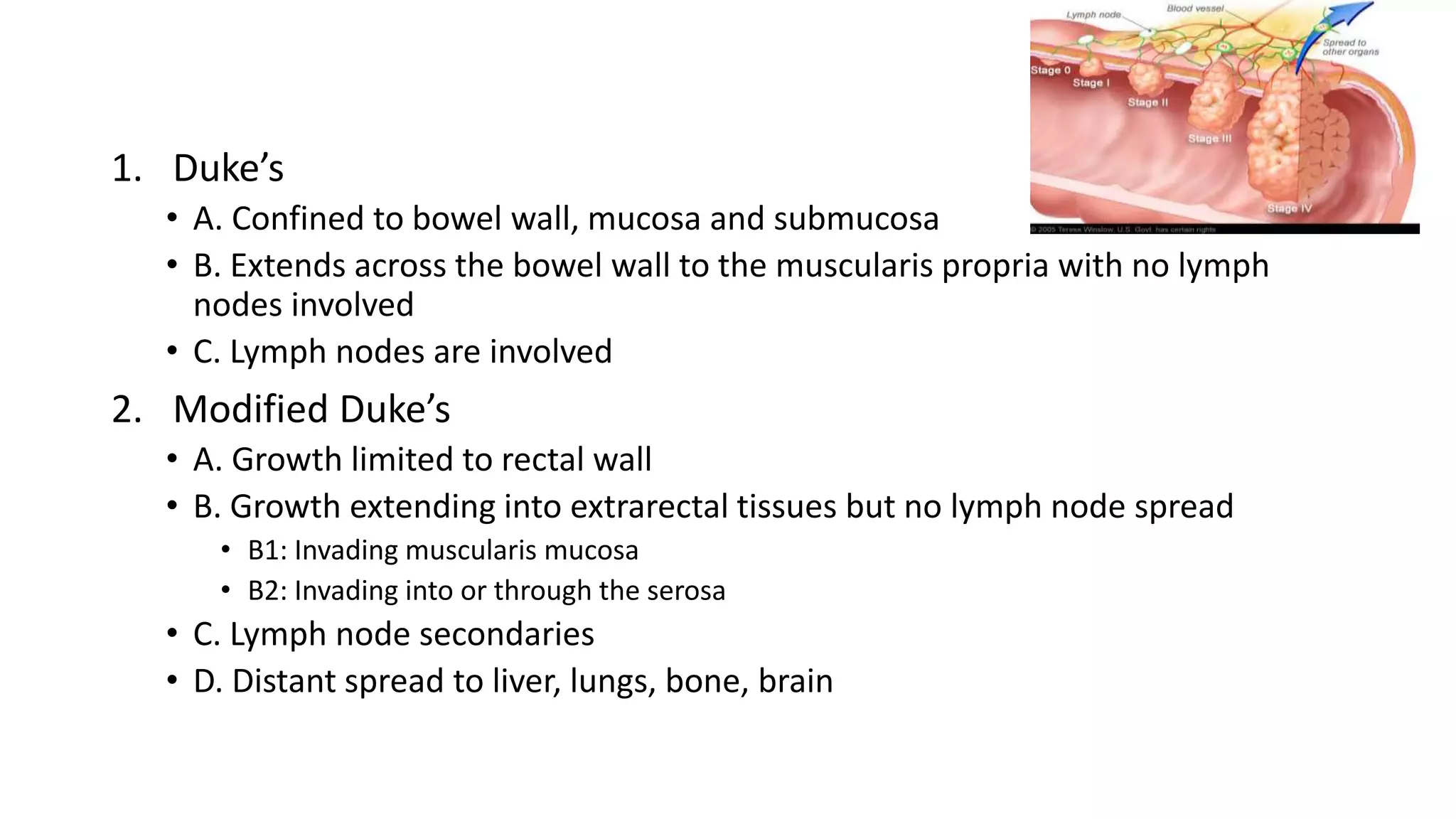
1. Duke’s
• A. Confined to bowel wall, mucosa and submucosa
• B. Extends across the bowel wall to the muscularis propria with no lymph
nodes involved
• C. Lymph nodes are involved
2. Modified Duke’s
• A. Growth limited to rectal wall
• B. Growth extending into extrarectal tissues but no lymph node spread
• B1: Invading muscularis mucosa
• B2: Invading into or through the serosa
• C. Lymph node secondaries
• D. Distant spread to liver, lungs, bone, brain
3. Astler-Coller’s grading of colorectal/rectal cancer
• A. Intramucosal
• B1 Involvement up to muscularis propria
• B2 Spread through the wall in to peritoneum
• C1 B1 + involvement of lymph nodes
• C2 B2 + involvement of lymph nodes
• D Distant spread
4. Cunderson-Sosin staging
• A – Lesion limited to mucosa
• B1 – Through mucosa, still within bowel wall
• B2 – Through entire bowel wall
• B3 – Adherent to or invading adjacent organs
• C1 – Limited to bowel wall but node +ve
• C2 – Through entire bowel wall, node +ve
• C3 – Adherent, invasion to adjacent organs with node +ve
• D – Distant spread / locally unresectable tumour
5. TNM staging of colorectal cancer
• Tumour—T
• Tx – Primary tumour cannot be assessed
• T0 – No evidence of tumour
• Tis – Carcinoma in situ—intraepithelial/invasion into lamina propria
• T1 – Invasion into submucosa
• T2 – Invasion into muscularis propria
• T3 – Invasion into pericolorectal tissues/fat
• T4a – Invasion into surface of the visceral peritoneum
• T4b – Direct Invasion or adherent to adjacent structures/organs
• Regional nodes—N
• Nx – Nodes cannot be assessed
• N0 – No nodal spread
• N1 – Regional nodes 1-3 involved
• N1a – 1 regional node
• N1b – 2 to 3 regional nodes
• N1c – Tumour deposits in serosa/mesentery/nonperitonealised pericolic or perirectal tissues without regional Nodes
• N2 – Regional nodes 4 or more involved
• N2a – 4-6 regional nodes
• N2b – 7 or more regional nodes
• Distant metastases—M
• M0 – No distant spread
• M1 – Distant spread present
• M1a – Spread confined to one organ or site—liver/lung/ovary/nonregional nodes;
• M1b – Spread to more than one organ or site/peritoneum
• Histological grade—G
• Gx – Grade cannot be assessed
• G1 – Well differentiated
• G2 – Moderately differentiated
• G3 – Poorly differentiated
• G4 – Undifferentiated
• Residual tumour—R
• R0 – No residual tumour after resection
• R1 – Microscopic residual tumour after resection
• R2 – Macroscopic residual tumour after resection
STAGE T N M
0 Tis N0 M0
I T1
T2
N0
N0
M0
M0
IIA T3 N0 MO
IIB T4a N0 M0
IIC T4b N0 M0
IIIA T1-T2 N1-N2a M0
IIIB T3-T4a
T2-T3
T1-T2
N1
N2a
N2b
M0
M0
MO
IIIC T4a
T3-T4a
T4b
N2a
N2b
N1-N2
M0
M0
M0
IVA T any N any M1a
IVB T any N any M1b
Clinical features
• m/c >50 yrs, familial type may present in
younger group
• M:F = 3:2
• Loss of appetite and weight
• Anemia
• Abdominal discomfort
• Mass per abdomen
• Rectal bleeding
• Acute intestinal obstruction (20%)
• At stage IV disease (20%) as first
presentation
Clinical features
Clinical features
• Right sided growth commonly presents with anaemia, palpable mass in the right
iliac fossa
• Carcinoma caecum can presents like acute appendicitis or intussusception with
intestinal obstruction
• Left sided growth presents with colicky pain, altered bowel habits (alternating
constipation and diarrhoea), palpable lump, distension of abdomen due to sub
acute/chronic obstruction.
• Later may present like complete colonic obstruction. Tenesmus, with passage of
blood and mucus, with alternate constipation and diarrhoea, is common.
• Bladder symptoms may warn colovesical fistula.
• Closed loop obstruction can occur in transverse colon growth (stricture type
causing block) with competent ileocaecal valve. Enormously dilated right sided
colon is prone for stercoral ulcer, perforation and faecal peritonitis.
• Enlarged liver with multiple hard secondaries, ascites, rectovesical secondaries,
palpable left supraclavicular lymph nodes are other presentations.
Diagnosis
• Complete history
• Physical examination / DRE
• Routine blood investigations
• Radiological investigations
• Biopsy
• Other investigations
Blood investigations
• CBC – low Hb, PCV, haematocrit,
• ESR.
• KFT
• LFT – low protein, increased Alk phosphatase, SGPT
• RBS
• PTINR
• Faecal occult blood test (FOBT)—it is nonspecific test for peroxidase
contained in haemoglobin. It is simple but with low specificity
Radiological investigations
• Xray Abdomen
• Xray chest
• Usg abdomen pelvis - to see
secondaries in liver, peritoneum,
lymph node status, rectovesical
secondaries.
• Barium enema: Shows irregular fi
lling defect and ‘apple core’ lesion
(in left sided carcinoma).
• It also helps in finding colonic
polyps (Air-contrast barium
enema).
Carcinoma colon. (A) Barium enema study,(B) Air-contrast study.
• Double-contrast barium
enema has traditionally
been used and shows a
cancer of the colon as
a constant irregular
filling defect, often
described as looking
like an apple-core
X-rays with barium enema showing narrowing in sigmoid region and irregularity
CT SCAN
• CT is used as a diagnostic tool in
patients with palpable abdominal
masses
• Also to see local spread, invasion,size
and extent, stage, nodal status and
liver secondaries
• Computed tomography (CT) virtual
colonoscopy, which is extremely
sensitive investigation
• CT colonography (Virtual
colonoscopy)—it is helical CT 3
dimensional intraluminal colon
imaging. Virtual colonoscopy of the right colon. Computed
tomography scan of the abdomen showing a caecal
tumour ;
Formatted ‘virtual’ image of the same lesion as in first
CT scan picture
showing growth in the
right side colon.
• MRI – for local spread in cases of rectal cancer
• PET /CT- for distant metastasis
Endoscopy
• Colonoscopy is the most accurate and
most complete method for evaluating the
entire colon. It allows identification of
small polyps (< 1 cm), allows biopsy,
polypectomy, control of bleeding,
stricture dilatation if needed.
• Problem as a screening method is—prior
need for mechanical bowel preparation
• Colonoscopy and biopsy confirms the
diagnosis
• CEA (Carcinoembryonic antigen):
• Uses in colorectal cancers are:
a. Preoperative levels >7.5 ng/ml signifies poor prognosis.
b. If postoperative level does not fall, it indicates either incomplete resection, or
occult metastasis elsewhere.
c. Increase CEA during follow-up indicates recurrence or secondaries.
• A slow rise indicates loco regional disease.
• A rapid rise signifies metastasis.
• It is not useful in assessing follow-up in poorly differentiated adenocarcinoma
as such tumour will not produce CEA.
Treatment
I.Surgery
II.Radiation
III.chemotherapy
IV.Targeted molecular therapies.
Treat -Depend on the location & extent of disease.
SURGERY
• The operations described are
designed to remove the primary
tumour and its draining
locoregional lymph nodes
• It is more important that healthy
bowel, free of tension or distal
obstruction, is used to construct
an anastomosis and that
patients are adequately
nourished and free from active
infection if anastomotic leakage
is to be avoided.
Levels of resection in growths in different
portions of the colon.
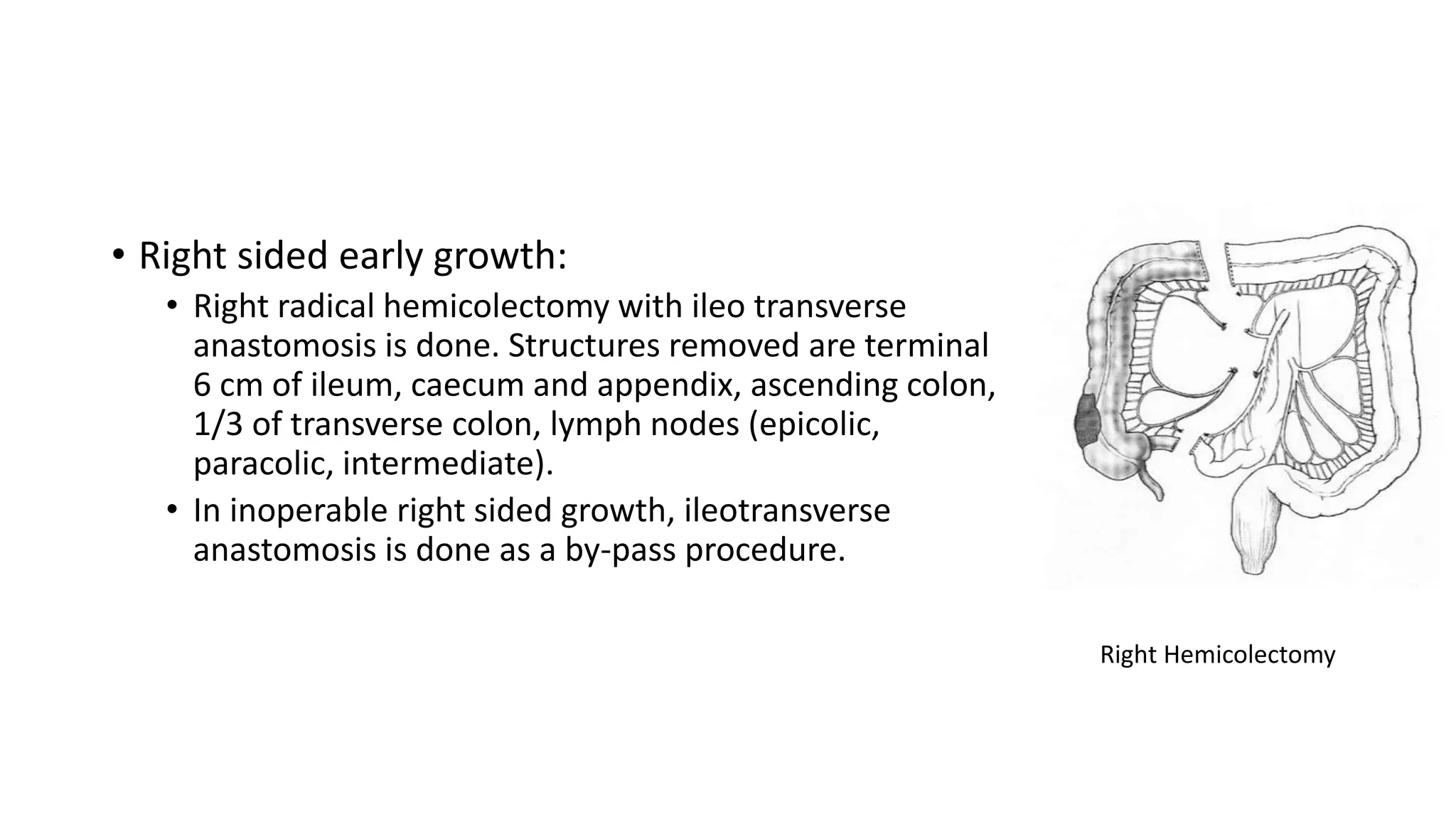
• Right sided early growth:
• Right radical hemicolectomy with ileo transverse
anastomosis is done. Structures removed are terminal
6 cm of ileum, caecum and appendix, ascending colon,
1/3 of transverse colon, lymph nodes (epicolic,
paracolic, intermediate).
• In inoperable right sided growth, ileotransverse
anastomosis is done as a by-pass procedure.
Right Hemicolectomy
• Transverse colon growth
• An extended right hemicolectomy is the
procedure done for transverse colon
growth which includes division of right
colic, middle colic arteries at their origin,
with removal of terminal 6 cm ileum,
ascending and transverse colon;
anastomosing terminal ileum and
proximal part of the descending colon—
ileocolic.
• Alternatively, in mid-transverse colon
growth, transverse colon with both
flexures can be removed; anastomosing
cut ends of ascending and descending
colon—colocolic.
Extended right Hemicolectomy
• Left sided early growth:
• Left radical hemicolectomy is
done, where in left ½ of
transverse colon and descending
colon is removed along with
lymph nodes.
Left Hemicolectomy
• Adjuvant Therapy
• Chemotherapy
• Indications for chemotherapy
• Positive nodes.
• T4 lesions.
• Venous (microscopic) spread.
• Signet cell type.
• Poorly differentiated tumour/aneuploidy.
• Changes in CEA level.
• Postoperative chemotherapy is used commonly. Occasionally also given
preoperatively
Common regimens
• Radiotherapy
• Usually there is no role for RT as tumour is radioresistant.
• It is often used in locally advanced tumour, infiltrating the psoas
major muscle or lateral abdominal wall, left sided colonic growth.
• It is also used in inoperable recurrent tumour
• Follow-up of Carcinoma Colon
• For 3 years at regular intervals, once in 3-6 months.
• This is by:
• Regular CEA analysis
• Ultrasound abdomen
• Barium enema X-ray
• Colonoscopy
• Rise in CEA is a definite indicator of recurrence or secondaries. In patients
with raised CEA, radioisotope antibody study will show the site of recurrence
or secondaries
• Serum alkaline phosphatase
Colon cancer
Colon cancer
Colon cancer
Colon cancer
Colon cancer
Colon cancer
Colon cancer

Colon cancer

  • 1.
    COLON CANCER BY DR LamtureY.R Professor in surgery Datta Meghe institute of medical sciences
  • 2.
    INTRODUCTION • The 3rdmost common malignancy worldwide ( ≥ 1.2 million new cases annually). • The incidence is greatest among males(37.4 per 100,000 vs. 29.9 per 100,000) • 3rd leading cause of cancer-related deaths in US. • An individual’s risk of developing cancer of the colon or rectum increases with advancing age. • Colorectal cancer occurs less frequently in the resource-poor world than in resource-rich countries
  • 3.
    ANATOMY • The colon(large intestine) is 135 cm long, and is divided into caecum, ascending colon, transverse colon, descending colon and sigmoid colon. • The wall of the colon is composed of mucosa, submucosa, inner circular muscle layer and outer longitudinal muscle layer which, in turn, is concen trated into 3 separate longitudinal strips—taeniae coli. • Small pockets of fat fi lled peritoneum—appendices epiploicae is scattered all over the colon except appendix, caecum and rectum. • Haustra are sacculations between the taeniae. • All the 3 above are important features of colon. • Distended small and large intestine can be distinguished on an abdominal radiograph as the small bowel has complete transverse markings caused by the valvulae conniventes, while the colon has incomplete lines from the sacculation caused by the taeniae.
  • 4.
    BLOOD SUPPLY • Iliocolic,right colic, and middle colic arteries which are branches of superior mesenteric artery supply the colon from caecum to splenic fl exure. • Left colic, sigmoid, superior rectal arteries which are branches of inferior mesenteric artery supply the descending and sigmoid colon. • The anastamotic arcade formed between the branches of superior and inferior mesenteric arteries is called ‘arc of Riolan’. • Venous drainage occurs into superior mesenteric vein (which joins the splenic vein to form the portal vein) and inferior mesenteric vein (drains into the splenic vein).
  • 5.
    BLOOD SUPPLY • Iliocolic,right colic, and middle colic arteries which are branches of superior mesenteric artery supply the colon from caecum to splenic fl exure. • Left colic, sigmoid, superior rectal arteries which are branches of inferior mesenteric artery supply the descending and sigmoid colon. • The anastamotic arcade formed between the branches of superior and inferior mesenteric arteries is called ‘arc of Riolan’. • Venous drainage occurs into superior mesenteric vein (which joins the splenic vein to form the portal vein) and inferior mesenteric vein (drains into the splenic vein).
  • 6.
    • Lymphatic Drainage •Mucosa contains no lymph channels, so mucosal cancers rarely metastasize. • Nodes are epicolic (located in the colonic wall), paracolic (located along the inner margin), intermediate (located near mesenteric vessels), principal (located near main mesenteric vesseles). • Nerve Supply • Colonic motility is under control of autonomic nervous system; parasympathetic via vagi and pelvic nerves, sympathetic via superior and inferior mesenteric ganglia.
  • 7.
    AETIOLOGY OF COLONCANCER • Diet: • Red meat and saturated fat • Cholesterol increases the bile acid concentration in the intestinal lumen which acts as cocarcinogen. • High fibre diet protects the colon against cancer. • Calcium in diet prevents colonic cancer by combining with bile salts and reducing bile salt concentration in the colon. It directly acts on the colonic mucosal cells to reduce their proliferative potential. • Diet with lack of fibre increases the risk. Diet with high fat increases the risk. • Dietary vitamins A,C, E and zinc reduces the risk. • Genetic: • Carcinoma colon is more common in individuals with adenoma colon or with familial adenomatous polyposis(FAP), Gardner’s syndrome, Turcot’s syndrome. • Relatives of colonic cancer patient have got 2-4 times increased risk of developing carcinoma of colon.
  • 8.
    ETIOLOGY INCREASED INCIDENCE • High-caloricdiet • High red meat consumption • Overcooked red meat • High saturated fats • Excess alcohol consumption • Cigarette smoking • Sedentary lifestyle • Obesity • Diabetes DECREASED INCIDENCE • High-fibre diet • Antioxidant vitamins • Fresh fruit/vegetables • Nonsteroidal anti-inflammatories • Coffee • High calcium • High Magnesium • Bisphosphonates
  • 9.
    Etiology • Long standingulcerative colitis, Crohn’s disease has high risk of colonic cancer. Crohn‘s disease is a premalignant condition but not as much as ulcerative colitis. • Alcohol and cigarette smoking • Hereditary nonpolyposis colonic cancer (HNCC) has got high incidence (25%) of synchronous and metachronous growth, so total colectomy is needed. • After cholecystectomy and ileal resection there is increased bile salts and so more prone for carcinoma colon. • Radiation increases the risk (mucinous type).
  • 11.
    Pathogenesis • Adenoma—carcinoma sequence •Most of the colonic carcinoma develops from polyp/adenoma pathway. • Normal epithelium →initiation by 5q loss APC gene →dysplasia (hyperproliferative) → DNA methylation →early adenoma → 12p activation K ras → intermediate adenoma →18q loss DCC → late adenoma → action by 17p loss p53 →carcinoma → spread . • 80% of colorectal cancer arises from loss of heterozygosity (LOH) pathway. • LOH pathway is due to APC gene defects (in FAP), K ras mutation altering the cell cycle [K ras binds to GTP (guanosine triphosphate) hydrolyse to GDP which inactivates G protein normally; K ras mutation blocks GTP hydrolyse leading into permanently active form of G protein causing carcinoma]; loss of DCC tumour suppressor gene; mutation of tumour suppressor gene p53. LOH pathway is microsatellite stable (MSS) and carries poor prognosis compared with MSI • 20% of colorectal cancer develops from mutation from RER (Replication Error Repair) pathway wherein repair mechanism of DNA replication error is lost. It causes microsatellite regions of genome to have repeated sequences leading into error and is called as microsatellite instability (MSI). In colon, it is seen in right side growths and is associated with better prognosis.
  • 12.
    Pathology • Annular (stenosing)type: • It is more common on left side. • Here the growth spreads round the internal wall and so it often presents with intestinal obstruction. • Ulcerative type: • It is common on right side. • Proliferative type: • Common in right side. It is fleshy, bulky and polypoid. It is less malignant. The four common macroscopic varieties of carcinoma of the colon: (1) annular; (2) tubular; (3) ulcer; (4) cauliflower
  • 13.
    Histology (WHO) • Adenocarcinoma—90%. •Mucinous adenocarcinoma—5-10%. • Signet ring cell carcinoma. • Small cell/oat cell carcinoma—rare—extremely poor prognosis. • Squamous cell carcinoma. • Undifferentiated carcinoma. • Duke’s histological grading of carcinoma colon (Now modified Morson-Dawson) • Grade I—low grade. • Grade II—average grade. • Grade III—high grade. • Grade IV—anaplastic.
  • 14.
    Spread • Direct spread: •Locally it can invade the bladder, obstruct ureter and so cause hydronephrosis. • Can perforate and cause peritonitis/pericolic abscess/faecal fistula. • Growth may get adherent to psoas muscle posteriorly. • Carcinoma sigmoid colon can infiltrate and cause colovesical or colovaginal fistula. It can infiltrate ureter, ovary, uterus etc. It can cause pericolic abscess or abscess in lateral abdominal wall. • Lymphatic spread: • Growth through lymphatics spreads to pericolic, epicolic, intermediate and principal group of lymph nodes. • Groups of lymph nodes draining colon • N1: Nodes immediately adjacent to bowel wall. • N2: Nodes along ileocolic/right colic/middle colic/ left colic/sigmoid arteries. • N3: Nodes near the origin of SMA and IMA. • Nodal spread in carcinoma colon is sequential from N1 →N2 → N3. • Blood spread: • 40% of carcinoma colon spreads to liver via portal veins. • Secondaries may be either solitary or multiple, present as liver with hard, umbilicated nodules. • Rarely it spreads to bone, lung, skin.
  • 15.
    Staging of coloncancer 1. Duke’s 2. Modified Duke’s 3. Astler-Coller’s grading of colorectal/rectal cancer 4. Cunderson-Sosin staging 5. TNM staging of colorectal cancer
  • 16.
    1. Duke’s • A.Confined to bowel wall, mucosa and submucosa • B. Extends across the bowel wall to the muscularis propria with no lymph nodes involved • C. Lymph nodes are involved 2. Modified Duke’s • A. Growth limited to rectal wall • B. Growth extending into extrarectal tissues but no lymph node spread • B1: Invading muscularis mucosa • B2: Invading into or through the serosa • C. Lymph node secondaries • D. Distant spread to liver, lungs, bone, brain
  • 17.
    3. Astler-Coller’s gradingof colorectal/rectal cancer • A. Intramucosal • B1 Involvement up to muscularis propria • B2 Spread through the wall in to peritoneum • C1 B1 + involvement of lymph nodes • C2 B2 + involvement of lymph nodes • D Distant spread 4. Cunderson-Sosin staging • A – Lesion limited to mucosa • B1 – Through mucosa, still within bowel wall • B2 – Through entire bowel wall • B3 – Adherent to or invading adjacent organs • C1 – Limited to bowel wall but node +ve • C2 – Through entire bowel wall, node +ve • C3 – Adherent, invasion to adjacent organs with node +ve • D – Distant spread / locally unresectable tumour
  • 18.
    5. TNM stagingof colorectal cancer • Tumour—T • Tx – Primary tumour cannot be assessed • T0 – No evidence of tumour • Tis – Carcinoma in situ—intraepithelial/invasion into lamina propria • T1 – Invasion into submucosa • T2 – Invasion into muscularis propria • T3 – Invasion into pericolorectal tissues/fat • T4a – Invasion into surface of the visceral peritoneum • T4b – Direct Invasion or adherent to adjacent structures/organs • Regional nodes—N • Nx – Nodes cannot be assessed • N0 – No nodal spread • N1 – Regional nodes 1-3 involved • N1a – 1 regional node • N1b – 2 to 3 regional nodes • N1c – Tumour deposits in serosa/mesentery/nonperitonealised pericolic or perirectal tissues without regional Nodes • N2 – Regional nodes 4 or more involved • N2a – 4-6 regional nodes • N2b – 7 or more regional nodes
  • 19.
    • Distant metastases—M •M0 – No distant spread • M1 – Distant spread present • M1a – Spread confined to one organ or site—liver/lung/ovary/nonregional nodes; • M1b – Spread to more than one organ or site/peritoneum • Histological grade—G • Gx – Grade cannot be assessed • G1 – Well differentiated • G2 – Moderately differentiated • G3 – Poorly differentiated • G4 – Undifferentiated • Residual tumour—R • R0 – No residual tumour after resection • R1 – Microscopic residual tumour after resection • R2 – Macroscopic residual tumour after resection
  • 20.
    STAGE T NM 0 Tis N0 M0 I T1 T2 N0 N0 M0 M0 IIA T3 N0 MO IIB T4a N0 M0 IIC T4b N0 M0 IIIA T1-T2 N1-N2a M0 IIIB T3-T4a T2-T3 T1-T2 N1 N2a N2b M0 M0 MO IIIC T4a T3-T4a T4b N2a N2b N1-N2 M0 M0 M0 IVA T any N any M1a IVB T any N any M1b
  • 21.
    Clinical features • m/c>50 yrs, familial type may present in younger group • M:F = 3:2 • Loss of appetite and weight • Anemia • Abdominal discomfort • Mass per abdomen • Rectal bleeding • Acute intestinal obstruction (20%) • At stage IV disease (20%) as first presentation Clinical features
  • 22.
    Clinical features • Rightsided growth commonly presents with anaemia, palpable mass in the right iliac fossa • Carcinoma caecum can presents like acute appendicitis or intussusception with intestinal obstruction • Left sided growth presents with colicky pain, altered bowel habits (alternating constipation and diarrhoea), palpable lump, distension of abdomen due to sub acute/chronic obstruction. • Later may present like complete colonic obstruction. Tenesmus, with passage of blood and mucus, with alternate constipation and diarrhoea, is common. • Bladder symptoms may warn colovesical fistula. • Closed loop obstruction can occur in transverse colon growth (stricture type causing block) with competent ileocaecal valve. Enormously dilated right sided colon is prone for stercoral ulcer, perforation and faecal peritonitis. • Enlarged liver with multiple hard secondaries, ascites, rectovesical secondaries, palpable left supraclavicular lymph nodes are other presentations.
  • 23.
    Diagnosis • Complete history •Physical examination / DRE • Routine blood investigations • Radiological investigations • Biopsy • Other investigations
  • 24.
    Blood investigations • CBC– low Hb, PCV, haematocrit, • ESR. • KFT • LFT – low protein, increased Alk phosphatase, SGPT • RBS • PTINR
  • 25.
    • Faecal occultblood test (FOBT)—it is nonspecific test for peroxidase contained in haemoglobin. It is simple but with low specificity
  • 26.
    Radiological investigations • XrayAbdomen • Xray chest • Usg abdomen pelvis - to see secondaries in liver, peritoneum, lymph node status, rectovesical secondaries. • Barium enema: Shows irregular fi lling defect and ‘apple core’ lesion (in left sided carcinoma). • It also helps in finding colonic polyps (Air-contrast barium enema). Carcinoma colon. (A) Barium enema study,(B) Air-contrast study.
  • 27.
    • Double-contrast barium enemahas traditionally been used and shows a cancer of the colon as a constant irregular filling defect, often described as looking like an apple-core X-rays with barium enema showing narrowing in sigmoid region and irregularity
  • 28.
    CT SCAN • CTis used as a diagnostic tool in patients with palpable abdominal masses • Also to see local spread, invasion,size and extent, stage, nodal status and liver secondaries • Computed tomography (CT) virtual colonoscopy, which is extremely sensitive investigation • CT colonography (Virtual colonoscopy)—it is helical CT 3 dimensional intraluminal colon imaging. Virtual colonoscopy of the right colon. Computed tomography scan of the abdomen showing a caecal tumour ; Formatted ‘virtual’ image of the same lesion as in first CT scan picture showing growth in the right side colon.
  • 29.
    • MRI –for local spread in cases of rectal cancer • PET /CT- for distant metastasis
  • 30.
    Endoscopy • Colonoscopy isthe most accurate and most complete method for evaluating the entire colon. It allows identification of small polyps (< 1 cm), allows biopsy, polypectomy, control of bleeding, stricture dilatation if needed. • Problem as a screening method is—prior need for mechanical bowel preparation • Colonoscopy and biopsy confirms the diagnosis
  • 31.
    • CEA (Carcinoembryonicantigen): • Uses in colorectal cancers are: a. Preoperative levels >7.5 ng/ml signifies poor prognosis. b. If postoperative level does not fall, it indicates either incomplete resection, or occult metastasis elsewhere. c. Increase CEA during follow-up indicates recurrence or secondaries. • A slow rise indicates loco regional disease. • A rapid rise signifies metastasis. • It is not useful in assessing follow-up in poorly differentiated adenocarcinoma as such tumour will not produce CEA.
  • 32.
  • 33.
    SURGERY • The operationsdescribed are designed to remove the primary tumour and its draining locoregional lymph nodes • It is more important that healthy bowel, free of tension or distal obstruction, is used to construct an anastomosis and that patients are adequately nourished and free from active infection if anastomotic leakage is to be avoided. Levels of resection in growths in different portions of the colon.
  • 34.
    • Right sidedearly growth: • Right radical hemicolectomy with ileo transverse anastomosis is done. Structures removed are terminal 6 cm of ileum, caecum and appendix, ascending colon, 1/3 of transverse colon, lymph nodes (epicolic, paracolic, intermediate). • In inoperable right sided growth, ileotransverse anastomosis is done as a by-pass procedure. Right Hemicolectomy
  • 35.
    • Transverse colongrowth • An extended right hemicolectomy is the procedure done for transverse colon growth which includes division of right colic, middle colic arteries at their origin, with removal of terminal 6 cm ileum, ascending and transverse colon; anastomosing terminal ileum and proximal part of the descending colon— ileocolic. • Alternatively, in mid-transverse colon growth, transverse colon with both flexures can be removed; anastomosing cut ends of ascending and descending colon—colocolic. Extended right Hemicolectomy
  • 36.
    • Left sidedearly growth: • Left radical hemicolectomy is done, where in left ½ of transverse colon and descending colon is removed along with lymph nodes. Left Hemicolectomy
  • 37.
    • Adjuvant Therapy •Chemotherapy • Indications for chemotherapy • Positive nodes. • T4 lesions. • Venous (microscopic) spread. • Signet cell type. • Poorly differentiated tumour/aneuploidy. • Changes in CEA level. • Postoperative chemotherapy is used commonly. Occasionally also given preoperatively
  • 38.
  • 39.
    • Radiotherapy • Usuallythere is no role for RT as tumour is radioresistant. • It is often used in locally advanced tumour, infiltrating the psoas major muscle or lateral abdominal wall, left sided colonic growth. • It is also used in inoperable recurrent tumour
  • 40.
    • Follow-up ofCarcinoma Colon • For 3 years at regular intervals, once in 3-6 months. • This is by: • Regular CEA analysis • Ultrasound abdomen • Barium enema X-ray • Colonoscopy • Rise in CEA is a definite indicator of recurrence or secondaries. In patients with raised CEA, radioisotope antibody study will show the site of recurrence or secondaries • Serum alkaline phosphatase