Osama Aldweik
Prostate Cancer
Al-Quds university Dr. Mahmoud Allan
Yahya Ghannam
ProstateCancer
Prostate cancer is one of the most common types of cancer in men.
Prostate cancer usually grows slowly and initially remains confined to the prostate gland,
where it may not cause serious harm.
3
Epidemiology
Incidence: most common
cancer in men.
Mortality: in 2020, second
leading cause of cancer
deaths in men in the US.
Main Types of Prostate Cancer
Adenocarcinoma of the Prostate: The vast majority of prostate cancers fall into this category. Adenocarcinomas form in
the glandular cells that produce prostate fluid.
Acinar adenocarcinoma: This is the most common subtype of prostate adenocarcinoma //high psa
Ductal adenocarcinoma: This subtype is less common, and tends to be more aggressive. It starts in the cells lining the
ducts that carry prostate fluid.
Small Cell Carcinoma of the Prostate: This is a rare and aggressive neuroendocrine tumor. Neuroendocrine cells are
involved in hormone production and release.
Transitional Cell Carcinoma of the Prostate: This subtype starts in the transitional cells lining the urethra. It's similar to
bladder cancer.
Squamous Cell Carcinoma of the Prostate: These cancers start from the flat cells covering the prostate. They are
relatively uncommon.
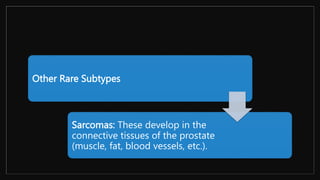
Other Rare Subtypes
Sarcomas: These develop in the
connective tissues of the prostate
(muscle, fat, blood vessels, etc.).
Risk factors
• - Advanced age (> 50 years)
• - Family history
• - African-American descent
• - Genetic disposition (e.g., BRCA2, Lynch syndrome)
• - Dietary factors: high intake of saturated fat, well-done meats, and calcium
8
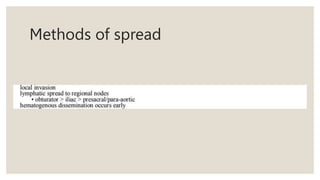
Methods of spread
Symptoms
• Typically asymptomatic
- Early prostate cancers detected during screening tests.
•
•
Patients may present with features of complicated lower urinary tract symptoms (LUTS), including:
- Urinary retention
◦
◦
◦
- Hematuria
- Incontinence
- Flank pain (due to hydronephrosis)
Advanced prostate cancer can manifest with:
◦ Constitutional symptoms: fatigue, loss of appetite, unintentional weight loss
◦ Features of metastatic disease; examples include:
▪
▪
▪
Bone pain (due to bone metastasis, especially in the lumbosacral spine)
Neurological deficits (e.g., due to vertebral fracture causing spinal cord compression)
Lymphedema (caused by obstructing metastases in the lymph nodes)
9
Diagnostic Parameters
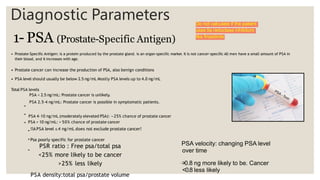
• Prostate-Specific Antigen: is a protein produced by the prostate gland. is an organ-specific marker. It is not cancer-specific All men have a small amount of PSA in
their blood, and it increases with age.
• Prostate cancer can increase the production of PSA, also benign conditions
• PSA level should usually be below 2.5 ng/mL Mostly PSA levels up to 4.0 ng/mL
Total PSA levels
▪
▪
▪
PSA < 2.5 ng/mL: Prostate cancer is unlikely.
PSA 2.5–4 ng/mL: Prostate cancer is possible in symptomatic patients.
▪
▪
PSA > 10 ng/mL: > 50% chance of prostate cancer
▪
1- PSA (Prostate-Specific Antigen)
!!APSA level ≤4 ng/mL does not exclude prostate cancer!
Psa poorly specific for prostate cancer
PSR ratio : Free psa/total psa
<25% more likely to be cancer
>25% less likely
PSA density:total psa/prostate volume
PSA 4–10 ng/mL (moderately elevated PSA): ∼25% chance of prostate cancer
PSA velocity: changing PSA level
over time
Type y
>
our t
e
xt
0.8 ng more likely to be. Cancer
<0.8 less likely
Do not calculate if the patient
uses 5a reductase inhibitors
like finastiride
2- Digital rectal examination (DRE)
A DRE should be performed in individuals with elevated serum PSA
• features suggestive of prostate cancer include:
◦
◦
◦
1
1
- Localized indurated nodules on an otherwise smooth surface
- Prostatomegaly, lobar asymmetry
- Hard nontender nodules
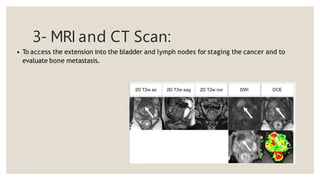
3- MRI and CT Scan:
• To access the extension into the bladder and lymph nodes for staging the cancer and to
evaluate bone metastasis.
4- Transrectal ultrasound of the prostate
predominantly used to guide prostate biopsy if there is clinical suspicion of prostate cancer
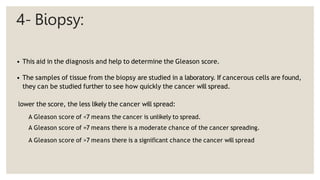
4- Biopsy:
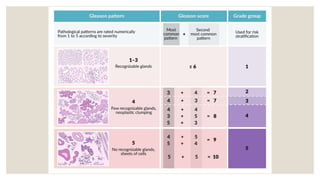
• This aid in the diagnosis and help to determine the Gleason score.
• The samples of tissue from the biopsy are studied in a laboratory. If cancerous cells are found,
they can be studied further to see how quickly the cancer will spread.
lower the score, the less likely the cancer will spread:
A Gleason score of <7 means the cancer is unlikely to spread.
A Gleason score of =7 means there is a moderate chance of the cancer spreading.
A Gleason score of >7 means there is a significant chance the cancer will spread
Staging
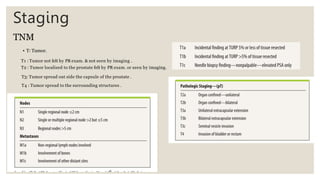
TNM
▪ T: Tumor.
- T3: Tumor spread out side the capsule of the prostate .
- T4 : Tumor spread to the surrounding structures .
- T1 : Tumor not felt by PR exam. & not seen by imaging .
- T2 : Tumor localized to the prostate felt by PR exam. or seen by imaging.
Treatment
• The treatment of prostate cancer can vary based on the stage and aggressiveness of the
cancer. Common treatment options include:
• 1.Active Surveillance: For low-risk cases, monitoring the cancer's progression with
scheduled DRE, PSA, prostate biopsies, and mpMRI
▪
▪
- Gonadotropin-releasing antagonist (e.g., degarelix)
- GnRH receptor antagonist (e.g., relugolix)
◦ *Surgical castration: bilateral orchiectomy
•
◦
◦
◦
◦
◦
Adverse effects
- Increased risk of osteoporosis and fractures
- Sexual dysfunction: loss of libido, erectile dysfunction
- Change in body image: gynecomastia, weight gain, decreased penile and testicular size
-Change in body composition: increased body fat, decreased muscle mass
- Increased cardiovascular and metabolic risk Anemia
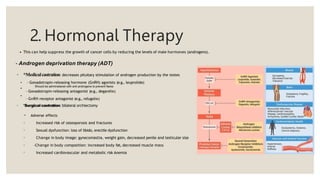
2. Hormonal Therapy
• This can help suppress the growth of cancer cells by reducing the levels of male hormones (androgens).
- Androgen deprivation therapy (ADT)
◦ *Medicalcastration: decreases pituitary stimulation of androgen production by the testes
▪ - Gonadotropin-releasing hormone (GnRH) agonists (e.g., leuprolide)
Should be administared with anti androgens to prevent flares
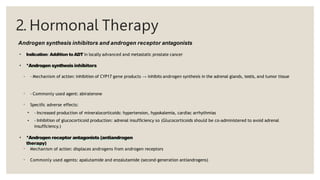
Androgen synthesis inhibitors and androgen receptor antagonists
• Indication: Addition to ADT in locally advanced and metastatic prostate cancer
• *Androgen synthesis inhibitors
◦ - Mechanism of action: inhibition of CYP17 gene products → inhibits androgen synthesis in the adrenal glands, testis, and tumor tissue
◦ - Commonly used agent: abiraterone
◦
▪
▪
Specific adverse effects:
- Increased production of mineralocorticoids: hypertension, hypokalemia, cardiac arrhythmias
- Inhibition of glucocorticoid production: adrenal insufficiency so (Glucocorticoids should be co-administered to avoid adrenal
insufficiency.)
• *Androgen receptor antagonists (antiandrogen
therapy)
◦ Mechanism of action: displaces androgens from androgen receptors
◦ Commonly used agents: apalutamide and enzalutamide (second-generation antiandrogens)
2. Hormonal Therapy
Treatment
• 3. Radiation Therapy: External beam radiation or brachytherapy (internal radiation) can be used to target
and destroy cancer cells After prostatectomy
◦ Life expectancy more. Than 10
◦ years
T1+T2
• 4. Surgery: Prostatectomy is the surgical removal of the prostate gland. This can be done
◦ through open surgery or minimally invasive procedures like laparoscopy or robotic-assisted
surgery.
• 5. Chemotherapy: Sometimes used for advanced cases that don't respond to other
treatments.
• 6. Management of bone health

Prostate cancer power point presentation

  • 1.
    Osama Aldweik Prostate Cancer Al-Qudsuniversity Dr. Mahmoud Allan Yahya Ghannam
  • 2.
    ProstateCancer Prostate cancer isone of the most common types of cancer in men. Prostate cancer usually grows slowly and initially remains confined to the prostate gland, where it may not cause serious harm. 3
  • 3.
    Epidemiology Incidence: most common cancerin men. Mortality: in 2020, second leading cause of cancer deaths in men in the US.
  • 5.
    Main Types ofProstate Cancer Adenocarcinoma of the Prostate: The vast majority of prostate cancers fall into this category. Adenocarcinomas form in the glandular cells that produce prostate fluid. Acinar adenocarcinoma: This is the most common subtype of prostate adenocarcinoma //high psa Ductal adenocarcinoma: This subtype is less common, and tends to be more aggressive. It starts in the cells lining the ducts that carry prostate fluid. Small Cell Carcinoma of the Prostate: This is a rare and aggressive neuroendocrine tumor. Neuroendocrine cells are involved in hormone production and release. Transitional Cell Carcinoma of the Prostate: This subtype starts in the transitional cells lining the urethra. It's similar to bladder cancer. Squamous Cell Carcinoma of the Prostate: These cancers start from the flat cells covering the prostate. They are relatively uncommon.
  • 6.
    Other Rare Subtypes Sarcomas:These develop in the connective tissues of the prostate (muscle, fat, blood vessels, etc.).
  • 7.
    Risk factors • -Advanced age (> 50 years) • - Family history • - African-American descent • - Genetic disposition (e.g., BRCA2, Lynch syndrome) • - Dietary factors: high intake of saturated fat, well-done meats, and calcium 8
  • 8.
  • 9.
    Symptoms • Typically asymptomatic -Early prostate cancers detected during screening tests. • • Patients may present with features of complicated lower urinary tract symptoms (LUTS), including: - Urinary retention ◦ ◦ ◦ - Hematuria - Incontinence - Flank pain (due to hydronephrosis) Advanced prostate cancer can manifest with: ◦ Constitutional symptoms: fatigue, loss of appetite, unintentional weight loss ◦ Features of metastatic disease; examples include: ▪ ▪ ▪ Bone pain (due to bone metastasis, especially in the lumbosacral spine) Neurological deficits (e.g., due to vertebral fracture causing spinal cord compression) Lymphedema (caused by obstructing metastases in the lymph nodes) 9
  • 10.
    Diagnostic Parameters • Prostate-SpecificAntigen: is a protein produced by the prostate gland. is an organ-specific marker. It is not cancer-specific All men have a small amount of PSA in their blood, and it increases with age. • Prostate cancer can increase the production of PSA, also benign conditions • PSA level should usually be below 2.5 ng/mL Mostly PSA levels up to 4.0 ng/mL Total PSA levels ▪ ▪ ▪ PSA < 2.5 ng/mL: Prostate cancer is unlikely. PSA 2.5–4 ng/mL: Prostate cancer is possible in symptomatic patients. ▪ ▪ PSA > 10 ng/mL: > 50% chance of prostate cancer ▪ 1- PSA (Prostate-Specific Antigen) !!APSA level ≤4 ng/mL does not exclude prostate cancer! Psa poorly specific for prostate cancer PSR ratio : Free psa/total psa <25% more likely to be cancer >25% less likely PSA density:total psa/prostate volume PSA 4–10 ng/mL (moderately elevated PSA): ∼25% chance of prostate cancer PSA velocity: changing PSA level over time Type y > our t e xt 0.8 ng more likely to be. Cancer <0.8 less likely Do not calculate if the patient uses 5a reductase inhibitors like finastiride
  • 11.
    2- Digital rectalexamination (DRE) A DRE should be performed in individuals with elevated serum PSA • features suggestive of prostate cancer include: ◦ ◦ ◦ 1 1 - Localized indurated nodules on an otherwise smooth surface - Prostatomegaly, lobar asymmetry - Hard nontender nodules
  • 12.
    3- MRI andCT Scan: • To access the extension into the bladder and lymph nodes for staging the cancer and to evaluate bone metastasis.
  • 13.
    4- Transrectal ultrasoundof the prostate predominantly used to guide prostate biopsy if there is clinical suspicion of prostate cancer
  • 14.
    4- Biopsy: • Thisaid in the diagnosis and help to determine the Gleason score. • The samples of tissue from the biopsy are studied in a laboratory. If cancerous cells are found, they can be studied further to see how quickly the cancer will spread. lower the score, the less likely the cancer will spread: A Gleason score of <7 means the cancer is unlikely to spread. A Gleason score of =7 means there is a moderate chance of the cancer spreading. A Gleason score of >7 means there is a significant chance the cancer will spread
  • 16.
    Staging TNM ▪ T: Tumor. -T3: Tumor spread out side the capsule of the prostate . - T4 : Tumor spread to the surrounding structures . - T1 : Tumor not felt by PR exam. & not seen by imaging . - T2 : Tumor localized to the prostate felt by PR exam. or seen by imaging.
  • 17.
    Treatment • The treatmentof prostate cancer can vary based on the stage and aggressiveness of the cancer. Common treatment options include: • 1.Active Surveillance: For low-risk cases, monitoring the cancer's progression with scheduled DRE, PSA, prostate biopsies, and mpMRI
  • 18.
    ▪ ▪ - Gonadotropin-releasing antagonist(e.g., degarelix) - GnRH receptor antagonist (e.g., relugolix) ◦ *Surgical castration: bilateral orchiectomy • ◦ ◦ ◦ ◦ ◦ Adverse effects - Increased risk of osteoporosis and fractures - Sexual dysfunction: loss of libido, erectile dysfunction - Change in body image: gynecomastia, weight gain, decreased penile and testicular size -Change in body composition: increased body fat, decreased muscle mass - Increased cardiovascular and metabolic risk Anemia 2. Hormonal Therapy • This can help suppress the growth of cancer cells by reducing the levels of male hormones (androgens). - Androgen deprivation therapy (ADT) ◦ *Medicalcastration: decreases pituitary stimulation of androgen production by the testes ▪ - Gonadotropin-releasing hormone (GnRH) agonists (e.g., leuprolide) Should be administared with anti androgens to prevent flares
  • 19.
    Androgen synthesis inhibitorsand androgen receptor antagonists • Indication: Addition to ADT in locally advanced and metastatic prostate cancer • *Androgen synthesis inhibitors ◦ - Mechanism of action: inhibition of CYP17 gene products → inhibits androgen synthesis in the adrenal glands, testis, and tumor tissue ◦ - Commonly used agent: abiraterone ◦ ▪ ▪ Specific adverse effects: - Increased production of mineralocorticoids: hypertension, hypokalemia, cardiac arrhythmias - Inhibition of glucocorticoid production: adrenal insufficiency so (Glucocorticoids should be co-administered to avoid adrenal insufficiency.) • *Androgen receptor antagonists (antiandrogen therapy) ◦ Mechanism of action: displaces androgens from androgen receptors ◦ Commonly used agents: apalutamide and enzalutamide (second-generation antiandrogens) 2. Hormonal Therapy
  • 20.
    Treatment • 3. RadiationTherapy: External beam radiation or brachytherapy (internal radiation) can be used to target and destroy cancer cells After prostatectomy ◦ Life expectancy more. Than 10 ◦ years T1+T2 • 4. Surgery: Prostatectomy is the surgical removal of the prostate gland. This can be done ◦ through open surgery or minimally invasive procedures like laparoscopy or robotic-assisted surgery. • 5. Chemotherapy: Sometimes used for advanced cases that don't respond to other treatments. • 6. Management of bone health