PROSODIC
MORPHOLOGY
PRESENTED BY:
ISNA AWALIA, KAYLA AGIESTA
TABLE OF CONTENT
INTORDUCTION
DISCUSSION QNA SESSION
EXERCISE
Prosodic Morphology is a study of
how the morphological and
phonological factors of linguistic
form relate with one to another and
relate with grammatical system. A
key area of research is how
prosodic structure influences
templatic and circumscriptional
morphology, such as reduplication
and infixation. (McCarthy and
Prince, 1986)
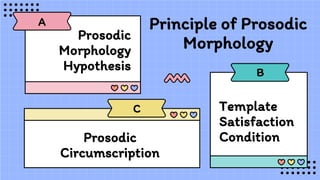
Principle of Prosodic
Morphology
A
C
B
Prosodic
Morphology
Hypothesis
Template
Satisfaction
Condition
Prosodic
Circumscription
Mapping Principle
The theory of autosegmental prosody was initially used to describe tone.
Tone can be shown as to be an independent prosody and not an integral
part of vowel and consonant segments.
Tones are represented on the tonal tier, and vowel also consonant on
the segmental tier. Processes affecting elements on one tier may in
some cases have no impact on elements on a different tier.
When vowels are deleted, the tone associated with one tier are not
necessarily lost.
The Skeletal Tier
Phonologycal phenomena as tones may
be linked in different ways to tone-
bearing units, segments may be linked
in a variety of ways to the skeletal tier.
Luganda has both long vowels and
geminate consonants. Geminate
consonants are longer and have a more
forceful articulation than short
consonant.
Skeletal tier: c v c v c v
Segmental tier: m u k a z i
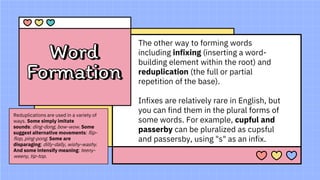
The other way to forming words
including infixing (inserting a word-
building element within the root) and
reduplication (the full or partial
repetition of the base).
Infixes are relatively rare in English, but
you can find them in the plural forms of
some words. For example, cupful and
passerby can be pluralized as cupsful
and passersby, using "s" as an infix.
Reduplications are used in a variety of
ways. Some simply imitate
sounds: ding-dong, bow-wow. Some
suggest alternative movements: flip-
flop, ping-pong. Some are
disparaging: dilly-dally, wishy-washy.
And some intensify meaning: teeny-
weeny, tip-top.
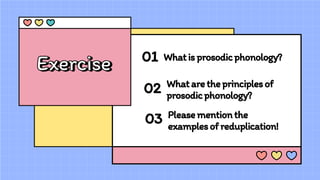
Pleasementionthe
examplesofreduplication!
Whatisprosodicphonology?
01
02
03
Whataretheprinciplesof
prosodicphonology?
Any Question?

Prosodic Morphology.pptx

  • 1.
  • 2.
  • 3.
    Prosodic Morphology isa study of how the morphological and phonological factors of linguistic form relate with one to another and relate with grammatical system. A key area of research is how prosodic structure influences templatic and circumscriptional morphology, such as reduplication and infixation. (McCarthy and Prince, 1986)
  • 4.
  • 6.
    Mapping Principle The theoryof autosegmental prosody was initially used to describe tone. Tone can be shown as to be an independent prosody and not an integral part of vowel and consonant segments. Tones are represented on the tonal tier, and vowel also consonant on the segmental tier. Processes affecting elements on one tier may in some cases have no impact on elements on a different tier. When vowels are deleted, the tone associated with one tier are not necessarily lost.
  • 7.
    The Skeletal Tier Phonologycalphenomena as tones may be linked in different ways to tone- bearing units, segments may be linked in a variety of ways to the skeletal tier. Luganda has both long vowels and geminate consonants. Geminate consonants are longer and have a more forceful articulation than short consonant. Skeletal tier: c v c v c v Segmental tier: m u k a z i
  • 8.
    The other wayto forming words including infixing (inserting a word- building element within the root) and reduplication (the full or partial repetition of the base). Infixes are relatively rare in English, but you can find them in the plural forms of some words. For example, cupful and passerby can be pluralized as cupsful and passersby, using "s" as an infix. Reduplications are used in a variety of ways. Some simply imitate sounds: ding-dong, bow-wow. Some suggest alternative movements: flip- flop, ping-pong. Some are disparaging: dilly-dally, wishy-washy. And some intensify meaning: teeny- weeny, tip-top.
  • 9.
  • 10.