

Properties of
Grease
Nye Lubricants Technical Reference
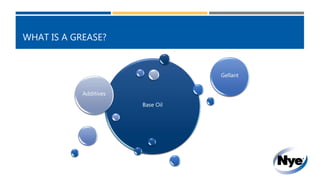
WHAT IS A GREASE?
Base Oil
Additives
Gellant
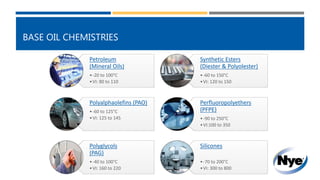
Synthetic Esters
(Diester & Polyolester)
•-60 to 150°C
•VI: 120 to 150
Perfluoropolyethers
(PFPE)
•-90 to 250°C
•VI:100 to 350
Silicones
•-70 to 200°C
•VI: 300 to 800
BASE OIL CHEMISTRIES
Petroleum
(Mineral Oils)
•-20 to 100°C
•VI: 80 to 110
Polyalphaolefins (PAO)
•-60 to 125°C
•VI: 125 to 145
Polyglycols
(PAG)
•-40 to 100°C
•VI: 160 to 220
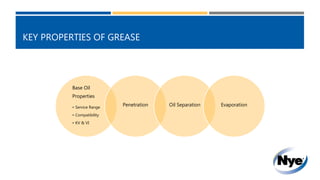
KEY PROPERTIES OF GREASE
Base Oil
Properties
• Service Range
• Compatibility
• KV & VI
Penetration Oil Separation Evaporation
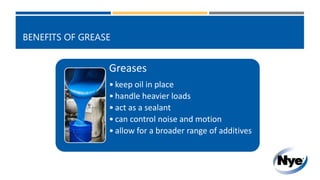
BENEFITS OF GREASE
Greases
• keep oil in place
• handle heavier loads
• act as a sealant
• can control noise and motion
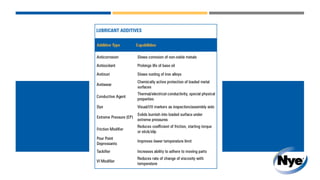
• allow for a broader range of additives
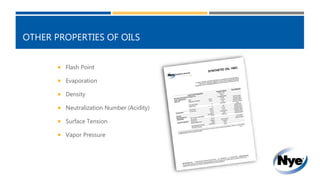
OTHER PROPERTIES OF OILS
 Flash Point
 Evaporation
 Density
 Neutralization Number (Acidity)
 Surface Tension
 Vapor Pressure
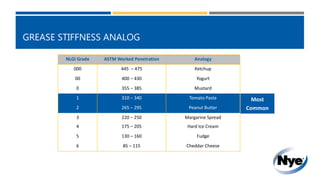
NLGI Grade ASTM Worked Penetration Analogy
000 445 – 475 Ketchup
00 400 – 430 Yogurt
0 355 – 385 Mustard
1 310 – 340 Tomato Paste
2 265 – 295 Peanut Butter
3 220 – 250 Margarine Spread
4 175 – 205 Hard Ice Cream
5 130 – 160 Fudge
6 85 – 115 Cheddar Cheese
Most
Common
GREASE STIFFNESS ANALOG
1 310 – 340 Tomato Paste
2 265 – 295 Peanut Butter
Learn More at NyeLubricants.com

Properties of Grease

  • 1.
  • 2.
    WHAT IS AGREASE? Base Oil Additives Gellant
  • 4.
    Synthetic Esters (Diester &Polyolester) •-60 to 150°C •VI: 120 to 150 Perfluoropolyethers (PFPE) •-90 to 250°C •VI:100 to 350 Silicones •-70 to 200°C •VI: 300 to 800 BASE OIL CHEMISTRIES Petroleum (Mineral Oils) •-20 to 100°C •VI: 80 to 110 Polyalphaolefins (PAO) •-60 to 125°C •VI: 125 to 145 Polyglycols (PAG) •-40 to 100°C •VI: 160 to 220
  • 6.
    KEY PROPERTIES OFGREASE Base Oil Properties • Service Range • Compatibility • KV & VI Penetration Oil Separation Evaporation
  • 7.
    BENEFITS OF GREASE Greases •keep oil in place • handle heavier loads • act as a sealant • can control noise and motion • allow for a broader range of additives
  • 8.
    OTHER PROPERTIES OFOILS  Flash Point  Evaporation  Density  Neutralization Number (Acidity)  Surface Tension  Vapor Pressure
  • 9.
    NLGI Grade ASTMWorked Penetration Analogy 000 445 – 475 Ketchup 00 400 – 430 Yogurt 0 355 – 385 Mustard 1 310 – 340 Tomato Paste 2 265 – 295 Peanut Butter 3 220 – 250 Margarine Spread 4 175 – 205 Hard Ice Cream 5 130 – 160 Fudge 6 85 – 115 Cheddar Cheese Most Common GREASE STIFFNESS ANALOG 1 310 – 340 Tomato Paste 2 265 – 295 Peanut Butter
  • 10.
    Learn More atNyeLubricants.com

Editor's Notes

  • #3 Greases are a gellant and additives dispersed in oils Oils Lubricate Gellants keep oil in place and deliver other key characteristics
  • #8 Broader range of additives are possible because they do not need to be soluble
  • #9 Explain the difference between long form and short form TDSs and how to obtain each one.
  • #10 Penetration Test Method: ASTM D-217