Copyright of ShellLubricants
APPLICATIONS FOR GREASES: SHELL
GADUS
2010 1
2.
Copyright of ShellLubricants
WHAT ARE GREASES?
2
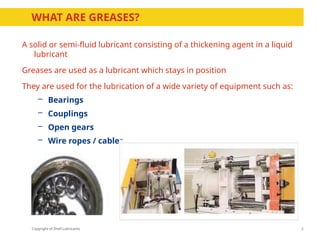
A solid or semi-fluid lubricant consisting of a thickening agent in a liquid
lubricant
Greases are used as a lubricant which stays in position
They are used for the lubrication of a wide variety of equipment such as:
– Bearings
– Couplings
– Open gears
– Wire ropes / cables
3.
Copyright of ShellLubricants
Oils are the lubricants of 1st choice, but greases are used when:
The parts to be lubricated are difficult to reach or require
infrequent lubrication
An effective seal against contaminant ingress is crucial
The system is unable to retain oil
Most common applications are in bearings, gears and joints
3
WHEN ARE GREASES USED?
4.
Copyright of ShellLubricants
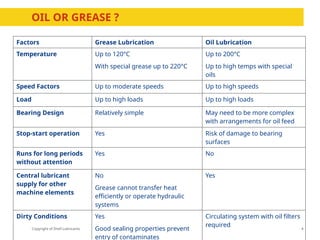
OIL OR GREASE ?
4
Factors Grease Lubrication Oil Lubrication
Temperature Up to 120°C
With special grease up to 220°C
Up to 200°C
Up to high temps with special
oils
Speed Factors Up to moderate speeds Up to high speeds
Load Up to high loads Up to high loads
Bearing Design Relatively simple May need to be more complex
with arrangements for oil feed
Stop-start operation Yes Risk of damage to bearing
surfaces
Runs for long periods
without attention
Yes No
Central lubricant
supply for other
machine elements
No
Grease cannot transfer heat
efficiently or operate hydraulic
systems
Yes
Dirty Conditions Yes
Good sealing properties prevent
entry of contaminates
Circulating system with oil filters
required
5.
Copyright of ShellLubricants
WHAT İS THE GREASE FOR?
5
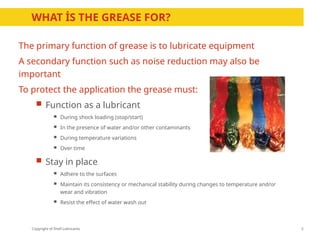
The primary function of grease is to lubricate equipment
A secondary function such as noise reduction may also be
important
To protect the application the grease must:
Function as a lubricant
During shock loading (stop/start)
In the presence of water and/or other contaminants
During temperature variations
Over time
Stay in place
Adhere to the surfaces
Maintain its consistency or mechanical stability during changes to temperature and/or
wear and vibration
Resist the effect of water wash out
Copyright of ShellLubricants
WHAT DOES A CUSTOMER WANT FROM GREASES?
The grease must perform its primary protection function
This will ensure that the equipment operates correctly
It will maintain the equipment’s life
Value-oriented customers want to lower their ‘Total cost of ownership’
The costs of equipment failure (either expressed as cost of
equipment repair or failure as well as production down time)
The cost of maintenance
Operational efficiencies
The actual cost of the grease (minimal compared to the other two)
By choosing the correct lubricant (or grease) the customer can get the
most value for the lowest possible cost
7
8.
Copyright of ShellLubricants
WHAT TYPES OF COMPONENTS NEED GREASE?
8
Industrial
Bearings
Electric motors
Couplings
Gears
Slides
Linkages
Chains
Automotive
Bearings
Universal and CV
Joints
Other driveline
components
Linkages
Hinges
Brake and seat
adjusters
Steering gears
On-highway
Bearings
Chassis
Wheel hubs
Fifth wheel
Off-highway
Bearings
Gears
Slides
Linkages
Chains
Pins
Buckets
Wheel hubs
Think about…
General purpose greases
High temperature greases
Greases for specific applications
The most important application of greases is for the lubrication of rolling bearings and
about 80% of all rolling bearings are lubricated with grease.
9.
Copyright of ShellLubricants
Hot Running
Noisy Running
Short Life – Frequent Replacement
Excessive Vibration
Difficult to Turn / Friction
9
Other than Improper design, causes are Lubrication,
Installation, Contamination, and or Improper uses
Likely that it is a combination
SYMPTOMS OF PROBLEMATIC BEARINGS
10.
Copyright of ShellLubricants
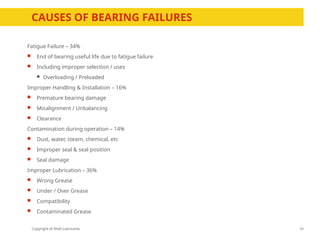
Fatigue Failure – 34%
End of bearing useful life due to fatigue failure
Including improper selection / uses
Overloading / Preloaded
Improper Handling & Installation – 16%
Premature bearing damage
Misalignment / Unbalancing
Clearance
Contamination during operation – 14%
Dust, water, steam, chemical, etc
Improper seal & seal position
Seal damage
Improper Lubrication – 36%
Wrong Grease
Under / Over Grease
Compatibility
Contaminated Grease
10
CAUSES OF BEARING FAILURES
11.
Copyright of ShellLubricants 11
IMPROPER LUBRICATION
Wrong or low quality grease
Under protection, wear / corrosion
Leaking / Fling off
Not suitable for specified service interval
Dirty Grease
Abrasive wear
Under grease
Could be too long service interval
Over packed
Too much feed / initial fill
No drain, wrong seal
Causes high internal friction and high temperatures
CAUSES OF BEARING FAILURES
12.
Copyright of ShellLubricants
Keep the new grease clean, uncontaminated
Use the right grease
Set and follow appropriate service volume / interval
Regreasing
See a good grease past the seal
Install a drain for critical & problematic units
Open drain when applying grease and leave open for 15 min
Monitor temperature if necessary
12
KEYS TO THE PREVENTION OF BEARING FAILURES
13.
Copyright of ShellLubricants
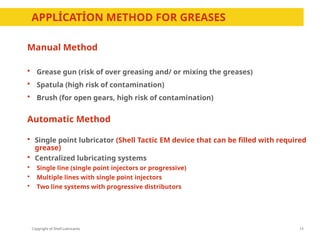
APPLİCATİON METHOD FOR GREASES
13
Manual Method
Grease gun (risk of over greasing and/ or mixing the greases)
Spatula (high risk of contamination)
Brush (for open gears, high risk of contamination)
Automatic Method
Single point lubricator (Shell Tactic EM device that can be filled with required
grease)
Centralized lubricating systems
Single line (single point injectors or progressive)
Multiple lines with single point injectors
Two line systems with progressive distributors
14.
Copyright of ShellLubricants
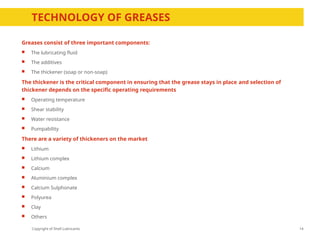
TECHNOLOGY OF GREASES
Greases consist of three important components:
The lubricating fluid
The additives
The thickener (soap or non-soap)
The thickener is the critical component in ensuring that the grease stays in place and selection of
thickener depends on the specific operating requirements
Operating temperature
Shear stability
Water resistance
Pumpability
There are a variety of thickeners on the market
Lithium
Lithium complex
Calcium
Aluminium complex
Calcium Sulphonate
Polyurea
Clay
Others
14
15.
Copyright of ShellLubricants
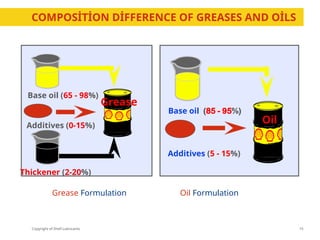
COMPOSİTİON DİFFERENCE OF GREASES AND OİLS
15
Base oil (65 - 98%)
Additives (0-15%)
Thickener (2-20%)
Base oil (85 - 95%)
Additives (5 - 15%)
Oil
Grease Formulation Oil Formulation
Grease
16.
Copyright of ShellLubricants
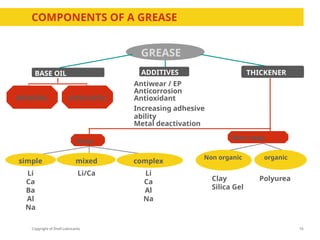
GREASE
MINERAL SYNTHETIC
BASE OIL
Antiwear / EP
Anticorrosion
Antioxidant
Increasing adhesive
ability
Metal deactivation
ADDITIVES THICKENER
Non soap
Non organic
Clay
Silica Gel
organic
Polyurea
Soap
simple
Li
Ca
Ba
Al
Na
mixed
Li/Ca
complex
Li
Ca
Al
Na
COMPONENTS OF A GREASE
16
17.
Copyright of ShellLubricants
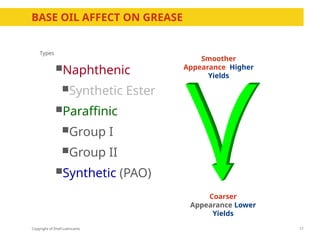
BASE OIL AFFECT ON GREASE
17
Types
Naphthenic
Synthetic Ester
Paraffinic
Group I
Group II
Synthetic (PAO)
Smoother
Appearance Higher
Yields
Coarser
Appearance Lower
Yields
18.
Copyright of ShellLubricants
SELECTİON OF GREASES – THİCKENER/SOAP TYPES
18
Selection of thickener is determined primarily by
temperature and mechanical stability (i.e. load and
bearing speed)
Lithium soap = Shell ALVANIA
Lithium soap based greases have been the industry standard products for more
than 50 years. They are suitable for many industrial applications
Shell invented Lithium based multipurpose grease technology
Lithium complex = Shell ALBIDA
Lithium complex based greases have a more complex chemical structure. This
makes them more resilient to the effects of temperature and mechanical stress
Lithium complex greases typically last longer than Lithium greases
Other thickeners
Shell offers many other thichener types for different specialist or niche
applications
19.
Copyright of ShellLubricants
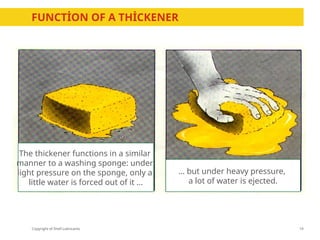
The thickener functions in a similar
manner to a washing sponge: under
light pressure on the sponge, only a
little water is forced out of it ...
… but under heavy pressure,
a lot of water is ejected.
FUNCTİON OF A THİCKENER
19
20.
Copyright of ShellLubricants
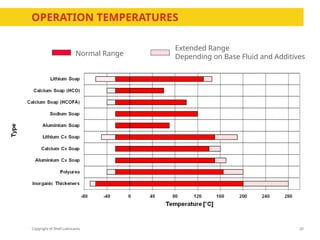
OPERATION TEMPERATURES
20
Normal Range
Extended Range
Depending on Base Fluid and Additives
21.
Copyright of ShellLubricants
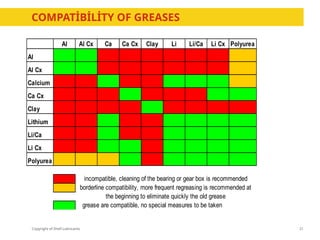
Al Al Cx Ca Ca Cx Clay Li Li/Ca Li Cx Polyurea
Al
Al Cx
Calcium
Ca Cx
Clay
Lithium
Li/Ca
Li Cx
Polyurea
incompatible, cleaning of the bearing or gear box is recommended
grease are compatible, no special measures to be taken
borderline compatibility, more frequent regreasing is recommended at
the beginning to eliminate quickly the old grease
COMPATİBİLİTY OF GREASES
21
22.
Copyright of ShellLubricants
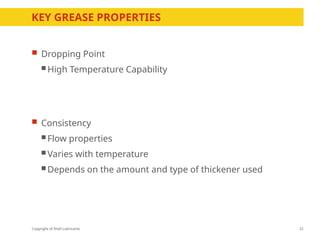
KEY GREASE PROPERTIES
Dropping Point
High Temperature Capability
Consistency
Flow properties
Varies with temperature
Depends on the amount and type of thickener used
22
23.
Copyright of ShellLubricants
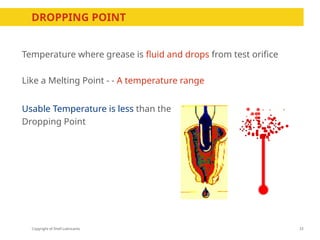
DROPPING POINT
23
Temperature where grease is fluid and drops from test orifice
Like a Melting Point - - A temperature range
Usable Temperature is less than the
Dropping Point
24.
Copyright of ShellLubricants
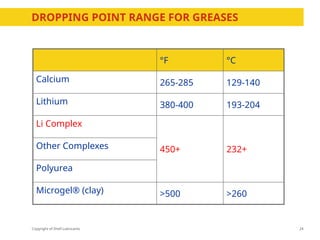
DROPPING POINT RANGE FOR GREASES
24
°F °C
Calcium 265-285 129-140
Lithium 380-400 193-204
Li Complex
450+ 232+
Other Complexes
Polyurea
Microgel® (clay) >500 >260
25.
Copyright of ShellLubricants
UNDISTURBED, UNWORKED, AND WORKED
PENETRATION
25
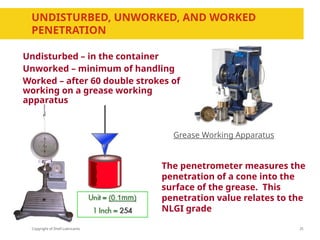
Grease Working Apparatus
Undisturbed – in the container
Unworked – minimum of handling
Worked – after 60 double strokes of
working on a grease working
apparatus
The penetrometer measures the
penetration of a cone into the
surface of the grease. This
penetration value relates to the
NLGI grade
26.
Copyright of ShellLubricants
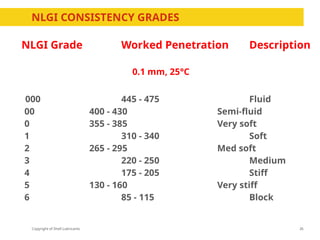
NLGI Grade Worked Penetration Description
0.1 mm, 25°C
000 445 - 475 Fluid
00 400 - 430 Semi-fluid
0 355 - 385 Very soft
1 310 - 340 Soft
2 265 - 295 Med soft
3 220 - 250 Medium
4 175 - 205 Stiff
5 130 - 160 Very stiff
6 85 - 115 Block
NLGI CONSISTENCY GRADES
26
27.
Copyright of ShellLubricants
SELECTİON OF GREASES – CONSİSTENCY
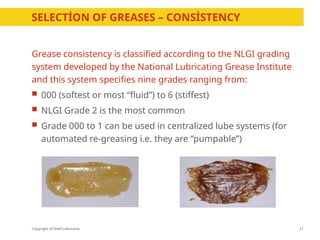
Grease consistency is classified according to the NLGI grading
system developed by the National Lubricating Grease Institute
and this system specifies nine grades ranging from:
000 (softest or most “fluid”) to 6 (stiffest)
NLGI Grade 2 is the most common
Grade 000 to 1 can be used in centralized lube systems (for
automated re-greasing i.e. they are “pumpable”)
27
28.
Copyright of ShellLubricants
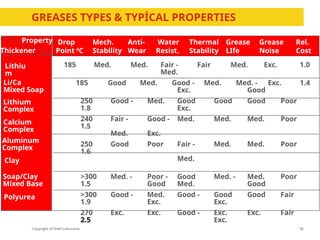
185 Med. Med. Fair - Fair Med. Exc. 1.0
Med.
185 Good Med. Good - Med. Med. - Exc. 1.4
Exc. Good
250 Good - Med. Good Good Good Poor
1.8 Exc.
240 Fair - Good - Med. Med. Med. Poor
1.5
Med. Exc.
250 Good Poor Fair - Med. Med. Poor
1.6
Med.
>300 Med. - Poor - Good Med. - Med. Poor
1.5 Good Med. Good
>300 Good - Med. Good - Good Good Fair
1.9 Exc. Exc.
270 Exc. Exc. Good - Exc. Exc. Fair
2.5 Exc.
Property
Thickener
Drop Mech. Anti- Water Thermal Grease Grease Rel.
Point 0
C Stability Wear Resist. Stability LIfe Noise Cost
Lithiu
m
Li/Ca
Mixed Soap
Lithium
Complex
Calcium
Complex
Aluminum
Complex
Clay
Soap/Clay
Mixed Base
Polyurea
GREASES TYPES & TYPİCAL PROPERTIES
28
29.
Copyright of ShellLubricants
SELECTİON OF GREASES – EQUİPMENT
29
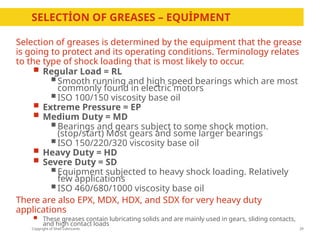
Selection of greases is determined by the equipment that the grease
is going to protect and its operating conditions. Terminology relates
to the type of shock loading that is most likely to occur.
Regular Load = RL
Smooth running and high speed bearings which are most
commonly found in electric motors
ISO 100/150 viscosity base oil
Extreme Pressure = EP
Medium Duty = MD
Bearings and gears subject to some shock motion.
(stop/start) Most gears and some larger bearings
ISO 150/220/320 viscosity base oil
Heavy Duty = HD
Severe Duty = SD
Equipment subjected to heavy shock loading. Relatively
few applications
ISO 460/680/1000 viscosity base oil
There are also EPX, MDX, HDX, and SDX for very heavy duty
applications
These greases contain lubricating solids and are mainly used in gears, sliding contacts,
and high contact loads
30.
Copyright of ShellLubricants
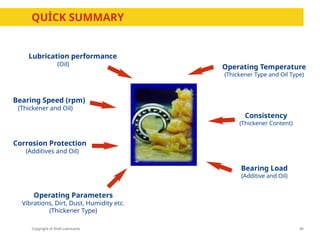
Consistency
(Thickener Content)
Operating Temperature
(Thickener Type and Oil Type)
Lubrication performance
(Oil)
Operating Parameters
Vibrations, Dirt, Dust, Humidity etc.
(Thickener Type)
Corrosion Protection
(Additives and Oil)
Bearing Load
(Additive and Oil)
Bearing Speed (rpm)
(Thickener and Oil)
QUİCK SUMMARY
30
31.
Copyright of ShellLubricants
SHELL GREASE FAMİLY
31
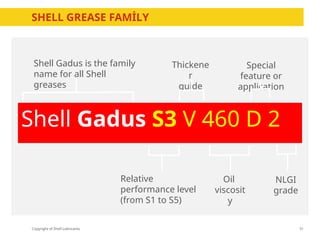
Shell Gadus S3 V 460 D 2
Shell Gadus is the family
name for all Shell
greases
Relative
performance level
(from S1 to S5)
Thickene
r
guide
Special
feature or
application
Oil
viscosit
y
NLGI
grade
32.
Copyright of ShellLubricants
Key
SHELL GREASE FAMİLY
32
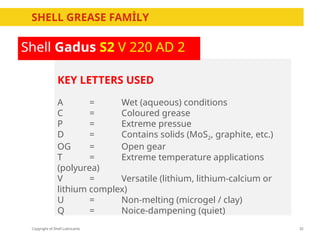
KEY LETTERS USED
A = Wet (aqueous) conditions
C = Coloured grease
P = Extreme pressue
D = Contains solids (MoS2, graphite, etc.)
OG = Open gear
T = Extreme temperature applications
(polyurea)
V = Versatile (lithium, lithium-calcium or
lithium complex)
U = Non-melting (microgel / clay)
Q = Noice-dampening (quiet)
Shell Gadus S2 V 220 AD 2
Editor's Notes
#17 The Base Oil used to make a grease is of primary importance since it provides the main lubricating ability of a grease. A base oil is fundamentally described by its viscosity as a grease is fundamentally described by its consistency. By now each of you should have a clear concept of viscosity. Another key property of a base oil is its TYPE. Most mineral oils may be considered either NAPHTHENIC or PARAFFINIC. These hydrocarbons are primarily differentiated by differences in their molecular structures. Naphthenic oils are comprised of mostly cyclic carbon bonds and usually provide the best thickening effect of the two. In other words, the thickener is more “soluble” in these base stocks. The resulting grease made with Naphthenic base stocks usually apprears smooth.
Paraffinic oils are comprised of mostly straight chain carbon bonds and similar thickener systems are typically less “soluble” in these base stocks compared to Naphthenic oils. However, the chemical structure of paraffinic oils promotes oxidative stability and better elastomer compatibility.
Synthesized hydrocarbons, i.e. SYNTHETIC BASE OILS, are the other class of base oils used to make greases. Synthetic base oils are often manufactured to possess outstanding extreme properties (i.e. very good low temperature characteristics) compared to mineral oils. They are also more expensive.
All three types of base oil may be used alone or in combination to make various greases.
#22 There are 2 basic properties used to fundamentally describe a grease. These properties are the Dropping Point and the Consistency of a grease.
The dropping point is the temperature where the thickener melts and becomes fluid in the oil phase. At the DP temperature, the grease has the texture and fluidity of the base oil. A grease will become more fluid and uncharacteristic of its nature as the DP is approached. At temperatures very near the DP, the grease will not perform well for extended periods of time. Therefore, manufacturers commonly quote a Maximum Usable Temperature at which sustained performance of a grease will be allowed. It is lower than the DP. How low depends on the inherent properties of the grease. DPs for grease vary and are usually a function of the type of thickner used.
An expression denoting the thickness of a grease is known as its “Consistency”. It is analogous to the VISCOSITY of an oil. Greases are most basically described by their consistency as denoted as being, for example, a Grade 1 or Grade 2, etc. The classification of greases according to various grades of consistency may be described by PENETRATION NUMBERS...
(On to next slide)