Turbine Lubrication
Page 1 of 12 Rev: 10/18/05
Analysts, Inc.
www.analystsinc.com
SM
Monitoring and Optimizing the
Life of Turbine Oils
SM
Turbine Lubrication
Page 2 of 12 Rev: 10/18/05
Analysts, Inc.
www.analystsinc.com
SM
Introduction
The economical and social vitality of a society depends upon energy. Global energy demands have
never been increasing at such a rapid rate. The uninterrupted and reliable performance of turbines is
fundamental to our way of life. Modern turbines are sophisticated machines, which can rotate in excess
of 7,500rpm and weigh over 100 tons.
The proper functioning of a turbine is critically dependent on the performance of the turbine oil in use. If
the lubricant does not provide the required performance, hundreds of thousands of dollars a day are at
risk to turbine owners. All turbine manufacturers carefully specify the characteristics of the lubricants
suitable for their turbines, defined by requirements specified in a broad set of performance and laboratory
bench tests.
Significant changes have occurred in turbine technologies over the last couple of decades. In particular,
strides have been made to combine efficient gas turbines and steam turbines, called Combined Cycle
System, which is now considered to be the most effective method for converting fuel into electrical
energy. By-products of these efficiency improvements however are increased compression ratios and
higher temperatures. For example, the center bearing on a GE MS7001 gas turbine may exceed 500o
F.
Turbine lube-oil systems have many missions. Among the most important: cooling bearings, flushing
contaminants away from rotating parts, preventing inleakage of gases, providing hydrostatic lift for shafts,
actuating valves in the hydraulic circuit, and protecting lube-system internals.
Formulating a lubricant capable of performing all these tasks well is a difficult job, one that must consider
the impacts of large temperature fluctuations and ingress of contaminants such as dirt and water, as well
as other physical and chemical challenges. Turbine oils have undergone several advancements as
turbine oil specifications have been amended. Turbine oils must now simultaneously meet the
requirements of both steam and gas turbines. Improvements in base oil refining technologies provide
more thermally and oxidatively robust products. Coupled with improvements in additive chemistries,
modern turbine oils represent a delicate blend of lubrication science.
Almost 99% of turbine oils are base oil with additives making up the remaining percent. There are
several different additives in turbine oils such as antioxidants, rust inhibitors, metal deactivators, antifoam
agents, demulsifier, pour depressants and antiwear additives. The most abundant additives are
antioxidants, which has the strongest influence on the life of turbine oil. Antioxidants can be categorized
as either primary (radical scavengers) or secondary (peroxide decomposers). Primary antioxidants
consists of aromatic amines, which perform well under high temperature oxidative conditions (>120o
C)
and hindered phenols which are designed for lower temperatures (<120o
C). The table below outlines
some of the formulaic changes that turbine oils have undergone over the last two decades.
“R&O”
Conventional Turbine
Oils
Current Generation
Turbine Oils
Basestock Group I Group I/II Group II/II+/III
Primary Antioxidants Phenolic Phenolic, Diphenylamine Phenolic, Diphenylamine,
PAN, APAN & others
Secondary Antioxidants - Sulfur containing
compoundes, phosphites
Sulfur containing
compoundes, phosphites
Metal Deactivators - Surface pacifiers (eg.
Benzotriazole) or
chelators
Surface pacifiers (eg.
Benzotriazole) or
chelators
Rust Inhibitors Succinic acid/ester Succinimide, succinic
acid/ester
Succinimide, succinic
acid/ester
Antifoam Silicone Acrylate, Silicone Acrylate
Other Pour depressant,
antiwear
Pour depressant,
antiwear, demulsifier
Pour depressant,
antiwear, demulsifier
Turbine Lubrication
Page 3 of 12 Rev: 10/18/05
Analysts, Inc.
www.analystsinc.com
SM
Turbine Oil Degradation
Oil degrades due to mechanical and thermal energy, which produces heat. When a turbine oil degrades
the integrity of the hydrocarbon base-stock becomes compromised and the sacrificial additive chemistries
deplete, causing irreversible molecular changes.
The two primary degradation mechanisms in turbine applications are:
• Oxidation – A chemical process where oxygen converts hydrocarbon molecules into different
products, such as carboxylic acids. The rate of oxidation doubles for every 10o
C rise in
temperature above 100o
C. In addition, catalysts will speed up the rate of oxidation such as air,
water and certain metals.
• Thermal Degradation – This process occurs in the absence of oxygen at temperatures above
300o
C. The hydrocarbon bonds are broken (“cracked”) often creating insoluble carbonaceous by-
products. The primary causes of thermal degradation are:
o Micro-dieseling (Adiabatic Compression) – When air bubbles transition from low pressure
zones (reservoir) to high pressure zones (pump), the bubbles can collapse creating a
temperature over 1,000o
C.
o Electrostatic Spark Discharge (ESD) – The result of an accumulation of internal
molecular friction developed as oil passes through very tight clearances at high flow
rates. ESD is common in full-flow, small micron mechanical filters and may produce
temperatures in excess of 10,000C.
o Hot Spots – Very hot spots in a turbine system will also cause in thermal degradation.
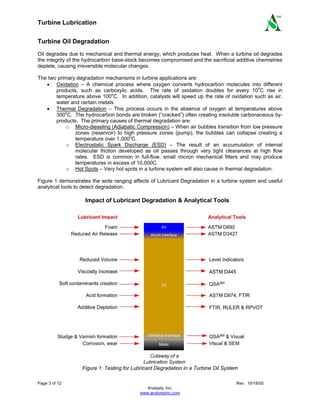
Figure 1 demonstrates the wide ranging affects of Lubricant Degradation in a turbine system and useful
analytical tools to detect degradation.
Figure 1: Testing for Lubricant Degradation in a Turbine Oil System
Turbine Lubrication
Page 4 of 12 Rev: 10/18/05
Analysts, Inc.
www.analystsinc.com
SM
Turbine Oil Varnish
One result of turbine oil degradation is the creation of insoluble byproducts called soft contaminants. Soft
contaminants are typically under 1-micron in size and cannot be removed through standard mechanical
filtration. Soft contaminants may be either soluble or insoluble in the oil. Insoluble soft contaminants are
polar in nature and are unstable in a non-polar oil environment. Soft contaminants will combine and
adsorb onto dipolar metallic surfaces forming varnish. These soft contaminants agglomerate on valve
spools and sleeves, bearing surfaces, gears and other internal surfaces of the lubricant system.
This micro layer of contamination is capable of shutting down a turbine or causing a unit trip. The sticky
nature of varnish captures hard contaminants as they flow within the system, forming an abrasive,
sandpaper-like finish on the metal surface that accelerates component wear. Varnish is an efficient
insulator, too. Bearing surfaces with varnish coatings typically run at much higher temperatures than
those without deposits. Heat exchanges coated with varnish have lower efficiencies than those with clean
tubes or plates.
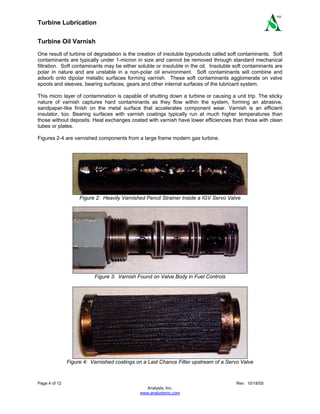
Figures 2-4 are varnished components from a large frame modern gas turbine.
Figure 2: Heavily Varnished Pencil Strainer Inside a IGV Servo Valve
Figure 3: Varnish Found on Valve Body in Fuel Controls
Figure 4: Varnished coatings on a Last Chance Filter upstream of a Servo Valve
Turbine Lubrication
Page 5 of 12 Rev: 10/18/05
Analysts, Inc.
www.analystsinc.com
SM
Quantitative Spectrophotometric Analysis – A Method to Measure Turbine Oil
Varnish Potential
Due to the potentially high costs associated with varnish, it is important for maintenance and reliability
personnel to have a predictive tool to measure the lubricant’s varnish potential. Determining the varnish
potential of a fluid enables the user to investigate the root cause and implement corrective action before a
catastrophic failure occurs. However, routine oil analysis cannot successfully identify varnish potential.
Analysts, Inc. has developed a predictive test called Quantitative Spectrophotometric Analysis (QSASM
),
designed to help turbine oil users be alerted to alarming varnish potentials.
QSASM
is a technique of purposely isolating and measuring the specific lubricant degradation by-products
responsible for varnish formation. The process begins by treating the lubricant sample with a specific
chemical mixture designed to isolate insoluble by-product material. Next, a separation process collects
the varnish forming insoluble degradation by-products including the sub-micron species. The process
concludes with Quantitative Spectrophotometric Analysis on the isolated degradation by-product. The
color of the isolated degradation by-products can directly correlate to the varnish potential of the fluid. By
comparing the results to a large database of QSASM
tests, a 1 to 100 severity rating scale indicates the
propensity of the lubricant to form sludge and varnish.
QSASM
has diagnosed hundreds of varnish problems in turbine applications. It is the most advanced
testing technology available for monitoring varnish problems and should be a part of any turbine oil user’s
predictive maintenance program.
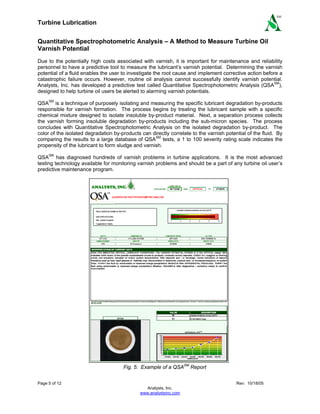
Fig. 5: Example of a QSASM
Report
Turbine Lubrication
Page 6 of 12 Rev: 10/18/05
Analysts, Inc.
www.analystsinc.com
SM
Turbine Oil Condition Monitoring
Turbine oils may last only a few hundred hours in jet engines to several decades in hydro-electric
systems. In recent years, condition monitoring became an essential focus to maximize the performance
and life of turbine oils. Careful assessment of the actual state of lubricants in use allows system
maintenance and oil change frequencies to be optimized. Premature replacement of the lubricants leads
to high running costs. The same is true if unplanned oil changes are required because of inadequate
assessment of the lubricant condition.
ASTM D4378 "Standard Practice for In-Service Monitoring of Mineral Turbine Oils for Steam and Gas
Turbines" is the recognized standard for determining the condition of turbine oils. This standard states
"The in-service monitoring of turbine oils has long been recognized by the power-generation industry as
being necessary to ensure long trouble-free operation of turbines. This practice is designed to assist the
user to understand how oils deteriorate and to carry out a meaningful program of sampling and testing of
oils in use. Also covered are some important aspects of interpretation of results and suggested actions to
maximize service life.
Maximizing the life of turbine oils has influences beyond establishing an effective condition monitoring
program. Other factors include:
• Selecting and using the correct lubricant
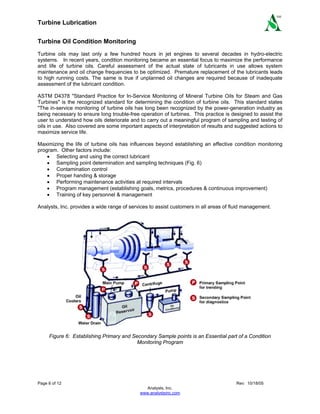
• Sampling point determination and sampling techniques (Fig. 6)
• Contamination control
• Proper handing & storage
• Performing maintenance activities at required intervals
• Program management (establishing goals, metrics, procedures & continuous improvement)
• Training of key personnel & management
Analysts, Inc. provides a wide range of services to assist customers in all areas of fluid management.
Figure 6: Establishing Primary and Secondary Sample points is an Essential part of a Condition
Monitoring Program
Turbine Lubrication
Page 7 of 12 Rev: 10/18/05
Analysts, Inc.
www.analystsinc.com
SM
Definitions and Significance Of Turbine Oil Testing
Acid Number – ASTM D974: A measure of the acidic constituents present within the lubricant.
Most rust inhibitors used in turbine oils are acidic and contribute to the acid number of the new
oil. Increases from the new oil level are monitored, and for the most part, increases reflect the
presence of acidic oxidation products. Though less likely, increases in acid number could be
attributed to contaminants, mixtures of products, and/or chemical transformations.
Appearance: Visual assessment for sample clarity, cloudiness, separations, visible debris or free
water, etc.
Color - ASTM D2500: New turbine oils are typically light in color. Darkening will occur with
age and service. Periodic comparisons of the sample color are useful in spotting significant
and/or rapid changes due to contamination or fluid degradation.
Copper Corrosion – ASTM D130: The copper strip test measures the potential corrosive nature
of a lubricant and the possible difficulties with yellow metals, such copper and brass or bronze
components, within a system.
Foaming Characteristics – ASTM D892: Measurement of the oil’s tendency to foam and the
stability of the foam after it is generated. Some foaming is a typical occurrence and antifoaming
agents are blended into the oil to assist with the rapid release of entrained air bubbles. These
additives will deplete with time and must be monitored. Excessive foaming is indicative of
mechanical or lubricant problems requiring investigation and correction.
FTIR – Fourier Transform Infrared: Infrared Spectroscopy is applied to measure organic
molecular components. FTIR can be applied to monitor for additive depletions (antioxidants),
organic degradation products (oxidation), and the presence of various contaminants.
Particle Count – ISO 11171: A count of the number of particles present greater than given
micron sizes per unit volume of fluid. The results reflect the solid contaminants present and are
applied to assess fluid cleanliness and filtration efficiency. Cleanliness levels are also
represented by the ISO 4406 classification system to classify the particles larger than 4-μm, 6-
μm, and 14-μm per milliliter of fluid (for example: 18/16/14).
QSA – Quantitative Spectrophotometric Analysis: An analysis technique for purposely isolating
and measuring the specific lubrication degradation by-products responsible for varnish
formations. This is not a measure of varnish already formed; it is a determination of the
lubricants propensity to form varnish and can be applied to preventing varnish formations and
build-up within the system. Results are represented as the Varnish Potential Rating (VPR) with a
scale of 1 to 100 severity rating.
Turbine Lubrication
Page 8 of 12 Rev: 10/18/05
Analysts, Inc.
www.analystsinc.com
SM
RPVOT – ASTM D2272: Rotating Pressure Vessel Oxidation Test (Previously RBOT). One of
the most important properties of turbine oil is its oxidation stability or resistance. RPVOT test is
a controlled, accelerated oxidation of a lubricant to determine the level of remaining antioxidant
additives. Results are evaluated and compared to new oil levels.
Rust Test – ASTM D665: Antirust protection provided by the lubricant is of significant
importance for turbine systems. Antirust inhibitors will deplete during lubricant service and can
also be affected by water contamination, adsorption onto wear and debris particles, and/or
chemical reactions with contaminants.
Spectrochemical Analysis – ASTM D6595: Specific trace metals are measured and monitored
for wear and corrosion levels, airborne or internally generated contaminants, oil additives, and
water treatment additives. Particles detected are typically 8-μm and less and results are reported
in parts per million (ppm) by weight.
Water Content – ASTM D1744: Water contamination within turbines adversely affects the
lubricants by acting as a catalyst for oxidation and rapidly depleting water sensitive additives.
Water also promotes rusting, corrosion, and filter plugging. Results are reported in parts per
million (ppm) by weight.
Water Separability – ASTM D1401: This test measures the ability of a lubricant to separate
from water. New turbine oils are designed to have good water separability characteristics. Polar
contaminants influence turbine oil’s ability to separate from water. This is particularly crucial to
steam turbine applications where water contamination is most prevalent and separation in the
reservoir is essential. Contamination control technologies such as oil/water coalescers also
depend on turbine oil’s water separability characteristics to function properly.
Viscosity – ASTM D445: Viscosity is the most important characteristic of turbine oil and can be
readily affected by more types of influences than any other property. Maintaining the proper
viscosity is crucial to retaining oil film thickness under hydrodynamic lubrication conditions.
Turbine Lubrication
Page 9 of 12 Rev: 10/18/05
Analysts, Inc.
www.analystsinc.com
SM
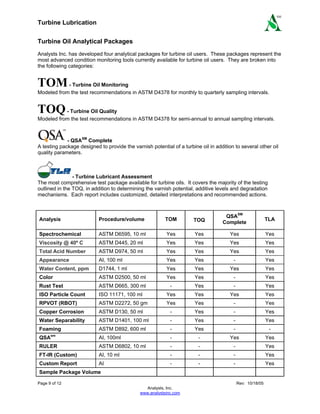
Turbine Oil Analytical Packages
Analysts Inc. has developed four analytical packages for turbine oil users. These packages represent the
most advanced condition monitoring tools currently available for turbine oil users. They are broken into
the following categories:
TOM- Turbine Oil Monitoring
Modeled from the test recommendations in ASTM D4378 for monthly to quarterly sampling intervals.
TOQ- Turbine Oil Quality
Modeled from the test recommendations in ASTM D4378 for semi-annual to annual sampling intervals.
- QSASM
Complete
A testing package designed to provide the varnish potential of a turbine oil in addition to several other oil
quality parameters.
- Turbine Lubricant Assessment
The most comprehensive test package available for turbine oils. It covers the majority of the testing
outlined in the TOQ, in addition to determining the varnish potential, additive levels and degradation
mechanisms. Each report includes customized, detailed interpretations and recommended actions.
Analysis Procedure/volume TOM TOQ
QSASM
Complete
TLA
Spectrochemical ASTM D6595, 10 ml Yes Yes Yes Yes
Viscosity @ 40º C ASTM D445, 20 ml Yes Yes Yes Yes
Total Acid Number ASTM D974, 50 ml Yes Yes Yes Yes
Appearance AI, 100 ml Yes Yes - Yes
Water Content, ppm D1744, 1 ml Yes Yes Yes Yes
Color ASTM D2500, 50 ml Yes Yes - Yes
Rust Test ASTM D665, 300 ml - Yes - Yes
ISO Particle Count ISO 11171, 100 ml Yes Yes Yes Yes
RPVOT (RBOT) ASTM D2272, 50 gm Yes Yes - Yes
Copper Corrosion ASTM D130, 50 ml - Yes - Yes
Water Separability ASTM D1401, 100 ml - Yes - Yes
Foaming ASTM D892, 600 ml - Yes - -
QSAsm
AI, 100ml - - Yes Yes
RULER ASTM D6802, 10 ml - - - Yes
FT-IR (Custom) AI, 10 ml - - - Yes
Custom Report AI - - - Yes
Sample Package Volume
Turbine Lubrication
Page 10 of 12 Rev: 10/18/05
Analysts, Inc.
www.analystsinc.com
SM
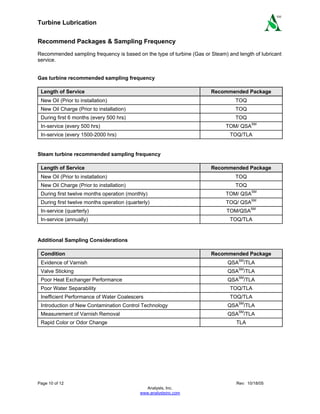
Recommend Packages & Sampling Frequency
Recommended sampling frequency is based on the type of turbine (Gas or Steam) and length of lubricant
service.
Gas turbine recommended sampling frequency
Length of Service Recommended Package
New Oil (Prior to installation) TOQ
New Oil Charge (Prior to installation) TOQ
During first 6 months (every 500 hrs) TOQ
In-service (every 500 hrs) TOM/ QSASM
In-service (every 1500-2000 hrs) TOQ/TLA
Steam turbine recommended sampling frequency
Length of Service Recommended Package
New Oil (Prior to installation) TOQ
New Oil Charge (Prior to installation) TOQ
During first twelve months operation (monthly) TOM/ QSASM
During first twelve months operation (quarterly) TOQ/ QSASM
In-service (quarterly) TOM/QSASM
In-service (annually) TOQ/TLA
Additional Sampling Considerations
Condition Recommended Package
Evidence of Varnish QSASM
/TLA
Valve Sticking QSASM
/TLA
Poor Heat Exchanger Performance QSASM
/TLA
Poor Water Separability TOQ/TLA
Inefficient Performance of Water Coalescers TOQ/TLA
Introduction of New Contamination Control Technology QSASM
/TLA
Measurement of Varnish Removal QSASM
/TLA
Rapid Color or Odor Change TLA
Turbine Lubrication
Page 11 of 12 Rev: 10/18/05
Analysts, Inc.
www.analystsinc.com
SM
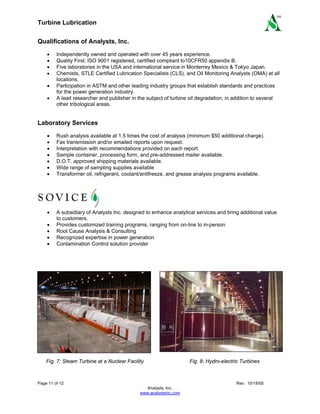
Qualifications of Analysts, Inc.
• Independently owned and operated with over 45 years experience.
• Quality First: ISO 9001 registered, certified compliant to10CFR50 appendix B.
• Five laboratories in the USA and international service in Monterrey Mexico & Tokyo Japan.
• Chemists, STLE Certified Lubrication Specialists (CLS), and Oil Monitoring Analysts (OMA) at all
locations.
• Participation in ASTM and other leading industry groups that establish standards and practices
for the power generation industry.
• A lead researcher and publisher in the subject of turbine oil degradation, in addition to several
other tribological areas.
Laboratory Services
• Rush analysis available at 1.5 times the cost of analysis (minimum $50 additional charge).
• Fax transmission and/or emailed reports upon request.
• Interpretation with recommendations provided on each report.
• Sample container, processing form, and pre-addressed mailer available.
• D.O.T. approved shipping materials available.
• Wide range of sampling supplies available
• Transformer oil, refrigerant, coolant/antifreeze, and grease analysis programs available.
• A subsidiary of Analysts Inc. designed to enhance analytical services and bring additional value
to customers.
• Provides customized training programs, ranging from on-line to in-person
• Root Cause Analysis & Consulting
• Recognized expertise in power generation
• Contamination Control solution provider
Fig. 7: Steam Turbine at a Nuclear Facility Fig. 8: Hydro-electric Turbines
Turbine Lubrication
Page 12 of 12 Rev: 10/18/05
Analysts, Inc.
www.analystsinc.com
SM
FIVE LABORATORIES TO SERVE YOU:
ANALYSTS, INC.
WESTERN LABORATORY
2910 FORD STREET
OAKLAND, CA 94601
(800) 424-0099
FAX (510) 536-5994
ANALYSTS MAINTENANCE LABS
MIDWESTERN LABORATORY
2450 HASSELL ROAD
HOFFMAN ESTATES, IL 60195
(800) 222-0071
FAX (708) 884-8098
ANALYSTS MAINTENANCE LABS
SOUTHWESTERN LABORATORY
12715 ROYAL DRIVE
STAFFORD, TX 77477
(800) 248-7778
FAX (713) 240-4481
ANALYSTS MAINTENANCE LABS.
SOUTHWESTERN LABORATORY
3075 CORNERS NORTH COURT, N.W.
NORCROSS, GA 30071
(800) 241-6315
FAX (404) 448-5918
ANALYSTS MAINTENANCE LABS
MID-CONTINENT LABORATORY
1803 Watterson Trail
Louisville, KY 40299
(888) 491-6063
FAX (502) 671-5370
CORPORATE OFFICE
ANALYSTS, INC.
2441 W. 205th Street, Suite C100
Torrance, CA 90501-6236
(800) 336-3637
FAX (310) 320-0970
VISIT OUR WEBSITE AT:
www.AnalystsInc.com
Disclosure
This correspondence and any of its attachments may contain Analysts, Inc. proprietary information, which is
privileged, confidential, or subject to copyright belonging to Analysts, Inc. The information is intended solely for the
use of the individual or entity to which it is addressed. If you are not the intended recipient, you are hereby notified
that any dissemination, distribution, copying, or action taken in relation to the contents of and attachments to this
correspondence is strictly prohibited and may be unlawful. If you have received this in error, please notify the
sender immediately and permanently delete the original and any copy of this correspondence and any printout.

Turbine Oil

  • 1.
    Turbine Lubrication Page 1of 12 Rev: 10/18/05 Analysts, Inc. www.analystsinc.com SM Monitoring and Optimizing the Life of Turbine Oils SM
  • 2.
    Turbine Lubrication Page 2of 12 Rev: 10/18/05 Analysts, Inc. www.analystsinc.com SM Introduction The economical and social vitality of a society depends upon energy. Global energy demands have never been increasing at such a rapid rate. The uninterrupted and reliable performance of turbines is fundamental to our way of life. Modern turbines are sophisticated machines, which can rotate in excess of 7,500rpm and weigh over 100 tons. The proper functioning of a turbine is critically dependent on the performance of the turbine oil in use. If the lubricant does not provide the required performance, hundreds of thousands of dollars a day are at risk to turbine owners. All turbine manufacturers carefully specify the characteristics of the lubricants suitable for their turbines, defined by requirements specified in a broad set of performance and laboratory bench tests. Significant changes have occurred in turbine technologies over the last couple of decades. In particular, strides have been made to combine efficient gas turbines and steam turbines, called Combined Cycle System, which is now considered to be the most effective method for converting fuel into electrical energy. By-products of these efficiency improvements however are increased compression ratios and higher temperatures. For example, the center bearing on a GE MS7001 gas turbine may exceed 500o F. Turbine lube-oil systems have many missions. Among the most important: cooling bearings, flushing contaminants away from rotating parts, preventing inleakage of gases, providing hydrostatic lift for shafts, actuating valves in the hydraulic circuit, and protecting lube-system internals. Formulating a lubricant capable of performing all these tasks well is a difficult job, one that must consider the impacts of large temperature fluctuations and ingress of contaminants such as dirt and water, as well as other physical and chemical challenges. Turbine oils have undergone several advancements as turbine oil specifications have been amended. Turbine oils must now simultaneously meet the requirements of both steam and gas turbines. Improvements in base oil refining technologies provide more thermally and oxidatively robust products. Coupled with improvements in additive chemistries, modern turbine oils represent a delicate blend of lubrication science. Almost 99% of turbine oils are base oil with additives making up the remaining percent. There are several different additives in turbine oils such as antioxidants, rust inhibitors, metal deactivators, antifoam agents, demulsifier, pour depressants and antiwear additives. The most abundant additives are antioxidants, which has the strongest influence on the life of turbine oil. Antioxidants can be categorized as either primary (radical scavengers) or secondary (peroxide decomposers). Primary antioxidants consists of aromatic amines, which perform well under high temperature oxidative conditions (>120o C) and hindered phenols which are designed for lower temperatures (<120o C). The table below outlines some of the formulaic changes that turbine oils have undergone over the last two decades. “R&O” Conventional Turbine Oils Current Generation Turbine Oils Basestock Group I Group I/II Group II/II+/III Primary Antioxidants Phenolic Phenolic, Diphenylamine Phenolic, Diphenylamine, PAN, APAN & others Secondary Antioxidants - Sulfur containing compoundes, phosphites Sulfur containing compoundes, phosphites Metal Deactivators - Surface pacifiers (eg. Benzotriazole) or chelators Surface pacifiers (eg. Benzotriazole) or chelators Rust Inhibitors Succinic acid/ester Succinimide, succinic acid/ester Succinimide, succinic acid/ester Antifoam Silicone Acrylate, Silicone Acrylate Other Pour depressant, antiwear Pour depressant, antiwear, demulsifier Pour depressant, antiwear, demulsifier
  • 3.
    Turbine Lubrication Page 3of 12 Rev: 10/18/05 Analysts, Inc. www.analystsinc.com SM Turbine Oil Degradation Oil degrades due to mechanical and thermal energy, which produces heat. When a turbine oil degrades the integrity of the hydrocarbon base-stock becomes compromised and the sacrificial additive chemistries deplete, causing irreversible molecular changes. The two primary degradation mechanisms in turbine applications are: • Oxidation – A chemical process where oxygen converts hydrocarbon molecules into different products, such as carboxylic acids. The rate of oxidation doubles for every 10o C rise in temperature above 100o C. In addition, catalysts will speed up the rate of oxidation such as air, water and certain metals. • Thermal Degradation – This process occurs in the absence of oxygen at temperatures above 300o C. The hydrocarbon bonds are broken (“cracked”) often creating insoluble carbonaceous by- products. The primary causes of thermal degradation are: o Micro-dieseling (Adiabatic Compression) – When air bubbles transition from low pressure zones (reservoir) to high pressure zones (pump), the bubbles can collapse creating a temperature over 1,000o C. o Electrostatic Spark Discharge (ESD) – The result of an accumulation of internal molecular friction developed as oil passes through very tight clearances at high flow rates. ESD is common in full-flow, small micron mechanical filters and may produce temperatures in excess of 10,000C. o Hot Spots – Very hot spots in a turbine system will also cause in thermal degradation. Figure 1 demonstrates the wide ranging affects of Lubricant Degradation in a turbine system and useful analytical tools to detect degradation. Figure 1: Testing for Lubricant Degradation in a Turbine Oil System
  • 4.
    Turbine Lubrication Page 4of 12 Rev: 10/18/05 Analysts, Inc. www.analystsinc.com SM Turbine Oil Varnish One result of turbine oil degradation is the creation of insoluble byproducts called soft contaminants. Soft contaminants are typically under 1-micron in size and cannot be removed through standard mechanical filtration. Soft contaminants may be either soluble or insoluble in the oil. Insoluble soft contaminants are polar in nature and are unstable in a non-polar oil environment. Soft contaminants will combine and adsorb onto dipolar metallic surfaces forming varnish. These soft contaminants agglomerate on valve spools and sleeves, bearing surfaces, gears and other internal surfaces of the lubricant system. This micro layer of contamination is capable of shutting down a turbine or causing a unit trip. The sticky nature of varnish captures hard contaminants as they flow within the system, forming an abrasive, sandpaper-like finish on the metal surface that accelerates component wear. Varnish is an efficient insulator, too. Bearing surfaces with varnish coatings typically run at much higher temperatures than those without deposits. Heat exchanges coated with varnish have lower efficiencies than those with clean tubes or plates. Figures 2-4 are varnished components from a large frame modern gas turbine. Figure 2: Heavily Varnished Pencil Strainer Inside a IGV Servo Valve Figure 3: Varnish Found on Valve Body in Fuel Controls Figure 4: Varnished coatings on a Last Chance Filter upstream of a Servo Valve
  • 5.
    Turbine Lubrication Page 5of 12 Rev: 10/18/05 Analysts, Inc. www.analystsinc.com SM Quantitative Spectrophotometric Analysis – A Method to Measure Turbine Oil Varnish Potential Due to the potentially high costs associated with varnish, it is important for maintenance and reliability personnel to have a predictive tool to measure the lubricant’s varnish potential. Determining the varnish potential of a fluid enables the user to investigate the root cause and implement corrective action before a catastrophic failure occurs. However, routine oil analysis cannot successfully identify varnish potential. Analysts, Inc. has developed a predictive test called Quantitative Spectrophotometric Analysis (QSASM ), designed to help turbine oil users be alerted to alarming varnish potentials. QSASM is a technique of purposely isolating and measuring the specific lubricant degradation by-products responsible for varnish formation. The process begins by treating the lubricant sample with a specific chemical mixture designed to isolate insoluble by-product material. Next, a separation process collects the varnish forming insoluble degradation by-products including the sub-micron species. The process concludes with Quantitative Spectrophotometric Analysis on the isolated degradation by-product. The color of the isolated degradation by-products can directly correlate to the varnish potential of the fluid. By comparing the results to a large database of QSASM tests, a 1 to 100 severity rating scale indicates the propensity of the lubricant to form sludge and varnish. QSASM has diagnosed hundreds of varnish problems in turbine applications. It is the most advanced testing technology available for monitoring varnish problems and should be a part of any turbine oil user’s predictive maintenance program. Fig. 5: Example of a QSASM Report
  • 6.
    Turbine Lubrication Page 6of 12 Rev: 10/18/05 Analysts, Inc. www.analystsinc.com SM Turbine Oil Condition Monitoring Turbine oils may last only a few hundred hours in jet engines to several decades in hydro-electric systems. In recent years, condition monitoring became an essential focus to maximize the performance and life of turbine oils. Careful assessment of the actual state of lubricants in use allows system maintenance and oil change frequencies to be optimized. Premature replacement of the lubricants leads to high running costs. The same is true if unplanned oil changes are required because of inadequate assessment of the lubricant condition. ASTM D4378 "Standard Practice for In-Service Monitoring of Mineral Turbine Oils for Steam and Gas Turbines" is the recognized standard for determining the condition of turbine oils. This standard states "The in-service monitoring of turbine oils has long been recognized by the power-generation industry as being necessary to ensure long trouble-free operation of turbines. This practice is designed to assist the user to understand how oils deteriorate and to carry out a meaningful program of sampling and testing of oils in use. Also covered are some important aspects of interpretation of results and suggested actions to maximize service life. Maximizing the life of turbine oils has influences beyond establishing an effective condition monitoring program. Other factors include: • Selecting and using the correct lubricant • Sampling point determination and sampling techniques (Fig. 6) • Contamination control • Proper handing & storage • Performing maintenance activities at required intervals • Program management (establishing goals, metrics, procedures & continuous improvement) • Training of key personnel & management Analysts, Inc. provides a wide range of services to assist customers in all areas of fluid management. Figure 6: Establishing Primary and Secondary Sample points is an Essential part of a Condition Monitoring Program
  • 7.
    Turbine Lubrication Page 7of 12 Rev: 10/18/05 Analysts, Inc. www.analystsinc.com SM Definitions and Significance Of Turbine Oil Testing Acid Number – ASTM D974: A measure of the acidic constituents present within the lubricant. Most rust inhibitors used in turbine oils are acidic and contribute to the acid number of the new oil. Increases from the new oil level are monitored, and for the most part, increases reflect the presence of acidic oxidation products. Though less likely, increases in acid number could be attributed to contaminants, mixtures of products, and/or chemical transformations. Appearance: Visual assessment for sample clarity, cloudiness, separations, visible debris or free water, etc. Color - ASTM D2500: New turbine oils are typically light in color. Darkening will occur with age and service. Periodic comparisons of the sample color are useful in spotting significant and/or rapid changes due to contamination or fluid degradation. Copper Corrosion – ASTM D130: The copper strip test measures the potential corrosive nature of a lubricant and the possible difficulties with yellow metals, such copper and brass or bronze components, within a system. Foaming Characteristics – ASTM D892: Measurement of the oil’s tendency to foam and the stability of the foam after it is generated. Some foaming is a typical occurrence and antifoaming agents are blended into the oil to assist with the rapid release of entrained air bubbles. These additives will deplete with time and must be monitored. Excessive foaming is indicative of mechanical or lubricant problems requiring investigation and correction. FTIR – Fourier Transform Infrared: Infrared Spectroscopy is applied to measure organic molecular components. FTIR can be applied to monitor for additive depletions (antioxidants), organic degradation products (oxidation), and the presence of various contaminants. Particle Count – ISO 11171: A count of the number of particles present greater than given micron sizes per unit volume of fluid. The results reflect the solid contaminants present and are applied to assess fluid cleanliness and filtration efficiency. Cleanliness levels are also represented by the ISO 4406 classification system to classify the particles larger than 4-μm, 6- μm, and 14-μm per milliliter of fluid (for example: 18/16/14). QSA – Quantitative Spectrophotometric Analysis: An analysis technique for purposely isolating and measuring the specific lubrication degradation by-products responsible for varnish formations. This is not a measure of varnish already formed; it is a determination of the lubricants propensity to form varnish and can be applied to preventing varnish formations and build-up within the system. Results are represented as the Varnish Potential Rating (VPR) with a scale of 1 to 100 severity rating.
  • 8.
    Turbine Lubrication Page 8of 12 Rev: 10/18/05 Analysts, Inc. www.analystsinc.com SM RPVOT – ASTM D2272: Rotating Pressure Vessel Oxidation Test (Previously RBOT). One of the most important properties of turbine oil is its oxidation stability or resistance. RPVOT test is a controlled, accelerated oxidation of a lubricant to determine the level of remaining antioxidant additives. Results are evaluated and compared to new oil levels. Rust Test – ASTM D665: Antirust protection provided by the lubricant is of significant importance for turbine systems. Antirust inhibitors will deplete during lubricant service and can also be affected by water contamination, adsorption onto wear and debris particles, and/or chemical reactions with contaminants. Spectrochemical Analysis – ASTM D6595: Specific trace metals are measured and monitored for wear and corrosion levels, airborne or internally generated contaminants, oil additives, and water treatment additives. Particles detected are typically 8-μm and less and results are reported in parts per million (ppm) by weight. Water Content – ASTM D1744: Water contamination within turbines adversely affects the lubricants by acting as a catalyst for oxidation and rapidly depleting water sensitive additives. Water also promotes rusting, corrosion, and filter plugging. Results are reported in parts per million (ppm) by weight. Water Separability – ASTM D1401: This test measures the ability of a lubricant to separate from water. New turbine oils are designed to have good water separability characteristics. Polar contaminants influence turbine oil’s ability to separate from water. This is particularly crucial to steam turbine applications where water contamination is most prevalent and separation in the reservoir is essential. Contamination control technologies such as oil/water coalescers also depend on turbine oil’s water separability characteristics to function properly. Viscosity – ASTM D445: Viscosity is the most important characteristic of turbine oil and can be readily affected by more types of influences than any other property. Maintaining the proper viscosity is crucial to retaining oil film thickness under hydrodynamic lubrication conditions.
  • 9.
    Turbine Lubrication Page 9of 12 Rev: 10/18/05 Analysts, Inc. www.analystsinc.com SM Turbine Oil Analytical Packages Analysts Inc. has developed four analytical packages for turbine oil users. These packages represent the most advanced condition monitoring tools currently available for turbine oil users. They are broken into the following categories: TOM- Turbine Oil Monitoring Modeled from the test recommendations in ASTM D4378 for monthly to quarterly sampling intervals. TOQ- Turbine Oil Quality Modeled from the test recommendations in ASTM D4378 for semi-annual to annual sampling intervals. - QSASM Complete A testing package designed to provide the varnish potential of a turbine oil in addition to several other oil quality parameters. - Turbine Lubricant Assessment The most comprehensive test package available for turbine oils. It covers the majority of the testing outlined in the TOQ, in addition to determining the varnish potential, additive levels and degradation mechanisms. Each report includes customized, detailed interpretations and recommended actions. Analysis Procedure/volume TOM TOQ QSASM Complete TLA Spectrochemical ASTM D6595, 10 ml Yes Yes Yes Yes Viscosity @ 40º C ASTM D445, 20 ml Yes Yes Yes Yes Total Acid Number ASTM D974, 50 ml Yes Yes Yes Yes Appearance AI, 100 ml Yes Yes - Yes Water Content, ppm D1744, 1 ml Yes Yes Yes Yes Color ASTM D2500, 50 ml Yes Yes - Yes Rust Test ASTM D665, 300 ml - Yes - Yes ISO Particle Count ISO 11171, 100 ml Yes Yes Yes Yes RPVOT (RBOT) ASTM D2272, 50 gm Yes Yes - Yes Copper Corrosion ASTM D130, 50 ml - Yes - Yes Water Separability ASTM D1401, 100 ml - Yes - Yes Foaming ASTM D892, 600 ml - Yes - - QSAsm AI, 100ml - - Yes Yes RULER ASTM D6802, 10 ml - - - Yes FT-IR (Custom) AI, 10 ml - - - Yes Custom Report AI - - - Yes Sample Package Volume
  • 10.
    Turbine Lubrication Page 10of 12 Rev: 10/18/05 Analysts, Inc. www.analystsinc.com SM Recommend Packages & Sampling Frequency Recommended sampling frequency is based on the type of turbine (Gas or Steam) and length of lubricant service. Gas turbine recommended sampling frequency Length of Service Recommended Package New Oil (Prior to installation) TOQ New Oil Charge (Prior to installation) TOQ During first 6 months (every 500 hrs) TOQ In-service (every 500 hrs) TOM/ QSASM In-service (every 1500-2000 hrs) TOQ/TLA Steam turbine recommended sampling frequency Length of Service Recommended Package New Oil (Prior to installation) TOQ New Oil Charge (Prior to installation) TOQ During first twelve months operation (monthly) TOM/ QSASM During first twelve months operation (quarterly) TOQ/ QSASM In-service (quarterly) TOM/QSASM In-service (annually) TOQ/TLA Additional Sampling Considerations Condition Recommended Package Evidence of Varnish QSASM /TLA Valve Sticking QSASM /TLA Poor Heat Exchanger Performance QSASM /TLA Poor Water Separability TOQ/TLA Inefficient Performance of Water Coalescers TOQ/TLA Introduction of New Contamination Control Technology QSASM /TLA Measurement of Varnish Removal QSASM /TLA Rapid Color or Odor Change TLA
  • 11.
    Turbine Lubrication Page 11of 12 Rev: 10/18/05 Analysts, Inc. www.analystsinc.com SM Qualifications of Analysts, Inc. • Independently owned and operated with over 45 years experience. • Quality First: ISO 9001 registered, certified compliant to10CFR50 appendix B. • Five laboratories in the USA and international service in Monterrey Mexico & Tokyo Japan. • Chemists, STLE Certified Lubrication Specialists (CLS), and Oil Monitoring Analysts (OMA) at all locations. • Participation in ASTM and other leading industry groups that establish standards and practices for the power generation industry. • A lead researcher and publisher in the subject of turbine oil degradation, in addition to several other tribological areas. Laboratory Services • Rush analysis available at 1.5 times the cost of analysis (minimum $50 additional charge). • Fax transmission and/or emailed reports upon request. • Interpretation with recommendations provided on each report. • Sample container, processing form, and pre-addressed mailer available. • D.O.T. approved shipping materials available. • Wide range of sampling supplies available • Transformer oil, refrigerant, coolant/antifreeze, and grease analysis programs available. • A subsidiary of Analysts Inc. designed to enhance analytical services and bring additional value to customers. • Provides customized training programs, ranging from on-line to in-person • Root Cause Analysis & Consulting • Recognized expertise in power generation • Contamination Control solution provider Fig. 7: Steam Turbine at a Nuclear Facility Fig. 8: Hydro-electric Turbines
  • 12.
    Turbine Lubrication Page 12of 12 Rev: 10/18/05 Analysts, Inc. www.analystsinc.com SM FIVE LABORATORIES TO SERVE YOU: ANALYSTS, INC. WESTERN LABORATORY 2910 FORD STREET OAKLAND, CA 94601 (800) 424-0099 FAX (510) 536-5994 ANALYSTS MAINTENANCE LABS MIDWESTERN LABORATORY 2450 HASSELL ROAD HOFFMAN ESTATES, IL 60195 (800) 222-0071 FAX (708) 884-8098 ANALYSTS MAINTENANCE LABS SOUTHWESTERN LABORATORY 12715 ROYAL DRIVE STAFFORD, TX 77477 (800) 248-7778 FAX (713) 240-4481 ANALYSTS MAINTENANCE LABS. SOUTHWESTERN LABORATORY 3075 CORNERS NORTH COURT, N.W. NORCROSS, GA 30071 (800) 241-6315 FAX (404) 448-5918 ANALYSTS MAINTENANCE LABS MID-CONTINENT LABORATORY 1803 Watterson Trail Louisville, KY 40299 (888) 491-6063 FAX (502) 671-5370 CORPORATE OFFICE ANALYSTS, INC. 2441 W. 205th Street, Suite C100 Torrance, CA 90501-6236 (800) 336-3637 FAX (310) 320-0970 VISIT OUR WEBSITE AT: www.AnalystsInc.com Disclosure This correspondence and any of its attachments may contain Analysts, Inc. proprietary information, which is privileged, confidential, or subject to copyright belonging to Analysts, Inc. The information is intended solely for the use of the individual or entity to which it is addressed. If you are not the intended recipient, you are hereby notified that any dissemination, distribution, copying, or action taken in relation to the contents of and attachments to this correspondence is strictly prohibited and may be unlawful. If you have received this in error, please notify the sender immediately and permanently delete the original and any copy of this correspondence and any printout.