Plant propagation
Definition:
Plant Propagation is defined as the multiplication
of plants by both sexual and asexual means.
Propagation is an art of multiplication of plants.
Most of the horticultural plants are now
propagated through grafting and budding, few
through cuttings, layering, seeds and micro-
propagation.
The propagation methods are broadly classified as
sexual, asexual and micro-propagation.
There are Two Method of Propagation:
1. Sexual propagation.
2. Asexual propagation
Sexual Propagation
Sexual propagation is the raising of plants by means
of seed which is formed due to the fusion of male
and female gametes within the ovule of a flower.
 Plants that are produced from seeds are called
seedlings.
 Advantages
1) Seedling trees generally live longer, bear more heavily and
are hardier than vegetatively propagated trees.
2) Seedlings are comparatively cheap, and can be more easily
raised than vegetatively propagated materials.
3) Plants which are difficult to propagate, e.g., papaya and
phalsa by vegetative method can only be propagated by
seed.
4) In breeding for evolution of new varieties, the hybrids are
first raised from the seed and it is, therefore, essential to
employ this method in such cases.
5) Seed propagation, some times results in the production of
Chance seedlings with superior characteristics, which may
be of great benefit to the horticulture industry.
6) Rootstocks, on which desirable scion variety is budded
or grafted, are usually raised from seeds.
7) Seeds of some fruits like citrus and mango varieties are
capable of giving out more than one seedling from one
seed. They arise from the cells of the nucellus and are
called poyembyonic. The nucellar seedlings can be
utilized for raising uniform plants, if they can be carefully
detected at the nursery stage.
8) Since most virus diseases are usually not transmitted
through seed propagation. Hence, it is useful in producing
virus free plants.
9) Seeds also offer a convenient method for storing plants
for a long time.
Seeds when kept properly may remain viable for very
long periods.
Eg. Indian lotus remains viable for over 1000 years.
Limitations/disadvantages
1) Owing to genetic segregation in heterozygous plants,
seedling trees are not uniform in their growth, yielding
capacity and fruit quality compared with asexually
propagated plants.
Seedling trees are not usually true to type and show
variation.
1) Seedling trees take more time to come to bearing than
grafted plants.
For example mango seedlings take 8 -10 years to come
to bearing ,compared with 3-4 years for grafted trees.
3) Seedling trees, being very large, pose problems for
efficient management of orchard trees, i.e., harvesting,
pruning spraying etc. become more difficult and
expensive.
4) It is not possible to derive the benefits of
rootstocks, if the plant is not propagated vegetatively
by means of grafting or budding.
5) Continuous seed propagation leads to inferiority in
the progeny.
6) Sexually propagated plants have long juvenile (pre-
bearing) period.
7) Choice or chance tress or hybrid trees can not be
multiplied true to type because of segregation of
characters.
8) Seeds loose viability with in a short period.Eg.
Citrus, mango, jackfruit, papaya, jamun etc.
Asexual propagation
Propagation of plants through any vegetative parts is called
vegetative or asexual propagation. The goal of vegetative
propagation is to reproduce progeny plants identical in
genotypes to a single source plant.
Advantages:
• As there is no change in the genetic makeup of the plant
propagated by this method, the fruit plants propagated
vegetatively are true to type, and, as a result, it is possible to
get uniformity in growth, yield and quality of fruit, which
makes harvesting and marketing easy.
• Some fruits such a as banana, pineapple and some guava
varieties being seedless, the only way of further propagation
is vegetative method.
• Vegetatively propagated fruit trees come into bearing earlier.
• Certain varieties of some fruit plants are susceptible to certain
diseases.
• By budding or grafting them on a resistant root stock, these
varieties can be grown with out pest or disease incidence.
• Hardiness to cold and other unfavourable conditions such as
drought can be secured, e.g. orange do well on trifoliate stock
in areas where frost occurrence is frequent.
• Trees can considerably dwarfed by using proper root stocks,
e.g., the apple trees can be dwarfed by using Malling 9 as the
root stock.
• Methods like bridge grafting can be used for healing of the
wounds caused by rodents.
• By top working the inferior quality fruit trees can be
converted into superior quality fruit trees.
• As a fancy, it is possible to grow 2-3 varieties on the same
plant, e.g; one can get 3-4 varieties of roses on various
branches of the stock plant.
Dis-advantages:
1)No, new variety can be evolved by means of the
vegetative method of propagation.
2)Vegetative propagation in many cases is more expensive
than seed propagation.
3)Vegetatively propagated plants are comparatively short
lived.
Lack of tap rootsystem in vegetatively propagated plants
results in poor anchorage in the soil.
Consequently, such plants are easily uprooted in storms
and or other such severe conditions.
4)Vegetatively propagated plants are comparatively less
hardy.
5)Transmit viral diseases from plant to plant.
• Which method of propagation is the best?
• Considering the merits and demerits of both the
methods, particularly in fruit crops and other
perennial crops, vegetative propagation is more
preferable than seed propagation because of
uniformity (even in delicate characters like shape,
taste, flavour etc.) and precocity.
Methods of Asexual Propagation:
Plant Propagation by Cutting:
 A portion of a stem, root or leaf is cut from the parent
plant and is placed under certain favourable
environmental conditions to form roots and shoots.
 Thus a new independent plant is produced which in most
cases identical with the parent plant.
Stem-cuttings:
This is the most important type of cutting and divided into three
parts:
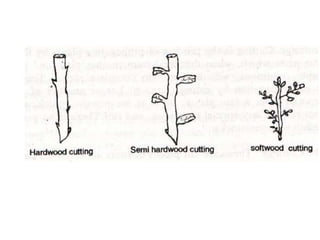
1. Hardwood cuttings:
 These cuttings are made from the past seasons growth or
wood that has matured and lignified are known as hardwood
cuttings.
 Propagation by hardwood cuttings is simple and cheapest
method of multiplication.
Hardwood cuttings are easily handled and transplanted.
One-year-old mature shoots are collected during
November-February.
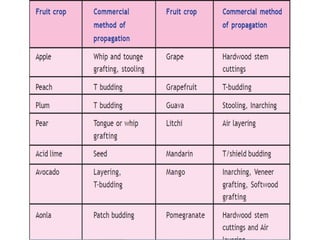
Grape, fig, pomegranate, some plums and apple are
propagated by hardwood cuttings
Length of cuttings should be between 10 and 30cm. It
should contain at least 2 buds.
 Just on the base of shoot below the node a slanting cut
is given while on the top of the cutting, 1-2cm above
the bud a straight cut is given.
 This helps maintain the polarity of the shoot and if rain
occurs, water does not accumulate on the tip of cutting.
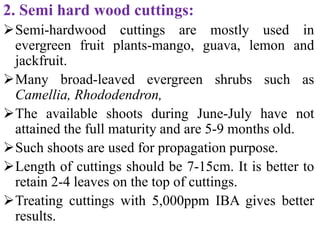
2. Semi hard wood cuttings:
Semi-hardwood cuttings are mostly used in
evergreen fruit plants-mango, guava, lemon and
jackfruit.
Many broad-leaved evergreen shrubs such as
Camellia, Rhododendron,
The available shoots during June-July have not
attained the full maturity and are 5-9 months old.
Such shoots are used for propagation purpose.
Length of cuttings should be 7-15cm. It is better to
retain 2-4 leaves on the top of cuttings.
Treating cuttings with 5,000ppm IBA gives better
results.
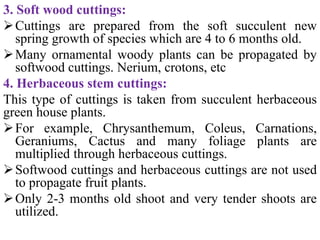
3. Soft wood cuttings:
Cuttings are prepared from the soft succulent new
spring growth of species which are 4 to 6 months old.
Many ornamental woody plants can be propagated by
softwood cuttings. Nerium, crotons, etc
4. Herbaceous stem cuttings:
This type of cuttings is taken from succulent herbaceous
green house plants.
For example, Chrysanthemum, Coleus, Carnations,
Geraniums, Cactus and many foliage plants are
multiplied through herbaceous cuttings.
Softwood cuttings and herbaceous cuttings are not used
to propagate fruit plants.
Only 2-3 months old shoot and very tender shoots are
utilized.
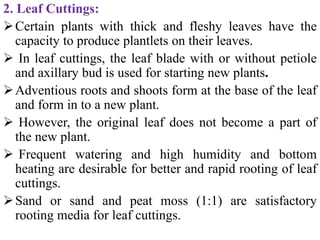
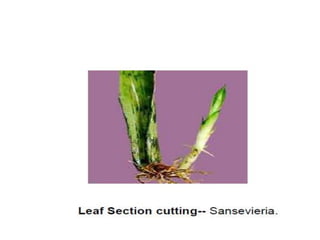
2. Leaf Cuttings:
Certain plants with thick and fleshy leaves have the
capacity to produce plantlets on their leaves.
 In leaf cuttings, the leaf blade with or without petiole
and axillary bud is used for starting new plants.
Adventious roots and shoots form at the base of the leaf
and form in to a new plant.
 However, the original leaf does not become a part of
the new plant.
 Frequent watering and high humidity and bottom
heating are desirable for better and rapid rooting of leaf
cuttings.
Sand or sand and peat moss (1:1) are satisfactory
rooting media for leaf cuttings.
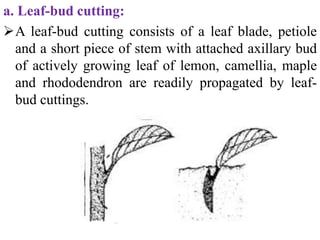
a. Leaf-bud cutting:
A leaf-bud cutting consists of a leaf blade, petiole
and a short piece of stem with attached axillary bud
of actively growing leaf of lemon, camellia, maple
and rhododendron are readily propagated by leaf-
bud cuttings.
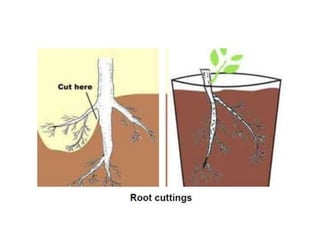
3. Root cuttings:
As the name indicates, roots of the plant are utilized
as propagating material.
 Roots of 1 cm thick and 10-15cm tall are used.
 In temperate fruits, such kind of roots are prepared
in December and kept in warm place in moss grass
or wet sand for callusing and transplanted during
February-March in open beds.
 Blackberry and raspberry are commercially
propagated by this method.
This method is also advocated in pecan nut, apple,
pear and peach.
Cutting Size Examples
Hard wood
cutting
10-30 cm long,
1-2.5 cm
diameter
Grape, Pomegranate, Figs, Pear, Plum, Mulberry,
Apple, Olive, Rose, Bougainvillea, Poinsettia, etc.
Semi-hard
wood cutting
10-15 cm long,
1-2 cm diameter
Citrus, Olive, Camellia, Croton, Roses, poinsettia,
bougainvillea, etc.
Soft wood
cutting
7-15 cm long,
1- 1.5 cm
diameter
Forsythia, Magnalia, Oleander, Justicia, Maple,
Juniper, etc.
Herbaceous
cutting
Coleus, Carnation, Geranium, Chrysanthemum,
Tomato, Pineapple, Sweet potato, etc.
Polarity in cuttings
 In cutting proximal end is given slanting cut where as distal end is
given straight cut.
 Proximal end should be cut just below a node and the distal end above
2-3 cm from a bud.
 Proximal end is slanted to increase surface area for rooting and for
easy establishment
 Distal end is straight cut to reduce surface area for infection.
 In making the cuttings the position near shoot terminals from older
shoot are often used.
 Stem cutting form shoots at the distal end and roots at the proximal
end whereas root cuttings form roots at the distal end.
Propagation by layering
Layering is the method of propagation in which
roots are developed on a stem while it is still
attached to the parent plant.
After proper rooting, the stem is detached and
becomes a new plant for growing on its own roots.
The high success of layering is obtained by ringing
or wounding, etiolation (absence of light), use of
rooting hormone (IBA, NAA) and favourable
environmental condition (temperature
and humidity).
Methods Of layering
1. Tip-layering:
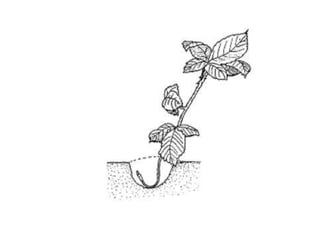
In tip-layering, rooting takes place near the tip of
current season's shoot which is bent to the ground.
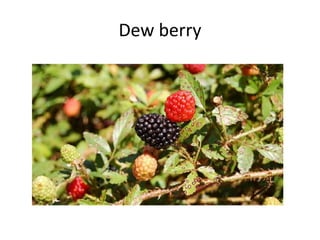
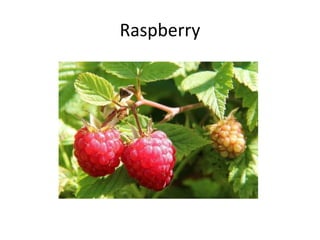
 It is commonly followed in black berries,
raspberries and dewberries.
The tips of these shoots are buried 5-10 cm deep in
soil.
Rooted layers are detached and planted in soil
during spring.
Dew berry
Raspberry
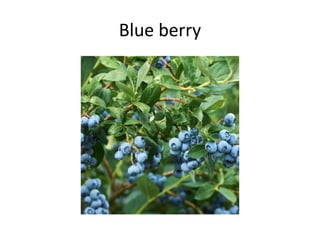
Blue berry
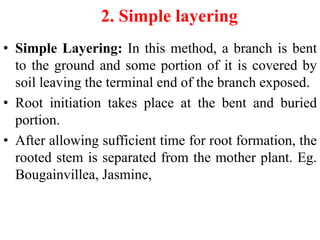
2. Simple layering
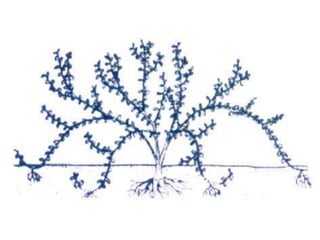
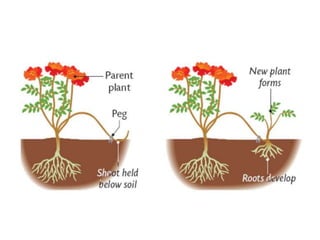
• Simple Layering: In this method, a branch is bent
to the ground and some portion of it is covered by
soil leaving the terminal end of the branch exposed.
• Root initiation takes place at the bent and buried
portion.
• After allowing sufficient time for root formation, the
rooted stem is separated from the mother plant. Eg.
Bougainvillea, Jasmine,
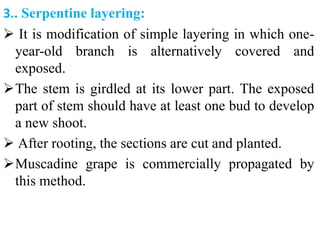
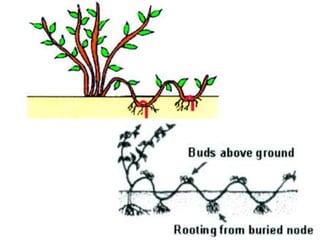
3.. Serpentine layering:
 It is modification of simple layering in which one-
year-old branch is alternatively covered and
exposed.
The stem is girdled at its lower part. The exposed
part of stem should have at least one bud to develop
a new shoot.
 After rooting, the sections are cut and planted.
Muscadine grape is commercially propagated by
this method.
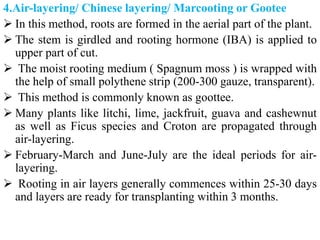
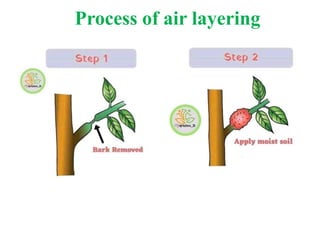
4.Air-layering/ Chinese layering/ Marcooting or Gootee
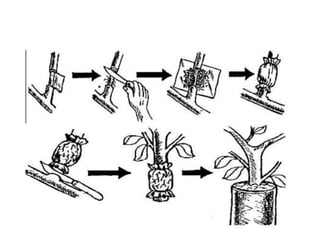
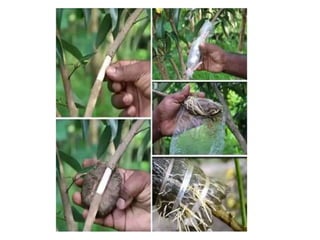
 In this method, roots are formed in the aerial part of the plant.
 The stem is girdled and rooting hormone (IBA) is applied to
upper part of cut.
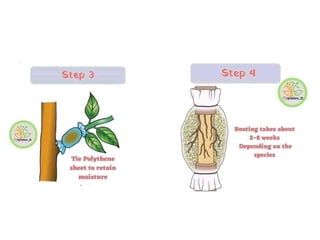
 The moist rooting medium ( Spagnum moss ) is wrapped with
the help of small polythene strip (200-300 gauze, transparent).
 This method is commonly known as goottee.
 Many plants like litchi, lime, jackfruit, guava and cashewnut
as well as Ficus species and Croton are propagated through
air-layering.
 February-March and June-July are the ideal periods for air-
layering.
 Rooting in air layers generally commences within 25-30 days
and layers are ready for transplanting within 3 months.
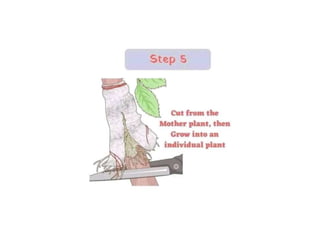
Process of air layering
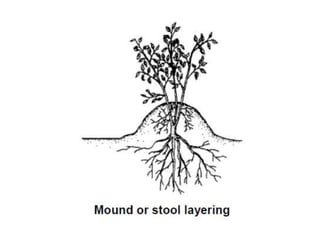
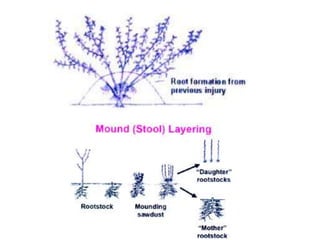
5. Mound layering/stooling:
In this method, the plant is headed back to 15cm above
the ground level during dormant season.
Mound (stool) Layering: In this method, a plant is cut
back to 15cm the ground level during the dormant
season and soil is heaped around the base of the newly
developing shoots.
Thenew sprouts will arise within 2 months.
These sprouts are then girdled near base and rooting
hormone (IBA), is applied to the upper portion of cut
with moist soil.
These shoots are left as such up to two days for proper
absorption of rooting hormone (IBA) before they are
covered with moist soil.

The concentration of rooting hormone varies from
plant-to-plant but in general 3,000-5,000 ppm is
most commonly used.
The rooting of shoots is observed within 20-30 days.
 After 2 months, the rooted shoots are separated
from mother plants and planted in nursery.
Apple and pear root stocks and guava are
commercially propagated by this method.
 However, this method is also advocated in other
fruits like plum, cherry, hazelnut, mango, jackfruit
and litchi.
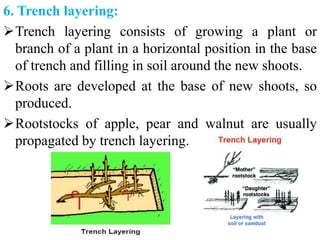
6. Trench layering:
Trench layering consists of growing a plant or
branch of a plant in a horizontal position in the base
of trench and filling in soil around the new shoots.
Roots are developed at the base of new shoots, so
produced.
Rootstocks of apple, pear and walnut are usually
propagated by trench layering.
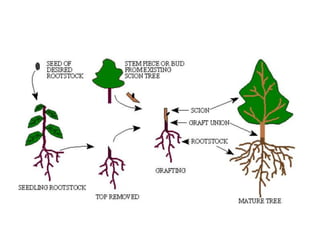
Plant propagation by grafting
Grafting is an art of joining parts of two
independent plants in such a manner that they
unite and grow together into single independent
plant.
The part of graft combination which is to become
the upper portion or the shoot system or top of the
new plant is termed as scion and
The part which is to become the lower portion or
the root system is the root stock or under stock or
some time stock.
Reasons of grafting
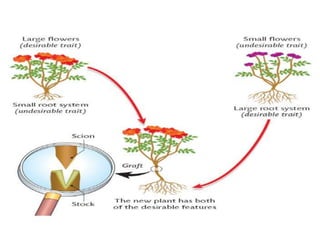
• Obtaining the benefits of certain rootstocks
• Obtaining the benefits of certain plants (double
working)
• Changing cultivars of established plants (top
working)
• Precocity in bearing
• Reduction in juvenility
• Obtaining special forms of plant growth
• Repairing the damaged parts of trees
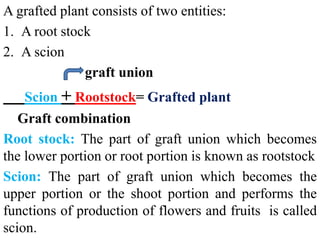
A grafted plant consists of two entities:
1. A root stock
2. A scion
graft union
Scion + Rootstock= Grafted plant
Graft combination
Root stock: The part of graft union which becomes
the lower portion or root portion is known as rootstock
Scion: The part of graft union which becomes the
upper portion or the shoot portion and performs the
functions of production of flowers and fruits is called
scion.
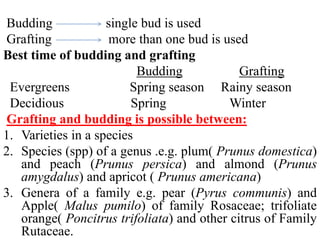
Budding single bud is used
Grafting more than one bud is used
Best time of budding and grafting
Budding Grafting
Evergreens Spring season Rainy season
Decidious Spring Winter
Grafting and budding is possible between:
1. Varieties in a species
2. Species (spp) of a genus .e.g. plum( Prunus domestica)
and peach (Prunus persica) and almond (Prunus
amygdalus) and apricot ( Prunus americana)
3. Genera of a family e.g. pear (Pyrus communis) and
Apple( Malus pumilo) of family Rosaceae; trifoliate
orange( Poncitrus trifoliata) and other citrus of Family
Rutaceae.
Success of grafting is more if:
1. Scion and root stock species are closely related
2.Scion and rootstock have equal thickness
3. Scion and rootstock are of one to two years of age.
4. There is close contact of cambial regions of scions
and rootstock.
5. Cells of the cut surface of the stock and scion are
not dessicated.
• Selection of scion and rootstock
Scion Rootstock
Scion is derived from a plant
with superior quality
The root stock is derived from a
plant which is hardy and efficient
in absorption of water and
nutrients.
Wild varieties are hardy and
seedling plants are efficient in
absorption of nutrients because of
their deep rooted system.
Hardy plants means:
1. Resistant or tolerant to disease, pest.
2. Withstand adverse climatic condition (frost , high
and low temperature, etc) and adverse soil
condition ( drought, water logging condition, high
salinity etc)
Formation of graft union
There are four stages viz; pre-callus, callus formation, formation of
cambial bridge and healing of the bud union.
1. Pre-callus stage:
• It lasts for 5 to 8 days, after budding or grafting operation.
• During this stage, there is no sign of callus formation and scion falls
if the wrapping material is removed.
2. Callus formation:
• After 5th to 8th day, the callus formation may take place in the
bud/graft union.
• The process of callus formation is fast in firmly attached stock and
scion.
• The initiation of callus formation takes place either from stock, scion
or both.
• Usually, living cells of recently formed xylem and phloem play active
role in the callus formation.
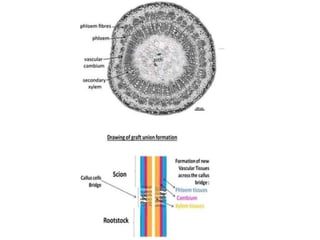
3.Formation of cambial bridges:
• The paranchymatous cells of the callus form a cambial bridge
within 12 to15 days after grafting/budding.
• After the formation of cambial bridge, de-differentiation of
secondary xylem and phloem takes place after 36-48 days.
• Afterwards, the partial movement of stock to scion takes place.
• The bud union is completed within 6-7 weeks, if conditions are
favourable.
4. Healing of the bud/graft union:
• After de-differentiation of secondary xylem and phloem of both
stock and scion, there is formation of many new xylem and phloem
cells after 6-8 months of budding or grafting.
• The callus unites completely with the scion pith and the union
heals completely.
• In general, better contact and alignment of the cambial cells of
stock and scion helps in development and proliferation of callus.
Graft incompatibility
The inability of two different plants grafted together to
produce a successful union and to develop
satisfactorily in to one complete plant is termed as
graft incompatibility
Symptoms of graft incompatibility
1. failure to form a successful graft or bud union
2. Yellowing of foliage followed by early defoliation
3. Premature death of tree
4. Overgrowth at, above or below graft union
5.Breaking of trees at the point of union, particularly
when they have been growing for some years
Methods of grafting:
There are two main types of grafting-
attached scion methods of grafting and
detached scion methods of grafting.
In attached scion methods of grafting, the
scion is still attached to the mother plant till
the graft union takes place where as in
detached scion methods of grafting the scion
is separated from the mother plant just
before grafting.
Inarching or approach grafting is most
important method under attached scion
methods of grafting.
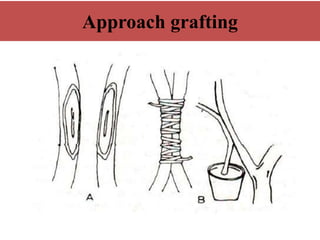
1. Inarching / Approach grafting:
The distinguishing feature of this method of
grafting is that two independent plants on their own
roots (self sustaining) are grafted together.
 This method provides a means of establishing a
successful union between certain plants which are
difficult to graft by any other method as the two
plants will be on their own roots till the formation
of successful graft.
Examples are Guava, mango, etc.
Approach grafting
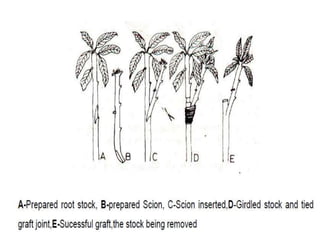
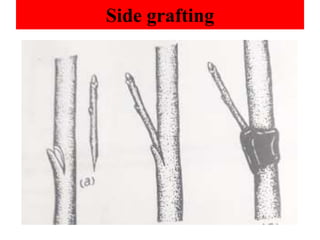
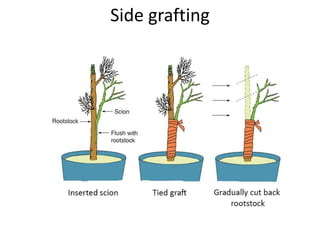
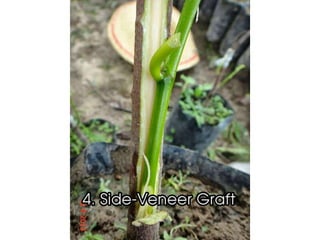
2. Veneer grafting/ side grafting:
 This method of propagation holds promise for large scale
commercial propagation.
 The method is simple and can be adopted with success.
 Eight months to one year old seedlings are used as rootstocks.
 In this method, a downward and inward 3-4 cm long cut is
made in the smooth area of the stock at a height of about 20
cm.
 At the base of cut, a small shorter cut is given to intersect the
first so as to remove the piece of wood and bark.
 Proper selection and preparation of scion are of utmost
importance.
 The scion should be of matching thickness with the stock,
preferably a terminal non-flowered shoot of 3 to 4 months
maturity.
 Remove the leaf blades from the selected scion shoot
on the mother plant keeping the petiole intact, about 7
to 10 days prior to detaching.
 This helps in forcing the buds to swell and in
increasing the grafting success.
 The scion stick is given a long slanting cut on one side
and a small short cut on the other so as to match the cuts
of the rootstock.
 The scion is inserted in the rootstock and the graft
union is then tied with polythene strip.
 The rootstock should be clipped in stages when the
scion takes and remains green for more than 10 days.It
is used widely for grafting plants such as Avocado,
Mango etc.
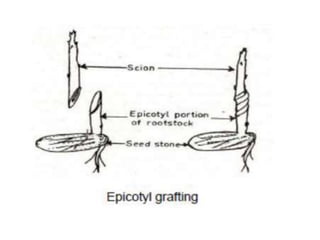
3. Epicotyl (Stone) Grafting:
• This method of grafting is done on the epicotyl region
of the young seedlings; hence the name epicotyl
grafting. Eg. Cashewnut, Mango etc.
Procedure:
• Select very young seedling about 10 days old raised in
polythene bags of size (15 cm×22 cm).
• Cut off the top portion of the chosen seedling leaving
5-6 cm long shoot (epicotyl).
• With a sharp knife make a vertical, downward slit (2-3
cm long) at the centre of the remaining portion of the
epicotyl.
• Select a dormant 3-4 months old terminal shoot of
about 5-8 cm long from a proven mother plant as the
scion stick.
• Cut the lower end of the selected scion to a wedge
shape by giving slanting and inward cuts of 2-3cm on
opposite sides.
• Insert the wedge shaped scion in the slit made on the
seedling and secure firmly with polythene strips or tape.
• Water the graft regularly without wetting the graft
region.
• In about three weeks the scion starts sprouting.
• If the seedlings are raised in sand beds they are
uprooted (with stones) 15 to 20 days after sowing (when
seedlings attain 10-15 cm height) and grafting is done
as described above.
• The grafted seedling is then planted in polythene bags
or pots keeping the graft union above the soil level and
without damaging the stone.
• June to September is the best period for epicotyl
grafting.
The scions should be 4- 5 months old and 10-15 cm
long containing terminal buds.
 The scion is then inserted in the cleft of the
seedlings and tied with polythene tape.
 Immediately thereafter, the grafts are planted in
polybags filled with the mixture of soil and
farmyard manure (1:1).
The polybags are watered and then kept in the shade
protecting from sun and heavy rain.
The successful grafts should be shifted to open
space or may be planted in nursery beds when their
leaves become green.
 The most suitable time for stone grafting is July.
Examples are Cashew, mango etc.
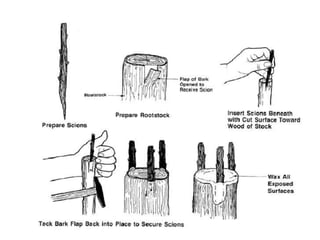
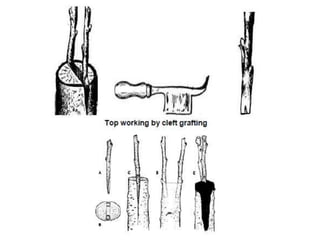
4. Cleft grafting:
This method is employed in the nursery when the
rootstock is quite thicker than the scion.
It can be done successfully in the rootstock having a
diameter of 3-10 cm.
 A vertical split (5 cm) is made in the rootstock with
a sharp knife. The scion should be one year old,
about 15-20 cm long and having 3-4 buds above the
slanting cuts.
 For preparing the scion, two slanting cuts (5-6 cm)
each are given on the opposite sides.
 The scion is inserted into the split of the rootstock
in such a way that the cambium of both stock and
scion coincides.
Careful tying is necessary to avoid displacing the
scion and separating the cambiums.
The graft union is then tied with the help of 150
gauge polythene strip.
Sprouting of scion shoots starts within 3 weeks of
grafting.
 The polythene strip is removed after about 6-8
weeks of grafting
The sprouts arising below the graft union should be
removed periodically. The best time for cleft
grafting is December- February in temperate fruits.
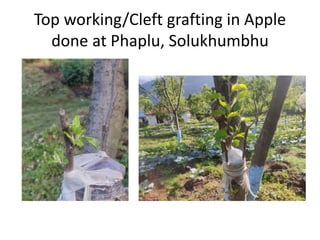
Top working/Cleft grafting in Apple
done at Phaplu, Solukhumbhu
5. Splice grafting:
This method is mostly applied in apple, pear,
cherries etc.
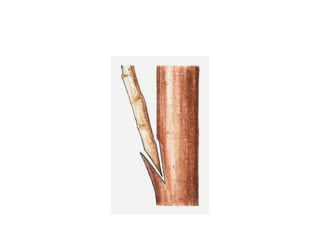
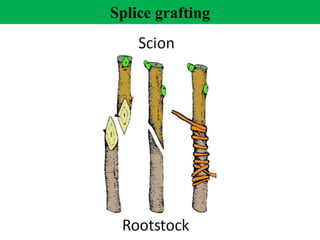
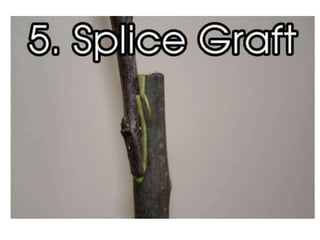
Nearly equal size(3-5 cm) of slanting cut should be
made on the proximal end of scion and distal end of
root stock.
The two cut surface are placed together, made tight
and wrapped with polythenene grafted tape.
Splice grafting
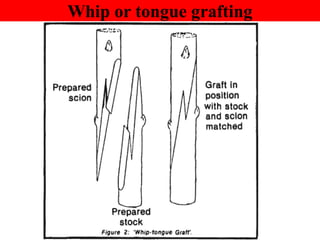
6. Whip or Tongue Grafting
 This method is highly effective and widely employed for the
propagation of peach and pear.
 In this method, the diameter of the scion and the rootstock
should be equal.
 In this method, a flat slanting cut, about 5 cm long is given at
the base of the scion so that the lowest bud is about midway
along the cut but on the opposite side.
 A downward pointing tongue is made in the upper half of the
slanting surface.
 A slanting cut, corresponding in length to that of the scion, is
made upwards through the stock 15-20 cm above the ground.
 An upward pointing tongue is made in the upper half of this
slanting surface.
 The cut surfaces of the scion and stock are now placed
together so that the tongues interlock and the cambial regions
are in close contact.
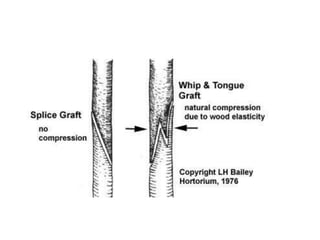
 This interlocking of tongue gives greater surface for the root
stock and scion come into contact with each other to make the
strong union.
 Careful tying is necessary to avoid displacing the scion and
separating the cambiums.
 The graft union is then tied with the help of 150 gauge
polythene strip.
 Sprouting of scion shoots starts within 3 weeks of grafting.
 The periodical removal of sprouts below the graft union
should be carried out.
 The polythene strip is removed after about 6-8 weeks of
grafting.
 Examples are apple, pear, peach, plum, apricot, almond,
cherry, kiwi fruit, pecan nut etc.
 The best time for tongue grafting is December- February in
temperate fruits.
Whip or tongue grafting
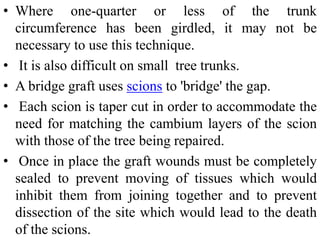
7. Bridge grafting
• A bridge graft is used to supply nutrients to the
rootstock of a woody perennial when the bark, and
therefore the conductive tissues, have been removed
from part of the trunk.
• This wound is often caused by rabbits or other
rodents, stripping the bark away and girdling the
tree.
• The inability of the plant to transport food
manufactured in the leaves down to the root system,
causes the root system to die and in the death cycle,
the resulting lack of root system causes the upper
portions of the plant to die.
•
• Where one-quarter or less of the trunk
circumference has been girdled, it may not be
necessary to use this technique.
• It is also difficult on small tree trunks.
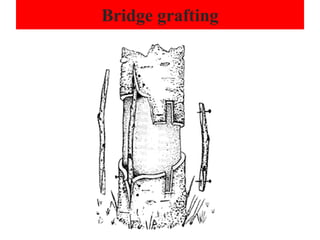
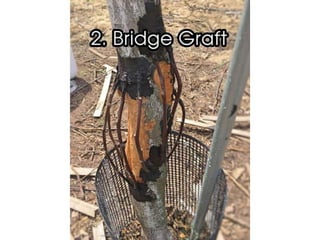
• A bridge graft uses scions to 'bridge' the gap.
• Each scion is taper cut in order to accommodate the
need for matching the cambium layers of the scion
with those of the tree being repaired.
• Once in place the graft wounds must be completely
sealed to prevent moving of tissues which would
inhibit them from joining together and to prevent
dissection of the site which would lead to the death
of the scions.
Bridge grafting
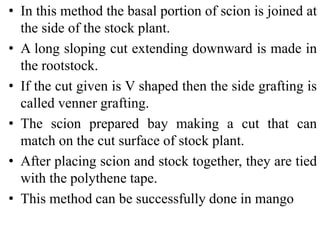
• In this method the basal portion of scion is joined at
the side of the stock plant.
• A long sloping cut extending downward is made in
the rootstock.
• If the cut given is V shaped then the side grafting is
called venner grafting.
• The scion prepared bay making a cut that can
match on the cut surface of stock plant.
• After placing scion and stock together, they are tied
with the polythene tape.
• This method can be successfully done in mango
Side grafting
Side grafting
Plant Propagation by Budding
 Budding is also a method of grafting wherein only one bud with
a piece of bark and with or without wood is used as the scion
material.
 It is also called as bud grafting. The plant that grows after union
of the stock and bud is known as budding.
Methods of budding:
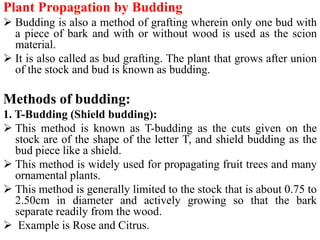
1. T-Budding (Shield budding):
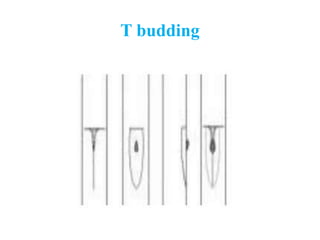
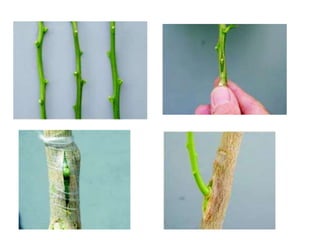
 This method is known as T-budding as the cuts given on the
stock are of the shape of the letter T, and shield budding as the
bud piece like a shield.
 This method is widely used for propagating fruit trees and many
ornamental plants.
 This method is generally limited to the stock that is about 0.75 to
2.50cm in diameter and actively growing so that the bark
separate readily from the wood.
 Example is Rose and Citrus.
T budding
2. Inverted T- Budding:
In heavy rainfall areas, water running down the stem
of the stock may enter the T cut, soak under the bark
and prevent healing of the bud piece.
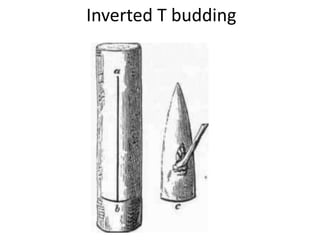
Under such conditions, an inverted T budding may
give better results as it is more likely to shed excess
water.
Inverted T budding procedure is same as that of T
budding except the horizontal cut on the stock is
made at the bottom of the vertical cut rather than at
the top.
Inverted T budding
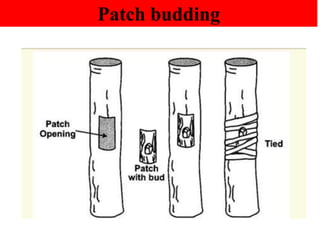
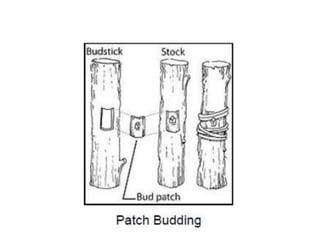
3. Patch Budding:
In this method a regular patch of bark is completely
removed from the stock plant and is replaced with a
patch of bark of the same size containing a bud from
the desired mother plant.
For this method to be successful the bark of the
stock and bud stick should be easily slipping .
The diameter of the stock and bud stick should be
preferably by about the same (1.5 to 2.75cm).
Examples are Pecan nut and walnut.
Patch budding
4. Ring budding:
The bud is prepared by taking a ring of a bark, 3cm
long with the bud in the centre.
 In the root stock, two transverse cut 1.5cm apart are
made and these are connected with a vertical cut and
a ring of bark is removed.
 The prepared scion bud with the ring of bark is
fitted in the exposed portion of the rootstock and
tied.
 Example is ber.