Propaganda Techniques
Propaganda
They are the methods and approaches
used to spread ideas that further a
cause - a political, commercial,
religious, or civil cause.
This is to publicize an idea and to
manipulate the readers' or viewers'
reason and emotions; to persuade you
to believe in something or someone,
buy an item, or vote a certain way.
Propaganda
They are the methods and approaches
used to spread ideas that further a
cause - a political, commercial,
religious, or civil cause.
This is to publicize an idea and to
manipulate the readers' or viewers'
reason and emotions; to persuade you
to believe in something or someone,
buy an item, or vote a certain way.
Card
Stacking
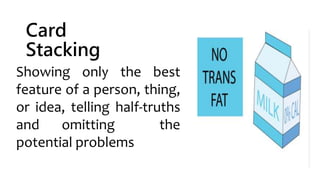
Showing only the best
feature of a person, thing,
or idea, telling half-truths
and omitting the
potential problems
Examples:
1. Choco drink brand Milo,
advertises to beat energy gap
when the product only
contains so much sugar that
stimulates the brain to signal
the body to exhibit an
appearance of strength and
energy.
Name-calling
• Attaching a negative label,
such as “racist”, “dictator”,
“terrorist”, “idiot”, to a
person or a thing or an idea
• People engage in this type
of behavior when they are
trying to avoid supporting
their own opinion with facts.
Examples:
1.A political candidate trash-talks his opponent in his
public speech.
2.An internet troll calls a candidate “lugaw” just to
tarnish the person’s reputation, without presenting
factual basis but just to spread hate.
3. Red tagging academic institution as “terrorist” or
“communist” to invalidate the institution’s good
reputation, without factual basis
Plain Folks
• The use of common people
to persuade an audience.
• Associating a person, a
thing, or an idea to be one
of common people or the
masses.
• Banks on the audience’s
desire for real experiences.
Examples:
1.A political candidate talking about growing up
in poverty in a small town in the Philippines.
2.An advertisement of a dishwashing liquid brand
making use of housewives to promote their
product.
3.An philanthropic organization showing how
ordinary people are making a difference in the
world through volunteerism.
Bandwagon
This is a technique that persuades people
by showing them that everyone else are
doing the same thing. It also implies that
one must accept or reject an idea because
everyone else is accepting or rejecting it.
Examples:
1.“Don’t be left out! Switch
to Camilla optical clinic.”
2.“Pepsi: the choice of the
new generation.”
3.People cancelling a certain
personality on social
media because so many
others are doing it.
Glittering Generalities
This technique uses important-
sounding "glad words" that
have little or no real
meaning. These words are
used in general statements that
cannot be proved or
disproved. Words like "good,"
"honest," "fair," and "best" are
examples of "glad" words.
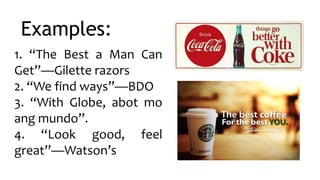
Examples:
1. “The Best a Man Can
Get”—Gilette razors
2. “We find ways”—BDO
3. “With Globe, abot mo
ang mundo”.
4. “Look good, feel
great”—Watson’s
Testimonial
This is a technique
wherein a famous or
seemingly authoritative
person recommends a
product or service, and
vouches for its value
Examples:
1.A famous singer performing in a campaign rally
of a politician.
2. Vlogger Sasa Gurl sharing her experiences in
using a a phone from a certain brand.
3. A celebrity converted to a vegetarianism and
talks about her journey towards her
conversion.
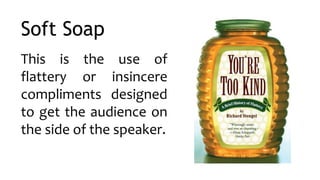
Soft Soap
This is the use of
flattery or insincere
compliments designed
to get the audience on
the side of the speaker.
Examples:
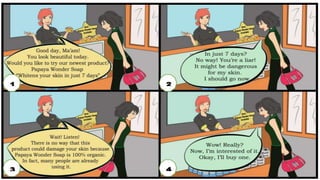
1. A salesperson in a cosmetic store offering a
brighter shade of a foundation to flatter the
costumer that she has fair skin.
2. “Try this dress, this will look good on you
because you’ve got a very nice body shape!”
3. “This red lipstick is best for a lady boss like
you!”
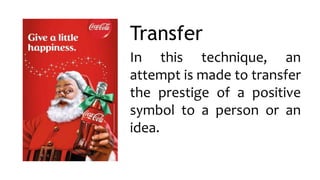
Transfer
In this technique, an
attempt is made to transfer
the prestige of a positive
symbol to a person or an
idea.
Examples:
1. Making use of religion and faith to
persuade others to stand against the
passing of divorce law.
2. A political campaign rally making use of
the Philippine flag to associate the event
as patriotic.
Either/Or Fallacy
This technique is also called "black-and-
white thinking" because only two choices
are given. You are either for something or
against it; there is no middle ground or
shades of gray. It is used to polarize
issues, and negates all attempts to find a
common ground.
Examples:
1. “If you’re supporting the passing of law
allowing abortion, that means you are
against life.”
2. “Agreeing to the passing of law on
divorce in the country is not pro-family.”
3. A religious guy persuading people that
supporting LGBTQ+ community is not a
Christian’s way of life.
Faulty Cause and Effect
This technique suggests that because B
follows A, A must cause B. Remember, just
because two events or two sets of data are
related does not necessarily mean that one
caused the other to happen. It is important
to evaluate data carefully before jumping
to a wrong conclusion.
Examples:
1. “Don’t lose your pen. If you lose your pen, you will
not be able to answer the test. If you don’t take the
test you will fail in class. If you fail in class, you will
not graduate. If you do not graduate you will not
find a job. If you don’t have a job, you will not have
money. If you don’t have money, you cannot buy
food. If there’s no food, you can’t eat. If you can’t
eat, you will die.”
2. People telling women that wearing short and
endearing clothing is the reason why men rape.
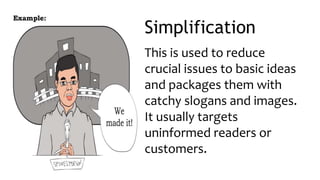
Simplification
This is used to reduce
crucial issues to basic ideas
and packages them with
catchy slogans and images.
It usually targets
uninformed readers or
customers.
Examples:
1. A teenage tiktoker is telling her viewers that
it’s okay to be pregnant at her age than to
engage in abortion, arguing that it is more
irresponsible and evil to abort her pregnancy.
2. A social media influencer tells her followers to
be happy about going back to work after the
Christmas holidays, saying that being sad
about it means being ungrateful for the job.

propaganda techniques.pptx

  • 2.
  • 3.
    Propaganda They are themethods and approaches used to spread ideas that further a cause - a political, commercial, religious, or civil cause. This is to publicize an idea and to manipulate the readers' or viewers' reason and emotions; to persuade you to believe in something or someone, buy an item, or vote a certain way.
  • 4.
    Propaganda They are themethods and approaches used to spread ideas that further a cause - a political, commercial, religious, or civil cause. This is to publicize an idea and to manipulate the readers' or viewers' reason and emotions; to persuade you to believe in something or someone, buy an item, or vote a certain way.
  • 5.
    Card Stacking Showing only thebest feature of a person, thing, or idea, telling half-truths and omitting the potential problems
  • 6.
    Examples: 1. Choco drinkbrand Milo, advertises to beat energy gap when the product only contains so much sugar that stimulates the brain to signal the body to exhibit an appearance of strength and energy.
  • 7.
    Name-calling • Attaching anegative label, such as “racist”, “dictator”, “terrorist”, “idiot”, to a person or a thing or an idea • People engage in this type of behavior when they are trying to avoid supporting their own opinion with facts.
  • 8.
    Examples: 1.A political candidatetrash-talks his opponent in his public speech. 2.An internet troll calls a candidate “lugaw” just to tarnish the person’s reputation, without presenting factual basis but just to spread hate. 3. Red tagging academic institution as “terrorist” or “communist” to invalidate the institution’s good reputation, without factual basis
  • 9.
    Plain Folks • Theuse of common people to persuade an audience. • Associating a person, a thing, or an idea to be one of common people or the masses. • Banks on the audience’s desire for real experiences.
  • 10.
    Examples: 1.A political candidatetalking about growing up in poverty in a small town in the Philippines. 2.An advertisement of a dishwashing liquid brand making use of housewives to promote their product. 3.An philanthropic organization showing how ordinary people are making a difference in the world through volunteerism.
  • 11.
    Bandwagon This is atechnique that persuades people by showing them that everyone else are doing the same thing. It also implies that one must accept or reject an idea because everyone else is accepting or rejecting it.
  • 12.
    Examples: 1.“Don’t be leftout! Switch to Camilla optical clinic.” 2.“Pepsi: the choice of the new generation.” 3.People cancelling a certain personality on social media because so many others are doing it.
  • 13.
    Glittering Generalities This techniqueuses important- sounding "glad words" that have little or no real meaning. These words are used in general statements that cannot be proved or disproved. Words like "good," "honest," "fair," and "best" are examples of "glad" words.
  • 14.
    Examples: 1. “The Besta Man Can Get”—Gilette razors 2. “We find ways”—BDO 3. “With Globe, abot mo ang mundo”. 4. “Look good, feel great”—Watson’s
  • 15.
    Testimonial This is atechnique wherein a famous or seemingly authoritative person recommends a product or service, and vouches for its value
  • 16.
    Examples: 1.A famous singerperforming in a campaign rally of a politician. 2. Vlogger Sasa Gurl sharing her experiences in using a a phone from a certain brand. 3. A celebrity converted to a vegetarianism and talks about her journey towards her conversion.
  • 17.
    Soft Soap This isthe use of flattery or insincere compliments designed to get the audience on the side of the speaker.
  • 18.
    Examples: 1. A salespersonin a cosmetic store offering a brighter shade of a foundation to flatter the costumer that she has fair skin. 2. “Try this dress, this will look good on you because you’ve got a very nice body shape!” 3. “This red lipstick is best for a lady boss like you!”
  • 19.
    Transfer In this technique,an attempt is made to transfer the prestige of a positive symbol to a person or an idea.
  • 20.
    Examples: 1. Making useof religion and faith to persuade others to stand against the passing of divorce law. 2. A political campaign rally making use of the Philippine flag to associate the event as patriotic.
  • 21.
    Either/Or Fallacy This techniqueis also called "black-and- white thinking" because only two choices are given. You are either for something or against it; there is no middle ground or shades of gray. It is used to polarize issues, and negates all attempts to find a common ground.
  • 22.
    Examples: 1. “If you’resupporting the passing of law allowing abortion, that means you are against life.” 2. “Agreeing to the passing of law on divorce in the country is not pro-family.” 3. A religious guy persuading people that supporting LGBTQ+ community is not a Christian’s way of life.
  • 23.
    Faulty Cause andEffect This technique suggests that because B follows A, A must cause B. Remember, just because two events or two sets of data are related does not necessarily mean that one caused the other to happen. It is important to evaluate data carefully before jumping to a wrong conclusion.
  • 24.
    Examples: 1. “Don’t loseyour pen. If you lose your pen, you will not be able to answer the test. If you don’t take the test you will fail in class. If you fail in class, you will not graduate. If you do not graduate you will not find a job. If you don’t have a job, you will not have money. If you don’t have money, you cannot buy food. If there’s no food, you can’t eat. If you can’t eat, you will die.” 2. People telling women that wearing short and endearing clothing is the reason why men rape.
  • 25.
    Simplification This is usedto reduce crucial issues to basic ideas and packages them with catchy slogans and images. It usually targets uninformed readers or customers.
  • 26.
    Examples: 1. A teenagetiktoker is telling her viewers that it’s okay to be pregnant at her age than to engage in abortion, arguing that it is more irresponsible and evil to abort her pregnancy. 2. A social media influencer tells her followers to be happy about going back to work after the Christmas holidays, saying that being sad about it means being ungrateful for the job.