BRAND TAGLINE
1. BDO A. May liwanag ang buhay!
2. RiteMed B. Balanced News, Fearless
News
3. KFC C. Para kanino ka
bumabangon?
4. Jollibee D. We got it all for you
5. Meralco E. Kapuso ng bawat Filipino
6. SM Malls F. Goodbye Stains
7. Philippine Daily Inquirer G. Wag Mahihiyang Magtanong
8. GMA Network H. Finger lickin’ good
9. Ariel I. We find ways
10. Nescafe J. Bida ang saya
RECOGNIZING
PROPAGANDAS
What is Propaganda?
• Propaganda is a mode of communication used to promote and
influence a cause or certain view. It is mostly focused on spreading
ideas to manipulate the behavior of many instead of telling them the
truth.
• When we want others to believe in us, we try to say or do something
that will convince/persuade them. To persuade someone means to
influence a person to a specific action that we want him or her to get
involved with.
• Some people are using manipulation in order to sway others to take
part in what they are promoting, supporting and endorsing.
Manipulation may come in different forms such as controlling some
situations, using flowery and sugar-coated words, and overdoing an
action just to convince others. This is where the idea of propaganda
comes into play.
Types of Propaganda Techniques
• Bandwagon
• Plain Folks
• Card Stacking
• Name-Calling
• Glittering Generalities
• Testimonials
• Transfer
BANDWAGON
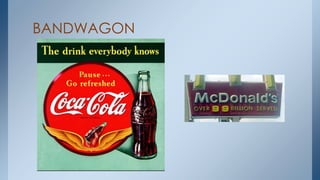
• Influencing people by telling then how everyone is using the
same product or is true to the same ideology. This encourages
people to take the same course of action. The idea of this type
of propaganda intentionally makes a person feel to be left out
from group.
• Examples:
– Pepsi commercial that pushed forth the slogan “the choice of a new
generation.”
– Proactive skincare commercial uses assertation: “Philippines’ #1 skin care
product” to group proactive with the entire country.
BANDWAGON
PLAIN FOLKS
• The user of this product is an ordinary or common people. It
relates more on one’s experiences. This technique works in a way
to establish that the speaker is regular and ordinary and has the
same views and opinions as the people he is appealing to.
• Examples:
– A baby promoting different foods.
– A little boy that could be anyone is advertising OREO.
PLAIN FOLKS
CARD STACKING
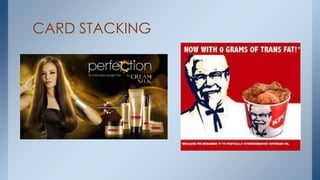
• This can also be called Cherry-Picking. The idea behind this
technique is that the advertiser intentionally removes any
information that may damage their image and put only the
information which will bait a person into the trap. The
propagandist uses only those facts and details that support their
argument. You will get misled if you do not notice that important
details are missing.
• Example:
– A brand of snack food is loaded with sugar then commercial may boast
that product is known in fat which implies that is also low in calories.
CARD STACKING
NAME-CALLING
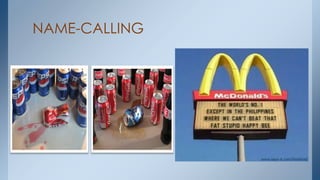
• This type of propaganda makes use of insulting or belittling labels
resulting in the formation of a negative opinion or impression
about a product, person, and group. Name-calling also called
stereotyping or labelling is another propaganda technique.
Direct name-calling is a direct attack on an opponent. If it is
likely to annoy the audience, indirect name-calling is used.
• Example:
– In TV commercial, the rival product will be branded either x or y despite
the advertiser would cover the brand name. But because of other clues
like its color, design and layout, you can still recognize that product.
NAME-CALLING
GLITTERING GENERALITIES
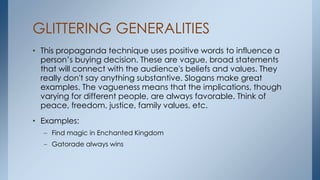
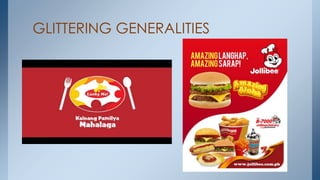
• This propaganda technique uses positive words to influence a
person’s buying decision. These are vague, broad statements
that will connect with the audience's beliefs and values. They
really don't say anything substantive. Slogans make great
examples. The vagueness means that the implications, though
varying for different people, are always favorable. Think of
peace, freedom, justice, family values, etc.
• Examples:
– Find magic in Enchanted Kingdom
– Gatorade always wins
GLITTERING GENERALITIES
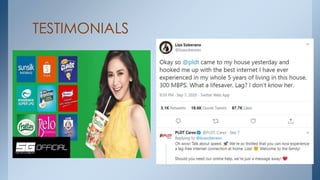
TESTIMONIALS
• Advertisers use the endorsements of influencers, popular
personalities, authority figures or experts in the field to convince
that the product is worth the money.
• Examples:
– Kathrine Bernardo promoting a beauty cream.
– Lebron James is promoting the famous fast food place Mc Donald's! When
his fans see this, they want to eat it because their favorite NBA Basketball
player eats it.
TESTIMONIALS
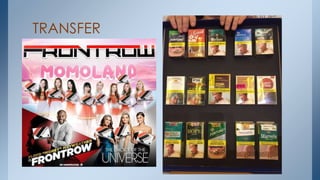
TRANSFER
• It is an attempt to make the subject view a certain item in the
same way as they view another item. It employs the use of
symbols, quotations, images of famous people to impart an idea
or claim that carries respect, authority, sanction to make it look
more acceptable. By linking an item to something the subject
respects or enjoys, positive feelings can be generated for it. This
is an effort to transfer your approval of something you respect
and approve of to another something that the propagandist
wants you to approve of.
• Examples:
– Manny Pacquiao train very hard for his fight but he feels pain every
training so he takes Alaxan FR to relieve the pain.
– Coco Martin loves to drink coffee in giving himself satisfaction he prefers to
use Nescafe.
TRANSFER
Activity
1. Milk tea is the choice of your generation unlike fruit juice.
2. Be beautiful again. Make your face look twenty years younger
and get the attention of every person in this world.
3. Experience the best with Everything Store! We have got
everything for you!
4. Buy Shiny Shoes. It’s 100% authentic. Made from our beloved
country, the Philippines (with some printed lyrics of a national
song on the shoebox).
5. Don’t use other beauty products than softy touch. If you don’t,
your skin will be dry forever!
Activity
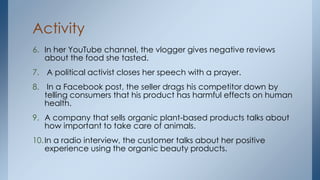
6. In her YouTube channel, the vlogger gives negative reviews
about the food she tasted.
7. A political activist closes her speech with a prayer.
8. In a Facebook post, the seller drags his competitor down by
telling consumers that his product has harmful effects on human
health.
9. A company that sells organic plant-based products talks about
how important to take care of animals.
10.In a radio interview, the customer talks about her positive
experience using the organic beauty products.
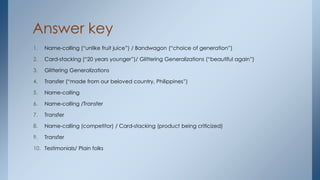
Answer key
1. Name-calling (“unlike fruit juice”) / Bandwagon (“choice of generation”)
2. Card-stacking (“20 years younger”)/ Glittering Generalizations (“beautiful again”)
3. Glittering Generalizations
4. Transfer (“made from our beloved country, Philippines”)
5. Name-calling
6. Name-calling /Transfer
7. Transfer
8. Name-calling (competitor) / Card-stacking (product being criticized)
9. Transfer
10. Testimonials/ Plain folks

PROPAGANDA.pptx

  • 1.
    BRAND TAGLINE 1. BDOA. May liwanag ang buhay! 2. RiteMed B. Balanced News, Fearless News 3. KFC C. Para kanino ka bumabangon? 4. Jollibee D. We got it all for you 5. Meralco E. Kapuso ng bawat Filipino 6. SM Malls F. Goodbye Stains 7. Philippine Daily Inquirer G. Wag Mahihiyang Magtanong 8. GMA Network H. Finger lickin’ good 9. Ariel I. We find ways 10. Nescafe J. Bida ang saya
  • 3.
  • 4.
    What is Propaganda? •Propaganda is a mode of communication used to promote and influence a cause or certain view. It is mostly focused on spreading ideas to manipulate the behavior of many instead of telling them the truth. • When we want others to believe in us, we try to say or do something that will convince/persuade them. To persuade someone means to influence a person to a specific action that we want him or her to get involved with. • Some people are using manipulation in order to sway others to take part in what they are promoting, supporting and endorsing. Manipulation may come in different forms such as controlling some situations, using flowery and sugar-coated words, and overdoing an action just to convince others. This is where the idea of propaganda comes into play.
  • 5.
    Types of PropagandaTechniques • Bandwagon • Plain Folks • Card Stacking • Name-Calling • Glittering Generalities • Testimonials • Transfer
  • 6.
    BANDWAGON • Influencing peopleby telling then how everyone is using the same product or is true to the same ideology. This encourages people to take the same course of action. The idea of this type of propaganda intentionally makes a person feel to be left out from group. • Examples: – Pepsi commercial that pushed forth the slogan “the choice of a new generation.” – Proactive skincare commercial uses assertation: “Philippines’ #1 skin care product” to group proactive with the entire country.
  • 7.
  • 8.
    PLAIN FOLKS • Theuser of this product is an ordinary or common people. It relates more on one’s experiences. This technique works in a way to establish that the speaker is regular and ordinary and has the same views and opinions as the people he is appealing to. • Examples: – A baby promoting different foods. – A little boy that could be anyone is advertising OREO.
  • 9.
  • 10.
    CARD STACKING • Thiscan also be called Cherry-Picking. The idea behind this technique is that the advertiser intentionally removes any information that may damage their image and put only the information which will bait a person into the trap. The propagandist uses only those facts and details that support their argument. You will get misled if you do not notice that important details are missing. • Example: – A brand of snack food is loaded with sugar then commercial may boast that product is known in fat which implies that is also low in calories.
  • 11.
  • 12.
    NAME-CALLING • This typeof propaganda makes use of insulting or belittling labels resulting in the formation of a negative opinion or impression about a product, person, and group. Name-calling also called stereotyping or labelling is another propaganda technique. Direct name-calling is a direct attack on an opponent. If it is likely to annoy the audience, indirect name-calling is used. • Example: – In TV commercial, the rival product will be branded either x or y despite the advertiser would cover the brand name. But because of other clues like its color, design and layout, you can still recognize that product.
  • 13.
  • 14.
    GLITTERING GENERALITIES • Thispropaganda technique uses positive words to influence a person’s buying decision. These are vague, broad statements that will connect with the audience's beliefs and values. They really don't say anything substantive. Slogans make great examples. The vagueness means that the implications, though varying for different people, are always favorable. Think of peace, freedom, justice, family values, etc. • Examples: – Find magic in Enchanted Kingdom – Gatorade always wins
  • 15.
  • 16.
    TESTIMONIALS • Advertisers usethe endorsements of influencers, popular personalities, authority figures or experts in the field to convince that the product is worth the money. • Examples: – Kathrine Bernardo promoting a beauty cream. – Lebron James is promoting the famous fast food place Mc Donald's! When his fans see this, they want to eat it because their favorite NBA Basketball player eats it.
  • 17.
  • 18.
    TRANSFER • It isan attempt to make the subject view a certain item in the same way as they view another item. It employs the use of symbols, quotations, images of famous people to impart an idea or claim that carries respect, authority, sanction to make it look more acceptable. By linking an item to something the subject respects or enjoys, positive feelings can be generated for it. This is an effort to transfer your approval of something you respect and approve of to another something that the propagandist wants you to approve of. • Examples: – Manny Pacquiao train very hard for his fight but he feels pain every training so he takes Alaxan FR to relieve the pain. – Coco Martin loves to drink coffee in giving himself satisfaction he prefers to use Nescafe.
  • 19.
  • 20.
    Activity 1. Milk teais the choice of your generation unlike fruit juice. 2. Be beautiful again. Make your face look twenty years younger and get the attention of every person in this world. 3. Experience the best with Everything Store! We have got everything for you! 4. Buy Shiny Shoes. It’s 100% authentic. Made from our beloved country, the Philippines (with some printed lyrics of a national song on the shoebox). 5. Don’t use other beauty products than softy touch. If you don’t, your skin will be dry forever!
  • 21.
    Activity 6. In herYouTube channel, the vlogger gives negative reviews about the food she tasted. 7. A political activist closes her speech with a prayer. 8. In a Facebook post, the seller drags his competitor down by telling consumers that his product has harmful effects on human health. 9. A company that sells organic plant-based products talks about how important to take care of animals. 10.In a radio interview, the customer talks about her positive experience using the organic beauty products.
  • 22.
    Answer key 1. Name-calling(“unlike fruit juice”) / Bandwagon (“choice of generation”) 2. Card-stacking (“20 years younger”)/ Glittering Generalizations (“beautiful again”) 3. Glittering Generalizations 4. Transfer (“made from our beloved country, Philippines”) 5. Name-calling 6. Name-calling /Transfer 7. Transfer 8. Name-calling (competitor) / Card-stacking (product being criticized) 9. Transfer 10. Testimonials/ Plain folks