Scientific evidence on road safety effects
of section control and red light cameras
Dublin, ITS Ireland, 17 September 2013
Charles Goldenbeld,
Institute for Road Safety Research SWOV
This presentation
• Institute for Road Safety Research SWOV
• Scientific evidence section control
• Separate studies
• Soole et al. review 2013
• Dutch experience
• Acceptance
• Conclusions
• Scientific evidence red light cameras
• International reviews (Cochrane 2005, Erke 2009, Høye 2013)
• Dutch experience
• Acceptance
• Conclusions
Dublin, ITS Ireland, 17 September 2013
What SWOV stands for
• Mission: to improve road safety with
knowledge from scientific research
• Public knowledge for professionals
• Network organization, top institute national
and international
Dublin, ITS Ireland, 17 September 2013
What we do
• In-depth studies into the causes of accidents
• Experimental research
• Evaluation studies
• Data analysis
• Calculating the effects of policy plans
• Second opinions
Independent, multidisciplinary, high quality
Dublin, ITS Ireland, 17 September 2013
Who we work for
• Road safety professionals:
– National, regional and local authorities
– Police and judicial authorities
– Consultants
– Trade and industry
Dublin, ITS Ireland, 17 September 2013
Section control: Terminology
• Section speed control
• Average speed control
• Point-to-point speed control
Dublin, ITS Ireland, 17 September 2013
Section control
Dublin, ITS Ireland, 17 September 2013
Figure from: Soole, Watson, & Fleiter, J.F. (2013). Effects of average speed enforcement on speed
compliance and crashes: A review of the literature. Accident Analysis and Prevention, 45, 46-56.
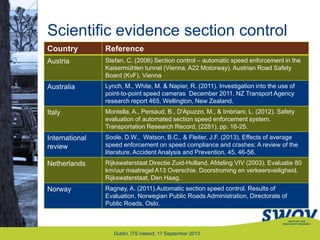
Scientific evidence section control
Country Reference
Austria Stefan, C. (2006) Section control – automatic speed enforcement in the
Kaisermühlen tunnel (Vienna, A22 Motorway). Austrian Road Safety
Board (KvF), Vienna
Australia Lynch, M., White, M. & Napier, R. (2011). Investigation into the use of
point-to-point speed cameras December 2011. NZ Transport Agency
research report 465, Wellington, New Zealand.
Italy Montella, A., Persaud, B., D'Apuzzo, M., & Imbriani, L. (2012). Safety
evaluation of automated section speed enforcement system.
Transportation Research Record, (2281), pp. 16-25.
International
review
Soole, D.W., Watson, B.C., & Fleiter, J.F. (2013). Effects of average
speed enforcement on speed compliance and crashes: A review of the
literature. Accident Analysis and Prevention, 45, 46-56.
Netherlands Rijkswaterstaat Directie Zuid-Holland, Afdeling VIV (2003). Evaluatie 80
km/uur maatregel A13 Overschie. Doorstroming en verkeersveiligheid.
Rijkswaterstaat, Den Haag.
Norway Ragnøy, A. (2011).Automatic section speed control. Results of
Evaluation. Norwegian Public Roads Administration, Directorate of
Public Roads, Oslo.
Dublin, ITS Ireland, 17 September 2013
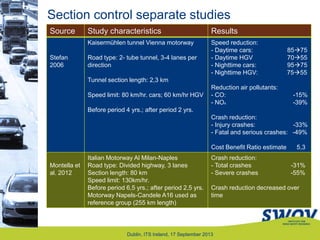
Section control separate studies
Source Study characteristics Results
Stefan
2006
Kaisermühlen tunnel Vienna motorway
Road type: 2- tube tunnel, 3-4 lanes per
direction
Tunnel section length: 2,3 km
Speed limit: 80 km/hr. cars; 60 km/hr HGV
Before period 4 yrs.; after period 2 yrs.
Speed reduction:
- Daytime cars: 8575
- Daytime HGV 7055
- Nighttime cars: 9575
- Nighttime HGV: 7555
Reduction air pollutants:
- CO: -15%
- NOx -39%
Crash reduction:
- Injury crashes: -33%
- Fatal and serious crashes: -49%
Cost Benefit Ratio estimate 5,3
Montella et
al. 2012
Italian Motorway Al Milan-Naples
Road type: Divided highway, 3 lanes
Section length: 80 km
Speed limit: 130km/hr.
Before period 6,5 yrs.; after period 2,5 yrs.
Motorway Napels-Candele A16 used as
reference group (255 km length)
Crash reduction:
- Total crashes -31%
- Severe crashes -55%
Crash reduction decreased over
time
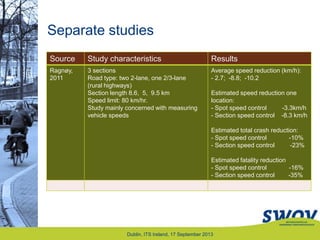
Separate studies
Source Study characteristics Results
Ragnøy,
2011
3 sections
Road type: two 2-lane, one 2/3-lane
(rural highways)
Section length 8.6, 5, 9.5 km
Speed limit: 80 km/hr.
Study mainly concerned with measuring
vehicle speeds
Average speed reduction (km/h):
- 2.7; -8.8; -10.2
Estimated speed reduction one
location:
- Spot speed control -3.3km/h
- Section speed control -8.3 km/h
Estimated total crash reduction:
- Spot speed control -10%
- Section speed control -23%
Estimated fatality reduction
- Spot speed control -16%
- Section speed control -35%
Dublin, ITS Ireland, 17 September 2013
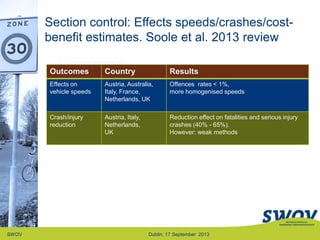
Section control: Effects speeds/crashes/cost-
benefit estimates. Soole et al. 2013 review
SWOV Dublin, 17 September 2013
• UitvoeringOutcomes Country Results
Effects on
vehicle speeds
Austria, Australia,
Italy, France,
Netherlands, UK
Offences rates < 1%,
more homogenised speeds
Crash/injury
reduction
Austria, Italy,
Netherlands,
UK
Reduction effect on fatalities and serious injury
crashes (40% - 65%).
However: weak methods
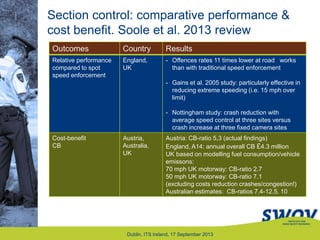
Section control: comparative performance &
cost benefit. Soole et al. 2013 review
Dublin, ITS Ireland, 17 September 2013
Outcomes
Outcomes Country Results
Relative performance
compared to spot
speed enforcement
England,
UK
- Offences rates 11 times lower at road works
than with traditional speed enforcement
- Gains et al. 2005 study: particularly effective in
reducing extreme speeding (i.e. 15 mph over
limit)
- Nottingham study: crash reduction with
average speed control at three sites versus
crash increase at three fixed camera sites
Cost-benefit
CB
Austria,
Australia,
UK
Austria: CB-ratio 5,3 (actual findings)
England, A14: annual overall CB £4.3 million
UK based on modelling fuel consumption/vehicle
emissons:
70 mph UK motorway: CB-ratio 2.7
50 mph UK motorway: CB-ratio 7.1
(excluding costs reduction crashes/congestion!)
Australian estimates: CB-ratios 7.4-12.5, 10
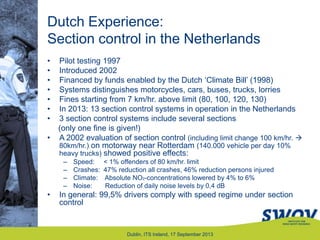
Dutch Experience:
Section control in the Netherlands
• Pilot testing 1997
• Introduced 2002
• Financed by funds enabled by the Dutch „Climate Bill‟ (1998)
• Systems distinguishes motorcycles, cars, buses, trucks, lorries
• Fines starting from 7 km/hr. above limit (80, 100, 120, 130)
• In 2013: 13 section control systems in operation in the Netherlands
• 3 section control systems include several sections
(only one fine is given!)
• A 2002 evaluation of section control (including limit change 100 km/hr. 
80km/hr.) on motorway near Rotterdam (140.000 vehicle per day 10%
heavy trucks) showed positive effects:
– Speed: < 1% offenders of 80 km/hr. limit
– Crashes: 47% reduction all crashes, 46% reduction persons injured
– Climate: Absolute NO2-concentrations lowered by 4% to 6%
– Noise: Reduction of daily noise levels by 0,4 dB
• In general: 99,5% drivers comply with speed regime under section
control
Dublin, ITS Ireland, 17 September 2013
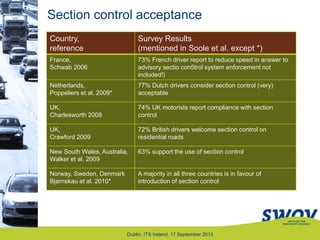
Section control acceptance
Country,
reference
Survey Results
(mentioned in Soole et al. except *)
France,
Schwab 2006
73% French driver report to reduce speed in answer to
advisory sectio con5trol system enforcement not
included!)
Netherlands,
Poppeliers et al. 2009*
77% Dutch drivers consider section control (very)
acceptable
UK,
Charlesworth 2008
74% UK motorists report compliance with section
control
UK,
Crawford 2009
72% British drivers welcome section control on
residential roads
New South Wales, Australia,
Walker et al. 2009
63% support the use of section control
Norway, Sweden, Denmark
Bjørnskau et al. 2010*
A majority in all three countries is in favour of
introduction of section control
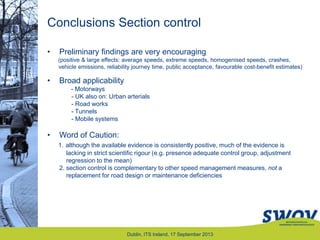
Conclusions Section control
Dublin, ITS Ireland, 17 September 2013
• Preliminary findings are very encouraging
(positive & large effects: average speeds, extreme speeds, homogenised speeds, crashes,
vehicle emissions, reliability journey time, public acceptance, favourable cost-benefit estimates)
• Broad applicability
- Motorways
- UK also on: Urban arterials
- Road works
- Tunnels
- Mobile systems
• Word of Caution:
1. although the available evidence is consistently positive, much of the evidence is
lacking in strict scientific rigour (e.g. presence adequate control group, adjustment
regression to the mean)
2. section control is complementary to other speed management measures, not a
replacement for road design or maintenance deficiencies
Dublin, ITS Ireland, 17 September 2013
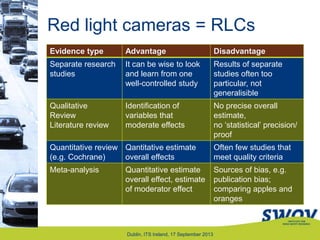
Red light cameras = RLCs
Evidence type Advantage Disadvantage
Separate research
studies
It can be wise to look
and learn from one
well-controlled study
Results of separate
studies often too
particular, not
generalisible
Qualitative
Review
Literature review
Identification of
variables that
moderate effects
No precise overall
estimate,
no „statistical‟ precision/
proof
Quantitative review
(e.g. Cochrane)
Qantitative estimate
overall effects
Often few studies that
meet quality criteria
Meta-analysis Quantitative estimate
overall effect, estimate
of moderator effect
Sources of bias, e.g.
publication bias;
comparing apples and
oranges
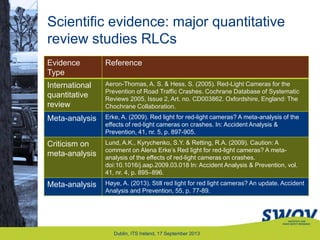
Scientific evidence: major quantitative
review studies RLCs
Evidence
Type
Reference
International
quantitative
review
Aeron-Thomas, A. S. & Hess, S. (2005). Red-Light Cameras for the
Prevention of Road Traffic Crashes. Cochrane Database of Systematic
Reviews 2005, Issue 2, Art. no. CD003862. Oxfordshire, England: The
Chochrane Collaboration.
Meta-analysis Erke, A. (2009). Red light for red-light cameras? A meta-analysis of the
effects of red-light cameras on crashes. In: Accident Analysis &
Prevention, 41, nr. 5, p. 897-905.
Criticism on
meta-analysis
Lund, A.K., Kyrychenko, S.Y. & Retting, R.A. (2009). Caution: A
comment on Alena Erke‟s Red light for red-light cameras? A meta-
analysis of the effects of red-light cameras on crashes.
doi:10.1016/j.aap.2009.03.018 In: Accident Analysis & Prevention, vol.
41, nr. 4, p. 895–896.
Meta-analysis Høye, A. (2013). Still red light for red light cameras? An update. Accident
Analysis and Prevention, 55, p. 77-89.
Dublin, ITS Ireland, 17 September 2013
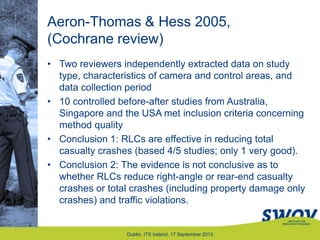
Aeron-Thomas & Hess 2005,
(Cochrane review)
• Two reviewers independently extracted data on study
type, characteristics of camera and control areas, and
data collection period
• 10 controlled before-after studies from Australia,
Singapore and the USA met inclusion criteria concerning
method quality
• Conclusion 1: RLCs are effective in reducing total
casualty crashes (based 4/5 studies; only 1 very good).
• Conclusion 2: The evidence is not conclusive as to
whether RLCs reduce right-angle or rear-end casualty
crashes or total crashes (including property damage only
crashes) and traffic violations.
Dublin, ITS Ireland, 17 September 2013
Meta-analysis Erke (2009)
• Meta-analysis = statistical method of combining
effect results of several studies to assess overall
effect and influence of moderating variables
• 21 studies
(10 USA, 4 Australia, 3 Singapore, 3 UK, 1 Norway)
• 5 well-controlled studies
Dublin, ITS Ireland, 17 September 2013
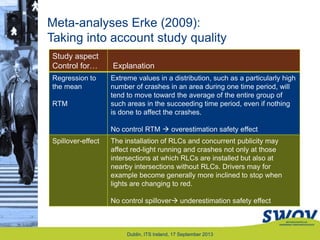
Meta-analyses Erke (2009):
Taking into account study quality
Dublin, ITS Ireland, 17 September 2013
Study aspect
Control for… Explanation
Regression to
the mean
RTM
Extreme values in a distribution, such as a particularly high
number of crashes in an area during one time period, will
tend to move toward the average of the entire group of
such areas in the succeeding time period, even if nothing
is done to affect the crashes.
No control RTM  overestimation safety effect
Spillover-effect The installation of RLCs and concurrent publicity may
affect red-light running and crashes not only at those
intersections at which RLCs are installed but also at
nearby intersections without RLCs. Drivers may for
example become generally more inclined to stop when
lights are changing to red.
No control spillover underestimation safety effect
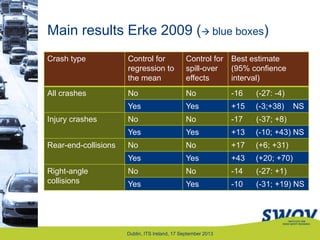
Main results Erke 2009 ( blue boxes)
Crash type Control for
regression to
the mean
Control for
spill-over
effects
Best estimate
(95% confience
interval)
All crashes No No -16 (-27: -4)
Yes Yes +15 (-3;+38) NS
Injury crashes No No -17 (-37; +8)
Yes Yes +13 (-10; +43) NS
Rear-end-collisions No No +17 (+6; +31)
Yes Yes +43 (+20; +70)
Right-angle
collisions
No No -14 (-27: +1)
Yes Yes -10 (-31; +19) NS
Dublin, ITS Ireland, 17 September 2013
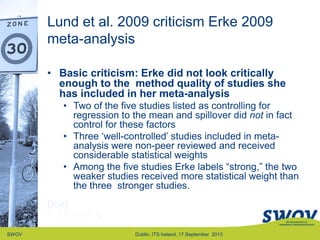
Lund et al. 2009 criticism Erke 2009
meta-analysis
SWOV Dublin, ITS Ireland, 17 September 2013
• Basic criticism: Erke did not look critically
enough to the method quality of studies she
has included in her meta-analysis
• Two of the five studies listed as controlling for
regression to the mean and spillover did not in fact
control for these factors
• Three „well-controlled‟ studies included in meta-
analysis were non-peer reviewed and received
considerable statistical weights
• Among the five studies Erke labels “strong,” the two
weaker studies received more statistical weight than
the three stronger studies.
Doel
• Uitvoering
Recent study Høye 2013: new meta-
analysis & answer to earlier criticism
• The aim of this study was to replicate the results
from the study by Erke (2009) based on a larger
sample of RLC-studies, and to investigate more
thoroughly the effects of study methodology.
• A closer look is especially taken at those studies
that have been critized by Lund et al. (2009) and
several analyses are performed to test if these or
other studies can be regarded as outliers.
Dublin, ITS Ireland, 17 September 2013
Meta-analysis Høye 2013
Dublin, ITS Ireland, 17 September 2013
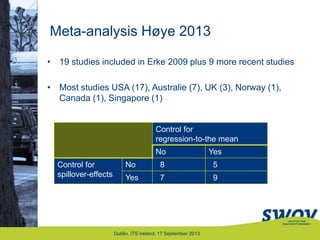
• 19 studies included in Erke 2009 plus 9 more recent studies
• Most studies USA (17), Australie (7), UK (3), Norway (1),
Canada (1), Singapore (1)
Control for
regression-to-the mean
No Yes
Control for
spillover-effects
No 8 5
Yes 7 9
Høye 3 step approach meta-analysis
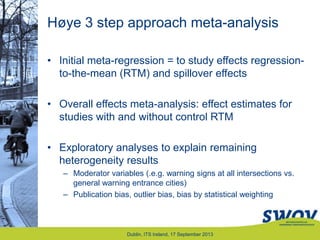
• Initial meta-regression = to study effects regression-
to-the-mean (RTM) and spillover effects
• Overall effects meta-analysis: effect estimates for
studies with and without control RTM
• Exploratory analyses to explain remaining
heterogeneity results
– Moderator variables (.e.g. warning signs at all intersections vs.
general warning entrance cities)
– Publication bias, outlier bias, bias by statistical weighting
Dublin, ITS Ireland, 17 September 2013
SWOV Dublin, ITS Ireland, 17 September 2013
Doel
• Uitvoering
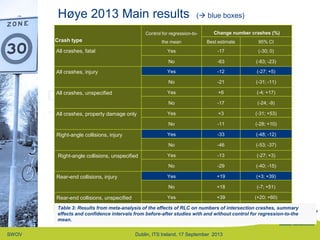
Crash type
Control for regression-to-
the mean
Change number crashes (%)
Best estimate 95% CI
All crashes, fatal Yes -17 (-30; 0)
No -63 (-83; -23)
All crashes, injury Yes -12 (-27; +5)
No -21 (-31; -11)
All crashes, unspecified Yes +6 (-4; +17)
No -17 (-24; -9)
All crashes, property damage only Yes +3 (-31; +53)
No -11 (-28; +10)
Right-angle collisions, injury Yes -33 (-48; -12)
No -46 (-53; -37)
Right-angle collisions, unspecified Yes -13 (-27; +3)
No -29 (-40; -15)
Rear-end collisions, injury Yes +19 (+3; +39)
No +18 (-7; +51)
Rear-end collisions, unspecified Yes +39 (+20; +60)
No +8 (+0; +17)Table 3: Results from meta-analysis of the effects of RLC on numbers of intersection crashes, summary
effects and confidence intervals from before-after studies with and without control for regression-to-the
mean.
Høye 2013 Main results ( blue boxes)
Høye 2013 Further results
Dublin, ITS Ireland, 17 September 2013
• General warning signs tend to be more effective than separate
signs at each intersection (however: not all results in support!)
• Some evidence for publication bias, but direction of the results
not changed by it
• In answer to Lund et al. 2009 criticism: no evidence that meta-
analysis results were excessively influenced by outliers or by
statistical weighting
Dutch experience:
Red light cameras in the Netherlands
• Estimate: > 600 speed/red light cameras
• In 2013 fine for red light running: € 220
• Few thorough evaluations
• 2005 study Amersfoort: Positive crash reduction
found (15 red light camera intersections
compared with 30 control intersections)
• 2011 national road users survey:
– 2% drivers report to have been fined for red light running;
– 71% in favour of installing more red light cameras
Dublin, ITS Ireland, 17 September 2013
Acceptance red light cameras
Dublin, ITS Ireland, 17 September 2013
• Dutch survey 2011: 71% in favour of more red light cameras
• European drivers survey 2010: 72% support (SARTRE-4)
• Insurance Institute for Highway Safety Status Report April
2013: 87% support RLC among those who live in areas with
long-standing automated enforcement
• Acceptance even higher when pedestrian, cyclist viewpoints
taken into account
Conclusions red light cameras
Dublin, ITS Ireland, 17 September 2013
• Høye 2013 meta-analysis: Evidence for road safety effects red light
cameras is positive but still less strong than we would like it to be
 Best estimate, best studies: -12% injury crashes (not significant)
 Best estimate, best studies: -33% right-angle injury collisions (significant)
 Best estimate, best studies: +19% rear-end injury collisions (significant)
• Complexity of intersections: Large inter- and intra-study variation:
variables that may be of importance are: the phasing of the traffic lights,
the offence rate before the cameras were placed, early warning signs
about the cameras, and the cameras' visibility.
• Red light cameras are only one candidate measure for problems with red
light running; start with proper, complete problem-analysis
• Red light cameras are likely not the best solution when crashes are
related to congestion, inattentive driving, or long signal delays
Thanks for you attention!
Dublin, ITS Ireland, 17 September 2013

Scientific evidence on road safety effects of section control and red light cameras

  • 1.
    Scientific evidence onroad safety effects of section control and red light cameras Dublin, ITS Ireland, 17 September 2013 Charles Goldenbeld, Institute for Road Safety Research SWOV
  • 2.
    This presentation • Institutefor Road Safety Research SWOV • Scientific evidence section control • Separate studies • Soole et al. review 2013 • Dutch experience • Acceptance • Conclusions • Scientific evidence red light cameras • International reviews (Cochrane 2005, Erke 2009, Høye 2013) • Dutch experience • Acceptance • Conclusions Dublin, ITS Ireland, 17 September 2013
  • 3.
    What SWOV standsfor • Mission: to improve road safety with knowledge from scientific research • Public knowledge for professionals • Network organization, top institute national and international Dublin, ITS Ireland, 17 September 2013
  • 4.
    What we do •In-depth studies into the causes of accidents • Experimental research • Evaluation studies • Data analysis • Calculating the effects of policy plans • Second opinions Independent, multidisciplinary, high quality Dublin, ITS Ireland, 17 September 2013
  • 5.
    Who we workfor • Road safety professionals: – National, regional and local authorities – Police and judicial authorities – Consultants – Trade and industry Dublin, ITS Ireland, 17 September 2013
  • 6.
    Section control: Terminology •Section speed control • Average speed control • Point-to-point speed control Dublin, ITS Ireland, 17 September 2013
  • 7.
    Section control Dublin, ITSIreland, 17 September 2013 Figure from: Soole, Watson, & Fleiter, J.F. (2013). Effects of average speed enforcement on speed compliance and crashes: A review of the literature. Accident Analysis and Prevention, 45, 46-56.
  • 8.
    Scientific evidence sectioncontrol Country Reference Austria Stefan, C. (2006) Section control – automatic speed enforcement in the Kaisermühlen tunnel (Vienna, A22 Motorway). Austrian Road Safety Board (KvF), Vienna Australia Lynch, M., White, M. & Napier, R. (2011). Investigation into the use of point-to-point speed cameras December 2011. NZ Transport Agency research report 465, Wellington, New Zealand. Italy Montella, A., Persaud, B., D'Apuzzo, M., & Imbriani, L. (2012). Safety evaluation of automated section speed enforcement system. Transportation Research Record, (2281), pp. 16-25. International review Soole, D.W., Watson, B.C., & Fleiter, J.F. (2013). Effects of average speed enforcement on speed compliance and crashes: A review of the literature. Accident Analysis and Prevention, 45, 46-56. Netherlands Rijkswaterstaat Directie Zuid-Holland, Afdeling VIV (2003). Evaluatie 80 km/uur maatregel A13 Overschie. Doorstroming en verkeersveiligheid. Rijkswaterstaat, Den Haag. Norway Ragnøy, A. (2011).Automatic section speed control. Results of Evaluation. Norwegian Public Roads Administration, Directorate of Public Roads, Oslo. Dublin, ITS Ireland, 17 September 2013
  • 9.
    Dublin, ITS Ireland,17 September 2013 Section control separate studies Source Study characteristics Results Stefan 2006 Kaisermühlen tunnel Vienna motorway Road type: 2- tube tunnel, 3-4 lanes per direction Tunnel section length: 2,3 km Speed limit: 80 km/hr. cars; 60 km/hr HGV Before period 4 yrs.; after period 2 yrs. Speed reduction: - Daytime cars: 8575 - Daytime HGV 7055 - Nighttime cars: 9575 - Nighttime HGV: 7555 Reduction air pollutants: - CO: -15% - NOx -39% Crash reduction: - Injury crashes: -33% - Fatal and serious crashes: -49% Cost Benefit Ratio estimate 5,3 Montella et al. 2012 Italian Motorway Al Milan-Naples Road type: Divided highway, 3 lanes Section length: 80 km Speed limit: 130km/hr. Before period 6,5 yrs.; after period 2,5 yrs. Motorway Napels-Candele A16 used as reference group (255 km length) Crash reduction: - Total crashes -31% - Severe crashes -55% Crash reduction decreased over time
  • 10.
    Separate studies Source Studycharacteristics Results Ragnøy, 2011 3 sections Road type: two 2-lane, one 2/3-lane (rural highways) Section length 8.6, 5, 9.5 km Speed limit: 80 km/hr. Study mainly concerned with measuring vehicle speeds Average speed reduction (km/h): - 2.7; -8.8; -10.2 Estimated speed reduction one location: - Spot speed control -3.3km/h - Section speed control -8.3 km/h Estimated total crash reduction: - Spot speed control -10% - Section speed control -23% Estimated fatality reduction - Spot speed control -16% - Section speed control -35% Dublin, ITS Ireland, 17 September 2013
  • 11.
    Section control: Effectsspeeds/crashes/cost- benefit estimates. Soole et al. 2013 review SWOV Dublin, 17 September 2013 • UitvoeringOutcomes Country Results Effects on vehicle speeds Austria, Australia, Italy, France, Netherlands, UK Offences rates < 1%, more homogenised speeds Crash/injury reduction Austria, Italy, Netherlands, UK Reduction effect on fatalities and serious injury crashes (40% - 65%). However: weak methods
  • 12.
    Section control: comparativeperformance & cost benefit. Soole et al. 2013 review Dublin, ITS Ireland, 17 September 2013 Outcomes Outcomes Country Results Relative performance compared to spot speed enforcement England, UK - Offences rates 11 times lower at road works than with traditional speed enforcement - Gains et al. 2005 study: particularly effective in reducing extreme speeding (i.e. 15 mph over limit) - Nottingham study: crash reduction with average speed control at three sites versus crash increase at three fixed camera sites Cost-benefit CB Austria, Australia, UK Austria: CB-ratio 5,3 (actual findings) England, A14: annual overall CB £4.3 million UK based on modelling fuel consumption/vehicle emissons: 70 mph UK motorway: CB-ratio 2.7 50 mph UK motorway: CB-ratio 7.1 (excluding costs reduction crashes/congestion!) Australian estimates: CB-ratios 7.4-12.5, 10
  • 13.
    Dutch Experience: Section controlin the Netherlands • Pilot testing 1997 • Introduced 2002 • Financed by funds enabled by the Dutch „Climate Bill‟ (1998) • Systems distinguishes motorcycles, cars, buses, trucks, lorries • Fines starting from 7 km/hr. above limit (80, 100, 120, 130) • In 2013: 13 section control systems in operation in the Netherlands • 3 section control systems include several sections (only one fine is given!) • A 2002 evaluation of section control (including limit change 100 km/hr.  80km/hr.) on motorway near Rotterdam (140.000 vehicle per day 10% heavy trucks) showed positive effects: – Speed: < 1% offenders of 80 km/hr. limit – Crashes: 47% reduction all crashes, 46% reduction persons injured – Climate: Absolute NO2-concentrations lowered by 4% to 6% – Noise: Reduction of daily noise levels by 0,4 dB • In general: 99,5% drivers comply with speed regime under section control Dublin, ITS Ireland, 17 September 2013
  • 14.
    Dublin, ITS Ireland,17 September 2013 Section control acceptance Country, reference Survey Results (mentioned in Soole et al. except *) France, Schwab 2006 73% French driver report to reduce speed in answer to advisory sectio con5trol system enforcement not included!) Netherlands, Poppeliers et al. 2009* 77% Dutch drivers consider section control (very) acceptable UK, Charlesworth 2008 74% UK motorists report compliance with section control UK, Crawford 2009 72% British drivers welcome section control on residential roads New South Wales, Australia, Walker et al. 2009 63% support the use of section control Norway, Sweden, Denmark Bjørnskau et al. 2010* A majority in all three countries is in favour of introduction of section control
  • 15.
    Conclusions Section control Dublin,ITS Ireland, 17 September 2013 • Preliminary findings are very encouraging (positive & large effects: average speeds, extreme speeds, homogenised speeds, crashes, vehicle emissions, reliability journey time, public acceptance, favourable cost-benefit estimates) • Broad applicability - Motorways - UK also on: Urban arterials - Road works - Tunnels - Mobile systems • Word of Caution: 1. although the available evidence is consistently positive, much of the evidence is lacking in strict scientific rigour (e.g. presence adequate control group, adjustment regression to the mean) 2. section control is complementary to other speed management measures, not a replacement for road design or maintenance deficiencies
  • 16.
    Dublin, ITS Ireland,17 September 2013 Red light cameras = RLCs Evidence type Advantage Disadvantage Separate research studies It can be wise to look and learn from one well-controlled study Results of separate studies often too particular, not generalisible Qualitative Review Literature review Identification of variables that moderate effects No precise overall estimate, no „statistical‟ precision/ proof Quantitative review (e.g. Cochrane) Qantitative estimate overall effects Often few studies that meet quality criteria Meta-analysis Quantitative estimate overall effect, estimate of moderator effect Sources of bias, e.g. publication bias; comparing apples and oranges
  • 17.
    Scientific evidence: majorquantitative review studies RLCs Evidence Type Reference International quantitative review Aeron-Thomas, A. S. & Hess, S. (2005). Red-Light Cameras for the Prevention of Road Traffic Crashes. Cochrane Database of Systematic Reviews 2005, Issue 2, Art. no. CD003862. Oxfordshire, England: The Chochrane Collaboration. Meta-analysis Erke, A. (2009). Red light for red-light cameras? A meta-analysis of the effects of red-light cameras on crashes. In: Accident Analysis & Prevention, 41, nr. 5, p. 897-905. Criticism on meta-analysis Lund, A.K., Kyrychenko, S.Y. & Retting, R.A. (2009). Caution: A comment on Alena Erke‟s Red light for red-light cameras? A meta- analysis of the effects of red-light cameras on crashes. doi:10.1016/j.aap.2009.03.018 In: Accident Analysis & Prevention, vol. 41, nr. 4, p. 895–896. Meta-analysis Høye, A. (2013). Still red light for red light cameras? An update. Accident Analysis and Prevention, 55, p. 77-89. Dublin, ITS Ireland, 17 September 2013
  • 18.
    Aeron-Thomas & Hess2005, (Cochrane review) • Two reviewers independently extracted data on study type, characteristics of camera and control areas, and data collection period • 10 controlled before-after studies from Australia, Singapore and the USA met inclusion criteria concerning method quality • Conclusion 1: RLCs are effective in reducing total casualty crashes (based 4/5 studies; only 1 very good). • Conclusion 2: The evidence is not conclusive as to whether RLCs reduce right-angle or rear-end casualty crashes or total crashes (including property damage only crashes) and traffic violations. Dublin, ITS Ireland, 17 September 2013
  • 19.
    Meta-analysis Erke (2009) •Meta-analysis = statistical method of combining effect results of several studies to assess overall effect and influence of moderating variables • 21 studies (10 USA, 4 Australia, 3 Singapore, 3 UK, 1 Norway) • 5 well-controlled studies Dublin, ITS Ireland, 17 September 2013
  • 20.
    Meta-analyses Erke (2009): Takinginto account study quality Dublin, ITS Ireland, 17 September 2013 Study aspect Control for… Explanation Regression to the mean RTM Extreme values in a distribution, such as a particularly high number of crashes in an area during one time period, will tend to move toward the average of the entire group of such areas in the succeeding time period, even if nothing is done to affect the crashes. No control RTM  overestimation safety effect Spillover-effect The installation of RLCs and concurrent publicity may affect red-light running and crashes not only at those intersections at which RLCs are installed but also at nearby intersections without RLCs. Drivers may for example become generally more inclined to stop when lights are changing to red. No control spillover underestimation safety effect
  • 21.
    Main results Erke2009 ( blue boxes) Crash type Control for regression to the mean Control for spill-over effects Best estimate (95% confience interval) All crashes No No -16 (-27: -4) Yes Yes +15 (-3;+38) NS Injury crashes No No -17 (-37; +8) Yes Yes +13 (-10; +43) NS Rear-end-collisions No No +17 (+6; +31) Yes Yes +43 (+20; +70) Right-angle collisions No No -14 (-27: +1) Yes Yes -10 (-31; +19) NS Dublin, ITS Ireland, 17 September 2013
  • 22.
    Lund et al.2009 criticism Erke 2009 meta-analysis SWOV Dublin, ITS Ireland, 17 September 2013 • Basic criticism: Erke did not look critically enough to the method quality of studies she has included in her meta-analysis • Two of the five studies listed as controlling for regression to the mean and spillover did not in fact control for these factors • Three „well-controlled‟ studies included in meta- analysis were non-peer reviewed and received considerable statistical weights • Among the five studies Erke labels “strong,” the two weaker studies received more statistical weight than the three stronger studies. Doel • Uitvoering
  • 23.
    Recent study Høye2013: new meta- analysis & answer to earlier criticism • The aim of this study was to replicate the results from the study by Erke (2009) based on a larger sample of RLC-studies, and to investigate more thoroughly the effects of study methodology. • A closer look is especially taken at those studies that have been critized by Lund et al. (2009) and several analyses are performed to test if these or other studies can be regarded as outliers. Dublin, ITS Ireland, 17 September 2013
  • 24.
    Meta-analysis Høye 2013 Dublin,ITS Ireland, 17 September 2013 • 19 studies included in Erke 2009 plus 9 more recent studies • Most studies USA (17), Australie (7), UK (3), Norway (1), Canada (1), Singapore (1) Control for regression-to-the mean No Yes Control for spillover-effects No 8 5 Yes 7 9
  • 25.
    Høye 3 stepapproach meta-analysis • Initial meta-regression = to study effects regression- to-the-mean (RTM) and spillover effects • Overall effects meta-analysis: effect estimates for studies with and without control RTM • Exploratory analyses to explain remaining heterogeneity results – Moderator variables (.e.g. warning signs at all intersections vs. general warning entrance cities) – Publication bias, outlier bias, bias by statistical weighting Dublin, ITS Ireland, 17 September 2013
  • 26.
    SWOV Dublin, ITSIreland, 17 September 2013 Doel • Uitvoering Crash type Control for regression-to- the mean Change number crashes (%) Best estimate 95% CI All crashes, fatal Yes -17 (-30; 0) No -63 (-83; -23) All crashes, injury Yes -12 (-27; +5) No -21 (-31; -11) All crashes, unspecified Yes +6 (-4; +17) No -17 (-24; -9) All crashes, property damage only Yes +3 (-31; +53) No -11 (-28; +10) Right-angle collisions, injury Yes -33 (-48; -12) No -46 (-53; -37) Right-angle collisions, unspecified Yes -13 (-27; +3) No -29 (-40; -15) Rear-end collisions, injury Yes +19 (+3; +39) No +18 (-7; +51) Rear-end collisions, unspecified Yes +39 (+20; +60) No +8 (+0; +17)Table 3: Results from meta-analysis of the effects of RLC on numbers of intersection crashes, summary effects and confidence intervals from before-after studies with and without control for regression-to-the mean. Høye 2013 Main results ( blue boxes)
  • 27.
    Høye 2013 Furtherresults Dublin, ITS Ireland, 17 September 2013 • General warning signs tend to be more effective than separate signs at each intersection (however: not all results in support!) • Some evidence for publication bias, but direction of the results not changed by it • In answer to Lund et al. 2009 criticism: no evidence that meta- analysis results were excessively influenced by outliers or by statistical weighting
  • 28.
    Dutch experience: Red lightcameras in the Netherlands • Estimate: > 600 speed/red light cameras • In 2013 fine for red light running: € 220 • Few thorough evaluations • 2005 study Amersfoort: Positive crash reduction found (15 red light camera intersections compared with 30 control intersections) • 2011 national road users survey: – 2% drivers report to have been fined for red light running; – 71% in favour of installing more red light cameras Dublin, ITS Ireland, 17 September 2013
  • 29.
    Acceptance red lightcameras Dublin, ITS Ireland, 17 September 2013 • Dutch survey 2011: 71% in favour of more red light cameras • European drivers survey 2010: 72% support (SARTRE-4) • Insurance Institute for Highway Safety Status Report April 2013: 87% support RLC among those who live in areas with long-standing automated enforcement • Acceptance even higher when pedestrian, cyclist viewpoints taken into account
  • 30.
    Conclusions red lightcameras Dublin, ITS Ireland, 17 September 2013 • Høye 2013 meta-analysis: Evidence for road safety effects red light cameras is positive but still less strong than we would like it to be  Best estimate, best studies: -12% injury crashes (not significant)  Best estimate, best studies: -33% right-angle injury collisions (significant)  Best estimate, best studies: +19% rear-end injury collisions (significant) • Complexity of intersections: Large inter- and intra-study variation: variables that may be of importance are: the phasing of the traffic lights, the offence rate before the cameras were placed, early warning signs about the cameras, and the cameras' visibility. • Red light cameras are only one candidate measure for problems with red light running; start with proper, complete problem-analysis • Red light cameras are likely not the best solution when crashes are related to congestion, inattentive driving, or long signal delays
  • 31.
    Thanks for youattention! Dublin, ITS Ireland, 17 September 2013